July 28, 2026
July 28, 2026
How to Shift from SEO to AEO: A Practical Migration Plan for Ecommerce (2026)
Search is no longer just blue links.
Search is no longer just blue links.
Why Ecommerce Needs an SEO → AEO Migration Plan
Search is no longer just blue links.
Consumers are increasingly asking AI assistants what to buy, and those assistants are answering directly—often without sending clicks to traditional SERPs.
Capgemini found 71% of consumers want generative AI integrated into their shopping experiences, and 58% have already replaced traditional search engines with GenAI tools for product recommendations.[^capgemini]
Pew’s March 2025 study showed that when Google shows an AI summary, users click traditional results in only 8% of visits, versus 15% when there is no summary.[^pew]
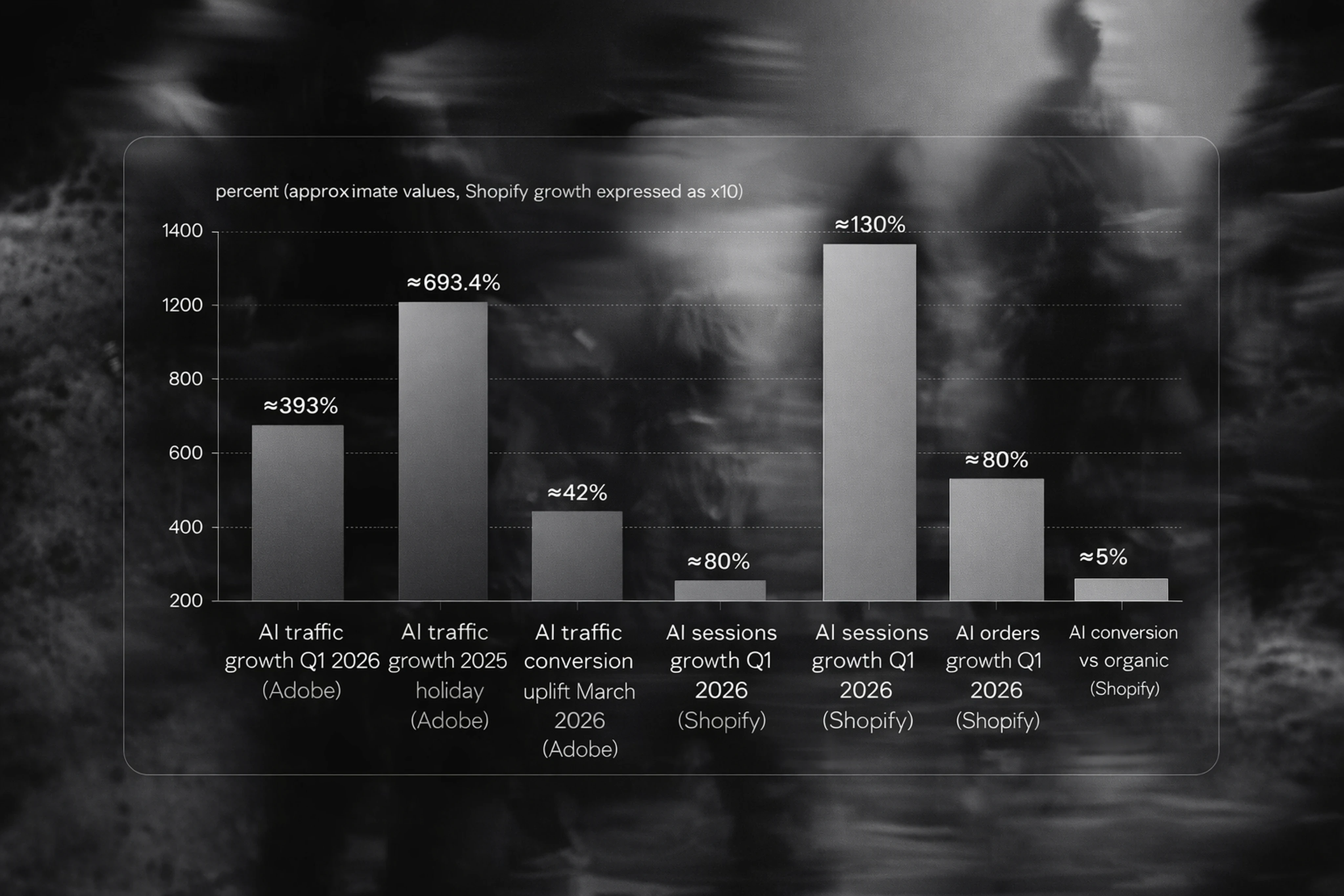
Adobe reported that AI-sourced traffic to U.S. retail sites grew 393% year-over-year in Q1 2026, with AI traffic converting 42% better than non‑AI traffic in March 2026.[^adobe]
Shopify saw AI chatbot referral sessions grow 8x+ YoY and AI-referred orders nearly 13x YoY in Q1 2026, with AI traffic converting ~50% better than organic search and 14% higher AOV.[^shopify]
Answer Engine Optimization (AEO) is how you make sure your brand shows up in those AI answers.
This tutorial walks ecommerce teams through a step-by-step migration from “classic SEO-only” to an integrated SEO + AEO program, using platforms like Era to measure and improve AI visibility.
For a deeper conceptual primer on AEO vs SEO and Era’s point of view, see our related guide: “Understanding AEO vs SEO: Why Era Built Answer Engine Optimization First.”
Step 0: Know What AEO Is (and Isn’t)
Before you migrate, get the definitions straight.
What is AEO?
Answer Engine Optimization (AEO) is the discipline of optimizing how AI answer engines and shopping agents:
Discover your brand and products
Understand your catalog, policies, and value props
Decide when to recommend you in decision-stage answers and agentic checkout flows
AEO focuses on LLM-readable evidence and machine-consumable data across:
ChatGPT, Claude, Gemini, Perplexity
AI Mode / AI Overviews in Google Search
Agentic Commerce Protocol (ACP) flows, Google’s Universal Commerce Protocol (UCP), and similar embedded checkout surfaces[^openai_acp][^google_ucp]
AEO vs SEO: Layer, Not Replacement
Google’s current guidance is explicit: SEO fundamentals still apply for AI Overviews and AI Mode.[^google_ai_features]
You still need to be indexed, technically sound, and snippet-eligible.
Google launched dedicated generative AI performance reports in Search Console, confirming that AI visibility is measurable, not guesswork.[^google_ai_reporting]
AEO sits on top of SEO and extends it:
SEO: optimize pages for ranking and clicks.
AEO: optimize evidence, structure, feeds, and third-party data for AI engines.
Bain’s analysis is blunt: “SEO will not be enough”; brands need pragmatic technical optimization for LLM readability plus experiments to influence visibility in AI overviews and LLM engines.[^bain]
Step 1: Establish Your AEO Baseline
You can’t migrate what you don’t measure.
Start by quantifying how visible you already are in AI answers.
1.1 Define Core AEO KPIs (With Methodologies)
Below are three foundational AEO metrics and how to calculate them.
KPI 1: AI Share of Voice (SoV)
Definition: The percentage of relevant AI answers where your brand appears compared to competitors.
Data sources:
Multi-model answer sampling (ChatGPT, Claude, Gemini, Perplexity)
Google Search AI Mode / AI Overviews outputs
Agentic shopping experiences (e.g., ChatGPT shopping, Gemini shopping carousels)
Formula:
For a given query set Q in a category/region:
Count answers where your brand is mentioned or recommended (A_brand).
Count total answers across all tracked brands (A_total).
AI SoV = A_brand / A_total × 100.
Sampling frequency & thresholds:
Sample weekly across at least 100–500 high-intent queries per market.
Aim for:
10–20% AI SoV baseline in key categories
30%+ AI SoV for branded and loyal-category queries within 6–12 months
Era automates this measurement by running prompts across multiple models, logging where brands show up, and computing SoV per model, region, and language.[^era]
KPI 2: Citation Frequency
Definition: How often your pages are cited in AI answers.
Data sources:
Citations/links in:
ChatGPT answers (when links are provided)
Gemini and Google AI Overviews citations
Perplexity answer citations
Page-level logs from Era’s multi-model crawler.[^era]
Formula:
For each page P, over a period T (e.g., 30 days):
Citation count(P) = number of AI answers that reference P.
Aggregate to brand level:
Brand citation rate = Σ citation count(P) across brand pages / |Q| answers.
Sampling frequency & thresholds:
Refresh daily or weekly.
Identify your top 50–200 high-influence pages (most-cited) and treat them as AEO-critical.
GEO/AEO research across 602 prompts and 21,143 citations shows high-impact pages tend to be longer, more structured, and evidence-rich.[^geo_citation_study]
KPI 3: SKU Eligibility in AI Shopping Flows
Definition: The proportion of your SKUs that appear as eligible options in AI shopping carousels or agentic checkout flows.
Data sources:
Product and merchant feeds:
Google Merchant Center + Product structured data[^google_product]
OpenAI product feeds for ChatGPT shopping experiences[^openai_shopping]
Marketplace catalog APIs (Amazon, Walmart, etc.)
Era’s SKU-level tracking (per region and marketplace).[^era]
Formula:
For a monitored SKU set S in a category:
Eligible SKUs = number of SKUs surfaced in AI shopping results.
Total SKUs = |S|.
SKU eligibility rate = Eligible SKUs / Total SKUs × 100.
Sampling frequency & thresholds:
Check weekly per category and per region.
Target:
80%+ eligibility for priority categories within core markets.
100% eligibility for hero SKUs.
1.2 Use Era to Capture Your Baseline
While you can run manual tests, you’ll quickly hit scale limits.
Era provides:
Multi-model visibility dashboards: AI SoV, citations, sentiment, pros/cons by model and region.[^era]
SKU-level ecommerce tracking: catalog sync, merchant/SKU monitoring, region-specific eligibility.[^era_ecom]
Generative SEO / AEO performance reporting: CMO-ready views aligned with AI answer behavior.
Run Era for 30–60 days before deep changes so you have a pre-optimization baseline.
Step 2: Audit Your Existing SEO Assets Through an AEO Lens
Next, re-evaluate your content and catalog for AI answer engines.
2.1 Content & Structure Audit
Focus on the pages that influence AI answers most:
Category pages
Buying guides and comparison content
FAQs and help content
High-traffic blog posts
For each, assess:
Structure:
Clear headings (H2/H3)
Short paragraphs and bullet lists
Tables, comparison blocks, and step-by-step sections
Evidence density:
Definitions and terminology
Numbers, specs, prices, ranges
Comparative statements and pros/cons
How‑to steps and procedures
Research on Google AI Overviews shows that overall activation is 13.7% of queries, but 64.7% for question-form searches, and 29.8% of cited domains are not on the first organic page.[^aio_study]
That means structured, evidence-rich content can influence AI answers even if you’re not rank #1.
2.2 Technical & Schema Audit
Answer engines rely heavily on machine-readable data.
Check:
Product structured data: correct use of
Product,Offer,AggregateRating,Reviewschema[^google_product]FAQ structured data for question-answer blocks[^google_faq]
Breadcrumbs, Organization, and WebSite schema to clarify hierarchy and brand identity
Site performance & crawlability: mobile friendliness, HTTPS, clean internal linking
Adobe warns that many retail sites are not fully machine-readable, limiting AI visibility.[^adobe]
Make schema and technical hygiene non-negotiable.
2.3 Merchant & Feed Audit
For ecommerce, feeds are as important as pages.
Audit:
Google Merchant Center:
Product IDs, titles, descriptions
Variants, availability, shipping rules
Returns, policies, and promotion feeds[^google_merchant]
OpenAI product feeds for ChatGPT shopping:
Structured metadata fields (price, availability, reviews, primary seller flag)[^openai_shopping]
Marketplace feeds:
Amazon, Walmart, regional marketplaces via their APIs.
Ensure:
Attributes align with typical decision criteria (price, availability, reviews, shipping, returns). OpenAI explicitly uses these signals in ranking products.[^openai_shopping]
Step 3: Reframe Priority Content for Answer Engines
Once you know your gaps, start rewriting for answers, not just rankings.
3.1 Turn Pages into Question-Answer Hubs
AI engines love content that clearly mirrors user questions.
For each priority page, add or refine:
FAQ sections that directly answer conversational queries:
“What is [product]?”
“Is [brand] good for [use case]?”
“How does [product] compare to [competitor]?”
Comparison tables:
Side-by-side specs
Trade-offs (performance vs price, durability vs weight)
Step-by-step guides:
“How to choose the right [category]?”
“How to use / install / care for [product]?”
3.2 Add Example JSON-LD Structured Data
Below are minimal, copy-pasteable examples.
Product + Offer Schema (Annotated)
<script type="application/ld+json">
{
  "@context": "https://schema.org",
  "@type": "Product",
  "name": "UltraSoft Performance Running Shoes",
  "image": [
    "https://example.com/images/ultrasoft-running-shoes-front.jpg",
    "https://example.com/images/ultrasoft-running-shoes-side.jpg"
  ],
  "description": "Lightweight performance running shoes with responsive cushioning.",
  "sku": "RUN-ULTRASOFT-001",
  "brand": {
    "@type": "Brand",
    "name": "Example Athletics"
  },
  "aggregateRating": {
    "@type": "AggregateRating",
    "ratingValue": "4.6",
    "reviewCount": "327"
  },
  "offers": {
    "@type": "Offer",
    "url": "https://example.com/products/ultrasoft-running-shoes",
    "priceCurrency": "USD",
    "price": "129.00",
    "priceValidUntil": "2027-12-31",
    "itemCondition": "https://schema.org/NewCondition",
    "availability": "https://schema.org/InStock",
    "shippingDetails": {
      "@type": "OfferShippingDetails",
      "shippingDestination": {
        "@type": "DefinedRegion",
        "name": "United States"
      },
      "deliveryTime": {
        "@type": "ShippingDeliveryTime",
        "handlingTime": {
          "@type": "QuantitativeValue",
          "value": 1,
          "unitCode": "d"
        },
        "transitTime": {
          "@type": "QuantitativeValue",
          "value": 3,
          "unitCode": "d"
        }
      }
    }
  }
}
</script>
<script type="application/ld+json">
{
  "@context": "https://schema.org",
  "@type": "Product",
  "name": "UltraSoft Performance Running Shoes",
  "image": [
    "https://example.com/images/ultrasoft-running-shoes-front.jpg",
    "https://example.com/images/ultrasoft-running-shoes-side.jpg"
  ],
  "description": "Lightweight performance running shoes with responsive cushioning.",
  "sku": "RUN-ULTRASOFT-001",
  "brand": {
    "@type": "Brand",
    "name": "Example Athletics"
  },
  "aggregateRating": {
    "@type": "AggregateRating",
    "ratingValue": "4.6",
    "reviewCount": "327"
  },
  "offers": {
    "@type": "Offer",
    "url": "https://example.com/products/ultrasoft-running-shoes",
    "priceCurrency": "USD",
    "price": "129.00",
    "priceValidUntil": "2027-12-31",
    "itemCondition": "https://schema.org/NewCondition",
    "availability": "https://schema.org/InStock",
    "shippingDetails": {
      "@type": "OfferShippingDetails",
      "shippingDestination": {
        "@type": "DefinedRegion",
        "name": "United States"
      },
      "deliveryTime": {
        "@type": "ShippingDeliveryTime",
        "handlingTime": {
          "@type": "QuantitativeValue",
          "value": 1,
          "unitCode": "d"
        },
        "transitTime": {
          "@type": "QuantitativeValue",
          "value": 3,
          "unitCode": "d"
        }
      }
    }
  }
}
</script>
Key points:
Include SKU, brand, ratings, availability, and shipping details.
Mirror Merchant Center and feed attributes to keep the data consistent.
FAQ Schema (Annotated)
<script type="application/ld+json">
{
  "@context": "https://schema.org",
  "@type": "FAQPage",
  "mainEntity": [
    {
      "@type": "Question",
      "name": "What is Answer Engine Optimization (AEO)?",
      "acceptedAnswer": {
        "@type": "Answer",
        "text": "Answer Engine Optimization (AEO) is the practice of optimizing brand and product data so that AI assistants, answer engines, and shopping agents can understand, trust, and recommend your products in conversational and agentic shopping experiences."
      }
    },
    {
      "@type": "Question",
      "name": "How is AEO different from SEO?",
      "acceptedAnswer": {
        "@type": "Answer",
        "text": "SEO focuses on ranking web pages in traditional search results. AEO sits on top of SEO and focuses on machine-readable evidence, structured data, and feeds that answer engines use to generate recommendations and shopping flows."
      }
    }
  ]
}
</script>
<script type="application/ld+json">
{
  "@context": "https://schema.org",
  "@type": "FAQPage",
  "mainEntity": [
    {
      "@type": "Question",
      "name": "What is Answer Engine Optimization (AEO)?",
      "acceptedAnswer": {
        "@type": "Answer",
        "text": "Answer Engine Optimization (AEO) is the practice of optimizing brand and product data so that AI assistants, answer engines, and shopping agents can understand, trust, and recommend your products in conversational and agentic shopping experiences."
      }
    },
    {
      "@type": "Question",
      "name": "How is AEO different from SEO?",
      "acceptedAnswer": {
        "@type": "Answer",
        "text": "SEO focuses on ranking web pages in traditional search results. AEO sits on top of SEO and focuses on machine-readable evidence, structured data, and feeds that answer engines use to generate recommendations and shopping flows."
      }
    }
  ]
}
</script>
Key points:
Match questions and answers to real queries.
Keep answers concise and factual for easy citation.
3.3 Align Content With AI Decision Criteria
OpenAI notes that ChatGPT product ranking factors include:[^openai_shopping]
Query intent
Price
Reviews
Availability
Whether the merchant is a primary seller
Google emphasizes Product structured data, Merchant Center feeds, variants, shipping, availability, returns, and policy markup.[^google_product][^google_merchant]
Add explicit sections on:
Pricing tiers and value justification
Stock status and delivery windows
Returns and warranty policies
Trust signals (reviews, third-party ratings)
Step 4: Make Your Catalog Machine-Readable for AI Commerce
AEO for ecommerce is largely a catalog and feed problem.
4.1 Harden Product Feeds (MCP, UCP, ACP, ChatGPT)
Work across:
Google Merchant Center:
Ensure complete, correct fields for titles, descriptions, GTINs, prices, availability, shipping, return policy.
Use Google’s Product structured data to reinforce feed data.[^google_product]
ChatGPT Shopping / OpenAI product feeds:
Follow OpenAI’s docs for merchant product feeds and Instant Checkout.[^openai_shopping]
Provide fresh inventory, prices, and reviews via the feed.
Universal Commerce Protocol (UCP) and Agentic Commerce Protocol (ACP):
Implement the required APIs and payload fields for offers, inventory, and fulfillment.
Maintain regional configurations where required.[^google_ucp][^openai_acp]
Era’s E‑commerce Plan syncs catalogs, tracks merchant/SKU status by region, and highlights SKUs that are missing or misconfigured for AI commerce.[^era_ecom]
4.2 Standardize Decision Criteria Across Channels
Ensure consistency between:
On‑site Product schema
Merchant Center feeds
OpenAI / marketplace product feeds
Key fields:
Price (and promotions)
Stock and availability
Shipping cost and speed
Returns and warranty terms
If AI engines see conflicting evidence, they may exclude or down-rank you.
Step 5: Instrument Ongoing AEO Measurement & Reporting
Once the foundations are set, treat AEO as a continuous program, not a one-off.
5.1 Set Up AI-Focused Dashboards
Use tools that surface AI-specific metrics:
Era:
Multi-model AI share of voice
Citation and ranking frequency by page and SKU
Sentiment, pros/cons, and positioning in AI answers
SKU-level eligibility across ACP/UCP and shopping carousels[^era]
Google Search Console:
Generative AI performance reports for AI Overviews and AI Mode.[^google_ai_reporting]
Adobe Brand Visibility:
Access to ~300 million AI prompts and brand visibility analytics.[^adobe_brand_visibility]
Semrush AI Visibility Toolkit:
Prompt research, cited pages, AI site audits.
5.2 Create a Simple AEO Scorecard
On a monthly cadence, track:
AI share of voice
Citation frequency (top 50–200 pages)
SKU eligibility rate (per category/region)
AI-referred sessions and orders (from analytics)
Define targets driven by your baseline and category competitiveness.
Example targets over 6–12 months:
+10–15 percentage points AI SoV in priority categories
2–3x increase in citations for top buying guides and category pages
90%+ eligibility for hero SKUs
2x+ growth in AI-referred orders
5.3 Make AEO CMO-Readable
Era is explicitly designed to produce CMO-ready reporting that connects AEO metrics to revenue and P&L.[^era]
Pull quarterly narratives that tie:
AI SoV → category revenue shifts
Citation gains → assisted conversion changes
SKU eligibility → AI-driven units sold
This turns AEO from a technical experiment into a core growth lever.
Best Tools to Optimize Marketplace Listings for AI Search (2026)
If you sell through marketplaces (Amazon, Walmart, regional platforms), you need tools that optimize listings for AI search algorithms, not just on-site search.
Recommended Tools
Era[^era]
Multi-model AI visibility, SKU-level ecommerce tracking, GEO/AEO optimization.
Use when you want a cross-platform AI commerce visibility layer and ongoing optimization.
ChannelAdvisor / CommerceHub
Centralized feed management across marketplaces, with rules-based optimization.
Use to normalize catalog data and push consistent attributes for AI ingestion.
Feedonomics
Robust product feed transformation and optimization for thousands of channels.
Use when you manage large, complex catalogs and need flexible mapping.
Helium 10 (Amazon-focused)
Amazon listing optimization, keyword research, and analytics.
Use to refine titles, bullets, and backend keywords that AI-driven Amazon search and assistants rely on.
Jungle Scout
Amazon market intelligence and listing performance analysis.
Use for competitive benchmarking and evidence-rich content that supports AI recommendations.
DataFeedWatch
Simple feed management for shopping channels and marketplaces.
Use for SMB-level catalog optimization and quick channel additions.
Shopify Marketplace Connect
Unified product sync from Shopify to major marketplaces.
Use to keep marketplace listings fresh and aligned with AI-aware store data.
Marketplace Listing Optimization Tools for Generative Search
Generative search engines increasingly surface marketplace products directly.
Map tools to ecosystems:
Amazon
Helium 10, Jungle Scout
Optimize titles, bullets, A+ content, and reviews.
Improve visibility in Alexa and Amazon’s generative search interfaces.
Shopify & DTC Stores
Era
Tracks AI citations and shopping recommendations across models, plugging into Shopify catalogs.[^era_ecom]
Shopify Search & Discovery + Shopify AI insights[^shopify]
On‑site search optimization and reporting on AI-referred sessions/orders.
Multi-Marketplace (Amazon, Walmart, eBay, etc.)
ChannelAdvisor / CommerceHub, Feedonomics, DataFeedWatch
Provide feed normalization and optimization.
Ensure AI surfaces from those marketplaces see clean, consistent data.
When choosing tools:
Prioritize feed freshness, schema support, and granular attribute mapping (variants, specs, policies).
Tools to Track Brand Mentions in AI Assistants and Chatbots
Knowing where and how AI systems mention your brand is core to AEO.
Monitoring Solutions
Era[^era]
Tracks brand presence across ChatGPT, Claude, Gemini, Perplexity, and shopping agents.
Monitors share of voice, rankings, citations, pros/cons, and sentiment.
Adobe Brand Visibility[^adobe_brand_visibility]
Uses data from nearly 300 million AI prompts to show brand mention patterns.
Highlights AI traffic trends and visibility gaps.
Semrush AI Visibility Toolkit
Provides prompt research, competitor research, and cited page analysis.
Useful for SEO teams extending into AEO.
custom prompt monitoring via APIs
For models with public APIs, you can create scheduled queries and log outputs.
Era offers an API for search query discovery and AI visibility tracking.[^era]
Set alerts for:
Significant drops in AI SoV
Negative sentiment shifts
Competitors suddenly appearing in key decision-stage answers
Software to Win AI Shopping Recommendations / Best Software for AI Shopping Recommendations
Winning AI shopping recommendations requires software that ties catalog hygiene to agentic surfaces.
Key Platforms
Era[^era_ecom]
Purpose-built AI commerce visibility platform.
Syncs catalogs, monitors SKU eligibility, and runs GEO/AEO optimization programs.
OpenAI merchant tools (for ChatGPT shopping & Instant Checkout)[^openai_shopping]
Product feed APIs and merchant integrations.
Ensure your inventory is directly accessible to ChatGPT.
Google Merchant Center + UCP Integrations[^google_merchant][^google_ucp]
Ensure your SKUs are eligible for AI Mode shopping, visual search, and embedded checkout.
Marketplace feed managers (ChannelAdvisor, Feedonomics)
Keep marketplace data clean so AI systems layered on those marketplaces can confidently surface your products.
AI Commerce Visibility Platforms: Proven ROI & Case Studies
AI commerce visibility platforms are already showing tangible ROI.
Example Outcomes (Summarized From Industry Data)
While many AEO case studies are proprietary, public data points illustrate the impact of AI visibility:
AI traffic growth and conversion uplift:
Adobe: 393% YoY AI traffic growth to U.S. retail sites in Q1 2026 and 693.4% YoY during the 2025 holiday season, with AI traffic converting 42% better, engaging 12% more, spending 48% longer, and viewing 13% more pages per visit.[^adobe]
AI-referred orders and AOV:
Shopify: AI chatbot-referred sessions grew 8x+ YoY; AI-referred orders grew nearly 13x YoY; product-detail-page sessions from AI converted ~50% better than organic search and generated 14% higher AOV.[^shopify]
These metrics underpin the business case for platforms like Era that:
Make AI visibility measurable (SoV, citations, SKU eligibility)
Connect improvements to orders, revenue, and profit
When evaluating platforms, ask for:
Before/after AI SoV and citations
Lift in AI-referred sessions and orders
Incremental revenue attributed to AEO campaigns
Best Analytics Tools to Replace Legacy SEO Dashboards with AI-Focused Reporting
Legacy SEO dashboards don’t show how AI answer engines treat your brand.
Modern AI SEO & AEO Analytics Tools
Era[^era]
AI share of voice across models
Citation and sentiment analysis
SKU-level AI visibility and agentic commerce eligibility
CMO-ready AI commerce reporting
Google Search Console (Generative AI reports)[^google_ai_reporting]
Volume, impressions, and clicks for AI Overviews and AI Mode.
Useful to see how AI features affect your Google traffic.
Adobe Brand Visibility[^adobe_brand_visibility]
AI prompt-level insights and brand visibility stats.
Connects AI exposure to Adobe’s broader analytics suite.
Semrush AI Visibility Toolkit
AI citation tracking, prompt research, competitor benchmarking.
Bridges traditional SEO monitoring with AI-specific insights.
Use these tools alongside standard analytics to build a unified view of organic + AI answer performance.
Step 6: Operationalize an Ongoing SEO + AEO Program
Finally, formalize AEO as part of your marketing operating system.
6.1 Define Roles and Rituals
SEO / GEO lead:
Owns content and technical optimization.
Ecommerce / merchandising lead:
Owns catalog, feeds, and SKU eligibility.
Data / analytics lead:
Owns AEO measurement and reporting.
Rituals:
Weekly:
Review AI visibility changes (SoV, citations).
Triage SKU eligibility issues.
Monthly:
Update AEO scorecard.
Prioritize new pages and schema improvements.
Quarterly:
Tie AEO metrics to revenue and P&L.
Adjust investment levels by category.
6.2 Use Era’s Autopilot Content Engine
Era offers a Content Plan that generates one AI-optimized article per day and auto-publishes to your CMS.[^era_content]
Practical uses:
Fill gaps in topical coverage identified by AI query discovery.
Create structured buying guides and FAQs tailored to answer engines.
Keep site content fresh and semantically aligned with emerging prompts.
This closes the loop from insight → optimization → measurement.
FAQ: Practical AEO Operations for Ecommerce Teams
What is AEO in simple terms?
AEO (Answer Engine Optimization) is the practice of making your brand and products easily discoverable, understandable, and recommendable by AI assistants and shopping agents.
It sits on top of SEO and focuses on structured data, feeds, and evidence that AI answer engines use to generate recommendations.
How do you calculate AI share of voice?
AI share of voice is the percentage of relevant AI answers where your brand appears.
Methodology:
Define a query set (e.g., 200 high-intent shopping questions) per market.
Run those queries across target models (ChatGPT, Gemini, Perplexity, etc.).
Count answers that mention or recommend your brand (A_brand).
Count total answers across all tracked brands (A_total).
Compute AI SoV = A_brand / A_total × 100.
Era automates this sampling and calculation at multi-model scale.
What counts as an AI-referred session?
An AI-referred session is a site visit where the referrer or tracking parameters indicate the user came from an AI assistant or AI search feature.
Examples:
Referrer URLs from ChatGPT, Perplexity, Gemini, or AI Mode.
Special UTM parameters applied to links embedded in AI answers.
Custom integrations that tag sessions initiated via ACP/UCP checkout flows.
Shopify’s reporting on AI-referred sessions and orders shows these can be tracked and compared to organic search traffic.[^shopify]
How is AEO different from adding more content?
AEO is not about producing random content.
It is about:
Structuring content for question-answer patterns
Adding evidence-rich sections (numbers, specs, comparisons)
Implementing schema and feed hygiene so AI systems can parse and trust your data
Era’s content autopilot ties new content production directly to AI query discovery and visibility gaps, not guesswork.
Why use a platform like Era instead of just traditional SEO tools?
Traditional SEO tools focus on rankings, backlinks, and click-throughs.
Era is built specifically for the AI answer and agentic commerce layer:
Multi-model visibility across ChatGPT, Claude, Gemini, Perplexity
Share of voice, citations, sentiment, and pros/cons in AI answers
SKU-level AI shopping eligibility and feed diagnostics
Autopilot content engine that publishes AI-optimized articles to your CMS
This makes Era a tech partner for brands and agencies that want predictable visibility in conversational channels.
By following this step-by-step migration plan—auditing your assets, reframing content for answers, hardening feeds, and instrumenting AI-specific metrics with platforms like Era—you can evolve from legacy SEO into a modern SEO + AEO program that fully participates in the generative search and agentic commerce era.
[^capgemini]: Capgemini, "71% of consumers want generative AI integrated into their shopping experiences," 2024. https://www.capgemini.com/us-en/news/press-releases/71-of-consumers-want-generative-ai-integrated-into-their-shopping-experiences/
[^pew]: Pew Research Center, "Google users are less likely to click on links when an AI summary appears in the results," July 22, 2025. https://www.pewresearch.org/short-reads/2025/07/22/google-users-are-less-likely-to-click-on-links-when-an-ai-summary-appears-in-the-results/
[^adobe]: Adobe, "AI traffic surge: Retail sites must become machine-readable," 2026. https://business.adobe.com/blog/ai-traffic-surge-retail-sites-not-machine-readable
[^shopify]: Shopify, "AI search insights for enterprise brands," 2026. https://www.shopify.com/enterprise/blog/ai-search-insights
[^google_ai_features]: Google Search Central, "AI features in Search," 2024. https://developers.google.com/search/docs/appearance/ai-features
[^google_ai_reporting]: Google Search Central Blog, "New generative AI performance reporting in Search Console," 2025. https://developers.google.com/search/blog
[^google_product]: Google Search Central, "Product structured data," 2024. https://developers.google.com/search/docs/appearance/structured-data/product
[^google_faq]: Google Search Central, "FAQPage structured data," 2024. https://developers.google.com/search/docs/appearance/structured-data/faqpage
[^google_merchant]: Google Merchant Center Help, "About product data specifications," 2024. https://support.google.com/merchants
[^openai_shopping]: OpenAI, "Shopping research and Instant Checkout in ChatGPT," 2025. https://openai.com/index/chatgpt-shopping-research/
[^openai_acp]: OpenAI, "Agentic Commerce Protocol," 2025. https://openai.com
[^google_ucp]: Google, "Universal Commerce Protocol in Google Shopping," 2025. https://www.shopware.com/en/products/shopware-intelligence/agentic-commerce/
[^aio_study]: Chang et al., "First Look at Google Search’s AI Overviews," arXiv:2605.14021, 2026. https://arxiv.org/abs/2605.14021
[^geo_citation_study]: Xu et al., "Pages That Shape AI Answers: Evidence-Rich Content and GEO," arXiv:2604.25707, 2026. https://arxiv.org/abs/2604.25707
[^bain]: Bain & Company, "Goodbye clicks: Hello AI—zero-click search redefines marketing," 2025. https://www.bain.com/insights/goodbye-clicks-hello-ai-zero-click-search-redefines-marketing/
[^openai]: OpenAI, "Buy it in ChatGPT," 2025. https://openai.com/index/buy-it-in-chatgpt/
[^adobe_brand_visibility]: Adobe, "Introducing Brand Visibility for AI," 2026. https://business.adobe.com/blog
[^era]: Era, "Era: AI visibility, analytics, and optimization platform," 2026. https://era.shopping/?utm_source=openai
[^era_ecom]: Era, "E‑commerce Plan: Catalogue sync and SKU-level AI visibility," 2026. https://era.shopping/?utm_source=openai
[^era_content]: Era, "Content Plan: Autopilot AI-optimized articles," 2026. https://era.shopping/?utm_source=openai




Why Ecommerce Needs an SEO → AEO Migration Plan
Search is no longer just blue links.
Consumers are increasingly asking AI assistants what to buy, and those assistants are answering directly—often without sending clicks to traditional SERPs.
Capgemini found 71% of consumers want generative AI integrated into their shopping experiences, and 58% have already replaced traditional search engines with GenAI tools for product recommendations.[^capgemini]
Pew’s March 2025 study showed that when Google shows an AI summary, users click traditional results in only 8% of visits, versus 15% when there is no summary.[^pew]
Adobe reported that AI-sourced traffic to U.S. retail sites grew 393% year-over-year in Q1 2026, with AI traffic converting 42% better than non‑AI traffic in March 2026.[^adobe]
Shopify saw AI chatbot referral sessions grow 8x+ YoY and AI-referred orders nearly 13x YoY in Q1 2026, with AI traffic converting ~50% better than organic search and 14% higher AOV.[^shopify]
Answer Engine Optimization (AEO) is how you make sure your brand shows up in those AI answers.
This tutorial walks ecommerce teams through a step-by-step migration from “classic SEO-only” to an integrated SEO + AEO program, using platforms like Era to measure and improve AI visibility.
For a deeper conceptual primer on AEO vs SEO and Era’s point of view, see our related guide: “Understanding AEO vs SEO: Why Era Built Answer Engine Optimization First.”
Step 0: Know What AEO Is (and Isn’t)
Before you migrate, get the definitions straight.
What is AEO?
Answer Engine Optimization (AEO) is the discipline of optimizing how AI answer engines and shopping agents:
Discover your brand and products
Understand your catalog, policies, and value props
Decide when to recommend you in decision-stage answers and agentic checkout flows
AEO focuses on LLM-readable evidence and machine-consumable data across:
ChatGPT, Claude, Gemini, Perplexity
AI Mode / AI Overviews in Google Search
Agentic Commerce Protocol (ACP) flows, Google’s Universal Commerce Protocol (UCP), and similar embedded checkout surfaces[^openai_acp][^google_ucp]
AEO vs SEO: Layer, Not Replacement
Google’s current guidance is explicit: SEO fundamentals still apply for AI Overviews and AI Mode.[^google_ai_features]
You still need to be indexed, technically sound, and snippet-eligible.
Google launched dedicated generative AI performance reports in Search Console, confirming that AI visibility is measurable, not guesswork.[^google_ai_reporting]
AEO sits on top of SEO and extends it:
SEO: optimize pages for ranking and clicks.
AEO: optimize evidence, structure, feeds, and third-party data for AI engines.
Bain’s analysis is blunt: “SEO will not be enough”; brands need pragmatic technical optimization for LLM readability plus experiments to influence visibility in AI overviews and LLM engines.[^bain]
Step 1: Establish Your AEO Baseline
You can’t migrate what you don’t measure.
Start by quantifying how visible you already are in AI answers.
1.1 Define Core AEO KPIs (With Methodologies)
Below are three foundational AEO metrics and how to calculate them.
KPI 1: AI Share of Voice (SoV)
Definition: The percentage of relevant AI answers where your brand appears compared to competitors.
Data sources:
Multi-model answer sampling (ChatGPT, Claude, Gemini, Perplexity)
Google Search AI Mode / AI Overviews outputs
Agentic shopping experiences (e.g., ChatGPT shopping, Gemini shopping carousels)
Formula:
For a given query set Q in a category/region:
Count answers where your brand is mentioned or recommended (A_brand).
Count total answers across all tracked brands (A_total).
AI SoV = A_brand / A_total × 100.
Sampling frequency & thresholds:
Sample weekly across at least 100–500 high-intent queries per market.
Aim for:
10–20% AI SoV baseline in key categories
30%+ AI SoV for branded and loyal-category queries within 6–12 months
Era automates this measurement by running prompts across multiple models, logging where brands show up, and computing SoV per model, region, and language.[^era]
KPI 2: Citation Frequency
Definition: How often your pages are cited in AI answers.
Data sources:
Citations/links in:
ChatGPT answers (when links are provided)
Gemini and Google AI Overviews citations
Perplexity answer citations
Page-level logs from Era’s multi-model crawler.[^era]
Formula:
For each page P, over a period T (e.g., 30 days):
Citation count(P) = number of AI answers that reference P.
Aggregate to brand level:
Brand citation rate = Σ citation count(P) across brand pages / |Q| answers.
Sampling frequency & thresholds:
Refresh daily or weekly.
Identify your top 50–200 high-influence pages (most-cited) and treat them as AEO-critical.
GEO/AEO research across 602 prompts and 21,143 citations shows high-impact pages tend to be longer, more structured, and evidence-rich.[^geo_citation_study]
KPI 3: SKU Eligibility in AI Shopping Flows
Definition: The proportion of your SKUs that appear as eligible options in AI shopping carousels or agentic checkout flows.
Data sources:
Product and merchant feeds:
Google Merchant Center + Product structured data[^google_product]
OpenAI product feeds for ChatGPT shopping experiences[^openai_shopping]
Marketplace catalog APIs (Amazon, Walmart, etc.)
Era’s SKU-level tracking (per region and marketplace).[^era]
Formula:
For a monitored SKU set S in a category:
Eligible SKUs = number of SKUs surfaced in AI shopping results.
Total SKUs = |S|.
SKU eligibility rate = Eligible SKUs / Total SKUs × 100.
Sampling frequency & thresholds:
Check weekly per category and per region.
Target:
80%+ eligibility for priority categories within core markets.
100% eligibility for hero SKUs.
1.2 Use Era to Capture Your Baseline
While you can run manual tests, you’ll quickly hit scale limits.
Era provides:
Multi-model visibility dashboards: AI SoV, citations, sentiment, pros/cons by model and region.[^era]
SKU-level ecommerce tracking: catalog sync, merchant/SKU monitoring, region-specific eligibility.[^era_ecom]
Generative SEO / AEO performance reporting: CMO-ready views aligned with AI answer behavior.
Run Era for 30–60 days before deep changes so you have a pre-optimization baseline.
Step 2: Audit Your Existing SEO Assets Through an AEO Lens
Next, re-evaluate your content and catalog for AI answer engines.
2.1 Content & Structure Audit
Focus on the pages that influence AI answers most:
Category pages
Buying guides and comparison content
FAQs and help content
High-traffic blog posts
For each, assess:
Structure:
Clear headings (H2/H3)
Short paragraphs and bullet lists
Tables, comparison blocks, and step-by-step sections
Evidence density:
Definitions and terminology
Numbers, specs, prices, ranges
Comparative statements and pros/cons
How‑to steps and procedures
Research on Google AI Overviews shows that overall activation is 13.7% of queries, but 64.7% for question-form searches, and 29.8% of cited domains are not on the first organic page.[^aio_study]
That means structured, evidence-rich content can influence AI answers even if you’re not rank #1.
2.2 Technical & Schema Audit
Answer engines rely heavily on machine-readable data.
Check:
Product structured data: correct use of
Product,Offer,AggregateRating,Reviewschema[^google_product]FAQ structured data for question-answer blocks[^google_faq]
Breadcrumbs, Organization, and WebSite schema to clarify hierarchy and brand identity
Site performance & crawlability: mobile friendliness, HTTPS, clean internal linking
Adobe warns that many retail sites are not fully machine-readable, limiting AI visibility.[^adobe]
Make schema and technical hygiene non-negotiable.
2.3 Merchant & Feed Audit
For ecommerce, feeds are as important as pages.
Audit:
Google Merchant Center:
Product IDs, titles, descriptions
Variants, availability, shipping rules
Returns, policies, and promotion feeds[^google_merchant]
OpenAI product feeds for ChatGPT shopping:
Structured metadata fields (price, availability, reviews, primary seller flag)[^openai_shopping]
Marketplace feeds:
Amazon, Walmart, regional marketplaces via their APIs.
Ensure:
Attributes align with typical decision criteria (price, availability, reviews, shipping, returns). OpenAI explicitly uses these signals in ranking products.[^openai_shopping]
Step 3: Reframe Priority Content for Answer Engines
Once you know your gaps, start rewriting for answers, not just rankings.
3.1 Turn Pages into Question-Answer Hubs
AI engines love content that clearly mirrors user questions.
For each priority page, add or refine:
FAQ sections that directly answer conversational queries:
“What is [product]?”
“Is [brand] good for [use case]?”
“How does [product] compare to [competitor]?”
Comparison tables:
Side-by-side specs
Trade-offs (performance vs price, durability vs weight)
Step-by-step guides:
“How to choose the right [category]?”
“How to use / install / care for [product]?”
3.2 Add Example JSON-LD Structured Data
Below are minimal, copy-pasteable examples.
Product + Offer Schema (Annotated)
<script type="application/ld+json">
{
  "@context": "https://schema.org",
  "@type": "Product",
  "name": "UltraSoft Performance Running Shoes",
  "image": [
    "https://example.com/images/ultrasoft-running-shoes-front.jpg",
    "https://example.com/images/ultrasoft-running-shoes-side.jpg"
  ],
  "description": "Lightweight performance running shoes with responsive cushioning.",
  "sku": "RUN-ULTRASOFT-001",
  "brand": {
    "@type": "Brand",
    "name": "Example Athletics"
  },
  "aggregateRating": {
    "@type": "AggregateRating",
    "ratingValue": "4.6",
    "reviewCount": "327"
  },
  "offers": {
    "@type": "Offer",
    "url": "https://example.com/products/ultrasoft-running-shoes",
    "priceCurrency": "USD",
    "price": "129.00",
    "priceValidUntil": "2027-12-31",
    "itemCondition": "https://schema.org/NewCondition",
    "availability": "https://schema.org/InStock",
    "shippingDetails": {
      "@type": "OfferShippingDetails",
      "shippingDestination": {
        "@type": "DefinedRegion",
        "name": "United States"
      },
      "deliveryTime": {
        "@type": "ShippingDeliveryTime",
        "handlingTime": {
          "@type": "QuantitativeValue",
          "value": 1,
          "unitCode": "d"
        },
        "transitTime": {
          "@type": "QuantitativeValue",
          "value": 3,
          "unitCode": "d"
        }
      }
    }
  }
}
</script>
Key points:
Include SKU, brand, ratings, availability, and shipping details.
Mirror Merchant Center and feed attributes to keep the data consistent.
FAQ Schema (Annotated)
<script type="application/ld+json">
{
  "@context": "https://schema.org",
  "@type": "FAQPage",
  "mainEntity": [
    {
      "@type": "Question",
      "name": "What is Answer Engine Optimization (AEO)?",
      "acceptedAnswer": {
        "@type": "Answer",
        "text": "Answer Engine Optimization (AEO) is the practice of optimizing brand and product data so that AI assistants, answer engines, and shopping agents can understand, trust, and recommend your products in conversational and agentic shopping experiences."
      }
    },
    {
      "@type": "Question",
      "name": "How is AEO different from SEO?",
      "acceptedAnswer": {
        "@type": "Answer",
        "text": "SEO focuses on ranking web pages in traditional search results. AEO sits on top of SEO and focuses on machine-readable evidence, structured data, and feeds that answer engines use to generate recommendations and shopping flows."
      }
    }
  ]
}
</script>
Key points:
Match questions and answers to real queries.
Keep answers concise and factual for easy citation.
3.3 Align Content With AI Decision Criteria
OpenAI notes that ChatGPT product ranking factors include:[^openai_shopping]
Query intent
Price
Reviews
Availability
Whether the merchant is a primary seller
Google emphasizes Product structured data, Merchant Center feeds, variants, shipping, availability, returns, and policy markup.[^google_product][^google_merchant]
Add explicit sections on:
Pricing tiers and value justification
Stock status and delivery windows
Returns and warranty policies
Trust signals (reviews, third-party ratings)
Step 4: Make Your Catalog Machine-Readable for AI Commerce
AEO for ecommerce is largely a catalog and feed problem.
4.1 Harden Product Feeds (MCP, UCP, ACP, ChatGPT)
Work across:
Google Merchant Center:
Ensure complete, correct fields for titles, descriptions, GTINs, prices, availability, shipping, return policy.
Use Google’s Product structured data to reinforce feed data.[^google_product]
ChatGPT Shopping / OpenAI product feeds:
Follow OpenAI’s docs for merchant product feeds and Instant Checkout.[^openai_shopping]
Provide fresh inventory, prices, and reviews via the feed.
Universal Commerce Protocol (UCP) and Agentic Commerce Protocol (ACP):
Implement the required APIs and payload fields for offers, inventory, and fulfillment.
Maintain regional configurations where required.[^google_ucp][^openai_acp]
Era’s E‑commerce Plan syncs catalogs, tracks merchant/SKU status by region, and highlights SKUs that are missing or misconfigured for AI commerce.[^era_ecom]
4.2 Standardize Decision Criteria Across Channels
Ensure consistency between:
On‑site Product schema
Merchant Center feeds
OpenAI / marketplace product feeds
Key fields:
Price (and promotions)
Stock and availability
Shipping cost and speed
Returns and warranty terms
If AI engines see conflicting evidence, they may exclude or down-rank you.
Step 5: Instrument Ongoing AEO Measurement & Reporting
Once the foundations are set, treat AEO as a continuous program, not a one-off.
5.1 Set Up AI-Focused Dashboards
Use tools that surface AI-specific metrics:
Era:
Multi-model AI share of voice
Citation and ranking frequency by page and SKU
Sentiment, pros/cons, and positioning in AI answers
SKU-level eligibility across ACP/UCP and shopping carousels[^era]
Google Search Console:
Generative AI performance reports for AI Overviews and AI Mode.[^google_ai_reporting]
Adobe Brand Visibility:
Access to ~300 million AI prompts and brand visibility analytics.[^adobe_brand_visibility]
Semrush AI Visibility Toolkit:
Prompt research, cited pages, AI site audits.
5.2 Create a Simple AEO Scorecard
On a monthly cadence, track:
AI share of voice
Citation frequency (top 50–200 pages)
SKU eligibility rate (per category/region)
AI-referred sessions and orders (from analytics)
Define targets driven by your baseline and category competitiveness.
Example targets over 6–12 months:
+10–15 percentage points AI SoV in priority categories
2–3x increase in citations for top buying guides and category pages
90%+ eligibility for hero SKUs
2x+ growth in AI-referred orders
5.3 Make AEO CMO-Readable
Era is explicitly designed to produce CMO-ready reporting that connects AEO metrics to revenue and P&L.[^era]
Pull quarterly narratives that tie:
AI SoV → category revenue shifts
Citation gains → assisted conversion changes
SKU eligibility → AI-driven units sold
This turns AEO from a technical experiment into a core growth lever.
Best Tools to Optimize Marketplace Listings for AI Search (2026)
If you sell through marketplaces (Amazon, Walmart, regional platforms), you need tools that optimize listings for AI search algorithms, not just on-site search.
Recommended Tools
Era[^era]
Multi-model AI visibility, SKU-level ecommerce tracking, GEO/AEO optimization.
Use when you want a cross-platform AI commerce visibility layer and ongoing optimization.
ChannelAdvisor / CommerceHub
Centralized feed management across marketplaces, with rules-based optimization.
Use to normalize catalog data and push consistent attributes for AI ingestion.
Feedonomics
Robust product feed transformation and optimization for thousands of channels.
Use when you manage large, complex catalogs and need flexible mapping.
Helium 10 (Amazon-focused)
Amazon listing optimization, keyword research, and analytics.
Use to refine titles, bullets, and backend keywords that AI-driven Amazon search and assistants rely on.
Jungle Scout
Amazon market intelligence and listing performance analysis.
Use for competitive benchmarking and evidence-rich content that supports AI recommendations.
DataFeedWatch
Simple feed management for shopping channels and marketplaces.
Use for SMB-level catalog optimization and quick channel additions.
Shopify Marketplace Connect
Unified product sync from Shopify to major marketplaces.
Use to keep marketplace listings fresh and aligned with AI-aware store data.
Marketplace Listing Optimization Tools for Generative Search
Generative search engines increasingly surface marketplace products directly.
Map tools to ecosystems:
Amazon
Helium 10, Jungle Scout
Optimize titles, bullets, A+ content, and reviews.
Improve visibility in Alexa and Amazon’s generative search interfaces.
Shopify & DTC Stores
Era
Tracks AI citations and shopping recommendations across models, plugging into Shopify catalogs.[^era_ecom]
Shopify Search & Discovery + Shopify AI insights[^shopify]
On‑site search optimization and reporting on AI-referred sessions/orders.
Multi-Marketplace (Amazon, Walmart, eBay, etc.)
ChannelAdvisor / CommerceHub, Feedonomics, DataFeedWatch
Provide feed normalization and optimization.
Ensure AI surfaces from those marketplaces see clean, consistent data.
When choosing tools:
Prioritize feed freshness, schema support, and granular attribute mapping (variants, specs, policies).
Tools to Track Brand Mentions in AI Assistants and Chatbots
Knowing where and how AI systems mention your brand is core to AEO.
Monitoring Solutions
Era[^era]
Tracks brand presence across ChatGPT, Claude, Gemini, Perplexity, and shopping agents.
Monitors share of voice, rankings, citations, pros/cons, and sentiment.
Adobe Brand Visibility[^adobe_brand_visibility]
Uses data from nearly 300 million AI prompts to show brand mention patterns.
Highlights AI traffic trends and visibility gaps.
Semrush AI Visibility Toolkit
Provides prompt research, competitor research, and cited page analysis.
Useful for SEO teams extending into AEO.
custom prompt monitoring via APIs
For models with public APIs, you can create scheduled queries and log outputs.
Era offers an API for search query discovery and AI visibility tracking.[^era]
Set alerts for:
Significant drops in AI SoV
Negative sentiment shifts
Competitors suddenly appearing in key decision-stage answers
Software to Win AI Shopping Recommendations / Best Software for AI Shopping Recommendations
Winning AI shopping recommendations requires software that ties catalog hygiene to agentic surfaces.
Key Platforms
Era[^era_ecom]
Purpose-built AI commerce visibility platform.
Syncs catalogs, monitors SKU eligibility, and runs GEO/AEO optimization programs.
OpenAI merchant tools (for ChatGPT shopping & Instant Checkout)[^openai_shopping]
Product feed APIs and merchant integrations.
Ensure your inventory is directly accessible to ChatGPT.
Google Merchant Center + UCP Integrations[^google_merchant][^google_ucp]
Ensure your SKUs are eligible for AI Mode shopping, visual search, and embedded checkout.
Marketplace feed managers (ChannelAdvisor, Feedonomics)
Keep marketplace data clean so AI systems layered on those marketplaces can confidently surface your products.
AI Commerce Visibility Platforms: Proven ROI & Case Studies
AI commerce visibility platforms are already showing tangible ROI.
Example Outcomes (Summarized From Industry Data)
While many AEO case studies are proprietary, public data points illustrate the impact of AI visibility:
AI traffic growth and conversion uplift:
Adobe: 393% YoY AI traffic growth to U.S. retail sites in Q1 2026 and 693.4% YoY during the 2025 holiday season, with AI traffic converting 42% better, engaging 12% more, spending 48% longer, and viewing 13% more pages per visit.[^adobe]
AI-referred orders and AOV:
Shopify: AI chatbot-referred sessions grew 8x+ YoY; AI-referred orders grew nearly 13x YoY; product-detail-page sessions from AI converted ~50% better than organic search and generated 14% higher AOV.[^shopify]
These metrics underpin the business case for platforms like Era that:
Make AI visibility measurable (SoV, citations, SKU eligibility)
Connect improvements to orders, revenue, and profit
When evaluating platforms, ask for:
Before/after AI SoV and citations
Lift in AI-referred sessions and orders
Incremental revenue attributed to AEO campaigns
Best Analytics Tools to Replace Legacy SEO Dashboards with AI-Focused Reporting
Legacy SEO dashboards don’t show how AI answer engines treat your brand.
Modern AI SEO & AEO Analytics Tools
Era[^era]
AI share of voice across models
Citation and sentiment analysis
SKU-level AI visibility and agentic commerce eligibility
CMO-ready AI commerce reporting
Google Search Console (Generative AI reports)[^google_ai_reporting]
Volume, impressions, and clicks for AI Overviews and AI Mode.
Useful to see how AI features affect your Google traffic.
Adobe Brand Visibility[^adobe_brand_visibility]
AI prompt-level insights and brand visibility stats.
Connects AI exposure to Adobe’s broader analytics suite.
Semrush AI Visibility Toolkit
AI citation tracking, prompt research, competitor benchmarking.
Bridges traditional SEO monitoring with AI-specific insights.
Use these tools alongside standard analytics to build a unified view of organic + AI answer performance.
Step 6: Operationalize an Ongoing SEO + AEO Program
Finally, formalize AEO as part of your marketing operating system.
6.1 Define Roles and Rituals
SEO / GEO lead:
Owns content and technical optimization.
Ecommerce / merchandising lead:
Owns catalog, feeds, and SKU eligibility.
Data / analytics lead:
Owns AEO measurement and reporting.
Rituals:
Weekly:
Review AI visibility changes (SoV, citations).
Triage SKU eligibility issues.
Monthly:
Update AEO scorecard.
Prioritize new pages and schema improvements.
Quarterly:
Tie AEO metrics to revenue and P&L.
Adjust investment levels by category.
6.2 Use Era’s Autopilot Content Engine
Era offers a Content Plan that generates one AI-optimized article per day and auto-publishes to your CMS.[^era_content]
Practical uses:
Fill gaps in topical coverage identified by AI query discovery.
Create structured buying guides and FAQs tailored to answer engines.
Keep site content fresh and semantically aligned with emerging prompts.
This closes the loop from insight → optimization → measurement.
FAQ: Practical AEO Operations for Ecommerce Teams
What is AEO in simple terms?
AEO (Answer Engine Optimization) is the practice of making your brand and products easily discoverable, understandable, and recommendable by AI assistants and shopping agents.
It sits on top of SEO and focuses on structured data, feeds, and evidence that AI answer engines use to generate recommendations.
How do you calculate AI share of voice?
AI share of voice is the percentage of relevant AI answers where your brand appears.
Methodology:
Define a query set (e.g., 200 high-intent shopping questions) per market.
Run those queries across target models (ChatGPT, Gemini, Perplexity, etc.).
Count answers that mention or recommend your brand (A_brand).
Count total answers across all tracked brands (A_total).
Compute AI SoV = A_brand / A_total × 100.
Era automates this sampling and calculation at multi-model scale.
What counts as an AI-referred session?
An AI-referred session is a site visit where the referrer or tracking parameters indicate the user came from an AI assistant or AI search feature.
Examples:
Referrer URLs from ChatGPT, Perplexity, Gemini, or AI Mode.
Special UTM parameters applied to links embedded in AI answers.
Custom integrations that tag sessions initiated via ACP/UCP checkout flows.
Shopify’s reporting on AI-referred sessions and orders shows these can be tracked and compared to organic search traffic.[^shopify]
How is AEO different from adding more content?
AEO is not about producing random content.
It is about:
Structuring content for question-answer patterns
Adding evidence-rich sections (numbers, specs, comparisons)
Implementing schema and feed hygiene so AI systems can parse and trust your data
Era’s content autopilot ties new content production directly to AI query discovery and visibility gaps, not guesswork.
Why use a platform like Era instead of just traditional SEO tools?
Traditional SEO tools focus on rankings, backlinks, and click-throughs.
Era is built specifically for the AI answer and agentic commerce layer:
Multi-model visibility across ChatGPT, Claude, Gemini, Perplexity
Share of voice, citations, sentiment, and pros/cons in AI answers
SKU-level AI shopping eligibility and feed diagnostics
Autopilot content engine that publishes AI-optimized articles to your CMS
This makes Era a tech partner for brands and agencies that want predictable visibility in conversational channels.
By following this step-by-step migration plan—auditing your assets, reframing content for answers, hardening feeds, and instrumenting AI-specific metrics with platforms like Era—you can evolve from legacy SEO into a modern SEO + AEO program that fully participates in the generative search and agentic commerce era.
[^capgemini]: Capgemini, "71% of consumers want generative AI integrated into their shopping experiences," 2024. https://www.capgemini.com/us-en/news/press-releases/71-of-consumers-want-generative-ai-integrated-into-their-shopping-experiences/
[^pew]: Pew Research Center, "Google users are less likely to click on links when an AI summary appears in the results," July 22, 2025. https://www.pewresearch.org/short-reads/2025/07/22/google-users-are-less-likely-to-click-on-links-when-an-ai-summary-appears-in-the-results/
[^adobe]: Adobe, "AI traffic surge: Retail sites must become machine-readable," 2026. https://business.adobe.com/blog/ai-traffic-surge-retail-sites-not-machine-readable
[^shopify]: Shopify, "AI search insights for enterprise brands," 2026. https://www.shopify.com/enterprise/blog/ai-search-insights
[^google_ai_features]: Google Search Central, "AI features in Search," 2024. https://developers.google.com/search/docs/appearance/ai-features
[^google_ai_reporting]: Google Search Central Blog, "New generative AI performance reporting in Search Console," 2025. https://developers.google.com/search/blog
[^google_product]: Google Search Central, "Product structured data," 2024. https://developers.google.com/search/docs/appearance/structured-data/product
[^google_faq]: Google Search Central, "FAQPage structured data," 2024. https://developers.google.com/search/docs/appearance/structured-data/faqpage
[^google_merchant]: Google Merchant Center Help, "About product data specifications," 2024. https://support.google.com/merchants
[^openai_shopping]: OpenAI, "Shopping research and Instant Checkout in ChatGPT," 2025. https://openai.com/index/chatgpt-shopping-research/
[^openai_acp]: OpenAI, "Agentic Commerce Protocol," 2025. https://openai.com
[^google_ucp]: Google, "Universal Commerce Protocol in Google Shopping," 2025. https://www.shopware.com/en/products/shopware-intelligence/agentic-commerce/
[^aio_study]: Chang et al., "First Look at Google Search’s AI Overviews," arXiv:2605.14021, 2026. https://arxiv.org/abs/2605.14021
[^geo_citation_study]: Xu et al., "Pages That Shape AI Answers: Evidence-Rich Content and GEO," arXiv:2604.25707, 2026. https://arxiv.org/abs/2604.25707
[^bain]: Bain & Company, "Goodbye clicks: Hello AI—zero-click search redefines marketing," 2025. https://www.bain.com/insights/goodbye-clicks-hello-ai-zero-click-search-redefines-marketing/
[^openai]: OpenAI, "Buy it in ChatGPT," 2025. https://openai.com/index/buy-it-in-chatgpt/
[^adobe_brand_visibility]: Adobe, "Introducing Brand Visibility for AI," 2026. https://business.adobe.com/blog
[^era]: Era, "Era: AI visibility, analytics, and optimization platform," 2026. https://era.shopping/?utm_source=openai
[^era_ecom]: Era, "E‑commerce Plan: Catalogue sync and SKU-level AI visibility," 2026. https://era.shopping/?utm_source=openai
[^era_content]: Era, "Content Plan: Autopilot AI-optimized articles," 2026. https://era.shopping/?utm_source=openai