
July 27, 2026
July 27, 2026
How to Build AI‑Ready Brand Guidelines and Ambassador Programs (Step‑by‑Step)
AI visibility platforms used by enterprise marketing teams are only as good as the brand data you feed them. If your brand guidelines and ambassador programs…
AI visibility platforms used by enterprise marketing teams are only as good as the brand data you feed them. If your brand guidelines and ambassador programs…
AI visibility platforms used by enterprise marketing teams are only as good as the brand data you feed them.
If your brand guidelines and ambassador programs aren’t machine‑readable, AI shopping recommendation tools and agents will misinterpret or simply ignore you.
This tutorial walks you through how to build AI‑ready brand systems, plus the tools to track brand mentions in AI assistants and optimize for generative search.
This article complements our in‑depth guide, Brand Strategy and Management in the AI Era: Identity, Power, and Risk. Refer to that pillar for the strategic “why”; use this tutorial for the “how”.
Prerequisites: What You Need Before You Start
Before you implement AI‑ready brand guidelines and ambassador programs, make sure you have:
A clear brand positioning and value proposition.
Access to your CMS, product feed, and analytics stack.
At least one AI visibility platform (e.g., Era, Mentionlayer, etc.) or a plan to adopt one.
Legal/compliance review for disclosure and data policies.
You’ll also want to skim the following developer documentation:
Google Product structured data: https://developers.google.com/search/docs/appearance/structured-data/product
schema.org/Product reference: https://schema.org/Product
Google Merchant Center product data specification: https://support.google.com/merchants/answer/7052112
Shopify product data requirements (agentic‑ready guidance): https://help.shopify.com/en/manual/products/details
Step 1 — Create Machine‑Readable Brand Cores for AI Visibility Platforms
AI answer engines and AI visibility platforms need a clean, structured definition of your brand entity. Think of this step as building a single source of truth that both humans and machines can read.
1.1 Define your brand as a structured entity
AI engines increasingly treat brands as “entities” with attributes. To be visible and correctly represented, you need a machine‑readable brand core.
Use this JSON schema template as a starting point. You can store it in your design system, repo, or brand operations wiki.
{
  "@context": "https://schema.org",
  "@type": "Organization",
  "name": "Your Brand Name",
  "alternateName": ["Short Name", "Ticker/Abbrev"],
  "url": "https://www.example.com",
  "logo": "https://www.example.com/logo.png",
  "description": "One‑sentence brand description for AI answers.",
  "foundingDate": "2015",
  "founder": [
    {
      "@type": "Person",
      "name": "Founder Name"
    }
  ],
  "sameAs": [
    "https://www.linkedin.com/company/example",
    "https://www.crunchbase.com/organization/example",
    "https://en.wikipedia.org/wiki/Example"
  ],
  "brandValues": [
    "Evidence‑based marketing",
    "Customer privacy",
    "Sustainable sourcing"
  ],
  "targetCustomers": [
    "Mid‑market ecommerce brands",
    "Enterprise retailers",
    "Digital marketing agencies"
  ],
  "primaryCategories": [
    "AI visibility platforms",
    "Ecommerce analytics",
    "Generative engine optimization (GEO)"
  ],
  "regionsServed": ["US", "CA", "UK", "DE", "EU", "APAC"],
  "contactPoint": {
    "@type": "ContactPoint",
    "contactType": "customer support",
    "email": "support@example.com"
  },
  "complianceNotes": {
    "disclosurePolicy": "All ambassadors must disclose paid partnerships.",
    "dataPolicy": "We do not resell customer data."
  }
}
{
  "@context": "https://schema.org",
  "@type": "Organization",
  "name": "Your Brand Name",
  "alternateName": ["Short Name", "Ticker/Abbrev"],
  "url": "https://www.example.com",
  "logo": "https://www.example.com/logo.png",
  "description": "One‑sentence brand description for AI answers.",
  "foundingDate": "2015",
  "founder": [
    {
      "@type": "Person",
      "name": "Founder Name"
    }
  ],
  "sameAs": [
    "https://www.linkedin.com/company/example",
    "https://www.crunchbase.com/organization/example",
    "https://en.wikipedia.org/wiki/Example"
  ],
  "brandValues": [
    "Evidence‑based marketing",
    "Customer privacy",
    "Sustainable sourcing"
  ],
  "targetCustomers": [
    "Mid‑market ecommerce brands",
    "Enterprise retailers",
    "Digital marketing agencies"
  ],
  "primaryCategories": [
    "AI visibility platforms",
    "Ecommerce analytics",
    "Generative engine optimization (GEO)"
  ],
  "regionsServed": ["US", "CA", "UK", "DE", "EU", "APAC"],
  "contactPoint": {
    "@type": "ContactPoint",
    "contactType": "customer support",
    "email": "support@example.com"
  },
  "complianceNotes": {
    "disclosurePolicy": "All ambassadors must disclose paid partnerships.",
    "dataPolicy": "We do not resell customer data."
  }
}
Implementation tips
Publish a public version (e.g.,
/brand.json) and reference it in your site<head>.Synchronize this JSON with your design system (Frontify, Zeroheight, etc.).
Treat it as the master reference for:
AI training corpora
Brand onboarding decks
Ambassador briefs
Frontify notes that machine‑readable brand governance should use JSON, APIs, metadata, taxonomies, permissions, and rule logic to translate brand knowledge into AI‑ready assets (Frontify, 2024).
1.2 Translate tone and messaging into AI‑friendly rules
Instead of only prose brand books, define tone in if/then rules and tags.
Example tone rules:
tone_default: “Professional but approachable; short sentences; no emojis unless requested.”tone_exec: “Concise, metric‑driven, C‑suite friendly; assumes familiarity with AI.”tone_support: “Empathetic, solution‑oriented; avoid blame.”
Add these fields to your brand JSON or a separate brandTone object. AI visibility platforms and content engines can then enforce them programmatically.
Step 2 — Turn Brand Guidelines into Structured CMS Metadata
To make your content AI‑ready, every page should expose consistent, structured metadata. Google emphasizes that AI‑assisted content still needs accuracy, quality, and structured metadata to be trustworthy (Google Search Central, 2024).
2.1 Define a CMS metadata field list (copy‑paste template)
Use this field list for your CMS (WordPress, headless CMS, custom).
Required metadata fields (site‑wide)

- content_id (string; unique ID)
- canonical_url (URL)
- content_type (enum: article, product, category, help, policy)
- primary_topic (short string; e.g., "AI visibility platforms")
- target_persona (enum: CMO, Head of Growth, Ecommerce Director, SEO Lead)
- funnel_stage (enum: awareness, consideration, decision, post‑purchase)
- region_focus (multi‑select: global, US, CA, UK, EU, APAC)
- brand_pillar (enum; defined in brand JSON)
- ai_answer_priority (integer 1–5; higher = more important for AI answers)
- schema_type (enum: Article, Product, FAQPage, HowTo, BreadcrumbList)
- faq_included (boolean)
- last_updated (ISO 8601 date)

Optional but recommended

- primary_model_targets (multi‑select: ChatGPT, Gemini, Claude, Perplexity, Copilot)
- key_stats_referenced (boolean; yes/no)
- third_party_sources (list of URLs)
- ambassador_id (if content is co‑created with an ambassador)
Required metadata fields (site‑wide)

- content_id (string; unique ID)
- canonical_url (URL)
- content_type (enum: article, product, category, help, policy)
- primary_topic (short string; e.g., "AI visibility platforms")
- target_persona (enum: CMO, Head of Growth, Ecommerce Director, SEO Lead)
- funnel_stage (enum: awareness, consideration, decision, post‑purchase)
- region_focus (multi‑select: global, US, CA, UK, EU, APAC)
- brand_pillar (enum; defined in brand JSON)
- ai_answer_priority (integer 1–5; higher = more important for AI answers)
- schema_type (enum: Article, Product, FAQPage, HowTo, BreadcrumbList)
- faq_included (boolean)
- last_updated (ISO 8601 date)

Optional but recommended

- primary_model_targets (multi‑select: ChatGPT, Gemini, Claude, Perplexity, Copilot)
- key_stats_referenced (boolean; yes/no)
- third_party_sources (list of URLs)
- ambassador_id (if content is co‑created with an ambassador)
2.2 Align structured data with Google & schema.org
For product pages, implement:
Productstructured data per Google: https://developers.google.com/search/docs/appearance/structured-data/productCore fields Google calls out as important:
namedescriptionimageskubrandoffers.priceoffers.priceCurrencyoffers.availabilityaggregateRating.ratingValueaggregateRating.reviewCountshippingDetailshasMerchantReturnPolicy
Google notes that combining page markup with Merchant Center feeds maximizes eligibility for rich results (Google, 2024).
For articles, use Article or FAQPage schema where relevant. This makes your content more extractable for LLMs and generative answers.
Step 3 — Make Product Data Agentic‑Ready for AI Shopping Recommendations
AI shopping agents rely on clean, structured product data.
NIQ reports 42% of consumers now use AI tools to shop (NIQ, May 2026).
Adyen found AI assistant usage among U.S. shoppers rose from 12% to 35% year over year (Adyen Retail Report US, Jan 2026).
OpenAI noted that ChatGPT had 700M+ weekly users and that shopping results are organic and unsponsored, ranked by availability, price, quality, primary seller status, and Instant Checkout availability (OpenAI, Sep 29 2025).
These systems prioritize complete, machine‑parsable data. Shopify similarly recommends that agentic‑ready product data be “complete, structured, and machine‑parsable” (Shopify Product Details Help, accessed 2026).
3.1 Use a product data scoring sheet (CSV template)
Create a scoring sheet to audit catalog readiness. Paste these columns into Google Sheets, Excel, or a data warehouse.
Required columns for AI‑ready product audit (CSV)

- product_id
- sku
- product_name
- brand_name
- category
- region (US, CA, UK, DE, EU, APAC, etc.)
- list_price
- sale_price
- currency
- availability_status (in_stock, out_of_stock, preorder)
- gtin / upc / ean
- primary_image_url
- additional_image_count
- description_length_chars
- bullet_points_count
- key_specs_present (yes/no)
- shipping_info_present (yes/no)
- return_policy_present (yes/no)
- aggregate_rating_value
- review_count
- merchant_center_synced (yes/no)
- structured_data_present (yes/no)
- last_feed_update_date
- ai_visibility_score (0–100)
- evidence_sources (brand_site, marketplace, review_site, media, etc.)
Required columns for AI‑ready product audit (CSV)

- product_id
- sku
- product_name
- brand_name
- category
- region (US, CA, UK, DE, EU, APAC, etc.)
- list_price
- sale_price
- currency
- availability_status (in_stock, out_of_stock, preorder)
- gtin / upc / ean
- primary_image_url
- additional_image_count
- description_length_chars
- bullet_points_count
- key_specs_present (yes/no)
- shipping_info_present (yes/no)
- return_policy_present (yes/no)
- aggregate_rating_value
- review_count
- merchant_center_synced (yes/no)
- structured_data_present (yes/no)
- last_feed_update_date
- ai_visibility_score (0–100)
- evidence_sources (brand_site, marketplace, review_site, media, etc.)
Use ai_visibility_score to summarize how well each SKU is represented across AI models. AI visibility platforms (e.g., Era, Mentionlayer) can populate or validate this score.
3.2 Align feeds with Google Merchant Center
Ensure your product feeds meet Google’s Merchant Center specification:
Product data spec: https://support.google.com/merchants/answer/7052112
Key attributes for AI‑friendly feeds:
idtitledescriptionlinkimage_linkpriceavailabilityconditionbrandgtinshippingreturn_policy
Google explicitly says that combining Merchant Center feeds with Product structured data maximizes eligibility for richer shopping results (Google Product structured data, 2024).
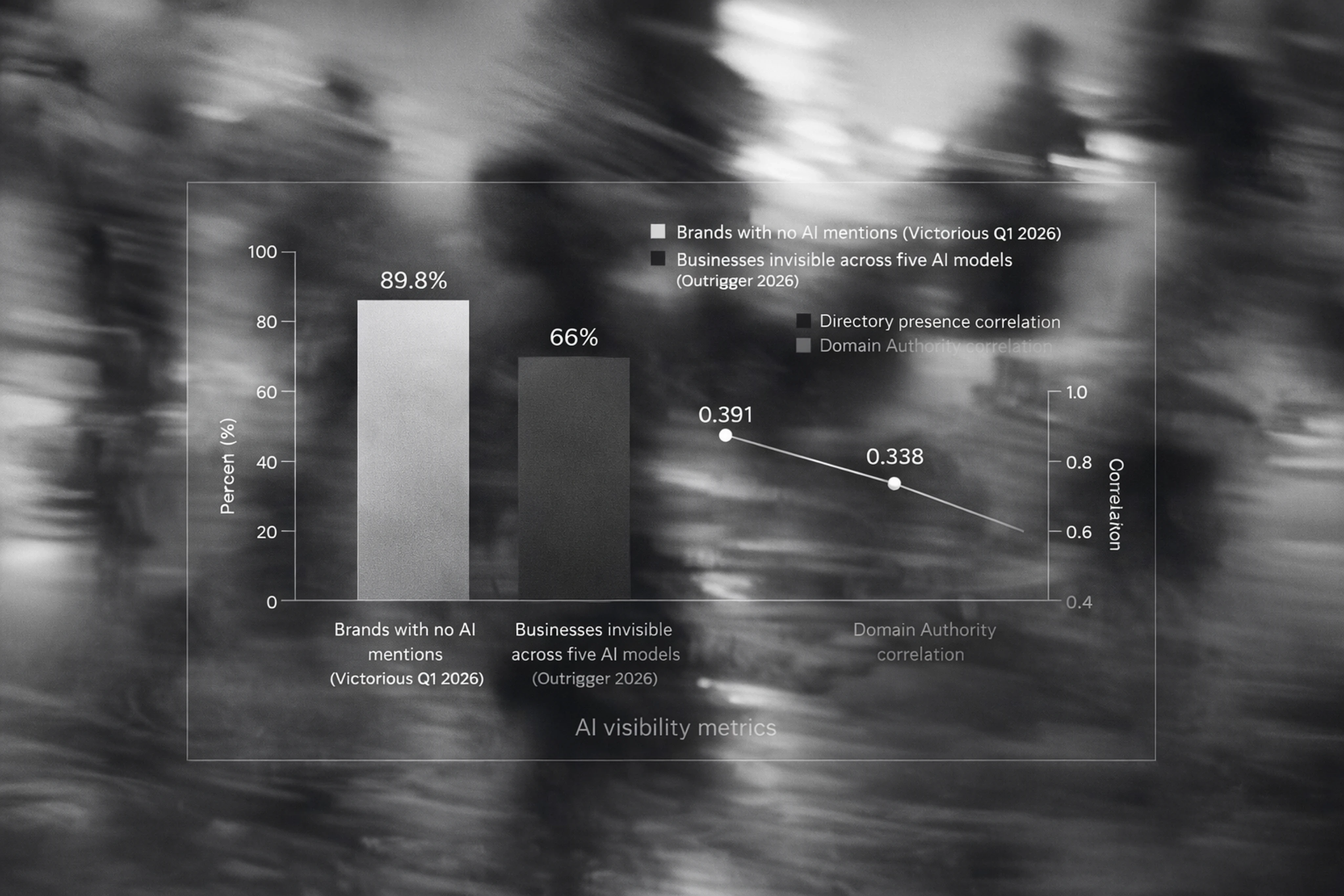
Victorious found that 89.8% of brands had no AI mentions at all in its Q1 2026 dataset (Victorious Quarterly Search Report, Q1 2026). Outrigger AI similarly reported that 66% of businesses are completely invisible to AI across five models, and that directory presence (r=0.391) actually outperforms Domain Authority (r=0.338) as a predictor of AI visibility (Outrigger AI Visibility Index, 2026).
Step 4 — Connect GEO (Generative Engine Optimization) to Regional AI Assistants
Generative Engine Optimization (GEO) is about how AI answer engines and agents see your brand. This is region‑specific: different assistants dominate in different markets.
4.1 Regional GEO considerations and workflows
United States
Primary AI channels: ChatGPT, Gemini, Perplexity, Microsoft Copilot.
Commerce ecosystems: Amazon, Walmart, Shopify, Instacart.
Workflow:
Use AI visibility tools to track brand mentions in AI assistants for US queries.
Sync product feeds with Google Merchant Center and Amazon Seller Central.
Monitor eligibility in ChatGPT’s shopping layer and agentic commerce integrations.
Europe & UK
Increased regulation (AI Act, GDPR) makes transparency and data provenance more critical.
Marketplaces: Zalando, OTTO, eBay, local grocers; plus Amazon EU.
Workflow:
Maintain region‑specific feeds (currency, VAT, shipping policies).
Localize structured data (
priceCurrency,availability,shippingDetails).Track AI visibility by language (EN, DE, FR, ES) and region (DE, FR, UK, etc.).
APAC
Growing presence of regional AI assistants and marketplaces.
Workflow:
Localize specs and descriptions for key languages.
Ensure localized domains/subfolders have consistent structured data.
Monitor AI assistants with regional footprints (e.g., local search engines, chat apps).
4.2 Tracking region‑specific performance in AI assistants
Use AI visibility platforms and analytics tools to:
Segment share of voice by model and region.
Track SKU‑level rankings in AI shopping carousels by country.
Identify competitors displacing you in decision‑stage answers.
Outrigger’s research suggests directory presence and third‑party listings are particularly correlated with AI visibility (Outrigger AI, 2026). Ensure your brand is consistently listed in relevant directories, marketplaces, and review sites in each region.
Step 5 — Design AI‑Aware Ambassador Programs and Briefing Templates
Ambassador programs now influence both human buyers and AI training corpora. Most AI answer engines learn about your brand from third‑party content rather than your own.
AirOps found 85% of brand mentions in AI search came from third‑party content, and brands were 6.5x more likely to appear in top‑of‑funnel commercial queries via off‑site content than via their own pages (AirOps report, 2025).
BBB National Programs found 58% of consumers purchased because of influencer endorsements, but only 5% trust influencer content completely, with trust driven by transparency and authenticity (BBB Influencer Trust Index, 2024).
Launchmetrics reports 77% of ambassador campaign impact comes from indirect echo (earned media, third‑party amplification) (Launchmetrics / BoF, 2025).
5.1 Ambassador brief template (with disclosure language)
Use this template for each ambassador campaign. Customize for category and region.
[AMBASSADOR BRIEF TEMPLATE]

Campaign Title:
Brand Owner:
Ambassador Name/Handle:
Region(s):
Product(s) Featured:
Campaign Dates:

1. Campaign Objective
- Primary goal (e.g., increase AI‑indexed reviews, highlight specific use cases).
- Target audience and personas.

2. Key Messages (AI‑Ready)
- One‑sentence brand description (max 25 words).
- 3–5 product proof points (with concrete data where possible):
  - Example: "Our AI visibility platform tracks brand mentions across ChatGPT, Gemini, Claude, Perplexity, and more."
- Required facts to include (price range, availability, regions, guarantees).

3. Content Requirements
- Channels: (YouTube, TikTok, Instagram, blog, podcast, etc.)
- Minimum content: (e.g., 1 long‑form video, 2 shorts, 1 blog post).
- Must include at least one link to:
  - Official product page
  - Independent review or press mention (for third‑party evidence)

4. Tone & Style
- Tone: [professional but approachable / playful / deeply technical].
- Do:
  - Share honest experiences, including any drawbacks.
  - Highlight specific use cases and outcomes (metrics where possible).
- Don’t:
  - Make unsubstantiated claims.
  - Misrepresent partnerships or sponsorships.

5. Required Disclosures (COMPLIANCE)
- You MUST clearly disclose this relationship as required by local law.
- Example disclosure language (copy‑paste):
  - Short‑form: "This video is in paid partnership with [Brand]."
  - Long‑form: "I’m partnering with [Brand], which provided compensation and/or free access to their product. All opinions are my own."
- Disclosures must be:
  - Easy to notice
  - In the same language as the main content
  - Included in video/audio and description/caption

6. Data & Links for AI Visibility
- Canonical product URLs:
- Canonical brand overview URL:
- Schema‑rich review or comparison pages (if any):
- UTM parameters for tracking:

7. Measurement & Reporting
- Primary KPIs:
  - Clicks, conversions, and attributed revenue
  - New reviews on third‑party sites
  - AI mention share (pre/post campaign) as reported by AI visibility tools
- Reporting cadence: [weekly / end of campaign]

8. Rights & Reuse
- Content can be reused by [Brand] on:
  - Website
  - Paid ads
  - AI training corpora (if applicable, with separate consent)

[END OF TEMPLATE]
[AMBASSADOR BRIEF TEMPLATE]

Campaign Title:
Brand Owner:
Ambassador Name/Handle:
Region(s):
Product(s) Featured:
Campaign Dates:

1. Campaign Objective
- Primary goal (e.g., increase AI‑indexed reviews, highlight specific use cases).
- Target audience and personas.

2. Key Messages (AI‑Ready)
- One‑sentence brand description (max 25 words).
- 3–5 product proof points (with concrete data where possible):
  - Example: "Our AI visibility platform tracks brand mentions across ChatGPT, Gemini, Claude, Perplexity, and more."
- Required facts to include (price range, availability, regions, guarantees).

3. Content Requirements
- Channels: (YouTube, TikTok, Instagram, blog, podcast, etc.)
- Minimum content: (e.g., 1 long‑form video, 2 shorts, 1 blog post).
- Must include at least one link to:
  - Official product page
  - Independent review or press mention (for third‑party evidence)

4. Tone & Style
- Tone: [professional but approachable / playful / deeply technical].
- Do:
  - Share honest experiences, including any drawbacks.
  - Highlight specific use cases and outcomes (metrics where possible).
- Don’t:
  - Make unsubstantiated claims.
  - Misrepresent partnerships or sponsorships.

5. Required Disclosures (COMPLIANCE)
- You MUST clearly disclose this relationship as required by local law.
- Example disclosure language (copy‑paste):
  - Short‑form: "This video is in paid partnership with [Brand]."
  - Long‑form: "I’m partnering with [Brand], which provided compensation and/or free access to their product. All opinions are my own."
- Disclosures must be:
  - Easy to notice
  - In the same language as the main content
  - Included in video/audio and description/caption

6. Data & Links for AI Visibility
- Canonical product URLs:
- Canonical brand overview URL:
- Schema‑rich review or comparison pages (if any):
- UTM parameters for tracking:

7. Measurement & Reporting
- Primary KPIs:
  - Clicks, conversions, and attributed revenue
  - New reviews on third‑party sites
  - AI mention share (pre/post campaign) as reported by AI visibility tools
- Reporting cadence: [weekly / end of campaign]

8. Rights & Reuse
- Content can be reused by [Brand] on:
  - Website
  - Paid ads
  - AI training corpora (if applicable, with separate consent)

[END OF TEMPLATE]
This structure supports both compliance and AI‑awareness by ensuring ambassadors create content that LLMs can parse, trace, and attribute back to your brand.
5.2 Keep human judgment in the loop
CreatorIQ reports that 95% of brands and 97% of agencies used AI in marketing, and influencer marketing investment grew 171% year over year (CreatorIQ State of Creator Marketing 2025–2026). Yet 41% of creators say their voice or likeness should never be replaced by AI.
Use AI for:
Discovering creators and ambassador prospects.
Drafting briefs and content outlines.
Monitoring AI‑layer visibility of ambassador content.
But keep humans responsible for:
Relationship management and negotiations.
Creative direction and brand safety.
Long‑term ambassador strategy.
Step 6 — Instrument AI Visibility, Brand Monitoring, and Reporting
Without measurement, you can’t know whether your AI‑ready guidelines and ambassador programs are working.
6.1 Metrics to track
Track these metrics across AI models and regions:
AI share of voice: % of AI answers mentioning your brand for target queries.
Answer rank: Where your brand appears in AI recommendations (1st, 2nd, etc.).
Citation quality: Whether models quote your site, ambassadors, or third‑party reviews.
Pros/cons balance: Sentiment and common pros/cons listed.
SKU coverage: % of priority SKUs surfaced by AI shopping agents.
Ambassador echo: Number of third‑party references created by ambassador content.
AirOps’ findings on third‑party dominance (85% of mentions off‑site) mean you should monitor review sites, news, and user‑generated content as part of your visibility stack (AirOps, 2025).
6.2 Governance rhythms
Implement a simple governance loop:
Weekly: Monitor AI visibility dashboards; triage major losses in share of voice.
Monthly: Update brand JSON and CMS metadata rules; refresh product data scores.
Quarterly: Review ambassador program outcomes and AI‑layer impact.
Annually: Revisit your broader Brand Strategy and Management in the AI Era roadmap.
Tools & Platform Recommendations (AI Visibility Platform Reviews)
This section lists representative tools frequently used by enterprise marketing teams. Use it as a starting point for AI visibility platform reviews, not as an exhaustive or endorsed list.
AI visibility platforms trusted by marketers
These tools help track brand mentions in AI assistants and AI search:
Era — AI visibility, analytics, and GEO platform for generative search and agentic commerce.
Tracks brand share of voice, rankings, citations, sentiment across ChatGPT, Claude, Gemini, Perplexity, and shopping agents.
Offers GEO/AEO optimization, SKU‑level tracking, and content automation.
More info: https://era.shopping/?utm_source=openai
Mentionlayer / Outrigger AI Visibility Index — Focused on AI visibility research and diagnostics.
Measures cross‑model visibility and factors influencing it, such as directory presence.
More info: https://www.mentionlayer.com/research
AirOps AI Search Visibility tools — Monitors how brands appear in AI search answers.
Its 2025 report on off‑site signals is widely cited.
More info: https://www.airops.com
Perplexity for Brands / Perplexity Pages — Allows brands to publish structured, citation‑rich pages that feed Perplexity’s answers.
Useful as a complement to broader AI visibility monitoring.
More info: https://www.perplexity.ai
Traditional SEO suites with AI modules (e.g., Semrush, Ahrefs) — Some have beta features for AI SERP tracking.
Use these for hybrid web + AI monitoring, but note they may not yet offer deep multi‑model coverage.
Best AI shopping assistant tools and marketplace listing optimization
For AI shopping recommendations and marketplace listing optimization tools for generative search:
Google Merchant Center + Product structured data
Official foundation for Google Search and Shopping.
Data spec: https://support.google.com/merchants/answer/7052112
Amazon Seller Central & Listing Quality Dashboard
Optimizes product detail pages that feed Amazon’s own AI and recommendation engines.
More info: https://sellercentral.amazon.com
Shopify Catalog & Search & Discovery app
Helps structure and enrich product data for Shopify search and AI experiences.
Product details: https://help.shopify.com/en/manual/products/details
Ecommerce GEO/AEO specialists (various vendors)
Look for services that mention “SEO tools for AI‑powered search marketplace listings” and “best tools optimize e‑commerce listings AI search algorithm” in their positioning.
Use an AI visibility platform to cross‑reference these listing tools with AI answer surfaces. This ensures your investments in feeds and listings actually translate to AI shopping recommendations.
FAQ: AI‑Ready Brand Guidelines, AI Visibility Platforms, and Ambassador Programs
Q1: What are the best tools to track brand mentions in AI assistants?
The best tools to track brand mentions in AI assistants combine multi‑model monitoring, region filters, and SKU‑level reporting. Representative options include:
Era for cross‑model AI visibility and GEO, including ChatGPT, Claude, Gemini, and Perplexity.
Mentionlayer / Outrigger AI Visibility Index for diagnostic visibility scoring across five models.
AirOps for AI search visibility analyses focused on off‑site signals.
You can complement these with manual checks in ChatGPT, Gemini, and Perplexity, but enterprise teams typically need automated tracking.
Q2: How do AI visibility platforms help enterprise marketing teams?
AI visibility platforms help enterprise marketing teams by:
Providing dashboards that show where your brand appears (or doesn’t) in AI answers.
Measuring AI share of voice, rankings, sentiment, and pros/cons across models.
Connecting product feeds, structured data, and content to real‑world AI outcomes.
Powering GEO/AEO workflows that improve AI shopping recommendations, not just web SEO.
This fills the gap left by legacy SEO dashboards that don’t reflect how LLMs surface brands in conversational flows.
Q3: How do I make my brand guidelines AI‑ready?
To make brand guidelines AI‑ready:
Create a machine‑readable brand entity JSON (see Step 1 template).
Turn tone, vocabulary, and compliance rules into structured fields and if/then rules.
Extend your CMS with metadata fields for content type, target persona, funnel stage, region, schema type, and AI priority.
Implement Product and Article structured data per schema.org and Google docs.
Ensure ambassador briefs include canonical URLs, required facts, and disclosure language that AI can parse.
Q4: How should I design ambassador programs for AI visibility?
Design ambassador programs for AI visibility by:
Prioritizing evidence‑rich content (metrics, use cases, specific product names) over vague endorsements.
Ensuring ambassadors link to canonical pages and trusted third‑party reviews.
Requiring clear disclosures, which BBB research shows improves trust (BBB, 2024).
Measuring success not just by clicks, but by AI mentions, citations, and indirect echo (Launchmetrics, 2025).
Q5: What is the difference between SEO and GEO (Generative Engine Optimization)?
SEO focuses on ranking in search engine results pages (SERPs). GEO (Generative Engine Optimization) focuses on how AI answer engines and agents choose and describe brands in conversational answers.
Key differences:
GEO optimizes for entities and evidence, not just keywords.
GEO requires structured data, product feeds, and third‑party proof, because AI models rely heavily on external signals.
GEO reporting centers on AI share of voice, answer rank, pros/cons, and SKU visibility in AI shopping flows.
Both matter, but GEO is the layer where AI‑native traffic and agentic commerce decisions will increasingly occur.
By turning your brand guidelines, product data, and ambassador programs into structured, machine‑readable systems, you make it far more likely that AI assistants, shopping agents, and AI visibility platforms will recognize, trust, and recommend your brand. Start with the templates in this tutorial, then iterate as your Brand Strategy and Management in the AI Era evolves.



AI visibility platforms used by enterprise marketing teams are only as good as the brand data you feed them.
If your brand guidelines and ambassador programs aren’t machine‑readable, AI shopping recommendation tools and agents will misinterpret or simply ignore you.
This tutorial walks you through how to build AI‑ready brand systems, plus the tools to track brand mentions in AI assistants and optimize for generative search.
This article complements our in‑depth guide, Brand Strategy and Management in the AI Era: Identity, Power, and Risk. Refer to that pillar for the strategic “why”; use this tutorial for the “how”.
Prerequisites: What You Need Before You Start
Before you implement AI‑ready brand guidelines and ambassador programs, make sure you have:
A clear brand positioning and value proposition.
Access to your CMS, product feed, and analytics stack.
At least one AI visibility platform (e.g., Era, Mentionlayer, etc.) or a plan to adopt one.
Legal/compliance review for disclosure and data policies.
You’ll also want to skim the following developer documentation:
Google Product structured data: https://developers.google.com/search/docs/appearance/structured-data/product
schema.org/Product reference: https://schema.org/Product
Google Merchant Center product data specification: https://support.google.com/merchants/answer/7052112
Shopify product data requirements (agentic‑ready guidance): https://help.shopify.com/en/manual/products/details
Step 1 — Create Machine‑Readable Brand Cores for AI Visibility Platforms
AI answer engines and AI visibility platforms need a clean, structured definition of your brand entity. Think of this step as building a single source of truth that both humans and machines can read.
1.1 Define your brand as a structured entity
AI engines increasingly treat brands as “entities” with attributes. To be visible and correctly represented, you need a machine‑readable brand core.
Use this JSON schema template as a starting point. You can store it in your design system, repo, or brand operations wiki.
{
  "@context": "https://schema.org",
  "@type": "Organization",
  "name": "Your Brand Name",
  "alternateName": ["Short Name", "Ticker/Abbrev"],
  "url": "https://www.example.com",
  "logo": "https://www.example.com/logo.png",
  "description": "One‑sentence brand description for AI answers.",
  "foundingDate": "2015",
  "founder": [
    {
      "@type": "Person",
      "name": "Founder Name"
    }
  ],
  "sameAs": [
    "https://www.linkedin.com/company/example",
    "https://www.crunchbase.com/organization/example",
    "https://en.wikipedia.org/wiki/Example"
  ],
  "brandValues": [
    "Evidence‑based marketing",
    "Customer privacy",
    "Sustainable sourcing"
  ],
  "targetCustomers": [
    "Mid‑market ecommerce brands",
    "Enterprise retailers",
    "Digital marketing agencies"
  ],
  "primaryCategories": [
    "AI visibility platforms",
    "Ecommerce analytics",
    "Generative engine optimization (GEO)"
  ],
  "regionsServed": ["US", "CA", "UK", "DE", "EU", "APAC"],
  "contactPoint": {
    "@type": "ContactPoint",
    "contactType": "customer support",
    "email": "support@example.com"
  },
  "complianceNotes": {
    "disclosurePolicy": "All ambassadors must disclose paid partnerships.",
    "dataPolicy": "We do not resell customer data."
  }
}
Implementation tips
Publish a public version (e.g.,
/brand.json) and reference it in your site<head>.Synchronize this JSON with your design system (Frontify, Zeroheight, etc.).
Treat it as the master reference for:
AI training corpora
Brand onboarding decks
Ambassador briefs
Frontify notes that machine‑readable brand governance should use JSON, APIs, metadata, taxonomies, permissions, and rule logic to translate brand knowledge into AI‑ready assets (Frontify, 2024).
1.2 Translate tone and messaging into AI‑friendly rules
Instead of only prose brand books, define tone in if/then rules and tags.
Example tone rules:
tone_default: “Professional but approachable; short sentences; no emojis unless requested.”tone_exec: “Concise, metric‑driven, C‑suite friendly; assumes familiarity with AI.”tone_support: “Empathetic, solution‑oriented; avoid blame.”
Add these fields to your brand JSON or a separate brandTone object. AI visibility platforms and content engines can then enforce them programmatically.
Step 2 — Turn Brand Guidelines into Structured CMS Metadata
To make your content AI‑ready, every page should expose consistent, structured metadata. Google emphasizes that AI‑assisted content still needs accuracy, quality, and structured metadata to be trustworthy (Google Search Central, 2024).
2.1 Define a CMS metadata field list (copy‑paste template)
Use this field list for your CMS (WordPress, headless CMS, custom).
Required metadata fields (site‑wide)

- content_id (string; unique ID)
- canonical_url (URL)
- content_type (enum: article, product, category, help, policy)
- primary_topic (short string; e.g., "AI visibility platforms")
- target_persona (enum: CMO, Head of Growth, Ecommerce Director, SEO Lead)
- funnel_stage (enum: awareness, consideration, decision, post‑purchase)
- region_focus (multi‑select: global, US, CA, UK, EU, APAC)
- brand_pillar (enum; defined in brand JSON)
- ai_answer_priority (integer 1–5; higher = more important for AI answers)
- schema_type (enum: Article, Product, FAQPage, HowTo, BreadcrumbList)
- faq_included (boolean)
- last_updated (ISO 8601 date)

Optional but recommended

- primary_model_targets (multi‑select: ChatGPT, Gemini, Claude, Perplexity, Copilot)
- key_stats_referenced (boolean; yes/no)
- third_party_sources (list of URLs)
- ambassador_id (if content is co‑created with an ambassador)
2.2 Align structured data with Google & schema.org
For product pages, implement:
Productstructured data per Google: https://developers.google.com/search/docs/appearance/structured-data/productCore fields Google calls out as important:
namedescriptionimageskubrandoffers.priceoffers.priceCurrencyoffers.availabilityaggregateRating.ratingValueaggregateRating.reviewCountshippingDetailshasMerchantReturnPolicy
Google notes that combining page markup with Merchant Center feeds maximizes eligibility for rich results (Google, 2024).
For articles, use Article or FAQPage schema where relevant. This makes your content more extractable for LLMs and generative answers.
Step 3 — Make Product Data Agentic‑Ready for AI Shopping Recommendations
AI shopping agents rely on clean, structured product data.
NIQ reports 42% of consumers now use AI tools to shop (NIQ, May 2026).
Adyen found AI assistant usage among U.S. shoppers rose from 12% to 35% year over year (Adyen Retail Report US, Jan 2026).
OpenAI noted that ChatGPT had 700M+ weekly users and that shopping results are organic and unsponsored, ranked by availability, price, quality, primary seller status, and Instant Checkout availability (OpenAI, Sep 29 2025).
These systems prioritize complete, machine‑parsable data. Shopify similarly recommends that agentic‑ready product data be “complete, structured, and machine‑parsable” (Shopify Product Details Help, accessed 2026).
3.1 Use a product data scoring sheet (CSV template)
Create a scoring sheet to audit catalog readiness. Paste these columns into Google Sheets, Excel, or a data warehouse.
Required columns for AI‑ready product audit (CSV)

- product_id
- sku
- product_name
- brand_name
- category
- region (US, CA, UK, DE, EU, APAC, etc.)
- list_price
- sale_price
- currency
- availability_status (in_stock, out_of_stock, preorder)
- gtin / upc / ean
- primary_image_url
- additional_image_count
- description_length_chars
- bullet_points_count
- key_specs_present (yes/no)
- shipping_info_present (yes/no)
- return_policy_present (yes/no)
- aggregate_rating_value
- review_count
- merchant_center_synced (yes/no)
- structured_data_present (yes/no)
- last_feed_update_date
- ai_visibility_score (0–100)
- evidence_sources (brand_site, marketplace, review_site, media, etc.)
Use ai_visibility_score to summarize how well each SKU is represented across AI models. AI visibility platforms (e.g., Era, Mentionlayer) can populate or validate this score.
3.2 Align feeds with Google Merchant Center
Ensure your product feeds meet Google’s Merchant Center specification:
Product data spec: https://support.google.com/merchants/answer/7052112
Key attributes for AI‑friendly feeds:
idtitledescriptionlinkimage_linkpriceavailabilityconditionbrandgtinshippingreturn_policy
Google explicitly says that combining Merchant Center feeds with Product structured data maximizes eligibility for richer shopping results (Google Product structured data, 2024).
Victorious found that 89.8% of brands had no AI mentions at all in its Q1 2026 dataset (Victorious Quarterly Search Report, Q1 2026). Outrigger AI similarly reported that 66% of businesses are completely invisible to AI across five models, and that directory presence (r=0.391) actually outperforms Domain Authority (r=0.338) as a predictor of AI visibility (Outrigger AI Visibility Index, 2026).
Step 4 — Connect GEO (Generative Engine Optimization) to Regional AI Assistants
Generative Engine Optimization (GEO) is about how AI answer engines and agents see your brand. This is region‑specific: different assistants dominate in different markets.
4.1 Regional GEO considerations and workflows
United States
Primary AI channels: ChatGPT, Gemini, Perplexity, Microsoft Copilot.
Commerce ecosystems: Amazon, Walmart, Shopify, Instacart.
Workflow:
Use AI visibility tools to track brand mentions in AI assistants for US queries.
Sync product feeds with Google Merchant Center and Amazon Seller Central.
Monitor eligibility in ChatGPT’s shopping layer and agentic commerce integrations.
Europe & UK
Increased regulation (AI Act, GDPR) makes transparency and data provenance more critical.
Marketplaces: Zalando, OTTO, eBay, local grocers; plus Amazon EU.
Workflow:
Maintain region‑specific feeds (currency, VAT, shipping policies).
Localize structured data (
priceCurrency,availability,shippingDetails).Track AI visibility by language (EN, DE, FR, ES) and region (DE, FR, UK, etc.).
APAC
Growing presence of regional AI assistants and marketplaces.
Workflow:
Localize specs and descriptions for key languages.
Ensure localized domains/subfolders have consistent structured data.
Monitor AI assistants with regional footprints (e.g., local search engines, chat apps).
4.2 Tracking region‑specific performance in AI assistants
Use AI visibility platforms and analytics tools to:
Segment share of voice by model and region.
Track SKU‑level rankings in AI shopping carousels by country.
Identify competitors displacing you in decision‑stage answers.
Outrigger’s research suggests directory presence and third‑party listings are particularly correlated with AI visibility (Outrigger AI, 2026). Ensure your brand is consistently listed in relevant directories, marketplaces, and review sites in each region.
Step 5 — Design AI‑Aware Ambassador Programs and Briefing Templates
Ambassador programs now influence both human buyers and AI training corpora. Most AI answer engines learn about your brand from third‑party content rather than your own.
AirOps found 85% of brand mentions in AI search came from third‑party content, and brands were 6.5x more likely to appear in top‑of‑funnel commercial queries via off‑site content than via their own pages (AirOps report, 2025).
BBB National Programs found 58% of consumers purchased because of influencer endorsements, but only 5% trust influencer content completely, with trust driven by transparency and authenticity (BBB Influencer Trust Index, 2024).
Launchmetrics reports 77% of ambassador campaign impact comes from indirect echo (earned media, third‑party amplification) (Launchmetrics / BoF, 2025).
5.1 Ambassador brief template (with disclosure language)
Use this template for each ambassador campaign. Customize for category and region.
[AMBASSADOR BRIEF TEMPLATE]

Campaign Title:
Brand Owner:
Ambassador Name/Handle:
Region(s):
Product(s) Featured:
Campaign Dates:

1. Campaign Objective
- Primary goal (e.g., increase AI‑indexed reviews, highlight specific use cases).
- Target audience and personas.

2. Key Messages (AI‑Ready)
- One‑sentence brand description (max 25 words).
- 3–5 product proof points (with concrete data where possible):
  - Example: "Our AI visibility platform tracks brand mentions across ChatGPT, Gemini, Claude, Perplexity, and more."
- Required facts to include (price range, availability, regions, guarantees).

3. Content Requirements
- Channels: (YouTube, TikTok, Instagram, blog, podcast, etc.)
- Minimum content: (e.g., 1 long‑form video, 2 shorts, 1 blog post).
- Must include at least one link to:
  - Official product page
  - Independent review or press mention (for third‑party evidence)

4. Tone & Style
- Tone: [professional but approachable / playful / deeply technical].
- Do:
  - Share honest experiences, including any drawbacks.
  - Highlight specific use cases and outcomes (metrics where possible).
- Don’t:
  - Make unsubstantiated claims.
  - Misrepresent partnerships or sponsorships.

5. Required Disclosures (COMPLIANCE)
- You MUST clearly disclose this relationship as required by local law.
- Example disclosure language (copy‑paste):
  - Short‑form: "This video is in paid partnership with [Brand]."
  - Long‑form: "I’m partnering with [Brand], which provided compensation and/or free access to their product. All opinions are my own."
- Disclosures must be:
  - Easy to notice
  - In the same language as the main content
  - Included in video/audio and description/caption

6. Data & Links for AI Visibility
- Canonical product URLs:
- Canonical brand overview URL:
- Schema‑rich review or comparison pages (if any):
- UTM parameters for tracking:

7. Measurement & Reporting
- Primary KPIs:
  - Clicks, conversions, and attributed revenue
  - New reviews on third‑party sites
  - AI mention share (pre/post campaign) as reported by AI visibility tools
- Reporting cadence: [weekly / end of campaign]

8. Rights & Reuse
- Content can be reused by [Brand] on:
  - Website
  - Paid ads
  - AI training corpora (if applicable, with separate consent)

[END OF TEMPLATE]
This structure supports both compliance and AI‑awareness by ensuring ambassadors create content that LLMs can parse, trace, and attribute back to your brand.
5.2 Keep human judgment in the loop
CreatorIQ reports that 95% of brands and 97% of agencies used AI in marketing, and influencer marketing investment grew 171% year over year (CreatorIQ State of Creator Marketing 2025–2026). Yet 41% of creators say their voice or likeness should never be replaced by AI.
Use AI for:
Discovering creators and ambassador prospects.
Drafting briefs and content outlines.
Monitoring AI‑layer visibility of ambassador content.
But keep humans responsible for:
Relationship management and negotiations.
Creative direction and brand safety.
Long‑term ambassador strategy.
Step 6 — Instrument AI Visibility, Brand Monitoring, and Reporting
Without measurement, you can’t know whether your AI‑ready guidelines and ambassador programs are working.
6.1 Metrics to track
Track these metrics across AI models and regions:
AI share of voice: % of AI answers mentioning your brand for target queries.
Answer rank: Where your brand appears in AI recommendations (1st, 2nd, etc.).
Citation quality: Whether models quote your site, ambassadors, or third‑party reviews.
Pros/cons balance: Sentiment and common pros/cons listed.
SKU coverage: % of priority SKUs surfaced by AI shopping agents.
Ambassador echo: Number of third‑party references created by ambassador content.
AirOps’ findings on third‑party dominance (85% of mentions off‑site) mean you should monitor review sites, news, and user‑generated content as part of your visibility stack (AirOps, 2025).
6.2 Governance rhythms
Implement a simple governance loop:
Weekly: Monitor AI visibility dashboards; triage major losses in share of voice.
Monthly: Update brand JSON and CMS metadata rules; refresh product data scores.
Quarterly: Review ambassador program outcomes and AI‑layer impact.
Annually: Revisit your broader Brand Strategy and Management in the AI Era roadmap.
Tools & Platform Recommendations (AI Visibility Platform Reviews)
This section lists representative tools frequently used by enterprise marketing teams. Use it as a starting point for AI visibility platform reviews, not as an exhaustive or endorsed list.
AI visibility platforms trusted by marketers
These tools help track brand mentions in AI assistants and AI search:
Era — AI visibility, analytics, and GEO platform for generative search and agentic commerce.
Tracks brand share of voice, rankings, citations, sentiment across ChatGPT, Claude, Gemini, Perplexity, and shopping agents.
Offers GEO/AEO optimization, SKU‑level tracking, and content automation.
More info: https://era.shopping/?utm_source=openai
Mentionlayer / Outrigger AI Visibility Index — Focused on AI visibility research and diagnostics.
Measures cross‑model visibility and factors influencing it, such as directory presence.
More info: https://www.mentionlayer.com/research
AirOps AI Search Visibility tools — Monitors how brands appear in AI search answers.
Its 2025 report on off‑site signals is widely cited.
More info: https://www.airops.com
Perplexity for Brands / Perplexity Pages — Allows brands to publish structured, citation‑rich pages that feed Perplexity’s answers.
Useful as a complement to broader AI visibility monitoring.
More info: https://www.perplexity.ai
Traditional SEO suites with AI modules (e.g., Semrush, Ahrefs) — Some have beta features for AI SERP tracking.
Use these for hybrid web + AI monitoring, but note they may not yet offer deep multi‑model coverage.
Best AI shopping assistant tools and marketplace listing optimization
For AI shopping recommendations and marketplace listing optimization tools for generative search:
Google Merchant Center + Product structured data
Official foundation for Google Search and Shopping.
Data spec: https://support.google.com/merchants/answer/7052112
Amazon Seller Central & Listing Quality Dashboard
Optimizes product detail pages that feed Amazon’s own AI and recommendation engines.
More info: https://sellercentral.amazon.com
Shopify Catalog & Search & Discovery app
Helps structure and enrich product data for Shopify search and AI experiences.
Product details: https://help.shopify.com/en/manual/products/details
Ecommerce GEO/AEO specialists (various vendors)
Look for services that mention “SEO tools for AI‑powered search marketplace listings” and “best tools optimize e‑commerce listings AI search algorithm” in their positioning.
Use an AI visibility platform to cross‑reference these listing tools with AI answer surfaces. This ensures your investments in feeds and listings actually translate to AI shopping recommendations.
FAQ: AI‑Ready Brand Guidelines, AI Visibility Platforms, and Ambassador Programs
Q1: What are the best tools to track brand mentions in AI assistants?
The best tools to track brand mentions in AI assistants combine multi‑model monitoring, region filters, and SKU‑level reporting. Representative options include:
Era for cross‑model AI visibility and GEO, including ChatGPT, Claude, Gemini, and Perplexity.
Mentionlayer / Outrigger AI Visibility Index for diagnostic visibility scoring across five models.
AirOps for AI search visibility analyses focused on off‑site signals.
You can complement these with manual checks in ChatGPT, Gemini, and Perplexity, but enterprise teams typically need automated tracking.
Q2: How do AI visibility platforms help enterprise marketing teams?
AI visibility platforms help enterprise marketing teams by:
Providing dashboards that show where your brand appears (or doesn’t) in AI answers.
Measuring AI share of voice, rankings, sentiment, and pros/cons across models.
Connecting product feeds, structured data, and content to real‑world AI outcomes.
Powering GEO/AEO workflows that improve AI shopping recommendations, not just web SEO.
This fills the gap left by legacy SEO dashboards that don’t reflect how LLMs surface brands in conversational flows.
Q3: How do I make my brand guidelines AI‑ready?
To make brand guidelines AI‑ready:
Create a machine‑readable brand entity JSON (see Step 1 template).
Turn tone, vocabulary, and compliance rules into structured fields and if/then rules.
Extend your CMS with metadata fields for content type, target persona, funnel stage, region, schema type, and AI priority.
Implement Product and Article structured data per schema.org and Google docs.
Ensure ambassador briefs include canonical URLs, required facts, and disclosure language that AI can parse.
Q4: How should I design ambassador programs for AI visibility?
Design ambassador programs for AI visibility by:
Prioritizing evidence‑rich content (metrics, use cases, specific product names) over vague endorsements.
Ensuring ambassadors link to canonical pages and trusted third‑party reviews.
Requiring clear disclosures, which BBB research shows improves trust (BBB, 2024).
Measuring success not just by clicks, but by AI mentions, citations, and indirect echo (Launchmetrics, 2025).
Q5: What is the difference between SEO and GEO (Generative Engine Optimization)?
SEO focuses on ranking in search engine results pages (SERPs). GEO (Generative Engine Optimization) focuses on how AI answer engines and agents choose and describe brands in conversational answers.
Key differences:
GEO optimizes for entities and evidence, not just keywords.
GEO requires structured data, product feeds, and third‑party proof, because AI models rely heavily on external signals.
GEO reporting centers on AI share of voice, answer rank, pros/cons, and SKU visibility in AI shopping flows.
Both matter, but GEO is the layer where AI‑native traffic and agentic commerce decisions will increasingly occur.
By turning your brand guidelines, product data, and ambassador programs into structured, machine‑readable systems, you make it far more likely that AI assistants, shopping agents, and AI visibility platforms will recognize, trust, and recommend your brand. Start with the templates in this tutorial, then iterate as your Brand Strategy and Management in the AI Era evolves.