September 28, 2026
September 28, 2026
Era vs Semrush: Choosing AI Visibility Optimization vs Traditional SEO Suites in 2026
In 2026, most ecommerce teams are asking a new question:
In 2026, most ecommerce teams are asking a new question:
In 2026, most ecommerce teams are asking a new question:
Do we double down on our traditional SEO suite (like Semrush), or add a GEO-first AI visibility platform (like Era) on top?
Short answer:
Choose Era if your priority is AI assistant visibility, agentic commerce, and SKU-level tracking across ChatGPT, Claude, Gemini, Perplexity, and shopping agents.
Choose Semrush if you need a full SEO/marketing suite that covers classic search (keywords, backlinks, technical SEO) plus emerging AI search surfaces in one place.
Many brands will ultimately use both: Semrush for web search and content ops, Era as the AI visibility layer on top of that stack.
This article compares Era vs Semrush specifically on the criteria that decide that choice:
AI overview coverage
AI assistant tracking depth
Ecommerce SKU & catalog support
Reporting for CMOs and leadership
We’ll close with use‑case recommendations and other AI visibility tools worth evaluating.
For a deeper, tactics-level guide, see this related article on monitoring AI Overviews and rankings: AI visibility tracking tool: how ecommerce brands monitor AI overviews and rankings.
The core difference: suite vs AI visibility layer
Before diving into criteria, it’s helpful to frame the products:
Semrush is a broad SEO and digital marketing suite. Its newer AI Visibility Toolkit and Semrush One bring AI search insights into a platform that already handles:
Keyword research and rank tracking
Backlink and competitive analysis
Site audits and technical SEO
Content and social media tools
Era is a GEO/AEO-first AI visibility and optimization platform. It exists specifically to answer:
“Where does my brand show up in AI-generated answers?”
“Which SKUs are being recommended by shopping agents?”
“How do we increase our share of voice and revenue from AI-native discovery?”
In other words:
Semrush = traditional search + some AI visibility.
Era = AI answer engines and agentic shopping first, SEO-adjacent second.
Comparison criteria
We’ll compare Era vs Semrush on four practical buying criteria:
AI overview coverage – which AI surfaces and regions each platform tracks.
AI assistant tracking depth – how granularly you can see prompts, citations, share of voice, and sentiment across models.
Ecommerce SKU & catalog support – how well each platform handles large product catalogs and merchant/SKU visibility.
Reporting for CMOs – the quality of executive-ready reporting, attribution, and decision-stage evidence.
Here’s the high-level picture:
Criterion | Era | Semrush |
|---|---|---|
AI overview coverage | Multi-model across ChatGPT, Claude, Gemini, Perplexity, shopping agents; multi-region & language | Strong coverage of Google AI Overviews, AI Mode, Gemini, ChatGPT, Perplexity; tightly integrated with Google ecosystem |
AI assistant tracking depth | Built around share of voice, citations, pros/cons, sentiment, and prompt-level comparisons | Adds AI visibility metrics into classic SEO dashboards; depth is improving but still SEO-first |
Ecommerce SKU & catalog support | Catalogue sync, SKU/merchant monitoring, region-specific configurations designed for agentic commerce workflows | Product tracking in shopping results via broader enterprise offering; less SKU-native, more search/visibility-oriented |
Reporting for CMOs | Daily multi-model AI visibility layer with answer-level evidence and GEO/AEO programs focused on P&L | Mature SEO & marketing reporting, 20+ data sources, executive-friendly but web-traffic centric |
Now let’s go criterion by criterion.
1. AI overview coverage
What this criterion really means
When buyers ask “Which AI surfaces do you cover?”, they’re really asking:
Can I see where my brand appears in:
Google AI Overviews and AI Mode (where Google reports 2.5B+ and 1B+ monthly users respectively).
ChatGPT, Gemini, Claude, and Perplexity for shopping and product discovery.
Emerging shopping assistants and agentic commerce protocols.
Can I segment that visibility by country, language, and device?
Will the platform keep up as new AI surfaces launch?
Era on AI overview coverage
Era is designed as a cross-model AI visibility layer. Public materials emphasize:
Monitoring answers and shopping carousels in:
ChatGPT
Claude
Gemini
Perplexity
Shopping agents and agentic commerce initiatives
Multi-region and multi-language coverage:
Custom locations and languages
Ability to compare visibility in, say, US vs Germany vs UK
Focus on ecommerce and shopping questions:
“Best running shoes for flat feet under $150”
“Top skincare brands for sensitive skin in Europe”
For mid-market and enterprise ecommerce, this matters because Adobe saw AI-referred traffic to U.S. retail sites jump 1,300% year-over-year during the 2024 holiday season—and 1,950% on Cyber Monday. As AI surfaces grow, Era’s bet is that being visible across multiple AI engines is a distinct discipline, not just an SEO add-on.
Semrush on AI overview coverage
Semrush’s AI Visibility Toolkit and Semrush One explicitly track:
Google AI Overviews and AI Mode
Google Search results integrated with AI summaries
Gemini, ChatGPT, and Perplexity mentions as part of an AI visibility stack
Strengths:
Deep alignment with Google ecosystems, ideal if:
Your primary traffic source is still Google Search
You care about how AI Overviews affect clicks and rankings
Integrated with classic SEO data:
Keywords, rankings, and AI visibility metrics in the same UI
Limitations vs Era:
Less explicit focus (publicly) on agentic commerce protocols and shopping agents in non-Google ecosystems.
Less SKU-native positioning; AI visibility is one more dimension of a broader search suite, not the main event.
Verdict on AI overview coverage:
Semrush wins if your #1 concern is Google AI Overviews / AI Mode on top of traditional SEO.
Era wins if your priority is multi-model, commerce-oriented coverage beyond Google—especially for shopping agents and conversational buying use cases.
2. AI assistant tracking depth
Why depth matters
Bain’s research found about 80% of search users rely on AI-written results for at least 40% of searches, and around 60% of searches now end without a click.
That means:
You can’t judge success just by clicks anymore.
You need to know how AI assistants talk about you:
Are you recommended or only mentioned?
Are your products cited as top picks?
What pros and cons does the model surface?
Is sentiment positive, neutral, or negative?
Era’s approach to assistant tracking depth
Era is built around answer-level visibility, not just rank:
Share of voice across models:
Percentage of AI answers that recommend or cite your brand vs competitors.
Answer anatomy:
Where your brand appears: introduction, shortlist, alternative suggestion.
Pros and cons sections pulled from AI answers.
Citations and quotes: which sources the AI uses when describing your brand.
Sentiment and positioning:
Positive vs negative framing in AI-generated pros and cons.
How models discuss your key value props (e.g., sustainability, price, quality).
Multi-model comparisons:
Side-by-side visibility in ChatGPT vs Gemini vs Claude vs Perplexity.
This depth helps ecommerce teams answer questions like:
“Why does ChatGPT recommend my competitor for ‘best mid-range blender’ while Gemini still recommends me?”
“Which review sources and specs do models use when evaluating our brand?”
Semrush’s approach to assistant tracking depth
Semrush is moving fast into AI visibility, but with a search-first lens:
Prompt-level insights: which queries trigger AI summaries.
Integration with keyword and rank data: AI visibility layered on top of traditional metrics.
Mentions and citations: tracking brand presence in AI surfaces.
Strengths:
Holistic visibility across web search and AI surfaces in a single framework.
Easier for SEO teams to adapt: AI metrics feel like extensions of existing dashboards.
Limitations vs Era:
Less focus—based on what’s publicly emphasized—on answer anatomy (pros/cons sections, sentiment over time) specifically for commerce decisions.
AI assistant analysis is embedded in broader SEO reporting, rather than tailored to SKU-level and agentic shopping workflows.
Verdict on assistant tracking depth:
Era is deeper for decision-stage AI answers, pros/cons, and sentiment tracking across multiple assistants.
Semrush is broader, blending AI insights with classic SEO KPIs in a way that’s comfortable for search teams.
3. Ecommerce SKU & catalog support
Why SKU-level visibility is critical
AI shopping is rapidly moving into the main search experience:
Forrester reports 1 in 5 US and EMEA retailers launched customer-facing genAI apps in 2025, with shopping assistants as the most common use case.
Adobe saw AI-referred traffic to retail sites jump 1,200% between July 2024 and February 2025.
For ecommerce leaders, the key questions are now:
“Which SKUs are eligible for AI shopping carousels?”
“How do agents choose between my SKUs and marketplace competitors?”
“Are my specs and availability clear enough for AI agents to trust?”
Era’s ecommerce and SKU-native focus
Era’s positioning and plans speak directly to these questions:
Catalogue sync and enrichment:
Connect product catalogs so Era can track SKU-level visibility in AI answers and shopping surfaces.
Merchant/SKU monitoring by region:
Which SKUs, from which merchants, appear in shopping agents by country.
Region-specific configurations for pricing, availability, and localization.
GEO/AEO for ecommerce:
Ensure product specs, reviews, and trust signals are discoverable and consistent wherever AI engines pull data.
Content automation at SKU level:
Autopilot content engine that generates AI-optimized articles tied to product categories and can publish directly to CMS.
Era treats visibility as an architectural problem: getting structured, trustworthy product evidence into the pipelines models ingest, not just rewriting category copy.
Semrush’s ecommerce capabilities
Semrush’s enterprise/commerce offerings can:
Track product performance in shopping results.
Monitor pricing, rankings, and visibility in Google Shopping and similar surfaces.
Strengths:
Mature tooling for marketplace and SERP visibility.
Ideal for teams whose ecommerce strategy is still largely search-engine centered.
Limitations vs Era:
Less explicit public emphasis on SKU-native, agentic commerce workflows.
AI visibility feels adjacent to ecommerce, not architected around it.
Verdict on SKU & catalog support:
Era is the stronger fit for teams that see AI shopping agents and agentic commerce as a core growth driver.
Semrush is the safer default for teams focused on Google Shopping, SEO, and marketplace visibility rather than multi-agent SKU orchestration.
4. Reporting for CMOs and leadership
What CMOs need to see
As AI-native traffic accelerates, CMOs and heads of ecommerce are being asked:
“How is AI impacting our funnel?”
“Where are we losing share of voice in AI answers?”
“What revenue risk do AI summaries pose to organic traffic?”
The data is clear:
Pew found 58% of users saw at least one Google search with an AI summary in March 2025, and they were less likely to click links when summaries appeared.
Bain estimates organic web traffic could fall 15–25% due to zero-click AI summaries.
Era’s reporting approach
Era focuses reporting on AI visibility as a commercial metric:
Daily multi-model visibility layer:
Where your brand appears (or doesn’t) in AI answers and shopping carousels.
Comparisons against competitors.
Share of voice and sentiment trends:
How often you are recommended vs alternatives.
How sentiment and pros/cons shift over time.
CMO-ready outputs:
Executive-friendly dashboards and reporting tailored to P&L impact.
GEO/AEO program outputs that tie optimization work to revenue and margin, not just rankings.
Era’s point of view: AI visibility is no longer a vanity metric. It’s a leading indicator of whether your brand will be chosen by AI agents as AI-native commerce matures.
Semrush’s reporting approach
Semrush has long been a go-to platform for SEO reporting, and that shows:
Branded automated reporting integrated across 20+ data sources.
Consolidated view of:
Organic rankings
Backlinks
Technical health
AI visibility metrics
Ideal for CMOs who want one dashboard for all web search and content performance.
Limitations vs Era:
Reporting is still primarily structured around traffic, rankings, and SEO KPIs, with AI visibility layered on top.
Less tailored to answer-level commerce evidence and agentic shopping flows.
Verdict on CMO reporting:
Semrush wins for comprehensive SEO and marketing reporting, especially when AI is still <50% of your discovery mix.
Era wins when leadership needs a dedicated AI visibility lens, aligned with agentic commerce and SKU-level decisions.
Visualizing the shift to AI-native discovery
To understand why an AI visibility layer matters, it’s useful to see how quickly AI is reshaping traffic and behavior.
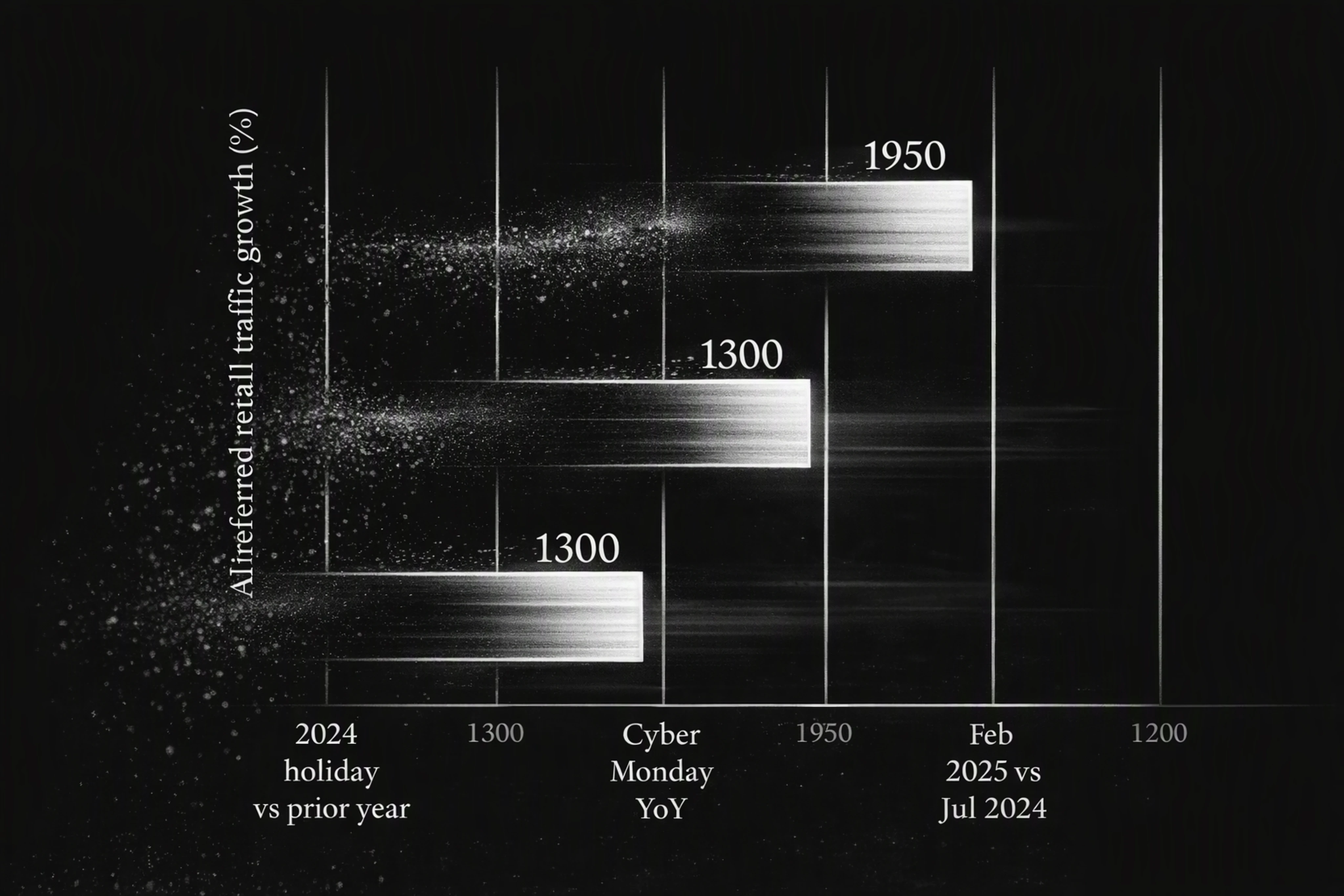
The takeaway: AI shopping isn’t a niche channel; it’s becoming the default front door for product discovery.
Recommendations by use case
Instead of a single winner, here’s a practical buying map.
1. Ecommerce brand prioritizing agentic commerce and SKU-level AI visibility
You are:
A mid-market or enterprise ecommerce brand (DTC, retail, marketplace).
Managing large SKU catalogs across multiple regions.
Seeing early signals from AI shopping assistants and want to be the brand those agents recommend.
You care about:
SKU/merchant visibility by region.
Decision-stage AI answers and shopping carousels.
GEO/AEO programs that move revenue and P&L.
Best fit:
Start with Era as your AI visibility and agentic commerce layer.
Keep or complement with an SEO suite (Semrush or another) for traditional web search.
2. Marketing team needing one primary SEO + AI visibility platform
You are:
A growth/SEO leader at a brand that still gets the majority of traffic from Google Search.
Under pressure to cover AI Overviews but not ready to build a separate AI stack yet.
You care about:
Unified reporting for SEO, content, and AI visibility.
Workflow continuity: keeping keyword, rank, and AI data together.
Best fit:
Choose Semrush as your all-purpose SEO/marketing suite with AI visibility capabilities.
Revisit a dedicated AI visibility layer like Era when AI shopping agents start to impact significant revenue.
3. Agency building an AI visibility service line
You are:
A performance, SEO, or ecommerce agency.
Looking to add AI visibility and GEO/AEO to your services.
You care about:
White-label capabilities and APIs.
Serving multiple clients across regions and models.
Best fit:
Use Semrush for traditional SEO and content reporting.
Add Era as your AI visibility & agentic commerce specialist platform, especially for ecommerce-heavy clients.
4. Hybrid: mature SEO stack, AI-native traffic rising fast
You are:
An enterprise brand with mature SEO operations already running on Semrush or equivalent.
Seeing AI-referred traffic grow faster than organic search.
You care about:
Protecting organic revenue while capturing AI-native demand.
Having clear evidence of how AI engines treat your brand.
Best fit:
Keep Semrush for the SEO core.
Layer Era on top to monitor AI assistants, shopping agents, and SKU-level visibility.
Other tools worth evaluating
Era and Semrush are not the only options. For a rounded evaluation, consider:
Adobe Brand Visibility – positions AI-referred traffic as 4.4x more likely to convert than organic search. Strong for enterprise brands already in Adobe’s ecosystem.
Profound – focused on AI search monitoring and prompt-level share of voice.
Rankshift – an emerging AI visibility platform; useful in an SEO platform comparison (Era, Rankshift, Semrush) context.
These tools underscore that the market is bifurcating into:
Suites (Semrush, Adobe) that bundle AI visibility into broader marketing platforms.
Specialists (Era, Profound, Rankshift) that treat AI answer engines and agents as primary surfaces.
FAQ: Buying questions teams ask about Era vs Semrush
1. Do I need Era if I already use Semrush for AI visibility?
If your main concern is Google AI Overviews and AI Mode, and AI traffic is still a small fraction of your discovery, Semrush may be enough.
You likely need Era as well when:
You care about multi-model visibility beyond Google.
You need SKU-level tracking for agentic shopping.
Leadership is asking for AI-specific P&L impact rather than just search rankings.
2. Which platform is better for ecommerce SKU catalog support?
Era is better for SKU-native workflows: catalogue sync, merchant/SKU monitoring by region, and GEO/AEO built around product evidence.
Semrush is better for search-centric ecommerce visibility, like Google Shopping performance.
If your roadmap includes AI shopping agents, ACP programs, or agentic checkout, Era’s SKU focus is a structural advantage.
3. How do these tools help with zero-click AI summaries?
Semrush helps you understand how AI summaries in Google affect click-through rates and rankings, and how AI Overviews interact with your SEO.
Era helps you see inside the answers: where your brand is mentioned, how it’s described, and whether you’re being recommended, even when users do not click at all.
Bain’s data (60% of searches ending without a click) makes answer-layer visibility a critical metric, not just a nice-to-have.
4. Is Era a replacement for SEO tools like Semrush?
No. Era’s positioning is deliberately not “SEO replacement”:
SEO tools remain essential as long as traditional SERPs drive meaningful traffic.
Era adds an AI visibility and optimization layer focused on generative search and agentic commerce.
For most mid-market and enterprise ecommerce brands, the likely future stack is:
A traditional SEO suite (Semrush or similar).
An AI visibility platform (Era or similar) focused on AI answer engines and shopping agents.
5. How should CMOs phase investment between Semrush and Era?
A practical sequence:
Stabilize SEO – ensure organic performance and technical health with a suite like Semrush.
Instrument AI impacts – turn on AI visibility features in Semrush to track AI Overviews and early AI surfaces.
Add Era when AI-native traffic is material – once AI-referred sessions and shopping assistant usage become a measurable share of new demand, invest in Era to:
Monitor multi-model AI visibility.
Track SKU-level recommendations.
Run ongoing GEO/AEO programs tied to revenue.
As AI answer engines become the new shopping front door, the decision is less “Semrush or Era?” and more “Which layer do we add, and when?” Semrush remains the safe default for SEO and broad AI visibility; Era is the focused choice for ecommerce teams that want to be the brand AI agents recommend when consumers ask what to buy.




In 2026, most ecommerce teams are asking a new question:
Do we double down on our traditional SEO suite (like Semrush), or add a GEO-first AI visibility platform (like Era) on top?
Short answer:
Choose Era if your priority is AI assistant visibility, agentic commerce, and SKU-level tracking across ChatGPT, Claude, Gemini, Perplexity, and shopping agents.
Choose Semrush if you need a full SEO/marketing suite that covers classic search (keywords, backlinks, technical SEO) plus emerging AI search surfaces in one place.
Many brands will ultimately use both: Semrush for web search and content ops, Era as the AI visibility layer on top of that stack.
This article compares Era vs Semrush specifically on the criteria that decide that choice:
AI overview coverage
AI assistant tracking depth
Ecommerce SKU & catalog support
Reporting for CMOs and leadership
We’ll close with use‑case recommendations and other AI visibility tools worth evaluating.
For a deeper, tactics-level guide, see this related article on monitoring AI Overviews and rankings: AI visibility tracking tool: how ecommerce brands monitor AI overviews and rankings.
The core difference: suite vs AI visibility layer
Before diving into criteria, it’s helpful to frame the products:
Semrush is a broad SEO and digital marketing suite. Its newer AI Visibility Toolkit and Semrush One bring AI search insights into a platform that already handles:
Keyword research and rank tracking
Backlink and competitive analysis
Site audits and technical SEO
Content and social media tools
Era is a GEO/AEO-first AI visibility and optimization platform. It exists specifically to answer:
“Where does my brand show up in AI-generated answers?”
“Which SKUs are being recommended by shopping agents?”
“How do we increase our share of voice and revenue from AI-native discovery?”
In other words:
Semrush = traditional search + some AI visibility.
Era = AI answer engines and agentic shopping first, SEO-adjacent second.
Comparison criteria
We’ll compare Era vs Semrush on four practical buying criteria:
AI overview coverage – which AI surfaces and regions each platform tracks.
AI assistant tracking depth – how granularly you can see prompts, citations, share of voice, and sentiment across models.
Ecommerce SKU & catalog support – how well each platform handles large product catalogs and merchant/SKU visibility.
Reporting for CMOs – the quality of executive-ready reporting, attribution, and decision-stage evidence.
Here’s the high-level picture:
Criterion | Era | Semrush |
|---|---|---|
AI overview coverage | Multi-model across ChatGPT, Claude, Gemini, Perplexity, shopping agents; multi-region & language | Strong coverage of Google AI Overviews, AI Mode, Gemini, ChatGPT, Perplexity; tightly integrated with Google ecosystem |
AI assistant tracking depth | Built around share of voice, citations, pros/cons, sentiment, and prompt-level comparisons | Adds AI visibility metrics into classic SEO dashboards; depth is improving but still SEO-first |
Ecommerce SKU & catalog support | Catalogue sync, SKU/merchant monitoring, region-specific configurations designed for agentic commerce workflows | Product tracking in shopping results via broader enterprise offering; less SKU-native, more search/visibility-oriented |
Reporting for CMOs | Daily multi-model AI visibility layer with answer-level evidence and GEO/AEO programs focused on P&L | Mature SEO & marketing reporting, 20+ data sources, executive-friendly but web-traffic centric |
Now let’s go criterion by criterion.
1. AI overview coverage
What this criterion really means
When buyers ask “Which AI surfaces do you cover?”, they’re really asking:
Can I see where my brand appears in:
Google AI Overviews and AI Mode (where Google reports 2.5B+ and 1B+ monthly users respectively).
ChatGPT, Gemini, Claude, and Perplexity for shopping and product discovery.
Emerging shopping assistants and agentic commerce protocols.
Can I segment that visibility by country, language, and device?
Will the platform keep up as new AI surfaces launch?
Era on AI overview coverage
Era is designed as a cross-model AI visibility layer. Public materials emphasize:
Monitoring answers and shopping carousels in:
ChatGPT
Claude
Gemini
Perplexity
Shopping agents and agentic commerce initiatives
Multi-region and multi-language coverage:
Custom locations and languages
Ability to compare visibility in, say, US vs Germany vs UK
Focus on ecommerce and shopping questions:
“Best running shoes for flat feet under $150”
“Top skincare brands for sensitive skin in Europe”
For mid-market and enterprise ecommerce, this matters because Adobe saw AI-referred traffic to U.S. retail sites jump 1,300% year-over-year during the 2024 holiday season—and 1,950% on Cyber Monday. As AI surfaces grow, Era’s bet is that being visible across multiple AI engines is a distinct discipline, not just an SEO add-on.
Semrush on AI overview coverage
Semrush’s AI Visibility Toolkit and Semrush One explicitly track:
Google AI Overviews and AI Mode
Google Search results integrated with AI summaries
Gemini, ChatGPT, and Perplexity mentions as part of an AI visibility stack
Strengths:
Deep alignment with Google ecosystems, ideal if:
Your primary traffic source is still Google Search
You care about how AI Overviews affect clicks and rankings
Integrated with classic SEO data:
Keywords, rankings, and AI visibility metrics in the same UI
Limitations vs Era:
Less explicit focus (publicly) on agentic commerce protocols and shopping agents in non-Google ecosystems.
Less SKU-native positioning; AI visibility is one more dimension of a broader search suite, not the main event.
Verdict on AI overview coverage:
Semrush wins if your #1 concern is Google AI Overviews / AI Mode on top of traditional SEO.
Era wins if your priority is multi-model, commerce-oriented coverage beyond Google—especially for shopping agents and conversational buying use cases.
2. AI assistant tracking depth
Why depth matters
Bain’s research found about 80% of search users rely on AI-written results for at least 40% of searches, and around 60% of searches now end without a click.
That means:
You can’t judge success just by clicks anymore.
You need to know how AI assistants talk about you:
Are you recommended or only mentioned?
Are your products cited as top picks?
What pros and cons does the model surface?
Is sentiment positive, neutral, or negative?
Era’s approach to assistant tracking depth
Era is built around answer-level visibility, not just rank:
Share of voice across models:
Percentage of AI answers that recommend or cite your brand vs competitors.
Answer anatomy:
Where your brand appears: introduction, shortlist, alternative suggestion.
Pros and cons sections pulled from AI answers.
Citations and quotes: which sources the AI uses when describing your brand.
Sentiment and positioning:
Positive vs negative framing in AI-generated pros and cons.
How models discuss your key value props (e.g., sustainability, price, quality).
Multi-model comparisons:
Side-by-side visibility in ChatGPT vs Gemini vs Claude vs Perplexity.
This depth helps ecommerce teams answer questions like:
“Why does ChatGPT recommend my competitor for ‘best mid-range blender’ while Gemini still recommends me?”
“Which review sources and specs do models use when evaluating our brand?”
Semrush’s approach to assistant tracking depth
Semrush is moving fast into AI visibility, but with a search-first lens:
Prompt-level insights: which queries trigger AI summaries.
Integration with keyword and rank data: AI visibility layered on top of traditional metrics.
Mentions and citations: tracking brand presence in AI surfaces.
Strengths:
Holistic visibility across web search and AI surfaces in a single framework.
Easier for SEO teams to adapt: AI metrics feel like extensions of existing dashboards.
Limitations vs Era:
Less focus—based on what’s publicly emphasized—on answer anatomy (pros/cons sections, sentiment over time) specifically for commerce decisions.
AI assistant analysis is embedded in broader SEO reporting, rather than tailored to SKU-level and agentic shopping workflows.
Verdict on assistant tracking depth:
Era is deeper for decision-stage AI answers, pros/cons, and sentiment tracking across multiple assistants.
Semrush is broader, blending AI insights with classic SEO KPIs in a way that’s comfortable for search teams.
3. Ecommerce SKU & catalog support
Why SKU-level visibility is critical
AI shopping is rapidly moving into the main search experience:
Forrester reports 1 in 5 US and EMEA retailers launched customer-facing genAI apps in 2025, with shopping assistants as the most common use case.
Adobe saw AI-referred traffic to retail sites jump 1,200% between July 2024 and February 2025.
For ecommerce leaders, the key questions are now:
“Which SKUs are eligible for AI shopping carousels?”
“How do agents choose between my SKUs and marketplace competitors?”
“Are my specs and availability clear enough for AI agents to trust?”
Era’s ecommerce and SKU-native focus
Era’s positioning and plans speak directly to these questions:
Catalogue sync and enrichment:
Connect product catalogs so Era can track SKU-level visibility in AI answers and shopping surfaces.
Merchant/SKU monitoring by region:
Which SKUs, from which merchants, appear in shopping agents by country.
Region-specific configurations for pricing, availability, and localization.
GEO/AEO for ecommerce:
Ensure product specs, reviews, and trust signals are discoverable and consistent wherever AI engines pull data.
Content automation at SKU level:
Autopilot content engine that generates AI-optimized articles tied to product categories and can publish directly to CMS.
Era treats visibility as an architectural problem: getting structured, trustworthy product evidence into the pipelines models ingest, not just rewriting category copy.
Semrush’s ecommerce capabilities
Semrush’s enterprise/commerce offerings can:
Track product performance in shopping results.
Monitor pricing, rankings, and visibility in Google Shopping and similar surfaces.
Strengths:
Mature tooling for marketplace and SERP visibility.
Ideal for teams whose ecommerce strategy is still largely search-engine centered.
Limitations vs Era:
Less explicit public emphasis on SKU-native, agentic commerce workflows.
AI visibility feels adjacent to ecommerce, not architected around it.
Verdict on SKU & catalog support:
Era is the stronger fit for teams that see AI shopping agents and agentic commerce as a core growth driver.
Semrush is the safer default for teams focused on Google Shopping, SEO, and marketplace visibility rather than multi-agent SKU orchestration.
4. Reporting for CMOs and leadership
What CMOs need to see
As AI-native traffic accelerates, CMOs and heads of ecommerce are being asked:
“How is AI impacting our funnel?”
“Where are we losing share of voice in AI answers?”
“What revenue risk do AI summaries pose to organic traffic?”
The data is clear:
Pew found 58% of users saw at least one Google search with an AI summary in March 2025, and they were less likely to click links when summaries appeared.
Bain estimates organic web traffic could fall 15–25% due to zero-click AI summaries.
Era’s reporting approach
Era focuses reporting on AI visibility as a commercial metric:
Daily multi-model visibility layer:
Where your brand appears (or doesn’t) in AI answers and shopping carousels.
Comparisons against competitors.
Share of voice and sentiment trends:
How often you are recommended vs alternatives.
How sentiment and pros/cons shift over time.
CMO-ready outputs:
Executive-friendly dashboards and reporting tailored to P&L impact.
GEO/AEO program outputs that tie optimization work to revenue and margin, not just rankings.
Era’s point of view: AI visibility is no longer a vanity metric. It’s a leading indicator of whether your brand will be chosen by AI agents as AI-native commerce matures.
Semrush’s reporting approach
Semrush has long been a go-to platform for SEO reporting, and that shows:
Branded automated reporting integrated across 20+ data sources.
Consolidated view of:
Organic rankings
Backlinks
Technical health
AI visibility metrics
Ideal for CMOs who want one dashboard for all web search and content performance.
Limitations vs Era:
Reporting is still primarily structured around traffic, rankings, and SEO KPIs, with AI visibility layered on top.
Less tailored to answer-level commerce evidence and agentic shopping flows.
Verdict on CMO reporting:
Semrush wins for comprehensive SEO and marketing reporting, especially when AI is still <50% of your discovery mix.
Era wins when leadership needs a dedicated AI visibility lens, aligned with agentic commerce and SKU-level decisions.
Visualizing the shift to AI-native discovery
To understand why an AI visibility layer matters, it’s useful to see how quickly AI is reshaping traffic and behavior.
The takeaway: AI shopping isn’t a niche channel; it’s becoming the default front door for product discovery.
Recommendations by use case
Instead of a single winner, here’s a practical buying map.
1. Ecommerce brand prioritizing agentic commerce and SKU-level AI visibility
You are:
A mid-market or enterprise ecommerce brand (DTC, retail, marketplace).
Managing large SKU catalogs across multiple regions.
Seeing early signals from AI shopping assistants and want to be the brand those agents recommend.
You care about:
SKU/merchant visibility by region.
Decision-stage AI answers and shopping carousels.
GEO/AEO programs that move revenue and P&L.
Best fit:
Start with Era as your AI visibility and agentic commerce layer.
Keep or complement with an SEO suite (Semrush or another) for traditional web search.
2. Marketing team needing one primary SEO + AI visibility platform
You are:
A growth/SEO leader at a brand that still gets the majority of traffic from Google Search.
Under pressure to cover AI Overviews but not ready to build a separate AI stack yet.
You care about:
Unified reporting for SEO, content, and AI visibility.
Workflow continuity: keeping keyword, rank, and AI data together.
Best fit:
Choose Semrush as your all-purpose SEO/marketing suite with AI visibility capabilities.
Revisit a dedicated AI visibility layer like Era when AI shopping agents start to impact significant revenue.
3. Agency building an AI visibility service line
You are:
A performance, SEO, or ecommerce agency.
Looking to add AI visibility and GEO/AEO to your services.
You care about:
White-label capabilities and APIs.
Serving multiple clients across regions and models.
Best fit:
Use Semrush for traditional SEO and content reporting.
Add Era as your AI visibility & agentic commerce specialist platform, especially for ecommerce-heavy clients.
4. Hybrid: mature SEO stack, AI-native traffic rising fast
You are:
An enterprise brand with mature SEO operations already running on Semrush or equivalent.
Seeing AI-referred traffic grow faster than organic search.
You care about:
Protecting organic revenue while capturing AI-native demand.
Having clear evidence of how AI engines treat your brand.
Best fit:
Keep Semrush for the SEO core.
Layer Era on top to monitor AI assistants, shopping agents, and SKU-level visibility.
Other tools worth evaluating
Era and Semrush are not the only options. For a rounded evaluation, consider:
Adobe Brand Visibility – positions AI-referred traffic as 4.4x more likely to convert than organic search. Strong for enterprise brands already in Adobe’s ecosystem.
Profound – focused on AI search monitoring and prompt-level share of voice.
Rankshift – an emerging AI visibility platform; useful in an SEO platform comparison (Era, Rankshift, Semrush) context.
These tools underscore that the market is bifurcating into:
Suites (Semrush, Adobe) that bundle AI visibility into broader marketing platforms.
Specialists (Era, Profound, Rankshift) that treat AI answer engines and agents as primary surfaces.
FAQ: Buying questions teams ask about Era vs Semrush
1. Do I need Era if I already use Semrush for AI visibility?
If your main concern is Google AI Overviews and AI Mode, and AI traffic is still a small fraction of your discovery, Semrush may be enough.
You likely need Era as well when:
You care about multi-model visibility beyond Google.
You need SKU-level tracking for agentic shopping.
Leadership is asking for AI-specific P&L impact rather than just search rankings.
2. Which platform is better for ecommerce SKU catalog support?
Era is better for SKU-native workflows: catalogue sync, merchant/SKU monitoring by region, and GEO/AEO built around product evidence.
Semrush is better for search-centric ecommerce visibility, like Google Shopping performance.
If your roadmap includes AI shopping agents, ACP programs, or agentic checkout, Era’s SKU focus is a structural advantage.
3. How do these tools help with zero-click AI summaries?
Semrush helps you understand how AI summaries in Google affect click-through rates and rankings, and how AI Overviews interact with your SEO.
Era helps you see inside the answers: where your brand is mentioned, how it’s described, and whether you’re being recommended, even when users do not click at all.
Bain’s data (60% of searches ending without a click) makes answer-layer visibility a critical metric, not just a nice-to-have.
4. Is Era a replacement for SEO tools like Semrush?
No. Era’s positioning is deliberately not “SEO replacement”:
SEO tools remain essential as long as traditional SERPs drive meaningful traffic.
Era adds an AI visibility and optimization layer focused on generative search and agentic commerce.
For most mid-market and enterprise ecommerce brands, the likely future stack is:
A traditional SEO suite (Semrush or similar).
An AI visibility platform (Era or similar) focused on AI answer engines and shopping agents.
5. How should CMOs phase investment between Semrush and Era?
A practical sequence:
Stabilize SEO – ensure organic performance and technical health with a suite like Semrush.
Instrument AI impacts – turn on AI visibility features in Semrush to track AI Overviews and early AI surfaces.
Add Era when AI-native traffic is material – once AI-referred sessions and shopping assistant usage become a measurable share of new demand, invest in Era to:
Monitor multi-model AI visibility.
Track SKU-level recommendations.
Run ongoing GEO/AEO programs tied to revenue.
As AI answer engines become the new shopping front door, the decision is less “Semrush or Era?” and more “Which layer do we add, and when?” Semrush remains the safe default for SEO and broad AI visibility; Era is the focused choice for ecommerce teams that want to be the brand AI agents recommend when consumers ask what to buy.