October 8, 2026
October 8, 2026
Best AI visibility platform for large ecommerce 2026: How brands monitor AI Overviews, citations & share of voice
An AI visibility tracking tool is software that continuously tests prompts in AI answer engines (ChatGPT, Claude, Gemini, Perplexity, Google AI Overviews) and…
An AI visibility tracking tool is software that continuously tests prompts in AI answer engines (ChatGPT, Claude, Gemini, Perplexity, Google AI Overviews) and…
Best AI visibility platform for large ecommerce 2026: How brands monitor AI Overviews, citations & share of voice
An AI visibility tracking tool is software that continuously tests prompts in AI answer engines (ChatGPT, Claude, Gemini, Perplexity, Google AI Overviews) and records whether your brand is mentioned, cited, recommended, or omitted, along with sentiment, pros/cons framing, and competitor share of voice.
For ecommerce and marketplace brands, these tools are now the measurement layer for generative search and agentic commerce—the new front door of product discovery.
This guide explains:
What an AI visibility tracking tool actually is (per IAB’s 2026 framework)
How ecommerce brands monitor AI Overviews, citations, pros/cons, and share of voice
How to connect AI visibility data to GEO (Generative Engine Optimization) KPIs: revenue, SKU lift, and market share
Where Era fits inside a modern AI visibility stack alongside tools like Ahrefs, OtterlyAI, AthenaHQ, and Searchable
What is an AI visibility tracking tool? (definition & standards)
The Interactive Advertising Bureau (IAB) defines AI visibility tracking as a distinct measurement category in its 2026 guidelines for AI-era visibility (IAB, "Measuring Visibility in the AI Era," 2026).
Core definition:
An AI visibility tracking tool runs a structured set of prompts through AI answer engines and records the brand’s mentions, citations, rankings/recommendations, sentiment, and omissions, often with prompt-level and engine-level breakdowns.
Typical metrics tracked (per IAB’s framework and leading tools):
Mentions – is your brand named in the answer?
Citations – is your site or PDP linked or referenced?
Recommendation rank – are you presented as a top-3 option, in carousels, or agent picks?
Share of voice (SOV) – how often and how prominently your brand appears vs competitors
Sentiment & pros/cons – how the AI frames you (strengths, weaknesses, risk points)
Source URLs & domains – which pages and sites are being cited
Prompt coverage – which buyer-intent prompts you win or lose
How AI visibility differs from traditional SEO rank tracking
Traditional SEO rank trackers measure where a URL ranks on a search results page (SERP).
AI visibility tools measure how a brand is represented in generated answers, AI Overviews, and agentic shopping flows.
Key differences (per BrightEdge and IAB data):
BrightEdge’s 16‑month study of Google AI Overviews found citation overlap with organic rankings rose from 32.3% to 54.5% across verticals (BrightEdge, "Rank Overlap After 16 Months of AIO," 2026).
Methodology: millions of queries across categories; AI Overview citations compared to top organic listings.
Ecommerce was an outlier, with only 22.9% overlap and a 0.6‑point change over the same period ([BrightEdge, ibid.]).
Implication: being strong in organic SEO does not guarantee visibility in AI answers for ecommerce. You need dedicated AI visibility measurement.
AI Overviews and generative search: why ecommerce can’t ignore this layer
Generative AI surfaces have moved from fringe to mainstream for shopping queries.
AI Overviews in shopping queries
The presence of Google AI Overviews in ecommerce is well-documented:
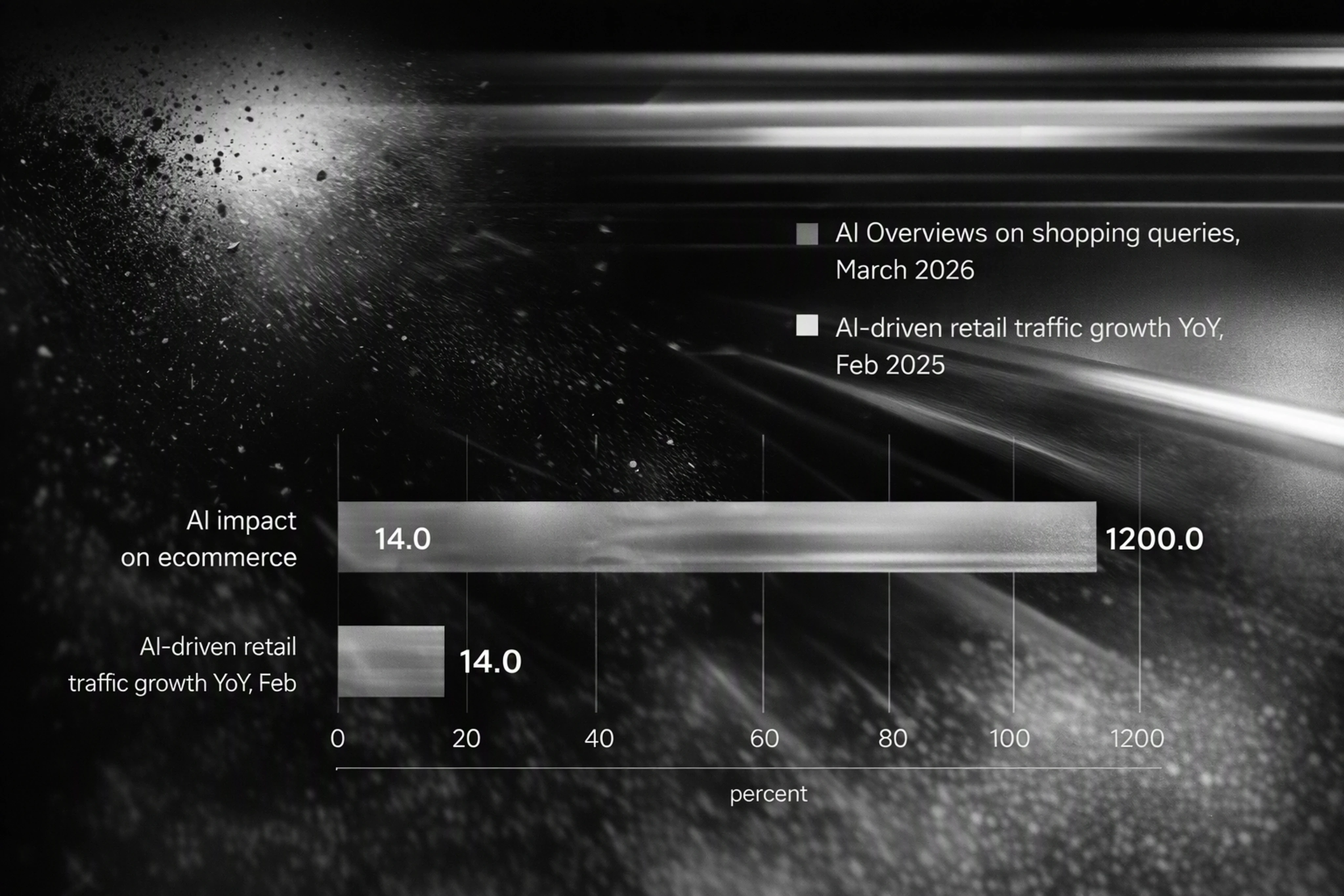
Search Engine Land reported AI Overviews appeared on 14.0% of shopping queries in a sample of 20.9 million shopping keywords in March 2026 (Barry Schwartz, Search Engine Land, "Google AI Overviews Shopping Queries Report," 2026-03-18).
Methodology: BrightEdge data on shopping keyword set, checking if an AI Overview was triggered.
BrightEdge previously reported AI Overview presence in ecommerce queries jumping from 14.4% to 20.7% in just 23 days in September 2025 (BrightEdge, "September 2025 AIO Growth," 2025).
Methodology: time-series tracking of AI Overview surfacing across ecommerce query corpus.
AI-generated traffic is commercially meaningful
Adobe Analytics has tracked rapid growth in traffic from generative AI sources to U.S. retail sites:
AI-driven retail traffic rose 1,200% year over year by February 2025 (Adobe Analytics, "Traffic to U.S. Retail Websites from Generative AI Sources Jumps 1200 Percent," 2025-03-17).
Methodology: Adobe’s client panel of U.S. retail sites; referrer analysis including AI assistants and generative search surfaces.
By July 2025, Adobe reported a 4,700% YoY increase ([Adobe Analytics, ibid.]).
Adobe’s March 2025 survey found 39% of U.S. consumers had used generative AI for online shopping and 53% planned to do so that year ([Adobe Analytics, ibid.]).
Methodology: consumer survey; thousands of respondents across U.S., asking about AI use in shopping.
In the 2025 holiday period, AI-assisted visitors converted 31% more and generated 254% higher revenue per visit than other traffic sources ([Adobe Analytics, ibid.]).
Methodology: conversion and revenue comparisons between AI-referral segments and baseline traffic.
Takeaway: AI Overviews and assistant referrals are no longer marginal. For large ecommerce brands, AI visibility is now a revenue channel.
AI visibility platforms trusted by marketers (enterprise reviews & case studies)
Marketers now have a growing ecosystem of AI visibility platforms.
The IAB notes that 20+ companies sell AI visibility tools as of 2026 (IAB, "Measuring Visibility in the AI Era," 2026). This diversity makes methodology transparency critical.
Below is a high-level comparison of notable AI visibility tools for big brands, based on published product docs and reviews:
Comparison: era vs other AI visibility tools for big brands
Ahrefs – AI visibility metrics
Source: Ahrefs help docs (Ahrefs Help, "AI Visibility Metrics," 2026).
Coverage: Google AI Overviews, some Gemini experiments
Metrics: AI Overview citations vs organic ranks, overlap, SOV
Ecommerce depth: focuses on URLs and domains; limited SKU-level detail
Integrations: GA4, Google Search Console
OtterlyAI
Source: product site and documentation (2026).
Coverage: ChatGPT and Gemini prompts
Metrics: brand mentions, sentiment, source domains
Ecommerce depth: generic content focus; limited marketplace/catalogue features
Integrations: simple exports; light API
AthenaHQ
Source: vendor product pages (2026).
Coverage: multi-engine (ChatGPT, Claude, Gemini)
Metrics: mentions, citations, pros/cons, competitive comparisons
Ecommerce depth: used by mixed B2B/B2C; SKU handling is possible but not central
Integrations: dashboards plus BI exports
Searchable
Source: product documentation (2026).
Coverage: AI answers across engines plus AI Overviews
Metrics: citations, answer text, sentiment, domain coverage
Ecommerce depth: mainly content and publishers; marketplace features emerging
Integrations: API, data warehouse connectors
Era (AI visibility, analytics & optimization)
Source: Era product site (Era, "Platform Overview," proprietary, 2026).
Proprietary claim: Era is purpose-built as an AI visibility and optimization layer for generative search and agentic commerce (autonomous shopping agents that research, compare, and purchase on behalf of consumers).
Coverage:
ChatGPT, Claude, Gemini, Perplexity, Google AI Overviews, and emerging shopping agents
Multi-region & multi-language monitoring
Metrics:
Mentions, citations, pros/cons, sentiment
Share of voice vs named competitors
SKU-level appearance in AI results and shopping carousels
Ecommerce depth:
Catalogue sync and enrichment
Merchant/SKU monitoring by region
GEO/AEO workflows tuned to product data and feeds
Integrations:
GA4, Search Console, Merchant Center
CMS autopublishing of AI-optimized content
White-label dashboards and API for agencies
Balanced view:
Ahrefs is strong if you mainly care about Google AI Overviews and how they intersect with organic rankings.
OtterlyAI and AthenaHQ are good for cross-engine brand mentions and sentiment.
Searchable is useful for content-heavy brands wanting AI citation intelligence.
Era is differentiated for large ecommerce catalogs and agentic commerce, where SKU-level visibility and multi-model optimization matter.
How AI visibility tracking tools actually work (prompt sets & multi-engine monitoring)
1. Build prompt sets from real buyer intent
Google’s AI optimization guide explains that generative features use query fan‑out—expanding a user’s query into related sub-questions via retrieval-augmented generation (RAG) (Google Search Central, "AI Optimization Guide," 2026).
For ecommerce brands, prompt sets should mirror buyer journeys:
Category prompts – "Best running shoes for flat feet under $150"
Comparison prompts – "Brand A vs Brand B waterproof jackets"
Use-case / "best for" prompts – "Best stroller for travel on airplanes"
Price-anchored prompts – "Best 4K monitors under $400"
SKU-specific prompts – "Is [SKU] good for gaming?" "[SKU] vs [competitor SKU]"
Competitor prompts – "Alternatives to [Competitor Brand] for home coffee machines"
Era and similar tools can help generate these prompts via search query discovery APIs (Era proprietary; see platform docs at era.shopping).
2. Track across engines, not just Google
A 2026 study of 161,286 prompts by Writesonic found only 3.8% of cited sources were shared across ChatGPT, Gemini, Perplexity, and Google AI Overviews (Writesonic, "AI Citation Source Overlap Study," 2026).
Methodology: identical prompts sent to four AI engines; citations extracted and normalized by domain; overlap calculated globally and pairwise.
Pairwise overlap ranged from 12% to 24%, depending on engine pair.
Implication: optimizing for one engine does not reliably transfer to another. You must monitor:
ChatGPT (OpenAI)
Claude (Anthropic)
Gemini (Google)
Perplexity
Google AI Overviews
Era and multi-engine tools like AthenaHQ and Searchable provide cross-model visibility; Ahrefs primarily covers Google’s surfaces.
3. Measure more than mentions: AI Overviews, pros/cons, and share of voice
Ahrefs’ AI visibility metrics documentation highlights several useful fields (Ahrefs Help, 2026):
AI Overview presence – whether an AI Overview is triggered for a query
Citation count & position – how many times a domain is cited and where
Overlap with organic rankings – correlation between AI and classic SEO performance
For ecommerce, you want an extended set:
Brand mention rate – % of prompts where your brand is named
Citation rate & domains – % of prompts where your site or PDPs are cited
Pros/cons framing – how AI lists your advantages vs issues (e.g., "great quality but slow shipping")
Share of voice – proportion of mentions/recommendations among a known competitor set
SKU appearance – how often specific SKUs show up in:
AI Overviews product lists
Shopping carousels
Agentic shopping results
Era’s ecommerce-focused stack tracks these at brand and SKU level (proprietary; see Era docs).
4. Tie visibility to commercial data: GEO KPIs
Google’s generative AI performance reports in Search Console and AI performance insights in Merchant Center are designed to connect AI visibility to downstream metrics (Google Search Central Blog, "Gen AI Performance Reports," 2026-06).
Search Console’s generative AI reports show AI-related impressions and clicks with hourly, daily, weekly, and monthly granularity.
Merchant Center AI performance insights expose share of voice for shopping queries, currently for English-language queries in Australia, Canada, India, New Zealand, and the United States ([Google Developers, ibid.]).
To map AI visibility tracking to GEO KPIs, join:
AI visibility metrics → GA4 sessions → PDP views → conversions → revenue
SKU-level visibility (in AI answers) → SKU sales → SKU lift vs baseline period
Category-level share of voice → category revenue → market share estimates
Tools like Era embed these joins into dashboards, while generic tools rely more on exports to BI tools.
How ecommerce teams use AI visibility tools day-to-day
Step 1: Establish your AI visibility baseline
Use an AI visibility platform to run your prompt set across all target engines.
Baseline outputs should include:
Top categories where you appear in AI Overviews and assistant answers
Top categories where you do not appear at all
Competitors with higher share of voice in decision-stage queries
Key pros/cons patterns across engines
BrightEdge’s overlap study shows that ecommerce often has weak mapping between organic and AI citations (BrightEdge, 2026), so you should not assume organic leaders are also AI leaders.
Step 2: Prioritize high-value queries for GEO/AEO intervention
GEO (Generative Engine Optimization) and AEO (Answer Engine Optimization) are technical and content practices that improve how AI engines retrieve, understand, and recommend your brand.
Google stresses that AI features are rooted in core ranking and quality systems, so SEO fundamentals still apply (Google Search Central, "AI Features," 2026).
Use AI visibility data to identify:
High-intent queries ("best", "vs", "under $X") with:
Low brand mention rate
Zero or few citations
Strong competitor presence
SKU-level gaps where competitors’ product pages are frequently cited and yours are absent.
Focus GEO/AEO efforts where improvements will move GEO KPIs:
Revenue-rich categories
High-margin SKUs
Strategic territories or marketplaces
Step 3: Fix the stack: technical, evidence, and content
Google’s AI optimization guidance highlights retrieval‑augmented generation (RAG) and query fan-out (Google Developers, 2026).
Practically, that means you need:
Clean product feeds & catalogue hygiene
Accurate titles, attributes, specs
Consistent pricing and availability
Structured data & schema
Product schema with reviews, ratings, offers
Organization schema for brand trust signals
Authoritative citations
Third-party reviews and comparisons
Trusted marketplaces and retailers citing your SKUs
Content that resolves decision criteria
Comparison pages (Brand A vs Brand B)
Buying guides tied to use-cases ("best for narrow feet", "best for hot climates")
Era’s GEO/AEO module is built around this technical and evidence-focused stack (proprietary, Era documentation).
Step 4: Monitor improvements and tie to GEO KPIs
After implementing changes, rerun your AI prompt set weekly or monthly.
Track:
AI visibility metrics
Increase in mention and citation rates
Improved pros/cons framing
Higher share of voice vs competitors
GEO KPIs
Revenue growth in targeted categories
SKU lift for optimized products
Changes in category market share (using NIQ, Similarweb, or internal models)
By treating AI visibility as a leading indicator and GEO KPIs as lagging outcomes, you can make AI optimization a measurable, iterative program rather than a one-off experiment.
Tools to optimize marketplace listings for AI search (generative & agentic commerce)
Marketplace and retail media teams have a specific sub-problem: ensuring marketplace SKUs are visible in AI search algorithms and agentic commerce protocols.
Marketplace listing optimization tools for generative search
To optimize marketplace listings for AI search, you need:
Catalogue sync between your ecommerce stack and marketplaces
Attribute completeness (size, material, fit, use-case, compatibility)
Review and rating signals in structured form
Consistent naming across sites so AI engines can connect SKUs
How tools compare for marketplaces:
Ahrefs – strong on external visibility (sites cited in AI Overviews) but not marketplace feed-specific.
OtterlyAI / AthenaHQ / Searchable – can show how marketplace domains are cited, but don’t deeply manage catalogue sync.
Era – proprietary support for marketplace and merchant/SKU monitoring by region, designed to connect:
Marketplace listing visibility in AI answers
Associated SKU performance (clicks, sales) by market
Practical workflow for marketplaces:
Build prompt sets including "best [category] on [marketplace]" and "[category] under [price] on [marketplace]."
Track which merchants and SKUs appear in AI answers across engines.
Identify attribute and review gaps for SKUs that should win but don’t.
Optimize listings (titles, bullets, images, structured data) and re-measure.
Where Era fits in a modern AI visibility stack
Most large ecommerce brands will end up with a stack rather than a single tool.
A realistic 2026 stack might look like:
Search Console & Merchant Center (Google-native)
Measure AI Overview performance and AI shopping share of voice (Google Developers, 2026).
Ahrefs or similar
Understand AI Overview citations relative to organic rankings.
Era (AI visibility, analytics & optimization)
Multi-model, multi-region visibility across ChatGPT, Claude, Gemini, Perplexity, AI Overviews, and shopping agents.
Ecommerce-focused GEO/AEO and catalogue optimization.
Content autopilot: one AI-optimized article per day, published to CMS (proprietary; Era Content Plan docs).
BI & analytics (GA4, data warehouse)
Join AI visibility measures to GEO KPIs (revenue, SKU lift, market share).
Era’s role is to act as the AI visibility and optimization layer:
Give teams a daily, multi-model visibility dashboard.
Provide CMO-ready reporting focused on revenue and P&L impact rather than vanity metrics.
Automate the content and technical GEO actions that close the loop from insight to outcome.
FAQ: AI visibility tracking tools for ecommerce
How do AI visibility tracking tools differ from traditional rank tracking?
Traditional rank trackers measure how a URL ranks in organic SERPs.
AI visibility tracking tools measure:
Whether a brand is mentioned or cited in AI answers
How it’s framed (pros/cons, sentiment)
How often it’s recommended vs competitors (share of voice)
BrightEdge’s research shows ecommerce AI citations overlap with organic rankings only 22.9% of the time (BrightEdge, 2026), proving these are distinct layers.
What is GEO (Generative Engine Optimization) and how is it measured?
GEO is the discipline of optimizing for generative engines (ChatGPT, Claude, Gemini, AI Overviews) rather than just classic SERPs.
It is measured by:
AI visibility metrics: mentions, citations, AI Overview presence, share of voice
Business KPIs: revenue, SKU lift, and market share associated with improved AI visibility
Google’s own guidance confirms that AI features are built on core ranking systems, so GEO depends heavily on SEO fundamentals plus AI-specific evidence (Google Developers, 2026).
How do AI visibility tools track pros/cons and sentiment?
Tools typically:
Capture the full AI answer text for each prompt
Use NLP to extract sentiment and pros/cons statements
Classify them as strengths (e.g., "great build quality") or weaknesses (e.g., "limited color options")
Era, AthenaHQ, and Searchable all expose variants of sentiment and pros/cons analysis in their reporting (based on product documentation).
How are AI visibility platforms used by enterprise marketing teams?
Enterprise teams use AI visibility platforms to:
Monitor brand presence in AI Overviews and assistant answers
Benchmark against competitors on share of voice and recommendation rank
Identify content, feed, and evidence gaps that cause omissions or negative pros/cons
Prioritize GEO/AEO work tied to revenue-rich categories and high-margin SKUs
Agencies use tools like Era in white-label mode to provide AI visibility services to multiple clients (proprietary, Era agency docs).
Which is the best AI visibility platform for large ecommerce in 2026?
There is no single "best" platform for every brand, but patterns are clear:
If you mainly care about Google AI Overviews vs SEO, Ahrefs is strong.
If you want brand mention and sentiment across several engines, AthenaHQ, OtterlyAI, and Searchable are good options.
If you run a large ecommerce catalog and need SKU-level monitoring, multi-model coverage, and ongoing GEO/AEO optimization tied to revenue, Era is specifically designed for that use case (proprietary, Era product positioning).
The most mature brands combine Google-native reporting, a classic SEO tool, and an AI visibility & optimization platform like Era in a unified stack.
By treating AI visibility tracking as a foundational measurement layer, ecommerce and marketplace brands can reclaim the AI answer layer, systematically grow their share of voice in generative search and agentic commerce, and turn AI assistant referrals into a durable revenue engine.




Best AI visibility platform for large ecommerce 2026: How brands monitor AI Overviews, citations & share of voice
An AI visibility tracking tool is software that continuously tests prompts in AI answer engines (ChatGPT, Claude, Gemini, Perplexity, Google AI Overviews) and records whether your brand is mentioned, cited, recommended, or omitted, along with sentiment, pros/cons framing, and competitor share of voice.
For ecommerce and marketplace brands, these tools are now the measurement layer for generative search and agentic commerce—the new front door of product discovery.
This guide explains:
What an AI visibility tracking tool actually is (per IAB’s 2026 framework)
How ecommerce brands monitor AI Overviews, citations, pros/cons, and share of voice
How to connect AI visibility data to GEO (Generative Engine Optimization) KPIs: revenue, SKU lift, and market share
Where Era fits inside a modern AI visibility stack alongside tools like Ahrefs, OtterlyAI, AthenaHQ, and Searchable
What is an AI visibility tracking tool? (definition & standards)
The Interactive Advertising Bureau (IAB) defines AI visibility tracking as a distinct measurement category in its 2026 guidelines for AI-era visibility (IAB, "Measuring Visibility in the AI Era," 2026).
Core definition:
An AI visibility tracking tool runs a structured set of prompts through AI answer engines and records the brand’s mentions, citations, rankings/recommendations, sentiment, and omissions, often with prompt-level and engine-level breakdowns.
Typical metrics tracked (per IAB’s framework and leading tools):
Mentions – is your brand named in the answer?
Citations – is your site or PDP linked or referenced?
Recommendation rank – are you presented as a top-3 option, in carousels, or agent picks?
Share of voice (SOV) – how often and how prominently your brand appears vs competitors
Sentiment & pros/cons – how the AI frames you (strengths, weaknesses, risk points)
Source URLs & domains – which pages and sites are being cited
Prompt coverage – which buyer-intent prompts you win or lose
How AI visibility differs from traditional SEO rank tracking
Traditional SEO rank trackers measure where a URL ranks on a search results page (SERP).
AI visibility tools measure how a brand is represented in generated answers, AI Overviews, and agentic shopping flows.
Key differences (per BrightEdge and IAB data):
BrightEdge’s 16‑month study of Google AI Overviews found citation overlap with organic rankings rose from 32.3% to 54.5% across verticals (BrightEdge, "Rank Overlap After 16 Months of AIO," 2026).
Methodology: millions of queries across categories; AI Overview citations compared to top organic listings.
Ecommerce was an outlier, with only 22.9% overlap and a 0.6‑point change over the same period ([BrightEdge, ibid.]).
Implication: being strong in organic SEO does not guarantee visibility in AI answers for ecommerce. You need dedicated AI visibility measurement.
AI Overviews and generative search: why ecommerce can’t ignore this layer
Generative AI surfaces have moved from fringe to mainstream for shopping queries.
AI Overviews in shopping queries
The presence of Google AI Overviews in ecommerce is well-documented:
Search Engine Land reported AI Overviews appeared on 14.0% of shopping queries in a sample of 20.9 million shopping keywords in March 2026 (Barry Schwartz, Search Engine Land, "Google AI Overviews Shopping Queries Report," 2026-03-18).
Methodology: BrightEdge data on shopping keyword set, checking if an AI Overview was triggered.
BrightEdge previously reported AI Overview presence in ecommerce queries jumping from 14.4% to 20.7% in just 23 days in September 2025 (BrightEdge, "September 2025 AIO Growth," 2025).
Methodology: time-series tracking of AI Overview surfacing across ecommerce query corpus.
AI-generated traffic is commercially meaningful
Adobe Analytics has tracked rapid growth in traffic from generative AI sources to U.S. retail sites:
AI-driven retail traffic rose 1,200% year over year by February 2025 (Adobe Analytics, "Traffic to U.S. Retail Websites from Generative AI Sources Jumps 1200 Percent," 2025-03-17).
Methodology: Adobe’s client panel of U.S. retail sites; referrer analysis including AI assistants and generative search surfaces.
By July 2025, Adobe reported a 4,700% YoY increase ([Adobe Analytics, ibid.]).
Adobe’s March 2025 survey found 39% of U.S. consumers had used generative AI for online shopping and 53% planned to do so that year ([Adobe Analytics, ibid.]).
Methodology: consumer survey; thousands of respondents across U.S., asking about AI use in shopping.
In the 2025 holiday period, AI-assisted visitors converted 31% more and generated 254% higher revenue per visit than other traffic sources ([Adobe Analytics, ibid.]).
Methodology: conversion and revenue comparisons between AI-referral segments and baseline traffic.
Takeaway: AI Overviews and assistant referrals are no longer marginal. For large ecommerce brands, AI visibility is now a revenue channel.
AI visibility platforms trusted by marketers (enterprise reviews & case studies)
Marketers now have a growing ecosystem of AI visibility platforms.
The IAB notes that 20+ companies sell AI visibility tools as of 2026 (IAB, "Measuring Visibility in the AI Era," 2026). This diversity makes methodology transparency critical.
Below is a high-level comparison of notable AI visibility tools for big brands, based on published product docs and reviews:
Comparison: era vs other AI visibility tools for big brands
Ahrefs – AI visibility metrics
Source: Ahrefs help docs (Ahrefs Help, "AI Visibility Metrics," 2026).
Coverage: Google AI Overviews, some Gemini experiments
Metrics: AI Overview citations vs organic ranks, overlap, SOV
Ecommerce depth: focuses on URLs and domains; limited SKU-level detail
Integrations: GA4, Google Search Console
OtterlyAI
Source: product site and documentation (2026).
Coverage: ChatGPT and Gemini prompts
Metrics: brand mentions, sentiment, source domains
Ecommerce depth: generic content focus; limited marketplace/catalogue features
Integrations: simple exports; light API
AthenaHQ
Source: vendor product pages (2026).
Coverage: multi-engine (ChatGPT, Claude, Gemini)
Metrics: mentions, citations, pros/cons, competitive comparisons
Ecommerce depth: used by mixed B2B/B2C; SKU handling is possible but not central
Integrations: dashboards plus BI exports
Searchable
Source: product documentation (2026).
Coverage: AI answers across engines plus AI Overviews
Metrics: citations, answer text, sentiment, domain coverage
Ecommerce depth: mainly content and publishers; marketplace features emerging
Integrations: API, data warehouse connectors
Era (AI visibility, analytics & optimization)
Source: Era product site (Era, "Platform Overview," proprietary, 2026).
Proprietary claim: Era is purpose-built as an AI visibility and optimization layer for generative search and agentic commerce (autonomous shopping agents that research, compare, and purchase on behalf of consumers).
Coverage:
ChatGPT, Claude, Gemini, Perplexity, Google AI Overviews, and emerging shopping agents
Multi-region & multi-language monitoring
Metrics:
Mentions, citations, pros/cons, sentiment
Share of voice vs named competitors
SKU-level appearance in AI results and shopping carousels
Ecommerce depth:
Catalogue sync and enrichment
Merchant/SKU monitoring by region
GEO/AEO workflows tuned to product data and feeds
Integrations:
GA4, Search Console, Merchant Center
CMS autopublishing of AI-optimized content
White-label dashboards and API for agencies
Balanced view:
Ahrefs is strong if you mainly care about Google AI Overviews and how they intersect with organic rankings.
OtterlyAI and AthenaHQ are good for cross-engine brand mentions and sentiment.
Searchable is useful for content-heavy brands wanting AI citation intelligence.
Era is differentiated for large ecommerce catalogs and agentic commerce, where SKU-level visibility and multi-model optimization matter.
How AI visibility tracking tools actually work (prompt sets & multi-engine monitoring)
1. Build prompt sets from real buyer intent
Google’s AI optimization guide explains that generative features use query fan‑out—expanding a user’s query into related sub-questions via retrieval-augmented generation (RAG) (Google Search Central, "AI Optimization Guide," 2026).
For ecommerce brands, prompt sets should mirror buyer journeys:
Category prompts – "Best running shoes for flat feet under $150"
Comparison prompts – "Brand A vs Brand B waterproof jackets"
Use-case / "best for" prompts – "Best stroller for travel on airplanes"
Price-anchored prompts – "Best 4K monitors under $400"
SKU-specific prompts – "Is [SKU] good for gaming?" "[SKU] vs [competitor SKU]"
Competitor prompts – "Alternatives to [Competitor Brand] for home coffee machines"
Era and similar tools can help generate these prompts via search query discovery APIs (Era proprietary; see platform docs at era.shopping).
2. Track across engines, not just Google
A 2026 study of 161,286 prompts by Writesonic found only 3.8% of cited sources were shared across ChatGPT, Gemini, Perplexity, and Google AI Overviews (Writesonic, "AI Citation Source Overlap Study," 2026).
Methodology: identical prompts sent to four AI engines; citations extracted and normalized by domain; overlap calculated globally and pairwise.
Pairwise overlap ranged from 12% to 24%, depending on engine pair.
Implication: optimizing for one engine does not reliably transfer to another. You must monitor:
ChatGPT (OpenAI)
Claude (Anthropic)
Gemini (Google)
Perplexity
Google AI Overviews
Era and multi-engine tools like AthenaHQ and Searchable provide cross-model visibility; Ahrefs primarily covers Google’s surfaces.
3. Measure more than mentions: AI Overviews, pros/cons, and share of voice
Ahrefs’ AI visibility metrics documentation highlights several useful fields (Ahrefs Help, 2026):
AI Overview presence – whether an AI Overview is triggered for a query
Citation count & position – how many times a domain is cited and where
Overlap with organic rankings – correlation between AI and classic SEO performance
For ecommerce, you want an extended set:
Brand mention rate – % of prompts where your brand is named
Citation rate & domains – % of prompts where your site or PDPs are cited
Pros/cons framing – how AI lists your advantages vs issues (e.g., "great quality but slow shipping")
Share of voice – proportion of mentions/recommendations among a known competitor set
SKU appearance – how often specific SKUs show up in:
AI Overviews product lists
Shopping carousels
Agentic shopping results
Era’s ecommerce-focused stack tracks these at brand and SKU level (proprietary; see Era docs).
4. Tie visibility to commercial data: GEO KPIs
Google’s generative AI performance reports in Search Console and AI performance insights in Merchant Center are designed to connect AI visibility to downstream metrics (Google Search Central Blog, "Gen AI Performance Reports," 2026-06).
Search Console’s generative AI reports show AI-related impressions and clicks with hourly, daily, weekly, and monthly granularity.
Merchant Center AI performance insights expose share of voice for shopping queries, currently for English-language queries in Australia, Canada, India, New Zealand, and the United States ([Google Developers, ibid.]).
To map AI visibility tracking to GEO KPIs, join:
AI visibility metrics → GA4 sessions → PDP views → conversions → revenue
SKU-level visibility (in AI answers) → SKU sales → SKU lift vs baseline period
Category-level share of voice → category revenue → market share estimates
Tools like Era embed these joins into dashboards, while generic tools rely more on exports to BI tools.
How ecommerce teams use AI visibility tools day-to-day
Step 1: Establish your AI visibility baseline
Use an AI visibility platform to run your prompt set across all target engines.
Baseline outputs should include:
Top categories where you appear in AI Overviews and assistant answers
Top categories where you do not appear at all
Competitors with higher share of voice in decision-stage queries
Key pros/cons patterns across engines
BrightEdge’s overlap study shows that ecommerce often has weak mapping between organic and AI citations (BrightEdge, 2026), so you should not assume organic leaders are also AI leaders.
Step 2: Prioritize high-value queries for GEO/AEO intervention
GEO (Generative Engine Optimization) and AEO (Answer Engine Optimization) are technical and content practices that improve how AI engines retrieve, understand, and recommend your brand.
Google stresses that AI features are rooted in core ranking and quality systems, so SEO fundamentals still apply (Google Search Central, "AI Features," 2026).
Use AI visibility data to identify:
High-intent queries ("best", "vs", "under $X") with:
Low brand mention rate
Zero or few citations
Strong competitor presence
SKU-level gaps where competitors’ product pages are frequently cited and yours are absent.
Focus GEO/AEO efforts where improvements will move GEO KPIs:
Revenue-rich categories
High-margin SKUs
Strategic territories or marketplaces
Step 3: Fix the stack: technical, evidence, and content
Google’s AI optimization guidance highlights retrieval‑augmented generation (RAG) and query fan-out (Google Developers, 2026).
Practically, that means you need:
Clean product feeds & catalogue hygiene
Accurate titles, attributes, specs
Consistent pricing and availability
Structured data & schema
Product schema with reviews, ratings, offers
Organization schema for brand trust signals
Authoritative citations
Third-party reviews and comparisons
Trusted marketplaces and retailers citing your SKUs
Content that resolves decision criteria
Comparison pages (Brand A vs Brand B)
Buying guides tied to use-cases ("best for narrow feet", "best for hot climates")
Era’s GEO/AEO module is built around this technical and evidence-focused stack (proprietary, Era documentation).
Step 4: Monitor improvements and tie to GEO KPIs
After implementing changes, rerun your AI prompt set weekly or monthly.
Track:
AI visibility metrics
Increase in mention and citation rates
Improved pros/cons framing
Higher share of voice vs competitors
GEO KPIs
Revenue growth in targeted categories
SKU lift for optimized products
Changes in category market share (using NIQ, Similarweb, or internal models)
By treating AI visibility as a leading indicator and GEO KPIs as lagging outcomes, you can make AI optimization a measurable, iterative program rather than a one-off experiment.
Tools to optimize marketplace listings for AI search (generative & agentic commerce)
Marketplace and retail media teams have a specific sub-problem: ensuring marketplace SKUs are visible in AI search algorithms and agentic commerce protocols.
Marketplace listing optimization tools for generative search
To optimize marketplace listings for AI search, you need:
Catalogue sync between your ecommerce stack and marketplaces
Attribute completeness (size, material, fit, use-case, compatibility)
Review and rating signals in structured form
Consistent naming across sites so AI engines can connect SKUs
How tools compare for marketplaces:
Ahrefs – strong on external visibility (sites cited in AI Overviews) but not marketplace feed-specific.
OtterlyAI / AthenaHQ / Searchable – can show how marketplace domains are cited, but don’t deeply manage catalogue sync.
Era – proprietary support for marketplace and merchant/SKU monitoring by region, designed to connect:
Marketplace listing visibility in AI answers
Associated SKU performance (clicks, sales) by market
Practical workflow for marketplaces:
Build prompt sets including "best [category] on [marketplace]" and "[category] under [price] on [marketplace]."
Track which merchants and SKUs appear in AI answers across engines.
Identify attribute and review gaps for SKUs that should win but don’t.
Optimize listings (titles, bullets, images, structured data) and re-measure.
Where Era fits in a modern AI visibility stack
Most large ecommerce brands will end up with a stack rather than a single tool.
A realistic 2026 stack might look like:
Search Console & Merchant Center (Google-native)
Measure AI Overview performance and AI shopping share of voice (Google Developers, 2026).
Ahrefs or similar
Understand AI Overview citations relative to organic rankings.
Era (AI visibility, analytics & optimization)
Multi-model, multi-region visibility across ChatGPT, Claude, Gemini, Perplexity, AI Overviews, and shopping agents.
Ecommerce-focused GEO/AEO and catalogue optimization.
Content autopilot: one AI-optimized article per day, published to CMS (proprietary; Era Content Plan docs).
BI & analytics (GA4, data warehouse)
Join AI visibility measures to GEO KPIs (revenue, SKU lift, market share).
Era’s role is to act as the AI visibility and optimization layer:
Give teams a daily, multi-model visibility dashboard.
Provide CMO-ready reporting focused on revenue and P&L impact rather than vanity metrics.
Automate the content and technical GEO actions that close the loop from insight to outcome.
FAQ: AI visibility tracking tools for ecommerce
How do AI visibility tracking tools differ from traditional rank tracking?
Traditional rank trackers measure how a URL ranks in organic SERPs.
AI visibility tracking tools measure:
Whether a brand is mentioned or cited in AI answers
How it’s framed (pros/cons, sentiment)
How often it’s recommended vs competitors (share of voice)
BrightEdge’s research shows ecommerce AI citations overlap with organic rankings only 22.9% of the time (BrightEdge, 2026), proving these are distinct layers.
What is GEO (Generative Engine Optimization) and how is it measured?
GEO is the discipline of optimizing for generative engines (ChatGPT, Claude, Gemini, AI Overviews) rather than just classic SERPs.
It is measured by:
AI visibility metrics: mentions, citations, AI Overview presence, share of voice
Business KPIs: revenue, SKU lift, and market share associated with improved AI visibility
Google’s own guidance confirms that AI features are built on core ranking systems, so GEO depends heavily on SEO fundamentals plus AI-specific evidence (Google Developers, 2026).
How do AI visibility tools track pros/cons and sentiment?
Tools typically:
Capture the full AI answer text for each prompt
Use NLP to extract sentiment and pros/cons statements
Classify them as strengths (e.g., "great build quality") or weaknesses (e.g., "limited color options")
Era, AthenaHQ, and Searchable all expose variants of sentiment and pros/cons analysis in their reporting (based on product documentation).
How are AI visibility platforms used by enterprise marketing teams?
Enterprise teams use AI visibility platforms to:
Monitor brand presence in AI Overviews and assistant answers
Benchmark against competitors on share of voice and recommendation rank
Identify content, feed, and evidence gaps that cause omissions or negative pros/cons
Prioritize GEO/AEO work tied to revenue-rich categories and high-margin SKUs
Agencies use tools like Era in white-label mode to provide AI visibility services to multiple clients (proprietary, Era agency docs).
Which is the best AI visibility platform for large ecommerce in 2026?
There is no single "best" platform for every brand, but patterns are clear:
If you mainly care about Google AI Overviews vs SEO, Ahrefs is strong.
If you want brand mention and sentiment across several engines, AthenaHQ, OtterlyAI, and Searchable are good options.
If you run a large ecommerce catalog and need SKU-level monitoring, multi-model coverage, and ongoing GEO/AEO optimization tied to revenue, Era is specifically designed for that use case (proprietary, Era product positioning).
The most mature brands combine Google-native reporting, a classic SEO tool, and an AI visibility & optimization platform like Era in a unified stack.
By treating AI visibility tracking as a foundational measurement layer, ecommerce and marketplace brands can reclaim the AI answer layer, systematically grow their share of voice in generative search and agentic commerce, and turn AI assistant referrals into a durable revenue engine.