September 27, 2026
September 27, 2026
Best AI SEO Analytics Tools 2026 — AI Visibility Platforms & GEO/AEO Capabilities
Meta description: Discover the best AI SEO analytics tools 2026. Compare AI visibility platforms, GEO/AEO capabilities, and learn how to integrate AI reporting…
Meta description: Discover the best AI SEO analytics tools 2026. Compare AI visibility platforms, GEO/AEO capabilities, and learn how to integrate AI reporting…
Meta description: Discover the best AI SEO analytics tools 2026. Compare AI visibility platforms, GEO/AEO capabilities, and learn how to integrate AI reporting into your SEO stack.
Best AI SEO Analytics Tools 2026 — AI Visibility Platforms & GEO/AEO Capabilities
AI SEO analytics tools in 2026 do two jobs at once:
Classic SEO reporting (rankings, traffic, technical health)
AI visibility tracking (how ChatGPT, Claude, Gemini, Perplexity, and shopping agents surface your brand)
This guide explains how to evaluate the best AI visibility platforms with SEO features, what metrics to track, and how to integrate GEO (Generative Engine Optimization) into your existing search analytics stack.
Era’s perspective: AI answer engines and agentic shopping are becoming the real front door for discovery. You need tools that treat AI visibility as a first-class analytics layer—not a bolt‑on keyword report.
Why AI SEO analytics tools matter in 2026
AI search is no longer experimental for consumers.
Vendor Bain & Company reports that about 80% of search users rely on AI-written summaries for at least 40% of their searches, and ~60% of searches on traditional engines now end without a click (press release, July 9, 2025: https://www.bain.com/about/media-center/press-releases/20252/).
Vendor Adobe reports that traffic to U.S. retail sites from generative AI sources increased 693.4% during the 2025 holiday season versus 2024; AI retail traffic jumped 769% in November and 673% in December 2025 (press release, Jan 8, 2026: https://news.adobe.com/news/2026/01/adobe-holiday-shopping-season).
Vendor Yext’s 2026 consumer survey found 42.7% of global respondents used AI for local search in the past month; 71% of those were using it more than a year ago, and 28% tried a new local business because of an AI recommendation (report, March 2026: https://www.yext.com/resources/consumer-search-behaviors-full-report).
Implications for ecommerce and performance leaders:
A growing share of discovery and consideration happens inside AI answers with no click.
Traditional SEO dashboards that only report organic sessions and blue‑link rankings miss this AI layer entirely.
You need AI visibility analytics—mentions, citations, AI share of voice—alongside your SEO metrics.
What is an AI visibility platform (and how is it different from SEO tools)?
An AI visibility platform tracks how large language models (LLMs) and AI assistants surface your brand in answers, carousels, and shopping flows.
Where classic SEO tools report on:
Keyword rankings on SERPs
Organic click-through and sessions
Technical issues (crawlability, schema, core web vitals)
AI visibility platforms focus on:
Mentions: when your brand or products are named in an AI answer
Citations/quotes: when the model references or quotes your pages or domains
Impressions: how often your brand appears in a set of AI responses
AI share of voice (AI SOV): your share of total impressions or mentions for a topic versus competitors
Vendor Semrush argues that AI visibility should be tracked separately from organic traffic because AI answers can fully satisfy intent without a click (Semrush AI visibility guide, updated Feb 2026: https://www.semrush.com/blog/measure-ai-visibility/).
Era extends this further: for ecommerce and agentic commerce, you also need SKU-level visibility and monitoring of shopping agents that autonomously choose products.
Top features in the best AI SEO analytics tools (2026)
When evaluating modern SEO analytics platforms with AI reporting, prioritize tools that combine SEO + AI visibility + actionability.
1. Multi-model AI visibility tracking
Look for platforms that monitor multiple AI engines, not just one.
Examples of market coverage (vendor‑reported):
Vendor Semrush’s 2026 AI Visibility Index analyzed 126 million real U.S. AI search prompts across 22 industries and four AI platforms (methodology, March 2026: https://ai-visibility-index.semrush.com/). Semrush states prompts were sampled from real user data partnerships over a 12‑month window; see its methodology page for sampling and update cadence.
Vendor Ahrefs Brand Radar says it tracks 451M+ search-backed prompts for AI responses, citations, and SOV (help article, updated May 2026: https://help.ahrefs.com/en/articles/15501968-ai-visibility-metrics). Ahrefs notes that prompts are generated from search query logs and refreshed monthly.
Vendor Yext Scout reports it processes ~10B signals monthly across five AI models and 12M+ business locations, combining search, listing, and review data (product page, April 2026: https://www.yext.com/products/scout/).
Because these are vendor claims, always review:
Which models are covered (e.g., ChatGPT, Claude, Gemini, Perplexity, local AIs)
How often prompts are re‑queried (daily vs weekly vs monthly)
Geographies and languages supported
Era’s approach: multi-model, multi-region tracking with custom locations and language settings so brands can see how answers differ by market.
2. Integrated SEO fundamentals
Despite AI growth, SEO basics still drive what AI models ingest.
Vendor BrightEdge reports that AI search platforms account for less than 1% of referral traffic while Google still holds over 90% of search visits as of early 2025, and stresses that schema, crawlability, and technical SEO create compound returns across both SERPs and AI surfaces (research report, Jan 2025: https://www.brightedge.com/resources/research-reports/ai-search-visits-in-surging-2025).
Your AI SEO analytics stack should therefore include:
Comprehensive keyword and topic coverage
Rank tracking (including AI Overviews, where relevant)
Site audits for crawl, index, internal links, and schema
Log-file or bot access analysis (including AI bot behavior if available)
3. AI-specific KPIs and data schema
The most useful tools expose AI metrics in a machine-friendly format that you can join to your BI stack.
Vendor Ahrefs, for example, defines AI visibility metrics such as Mentions, Citations, Impressions, and AI Share of Voice, and exposes them via API (help article, updated May 2026: https://help.ahrefs.com/en/articles/15501968-ai-visibility-metrics).
Below is a generic, vendor‑neutral schema you can use when evaluating platforms.
Core AI visibility fields (example schema)
prompt_id(string): Internal ID for a canonicalized user intentprompt_text(string): The normalized prompt used (e.g., "best running shoes for flat feet")model_name(string): e.g.,gpt-4.1,claude-3.5,gemini-2,perplexity-onlinemodel_version(string): Provider-specific version or date tagregion(string): ISO country/region code, e.g.,US,DElanguage(string): ISO language code, e.g.,en,frbrand_name(string): Brand or merchant normalized namedomain(string): First-party domain cited, if anysku_id(string, nullable): SKU or product ID when applicableis_mentioned(boolean): True if brand name appears in the answermention_count(integer): Number of occurrences of the brand in the answeris_cited(boolean): True if any of your URLs/domains are cited/linked/quotedcitation_urls(array<string>): List of cited URLs for your brandposition_in_answer(integer): 1‑based rank order if multiple brands are listedanswer_type(string): e.g.,list,narrative,carousel,shopping_agentanswer_timestamp(datetime, ISO 8601): Time of the AI responseimpression(integer): 1 per answer per prompt/model/region combinationai_sov(float): Share of impressions or mentions for topic vs competitor set (0‑1)
Sample AI visibility JSON (simplified)
{
  "prompt_id": "p-001234",
  "prompt_text": "best trail running shoes for wide feet",
  "model_name": "gpt-4.1",
  "model_version": "2026-09-01",
  "region": "US",
  "language": "en",
  "brand_name": "Brand X",
  "domain": "brandx.com",
  "sku_id": null,
  "is_mentioned": true,
  "mention_count": 2,
  "is_cited": true,
  "citation_urls": ["https://www.brandx.com/trail-shoes/model-a"],
  "position_in_answer": 1,
  "answer_type": "list",
  "answer_timestamp": "2026-09-24T10:15:00Z",
  "impression": 1,
  "ai_sov": 0.37
}
{
  "prompt_id": "p-001234",
  "prompt_text": "best trail running shoes for wide feet",
  "model_name": "gpt-4.1",
  "model_version": "2026-09-01",
  "region": "US",
  "language": "en",
  "brand_name": "Brand X",
  "domain": "brandx.com",
  "sku_id": null,
  "is_mentioned": true,
  "mention_count": 2,
  "is_cited": true,
  "citation_urls": ["https://www.brandx.com/trail-shoes/model-a"],
  "position_in_answer": 1,
  "answer_type": "list",
  "answer_timestamp": "2026-09-24T10:15:00Z",
  "impression": 1,
  "ai_sov": 0.37
}
When comparing AI visibility platforms, ask vendors how closely their API resembles this kind of structure and whether you can export raw row‑level data.
4. GEO/AEO and content optimization workflows
Modern AI SEO analytics tools shouldn’t just show you gaps—they should help fix them.
Look for:
GEO/AEO recommendations: Structured content, schema, and evidence improvements aimed at AI answer engines.
Query discovery: Tools that infer AI‑native prompts from search data and AI logs.
Content automation: Ability to generate AI-optimized content and push it to your CMS or product detail pages (PDPs).
Vendor platforms such as Semrush, BrightEdge, Yext, and Adobe all highlight workflows that turn AI visibility insights into prioritized content or technical actions (see Adobe–Semrush acquisition announcement, April 28, 2026: https://news.adobe.com/news/2026/04/adobe-completes-semrush-acquisition; BrightEdge Copilot/Autopilot overview, 2025–2026: https://help.brightedge.com/blog/what-share-of-voice-really-means-for-search-in-2026).
Era’s platform pairs GEO diagnostics with an autopilot content engine that can publish AI-optimized articles daily, closing the loop from analytics to execution.
5. Ecommerce and marketplace depth
If you run large catalogs or marketplace storefronts, generic AI SEO tools are not enough.
You need:
Catalogue sync and SKU-level tracking across models
Merchant‑level monitoring by region and marketplace
Tools to optimize marketplace listings for AI search (titles, attributes, structured specs)
Region-specific configurations for price, availability, and shipping
Era’s E‑commerce Plan, for example, is explicitly designed for agentic commerce: SKU monitoring, shopping-agent eligibility, and localized catalogue enrichment (see https://era.shopping/?utm_source=openai).
How to evaluate AI SEO analytics tools: a practical checklist
Use this framework to compare the best AI search optimization tools with strong support in 2026.
Coverage & methodology
Questions to ask every vendor:
Which AI models and locales do you track?
ChatGPT, Claude, Gemini, Perplexity, Copilot, local players?
Countries and languages?
How do you construct prompts?
Are prompts based on real search data, synthetic variations, or both?
How often are prompts refreshed?
What is your re-query cadence?
Daily, weekly, monthly?
Do you monitor volatility for features like Google AI Overviews?
Vendor Semrush, for instance, studied AI Overviews across 10M+ keywords and reported that U.S. AI Overviews appeared for 6.49% of keywords in January 2025, peaked near 25% in July, then declined to 15.69% by November 2025 (Semrush study, Nov 13, 2025: https://www.semrush.com/blog/semrush-ai-overviews-study/). Semrush details that results were checked several times per day and grouped by query type.
How do you deduplicate and normalize data?
Do they canonicalize similar prompts?
How are brands and domains normalized across typo variants?
How transparent is the methodology?
Public methodology pages (like Semrush’s index and Yext’s survey methodology) are a positive signal.
Metrics & reporting
You want AI SEO analytics tools that provide:
AI visibility metrics (mentions, citations, AI SOV, answer position)
Classic SEO metrics (rankings, traffic, crawl, schema)
Cohesive dashboards that separate AI vs organic but allow comparison
API access to raw data for your warehouse/BI
Vendor Ahrefs’ AI visibility metrics page (updated May 2026) is a good reference for how these definitions should be documented: https://help.ahrefs.com/en/articles/15501968-ai-visibility-metrics.
Actionability & support
For mid-market and enterprise teams, great support matters as much as features.
Look for:
Expert advisory to interpret AI visibility trends
GEO roadmaps and playbooks tailored to your category
Change logs and alerts when AI models update behavior
CMO-ready reporting that ties AI visibility to revenue, not just vanity metrics
Era positions itself as a “tech partner” rather than a generic dashboard, with ongoing optimization programs aimed at P&L impact, not just rankings (https://era.shopping/?utm_source=openai).
Methodology: how to measure AI visibility yourself
Even if you rely on vendors, it helps to understand how AI visibility measurement should work under the hood.
1. Prompt construction
Start from real user intent: search query logs, autocomplete data, PDP search terms.
Normalize to canonical prompts:
Remove brand names for category-level measurement.
Keep brand names for branded and competitive queries.
Cluster prompts by intent (e.g., "best running shoes for flat feet" / "trail shoes flat feet") and assign a
prompt_id.
2. Model versioning
Always record
model_nameandmodel_versionor date.When models update (e.g., GPT-4.x → GPT‑4.1), treat this as a regime change and annotate your time series.
3. Location and language seeding
Use provider parameters (where available) to set region and language.
For tools without explicit geo controls, vary prompt phrasing with local hints (e.g., "in Germany", "in Toronto") and note limitations.
4. Re-query cadence
High-volatility surfaces (like AI Overviews): daily or multiple times per day.
General AI recommendations: at least weekly to catch shifts.
Critical seasonal categories (e.g., Black Friday, holidays): increase frequency.
5. Parsing & deduplication
Parse answers to extract:
Brand names and products
Cited domains and URLs
Pros/cons, price ranges, availability mentions
Normalize brands and domains into canonical IDs.
Deduplicate impressions by
prompt_id+model_name+region+datewindow.
6. AI SOV calculation (simple model)
For a given topic cluster and period:
brand_impressions= sum ofimpressionrows wherebrand_name = Xtotal_impressions= sum ofimpressionrows for all brands in the topicai_sov=brand_impressions / total_impressions
This matches how vendors like Ahrefs and Semrush describe AI SOV in their public docs while staying vendor-neutral.
Integrating AI visibility into your SEO analytics stack
You do not need to rip out your existing SEO stack to adopt AI visibility. The best approach is layered.
Step 1: Keep SEO as the base layer
Continue to rely on:
Google Search Console and Bing Webmaster Tools
Your primary SEO platform (e.g., Adobe–Semrush, BrightEdge, Ahrefs)
Site analytics (GA4 or alternative)
This aligns with vendor BrightEdge’s view that SEO fundamentals remain the base for discovery (BrightEdge blog, May 2026: https://help.brightedge.com/blog/what-share-of-voice-really-means-for-search-in-2026).
Step 2: Add an AI visibility platform as a second layer
Integrate an AI visibility platform (such as Era) that provides:
Multi-model AI visibility data
SKU-level and merchant-level tracking for ecommerce
GEO/AEO recommendations
Connect its API into your data warehouse and join on:
queryorprompt_idlanding_pageordomainsku_idorproduct_id
Step 3: Build AI discovery → verification → conversion funnels
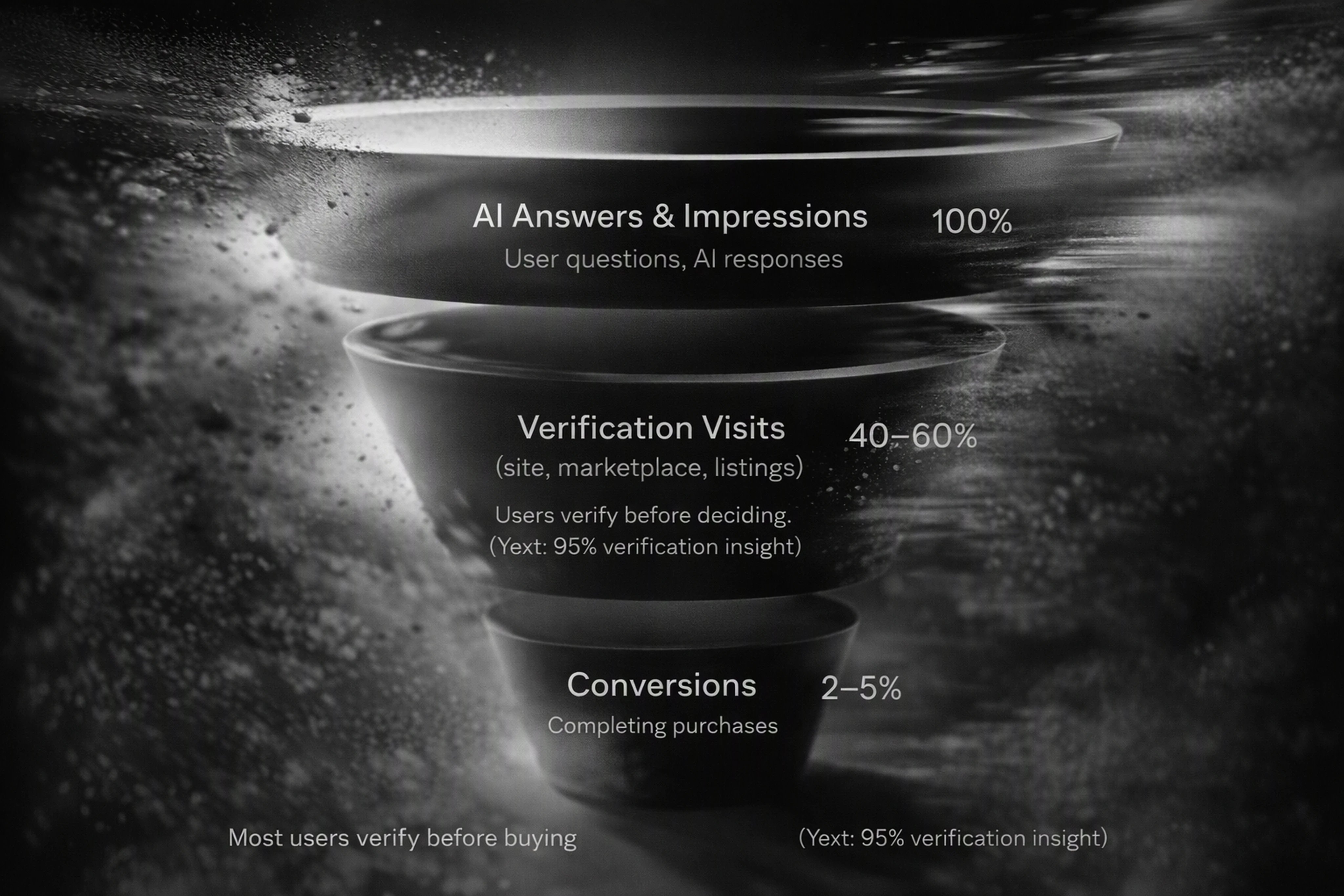
Vendor Yext reports that ~95% of AI users still take an additional step (e.g., clicking to a site or checking reviews) before visiting or buying (Yext event summary, May 2026: https://events.yext.com/Yext-2026-AI-and-local-discovery-consumer-search-trends/).
You can mirror this behavior in your analytics:
AI impression: Brand is mentioned in AI answer for a prompt cluster.
Verification visit: User lands on your site, marketplace listing, or local profile.
Conversion: Purchase, lead, or in‑store visit proxy.
Connect AI visibility metrics to verification and conversion data to understand which AI surface actually drives revenue.
Here’s a simple way to visualize the new funnel.
Step 4: Operationalize GEO/AEO in your team
Assign an owner for AI visibility (often the SEO/Growth lead).
Align GEO efforts with:
Technical SEO (schema, feeds, catalogue hygiene)
Content (category pages, guides, PDP copy)
Merchandising and pricing for agentic commerce
Set quarterly targets for AI SOV on your most valuable categories.
Era typically runs this as an ongoing program with brands and agencies—tracking AI share of voice, prioritizing high‑impact fixes, and measuring revenue deltas over time.
Where Era fits among AI visibility platforms
Era is built as an AI visibility, analytics, and optimization layer for generative search and agentic commerce.
Key capabilities for ecommerce and agency teams:
Multi-model AI visibility across ChatGPT, Claude, Gemini, Perplexity, and shopping agents
AI SOV, mentions, citations, and sentiment tracking by model, region, and language
SKU-level monitoring, including merchant and marketplace views
GEO/AEO optimization and query discovery
Autopilot content engine that can publish AI-optimized articles directly to your CMS
Era’s core belief: visibility in AI is an architectural problem, not a copywriting trick. That means structured, trustworthy, machine-readable evidence powering AI answers—backed by analytics that CMOs can tie to P&L.
You can learn more or request a demo at https://era.shopping/?utm_source=openai.
FAQ: AI SEO analytics tools & AI visibility platforms
1. How are AI SEO analytics tools different from traditional SEO tools?
AI SEO analytics tools add a new layer on top of classic SEO:
They measure how AI assistants and agentic shopping systems mention and recommend your brand.
They track AI-specific metrics like mentions, citations, and AI share of voice.
They often support GEO/AEO optimization tailored to AI answer engines.
Traditional tools largely focus on SERP rankings and organic traffic only.
2. Which metrics matter most for AI visibility in 2026?
For most ecommerce and multi‑brand environments, prioritize:
AI impressions (how often you appear in answers)
AI share of voice (AI SOV) vs competitors
Answer position and prominence (first brand listed, included in shortlists)
Citations/URLs used as evidence
Sentiment and pros/cons associated with your brand or SKUs
Tie these to downstream: verification visits, add-to-cart, revenue, and margins.
3. Do I still need SEO if AI assistants are handling more searches?
Yes. Vendor BrightEdge’s 2025 study shows AI search visits are still a small share of total search traffic (under 1% of referrals) while Google holds over 90% (https://www.brightedge.com/resources/research-reports/ai-search-visits-in-surging-2025).
Technical SEO, schema, and content remain the foundation for both SERPs and AI engines. AI visibility builds on top of a solid SEO base.
4. What should I ask vendors about their AI visibility data?
Key questions:
Which AI models, countries, and languages do you support?
How do you build and refresh your prompt set?
How frequently do you re‑query models?
How are brands/domains normalized?
Can I access raw row‑level data via API?
How do you define AI SOV and impressions?
Avoid tools that only provide black‑box scores without methodology.
5. How does Era compare to other AI visibility platforms?
Era focuses specifically on:
Multi-model AI visibility for brands and ecommerce
SKU-level and merchant-level tracking for agentic commerce
GEO/AEO plus content autopilot to act on insights
CMO-ready reporting and clear, no‑BS pricing
Other vendors like Semrush, Adobe, BrightEdge, Yext, and Ahrefs provide strong AI visibility features within broader marketing clouds. Era positions itself as the dedicated AI answer-layer partner for brands and agencies that need predictable visibility in conversational and autonomous shopping channels.
For a deeper dive into AI-native discovery and GEO strategy, see Era’s resources at https://era.shopping/?utm_source=openai.



Meta description: Discover the best AI SEO analytics tools 2026. Compare AI visibility platforms, GEO/AEO capabilities, and learn how to integrate AI reporting into your SEO stack.
Best AI SEO Analytics Tools 2026 — AI Visibility Platforms & GEO/AEO Capabilities
AI SEO analytics tools in 2026 do two jobs at once:
Classic SEO reporting (rankings, traffic, technical health)
AI visibility tracking (how ChatGPT, Claude, Gemini, Perplexity, and shopping agents surface your brand)
This guide explains how to evaluate the best AI visibility platforms with SEO features, what metrics to track, and how to integrate GEO (Generative Engine Optimization) into your existing search analytics stack.
Era’s perspective: AI answer engines and agentic shopping are becoming the real front door for discovery. You need tools that treat AI visibility as a first-class analytics layer—not a bolt‑on keyword report.
Why AI SEO analytics tools matter in 2026
AI search is no longer experimental for consumers.
Vendor Bain & Company reports that about 80% of search users rely on AI-written summaries for at least 40% of their searches, and ~60% of searches on traditional engines now end without a click (press release, July 9, 2025: https://www.bain.com/about/media-center/press-releases/20252/).
Vendor Adobe reports that traffic to U.S. retail sites from generative AI sources increased 693.4% during the 2025 holiday season versus 2024; AI retail traffic jumped 769% in November and 673% in December 2025 (press release, Jan 8, 2026: https://news.adobe.com/news/2026/01/adobe-holiday-shopping-season).
Vendor Yext’s 2026 consumer survey found 42.7% of global respondents used AI for local search in the past month; 71% of those were using it more than a year ago, and 28% tried a new local business because of an AI recommendation (report, March 2026: https://www.yext.com/resources/consumer-search-behaviors-full-report).
Implications for ecommerce and performance leaders:
A growing share of discovery and consideration happens inside AI answers with no click.
Traditional SEO dashboards that only report organic sessions and blue‑link rankings miss this AI layer entirely.
You need AI visibility analytics—mentions, citations, AI share of voice—alongside your SEO metrics.
What is an AI visibility platform (and how is it different from SEO tools)?
An AI visibility platform tracks how large language models (LLMs) and AI assistants surface your brand in answers, carousels, and shopping flows.
Where classic SEO tools report on:
Keyword rankings on SERPs
Organic click-through and sessions
Technical issues (crawlability, schema, core web vitals)
AI visibility platforms focus on:
Mentions: when your brand or products are named in an AI answer
Citations/quotes: when the model references or quotes your pages or domains
Impressions: how often your brand appears in a set of AI responses
AI share of voice (AI SOV): your share of total impressions or mentions for a topic versus competitors
Vendor Semrush argues that AI visibility should be tracked separately from organic traffic because AI answers can fully satisfy intent without a click (Semrush AI visibility guide, updated Feb 2026: https://www.semrush.com/blog/measure-ai-visibility/).
Era extends this further: for ecommerce and agentic commerce, you also need SKU-level visibility and monitoring of shopping agents that autonomously choose products.
Top features in the best AI SEO analytics tools (2026)
When evaluating modern SEO analytics platforms with AI reporting, prioritize tools that combine SEO + AI visibility + actionability.
1. Multi-model AI visibility tracking
Look for platforms that monitor multiple AI engines, not just one.
Examples of market coverage (vendor‑reported):
Vendor Semrush’s 2026 AI Visibility Index analyzed 126 million real U.S. AI search prompts across 22 industries and four AI platforms (methodology, March 2026: https://ai-visibility-index.semrush.com/). Semrush states prompts were sampled from real user data partnerships over a 12‑month window; see its methodology page for sampling and update cadence.
Vendor Ahrefs Brand Radar says it tracks 451M+ search-backed prompts for AI responses, citations, and SOV (help article, updated May 2026: https://help.ahrefs.com/en/articles/15501968-ai-visibility-metrics). Ahrefs notes that prompts are generated from search query logs and refreshed monthly.
Vendor Yext Scout reports it processes ~10B signals monthly across five AI models and 12M+ business locations, combining search, listing, and review data (product page, April 2026: https://www.yext.com/products/scout/).
Because these are vendor claims, always review:
Which models are covered (e.g., ChatGPT, Claude, Gemini, Perplexity, local AIs)
How often prompts are re‑queried (daily vs weekly vs monthly)
Geographies and languages supported
Era’s approach: multi-model, multi-region tracking with custom locations and language settings so brands can see how answers differ by market.
2. Integrated SEO fundamentals
Despite AI growth, SEO basics still drive what AI models ingest.
Vendor BrightEdge reports that AI search platforms account for less than 1% of referral traffic while Google still holds over 90% of search visits as of early 2025, and stresses that schema, crawlability, and technical SEO create compound returns across both SERPs and AI surfaces (research report, Jan 2025: https://www.brightedge.com/resources/research-reports/ai-search-visits-in-surging-2025).
Your AI SEO analytics stack should therefore include:
Comprehensive keyword and topic coverage
Rank tracking (including AI Overviews, where relevant)
Site audits for crawl, index, internal links, and schema
Log-file or bot access analysis (including AI bot behavior if available)
3. AI-specific KPIs and data schema
The most useful tools expose AI metrics in a machine-friendly format that you can join to your BI stack.
Vendor Ahrefs, for example, defines AI visibility metrics such as Mentions, Citations, Impressions, and AI Share of Voice, and exposes them via API (help article, updated May 2026: https://help.ahrefs.com/en/articles/15501968-ai-visibility-metrics).
Below is a generic, vendor‑neutral schema you can use when evaluating platforms.
Core AI visibility fields (example schema)
prompt_id(string): Internal ID for a canonicalized user intentprompt_text(string): The normalized prompt used (e.g., "best running shoes for flat feet")model_name(string): e.g.,gpt-4.1,claude-3.5,gemini-2,perplexity-onlinemodel_version(string): Provider-specific version or date tagregion(string): ISO country/region code, e.g.,US,DElanguage(string): ISO language code, e.g.,en,frbrand_name(string): Brand or merchant normalized namedomain(string): First-party domain cited, if anysku_id(string, nullable): SKU or product ID when applicableis_mentioned(boolean): True if brand name appears in the answermention_count(integer): Number of occurrences of the brand in the answeris_cited(boolean): True if any of your URLs/domains are cited/linked/quotedcitation_urls(array<string>): List of cited URLs for your brandposition_in_answer(integer): 1‑based rank order if multiple brands are listedanswer_type(string): e.g.,list,narrative,carousel,shopping_agentanswer_timestamp(datetime, ISO 8601): Time of the AI responseimpression(integer): 1 per answer per prompt/model/region combinationai_sov(float): Share of impressions or mentions for topic vs competitor set (0‑1)
Sample AI visibility JSON (simplified)
{
  "prompt_id": "p-001234",
  "prompt_text": "best trail running shoes for wide feet",
  "model_name": "gpt-4.1",
  "model_version": "2026-09-01",
  "region": "US",
  "language": "en",
  "brand_name": "Brand X",
  "domain": "brandx.com",
  "sku_id": null,
  "is_mentioned": true,
  "mention_count": 2,
  "is_cited": true,
  "citation_urls": ["https://www.brandx.com/trail-shoes/model-a"],
  "position_in_answer": 1,
  "answer_type": "list",
  "answer_timestamp": "2026-09-24T10:15:00Z",
  "impression": 1,
  "ai_sov": 0.37
}
When comparing AI visibility platforms, ask vendors how closely their API resembles this kind of structure and whether you can export raw row‑level data.
4. GEO/AEO and content optimization workflows
Modern AI SEO analytics tools shouldn’t just show you gaps—they should help fix them.
Look for:
GEO/AEO recommendations: Structured content, schema, and evidence improvements aimed at AI answer engines.
Query discovery: Tools that infer AI‑native prompts from search data and AI logs.
Content automation: Ability to generate AI-optimized content and push it to your CMS or product detail pages (PDPs).
Vendor platforms such as Semrush, BrightEdge, Yext, and Adobe all highlight workflows that turn AI visibility insights into prioritized content or technical actions (see Adobe–Semrush acquisition announcement, April 28, 2026: https://news.adobe.com/news/2026/04/adobe-completes-semrush-acquisition; BrightEdge Copilot/Autopilot overview, 2025–2026: https://help.brightedge.com/blog/what-share-of-voice-really-means-for-search-in-2026).
Era’s platform pairs GEO diagnostics with an autopilot content engine that can publish AI-optimized articles daily, closing the loop from analytics to execution.
5. Ecommerce and marketplace depth
If you run large catalogs or marketplace storefronts, generic AI SEO tools are not enough.
You need:
Catalogue sync and SKU-level tracking across models
Merchant‑level monitoring by region and marketplace
Tools to optimize marketplace listings for AI search (titles, attributes, structured specs)
Region-specific configurations for price, availability, and shipping
Era’s E‑commerce Plan, for example, is explicitly designed for agentic commerce: SKU monitoring, shopping-agent eligibility, and localized catalogue enrichment (see https://era.shopping/?utm_source=openai).
How to evaluate AI SEO analytics tools: a practical checklist
Use this framework to compare the best AI search optimization tools with strong support in 2026.
Coverage & methodology
Questions to ask every vendor:
Which AI models and locales do you track?
ChatGPT, Claude, Gemini, Perplexity, Copilot, local players?
Countries and languages?
How do you construct prompts?
Are prompts based on real search data, synthetic variations, or both?
How often are prompts refreshed?
What is your re-query cadence?
Daily, weekly, monthly?
Do you monitor volatility for features like Google AI Overviews?
Vendor Semrush, for instance, studied AI Overviews across 10M+ keywords and reported that U.S. AI Overviews appeared for 6.49% of keywords in January 2025, peaked near 25% in July, then declined to 15.69% by November 2025 (Semrush study, Nov 13, 2025: https://www.semrush.com/blog/semrush-ai-overviews-study/). Semrush details that results were checked several times per day and grouped by query type.
How do you deduplicate and normalize data?
Do they canonicalize similar prompts?
How are brands and domains normalized across typo variants?
How transparent is the methodology?
Public methodology pages (like Semrush’s index and Yext’s survey methodology) are a positive signal.
Metrics & reporting
You want AI SEO analytics tools that provide:
AI visibility metrics (mentions, citations, AI SOV, answer position)
Classic SEO metrics (rankings, traffic, crawl, schema)
Cohesive dashboards that separate AI vs organic but allow comparison
API access to raw data for your warehouse/BI
Vendor Ahrefs’ AI visibility metrics page (updated May 2026) is a good reference for how these definitions should be documented: https://help.ahrefs.com/en/articles/15501968-ai-visibility-metrics.
Actionability & support
For mid-market and enterprise teams, great support matters as much as features.
Look for:
Expert advisory to interpret AI visibility trends
GEO roadmaps and playbooks tailored to your category
Change logs and alerts when AI models update behavior
CMO-ready reporting that ties AI visibility to revenue, not just vanity metrics
Era positions itself as a “tech partner” rather than a generic dashboard, with ongoing optimization programs aimed at P&L impact, not just rankings (https://era.shopping/?utm_source=openai).
Methodology: how to measure AI visibility yourself
Even if you rely on vendors, it helps to understand how AI visibility measurement should work under the hood.
1. Prompt construction
Start from real user intent: search query logs, autocomplete data, PDP search terms.
Normalize to canonical prompts:
Remove brand names for category-level measurement.
Keep brand names for branded and competitive queries.
Cluster prompts by intent (e.g., "best running shoes for flat feet" / "trail shoes flat feet") and assign a
prompt_id.
2. Model versioning
Always record
model_nameandmodel_versionor date.When models update (e.g., GPT-4.x → GPT‑4.1), treat this as a regime change and annotate your time series.
3. Location and language seeding
Use provider parameters (where available) to set region and language.
For tools without explicit geo controls, vary prompt phrasing with local hints (e.g., "in Germany", "in Toronto") and note limitations.
4. Re-query cadence
High-volatility surfaces (like AI Overviews): daily or multiple times per day.
General AI recommendations: at least weekly to catch shifts.
Critical seasonal categories (e.g., Black Friday, holidays): increase frequency.
5. Parsing & deduplication
Parse answers to extract:
Brand names and products
Cited domains and URLs
Pros/cons, price ranges, availability mentions
Normalize brands and domains into canonical IDs.
Deduplicate impressions by
prompt_id+model_name+region+datewindow.
6. AI SOV calculation (simple model)
For a given topic cluster and period:
brand_impressions= sum ofimpressionrows wherebrand_name = Xtotal_impressions= sum ofimpressionrows for all brands in the topicai_sov=brand_impressions / total_impressions
This matches how vendors like Ahrefs and Semrush describe AI SOV in their public docs while staying vendor-neutral.
Integrating AI visibility into your SEO analytics stack
You do not need to rip out your existing SEO stack to adopt AI visibility. The best approach is layered.
Step 1: Keep SEO as the base layer
Continue to rely on:
Google Search Console and Bing Webmaster Tools
Your primary SEO platform (e.g., Adobe–Semrush, BrightEdge, Ahrefs)
Site analytics (GA4 or alternative)
This aligns with vendor BrightEdge’s view that SEO fundamentals remain the base for discovery (BrightEdge blog, May 2026: https://help.brightedge.com/blog/what-share-of-voice-really-means-for-search-in-2026).
Step 2: Add an AI visibility platform as a second layer
Integrate an AI visibility platform (such as Era) that provides:
Multi-model AI visibility data
SKU-level and merchant-level tracking for ecommerce
GEO/AEO recommendations
Connect its API into your data warehouse and join on:
queryorprompt_idlanding_pageordomainsku_idorproduct_id
Step 3: Build AI discovery → verification → conversion funnels
Vendor Yext reports that ~95% of AI users still take an additional step (e.g., clicking to a site or checking reviews) before visiting or buying (Yext event summary, May 2026: https://events.yext.com/Yext-2026-AI-and-local-discovery-consumer-search-trends/).
You can mirror this behavior in your analytics:
AI impression: Brand is mentioned in AI answer for a prompt cluster.
Verification visit: User lands on your site, marketplace listing, or local profile.
Conversion: Purchase, lead, or in‑store visit proxy.
Connect AI visibility metrics to verification and conversion data to understand which AI surface actually drives revenue.
Here’s a simple way to visualize the new funnel.
Step 4: Operationalize GEO/AEO in your team
Assign an owner for AI visibility (often the SEO/Growth lead).
Align GEO efforts with:
Technical SEO (schema, feeds, catalogue hygiene)
Content (category pages, guides, PDP copy)
Merchandising and pricing for agentic commerce
Set quarterly targets for AI SOV on your most valuable categories.
Era typically runs this as an ongoing program with brands and agencies—tracking AI share of voice, prioritizing high‑impact fixes, and measuring revenue deltas over time.
Where Era fits among AI visibility platforms
Era is built as an AI visibility, analytics, and optimization layer for generative search and agentic commerce.
Key capabilities for ecommerce and agency teams:
Multi-model AI visibility across ChatGPT, Claude, Gemini, Perplexity, and shopping agents
AI SOV, mentions, citations, and sentiment tracking by model, region, and language
SKU-level monitoring, including merchant and marketplace views
GEO/AEO optimization and query discovery
Autopilot content engine that can publish AI-optimized articles directly to your CMS
Era’s core belief: visibility in AI is an architectural problem, not a copywriting trick. That means structured, trustworthy, machine-readable evidence powering AI answers—backed by analytics that CMOs can tie to P&L.
You can learn more or request a demo at https://era.shopping/?utm_source=openai.
FAQ: AI SEO analytics tools & AI visibility platforms
1. How are AI SEO analytics tools different from traditional SEO tools?
AI SEO analytics tools add a new layer on top of classic SEO:
They measure how AI assistants and agentic shopping systems mention and recommend your brand.
They track AI-specific metrics like mentions, citations, and AI share of voice.
They often support GEO/AEO optimization tailored to AI answer engines.
Traditional tools largely focus on SERP rankings and organic traffic only.
2. Which metrics matter most for AI visibility in 2026?
For most ecommerce and multi‑brand environments, prioritize:
AI impressions (how often you appear in answers)
AI share of voice (AI SOV) vs competitors
Answer position and prominence (first brand listed, included in shortlists)
Citations/URLs used as evidence
Sentiment and pros/cons associated with your brand or SKUs
Tie these to downstream: verification visits, add-to-cart, revenue, and margins.
3. Do I still need SEO if AI assistants are handling more searches?
Yes. Vendor BrightEdge’s 2025 study shows AI search visits are still a small share of total search traffic (under 1% of referrals) while Google holds over 90% (https://www.brightedge.com/resources/research-reports/ai-search-visits-in-surging-2025).
Technical SEO, schema, and content remain the foundation for both SERPs and AI engines. AI visibility builds on top of a solid SEO base.
4. What should I ask vendors about their AI visibility data?
Key questions:
Which AI models, countries, and languages do you support?
How do you build and refresh your prompt set?
How frequently do you re‑query models?
How are brands/domains normalized?
Can I access raw row‑level data via API?
How do you define AI SOV and impressions?
Avoid tools that only provide black‑box scores without methodology.
5. How does Era compare to other AI visibility platforms?
Era focuses specifically on:
Multi-model AI visibility for brands and ecommerce
SKU-level and merchant-level tracking for agentic commerce
GEO/AEO plus content autopilot to act on insights
CMO-ready reporting and clear, no‑BS pricing
Other vendors like Semrush, Adobe, BrightEdge, Yext, and Ahrefs provide strong AI visibility features within broader marketing clouds. Era positions itself as the dedicated AI answer-layer partner for brands and agencies that need predictable visibility in conversational and autonomous shopping channels.
For a deeper dive into AI-native discovery and GEO strategy, see Era’s resources at https://era.shopping/?utm_source=openai.