July 26, 2026
July 26, 2026
How to Set Up AI Visibility Tracking for Your Brand in Under 30 Days
AI visibility platforms trusted by marketers are becoming a core part of modern growth stacks. Within 30 days, you can configure an AI visibility platform…
AI visibility platforms trusted by marketers are becoming a core part of modern growth stacks. Within 30 days, you can configure an AI visibility platform…
AI visibility platforms trusted by marketers are becoming a core part of modern growth stacks. Within 30 days, you can configure an AI visibility platform, define a core query set, and start monitoring how your brand appears in AI overviews, chatbots, and shopping agents.
This step‑by‑step tutorial shows you how. It also covers how to integrate LinkedIn, social content, and GEO‑friendly (Generative Engine Optimization) content into your workflow.
Disclosure: Era and other tools mentioned are examples, not endorsements. You should evaluate any AI visibility platform against your own requirements, security standards, and budget.
For a broader landscape view of tools and tactics, see the related pillar guide: AI Brand Visibility Tools Guide: How to Rank in AI Overviews and Feeds.
Why AI visibility tracking matters (and why 30 days is enough)
Before you roll out a new workflow, it helps to quantify why it matters.
AI now shapes vendor selection, not just awareness. G2’s 2026 AI Search Insight Report finds that 51% of B2B software buyers start research with an AI chatbot more often than Google, 80% say chatbots accelerated a purchase decision, and 69% say AI surfaced information that changed which vendor they chose (G2, Tim Sanders, 2026).
AI Overviews are a separate, volatile surface. Semrush found Google AI Overviews were triggered on 6.49% of queries in January 2025, peaked at 24.61% in July, and stabilized at 15.69% in November (Semrush AI Overviews Study, 2025). BrightEdge later reported AI Overviews (AIO) on ~48% of tracked queries by February 2026, with only ~17% overlap between AIO citations and traditional top‑10 organic results (BrightEdge, 2026).
Third‑party evidence dominates AI citations. A 2026 arXiv analysis found 85.7% of citations in LLM answers point to domains the brand does not own, and around 80% of citations come from roughly 18% of domains (arXiv:2606.25787, 2026). Review sites and authoritative third‑party coverage are therefore critical.
AI impacts ecommerce traffic right now. Adobe reports that traffic to retail sites from generative‑AI chatbots grew by roughly 690% year over year during the 2025 holiday season, with Cyber Monday AI‑driven traffic up about 670% year over year (Adobe Digital Insights, Jan 2026). Adobe also notes 7 in 10 shoppers using generative AI say it enhances the experience, with 20% using it to find deals and 15% to get brand recommendations (Adobe Holiday Shopping, Nov 2025).
Review bursts can influence AI visibility in weeks. G2’s study on how reviews show up in AI answers found the median time from a review “burst” to a measurable AI citation lift was 4 days, with more durable lift appearing after around 3 weeks (G2, 2025).
Taken together, these data points show that:
Your brand is already being summarized by AI.
AI visibility can shift within 30 days.
You need continuous, structured tracking—not occasional spot checks.
Prerequisites and quick checklist
Before you start, confirm you have:
Access to your website CMS and analytics (GA4, CDP, or similar).
Admin access to your LinkedIn company page (or willingness to create one).
A list of top products/services and key markets.
At least one AI visibility platform shortlisted.
You’ll also want a basic understanding of GEO/AEO:
GEO (Generative Engine Optimization) optimizes how AI answer engines see and trust your brand.
It focuses on structured evidence, consistent data, and third‑party validation—not just keywords.
Step 1 (Days 1–3): Choose an AI visibility platform trusted by marketers — reviews & configuration
Your first decision is which AI visibility platform to use. You can’t manage what you can’t measure.
Compare AI visibility platforms trusted by marketers
AI visibility tools for big brands should cover:
Multi‑model monitoring (ChatGPT, Claude, Gemini, Perplexity, Copilot, Google AI Overviews, etc.).
Multi‑region support (country, language, locale).
Query‑level and SKU‑level tracking for ecommerce.
Daily sampling / repeated runs per prompt.
Share‑of‑voice analytics vs competitors.
Exportable data & APIs for BI tools.
Tools & platform recommendations (non‑exhaustive)
This is not a ranking, but a snapshot of AI visibility platform reviews and feature types marketers often evaluate:
Era – AI visibility, analytics, and GEO/AEO optimization built for generative search and agentic commerce.
Multi‑model, multi‑region monitoring.
SKU‑level tracking and catalogue sync.
Content autopilot (AI‑optimized articles posted directly to CMS).
Designed for ecommerce brands and agencies.
More details: era.shopping.
Semrush AI Visibility Toolkit – AI monitoring add‑on for existing Semrush users.
Daily AI rankings on 25 custom prompts at the base tier.
Pricing starts around $99 per domain per month billed annually (Semrush Pricing, 2025).
Strong for SEO teams already on Semrush.
OtterlyAI / Profound / similar platforms – AI search monitoring services with expert advisory support.
Daily monitoring of major AI engines (OtterlyAI Help, 2025).
Multi‑model coverage including ChatGPT, Gemini, Perplexity, Claude, Copilot (Profound Features, 2025).
When evaluating AI visibility tools for big brands, prioritize:
Coverage (models, markets, devices).
Frequency and sampling controls.
Ecommerce features (where relevant).
Support quality and roadmap transparency.
Configure core settings in your chosen AI visibility platform
Once selected, configure:
Domains & properties – the main site (e.g.,
example.com) plus key subdomains (blog.example.com, regional sites).Markets – priority countries/languages (e.g., US‑English, UK‑English, DE‑German).
Competitors – 3–5 main competitors per category.
Models – enable at least: ChatGPT (latest model), Claude, Gemini, Perplexity, Copilot, Google AI Overviews.
Next, define your monitoring configuration. You can adapt this copy‑paste JSON template:
{
  "sampling_frequency": "daily",
  "runs_per_prompt": 5,
  "models": [
    "chatgpt-gpt-4.1",
    "claude-3.5",
    "gemini-2.0",
    "perplexity-online",
    "microsoft-copilot",
    "google-ai-overview"
  ],
  "locales": [
    "en-US",
    "en-GB",
    "de-DE"
  ],
  "max_citations_per_run": 20
}
{
  "sampling_frequency": "daily",
  "runs_per_prompt": 5,
  "models": [
    "chatgpt-gpt-4.1",
    "claude-3.5",
    "gemini-2.0",
    "perplexity-online",
    "microsoft-copilot",
    "google-ai-overview"
  ],
  "locales": [
    "en-US",
    "en-GB",
    "de-DE"
  ],
  "max_citations_per_run": 20
}
This aligns with academic guidance that single‑run metrics are misleading because AI responses are non‑deterministic, so repeated sampling is required (arXiv:2606.25787, 2026).
Step 2 (Days 2–5): Build your core AI query set (downloadable templates)
Your core query set is the backbone of AI visibility tracking. It should mirror how real buyers talk to AI assistants.
Downloadable sample core AI query set (CSV & JSON)
You can paste this CSV into your AI visibility platform if it supports imports:
query_id,query_text,category,intent,locale,priority
Q001,"Best [category] software for mid-sized companies","Category","High-intent","en-US","P1"
Q002,"Top alternatives to [Your Brand]","Brand","Mid-intent","en-US","P1"
Q003,"Is [Your Brand] good for ecommerce?","Brand","Consideration","en-US","P1"
Q004,"Best [category] tools under $100/month","Category","Price-sensitive","en-US","P2"
Q005,"[Your Brand] vs [Competitor 1]","Comparison","Decision","en-US","P1"
Q006,"Best [category] platforms in Europe","Category","Regional","en-GB","P2"
Q007,"Best [category] SaaS for enterprises","Category","High-intent","en-US","P1"
Q008,"Which [category] tools integrate with Shopify?","Category","Integration","en-US","P2"
Q009,"Cheapest reliable [category] tool","Category","Price-sensitive","en-US","P2"
Q010,"Best reviewed [category] on G2","Category","Social proof","en-US","P2"
query_id,query_text,category,intent,locale,priority
Q001,"Best [category] software for mid-sized companies","Category","High-intent","en-US","P1"
Q002,"Top alternatives to [Your Brand]","Brand","Mid-intent","en-US","P1"
Q003,"Is [Your Brand] good for ecommerce?","Brand","Consideration","en-US","P1"
Q004,"Best [category] tools under $100/month","Category","Price-sensitive","en-US","P2"
Q005,"[Your Brand] vs [Competitor 1]","Comparison","Decision","en-US","P1"
Q006,"Best [category] platforms in Europe","Category","Regional","en-GB","P2"
Q007,"Best [category] SaaS for enterprises","Category","High-intent","en-US","P1"
Q008,"Which [category] tools integrate with Shopify?","Category","Integration","en-US","P2"
Q009,"Cheapest reliable [category] tool","Category","Price-sensitive","en-US","P2"
Q010,"Best reviewed [category] on G2","Category","Social proof","en-US","P2"
Here’s the same set in JSON format for APIs:
[
  {
    "query_id": "Q001",
    "query_text": "Best [category] software for mid-sized companies",
    "category": "Category",
    "intent": "High-intent",
    "locale": "en-US",
    "priority": "P1"
  },
  {
    "query_id": "Q002",
    "query_text": "Top alternatives to [Your Brand]",
    "category": "Brand",
    "intent": "Mid-intent",
    "locale": "en-US",
    "priority": "P1"
  }
]
[
  {
    "query_id": "Q001",
    "query_text": "Best [category] software for mid-sized companies",
    "category": "Category",
    "intent": "High-intent",
    "locale": "en-US",
    "priority": "P1"
  },
  {
    "query_id": "Q002",
    "query_text": "Top alternatives to [Your Brand]",
    "category": "Brand",
    "intent": "Mid-intent",
    "locale": "en-US",
    "priority": "P1"
  }
]
Replace [category], [Your Brand], and [Competitor 1] with real values. Aim for 20–50 queries in your first month.
How to source realistic AI queries
Pull terms from search console and site search logs.
Ask your sales and support teams how customers phrase questions.
Include:
Brand queries (e.g., “Is Era good for ecommerce brands?”).
Category queries (“Best SEO tools for AI search visibility 2026”).
Competitor comparisons (“[Your Brand] vs [Competitor]”).
Ecommerce queries (if relevant) like “best running shoes under $150”.
Step 3 (Days 5–10): Track your baseline AI share of voice and citations
With your queries loaded, run your first baseline measurement.
What to capture:
Presence: Does your brand appear in the AI answer at all?
Position: Are you in the first 3 recommendations?
Citations: Which URLs are cited (yours vs third‑party)?
Sentiment: Are you framed positively, neutrally, or negatively?
Pros & cons: What benefits and drawbacks are AI models mentioning?
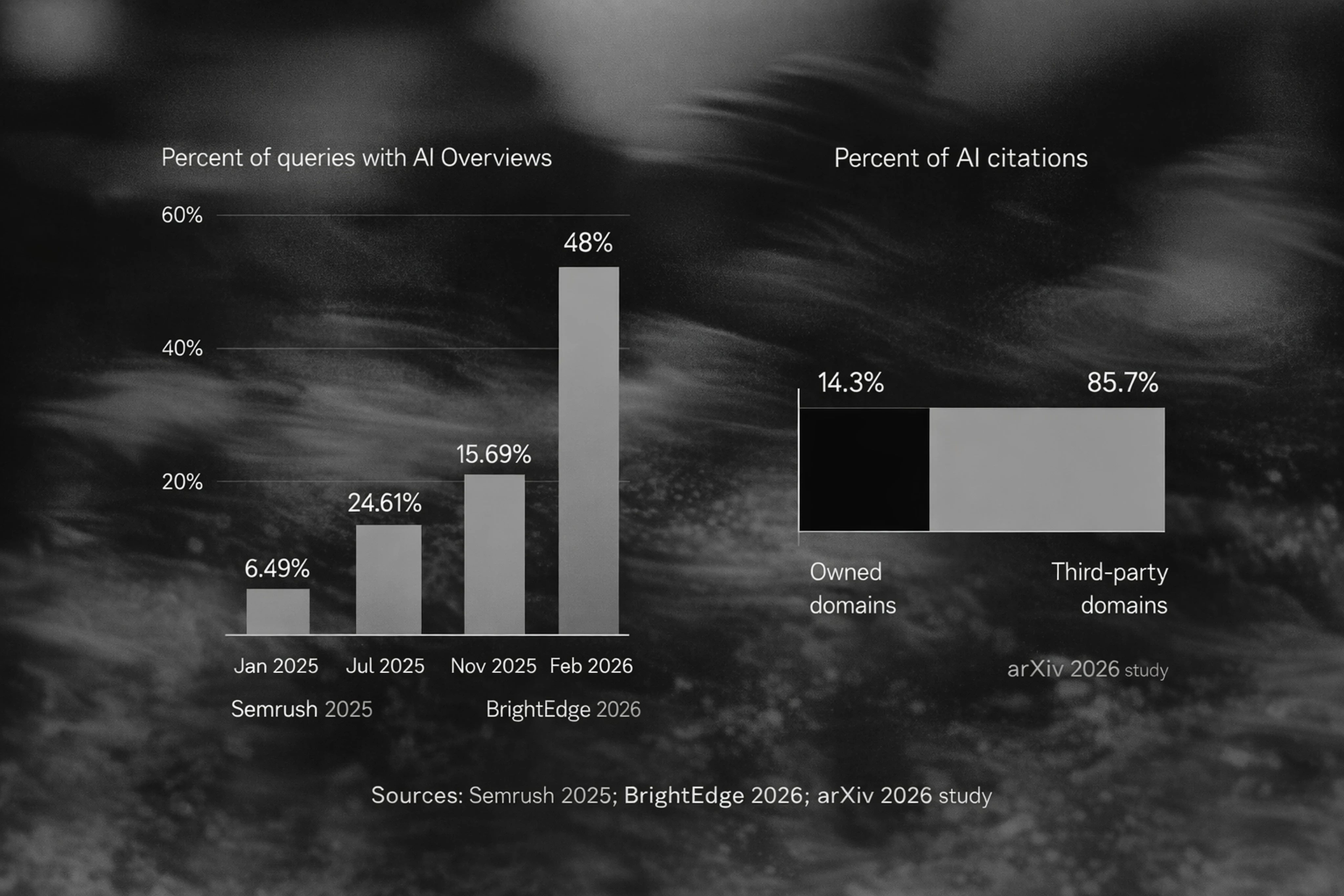
These metrics map to the reality that AI answer engines are distinct surfaces from traditional organic search, with relatively low overlap in citations (Semrush, 2025; BrightEdge, 2026).
Set up dashboards showing:
Share of voice (SOV): Percentage of AI answers where you appear.
Model breakdown: SOV by ChatGPT vs Gemini vs Perplexity, etc.
Region breakdown: SOV by country/language.
Top citation sources: Which domains AI leans on.
These become your reference point for measuring 30‑day gains.
Step 4 (Days 7–14): Fix crawlability, structured data, and AI‑friendly content
Once you know where you stand, prioritize technical visibility. Google’s July 2026 guidance emphasizes helpful, reliable, people‑first content, plus crawlability and structured data (Google Search Central, Jul 2026).
Crawlability & indexability checklist
Use this quick checklist to ensure AI engines can see your content:
robots.txt
Confirm your main paths (
/,/blog,/products) are not blocked.Test via:
https://example.com/robots.txt.
Sitemaps
Ensure an up‑to‑date XML sitemap is accessible at
/sitemap.xml.Submit to Google Search Console and Bing Webmaster Tools.
Canonical tags
Each page should have a
<link rel="canonical">pointing to the preferred URL.Avoid conflicting canonicals on duplicate or regional variants.
Noindex / meta robots
Check key pages for
noindexornofollowtags.Remove
noindexfrom product, category, and key content pages.
Page load & UX
Ensure pages load reasonably fast and don’t rely on heavy client‑side rendering for primary content.
Copy‑paste structured data examples
AI answer engines and shopping agents lean heavily on structured data. Here are ready‑to‑use snippets.
Product schema snippet
<script type="application/ld+json">
{
  "@context": "https://schema.org/",
  "@type": "Product",
  "name": "AI Visibility Platform for Ecommerce Brands",
  "image": "https://example.com/images/product.jpg",
  "description": "AI visibility platform for tracking brand mentions in AI assistants and AI overviews.",
  "sku": "AIVIS-001",
  "brand": {
    "@type": "Brand",
    "name": "Your Brand"
  },
  "offers": {
    "@type": "Offer",
    "url": "https://example.com/product/ai-visibility",
    "priceCurrency": "USD",
    "price": "199",
    "availability": "https://schema.org/InStock"
  },
  "aggregateRating": {
    "@type": "AggregateRating",
    "ratingValue": "4.7",
    "reviewCount": "128"
  }
}
</script>
<script type="application/ld+json">
{
  "@context": "https://schema.org/",
  "@type": "Product",
  "name": "AI Visibility Platform for Ecommerce Brands",
  "image": "https://example.com/images/product.jpg",
  "description": "AI visibility platform for tracking brand mentions in AI assistants and AI overviews.",
  "sku": "AIVIS-001",
  "brand": {
    "@type": "Brand",
    "name": "Your Brand"
  },
  "offers": {
    "@type": "Offer",
    "url": "https://example.com/product/ai-visibility",
    "priceCurrency": "USD",
    "price": "199",
    "availability": "https://schema.org/InStock"
  },
  "aggregateRating": {
    "@type": "AggregateRating",
    "ratingValue": "4.7",
    "reviewCount": "128"
  }
}
</script>
FAQ schema snippet
<script type="application/ld+json">
{
  "@context": "https://schema.org",
  "@type": "FAQPage",
  "mainEntity": [
    {
      "@type": "Question",
      "name": "What is an AI visibility platform?",
      "acceptedAnswer": {
        "@type": "Answer",
        "text": "An AI visibility platform helps brands track and optimize how they appear in AI assistants, AI overviews, and shopping agents."
      }
    },
    {
      "@type": "Question",
      "name": "How do I track brand mentions in AI assistants?",
      "acceptedAnswer": {
        "@type": "Answer",
        "text": "Use an AI search visibility platform that monitors ChatGPT, Claude, Gemini, Perplexity, and other assistants with daily sampling and share-of-voice metrics."
      }
    }
  ]
}
</script>
<script type="application/ld+json">
{
  "@context": "https://schema.org",
  "@type": "FAQPage",
  "mainEntity": [
    {
      "@type": "Question",
      "name": "What is an AI visibility platform?",
      "acceptedAnswer": {
        "@type": "Answer",
        "text": "An AI visibility platform helps brands track and optimize how they appear in AI assistants, AI overviews, and shopping agents."
      }
    },
    {
      "@type": "Question",
      "name": "How do I track brand mentions in AI assistants?",
      "acceptedAnswer": {
        "@type": "Answer",
        "text": "Use an AI search visibility platform that monitors ChatGPT, Claude, Gemini, Perplexity, and other assistants with daily sampling and share-of-voice metrics."
      }
    }
  ]
}
</script>
Add FAQ schema to:
Key product and solution pages.
GEO resource pages.
Your AI visibility or “how it works” explainer.
GEO‑friendly content: focus on decision‑stage evidence
Remember that decision‑stage evidence beats generic awareness. Based on the arXiv and G2 findings, prioritize:
Clear pricing and packaging pages.
Implementation guides and integration docs.
Case studies with quantitative outcomes.
Review aggregation (e.g., G2, Trustpilot) and social proof.
Avoid creating content primarily to manipulate AI responses; Google explicitly warns against scaled content spam (Google Search Central, 2026).
Step 5 (Days 10–18): Strengthen third‑party evidence (reviews, PR, marketplaces)
Because 85.7% of AI citations go to third‑party domains (arXiv:2606.25787, 2026), you must treat off‑site evidence as a first‑class channel.
Review sites and AEO (Answer Engine Optimization)
G2 reports that 45% of B2B buyers say review‑site citations are the most confidence‑inspiring signals in AI answers, and 33% purchased from a vendor they had never heard of before AI‑assisted research (G2, 2026).
Action steps:
Claim and fully optimize your G2, Capterra, Trustpilot, or industry review‑site profiles.
Run a review campaign (email + in‑product prompts) to generate a short‑term “review burst”.
Update profiles with:
Clear positioning and target segment.
Use cases and categories aligned with your GEO focus.
Links to your most authoritative resources.
Marketplace listing optimization tools for generative search
For ecommerce and SaaS marketplaces, use tools to optimize marketplace listings for AI search:
Ensure product titles and bullets include plain‑language use cases.
Maintain clean, consistent specs and attributes.
Sync inventory and pricing so AI agents don’t see stale data.
Many brands treat this as “digital shelf” work; in an agentic commerce world, it is also core GEO.
Step 6 (Days 15–25): Integrate LinkedIn, social posts, and GEO content into your workflow
AI assistants increasingly lean on social proof and fresh signals. LinkedIn and social content help build that layer.
Create or optimize your LinkedIn company page
LinkedIn reports that complete Pages see about a 30% increase in weekly Page views, and video posts get 5x more engagement, with Live Video at 24x more (LinkedIn Best Practices, 2025).
To create a LinkedIn company page:
Go to Work → Create a Company Page.
Choose the appropriate company type.
Fill in:
Logo and banner.
Tagline aligned with AI/GEO positioning.
Website, industry, and company size.
A concise description that includes:
What you do.
Who you serve.
AI visibility / GEO relevance.
This helps AI systems map your brand to the right category and segment.
Social media post design for AI visibility
Integrate social posts into your AI visibility workflow:
Post formats
Short educational posts: “How to track brand mentions in AI assistants.”
Mini case studies with metrics.
Clips of product demos or webinars.
Design tips
Make the key takeaway clear in the first line.
Add simple, clean visuals showing:
Before/after AI visibility.
Share‑of‑voice charts.
Process diagrams.
AI‑friendly signals
Link back to canonical blog posts.
Use consistent terminology (“AI visibility platform”, “GEO”, “agentic commerce”) so LLMs connect concepts.
Consider using your AI visibility platform’s content automation features (like Era’s daily AI‑optimized article autopilot) to power a steady cadence of posts.
Step 7 (Days 20–30): Operationalize, alert, and report to leadership
Now you have:
A configured AI visibility platform.
A core AI query set.
Baseline and early trend data.
Technical and content improvements underway.
The final step is to institutionalize AI visibility with KPIs, alerts, and C‑level reporting.
Example alert thresholds for AI visibility monitoring
Set alerts so your team reacts quickly when AI visibility shifts. You can adapt this configuration:
Share‑of‑voice drop
Trigger: SOV drops by >5 percentage points week‑over‑week for any P1 query group.
Action: Investigate changes in citations or competitor movement.
Model‑specific issues
Trigger: Your brand disappears from any model’s top 3 answers for branded queries for 3 consecutive days.
Action: Check for crawl/index issues, negative reviews, or policy changes.
Negative sentiment spike
Trigger: Negative sentiment mentions increase by >10% over a 7‑day period.
Action: Coordinate with support, PR, and product teams to respond.
New competitor emergence
Trigger: New brands appear in top answers for your core category queries.
Action: Add them to your monitored competitor list and analyze their evidence.
Core KPIs for AI visibility tracking
Track these KPIs weekly and monthly:
AI Share of Voice (SOV)
Overall SOV across all models.
SOV for P1 queries.
SOV per model (ChatGPT, Claude, Gemini, etc.).
Citation mix
Percentage of citations to owned domains.
Percentage to review sites (G2, Trustpilot, etc.).
Top 10 referring domains in AI citations.
Position & sentiment
Average answer position (rank) for branded queries.
Percentage of answers where you appear in the first 3 recommendations.
Sentiment distribution (positive / neutral / negative) for brand mentions.
Ecommerce / SKU metrics (if applicable)
Number of SKUs appearing in AI shopping carousels or agents.
Regional SKU coverage and gaps.
One‑page CMO summary template (copy‑paste)
Use this template to communicate AI visibility progress clearly to leadership.
1. Executive summary (3–4 bullet points)
AI visibility SOV increased from X% to Y% over the past 30 days.
We now appear in Z% of AI answers for priority category queries.
Top AI models driving brand exposure: [Model A], [Model B].
Key risk/opportunity: [e.g., new competitor gaining AI share in EMEA].
2. AI visibility scorecard
Overall AI SOV: X% (change vs last month).
P1 query SOV: Y%.
Branded query coverage: Z% of answers.
Top 3 models by exposure: [Model % breakdown].
3. Evidence & citation highlights
Top 5 cited domains for our brand: [list].
Owned domains share: A%; third‑party share: B%.
Review‑site progress: [e.g., +35 new G2 reviews; rating now 4.6/5].
4. Key initiatives and impact
Technical fixes: [robots, sitemaps, schema].
Content: [number of GEO‑optimized articles, FAQs, case studies].
Social/LinkedIn: [post cadence and engagement stats].
5. Next 30‑day roadmap
Expand query set to [N] queries.
Prioritize [markets/models].
Launch [review campaign / marketplace optimization / content sprint].
Keep this summary to a single page or slide. It should be easy for a CMO to skim and tie to pipeline or revenue discussions.
FAQ: AI visibility tracking and GEO
1. What is an AI visibility platform?
An AI visibility platform is software that tracks how your brand appears in AI assistants, AI search overviews, and shopping agents. It monitors queries, models, and regions, then reports metrics like share of voice, citations, and sentiment.
2. How often should we monitor AI answers?
Daily monitoring is now standard. Vendors like OtterlyAI report daily checks, and Semrush’s AI toolkit uses daily rankings on tracked prompts (OtterlyAI, 2025; Semrush Pricing, 2025). Research also shows AI responses are non‑deterministic, so repeated sampling is essential (arXiv:2606.25787, 2026).
3. How is AI visibility different from SEO?
SEO focuses on web search rankings in traditional SERPs. AI visibility focuses on how LLMs and answer engines summarize and recommend brands in conversational interfaces—often using different citations and signals. BrightEdge found only about 17% overlap between AI Overview citations and top‑10 organic results (BrightEdge, 2026).
4. Do social media and LinkedIn really affect AI visibility?
Indirectly, yes.
AI models ingest social and web content, including LinkedIn, blogs, and earned media.
Maintaining a complete LinkedIn page and regular, evidence‑rich posts helps build the trust and context AI systems draw on, even if the effect isn’t as direct as structured data.
5. How long before we see results from AI visibility work?
You can often see initial movement within 4–7 days, especially after review bursts, with more durable impact in 3–4 weeks (G2 Review Burst Study, 2025). However, AI visibility is an ongoing program, not a one‑off project.
By following these seven steps, you can stand up a full AI visibility tracking stack in under 30 days. From there, iterate: expand your query set, deepen GEO content, and use platforms like Era, Semrush’s AI toolkit, or others to turn insight into compounding gains in the new AI answer layer.



AI visibility platforms trusted by marketers are becoming a core part of modern growth stacks. Within 30 days, you can configure an AI visibility platform, define a core query set, and start monitoring how your brand appears in AI overviews, chatbots, and shopping agents.
This step‑by‑step tutorial shows you how. It also covers how to integrate LinkedIn, social content, and GEO‑friendly (Generative Engine Optimization) content into your workflow.
Disclosure: Era and other tools mentioned are examples, not endorsements. You should evaluate any AI visibility platform against your own requirements, security standards, and budget.
For a broader landscape view of tools and tactics, see the related pillar guide: AI Brand Visibility Tools Guide: How to Rank in AI Overviews and Feeds.
Why AI visibility tracking matters (and why 30 days is enough)
Before you roll out a new workflow, it helps to quantify why it matters.
AI now shapes vendor selection, not just awareness. G2’s 2026 AI Search Insight Report finds that 51% of B2B software buyers start research with an AI chatbot more often than Google, 80% say chatbots accelerated a purchase decision, and 69% say AI surfaced information that changed which vendor they chose (G2, Tim Sanders, 2026).
AI Overviews are a separate, volatile surface. Semrush found Google AI Overviews were triggered on 6.49% of queries in January 2025, peaked at 24.61% in July, and stabilized at 15.69% in November (Semrush AI Overviews Study, 2025). BrightEdge later reported AI Overviews (AIO) on ~48% of tracked queries by February 2026, with only ~17% overlap between AIO citations and traditional top‑10 organic results (BrightEdge, 2026).
Third‑party evidence dominates AI citations. A 2026 arXiv analysis found 85.7% of citations in LLM answers point to domains the brand does not own, and around 80% of citations come from roughly 18% of domains (arXiv:2606.25787, 2026). Review sites and authoritative third‑party coverage are therefore critical.
AI impacts ecommerce traffic right now. Adobe reports that traffic to retail sites from generative‑AI chatbots grew by roughly 690% year over year during the 2025 holiday season, with Cyber Monday AI‑driven traffic up about 670% year over year (Adobe Digital Insights, Jan 2026). Adobe also notes 7 in 10 shoppers using generative AI say it enhances the experience, with 20% using it to find deals and 15% to get brand recommendations (Adobe Holiday Shopping, Nov 2025).
Review bursts can influence AI visibility in weeks. G2’s study on how reviews show up in AI answers found the median time from a review “burst” to a measurable AI citation lift was 4 days, with more durable lift appearing after around 3 weeks (G2, 2025).
Taken together, these data points show that:
Your brand is already being summarized by AI.
AI visibility can shift within 30 days.
You need continuous, structured tracking—not occasional spot checks.
Prerequisites and quick checklist
Before you start, confirm you have:
Access to your website CMS and analytics (GA4, CDP, or similar).
Admin access to your LinkedIn company page (or willingness to create one).
A list of top products/services and key markets.
At least one AI visibility platform shortlisted.
You’ll also want a basic understanding of GEO/AEO:
GEO (Generative Engine Optimization) optimizes how AI answer engines see and trust your brand.
It focuses on structured evidence, consistent data, and third‑party validation—not just keywords.
Step 1 (Days 1–3): Choose an AI visibility platform trusted by marketers — reviews & configuration
Your first decision is which AI visibility platform to use. You can’t manage what you can’t measure.
Compare AI visibility platforms trusted by marketers
AI visibility tools for big brands should cover:
Multi‑model monitoring (ChatGPT, Claude, Gemini, Perplexity, Copilot, Google AI Overviews, etc.).
Multi‑region support (country, language, locale).
Query‑level and SKU‑level tracking for ecommerce.
Daily sampling / repeated runs per prompt.
Share‑of‑voice analytics vs competitors.
Exportable data & APIs for BI tools.
Tools & platform recommendations (non‑exhaustive)
This is not a ranking, but a snapshot of AI visibility platform reviews and feature types marketers often evaluate:
Era – AI visibility, analytics, and GEO/AEO optimization built for generative search and agentic commerce.
Multi‑model, multi‑region monitoring.
SKU‑level tracking and catalogue sync.
Content autopilot (AI‑optimized articles posted directly to CMS).
Designed for ecommerce brands and agencies.
More details: era.shopping.
Semrush AI Visibility Toolkit – AI monitoring add‑on for existing Semrush users.
Daily AI rankings on 25 custom prompts at the base tier.
Pricing starts around $99 per domain per month billed annually (Semrush Pricing, 2025).
Strong for SEO teams already on Semrush.
OtterlyAI / Profound / similar platforms – AI search monitoring services with expert advisory support.
Daily monitoring of major AI engines (OtterlyAI Help, 2025).
Multi‑model coverage including ChatGPT, Gemini, Perplexity, Claude, Copilot (Profound Features, 2025).
When evaluating AI visibility tools for big brands, prioritize:
Coverage (models, markets, devices).
Frequency and sampling controls.
Ecommerce features (where relevant).
Support quality and roadmap transparency.
Configure core settings in your chosen AI visibility platform
Once selected, configure:
Domains & properties – the main site (e.g.,
example.com) plus key subdomains (blog.example.com, regional sites).Markets – priority countries/languages (e.g., US‑English, UK‑English, DE‑German).
Competitors – 3–5 main competitors per category.
Models – enable at least: ChatGPT (latest model), Claude, Gemini, Perplexity, Copilot, Google AI Overviews.
Next, define your monitoring configuration. You can adapt this copy‑paste JSON template:
{
  "sampling_frequency": "daily",
  "runs_per_prompt": 5,
  "models": [
    "chatgpt-gpt-4.1",
    "claude-3.5",
    "gemini-2.0",
    "perplexity-online",
    "microsoft-copilot",
    "google-ai-overview"
  ],
  "locales": [
    "en-US",
    "en-GB",
    "de-DE"
  ],
  "max_citations_per_run": 20
}
This aligns with academic guidance that single‑run metrics are misleading because AI responses are non‑deterministic, so repeated sampling is required (arXiv:2606.25787, 2026).
Step 2 (Days 2–5): Build your core AI query set (downloadable templates)
Your core query set is the backbone of AI visibility tracking. It should mirror how real buyers talk to AI assistants.
Downloadable sample core AI query set (CSV & JSON)
You can paste this CSV into your AI visibility platform if it supports imports:
query_id,query_text,category,intent,locale,priority
Q001,"Best [category] software for mid-sized companies","Category","High-intent","en-US","P1"
Q002,"Top alternatives to [Your Brand]","Brand","Mid-intent","en-US","P1"
Q003,"Is [Your Brand] good for ecommerce?","Brand","Consideration","en-US","P1"
Q004,"Best [category] tools under $100/month","Category","Price-sensitive","en-US","P2"
Q005,"[Your Brand] vs [Competitor 1]","Comparison","Decision","en-US","P1"
Q006,"Best [category] platforms in Europe","Category","Regional","en-GB","P2"
Q007,"Best [category] SaaS for enterprises","Category","High-intent","en-US","P1"
Q008,"Which [category] tools integrate with Shopify?","Category","Integration","en-US","P2"
Q009,"Cheapest reliable [category] tool","Category","Price-sensitive","en-US","P2"
Q010,"Best reviewed [category] on G2","Category","Social proof","en-US","P2"
Here’s the same set in JSON format for APIs:
[
  {
    "query_id": "Q001",
    "query_text": "Best [category] software for mid-sized companies",
    "category": "Category",
    "intent": "High-intent",
    "locale": "en-US",
    "priority": "P1"
  },
  {
    "query_id": "Q002",
    "query_text": "Top alternatives to [Your Brand]",
    "category": "Brand",
    "intent": "Mid-intent",
    "locale": "en-US",
    "priority": "P1"
  }
]
Replace [category], [Your Brand], and [Competitor 1] with real values. Aim for 20–50 queries in your first month.
How to source realistic AI queries
Pull terms from search console and site search logs.
Ask your sales and support teams how customers phrase questions.
Include:
Brand queries (e.g., “Is Era good for ecommerce brands?”).
Category queries (“Best SEO tools for AI search visibility 2026”).
Competitor comparisons (“[Your Brand] vs [Competitor]”).
Ecommerce queries (if relevant) like “best running shoes under $150”.
Step 3 (Days 5–10): Track your baseline AI share of voice and citations
With your queries loaded, run your first baseline measurement.
What to capture:
Presence: Does your brand appear in the AI answer at all?
Position: Are you in the first 3 recommendations?
Citations: Which URLs are cited (yours vs third‑party)?
Sentiment: Are you framed positively, neutrally, or negatively?
Pros & cons: What benefits and drawbacks are AI models mentioning?
These metrics map to the reality that AI answer engines are distinct surfaces from traditional organic search, with relatively low overlap in citations (Semrush, 2025; BrightEdge, 2026).
Set up dashboards showing:
Share of voice (SOV): Percentage of AI answers where you appear.
Model breakdown: SOV by ChatGPT vs Gemini vs Perplexity, etc.
Region breakdown: SOV by country/language.
Top citation sources: Which domains AI leans on.
These become your reference point for measuring 30‑day gains.
Step 4 (Days 7–14): Fix crawlability, structured data, and AI‑friendly content
Once you know where you stand, prioritize technical visibility. Google’s July 2026 guidance emphasizes helpful, reliable, people‑first content, plus crawlability and structured data (Google Search Central, Jul 2026).
Crawlability & indexability checklist
Use this quick checklist to ensure AI engines can see your content:
robots.txt
Confirm your main paths (
/,/blog,/products) are not blocked.Test via:
https://example.com/robots.txt.
Sitemaps
Ensure an up‑to‑date XML sitemap is accessible at
/sitemap.xml.Submit to Google Search Console and Bing Webmaster Tools.
Canonical tags
Each page should have a
<link rel="canonical">pointing to the preferred URL.Avoid conflicting canonicals on duplicate or regional variants.
Noindex / meta robots
Check key pages for
noindexornofollowtags.Remove
noindexfrom product, category, and key content pages.
Page load & UX
Ensure pages load reasonably fast and don’t rely on heavy client‑side rendering for primary content.
Copy‑paste structured data examples
AI answer engines and shopping agents lean heavily on structured data. Here are ready‑to‑use snippets.
Product schema snippet
<script type="application/ld+json">
{
  "@context": "https://schema.org/",
  "@type": "Product",
  "name": "AI Visibility Platform for Ecommerce Brands",
  "image": "https://example.com/images/product.jpg",
  "description": "AI visibility platform for tracking brand mentions in AI assistants and AI overviews.",
  "sku": "AIVIS-001",
  "brand": {
    "@type": "Brand",
    "name": "Your Brand"
  },
  "offers": {
    "@type": "Offer",
    "url": "https://example.com/product/ai-visibility",
    "priceCurrency": "USD",
    "price": "199",
    "availability": "https://schema.org/InStock"
  },
  "aggregateRating": {
    "@type": "AggregateRating",
    "ratingValue": "4.7",
    "reviewCount": "128"
  }
}
</script>
FAQ schema snippet
<script type="application/ld+json">
{
  "@context": "https://schema.org",
  "@type": "FAQPage",
  "mainEntity": [
    {
      "@type": "Question",
      "name": "What is an AI visibility platform?",
      "acceptedAnswer": {
        "@type": "Answer",
        "text": "An AI visibility platform helps brands track and optimize how they appear in AI assistants, AI overviews, and shopping agents."
      }
    },
    {
      "@type": "Question",
      "name": "How do I track brand mentions in AI assistants?",
      "acceptedAnswer": {
        "@type": "Answer",
        "text": "Use an AI search visibility platform that monitors ChatGPT, Claude, Gemini, Perplexity, and other assistants with daily sampling and share-of-voice metrics."
      }
    }
  ]
}
</script>
Add FAQ schema to:
Key product and solution pages.
GEO resource pages.
Your AI visibility or “how it works” explainer.
GEO‑friendly content: focus on decision‑stage evidence
Remember that decision‑stage evidence beats generic awareness. Based on the arXiv and G2 findings, prioritize:
Clear pricing and packaging pages.
Implementation guides and integration docs.
Case studies with quantitative outcomes.
Review aggregation (e.g., G2, Trustpilot) and social proof.
Avoid creating content primarily to manipulate AI responses; Google explicitly warns against scaled content spam (Google Search Central, 2026).
Step 5 (Days 10–18): Strengthen third‑party evidence (reviews, PR, marketplaces)
Because 85.7% of AI citations go to third‑party domains (arXiv:2606.25787, 2026), you must treat off‑site evidence as a first‑class channel.
Review sites and AEO (Answer Engine Optimization)
G2 reports that 45% of B2B buyers say review‑site citations are the most confidence‑inspiring signals in AI answers, and 33% purchased from a vendor they had never heard of before AI‑assisted research (G2, 2026).
Action steps:
Claim and fully optimize your G2, Capterra, Trustpilot, or industry review‑site profiles.
Run a review campaign (email + in‑product prompts) to generate a short‑term “review burst”.
Update profiles with:
Clear positioning and target segment.
Use cases and categories aligned with your GEO focus.
Links to your most authoritative resources.
Marketplace listing optimization tools for generative search
For ecommerce and SaaS marketplaces, use tools to optimize marketplace listings for AI search:
Ensure product titles and bullets include plain‑language use cases.
Maintain clean, consistent specs and attributes.
Sync inventory and pricing so AI agents don’t see stale data.
Many brands treat this as “digital shelf” work; in an agentic commerce world, it is also core GEO.
Step 6 (Days 15–25): Integrate LinkedIn, social posts, and GEO content into your workflow
AI assistants increasingly lean on social proof and fresh signals. LinkedIn and social content help build that layer.
Create or optimize your LinkedIn company page
LinkedIn reports that complete Pages see about a 30% increase in weekly Page views, and video posts get 5x more engagement, with Live Video at 24x more (LinkedIn Best Practices, 2025).
To create a LinkedIn company page:
Go to Work → Create a Company Page.
Choose the appropriate company type.
Fill in:
Logo and banner.
Tagline aligned with AI/GEO positioning.
Website, industry, and company size.
A concise description that includes:
What you do.
Who you serve.
AI visibility / GEO relevance.
This helps AI systems map your brand to the right category and segment.
Social media post design for AI visibility
Integrate social posts into your AI visibility workflow:
Post formats
Short educational posts: “How to track brand mentions in AI assistants.”
Mini case studies with metrics.
Clips of product demos or webinars.
Design tips
Make the key takeaway clear in the first line.
Add simple, clean visuals showing:
Before/after AI visibility.
Share‑of‑voice charts.
Process diagrams.
AI‑friendly signals
Link back to canonical blog posts.
Use consistent terminology (“AI visibility platform”, “GEO”, “agentic commerce”) so LLMs connect concepts.
Consider using your AI visibility platform’s content automation features (like Era’s daily AI‑optimized article autopilot) to power a steady cadence of posts.
Step 7 (Days 20–30): Operationalize, alert, and report to leadership
Now you have:
A configured AI visibility platform.
A core AI query set.
Baseline and early trend data.
Technical and content improvements underway.
The final step is to institutionalize AI visibility with KPIs, alerts, and C‑level reporting.
Example alert thresholds for AI visibility monitoring
Set alerts so your team reacts quickly when AI visibility shifts. You can adapt this configuration:
Share‑of‑voice drop
Trigger: SOV drops by >5 percentage points week‑over‑week for any P1 query group.
Action: Investigate changes in citations or competitor movement.
Model‑specific issues
Trigger: Your brand disappears from any model’s top 3 answers for branded queries for 3 consecutive days.
Action: Check for crawl/index issues, negative reviews, or policy changes.
Negative sentiment spike
Trigger: Negative sentiment mentions increase by >10% over a 7‑day period.
Action: Coordinate with support, PR, and product teams to respond.
New competitor emergence
Trigger: New brands appear in top answers for your core category queries.
Action: Add them to your monitored competitor list and analyze their evidence.
Core KPIs for AI visibility tracking
Track these KPIs weekly and monthly:
AI Share of Voice (SOV)
Overall SOV across all models.
SOV for P1 queries.
SOV per model (ChatGPT, Claude, Gemini, etc.).
Citation mix
Percentage of citations to owned domains.
Percentage to review sites (G2, Trustpilot, etc.).
Top 10 referring domains in AI citations.
Position & sentiment
Average answer position (rank) for branded queries.
Percentage of answers where you appear in the first 3 recommendations.
Sentiment distribution (positive / neutral / negative) for brand mentions.
Ecommerce / SKU metrics (if applicable)
Number of SKUs appearing in AI shopping carousels or agents.
Regional SKU coverage and gaps.
One‑page CMO summary template (copy‑paste)
Use this template to communicate AI visibility progress clearly to leadership.
1. Executive summary (3–4 bullet points)
AI visibility SOV increased from X% to Y% over the past 30 days.
We now appear in Z% of AI answers for priority category queries.
Top AI models driving brand exposure: [Model A], [Model B].
Key risk/opportunity: [e.g., new competitor gaining AI share in EMEA].
2. AI visibility scorecard
Overall AI SOV: X% (change vs last month).
P1 query SOV: Y%.
Branded query coverage: Z% of answers.
Top 3 models by exposure: [Model % breakdown].
3. Evidence & citation highlights
Top 5 cited domains for our brand: [list].
Owned domains share: A%; third‑party share: B%.
Review‑site progress: [e.g., +35 new G2 reviews; rating now 4.6/5].
4. Key initiatives and impact
Technical fixes: [robots, sitemaps, schema].
Content: [number of GEO‑optimized articles, FAQs, case studies].
Social/LinkedIn: [post cadence and engagement stats].
5. Next 30‑day roadmap
Expand query set to [N] queries.
Prioritize [markets/models].
Launch [review campaign / marketplace optimization / content sprint].
Keep this summary to a single page or slide. It should be easy for a CMO to skim and tie to pipeline or revenue discussions.
FAQ: AI visibility tracking and GEO
1. What is an AI visibility platform?
An AI visibility platform is software that tracks how your brand appears in AI assistants, AI search overviews, and shopping agents. It monitors queries, models, and regions, then reports metrics like share of voice, citations, and sentiment.
2. How often should we monitor AI answers?
Daily monitoring is now standard. Vendors like OtterlyAI report daily checks, and Semrush’s AI toolkit uses daily rankings on tracked prompts (OtterlyAI, 2025; Semrush Pricing, 2025). Research also shows AI responses are non‑deterministic, so repeated sampling is essential (arXiv:2606.25787, 2026).
3. How is AI visibility different from SEO?
SEO focuses on web search rankings in traditional SERPs. AI visibility focuses on how LLMs and answer engines summarize and recommend brands in conversational interfaces—often using different citations and signals. BrightEdge found only about 17% overlap between AI Overview citations and top‑10 organic results (BrightEdge, 2026).
4. Do social media and LinkedIn really affect AI visibility?
Indirectly, yes.
AI models ingest social and web content, including LinkedIn, blogs, and earned media.
Maintaining a complete LinkedIn page and regular, evidence‑rich posts helps build the trust and context AI systems draw on, even if the effect isn’t as direct as structured data.
5. How long before we see results from AI visibility work?
You can often see initial movement within 4–7 days, especially after review bursts, with more durable impact in 3–4 weeks (G2 Review Burst Study, 2025). However, AI visibility is an ongoing program, not a one‑off project.
By following these seven steps, you can stand up a full AI visibility tracking stack in under 30 days. From there, iterate: expand your query set, deepen GEO content, and use platforms like Era, Semrush’s AI toolkit, or others to turn insight into compounding gains in the new AI answer layer.