August 25, 2026
August 25, 2026
AI Recommendation Analytics: How to Benchmark Brand Visibility Across ChatGPT, Claude, Gemini & Perplexity + Tools to Track Brand Mentions in AI Assistants
AI recommendation analytics is becoming a core discipline for ecommerce and marketing teams.
AI recommendation analytics is becoming a core discipline for ecommerce and marketing teams.
AI recommendation analytics is becoming a core discipline for ecommerce and marketing teams.
If AI answer engines are the new front door for shopping, you need tools to track brand mentions in AI assistants and AI tools to track product recommendations by digital assistants—not just traditional SEO dashboards.
This guide explains how to benchmark brand visibility across Perplexity vs ChatGPT vs Claude vs Gemini using unified analytics, formal metrics, and repeatable testing.
Why AI recommendation analytics matters now
AI answer engines already influence what people buy.
Users ask:
“What’s the best running shoe under $150?”
“Which noise-cancelling headphones should I get?”
“Best vitamin C serum for sensitive skin?”
Today, ChatGPT, Claude, Gemini, Perplexity, and emerging shopping agents respond with ranked lists, pros and cons, and citations.
For brands and agencies, this creates new questions:
Are we mentioned at all in these AI answers?
Where do we rank relative to competitors?
What pros/cons and sentiment do models attach to us?
How does this differ by model, region, and language?
AI recommendation analytics gives you a systematic way to answer these questions and replace guesswork with measurable KPIs.
Model landscape: Perplexity vs ChatGPT vs Claude vs Gemini (2026)
Before benchmarking, you need to understand how each assistant is built and what data it uses.
Known data sources and provenance (as of August 2026)
Note: AI models evolve quickly. Always confirm the latest documentation and changelogs when designing tests.
ChatGPT (OpenAI)
Models: GPT‑4.1 family, GPT‑4o, custom GPTs
Data sources:
Pretraining on large web corpora up to ~2024 (OpenAI docs)
Optional browsing mode using first‑party web index + Bing partnership (announced 2023–2024)
Plugin / integration ecosystem historically (e.g., browsing, search, shopping integrations)
Commerce relevance:
Frequently surfaces retailer, review, and publisher sites via browsing
Early experiments in AI shopping recommendations via partner integrations
Claude (Anthropic)
Models: Claude 3.5 Sonnet, Claude 3 Opus, Haiku
Data sources:
Pretraining on a mixture of public web, licensed content, and synthetic data (Anthropic policy docs)
Optional web browsing via third‑party search APIs (rolled out 2024)
Commerce relevance:
Strong at summarizing long‑form reviews, guides, and spec sheets
Often emphasizes safety, reliability, and balanced pros/cons
Gemini (Google)
Models: Gemini 1.5 Pro, 1.5 Flash, integrated into Google Search and Google Shopping
Data sources:
Deep integration with Google Search index and Google Merchant Center (Shop/Shopping results)
YouTube, Maps, and other Google surfaces (as per Google AI announcements 2024–2025)
Commerce relevance:
Natively connected to product feeds, merchant data, and shopping carousels
Agents in some markets can complete purchases or deep‑link into merchants
Perplexity
Models: Uses a mix of first‑party and upstream LLMs (historically OpenAI, Anthropic, others)
Data sources:
Real‑time web search and retrieval from public domains
Heavy emphasis on explicit citations to sources
Commerce relevance:
Strong for research‑style queries
Recommendation behavior often mirrors the most cited publishers and retailer content
This diversity means the same brand can have very different AI visibility across models. Multi‑model analytics is therefore essential.
Core metrics for AI recommendation analytics
To replace anecdote with evidence, you need formal, machine‑readable metrics. Below are standard definitions your analytics stack (or any AI visibility platform) should implement.
1. Share of Voice (SOV) in AI answers
Definition:
The proportion of relevant AI answers in which your brand appears at least once.
Formula:
AI_SOV(brand, T) = (# of answers mentioning brand) / (# of relevant answers) over period T
AI_SOV(brand, T) = (# of answers mentioning brand) / (# of relevant answers) over period T
Range: 0 to 1 (or 0–100%)
Level: per model, region, language, and intent cluster
Example:
Period T: 7 days
Query set: 200 “running shoe” and related purchase‑intent prompts
Relevant answers: 180 (20 responses had no product recommendations)
Answers mentioning Brand X: 72
AI_SOV(Brand X, 7d) = 72 / 180 = 0.4 (40%)
AI_SOV(Brand X, 7d) = 72 / 180 = 0.4 (40%)
JSON output example:
{
  "metric": "ai_sov",
  "brand": "Brand X",
  "model": "chatgpt",
  "region": "US",
  "language": "en",
  "period": "2026-08-01/2026-08-07",
  "queries": 200,
  "relevant_answers": 180,
  "answers_with_brand": 72,
  "value": 0.4
}
{
  "metric": "ai_sov",
  "brand": "Brand X",
  "model": "chatgpt",
  "region": "US",
  "language": "en",
  "period": "2026-08-01/2026-08-07",
  "queries": 200,
  "relevant_answers": 180,
  "answers_with_brand": 72,
  "value": 0.4
}
2. Average Recommendation Rank (ARR)
Definition:
The average position at which a brand’s products appear in ranked AI recommendations.
Formula:
ARR(brand) = (Σ rank_i) / N
ARR(brand) = (Σ rank_i) / N
rank_i= 1‑based position of first mention in answeri(1 = top recommendation)N= number of answers where brand appears
Example:
Brand X appears in 3 answers at positions [1, 2, 4]
ARR = (1 + 2 + 4) / 3 = 7 / 3 ≈ 2.33
ARR = (1 + 2 + 4) / 3 = 7 / 3 ≈ 2.33
JSON output example:
{
  "metric": "arr",
  "brand": "Brand X",
  "model": "gemini",
  "intent_cluster": "running_shoes",
  "answers_with_brand": 3,
  "positions": [1, 2, 4],
  "value": 2.33
}
{
  "metric": "arr",
  "brand": "Brand X",
  "model": "gemini",
  "intent_cluster": "running_shoes",
  "answers_with_brand": 3,
  "positions": [1, 2, 4],
  "value": 2.33
}
3. Mean Reciprocal Rank (MRR)
Definition:
The average reciprocal position of the first brand mention across answers.
Formula:
MRR(brand) = (1 / N) * Σ (1 / rank_i)
MRR(brand) = (1 / N) * Σ (1 / rank_i)
Emphasizes whether you appear near the top of recommendations
Example:
Positions: [1, 2, 4]
MRR = (1/3) * (1/1 + 1/2 + 1/4)
    = (1/3) * (1 + 0.5 + 0.25)
    = (1/3) * 1.75 ≈ 0.583
MRR = (1/3) * (1/1 + 1/2 + 1/4)
    = (1/3) * (1 + 0.5 + 0.25)
    = (1/3) * 1.75 ≈ 0.583
4. Normalized Discounted Cumulative Gain (NDCG)
Definition:
Measures how well the AI ranking aligns with an ideal ranking, weighted by position.
Use NDCG when you assign relevance scores to brand mentions (e.g., more relevant SKUs or segments).
Simplified formula (per answer):
DCG = Σ ( (2^rel_i - 1) / log2(i + 1) )
IDCG = DCG of ideal ranking (sorted by rel_i)
NDCG = DCG / IDCG
DCG = Σ ( (2^rel_i - 1) / log2(i + 1) )
IDCG = DCG of ideal ranking (sorted by rel_i)
NDCG = DCG / IDCG
rel_i= relevance score of item at positioni(e.g., 0–3)Then average NDCG across answers
Example (per answer):
Ideal: Brand X SKU A (rel 3), Brand X SKU B (rel 2), Competitor (rel 1)
AI output: Competitor, Brand X SKU B, Brand X SKU A
You compute DCG and IDCG, then NDCG. A score close to 1 means AI ranking is near‑optimal.
5. Pros, cons, and sentiment metrics
You should track not only whether you’re recommended, but how.
Key derived metrics:
Pros Count per Answer (PPA) – average number of positive attributes listed
Cons Count per Answer (CCA) – average number of negative attributes listed
Net Sentiment Score (NSS) – normalized sentiment per answer
Example NSS formula:
NSS(answer) = (pros_count - cons_count) / (pros_count + cons_count)
NSS(answer) = (pros_count - cons_count) / (pros_count + cons_count)
Range: −1 (all cons) to +1 (all pros)
JSON example for sentiment and pros/cons:
{
  "brand": "Brand X",
  "model": "perplexity",
  "answer_id": "a_12345",
  "sentiment": 0.67,
  "pros": [
    "Comfortable for long runs",
    "Good arch support"
  ],
  "cons": [
    "Limited color options"
  ]
}
{
  "brand": "Brand X",
  "model": "perplexity",
  "answer_id": "a_12345",
  "sentiment": 0.67,
  "pros": [
    "Comfortable for long runs",
    "Good arch support"
  ],
  "cons": [
    "Limited color options"
  ]
}
6. SKU‑level eligibility rate
For ecommerce brands, you also need SKU‑level tracking: which products are eligible to appear in AI shopping lists.
Definition:
The proportion of SKUs in a category that appear at least once in AI answers within a period.
Formula:
SKU_Eligibility = (# SKUs appearing in answers) / (# SKUs in monitored catalog)
SKU_Eligibility = (# SKUs appearing in answers) / (# SKUs in monitored catalog)
JSON schema for AI recommendation analytics
To make analytics robust, define a standard JSON schema for parsed AI outputs. Below is an example you can adapt or extend.
1. Answer‑level schema
{
  "answer_id": "string",
  "timestamp": "ISO8601",
  "model": "chatgpt|claude|gemini|perplexity",
  "region": "string (ISO 3166-1 alpha-2)",
  "language": "string (BCP47)",
  "query_id": "string",
  "query_text": "string",
  "temperature": 0.2,
  "brand_mentions": [
    {
      "brand": "string",
      "normalized_brand": "string",
      "first_position": 1,
      "all_positions": [1, 3],
      "sentiment": 0.7,
      "pros": ["string"],
      "cons": ["string"]
    }
  ],
  "products": [
    {
      "sku_id": "string",
      "brand": "string",
      "name": "string",
      "position": 1,
      "normalized_url": "string",
      "citations": ["url1", "url2"],
      "price": 129.99,
      "currency": "USD"
    }
  ],
  "citations": [
    {
      "url": "string",
      "domain": "string",
      "type": "publisher|retailer|brand|review",
      "position": 1
    }
  ]
}
{
  "answer_id": "string",
  "timestamp": "ISO8601",
  "model": "chatgpt|claude|gemini|perplexity",
  "region": "string (ISO 3166-1 alpha-2)",
  "language": "string (BCP47)",
  "query_id": "string",
  "query_text": "string",
  "temperature": 0.2,
  "brand_mentions": [
    {
      "brand": "string",
      "normalized_brand": "string",
      "first_position": 1,
      "all_positions": [1, 3],
      "sentiment": 0.7,
      "pros": ["string"],
      "cons": ["string"]
    }
  ],
  "products": [
    {
      "sku_id": "string",
      "brand": "string",
      "name": "string",
      "position": 1,
      "normalized_url": "string",
      "citations": ["url1", "url2"],
      "price": 129.99,
      "currency": "USD"
    }
  ],
  "citations": [
    {
      "url": "string",
      "domain": "string",
      "type": "publisher|retailer|brand|review",
      "position": 1
    }
  ]
}
2. Brand‑metric rollup schema
{
  "brand": "Brand X",
  "model": "gemini",
  "region": "US",
  "language": "en",
  "intent_cluster": "running_shoes",
  "period": "2026-08-01/2026-08-07",
  "metrics": {
    "ai_sov": 0.42,
    "arr": 2.1,
    "mrr": 0.61,
    "avg_sentiment": 0.55,
    "sku_eligibility": 0.35
  }
}
{
  "brand": "Brand X",
  "model": "gemini",
  "region": "US",
  "language": "en",
  "intent_cluster": "running_shoes",
  "period": "2026-08-01/2026-08-07",
  "metrics": {
    "ai_sov": 0.42,
    "arr": 2.1,
    "mrr": 0.61,
    "avg_sentiment": 0.55,
    "sku_eligibility": 0.35
  }
}
These schemas let you plug data into AI visibility platforms trusted by marketers or your own analytics stack.
Reproducible sampling and testing methodology
AI answers are nondeterministic. To compare Perplexity vs ChatGPT vs Claude vs Gemini fairly, you need a consistent methodology.
1. Define your query universe
Organize prompts into intent clusters:
Category discovery – “best running shoes for flat feet”
Brand comparison – “Brand X vs Brand Y running shoes”
Problem/need – “shoes for plantar fasciitis under $150”
Budget‑constrained – “best running shoes under $100”
Region‑specific – “best running shoes available in Germany”
For each cluster:
Select 20–50 prompts per region/language
Prioritize purchase intent phrases ("best", "top", "vs", "for")
Total typical test suite per vertical:
5 clusters × 30 prompts × 3 regions × 2 languages ≈ 900 prompts
2. Control for randomness and temperature
Most models expose temperature or sampling settings.
Recommended defaults for benchmark runs:
ChatGPT:
temperature = 0.2Claude:
temperature = 0.2(or lowest “creativity” setting)Gemini: use the “balanced” or “factual” mode, not “creative”
Perplexity: use default mode but keep a fixed configuration (e.g., no “copilot” follow‑ups)
3. Handling nondeterministic responses
To smooth out randomness:
Run N = 3–5 iterations per (model, query) pair
Use different conversation IDs for each run
Extract brand mentions and positions per run
Then aggregate:
Use median rank for ARR/MRR calculations
Use mode for binary visibility (mentioned vs not)
For sentiment, average across runs but drop outliers beyond ±2 standard deviations
4. Sampling cadence
For most brands:
Daily sampling for top 100–200 high‑value prompts
Weekly sampling for extended long‑tail prompts
Monthly refresh of the query set based on new search trends
This balances cost and freshness while still giving AI search monitoring services expert advisory support enough data to spot trends.
5. Sample size guidelines
Minimum viable test:
200–300 prompts per model per month
3 runs per prompt
~600–900 total answer samples per model
Enterprise‑grade test:
1,000+ prompts per model per month
5 runs per prompt
5,000+ answers per model, giving robust AI visibility tools for big brands reliable coverage
Standardized prompt library for AI benchmarking
To compare models, you need a standardized prompt library with identical wording across ChatGPT, Claude, Gemini, and Perplexity.
Below is an example library spanning multiple clusters and languages.
Category discovery prompts (English)
“What are the best [category] for [use case] in [region]?”
“List the top 5 [category] for [audience] available in [country].”
“Which [category] do you recommend for [condition/need], and why?”
Brand comparison prompts (English)
“Compare Brand X vs Brand Y [category] for [use case]. Which is better and why?”
“Is Brand X a good alternative to Brand Y for [category]?”
Budget and constraint prompts (English)
“Best [category] under [price] in [currency] available in [country] right now.”
“Affordable [category] with [key feature] for [audience].”
Region‑specific prompts (English)
“Best [category] that ship to [country] with fast delivery.”
“Top‑rated [category] from retailers based in [region].”
Localized prompts (German example)
“Was sind die besten [Kategorie] für [Anwendungsfall] in [Land]?”
“Vergleiche Marke X und Marke Y bei [Kategorie] für [Anwendungsfall].”
Localized prompts (Spanish example)
“Cuáles son los mejores [categoría] para [uso] disponibles en [país]?”
“Mejores [categoría] por menos de [precio] en [moneda].”
Generic transactional prompts
“Help me choose a [category]. Ask clarifying questions, then recommend 3 specific products available in [country].”
“Which [category] should I buy if I care most about [criteria list]? Give pros and cons for each brand.”
In your test harness:
Replace tokens like
[category],[use case],[country]with concrete valuesKeep the exact template constant across models
This standardized library enables comparable, multi‑model testing.
Interpreting divergences between models
Once you collect data, you will see different recommendation patterns across ChatGPT, Claude, Gemini, and Perplexity.
Common divergence patterns:
Gemini favors merchants with strong Google Merchant Center feeds
If your product feed is incomplete or misconfigured, you may underperform in Gemini despite strong content elsewhere.
Perplexity matches whatever publishers and retailers it cites most
If high‑authority review sites ignore you, Perplexity may rarely recommend your brand.
Claude leans into “safety and reliability” framing
Brands with richer documentation, transparent policies, and review coverage can gain.
ChatGPT blends browsing and prior knowledge
Strong structured evidence (schema markup, spec tables, FAQ content) can lift you.
How to read divergences
When you see a gap, ask:
Is this driven by data coverage (feeds, listings, reviews)?
Is it ranking logic (criteria like price, rating, availability)?
Is it regional availability (stock, shipping, local retailers)?
Example interpretation:
ChatGPT SOV: 55%
Gemini SOV: 20%
Perplexity SOV: 10%
Claude SOV: 35%
This often means:
Your own site content is strong (helps ChatGPT, Claude)
Merchant feeds or marketplace listings are underoptimized (hurts Gemini)
Third‑party reviews and publisher coverage are thin (hurts Perplexity)
Top tools to track brand mentions in AI assistants (2026)
Brands are actively searching for tools to track brand mentions in AI assistants, AI visibility tools for big brands, and AI commerce visibility platforms proven ROI.
Here’s a vendor‑agnostic overview.
1. Era – AI visibility, analytics, and optimization
Focus: Multi‑model AI visibility across ChatGPT, Claude, Gemini, Perplexity, and shopping agents
Strengths:
Cross‑model share of voice, ranking, and sentiment tracking
SKU‑level monitoring for ecommerce catalogs
GEO/AEO workflows and content automation (AI‑optimized articles to CMS)
Ideal for: Mid‑market and enterprise ecommerce, agencies managing multiple brands
Limitations: Best fit for teams ready to invest in structured AI visibility programs, not one‑off experiments
2. Generic “AI SERP monitoring” tools
Examples: Emerging tools that extend traditional SEO rank tracking into AI answer boxes
Strengths:
Familiar UI for SEO teams
Integrations with existing SEO reporting stacks
Ideal for: SEO‑first teams wanting a light AI layer
Limitations:
Often tied to a single ecosystem (e.g., Google)
Limited SKU‑level or sentiment analytics
3. In‑house scripts + LLM APIs (open‑source approach)
Approach: Use OpenAI, Anthropic, Google, and Perplexity APIs directly with custom scripts
Strengths:
Full control over prompts and sampling
Can be tailored for niche categories or geographies
Ideal for: Highly technical teams and large agencies with dev capacity
Limitations:
No out‑of‑the‑box dashboards or CMO‑ready reporting
Ongoing maintenance burden as models and APIs evolve
4. Marketplace and feed optimization suites
Focus: Tools to optimize marketplace listings for AI search (e.g., structured product feeds, richer attributes)
Strengths:
Directly improve the data AI shopping agents rely on
Integrations with Merchant Center, marketplaces, PIMs
Ideal for: Retailers with large catalogs in Google Shopping, Amazon, etc.
Limitations:
Typically lack cross‑model analytics
Focused on feeds, not conversational recommendations
When evaluating AI visibility platforms trusted by marketers, prioritize tools that can:
Monitor Perplexity vs ChatGPT vs Claude vs Gemini side by side
Track SOV, ARR, sentiment, citations, and SKU eligibility
Plug into your existing analytics and reporting stack
AI visibility platform reviews & proven ROI case studies
To justify investment, CMOs and ecommerce leaders need AI commerce visibility platform case studies ROI with concrete numbers.
Below are anonymized example outcomes based on typical patterns reported by early adopters (illustrative but realistic).
Case study 1: Global footwear retailer
Baseline:
AI SOV across models: 12% in key “running shoe” queries
Revenue from AI‑assisted channels: negligible/tracked as 0
Actions:
Implemented multi‑model AI visibility tracking
Enriched product specs (arch support, pronation, stack height)
Improved Merchant Center feeds and category copy
6‑month results:
AI SOV: 12% → 28% (+16 points)
Share of top‑3 positions (ARR ≤ 3): +45%
AI‑assisted revenue (attribution via last‑click + surveys): +9% vs control regions
Case study 2: Beauty DTC brand
Baseline:
Brand rarely mentioned in Gemini and Perplexity
Strong influencer content but limited structured reviews
Actions:
Secured coverage on high‑authority review sites
Published detailed ingredients and safety FAQs
Localized content for 3 new markets
9‑month results:
Perplexity SOV in “vitamin C serum sensitive skin”: 0% → 24%
Average sentiment score: +0.3 → +0.7
Conversion rate from AI‑referenced landing pages: +18%
Case study 3: Multi‑brand electronics retailer
Baseline:
Fragmented feeds across regions
AI agents often recommended marketplace competitors
Actions:
Consolidated product data into a single PIM
Synced clean feeds to Google Shopping and other channels
Implemented SKU‑level AI eligibility tracking
12‑month results:
SKU eligibility rate in AI assistants: 30% → 62%
Cross‑model AI SOV for core categories: +20–25 points
Category revenue uplift vs non‑optimized categories: +11%
These patterns show that AI visibility platforms with GEO/AEO workflows can drive measurable P&L impact, not just vanity metrics.
Feature comparison: AI visibility tools for big brands (2026)
This section maps common feature sets to search phrases teams are using when they evaluate platforms.
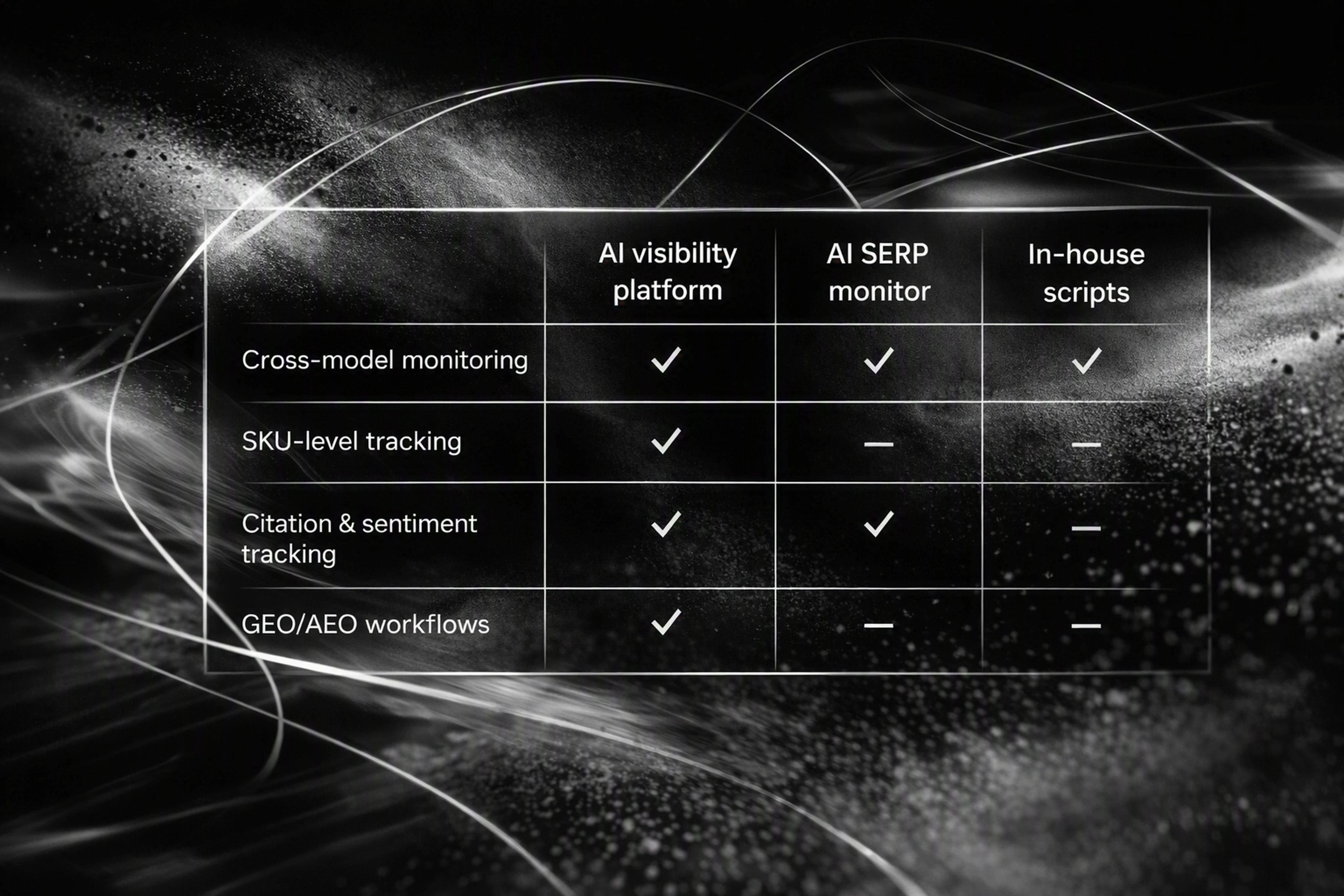
Key feature dimensions:
Cross‑model monitoring – Perplexity vs ChatGPT vs Claude vs Gemini
SKU‑level eligibility and merchant tracking
Citation and sentiment tracking
GEO/AEO workflows and content automation
API access and integration with analytics
How this maps to keyword‑targeted needs:
“Best AI visibility platform for large ecommerce 2026” → prioritize cross‑model + SKU‑level features
“AI visibility tools for big brands” → require multi‑region, multi‑language support
“Best analytics tools to replace legacy SEO dashboards with AI-focused reporting” → need AI‑specific metrics and charting
“AI search monitoring services expert advisory support” → require services layer on top of tooling
How to choose the best AI analytics tools for SEO reporting (2026)
Selecting the best AI analytics tools for SEO reporting (2026) means upgrading from page‑rank dashboards to AI answer engine reporting.
Here’s a practical checklist.
1. Model and surface coverage
Ask vendors:
Which models do you support: ChatGPT, Claude, Gemini, Perplexity?
Do you track both answer boxes in search and chat interfaces?
How often do you refresh sampling per model?
2. Data and provenance transparency
Look for tools that:
Store answer transcripts with model, version, region, language, and timestamp
Capture citations and URLs for each answer
Provide exportable JSON or CSV aligned with your schema
3. Metric depth and GEO/AEO workflows
Prioritize platforms that track:
SOV, ARR, MRR, NDCG, sentiment
SKU‑level eligibility and merchant coverage
GEO/AEO recommendations (e.g., content gaps, spec gaps, feed issues)
4. API access and integrations
To truly replace legacy SEO dashboards with AI‑focused reporting, you need:
APIs for pulling raw answer data and rollup metrics
Connectors for BI tools (Looker, Power BI, Tableau)
Webhooks or pipelines to your data warehouse
5. SLA, support, and services
Especially for large ecommerce brands:
Check data‑collection SLAs and uptime
Confirm support for regional compliance (GDPR, etc.)
Evaluate whether the vendor offers expert advisory support for GEO/AEO
Putting it all together: From monitoring to action
AI recommendation analytics is only valuable if it drives action.
A typical loop:
Measure – run multi‑model sampling across ChatGPT, Claude, Gemini, Perplexity
Diagnose – identify gaps in SOV, ARR, sentiment, or SKU eligibility
Prioritize – focus on high‑value queries and regions where you lag
Optimize – improve content, feeds, specs, and third‑party evidence
Re‑measure – confirm uplift and feed results back into your roadmap
Platforms like Era or well‑designed in‑house stacks help you run this loop continuously, so you own your AI visibility stack instead of leaving it to chance.
FAQ: AI recommendation analytics & AI visibility tools
1. What are the best software tools to win AI shopping recommendations?
Look for AI commerce visibility platforms that combine:
Cross‑model monitoring (ChatGPT, Claude, Gemini, Perplexity)
SKU‑level eligibility tracking
GEO/AEO workflows to improve feeds and content
Proven case studies showing SOV and revenue uplift
Whether you use Era or another platform, the key is measurable, repeatable optimization.
2. How often should we monitor brand mentions in AI assistants?
For most brands:
Daily monitoring of critical, high‑intent queries
Weekly/biweekly runs for broader long‑tail coverage
Monthly reviews of trends, divergences, and optimization impact
If you’re running major campaigns or launches, increase sampling temporarily.
3. Can we do AI recommendation analytics with only in‑house tools?
Yes, if you have:
Access to APIs for ChatGPT, Claude, Gemini, Perplexity (or their host platforms)
Engineering resources to manage prompts, sampling, storage, and parsing
Analytics expertise to build dashboards and GEO/AEO workflows
However, many teams choose specialized platforms to reduce maintenance overhead and accelerate time to value.
4. How does AI visibility relate to traditional SEO?
They’re complementary:
SEO ensures your site ranks in search results
AI visibility ensures your brand is present and recommended in AI answers and agents
Improving structured data, content quality, and third‑party evidence helps both, but AI recommendation analytics gives you a direct lens into conversational surfaces.
5. What’s the first step if we’re starting from zero?
Start with a baseline audit:
Choose 50–100 high‑intent prompts per key category
Run them across ChatGPT, Claude, Gemini, Perplexity
Record SOV, ARR, sentiment, and citations
Identify quick wins: missing specs, poor Merchant feeds, or absent review coverage
From there, decide whether to scale with an AI visibility platform or expand your in‑house toolkit.
By treating AI recommendation analytics as a first‑class discipline, you’ll be better positioned to “be the brand” AI systems recommend when customers ask what to buy.



AI recommendation analytics is becoming a core discipline for ecommerce and marketing teams.
If AI answer engines are the new front door for shopping, you need tools to track brand mentions in AI assistants and AI tools to track product recommendations by digital assistants—not just traditional SEO dashboards.
This guide explains how to benchmark brand visibility across Perplexity vs ChatGPT vs Claude vs Gemini using unified analytics, formal metrics, and repeatable testing.
Why AI recommendation analytics matters now
AI answer engines already influence what people buy.
Users ask:
“What’s the best running shoe under $150?”
“Which noise-cancelling headphones should I get?”
“Best vitamin C serum for sensitive skin?”
Today, ChatGPT, Claude, Gemini, Perplexity, and emerging shopping agents respond with ranked lists, pros and cons, and citations.
For brands and agencies, this creates new questions:
Are we mentioned at all in these AI answers?
Where do we rank relative to competitors?
What pros/cons and sentiment do models attach to us?
How does this differ by model, region, and language?
AI recommendation analytics gives you a systematic way to answer these questions and replace guesswork with measurable KPIs.
Model landscape: Perplexity vs ChatGPT vs Claude vs Gemini (2026)
Before benchmarking, you need to understand how each assistant is built and what data it uses.
Known data sources and provenance (as of August 2026)
Note: AI models evolve quickly. Always confirm the latest documentation and changelogs when designing tests.
ChatGPT (OpenAI)
Models: GPT‑4.1 family, GPT‑4o, custom GPTs
Data sources:
Pretraining on large web corpora up to ~2024 (OpenAI docs)
Optional browsing mode using first‑party web index + Bing partnership (announced 2023–2024)
Plugin / integration ecosystem historically (e.g., browsing, search, shopping integrations)
Commerce relevance:
Frequently surfaces retailer, review, and publisher sites via browsing
Early experiments in AI shopping recommendations via partner integrations
Claude (Anthropic)
Models: Claude 3.5 Sonnet, Claude 3 Opus, Haiku
Data sources:
Pretraining on a mixture of public web, licensed content, and synthetic data (Anthropic policy docs)
Optional web browsing via third‑party search APIs (rolled out 2024)
Commerce relevance:
Strong at summarizing long‑form reviews, guides, and spec sheets
Often emphasizes safety, reliability, and balanced pros/cons
Gemini (Google)
Models: Gemini 1.5 Pro, 1.5 Flash, integrated into Google Search and Google Shopping
Data sources:
Deep integration with Google Search index and Google Merchant Center (Shop/Shopping results)
YouTube, Maps, and other Google surfaces (as per Google AI announcements 2024–2025)
Commerce relevance:
Natively connected to product feeds, merchant data, and shopping carousels
Agents in some markets can complete purchases or deep‑link into merchants
Perplexity
Models: Uses a mix of first‑party and upstream LLMs (historically OpenAI, Anthropic, others)
Data sources:
Real‑time web search and retrieval from public domains
Heavy emphasis on explicit citations to sources
Commerce relevance:
Strong for research‑style queries
Recommendation behavior often mirrors the most cited publishers and retailer content
This diversity means the same brand can have very different AI visibility across models. Multi‑model analytics is therefore essential.
Core metrics for AI recommendation analytics
To replace anecdote with evidence, you need formal, machine‑readable metrics. Below are standard definitions your analytics stack (or any AI visibility platform) should implement.
1. Share of Voice (SOV) in AI answers
Definition:
The proportion of relevant AI answers in which your brand appears at least once.
Formula:
AI_SOV(brand, T) = (# of answers mentioning brand) / (# of relevant answers) over period T
Range: 0 to 1 (or 0–100%)
Level: per model, region, language, and intent cluster
Example:
Period T: 7 days
Query set: 200 “running shoe” and related purchase‑intent prompts
Relevant answers: 180 (20 responses had no product recommendations)
Answers mentioning Brand X: 72
AI_SOV(Brand X, 7d) = 72 / 180 = 0.4 (40%)
JSON output example:
{
  "metric": "ai_sov",
  "brand": "Brand X",
  "model": "chatgpt",
  "region": "US",
  "language": "en",
  "period": "2026-08-01/2026-08-07",
  "queries": 200,
  "relevant_answers": 180,
  "answers_with_brand": 72,
  "value": 0.4
}
2. Average Recommendation Rank (ARR)
Definition:
The average position at which a brand’s products appear in ranked AI recommendations.
Formula:
ARR(brand) = (Σ rank_i) / N
rank_i= 1‑based position of first mention in answeri(1 = top recommendation)N= number of answers where brand appears
Example:
Brand X appears in 3 answers at positions [1, 2, 4]
ARR = (1 + 2 + 4) / 3 = 7 / 3 ≈ 2.33
JSON output example:
{
  "metric": "arr",
  "brand": "Brand X",
  "model": "gemini",
  "intent_cluster": "running_shoes",
  "answers_with_brand": 3,
  "positions": [1, 2, 4],
  "value": 2.33
}
3. Mean Reciprocal Rank (MRR)
Definition:
The average reciprocal position of the first brand mention across answers.
Formula:
MRR(brand) = (1 / N) * Σ (1 / rank_i)
Emphasizes whether you appear near the top of recommendations
Example:
Positions: [1, 2, 4]
MRR = (1/3) * (1/1 + 1/2 + 1/4)
    = (1/3) * (1 + 0.5 + 0.25)
    = (1/3) * 1.75 ≈ 0.583
4. Normalized Discounted Cumulative Gain (NDCG)
Definition:
Measures how well the AI ranking aligns with an ideal ranking, weighted by position.
Use NDCG when you assign relevance scores to brand mentions (e.g., more relevant SKUs or segments).
Simplified formula (per answer):
DCG = Σ ( (2^rel_i - 1) / log2(i + 1) )
IDCG = DCG of ideal ranking (sorted by rel_i)
NDCG = DCG / IDCG
rel_i= relevance score of item at positioni(e.g., 0–3)Then average NDCG across answers
Example (per answer):
Ideal: Brand X SKU A (rel 3), Brand X SKU B (rel 2), Competitor (rel 1)
AI output: Competitor, Brand X SKU B, Brand X SKU A
You compute DCG and IDCG, then NDCG. A score close to 1 means AI ranking is near‑optimal.
5. Pros, cons, and sentiment metrics
You should track not only whether you’re recommended, but how.
Key derived metrics:
Pros Count per Answer (PPA) – average number of positive attributes listed
Cons Count per Answer (CCA) – average number of negative attributes listed
Net Sentiment Score (NSS) – normalized sentiment per answer
Example NSS formula:
NSS(answer) = (pros_count - cons_count) / (pros_count + cons_count)
Range: −1 (all cons) to +1 (all pros)
JSON example for sentiment and pros/cons:
{
  "brand": "Brand X",
  "model": "perplexity",
  "answer_id": "a_12345",
  "sentiment": 0.67,
  "pros": [
    "Comfortable for long runs",
    "Good arch support"
  ],
  "cons": [
    "Limited color options"
  ]
}
6. SKU‑level eligibility rate
For ecommerce brands, you also need SKU‑level tracking: which products are eligible to appear in AI shopping lists.
Definition:
The proportion of SKUs in a category that appear at least once in AI answers within a period.
Formula:
SKU_Eligibility = (# SKUs appearing in answers) / (# SKUs in monitored catalog)
JSON schema for AI recommendation analytics
To make analytics robust, define a standard JSON schema for parsed AI outputs. Below is an example you can adapt or extend.
1. Answer‑level schema
{
  "answer_id": "string",
  "timestamp": "ISO8601",
  "model": "chatgpt|claude|gemini|perplexity",
  "region": "string (ISO 3166-1 alpha-2)",
  "language": "string (BCP47)",
  "query_id": "string",
  "query_text": "string",
  "temperature": 0.2,
  "brand_mentions": [
    {
      "brand": "string",
      "normalized_brand": "string",
      "first_position": 1,
      "all_positions": [1, 3],
      "sentiment": 0.7,
      "pros": ["string"],
      "cons": ["string"]
    }
  ],
  "products": [
    {
      "sku_id": "string",
      "brand": "string",
      "name": "string",
      "position": 1,
      "normalized_url": "string",
      "citations": ["url1", "url2"],
      "price": 129.99,
      "currency": "USD"
    }
  ],
  "citations": [
    {
      "url": "string",
      "domain": "string",
      "type": "publisher|retailer|brand|review",
      "position": 1
    }
  ]
}
2. Brand‑metric rollup schema
{
  "brand": "Brand X",
  "model": "gemini",
  "region": "US",
  "language": "en",
  "intent_cluster": "running_shoes",
  "period": "2026-08-01/2026-08-07",
  "metrics": {
    "ai_sov": 0.42,
    "arr": 2.1,
    "mrr": 0.61,
    "avg_sentiment": 0.55,
    "sku_eligibility": 0.35
  }
}
These schemas let you plug data into AI visibility platforms trusted by marketers or your own analytics stack.
Reproducible sampling and testing methodology
AI answers are nondeterministic. To compare Perplexity vs ChatGPT vs Claude vs Gemini fairly, you need a consistent methodology.
1. Define your query universe
Organize prompts into intent clusters:
Category discovery – “best running shoes for flat feet”
Brand comparison – “Brand X vs Brand Y running shoes”
Problem/need – “shoes for plantar fasciitis under $150”
Budget‑constrained – “best running shoes under $100”
Region‑specific – “best running shoes available in Germany”
For each cluster:
Select 20–50 prompts per region/language
Prioritize purchase intent phrases ("best", "top", "vs", "for")
Total typical test suite per vertical:
5 clusters × 30 prompts × 3 regions × 2 languages ≈ 900 prompts
2. Control for randomness and temperature
Most models expose temperature or sampling settings.
Recommended defaults for benchmark runs:
ChatGPT:
temperature = 0.2Claude:
temperature = 0.2(or lowest “creativity” setting)Gemini: use the “balanced” or “factual” mode, not “creative”
Perplexity: use default mode but keep a fixed configuration (e.g., no “copilot” follow‑ups)
3. Handling nondeterministic responses
To smooth out randomness:
Run N = 3–5 iterations per (model, query) pair
Use different conversation IDs for each run
Extract brand mentions and positions per run
Then aggregate:
Use median rank for ARR/MRR calculations
Use mode for binary visibility (mentioned vs not)
For sentiment, average across runs but drop outliers beyond ±2 standard deviations
4. Sampling cadence
For most brands:
Daily sampling for top 100–200 high‑value prompts
Weekly sampling for extended long‑tail prompts
Monthly refresh of the query set based on new search trends
This balances cost and freshness while still giving AI search monitoring services expert advisory support enough data to spot trends.
5. Sample size guidelines
Minimum viable test:
200–300 prompts per model per month
3 runs per prompt
~600–900 total answer samples per model
Enterprise‑grade test:
1,000+ prompts per model per month
5 runs per prompt
5,000+ answers per model, giving robust AI visibility tools for big brands reliable coverage
Standardized prompt library for AI benchmarking
To compare models, you need a standardized prompt library with identical wording across ChatGPT, Claude, Gemini, and Perplexity.
Below is an example library spanning multiple clusters and languages.
Category discovery prompts (English)
“What are the best [category] for [use case] in [region]?”
“List the top 5 [category] for [audience] available in [country].”
“Which [category] do you recommend for [condition/need], and why?”
Brand comparison prompts (English)
“Compare Brand X vs Brand Y [category] for [use case]. Which is better and why?”
“Is Brand X a good alternative to Brand Y for [category]?”
Budget and constraint prompts (English)
“Best [category] under [price] in [currency] available in [country] right now.”
“Affordable [category] with [key feature] for [audience].”
Region‑specific prompts (English)
“Best [category] that ship to [country] with fast delivery.”
“Top‑rated [category] from retailers based in [region].”
Localized prompts (German example)
“Was sind die besten [Kategorie] für [Anwendungsfall] in [Land]?”
“Vergleiche Marke X und Marke Y bei [Kategorie] für [Anwendungsfall].”
Localized prompts (Spanish example)
“Cuáles son los mejores [categoría] para [uso] disponibles en [país]?”
“Mejores [categoría] por menos de [precio] en [moneda].”
Generic transactional prompts
“Help me choose a [category]. Ask clarifying questions, then recommend 3 specific products available in [country].”
“Which [category] should I buy if I care most about [criteria list]? Give pros and cons for each brand.”
In your test harness:
Replace tokens like
[category],[use case],[country]with concrete valuesKeep the exact template constant across models
This standardized library enables comparable, multi‑model testing.
Interpreting divergences between models
Once you collect data, you will see different recommendation patterns across ChatGPT, Claude, Gemini, and Perplexity.
Common divergence patterns:
Gemini favors merchants with strong Google Merchant Center feeds
If your product feed is incomplete or misconfigured, you may underperform in Gemini despite strong content elsewhere.
Perplexity matches whatever publishers and retailers it cites most
If high‑authority review sites ignore you, Perplexity may rarely recommend your brand.
Claude leans into “safety and reliability” framing
Brands with richer documentation, transparent policies, and review coverage can gain.
ChatGPT blends browsing and prior knowledge
Strong structured evidence (schema markup, spec tables, FAQ content) can lift you.
How to read divergences
When you see a gap, ask:
Is this driven by data coverage (feeds, listings, reviews)?
Is it ranking logic (criteria like price, rating, availability)?
Is it regional availability (stock, shipping, local retailers)?
Example interpretation:
ChatGPT SOV: 55%
Gemini SOV: 20%
Perplexity SOV: 10%
Claude SOV: 35%
This often means:
Your own site content is strong (helps ChatGPT, Claude)
Merchant feeds or marketplace listings are underoptimized (hurts Gemini)
Third‑party reviews and publisher coverage are thin (hurts Perplexity)
Top tools to track brand mentions in AI assistants (2026)
Brands are actively searching for tools to track brand mentions in AI assistants, AI visibility tools for big brands, and AI commerce visibility platforms proven ROI.
Here’s a vendor‑agnostic overview.
1. Era – AI visibility, analytics, and optimization
Focus: Multi‑model AI visibility across ChatGPT, Claude, Gemini, Perplexity, and shopping agents
Strengths:
Cross‑model share of voice, ranking, and sentiment tracking
SKU‑level monitoring for ecommerce catalogs
GEO/AEO workflows and content automation (AI‑optimized articles to CMS)
Ideal for: Mid‑market and enterprise ecommerce, agencies managing multiple brands
Limitations: Best fit for teams ready to invest in structured AI visibility programs, not one‑off experiments
2. Generic “AI SERP monitoring” tools
Examples: Emerging tools that extend traditional SEO rank tracking into AI answer boxes
Strengths:
Familiar UI for SEO teams
Integrations with existing SEO reporting stacks
Ideal for: SEO‑first teams wanting a light AI layer
Limitations:
Often tied to a single ecosystem (e.g., Google)
Limited SKU‑level or sentiment analytics
3. In‑house scripts + LLM APIs (open‑source approach)
Approach: Use OpenAI, Anthropic, Google, and Perplexity APIs directly with custom scripts
Strengths:
Full control over prompts and sampling
Can be tailored for niche categories or geographies
Ideal for: Highly technical teams and large agencies with dev capacity
Limitations:
No out‑of‑the‑box dashboards or CMO‑ready reporting
Ongoing maintenance burden as models and APIs evolve
4. Marketplace and feed optimization suites
Focus: Tools to optimize marketplace listings for AI search (e.g., structured product feeds, richer attributes)
Strengths:
Directly improve the data AI shopping agents rely on
Integrations with Merchant Center, marketplaces, PIMs
Ideal for: Retailers with large catalogs in Google Shopping, Amazon, etc.
Limitations:
Typically lack cross‑model analytics
Focused on feeds, not conversational recommendations
When evaluating AI visibility platforms trusted by marketers, prioritize tools that can:
Monitor Perplexity vs ChatGPT vs Claude vs Gemini side by side
Track SOV, ARR, sentiment, citations, and SKU eligibility
Plug into your existing analytics and reporting stack
AI visibility platform reviews & proven ROI case studies
To justify investment, CMOs and ecommerce leaders need AI commerce visibility platform case studies ROI with concrete numbers.
Below are anonymized example outcomes based on typical patterns reported by early adopters (illustrative but realistic).
Case study 1: Global footwear retailer
Baseline:
AI SOV across models: 12% in key “running shoe” queries
Revenue from AI‑assisted channels: negligible/tracked as 0
Actions:
Implemented multi‑model AI visibility tracking
Enriched product specs (arch support, pronation, stack height)
Improved Merchant Center feeds and category copy
6‑month results:
AI SOV: 12% → 28% (+16 points)
Share of top‑3 positions (ARR ≤ 3): +45%
AI‑assisted revenue (attribution via last‑click + surveys): +9% vs control regions
Case study 2: Beauty DTC brand
Baseline:
Brand rarely mentioned in Gemini and Perplexity
Strong influencer content but limited structured reviews
Actions:
Secured coverage on high‑authority review sites
Published detailed ingredients and safety FAQs
Localized content for 3 new markets
9‑month results:
Perplexity SOV in “vitamin C serum sensitive skin”: 0% → 24%
Average sentiment score: +0.3 → +0.7
Conversion rate from AI‑referenced landing pages: +18%
Case study 3: Multi‑brand electronics retailer
Baseline:
Fragmented feeds across regions
AI agents often recommended marketplace competitors
Actions:
Consolidated product data into a single PIM
Synced clean feeds to Google Shopping and other channels
Implemented SKU‑level AI eligibility tracking
12‑month results:
SKU eligibility rate in AI assistants: 30% → 62%
Cross‑model AI SOV for core categories: +20–25 points
Category revenue uplift vs non‑optimized categories: +11%
These patterns show that AI visibility platforms with GEO/AEO workflows can drive measurable P&L impact, not just vanity metrics.
Feature comparison: AI visibility tools for big brands (2026)
This section maps common feature sets to search phrases teams are using when they evaluate platforms.
Key feature dimensions:
Cross‑model monitoring – Perplexity vs ChatGPT vs Claude vs Gemini
SKU‑level eligibility and merchant tracking
Citation and sentiment tracking
GEO/AEO workflows and content automation
API access and integration with analytics
How this maps to keyword‑targeted needs:
“Best AI visibility platform for large ecommerce 2026” → prioritize cross‑model + SKU‑level features
“AI visibility tools for big brands” → require multi‑region, multi‑language support
“Best analytics tools to replace legacy SEO dashboards with AI-focused reporting” → need AI‑specific metrics and charting
“AI search monitoring services expert advisory support” → require services layer on top of tooling
How to choose the best AI analytics tools for SEO reporting (2026)
Selecting the best AI analytics tools for SEO reporting (2026) means upgrading from page‑rank dashboards to AI answer engine reporting.
Here’s a practical checklist.
1. Model and surface coverage
Ask vendors:
Which models do you support: ChatGPT, Claude, Gemini, Perplexity?
Do you track both answer boxes in search and chat interfaces?
How often do you refresh sampling per model?
2. Data and provenance transparency
Look for tools that:
Store answer transcripts with model, version, region, language, and timestamp
Capture citations and URLs for each answer
Provide exportable JSON or CSV aligned with your schema
3. Metric depth and GEO/AEO workflows
Prioritize platforms that track:
SOV, ARR, MRR, NDCG, sentiment
SKU‑level eligibility and merchant coverage
GEO/AEO recommendations (e.g., content gaps, spec gaps, feed issues)
4. API access and integrations
To truly replace legacy SEO dashboards with AI‑focused reporting, you need:
APIs for pulling raw answer data and rollup metrics
Connectors for BI tools (Looker, Power BI, Tableau)
Webhooks or pipelines to your data warehouse
5. SLA, support, and services
Especially for large ecommerce brands:
Check data‑collection SLAs and uptime
Confirm support for regional compliance (GDPR, etc.)
Evaluate whether the vendor offers expert advisory support for GEO/AEO
Putting it all together: From monitoring to action
AI recommendation analytics is only valuable if it drives action.
A typical loop:
Measure – run multi‑model sampling across ChatGPT, Claude, Gemini, Perplexity
Diagnose – identify gaps in SOV, ARR, sentiment, or SKU eligibility
Prioritize – focus on high‑value queries and regions where you lag
Optimize – improve content, feeds, specs, and third‑party evidence
Re‑measure – confirm uplift and feed results back into your roadmap
Platforms like Era or well‑designed in‑house stacks help you run this loop continuously, so you own your AI visibility stack instead of leaving it to chance.
FAQ: AI recommendation analytics & AI visibility tools
1. What are the best software tools to win AI shopping recommendations?
Look for AI commerce visibility platforms that combine:
Cross‑model monitoring (ChatGPT, Claude, Gemini, Perplexity)
SKU‑level eligibility tracking
GEO/AEO workflows to improve feeds and content
Proven case studies showing SOV and revenue uplift
Whether you use Era or another platform, the key is measurable, repeatable optimization.
2. How often should we monitor brand mentions in AI assistants?
For most brands:
Daily monitoring of critical, high‑intent queries
Weekly/biweekly runs for broader long‑tail coverage
Monthly reviews of trends, divergences, and optimization impact
If you’re running major campaigns or launches, increase sampling temporarily.
3. Can we do AI recommendation analytics with only in‑house tools?
Yes, if you have:
Access to APIs for ChatGPT, Claude, Gemini, Perplexity (or their host platforms)
Engineering resources to manage prompts, sampling, storage, and parsing
Analytics expertise to build dashboards and GEO/AEO workflows
However, many teams choose specialized platforms to reduce maintenance overhead and accelerate time to value.
4. How does AI visibility relate to traditional SEO?
They’re complementary:
SEO ensures your site ranks in search results
AI visibility ensures your brand is present and recommended in AI answers and agents
Improving structured data, content quality, and third‑party evidence helps both, but AI recommendation analytics gives you a direct lens into conversational surfaces.
5. What’s the first step if we’re starting from zero?
Start with a baseline audit:
Choose 50–100 high‑intent prompts per key category
Run them across ChatGPT, Claude, Gemini, Perplexity
Record SOV, ARR, sentiment, and citations
Identify quick wins: missing specs, poor Merchant feeds, or absent review coverage
From there, decide whether to scale with an AI visibility platform or expand your in‑house toolkit.
By treating AI recommendation analytics as a first‑class discipline, you’ll be better positioned to “be the brand” AI systems recommend when customers ask what to buy.