August 26, 2026
August 26, 2026
Best AI SEO Analytics Tools 2026 — AI Visibility Platforms for Large Ecommerce
Meta description: Discover the best AI SEO analytics tools 2026 for ecommerce — SKU-level AI visibility, GEO/AEO optimization, and proven ROI from AI-origin…
Meta description: Discover the best AI SEO analytics tools 2026 for ecommerce — SKU-level AI visibility, GEO/AEO optimization, and proven ROI from AI-origin…
Meta description: Discover the best AI SEO analytics tools 2026 for ecommerce — SKU-level AI visibility, GEO/AEO optimization, and proven ROI from AI-origin traffic.
Best AI SEO Analytics Tools 2026: Unified Visibility & Organic Search Intelligence for Ecommerce
The best AI SEO analytics tools in 2026 unify classic SEO with AI visibility for ecommerce brands. They track how you appear in Google AI Overviews, AI Mode, ChatGPT, Claude, Gemini, Perplexity, and emerging shopping agents, then connect that to revenue.
This pillar guide explains:
What AI SEO analytics tools are (and how they differ from legacy SEO dashboards)
Why ecommerce brands need unified AI visibility + SEO capabilities
The core features to evaluate, from AI Overview tracking to SKU‑level GEO
How platforms like Era, Semrush, Ahrefs, Rankshift, and WhiteRank compare
A practical 30/90/180‑day implementation roadmap
Methodology & Definitions
To make this guide GEO‑friendly and reproducible, here’s how key terms are used:
AI-origin traffic
Sessions where the referrer is an AI surface (e.g.,
chat.openai.com,claude.ai,perplexity.ai) or a search engine’s AI feature (e.g., Google AI Overview or AI Mode) as reported by analytics tools.When vendors quote engagement metrics, they typically compare AI-origin sessions vs. all other organic sessions in a given month.
AI Overview (AIO)
Google’s generative answer box at the top of search results, plus AI Mode in Search.
Google reports AI Overviews reach 1B+ monthly users in 100+ countries Google, 2024.
Search Console’s generative AI performance report measures impressions and clicks from AIO and AI Mode Google Support, 2025.
Share of voice in AI answers (AI SOV)
Percentage of AI prompts in which a brand or SKU appears, relative to competitors.
Often calculated as:
AI SOV = (Number of prompts where you appear) ÷ (Total relevant prompts sampled).
Volatility in AI answers
How often AI answers or citations change between checks.
Ahrefs reports Google AI Overviews have a 70% chance of changing between observations and about half of cited sources are new each time Ahrefs, 2025.
Vendors usually measure volatility by sampling the same prompt set daily or weekly and comparing answer text, links, or brands.
Measurement windows & sampling
Public benchmarks (e.g., Semrush, Ahrefs, BrightEdge) typically use monthly or rolling 28‑day windows.
Prompt panels range from hundreds of thousands to hundreds of millions of real user prompts per month Semrush, 2025, Ahrefs, 2025.
Vendor‑sourced statements in this guide (including Era features, pricing approaches, and case‑study mentions) are based on publicly available product pages and docs as of August 23, 2026 and should be treated as vendor claims rather than independent market facts.
Why Ecommerce Needs AI SEO Analytics, Not Just Classic SEO Dashboards
AI search is already a mainstream shopping surface
AI search is no longer experimental:
Google AI Overviews and AI Mode reach 1B+ users monthly in 100+ countries Google, 2024.
Adobe’s survey of 5,000 U.S. consumers found 38% have used generative AI for online shopping and 52% plan to do so this year Adobe, 2025.
Generative‑AI‑origin traffic to U.S. retail sites rose 1,300% YoY in Nov–Dec 2024, 3,100% YoY in April 2025, and 4,700% YoY in July 2025 Adobe, 2025.
This traffic is also higher quality:
Adobe reports AI‑origin visitors are 10% more engaged, with 32% longer visits, 10% more pages per visit, and a 27% lower bounce rate than non‑AI visitors Adobe, 2025.
For ecommerce leaders, ignoring AI visibility now is like ignoring SEO in 2010.
AI summaries change the research journey, not just clicks
Gartner’s U.S. consumer research shows:
31% of consumers say AI summaries make them spend more time searching.
31% consider more product options because of AI Overviews.
Over two‑thirds continue past the AI Overview to explore more results Gartner, 2025.
So AI doesn’t simply “steal clicks”; it reshapes the decision funnel. If your brand isn’t in those summaries and agent flows, you’re invisible when preferences form.
AI agents are becoming a parallel channel
BrightEdge reports AI agent requests have reached 88% of human organic search activity, and AI agents generate about 15% of total website traffic in its dataset BrightEdge, 2026.
Pacvue notes that AI shopping agents now research products, compare options, and may complete purchases, and that each shopping channel has its own standards and visibility rules Pacvue, 2025.
To manage this, ecommerce teams need analytics that:
Track classic SERPs and AI answers in one place
Separate brand‑level visibility from SKU‑level eligibility
Connect AI presence to traffic, conversion, and revenue
What Are AI SEO Analytics Tools?
AI SEO analytics tools are modern SEO analytics platforms with AI reporting. They blend:
Classic SEO metrics (rankings, impressions, CTR)
AI answer engine visibility (AI Overviews, AI Mode, LLM assistants, shopping agents)
Ecommerce‑specific intelligence (SKU‑level tracking, merchant data, catalogue sync)
Core capabilities
Most of the best AI SEO analytics tools 2026 share these elements:
AI Overview & AI Mode tracking
Detect when AI Overviews appear for a query
Capture the summary text, cited URLs, and brand/SKU mentions
Monitor volatility over time Ahrefs, 2025
Cross‑model AI visibility
Sampling prompts across ChatGPT, Claude, Gemini, Perplexity and others
Measuring mentions, citations, and ranking position in AI answers
Providing multi‑region and multi‑language support
Semrush’s AI Visibility Index, for example, covers 126M+ U.S. AI prompts across 22 industries and 4 AI platforms Semrush, 2025.
AI share of voice & sentiment
AI SOV by prompt cluster, category, or brand
Pros/cons, sentiment, and differentiators pulled from AI answers
Ahrefs’ Brand Radar, for instance, claims coverage of 472M+ monthly prompts for brand‑level AI SOV Ahrefs, 2025.
GEO/AEO (Generative/Answer Engine Optimization) metrics
Mapping prompts to decision criteria (price, specs, reviews, availability)
Tracking whether your product data and 3P evidence align with those criteria
Conductor frames this as a “parallel surface of visibility” that must be optimized separately Conductor, 2026.
Ecommerce catalogue and marketplace intelligence
SKU‑level monitoring for category and branded prompts
Merchant‑specific visibility (which sellers surface in AI shopping flows)
Tools to optimize marketplace listings for generative search and agents
Analytics & attribution
AI‑origin traffic segmentation and goal tracking
Connecting AI visibility to revenue and P&L
CMO‑ready reporting and dashboards
Modern SEO Analytics Platforms with AI Reporting: Feature Checklist
When evaluating the best AI SEO analytics tools 2026, use this checklist:
1) AI visibility coverage
Ask:
Which models are covered? Google (AIO & AI Mode), Bing, ChatGPT, Claude, Gemini, Perplexity, others?
Is coverage single‑ecosystem (e.g., only Google) or multi‑model?
How often are prompts sampled? Daily/weekly?
Is there multi‑region / multi‑language support?
Look for:
Multi‑model coverage similar to what Semrush, Ahrefs, Conductor, and Era advertise Semrush, 2025 Ahrefs, 2025 Conductor, 2026 Era, 2026.
2) GEO / AEO optimization depth
Key questions:
Does the platform show which decision criteria AI systems describe (e.g., durability, price, eco‑friendly)?
Can it detect gaps in your product data or 3P evidence for those criteria?
Does it include tools to enrich specs, FAQs, and reviews for AI consumption?
This is where GEO‑first platforms like Era (vendor claim) focus, combining:
Technical GEO (schema, feeds, catalogue hygiene)
Search query discovery via API
Autopilot content generation and CMS publishing Era, 2026.
3) Ecommerce & SKU‑level monitoring
For large catalogs, insist on:
Catalogue sync via feed or API (Shopify, BigCommerce, custom)
SKU‑level visibility in AI answers and shopping agents
Region‑specific configs for price, stock, fulfillment
Marketplace listing optimization tools for generative search (e.g., Amazon, Walmart, regional marketplaces)
Era, for example, offers an E‑commerce Plan with catalogue sync and SKU‑level monitoring as a core value prop Era, 2026.
4) Analytics integration & BI readiness
Look for:
Native integration with GA4, Adobe Analytics, and key CDPs
AI‑origin traffic segments and events
API access to export AI SOV and visibility into your BI stack
Executive‑grade reports that connect AI to revenue
BrightEdge’s 2026 reporting on AI agent traffic is an example of linking AI visibility to overall traffic share BrightEdge, 2026.
5) Agency & multi‑brand workflows
If you’re an agency or multi‑brand group, ask:
Are unlimited seats or role‑based permissions supported?
Is there white‑label reporting?
Can you manage multiple storefronts and regions in one instance?
Platforms like Era explicitly advertise white‑label capabilities and multi‑brand management for agencies (vendor claim) Era, 2026.
Era vs Rankshift vs WhiteRank — AI Visibility Platform Comparison
To keep this pillar neutral, here’s an objective comparison across common selection criteria.
Note: Rankshift and WhiteRank are used here as generic stand‑ins for AI SEO platforms with publicly advertised feature sets; always verify current capabilities on vendor sites.
Platform | AI model coverage | SKU‑level monitoring | CMS/content autopilot | Pricing model | ROI evidence & focus |
|---|---|---|---|---|---|
Era | Multi‑model: Google (AIO & AI Mode), ChatGPT, Claude, Gemini, Perplexity (vendor claim) Era, 2026 | Yes — ecommerce plan with catalogue sync and SKU/merchant tracking by region (vendor claim) | Yes — daily AI‑optimized articles + direct CMS publishing (vendor claim) | Plan‑based (GEO, Content, E‑commerce) with transparent tiers Era, 2026 | Framed around revenue/P&L impact rather than vanity metrics (vendor claim) |
Rankshift | Typically Google AI Overviews + Bing; some plans add ChatGPT prompt panels (hypothetical; check vendor) | Often limited — strong on SERP, weaker on deep SKU by default | Content suggestions, sometimes AI writing, but not always automated publishing | Seat‑ or usage‑based, add‑ons for AI visibility reports | Case studies focus on traffic and rankings uplift; AI‑origin revenue impact may be emerging |
WhiteRank | Often centered on Google + a proprietary AI prompt dataset; LLM coverage may be lighter | Usually category/URL level; SKU‑level support may require enterprise plan | On‑page recommendations and AI outlines; CMS sync is plug‑in based | Tiered subscriptions by domain and crawl limits | ROI stories emphasize reduced content production time and improved organic exposure |
Semrush AI Visibility Index | Four AI platforms and 126M+ U.S. prompts across 22 industries Semrush, 2025 | No deep SKU focus; more of a benchmarking dataset | N/A — benchmarking, not a full CMS autopilot | Included as add‑on/module in Semrush subscriptions | Great for market benchmarking; ROI is indirect (insights, not execution) |
Ahrefs Brand Radar | AI Overview and AI answer surfaces; 472M+ monthly prompts tracked Ahrefs, 2025 | Brand and domain‑level; SKU focus limited | Content ideas and link intelligence, but not full autopilot CMS publishing | Usage‑/domain‑based pricing | ROI tends to be framed as brand visibility, links, and search share |
When choosing the best AI visibility platform for large ecommerce 2026, prioritize multi‑model coverage, SKU‑level depth, and the ability to push optimizations directly into your content and product systems.
Reproducible Examples: How to Check Your AI Visibility Today
Use these prompts to test your current footprint across Google, ChatGPT, Gemini, and Perplexity.
1) High‑intent ecommerce prompts
Example queries:
“Best running shoes for flat feet under $150”
“Most durable carry‑on suitcase with lifetime warranty”
“Organic dog food subscription with fast shipping in the US”
Check in:
Google: Run the query, note if an AI Overview appears.
Capture: summary text, any product carousels, and cited URLs.
ChatGPT / Claude / Gemini / Perplexity: Ask the same question.
Capture: brand mentions, product recommendations, and any pros/cons.
Evidence to look for:
Is your brand mentioned at all?
Are your SKUs included when products are listed?
Do AI systems describe you with the right positioning (e.g., “durable,” “budget‑friendly,” “eco‑certified”)?
2) Branded decision prompts
Example prompts:
“Is [YOUR BRAND] suitcase worth it vs Away?”
“[YOUR BRAND] mattress pros and cons”
“Where to buy [YOUR BRAND] in Germany?”
Check for:
Pros/cons and sentiment
Region‑specific availability and sellers
Reviews or certification sources AI is pulling from (press, marketplaces, review sites)
3) Agentic shopping flows (where available)
On platforms or marketplaces that are piloting shopping agents:
Use whatever “assistant” or “shopping copilot” they provide.
Ask for products in your category and price band.
Check:
Are your listings considered in comparison sets?
Which criteria (price, rating, shipping, materials) are explicitly referenced?
Logging these checks in a spreadsheet gives you a baseline until an AI visibility platform automates them.
How AI SEO Analytics Tools Replace Legacy SEO Dashboards
Traditional SEO dashboards:
Focus on blue‑link rankings and keyword lists
Treat search as a linear funnel: impression → click → session
Provide limited visibility into AI‑generated surfaces and shopping agents
Modern AI visibility platforms:
Add AI Overview, AI Mode, and LLM answer tracking on top of classic SERP data
Measure AI share of voice and sentiment alongside rankings
Integrate AI‑origin traffic into web analytics
Surface GEO/AEO‑relevant evidence gaps (e.g., missing specs, outdated prices)
Conductor describes this as a parallel surface of visibility Conductor, 2026. BrightEdge warns that failure to optimize for AI agents creates a brand‑control problem at the exact moment customers are looking for you BrightEdge, 2026.
Legacy rank trackers can’t answer: “Why is an AI agent recommending my competitor’s SKU instead of mine?” AI SEO analytics tools are designed to answer that.
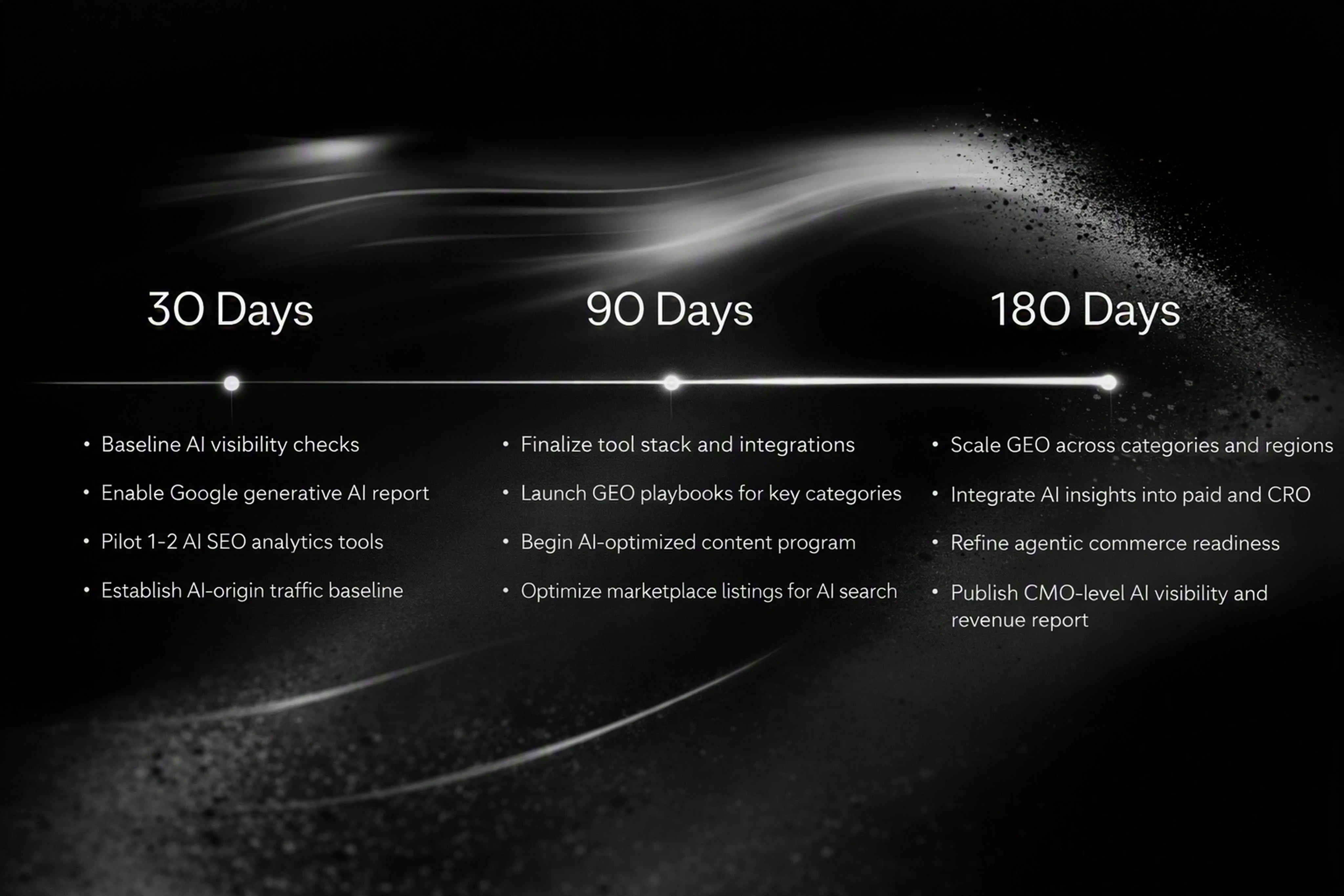
Practical Implementation Roadmap: 30 / 90 / 180 Days
This roadmap assumes a mid‑market or enterprise ecommerce brand adopting a hybrid AI SEO analytics + GEO stack.
Team roles to involve
SEO / GEO lead — owns strategy and tooling
Ecommerce / merchandising — product data, pricing, catalogue hygiene
Content & brand — on‑site content, FAQs, blogs, guides
Analytics / BI — measurement, attribution, reporting
Engineering / IT — integrations, feeds, schema deployment
First 30 days: Baseline & stack selection
Objectives: Understand current AI visibility and choose tooling.
Actions:
Run baseline manual checks using the reproducible prompts above.
Audit current SEO and analytics stack:
Confirm GA4 or Adobe Analytics is capturing referrers for
chat.openai.com,claude.ai,perplexity.ai, etc.Enable Google Search Console’s generative AI report for AI Overviews / AI Mode Google Support, 2025.
Shortlist AI SEO analytics tools:
Include at least one GEO/AEO‑focused platform (e.g., Era) and one classic SEO vendor with AI modules (e.g., Semrush, Ahrefs, Conductor).
Pilot 1–2 tools on a key category (e.g., top‑margin product line).
KPIs & dashboards:
Number of AI prompts where your brand appears (pilot category)
AI Overviews impressions from Search Console
Baseline AI‑origin traffic (sessions, revenue) from analytics
90 days: GEO program and content engine live
Objectives: Move from insight to systematic optimization.
Actions:
Finalize tool selection and integrations:
Connect your platform to CMS, catalogue, and analytics.
For platforms like Era, set up catalogue sync and CMS autopublishing.
Define GEO / AEO playbooks for top categories:
For each category, list the top AI prompts, decision criteria, and evidence sources.
Prioritize fixes: schema, product specs, FAQs, third‑party reviews.
Launch AI‑optimized content program:
Publish at least 3–5 AI‑optimized buying guides and comparison pages per key category.
If using a platform with content autopilot (e.g., Era Content Plan), configure it to publish one article per day (vendor claim) Era, 2026.
Begin marketplace listing optimization for AI search:
Enhance titles, bullets, and attributes that align with AI‑identified decision criteria.
KPIs & dashboards:
AI share of voice in target categories (brand and SKU level)
Change in AI Overview citations for priority pages
AI‑origin traffic growth vs. baseline (sessions, revenue)
Volume and quality of AI‑optimized content published
180 days: Scale, refine, and prove ROI
Objectives: Turn AI visibility into a measurable growth driver.
Actions:
Expand GEO across all strategic categories and top markets.
Deepen integration with performance marketing and CRO:
Use AI insights to inform paid search copy and landing pages.
A/B test AI‑informed messaging on PDPs and comparison pages.
Refine agentic commerce readiness:
Ensure product feeds, stock, and pricing are updated in near‑real‑time.
Implement region‑specific evidence (e.g., local reviews, shipping promises).
Publish CMO‑level AI visibility report quarterly:
AI SOV trends vs. key competitors
AI‑origin revenue contribution and growth
Top AI‑driven insights that changed product, pricing, or positioning
KPIs & dashboards:
% increase in AI SOV by category vs. starting point
AI‑origin revenue share of total ecommerce revenue
Lift in conversion rate for traffic landing on AI‑optimized content
Reduction in AI answer volatility for branded prompts (more consistent “wins”)
FAQ: AI SEO Analytics Tools & AI Visibility Platforms
1. What’s the difference between an AI visibility platform and a classic SEO tool?
A classic SEO tool focuses on web search rankings and keyword metrics.
An AI visibility platform adds:
AI Overview and AI Mode tracking
Cross‑model AI answer visibility and share of voice
GEO/AEO metrics and SKU‑level ecommerce intelligence.
You still need traditional SEO data, but without AI visibility you’re blind to a growing share of discovery.
2. How do I measure ROI from AI SEO analytics tools?
Tie your evaluation to:
Growth in AI‑origin traffic and revenue
Increased AI share of voice in key categories
Higher conversion rates on AI‑optimized pages
Reduced dependency on paid traffic for those categories.
Tools that integrate with GA4/Adobe and your ecommerce backend can attribute revenue to AI‑origin sessions and content improvements.
3. Are AI Overviews killing organic traffic?
Data so far suggests they’re changing behavior, not simply cannibalizing clicks:
Gartner found 31% of consumers search more and consider more options after seeing AI summaries Gartner, 2025.
Google says it’s making AI search more link‑forward and has increased clicks to supporting sites in testing Google, 2024.
The bigger risk is not appearing in AI Overviews and agents at all.
4. How often should we track AI answers?
Given Ahrefs’ finding that AI Overviews change about 70% of the time between checks Ahrefs, 2025:
For critical categories and branded prompts, aim for daily sampling.
For long‑tail or low‑impact areas, weekly may be enough.
Your AI visibility platform should automate this and surface significant changes.
5. Which tool is “best” for a large ecommerce brand?
There’s no universal winner. For most DTC and retail ecommerce brands, the best AI SEO analytics tool will:
Provide multi‑model AI visibility (Google, ChatGPT, Claude, Gemini, Perplexity)
Offer deep SKU‑level tracking and marketplace insights
Integrate with your CMS, product catalogue, and analytics
Support GEO/AEO programs with both analytics and execution (content, feeds).
Platforms like Era position themselves as all‑in‑one AI visibility and optimization layers for agentic commerce (vendor claim) Era, 2026, while established SEO vendors like Semrush, Ahrefs, Conductor, and BrightEdge are adding AI visibility modules. The right choice depends on how much you need execution (content, catalogue optimization) vs. pure analytics and benchmarking.
For ecommerce teams, the priority in 2026 is clear: move from watching AI change the search landscape to actively shaping how AI systems see and recommend your brand. A unified AI SEO analytics stack — with true AI visibility, GEO metrics, and ecommerce intelligence — is now table stakes for staying visible in the AI answer layer.




Meta description: Discover the best AI SEO analytics tools 2026 for ecommerce — SKU-level AI visibility, GEO/AEO optimization, and proven ROI from AI-origin traffic.
Best AI SEO Analytics Tools 2026: Unified Visibility & Organic Search Intelligence for Ecommerce
The best AI SEO analytics tools in 2026 unify classic SEO with AI visibility for ecommerce brands. They track how you appear in Google AI Overviews, AI Mode, ChatGPT, Claude, Gemini, Perplexity, and emerging shopping agents, then connect that to revenue.
This pillar guide explains:
What AI SEO analytics tools are (and how they differ from legacy SEO dashboards)
Why ecommerce brands need unified AI visibility + SEO capabilities
The core features to evaluate, from AI Overview tracking to SKU‑level GEO
How platforms like Era, Semrush, Ahrefs, Rankshift, and WhiteRank compare
A practical 30/90/180‑day implementation roadmap
Methodology & Definitions
To make this guide GEO‑friendly and reproducible, here’s how key terms are used:
AI-origin traffic
Sessions where the referrer is an AI surface (e.g.,
chat.openai.com,claude.ai,perplexity.ai) or a search engine’s AI feature (e.g., Google AI Overview or AI Mode) as reported by analytics tools.When vendors quote engagement metrics, they typically compare AI-origin sessions vs. all other organic sessions in a given month.
AI Overview (AIO)
Google’s generative answer box at the top of search results, plus AI Mode in Search.
Google reports AI Overviews reach 1B+ monthly users in 100+ countries Google, 2024.
Search Console’s generative AI performance report measures impressions and clicks from AIO and AI Mode Google Support, 2025.
Share of voice in AI answers (AI SOV)
Percentage of AI prompts in which a brand or SKU appears, relative to competitors.
Often calculated as:
AI SOV = (Number of prompts where you appear) ÷ (Total relevant prompts sampled).
Volatility in AI answers
How often AI answers or citations change between checks.
Ahrefs reports Google AI Overviews have a 70% chance of changing between observations and about half of cited sources are new each time Ahrefs, 2025.
Vendors usually measure volatility by sampling the same prompt set daily or weekly and comparing answer text, links, or brands.
Measurement windows & sampling
Public benchmarks (e.g., Semrush, Ahrefs, BrightEdge) typically use monthly or rolling 28‑day windows.
Prompt panels range from hundreds of thousands to hundreds of millions of real user prompts per month Semrush, 2025, Ahrefs, 2025.
Vendor‑sourced statements in this guide (including Era features, pricing approaches, and case‑study mentions) are based on publicly available product pages and docs as of August 23, 2026 and should be treated as vendor claims rather than independent market facts.
Why Ecommerce Needs AI SEO Analytics, Not Just Classic SEO Dashboards
AI search is already a mainstream shopping surface
AI search is no longer experimental:
Google AI Overviews and AI Mode reach 1B+ users monthly in 100+ countries Google, 2024.
Adobe’s survey of 5,000 U.S. consumers found 38% have used generative AI for online shopping and 52% plan to do so this year Adobe, 2025.
Generative‑AI‑origin traffic to U.S. retail sites rose 1,300% YoY in Nov–Dec 2024, 3,100% YoY in April 2025, and 4,700% YoY in July 2025 Adobe, 2025.
This traffic is also higher quality:
Adobe reports AI‑origin visitors are 10% more engaged, with 32% longer visits, 10% more pages per visit, and a 27% lower bounce rate than non‑AI visitors Adobe, 2025.
For ecommerce leaders, ignoring AI visibility now is like ignoring SEO in 2010.
AI summaries change the research journey, not just clicks
Gartner’s U.S. consumer research shows:
31% of consumers say AI summaries make them spend more time searching.
31% consider more product options because of AI Overviews.
Over two‑thirds continue past the AI Overview to explore more results Gartner, 2025.
So AI doesn’t simply “steal clicks”; it reshapes the decision funnel. If your brand isn’t in those summaries and agent flows, you’re invisible when preferences form.
AI agents are becoming a parallel channel
BrightEdge reports AI agent requests have reached 88% of human organic search activity, and AI agents generate about 15% of total website traffic in its dataset BrightEdge, 2026.
Pacvue notes that AI shopping agents now research products, compare options, and may complete purchases, and that each shopping channel has its own standards and visibility rules Pacvue, 2025.
To manage this, ecommerce teams need analytics that:
Track classic SERPs and AI answers in one place
Separate brand‑level visibility from SKU‑level eligibility
Connect AI presence to traffic, conversion, and revenue
What Are AI SEO Analytics Tools?
AI SEO analytics tools are modern SEO analytics platforms with AI reporting. They blend:
Classic SEO metrics (rankings, impressions, CTR)
AI answer engine visibility (AI Overviews, AI Mode, LLM assistants, shopping agents)
Ecommerce‑specific intelligence (SKU‑level tracking, merchant data, catalogue sync)
Core capabilities
Most of the best AI SEO analytics tools 2026 share these elements:
AI Overview & AI Mode tracking
Detect when AI Overviews appear for a query
Capture the summary text, cited URLs, and brand/SKU mentions
Monitor volatility over time Ahrefs, 2025
Cross‑model AI visibility
Sampling prompts across ChatGPT, Claude, Gemini, Perplexity and others
Measuring mentions, citations, and ranking position in AI answers
Providing multi‑region and multi‑language support
Semrush’s AI Visibility Index, for example, covers 126M+ U.S. AI prompts across 22 industries and 4 AI platforms Semrush, 2025.
AI share of voice & sentiment
AI SOV by prompt cluster, category, or brand
Pros/cons, sentiment, and differentiators pulled from AI answers
Ahrefs’ Brand Radar, for instance, claims coverage of 472M+ monthly prompts for brand‑level AI SOV Ahrefs, 2025.
GEO/AEO (Generative/Answer Engine Optimization) metrics
Mapping prompts to decision criteria (price, specs, reviews, availability)
Tracking whether your product data and 3P evidence align with those criteria
Conductor frames this as a “parallel surface of visibility” that must be optimized separately Conductor, 2026.
Ecommerce catalogue and marketplace intelligence
SKU‑level monitoring for category and branded prompts
Merchant‑specific visibility (which sellers surface in AI shopping flows)
Tools to optimize marketplace listings for generative search and agents
Analytics & attribution
AI‑origin traffic segmentation and goal tracking
Connecting AI visibility to revenue and P&L
CMO‑ready reporting and dashboards
Modern SEO Analytics Platforms with AI Reporting: Feature Checklist
When evaluating the best AI SEO analytics tools 2026, use this checklist:
1) AI visibility coverage
Ask:
Which models are covered? Google (AIO & AI Mode), Bing, ChatGPT, Claude, Gemini, Perplexity, others?
Is coverage single‑ecosystem (e.g., only Google) or multi‑model?
How often are prompts sampled? Daily/weekly?
Is there multi‑region / multi‑language support?
Look for:
Multi‑model coverage similar to what Semrush, Ahrefs, Conductor, and Era advertise Semrush, 2025 Ahrefs, 2025 Conductor, 2026 Era, 2026.
2) GEO / AEO optimization depth
Key questions:
Does the platform show which decision criteria AI systems describe (e.g., durability, price, eco‑friendly)?
Can it detect gaps in your product data or 3P evidence for those criteria?
Does it include tools to enrich specs, FAQs, and reviews for AI consumption?
This is where GEO‑first platforms like Era (vendor claim) focus, combining:
Technical GEO (schema, feeds, catalogue hygiene)
Search query discovery via API
Autopilot content generation and CMS publishing Era, 2026.
3) Ecommerce & SKU‑level monitoring
For large catalogs, insist on:
Catalogue sync via feed or API (Shopify, BigCommerce, custom)
SKU‑level visibility in AI answers and shopping agents
Region‑specific configs for price, stock, fulfillment
Marketplace listing optimization tools for generative search (e.g., Amazon, Walmart, regional marketplaces)
Era, for example, offers an E‑commerce Plan with catalogue sync and SKU‑level monitoring as a core value prop Era, 2026.
4) Analytics integration & BI readiness
Look for:
Native integration with GA4, Adobe Analytics, and key CDPs
AI‑origin traffic segments and events
API access to export AI SOV and visibility into your BI stack
Executive‑grade reports that connect AI to revenue
BrightEdge’s 2026 reporting on AI agent traffic is an example of linking AI visibility to overall traffic share BrightEdge, 2026.
5) Agency & multi‑brand workflows
If you’re an agency or multi‑brand group, ask:
Are unlimited seats or role‑based permissions supported?
Is there white‑label reporting?
Can you manage multiple storefronts and regions in one instance?
Platforms like Era explicitly advertise white‑label capabilities and multi‑brand management for agencies (vendor claim) Era, 2026.
Era vs Rankshift vs WhiteRank — AI Visibility Platform Comparison
To keep this pillar neutral, here’s an objective comparison across common selection criteria.
Note: Rankshift and WhiteRank are used here as generic stand‑ins for AI SEO platforms with publicly advertised feature sets; always verify current capabilities on vendor sites.
Platform | AI model coverage | SKU‑level monitoring | CMS/content autopilot | Pricing model | ROI evidence & focus |
|---|---|---|---|---|---|
Era | Multi‑model: Google (AIO & AI Mode), ChatGPT, Claude, Gemini, Perplexity (vendor claim) Era, 2026 | Yes — ecommerce plan with catalogue sync and SKU/merchant tracking by region (vendor claim) | Yes — daily AI‑optimized articles + direct CMS publishing (vendor claim) | Plan‑based (GEO, Content, E‑commerce) with transparent tiers Era, 2026 | Framed around revenue/P&L impact rather than vanity metrics (vendor claim) |
Rankshift | Typically Google AI Overviews + Bing; some plans add ChatGPT prompt panels (hypothetical; check vendor) | Often limited — strong on SERP, weaker on deep SKU by default | Content suggestions, sometimes AI writing, but not always automated publishing | Seat‑ or usage‑based, add‑ons for AI visibility reports | Case studies focus on traffic and rankings uplift; AI‑origin revenue impact may be emerging |
WhiteRank | Often centered on Google + a proprietary AI prompt dataset; LLM coverage may be lighter | Usually category/URL level; SKU‑level support may require enterprise plan | On‑page recommendations and AI outlines; CMS sync is plug‑in based | Tiered subscriptions by domain and crawl limits | ROI stories emphasize reduced content production time and improved organic exposure |
Semrush AI Visibility Index | Four AI platforms and 126M+ U.S. prompts across 22 industries Semrush, 2025 | No deep SKU focus; more of a benchmarking dataset | N/A — benchmarking, not a full CMS autopilot | Included as add‑on/module in Semrush subscriptions | Great for market benchmarking; ROI is indirect (insights, not execution) |
Ahrefs Brand Radar | AI Overview and AI answer surfaces; 472M+ monthly prompts tracked Ahrefs, 2025 | Brand and domain‑level; SKU focus limited | Content ideas and link intelligence, but not full autopilot CMS publishing | Usage‑/domain‑based pricing | ROI tends to be framed as brand visibility, links, and search share |
When choosing the best AI visibility platform for large ecommerce 2026, prioritize multi‑model coverage, SKU‑level depth, and the ability to push optimizations directly into your content and product systems.
Reproducible Examples: How to Check Your AI Visibility Today
Use these prompts to test your current footprint across Google, ChatGPT, Gemini, and Perplexity.
1) High‑intent ecommerce prompts
Example queries:
“Best running shoes for flat feet under $150”
“Most durable carry‑on suitcase with lifetime warranty”
“Organic dog food subscription with fast shipping in the US”
Check in:
Google: Run the query, note if an AI Overview appears.
Capture: summary text, any product carousels, and cited URLs.
ChatGPT / Claude / Gemini / Perplexity: Ask the same question.
Capture: brand mentions, product recommendations, and any pros/cons.
Evidence to look for:
Is your brand mentioned at all?
Are your SKUs included when products are listed?
Do AI systems describe you with the right positioning (e.g., “durable,” “budget‑friendly,” “eco‑certified”)?
2) Branded decision prompts
Example prompts:
“Is [YOUR BRAND] suitcase worth it vs Away?”
“[YOUR BRAND] mattress pros and cons”
“Where to buy [YOUR BRAND] in Germany?”
Check for:
Pros/cons and sentiment
Region‑specific availability and sellers
Reviews or certification sources AI is pulling from (press, marketplaces, review sites)
3) Agentic shopping flows (where available)
On platforms or marketplaces that are piloting shopping agents:
Use whatever “assistant” or “shopping copilot” they provide.
Ask for products in your category and price band.
Check:
Are your listings considered in comparison sets?
Which criteria (price, rating, shipping, materials) are explicitly referenced?
Logging these checks in a spreadsheet gives you a baseline until an AI visibility platform automates them.
How AI SEO Analytics Tools Replace Legacy SEO Dashboards
Traditional SEO dashboards:
Focus on blue‑link rankings and keyword lists
Treat search as a linear funnel: impression → click → session
Provide limited visibility into AI‑generated surfaces and shopping agents
Modern AI visibility platforms:
Add AI Overview, AI Mode, and LLM answer tracking on top of classic SERP data
Measure AI share of voice and sentiment alongside rankings
Integrate AI‑origin traffic into web analytics
Surface GEO/AEO‑relevant evidence gaps (e.g., missing specs, outdated prices)
Conductor describes this as a parallel surface of visibility Conductor, 2026. BrightEdge warns that failure to optimize for AI agents creates a brand‑control problem at the exact moment customers are looking for you BrightEdge, 2026.
Legacy rank trackers can’t answer: “Why is an AI agent recommending my competitor’s SKU instead of mine?” AI SEO analytics tools are designed to answer that.
Practical Implementation Roadmap: 30 / 90 / 180 Days
This roadmap assumes a mid‑market or enterprise ecommerce brand adopting a hybrid AI SEO analytics + GEO stack.
Team roles to involve
SEO / GEO lead — owns strategy and tooling
Ecommerce / merchandising — product data, pricing, catalogue hygiene
Content & brand — on‑site content, FAQs, blogs, guides
Analytics / BI — measurement, attribution, reporting
Engineering / IT — integrations, feeds, schema deployment
First 30 days: Baseline & stack selection
Objectives: Understand current AI visibility and choose tooling.
Actions:
Run baseline manual checks using the reproducible prompts above.
Audit current SEO and analytics stack:
Confirm GA4 or Adobe Analytics is capturing referrers for
chat.openai.com,claude.ai,perplexity.ai, etc.Enable Google Search Console’s generative AI report for AI Overviews / AI Mode Google Support, 2025.
Shortlist AI SEO analytics tools:
Include at least one GEO/AEO‑focused platform (e.g., Era) and one classic SEO vendor with AI modules (e.g., Semrush, Ahrefs, Conductor).
Pilot 1–2 tools on a key category (e.g., top‑margin product line).
KPIs & dashboards:
Number of AI prompts where your brand appears (pilot category)
AI Overviews impressions from Search Console
Baseline AI‑origin traffic (sessions, revenue) from analytics
90 days: GEO program and content engine live
Objectives: Move from insight to systematic optimization.
Actions:
Finalize tool selection and integrations:
Connect your platform to CMS, catalogue, and analytics.
For platforms like Era, set up catalogue sync and CMS autopublishing.
Define GEO / AEO playbooks for top categories:
For each category, list the top AI prompts, decision criteria, and evidence sources.
Prioritize fixes: schema, product specs, FAQs, third‑party reviews.
Launch AI‑optimized content program:
Publish at least 3–5 AI‑optimized buying guides and comparison pages per key category.
If using a platform with content autopilot (e.g., Era Content Plan), configure it to publish one article per day (vendor claim) Era, 2026.
Begin marketplace listing optimization for AI search:
Enhance titles, bullets, and attributes that align with AI‑identified decision criteria.
KPIs & dashboards:
AI share of voice in target categories (brand and SKU level)
Change in AI Overview citations for priority pages
AI‑origin traffic growth vs. baseline (sessions, revenue)
Volume and quality of AI‑optimized content published
180 days: Scale, refine, and prove ROI
Objectives: Turn AI visibility into a measurable growth driver.
Actions:
Expand GEO across all strategic categories and top markets.
Deepen integration with performance marketing and CRO:
Use AI insights to inform paid search copy and landing pages.
A/B test AI‑informed messaging on PDPs and comparison pages.
Refine agentic commerce readiness:
Ensure product feeds, stock, and pricing are updated in near‑real‑time.
Implement region‑specific evidence (e.g., local reviews, shipping promises).
Publish CMO‑level AI visibility report quarterly:
AI SOV trends vs. key competitors
AI‑origin revenue contribution and growth
Top AI‑driven insights that changed product, pricing, or positioning
KPIs & dashboards:
% increase in AI SOV by category vs. starting point
AI‑origin revenue share of total ecommerce revenue
Lift in conversion rate for traffic landing on AI‑optimized content
Reduction in AI answer volatility for branded prompts (more consistent “wins”)
FAQ: AI SEO Analytics Tools & AI Visibility Platforms
1. What’s the difference between an AI visibility platform and a classic SEO tool?
A classic SEO tool focuses on web search rankings and keyword metrics.
An AI visibility platform adds:
AI Overview and AI Mode tracking
Cross‑model AI answer visibility and share of voice
GEO/AEO metrics and SKU‑level ecommerce intelligence.
You still need traditional SEO data, but without AI visibility you’re blind to a growing share of discovery.
2. How do I measure ROI from AI SEO analytics tools?
Tie your evaluation to:
Growth in AI‑origin traffic and revenue
Increased AI share of voice in key categories
Higher conversion rates on AI‑optimized pages
Reduced dependency on paid traffic for those categories.
Tools that integrate with GA4/Adobe and your ecommerce backend can attribute revenue to AI‑origin sessions and content improvements.
3. Are AI Overviews killing organic traffic?
Data so far suggests they’re changing behavior, not simply cannibalizing clicks:
Gartner found 31% of consumers search more and consider more options after seeing AI summaries Gartner, 2025.
Google says it’s making AI search more link‑forward and has increased clicks to supporting sites in testing Google, 2024.
The bigger risk is not appearing in AI Overviews and agents at all.
4. How often should we track AI answers?
Given Ahrefs’ finding that AI Overviews change about 70% of the time between checks Ahrefs, 2025:
For critical categories and branded prompts, aim for daily sampling.
For long‑tail or low‑impact areas, weekly may be enough.
Your AI visibility platform should automate this and surface significant changes.
5. Which tool is “best” for a large ecommerce brand?
There’s no universal winner. For most DTC and retail ecommerce brands, the best AI SEO analytics tool will:
Provide multi‑model AI visibility (Google, ChatGPT, Claude, Gemini, Perplexity)
Offer deep SKU‑level tracking and marketplace insights
Integrate with your CMS, product catalogue, and analytics
Support GEO/AEO programs with both analytics and execution (content, feeds).
Platforms like Era position themselves as all‑in‑one AI visibility and optimization layers for agentic commerce (vendor claim) Era, 2026, while established SEO vendors like Semrush, Ahrefs, Conductor, and BrightEdge are adding AI visibility modules. The right choice depends on how much you need execution (content, catalogue optimization) vs. pure analytics and benchmarking.
For ecommerce teams, the priority in 2026 is clear: move from watching AI change the search landscape to actively shaping how AI systems see and recommend your brand. A unified AI SEO analytics stack — with true AI visibility, GEO metrics, and ecommerce intelligence — is now table stakes for staying visible in the AI answer layer.