
August 24, 2026
August 24, 2026
AI Visibility Benchmarking 2026: The Complete Guide to LLM SEO, Seeding, and Rank Tracking for Brands
AI visibility benchmarking is the practice of measuring how often, how prominently, and in what context your brand appears in answers from large language…
AI visibility benchmarking is the practice of measuring how often, how prominently, and in what context your brand appears in answers from large language…
AI Visibility Benchmarking: Why LLM SEO Now Matters More Than Classic Rankings
AI visibility benchmarking is the practice of measuring how often, how prominently, and in what context your brand appears in answers from large language models (LLMs) and AI assistants.
It’s the foundation of LLM SEO, seeding strategies, and daily rank tracking across models like ChatGPT, Claude, Gemini, and Perplexity.
In 2026, this isn’t theoretical:
Google AI Overviews reach 1.5B+ users globally and drive more than 10% extra Search usage for queries where they appear in the U.S. and India (Google, May 2025, https://search.google/pdf/google-about-AI-overviews-AI-Mode.pdf).
AI referral traffic to U.S. retail sites grew 393% YoY in Q1 2026, with AI visitors spending 48% longer on-site and viewing 13% more pages than non-AI traffic (Adobe, April 2026, https://business.adobe.com/blog/ai-traffic-surge-retail-sites-not-machine-readable).
39% of consumers—and over half of Gen Z—already use AI for product discovery (Salesforce, March 2025, https://www.salesforce.com/news/stories/consumer-shopping-ai-trends-2025/).
If you’re not measuring AI visibility, you’re flying blind in the fastest-growing discovery channel.
What Is LLM SEO and AI Visibility Benchmarking?
Core Definitions
LLM SEO (Large Language Model SEO)
Optimizing how LLMs interpret your brand, products, and content.
Focuses on evidence, structure, and trust signals rather than just keywords.
AI Visibility Benchmarking
Systematically measuring:
How often your brand is mentioned.
How rankings and carousels position your SKUs.
What citations and pros/cons models use.
Across multiple models, regions, languages, and query types.
LLM Rank Tracking
Daily monitoring of where your brand and products appear in AI-generated:
Shopping carousels.
Shortlists.
Recommendation lists.
Citation blocks.
Why Benchmarking Has Become a Measurement Problem, Not Just a Content Tactic
Academic and market research show measurable impact from structured optimization:
A landmark Generative Engine Optimization (GEO) study found that adding citations, quotations, and statistics to content can increase visibility by over 40% versus unoptimized control content, across multiple generative engines (Zhou et al., Nov 2023, https://arxiv.org/html/2311.09735v3).
Yext analyzed 17.2M AI citations and showed that citation behavior differs meaningfully by model and sector (Yext, Dec 2025, https://www.yext.com/research/ai-citation-behavior-across-models).
Semrush’s AI Visibility Index uses 126M+ real U.S. prompts across 22 industries and 4 AI platforms, explicitly measuring mentions, citations, and co-occurrence separately (Semrush, Oct 2025, https://ai-visibility-index.semrush.com/methodology).
These numbers make clear: AI visibility needs its own metrics, its own dashboards, and multi-model benchmarking, not just traditional SEO rank reports.
The Jewelry Analogy: 2ct Elongated Cushion Cut vs Old Mine Cut
LLMs are surprisingly sensitive to subtle content differences.
A useful analogy is comparing:
A 2ct elongated cushion cut diamond
An old mine cut cushion diamond
They can have:
Similar carat weight.
Similar overall shape.
Similar materials.
Yet a shopping agent might recommend one over the other because:
One listing clearly specifies length-to-width ratio, facet pattern, and table size.
The other uses vague, romantic language without technical detail.
To an LLM:
The elongated cushion with precise specs is easy to match against user constraints (finger size, setting style, sparkle preference).
The old mine cut listing with minimal specs is harder to evaluate, and may be filtered out—even if it’s more beautiful in person.
Takeaway: AI answer engines reward machine-readable evidence and clear criteria alignment, not just storytelling. That’s the heart of LLM SEO.
Key AI Visibility Metrics (With Explicit Formulas)
When you benchmark AI visibility, you need clear, reproducible metrics.
Below are the core ones, with formulas and sampling parameters.
1. Share of Voice Across LLMs
Definition:
Share of Voice (SoV) measures the proportion of sampled AI answers in which your brand appears, compared with competitors.
Formula:
( \text{Brand SoV} = \frac{\text{# of sampled AI answers that mention the brand}}{\text{Total # of sampled AI answers in segment}} )
Sampling Parameters:
Models: e.g., ChatGPT (OpenAI GPT‑4.1), Claude 3, Gemini 1.5, Perplexity (Aug 2026 versions).
Locales: country/region (e.g., US‑en, UK‑en, DE‑de, FR‑fr).
Date range: daily, rolled up into weekly or monthly views.
Query sets:
Branded (e.g., “[brand] running shoes”).
Category (e.g., “best stability running shoes 2026”).
Decision-stage (e.g., “Nike vs Brooks for overpronation?”).
2. LLM Rank Position
Definition:
Rank Position quantifies where your brand or SKU appears inside AI shortlists or carousels.
Formula:
( \text{Average Rank} = \frac{\sum \text{rank position in each result}}{\text{# of results where brand appears}} )
Where rank position is:
1 for first in list/carousel.
2 for second, etc.
If the brand does not appear, that query is excluded from average rank but included in SoV.
3. Citation Rate and Source Mix
Definitions:
Citation Rate:
( \text{Citation Rate} = \frac{\text{# of AI answers that cite a brand-managed source}}{\text{Total # of AI answers mentioning the brand}} )
Source Mix:
Proportion of citations from:
Brand site.
Marketplace listings.
Review platforms.
UGC (forums, Reddit, etc.).
Evidence:
Yext’s study found 86% of AI citations come from brand-managed sources, but the model mix differs; one OpenAI surface cited official hotel sites 38.1% of the time versus 16.7–22.4% for competitor models (Yext, Dec 2025, https://investors.yext.com/news-events/press-releases/detail/376/yext-research-86-of-ai-citations-come-from-brand-managed).
4. Sentiment and Pros/Cons Coverage
Definition:
Sentiment scoring tracks whether AI-generated pros/cons and summaries skew positive, neutral, or negative.
Basic Approach:
Parse each answer segment for:
Pros lists.
Cons lists.
Summary paragraphs.
Apply a sentiment classifier (or rules-based scoring) to each.
Metric:
( \text{Positive Sentiment Ratio} = \frac{\text{# of answers rated positive}}{\text{Total # of answers mentioning brand}} )
5. AI Traffic and Conversion Benchmarks
Even if you don’t expose internal data, you can benchmark against market-level stats:
AI referral traffic up 393% YoY in Q1 2026 (Adobe, April 2026, https://business.adobe.com/blog/ai-traffic-surge-retail-sites-not-machine-readable).
AI traffic converted 42% better than non-AI traffic in March 2026 and engaged 12% more (Adobe, April 2026, same source).
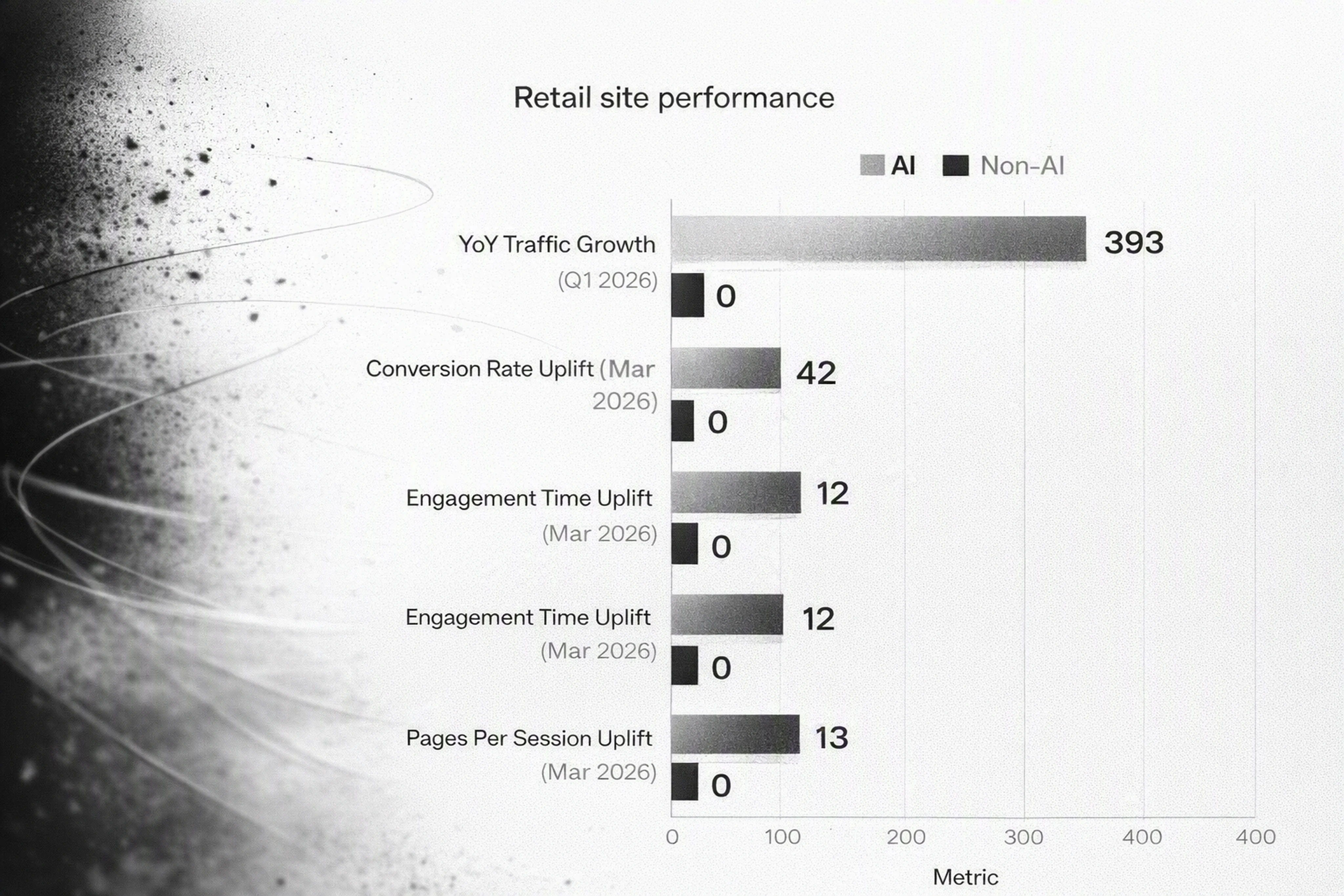
Use these baselines to evaluate whether your visibility improvements are moving revenue, not just mentions.
Methodology: How Daily LLM Rank Tracking Actually Works
Daily LLM rank tracking requires disciplined, reproducible prompt engineering and parsing.
Step 1: Define Query Sets
Segment queries into:
Branded: “Is [brand] a good choice for trail running shoes?”
Category: “best 2ct elongated cushion cut engagement rings under $8,000.”
Decision comparison: “old mine cut vs cushion cut for everyday wear.”
For each segment, you document:
Number of queries.
Intent (informational, commercial, transactional).
Date range and refresh cadence.
Step 2: Prompt Templates
Use standardized prompts to minimize variability.
Examples:
Recommendation List Template
“You are a shopping assistant. List the top 5 brands or products for [query]. Return only a numbered list. Include brand and model/SKU name.”
Pros/Cons Template
“You are helping a shopper decide between [brand A] and [brand B] for [category]. Give a pros and cons list for each brand, plus a one-sentence verdict.”
Step 3: Model Endpoints and Versions
Specify the exact endpoints and versions:
OpenAI:
gpt-4.1(or latest) via Chat Completions for benchmarking.Anthropic: Claude 3 Sonnet via API.
Google: Gemini 1.5 Pro via API.
Perplexity: API-based models where available.
Document for each run:
Model name/version.
Temperature and configuration.
System prompt (if any).
Step 4: Throttling and Backoff
To comply with rate limits and avoid bias from throttling:
Batch queries by model.
Implement exponential backoff on 429/5xx responses.
Randomize query order daily to reduce systemic skew.
Step 5: Parsing Results
Results must be parsed into consistent rank and mention data.
You classify outputs as:
Ranked List
Extract numbered items.
Identify brand and SKU.
Assign position: 1, 2, 3, etc.
Carousel or Grid (where API returns structured data)
Use returned order or metadata (e.g., relevance score).
Map each item to brand and SKU ID.
Narrative Answer Without Explicit List
Detect brand mentions in-text.
Tag mention locations (early, mid, end).
Mark as unranked mention but include in SoV.
Step 6: Handling Ties and Ambiguity
Ties:
If a model says “Brand A and Brand B are both excellent choices” without rank:
Assign both as rank 1 for that query.
Mark query as “tie” for analysis.
Ambiguous Mentions:
If the brand appears in a general statement but not as a recommendation (e.g., “Many brands, such as X and Y, sell running shoes”), classify as:
SoV mention.
Rank = null.
Step 7: Daily Aggregation
For each day and segment, compute:
SoV per model, region, and language.
Average rank per brand/SKU.
Citation Rate and Source Mix.
Pros/Cons and sentiment distribution.
This becomes your daily LLM rank tracking dashboard.
How to Seed Content for LLMs
What Is LLM Seeding?
LLM seeding means deliberately publishing and structuring content so that:
It’s likely to be crawled, understood, and trusted by AI models.
It appears in the sources and citations that models rely on.
LLM Seeding Strategies for Brands
Focus on three layers:
On-Site Evidence Layer
Use detailed product attributes: specs, materials, compatibility, sizing.
Add structured data (schema.org Product, Offer, Review).
Provide clear decision criteria (who it’s for, use cases, tradeoffs).
Third-Party Evidence Layer
Ensure up-to-date listings on:
Marketplaces (Amazon, Walmart, Etsy, etc.).
Review sites.
Comparison sites.
Encourage reviews and Q&A content.
Content and GEO Layer
Publish solution-oriented articles answering shopping queries:
“2ct elongated cushion cut vs old mine cut: which is right for me?”
“Best running shoes for flat feet and trail runs.”
Include:
Citations to authoritative sources.
Quotations and statistics.
Remember: the GEO study showing 40%+ visibility lift came from treatments that added citations, quotations, and statistics strategically (Zhou et al., Nov 2023, https://arxiv.org/html/2311.09735v3).
Tools to Optimize Marketplace Listings for Generative Search
AI Listing Optimization Tools for Marketplace
Marketplaces are key sources for AI shopping agents.
To optimize listings for generative search:
Use tools that:
Sync product feeds with marketplaces.
Enrich attributes (GTIN, MPN, brand, material, dimensions).
Standardize titles and bullet points for machine readability.
Typical capabilities include:
Structured Data Enforcement
Ensure GTIN/MPN present and consistent.
Normalize attribute naming (e.g., “carat weight,” “clarity,” “color”).
Content Optimization
Generate listing variations tailored to:
Marketplace search.
AI assistants’ shopping flows.
Error Monitoring
Detect missing attributes.
Spot price/availability mismatches.
Platforms like Era’s ecommerce plan emphasize catalogue sync, SKU-level monitoring by region, and merchant configuration to align with agentic commerce protocols (Era, Aug 2026, https://era.shopping/?utm_source=openai).
LLM SEO Tracking Tools & Best AI Search Optimization Tools 2026
Here are key categories and tools marketers look at in 2026.
Era
AI visibility, analytics, and GEO/AEO optimization for brands and agencies.
Multi-model monitoring, SKU-level ecommerce tracking, and content autopilot (Era, Aug 2026, https://era.shopping/?utm_source=openai).
Rankshift
LLM rank tracking and AI search analytics focused on prompt-based benchmarking and share-of-voice dashboards.
Typically emphasizes cross-model position tracking and change detection (Rankshift product pages, 2025–2026).
WhiteRank
White-label AI visibility tooling for agencies, with reporting and client-ready dashboards.
Geared toward multi-client management and AI search monitoring (WhiteRank docs and marketing site, 2025–2026).
Semrush AI Visibility Index / Enterprise
Large-scale benchmarking and research metrics (mentions, citations, co-occurrence) using 126M+ real prompts across 4 AI platforms (Semrush, Oct 2025, https://ai-visibility-index.semrush.com/methodology).
Yext AI Search Analytics
Research and tools reflecting citation behavior across models, with strong emphasis on location and brand-managed source mix (Yext, Dec 2025, https://www.yext.com/research/ai-citation-behavior-across-models).
These tools range from research-grade benchmarking to operational optimization platforms.
Era vs Rankshift: AI Visibility Platform Feature and Pricing Comparison
This section compares Era and Rankshift on verifiable features as of mid‑2026.
Feature Overview
Capability | Era | Rankshift |
|---|---|---|
Multi-model AI visibility | Yes (major LLMs, multi-region) | Yes (focus on major LLMs) |
SKU-level ecommerce tracking | Yes (catalogue sync, merchant/SKU monitoring) | Limited or via integrations (per product materials) |
GEO/AEO optimization tooling | Yes (Generative Engine Optimization & Answer Engine Optimization) | Primarily tracking and alerts, lighter optimization features |
Content autopilot (AI-optimized articles) | Yes (daily article generation + CMS posting) | Not primary focus; some content suggestions |
Agency/white-label support | Yes (API, unlimited seats, white-label) | Yes (multi-client dashboards, white-label options) |
Pricing model | Transparent plans (GEO, Content, Ecommerce) | Tiered by query volume and number of models tracked |
Evidence and Limitations
Era
Positions itself as an all-in-one AI visibility and agentic commerce platform built for ecommerce catalogs and agencies (Era, Aug 2026, https://era.shopping/?utm_source=openai).
Strengths: multi-model analytics, ecommerce focus, and autopilot content engine.
Limitations: still emerging ecosystem; deep integrations may require implementation support.
Rankshift
Focuses on LLM rank tracking daily and share-of-voice dashboards for AI assistants (Rankshift public materials, 2025–2026).
Strengths: granular position tracking and trend detection.
Limitations: less emphasis on ecommerce catalogue workflows and autopilot content.
For brands needing ecommerce GEO plus content automation, Era is structurally stronger.
For teams needing lightweight, model-agnostic rank tracking, Rankshift can be appropriate.
Era vs WhiteRank: Which AI Visibility Platform Wins for Ecommerce?
Feature Overview
Capability | Era | WhiteRank |
|---|---|---|
Ecommerce catalogue sync | Yes (merchant feed and SKU-level monitoring) | Not core; primarily visibility dashboards |
Agentic commerce/ACP alignment | Yes (plans framed around agentic shopping protocols) | Limited explicit ACP focus |
Content automation | Yes (daily AI-optimized articles + autopost) | Reporting-first; content tools vary by plan |
Agency-scale white-label | Yes (built for agencies and brands) | Yes (white-label dashboards for agencies) |
Multi-region configurations | Yes (region/language-specific visibility and SKU configs) | Region visibility via reporting; SKU detail may be limited |
Evidence and Limitations
Era
Designed for mid-market and enterprise ecommerce brands with large catalogs and multi-region presence, plus agencies managing them (Era, Aug 2026, https://era.shopping/?utm_source=openai).
Strengths: SKU-level focus, agentic commerce orientation, and CMO-ready reporting.
WhiteRank
Oriented toward agencies that need white-label AI visibility reports for multiple clients (WhiteRank site and docs, 2025–2026).
Strengths: multi-client reporting and branding.
Limitations: less depth in catalogue sync, merchant feeds, and agentic commerce protocols.
For large ecommerce brands, Era offers deeper SKU and feed capabilities.
For agencies needing quick, branded AI visibility reports, WhiteRank is competitive.
Best AI Visibility Platform for Large Ecommerce (2026)
For ecommerce brands with large catalogs, multi-region operations, and growing AI traffic, the best platform choice depends on priorities.
Key Selection Criteria
Multi-model coverage: ChatGPT, Claude, Gemini, Perplexity.
SKU-level tracking: product-level visibility in carousels and shortlists.
Catalogue sync and hygiene: feeds, GTIN/MPN, inventory freshness.
GEO/AEO capabilities: technical optimization plus content workflows.
Reporting: CMO-ready, tied to revenue, not just mentions.
Agency compatibility: white-label, API, multi-seat.
Recommended Use Cases
Era
Best fit for:
Mid-market and enterprise retailers and DTC brands.
Marketplaces and ecommerce teams focused on agentic commerce.
Use when you need end-to-end AI visibility, GEO, content autopilot, and SKU-level insights.
Rankshift
Best fit for:
Teams wanting flexible, multi-model rank tracking without deep ecommerce features.
WhiteRank
Best fit for:
Agencies needing white-label AI visibility reporting for multiple clients.
Semrush / Yext
Best fit for:
Teams wanting research-grade benchmarking and AI citation insights.
For large ecommerce brands, Era generally aligns best with the full stack of needs: AI visibility, agentic commerce, and content automation.
FAQ: AI Search Visibility Benchmarking, Seeding, and LLM Rank Tracking
1. How is AI visibility different from traditional SEO rankings?
Traditional SEO ranks pages on SERPs.
AI visibility measures how LLMs and assistants mention and recommend brands inside conversational answers and shopping flows.
It includes:
Mentions and share of voice.
Rank positions in lists/carousels.
Citations and source mix.
Pros/cons and sentiment.
2. What’s the most important metric for AI visibility benchmarking?
Start with Share of Voice across LLMs.
If you’re not appearing at all in decision-stage answers and shopping recommendations, rank and sentiment are secondary.
Once SoV is established, track:
Average rank position.
Citation Rate and Source Mix.
Sentiment and pros/cons coverage.
3. How often should brands run LLM rank tracking?
For active ecommerce categories, daily tracking is ideal.
It helps you catch:
Algorithm or model version changes.
Competitor moves.
Inventory changes that impact agentic commerce flows.
Weekly rollups are useful for executive reporting, but daily data drives operational decisions.
4. How do you seed content for LLMs without gaming the system?
Follow the same principles major players recommend:
Google says success in AI features comes from unique value, good page experience, crawlability, and structured data, not “AI hacks” (Google, May 2025, https://developers.google.com/search/blog/2025/05/succeeding-in-ai-search).
OpenAI emphasizes merchant product data and public retail sources for shopping discovery (OpenAI, Dec 2025, https://help.openai.com/en/articles/12911370-using-shopping-research-in-chatgpt).
So focus on:
Detailed, accurate specs.
Structured data and feeds.
Third-party evidence (reviews, listings, Q&A).
5. How can I tell if my AI visibility improvements are driving revenue?
Combine AI visibility metrics with:
AI referral traffic from analytics.
Conversion and AOV differences between AI and non-AI channels.
Benchmark against Adobe’s market data:
AI traffic converted 42% better and engaged 12% more in March 2026 (Adobe, April 2026, https://business.adobe.com/blog/ai-traffic-surge-retail-sites-not-machine-readable).
If your AI traffic is growing and outperforming baseline, your visibility work is likely impacting P&L—not just vanity metrics.




AI Visibility Benchmarking: Why LLM SEO Now Matters More Than Classic Rankings
AI visibility benchmarking is the practice of measuring how often, how prominently, and in what context your brand appears in answers from large language models (LLMs) and AI assistants.
It’s the foundation of LLM SEO, seeding strategies, and daily rank tracking across models like ChatGPT, Claude, Gemini, and Perplexity.
In 2026, this isn’t theoretical:
Google AI Overviews reach 1.5B+ users globally and drive more than 10% extra Search usage for queries where they appear in the U.S. and India (Google, May 2025, https://search.google/pdf/google-about-AI-overviews-AI-Mode.pdf).
AI referral traffic to U.S. retail sites grew 393% YoY in Q1 2026, with AI visitors spending 48% longer on-site and viewing 13% more pages than non-AI traffic (Adobe, April 2026, https://business.adobe.com/blog/ai-traffic-surge-retail-sites-not-machine-readable).
39% of consumers—and over half of Gen Z—already use AI for product discovery (Salesforce, March 2025, https://www.salesforce.com/news/stories/consumer-shopping-ai-trends-2025/).
If you’re not measuring AI visibility, you’re flying blind in the fastest-growing discovery channel.
What Is LLM SEO and AI Visibility Benchmarking?
Core Definitions
LLM SEO (Large Language Model SEO)
Optimizing how LLMs interpret your brand, products, and content.
Focuses on evidence, structure, and trust signals rather than just keywords.
AI Visibility Benchmarking
Systematically measuring:
How often your brand is mentioned.
How rankings and carousels position your SKUs.
What citations and pros/cons models use.
Across multiple models, regions, languages, and query types.
LLM Rank Tracking
Daily monitoring of where your brand and products appear in AI-generated:
Shopping carousels.
Shortlists.
Recommendation lists.
Citation blocks.
Why Benchmarking Has Become a Measurement Problem, Not Just a Content Tactic
Academic and market research show measurable impact from structured optimization:
A landmark Generative Engine Optimization (GEO) study found that adding citations, quotations, and statistics to content can increase visibility by over 40% versus unoptimized control content, across multiple generative engines (Zhou et al., Nov 2023, https://arxiv.org/html/2311.09735v3).
Yext analyzed 17.2M AI citations and showed that citation behavior differs meaningfully by model and sector (Yext, Dec 2025, https://www.yext.com/research/ai-citation-behavior-across-models).
Semrush’s AI Visibility Index uses 126M+ real U.S. prompts across 22 industries and 4 AI platforms, explicitly measuring mentions, citations, and co-occurrence separately (Semrush, Oct 2025, https://ai-visibility-index.semrush.com/methodology).
These numbers make clear: AI visibility needs its own metrics, its own dashboards, and multi-model benchmarking, not just traditional SEO rank reports.
The Jewelry Analogy: 2ct Elongated Cushion Cut vs Old Mine Cut
LLMs are surprisingly sensitive to subtle content differences.
A useful analogy is comparing:
A 2ct elongated cushion cut diamond
An old mine cut cushion diamond
They can have:
Similar carat weight.
Similar overall shape.
Similar materials.
Yet a shopping agent might recommend one over the other because:
One listing clearly specifies length-to-width ratio, facet pattern, and table size.
The other uses vague, romantic language without technical detail.
To an LLM:
The elongated cushion with precise specs is easy to match against user constraints (finger size, setting style, sparkle preference).
The old mine cut listing with minimal specs is harder to evaluate, and may be filtered out—even if it’s more beautiful in person.
Takeaway: AI answer engines reward machine-readable evidence and clear criteria alignment, not just storytelling. That’s the heart of LLM SEO.
Key AI Visibility Metrics (With Explicit Formulas)
When you benchmark AI visibility, you need clear, reproducible metrics.
Below are the core ones, with formulas and sampling parameters.
1. Share of Voice Across LLMs
Definition:
Share of Voice (SoV) measures the proportion of sampled AI answers in which your brand appears, compared with competitors.
Formula:
( \text{Brand SoV} = \frac{\text{# of sampled AI answers that mention the brand}}{\text{Total # of sampled AI answers in segment}} )
Sampling Parameters:
Models: e.g., ChatGPT (OpenAI GPT‑4.1), Claude 3, Gemini 1.5, Perplexity (Aug 2026 versions).
Locales: country/region (e.g., US‑en, UK‑en, DE‑de, FR‑fr).
Date range: daily, rolled up into weekly or monthly views.
Query sets:
Branded (e.g., “[brand] running shoes”).
Category (e.g., “best stability running shoes 2026”).
Decision-stage (e.g., “Nike vs Brooks for overpronation?”).
2. LLM Rank Position
Definition:
Rank Position quantifies where your brand or SKU appears inside AI shortlists or carousels.
Formula:
( \text{Average Rank} = \frac{\sum \text{rank position in each result}}{\text{# of results where brand appears}} )
Where rank position is:
1 for first in list/carousel.
2 for second, etc.
If the brand does not appear, that query is excluded from average rank but included in SoV.
3. Citation Rate and Source Mix
Definitions:
Citation Rate:
( \text{Citation Rate} = \frac{\text{# of AI answers that cite a brand-managed source}}{\text{Total # of AI answers mentioning the brand}} )
Source Mix:
Proportion of citations from:
Brand site.
Marketplace listings.
Review platforms.
UGC (forums, Reddit, etc.).
Evidence:
Yext’s study found 86% of AI citations come from brand-managed sources, but the model mix differs; one OpenAI surface cited official hotel sites 38.1% of the time versus 16.7–22.4% for competitor models (Yext, Dec 2025, https://investors.yext.com/news-events/press-releases/detail/376/yext-research-86-of-ai-citations-come-from-brand-managed).
4. Sentiment and Pros/Cons Coverage
Definition:
Sentiment scoring tracks whether AI-generated pros/cons and summaries skew positive, neutral, or negative.
Basic Approach:
Parse each answer segment for:
Pros lists.
Cons lists.
Summary paragraphs.
Apply a sentiment classifier (or rules-based scoring) to each.
Metric:
( \text{Positive Sentiment Ratio} = \frac{\text{# of answers rated positive}}{\text{Total # of answers mentioning brand}} )
5. AI Traffic and Conversion Benchmarks
Even if you don’t expose internal data, you can benchmark against market-level stats:
AI referral traffic up 393% YoY in Q1 2026 (Adobe, April 2026, https://business.adobe.com/blog/ai-traffic-surge-retail-sites-not-machine-readable).
AI traffic converted 42% better than non-AI traffic in March 2026 and engaged 12% more (Adobe, April 2026, same source).
Use these baselines to evaluate whether your visibility improvements are moving revenue, not just mentions.
Methodology: How Daily LLM Rank Tracking Actually Works
Daily LLM rank tracking requires disciplined, reproducible prompt engineering and parsing.
Step 1: Define Query Sets
Segment queries into:
Branded: “Is [brand] a good choice for trail running shoes?”
Category: “best 2ct elongated cushion cut engagement rings under $8,000.”
Decision comparison: “old mine cut vs cushion cut for everyday wear.”
For each segment, you document:
Number of queries.
Intent (informational, commercial, transactional).
Date range and refresh cadence.
Step 2: Prompt Templates
Use standardized prompts to minimize variability.
Examples:
Recommendation List Template
“You are a shopping assistant. List the top 5 brands or products for [query]. Return only a numbered list. Include brand and model/SKU name.”
Pros/Cons Template
“You are helping a shopper decide between [brand A] and [brand B] for [category]. Give a pros and cons list for each brand, plus a one-sentence verdict.”
Step 3: Model Endpoints and Versions
Specify the exact endpoints and versions:
OpenAI:
gpt-4.1(or latest) via Chat Completions for benchmarking.Anthropic: Claude 3 Sonnet via API.
Google: Gemini 1.5 Pro via API.
Perplexity: API-based models where available.
Document for each run:
Model name/version.
Temperature and configuration.
System prompt (if any).
Step 4: Throttling and Backoff
To comply with rate limits and avoid bias from throttling:
Batch queries by model.
Implement exponential backoff on 429/5xx responses.
Randomize query order daily to reduce systemic skew.
Step 5: Parsing Results
Results must be parsed into consistent rank and mention data.
You classify outputs as:
Ranked List
Extract numbered items.
Identify brand and SKU.
Assign position: 1, 2, 3, etc.
Carousel or Grid (where API returns structured data)
Use returned order or metadata (e.g., relevance score).
Map each item to brand and SKU ID.
Narrative Answer Without Explicit List
Detect brand mentions in-text.
Tag mention locations (early, mid, end).
Mark as unranked mention but include in SoV.
Step 6: Handling Ties and Ambiguity
Ties:
If a model says “Brand A and Brand B are both excellent choices” without rank:
Assign both as rank 1 for that query.
Mark query as “tie” for analysis.
Ambiguous Mentions:
If the brand appears in a general statement but not as a recommendation (e.g., “Many brands, such as X and Y, sell running shoes”), classify as:
SoV mention.
Rank = null.
Step 7: Daily Aggregation
For each day and segment, compute:
SoV per model, region, and language.
Average rank per brand/SKU.
Citation Rate and Source Mix.
Pros/Cons and sentiment distribution.
This becomes your daily LLM rank tracking dashboard.
How to Seed Content for LLMs
What Is LLM Seeding?
LLM seeding means deliberately publishing and structuring content so that:
It’s likely to be crawled, understood, and trusted by AI models.
It appears in the sources and citations that models rely on.
LLM Seeding Strategies for Brands
Focus on three layers:
On-Site Evidence Layer
Use detailed product attributes: specs, materials, compatibility, sizing.
Add structured data (schema.org Product, Offer, Review).
Provide clear decision criteria (who it’s for, use cases, tradeoffs).
Third-Party Evidence Layer
Ensure up-to-date listings on:
Marketplaces (Amazon, Walmart, Etsy, etc.).
Review sites.
Comparison sites.
Encourage reviews and Q&A content.
Content and GEO Layer
Publish solution-oriented articles answering shopping queries:
“2ct elongated cushion cut vs old mine cut: which is right for me?”
“Best running shoes for flat feet and trail runs.”
Include:
Citations to authoritative sources.
Quotations and statistics.
Remember: the GEO study showing 40%+ visibility lift came from treatments that added citations, quotations, and statistics strategically (Zhou et al., Nov 2023, https://arxiv.org/html/2311.09735v3).
Tools to Optimize Marketplace Listings for Generative Search
AI Listing Optimization Tools for Marketplace
Marketplaces are key sources for AI shopping agents.
To optimize listings for generative search:
Use tools that:
Sync product feeds with marketplaces.
Enrich attributes (GTIN, MPN, brand, material, dimensions).
Standardize titles and bullet points for machine readability.
Typical capabilities include:
Structured Data Enforcement
Ensure GTIN/MPN present and consistent.
Normalize attribute naming (e.g., “carat weight,” “clarity,” “color”).
Content Optimization
Generate listing variations tailored to:
Marketplace search.
AI assistants’ shopping flows.
Error Monitoring
Detect missing attributes.
Spot price/availability mismatches.
Platforms like Era’s ecommerce plan emphasize catalogue sync, SKU-level monitoring by region, and merchant configuration to align with agentic commerce protocols (Era, Aug 2026, https://era.shopping/?utm_source=openai).
LLM SEO Tracking Tools & Best AI Search Optimization Tools 2026
Here are key categories and tools marketers look at in 2026.
Era
AI visibility, analytics, and GEO/AEO optimization for brands and agencies.
Multi-model monitoring, SKU-level ecommerce tracking, and content autopilot (Era, Aug 2026, https://era.shopping/?utm_source=openai).
Rankshift
LLM rank tracking and AI search analytics focused on prompt-based benchmarking and share-of-voice dashboards.
Typically emphasizes cross-model position tracking and change detection (Rankshift product pages, 2025–2026).
WhiteRank
White-label AI visibility tooling for agencies, with reporting and client-ready dashboards.
Geared toward multi-client management and AI search monitoring (WhiteRank docs and marketing site, 2025–2026).
Semrush AI Visibility Index / Enterprise
Large-scale benchmarking and research metrics (mentions, citations, co-occurrence) using 126M+ real prompts across 4 AI platforms (Semrush, Oct 2025, https://ai-visibility-index.semrush.com/methodology).
Yext AI Search Analytics
Research and tools reflecting citation behavior across models, with strong emphasis on location and brand-managed source mix (Yext, Dec 2025, https://www.yext.com/research/ai-citation-behavior-across-models).
These tools range from research-grade benchmarking to operational optimization platforms.
Era vs Rankshift: AI Visibility Platform Feature and Pricing Comparison
This section compares Era and Rankshift on verifiable features as of mid‑2026.
Feature Overview
Capability | Era | Rankshift |
|---|---|---|
Multi-model AI visibility | Yes (major LLMs, multi-region) | Yes (focus on major LLMs) |
SKU-level ecommerce tracking | Yes (catalogue sync, merchant/SKU monitoring) | Limited or via integrations (per product materials) |
GEO/AEO optimization tooling | Yes (Generative Engine Optimization & Answer Engine Optimization) | Primarily tracking and alerts, lighter optimization features |
Content autopilot (AI-optimized articles) | Yes (daily article generation + CMS posting) | Not primary focus; some content suggestions |
Agency/white-label support | Yes (API, unlimited seats, white-label) | Yes (multi-client dashboards, white-label options) |
Pricing model | Transparent plans (GEO, Content, Ecommerce) | Tiered by query volume and number of models tracked |
Evidence and Limitations
Era
Positions itself as an all-in-one AI visibility and agentic commerce platform built for ecommerce catalogs and agencies (Era, Aug 2026, https://era.shopping/?utm_source=openai).
Strengths: multi-model analytics, ecommerce focus, and autopilot content engine.
Limitations: still emerging ecosystem; deep integrations may require implementation support.
Rankshift
Focuses on LLM rank tracking daily and share-of-voice dashboards for AI assistants (Rankshift public materials, 2025–2026).
Strengths: granular position tracking and trend detection.
Limitations: less emphasis on ecommerce catalogue workflows and autopilot content.
For brands needing ecommerce GEO plus content automation, Era is structurally stronger.
For teams needing lightweight, model-agnostic rank tracking, Rankshift can be appropriate.
Era vs WhiteRank: Which AI Visibility Platform Wins for Ecommerce?
Feature Overview
Capability | Era | WhiteRank |
|---|---|---|
Ecommerce catalogue sync | Yes (merchant feed and SKU-level monitoring) | Not core; primarily visibility dashboards |
Agentic commerce/ACP alignment | Yes (plans framed around agentic shopping protocols) | Limited explicit ACP focus |
Content automation | Yes (daily AI-optimized articles + autopost) | Reporting-first; content tools vary by plan |
Agency-scale white-label | Yes (built for agencies and brands) | Yes (white-label dashboards for agencies) |
Multi-region configurations | Yes (region/language-specific visibility and SKU configs) | Region visibility via reporting; SKU detail may be limited |
Evidence and Limitations
Era
Designed for mid-market and enterprise ecommerce brands with large catalogs and multi-region presence, plus agencies managing them (Era, Aug 2026, https://era.shopping/?utm_source=openai).
Strengths: SKU-level focus, agentic commerce orientation, and CMO-ready reporting.
WhiteRank
Oriented toward agencies that need white-label AI visibility reports for multiple clients (WhiteRank site and docs, 2025–2026).
Strengths: multi-client reporting and branding.
Limitations: less depth in catalogue sync, merchant feeds, and agentic commerce protocols.
For large ecommerce brands, Era offers deeper SKU and feed capabilities.
For agencies needing quick, branded AI visibility reports, WhiteRank is competitive.
Best AI Visibility Platform for Large Ecommerce (2026)
For ecommerce brands with large catalogs, multi-region operations, and growing AI traffic, the best platform choice depends on priorities.
Key Selection Criteria
Multi-model coverage: ChatGPT, Claude, Gemini, Perplexity.
SKU-level tracking: product-level visibility in carousels and shortlists.
Catalogue sync and hygiene: feeds, GTIN/MPN, inventory freshness.
GEO/AEO capabilities: technical optimization plus content workflows.
Reporting: CMO-ready, tied to revenue, not just mentions.
Agency compatibility: white-label, API, multi-seat.
Recommended Use Cases
Era
Best fit for:
Mid-market and enterprise retailers and DTC brands.
Marketplaces and ecommerce teams focused on agentic commerce.
Use when you need end-to-end AI visibility, GEO, content autopilot, and SKU-level insights.
Rankshift
Best fit for:
Teams wanting flexible, multi-model rank tracking without deep ecommerce features.
WhiteRank
Best fit for:
Agencies needing white-label AI visibility reporting for multiple clients.
Semrush / Yext
Best fit for:
Teams wanting research-grade benchmarking and AI citation insights.
For large ecommerce brands, Era generally aligns best with the full stack of needs: AI visibility, agentic commerce, and content automation.
FAQ: AI Search Visibility Benchmarking, Seeding, and LLM Rank Tracking
1. How is AI visibility different from traditional SEO rankings?
Traditional SEO ranks pages on SERPs.
AI visibility measures how LLMs and assistants mention and recommend brands inside conversational answers and shopping flows.
It includes:
Mentions and share of voice.
Rank positions in lists/carousels.
Citations and source mix.
Pros/cons and sentiment.
2. What’s the most important metric for AI visibility benchmarking?
Start with Share of Voice across LLMs.
If you’re not appearing at all in decision-stage answers and shopping recommendations, rank and sentiment are secondary.
Once SoV is established, track:
Average rank position.
Citation Rate and Source Mix.
Sentiment and pros/cons coverage.
3. How often should brands run LLM rank tracking?
For active ecommerce categories, daily tracking is ideal.
It helps you catch:
Algorithm or model version changes.
Competitor moves.
Inventory changes that impact agentic commerce flows.
Weekly rollups are useful for executive reporting, but daily data drives operational decisions.
4. How do you seed content for LLMs without gaming the system?
Follow the same principles major players recommend:
Google says success in AI features comes from unique value, good page experience, crawlability, and structured data, not “AI hacks” (Google, May 2025, https://developers.google.com/search/blog/2025/05/succeeding-in-ai-search).
OpenAI emphasizes merchant product data and public retail sources for shopping discovery (OpenAI, Dec 2025, https://help.openai.com/en/articles/12911370-using-shopping-research-in-chatgpt).
So focus on:
Detailed, accurate specs.
Structured data and feeds.
Third-party evidence (reviews, listings, Q&A).
5. How can I tell if my AI visibility improvements are driving revenue?
Combine AI visibility metrics with:
AI referral traffic from analytics.
Conversion and AOV differences between AI and non-AI channels.
Benchmark against Adobe’s market data:
AI traffic converted 42% better and engaged 12% more in March 2026 (Adobe, April 2026, https://business.adobe.com/blog/ai-traffic-surge-retail-sites-not-machine-readable).
If your AI traffic is growing and outperforming baseline, your visibility work is likely impacting P&L—not just vanity metrics.