
August 12, 2026
August 12, 2026
AI Search Tracking & GEO Tools for Ecommerce: How to Deploy AI Search Logs, Track Brand Mentions (ChatGPT, Gemini) & Prioritize SKUs
AI search is now a real commerce channel, not a side experiment. Within the first 50 words, many teams are already evaluating tools to optimize e‑commerce…
AI search is now a real commerce channel, not a side experiment. Within the first 50 words, many teams are already evaluating tools to optimize e‑commerce…
AI search is now a real commerce channel, not a side experiment. Within the first 50 words, many teams are already evaluating tools to optimize e‑commerce listings for AI‑powered search and marketplace listing optimization tools for generative search—but lack a concrete deployment plan.
This step‑by‑step tutorial shows ecommerce leaders how to implement AI search tracking and GEO tools across a SKU catalog with minimal dev support.
See our full GEO playbook: Ecommerce AI Search Optimization: GEO Playbook for Multi‑Region Retail Brands for a deeper strategy overview.
Why AI search tracking now matters for ecommerce
Consumer use of generative AI for shopping is already material:
Adobe found generative AI referral traffic to U.S. retail sites grew 4,700% YoY in July 2025 based on Adobe Analytics data from thousands of retailers (Adobe, July 2025, panel‑based measurement). (source)
In a February 2025 survey of 5,000 U.S. consumers, 38% had used generative AI for online shopping and 52% planned to do so that year (Adobe, online survey, Feb 2025). (source)
Bloomreach’s March 2025 survey of 1,007 U.S. adults found 61% used ChatGPT/Gemini‑like tools to help shop and 93% wanted ecommerce search that understands conversational queries (Bloomreach, online survey, March 2025). (source)
On the search engine side, AI search is now operationally measurable:
In June 2026, Google launched Search Generative AI performance reports in Search Console, exposing impressions and clicks for AI Overviews and AI Mode by page, country, device, and date (Google, product documentation update, June 2026). (source)
This means ecommerce teams can now:
Track AI search visibility and AI‑attributed sessions.
Compare AI answer presence to classic organic rankings.
Treat AI assistants and AI Overviews as first‑class acquisition surfaces.
The rest of this tutorial walks through a practical rollout.
Core concepts and metrics for AI search visibility
Before you deploy tools, align on definitions.
Key metrics
You can use these formulas directly or have an AI assistant extract them:
AI share of voice (SoV)
AI share of voice = (number of AI answers including your brand / total sampled AI answers for a category) × 100
Numerator: count of AI answers where your brand or SKU appears.
Denominator: total AI answers sampled for the category.
Use this per model (ChatGPT, Gemini, Claude, Perplexity) and per locale.
AI citation count and rate
Citation (link) definition: a distinct URL or domain referenced or linked in an AI answer.
AI citation rate = (number of citations to your domain / total citations across sampled answers) × 100.
AI‑attributed sessions
To compute AI‑attributed sessions, use UTM parameters and referrer patterns:
Tag AI‑specific landing pages and campaigns with utm_medium=ai and utm_source equal to the assistant (e.g.,
utm_source=chatgpt,utm_source=gemini).In analytics, define:
AI‑attributed sessions = total sessions where (utm_medium = 'ai') OR (referrer contains 'openai.com' OR 'gemini.google.com' OR other known AI domains).
You can further split by:
AI search sessions: visits originating from AI Overviews or AI Mode (from Google’s GenAI reports).
AI assistant sessions: visits from ChatGPT, Gemini, Claude, Perplexity.
AI engagement uplift
Adobe reported that AI‑referral visitors to retail sites were 10% more engaged, with 32% longer visits, 10% more pages per visit, and a 27% lower bounce rate than non‑AI traffic (Adobe Analytics, February 2025, aggregated retailer panel). (source)
You can mirror that metric in your stack:
AI engagement uplift = ((avg session duration for AI‑attributed sessions − avg session duration for non‑AI sessions) / avg session duration for non‑AI sessions) × 100.
Step 1: Instrument AI search tracking across your stack
Goal: Get a baseline of AI visibility and traffic before you optimize.
1.1 Enable Google AI search reports
For Google’s AI Overviews and AI Mode:
Verify all key domains in Google Search Console.
Enable and review Search Generative AI performance reports:
Dimensions: pages, queries, countries, devices, dates.
Metrics: impressions, clicks, CTR.
Export weekly data for:
Top categories (e.g., "running shoes", "skincare", "home office").
Top SKUs.
This gives you:
Which PDPs and category pages show up in AI Overviews.
Basic AI search logs for Google without engineering work.
1.2 Set up AI assistant referral tracking
To track brand mentions and clicks from assistants like ChatGPT and Gemini:
Create AI‑specific UTM patterns:
utm_medium=aiutm_source=chatgpt/gemini/claude/perplexity/other_ai
Make sure your analytics platform (GA4, Adobe, Amplitude) stores:
Source, medium, campaign.
Landing page and session metrics.
In parallel, configure filters for AI‑specific referrers:
Examples:
openai.com,chat.openai.comgemini.google.comclaude.aiperplexity.ai
Even if current volumes are modest, you will have baselines when usage spikes.
1.3 Establish an AI search log schema
If you’re using an AI search visibility tool or your own scripts, define a simple schema for AI search logs so your team can query them.
A minimal AI search log record (JSON) might include:
{
  "timestamp": "2026-08-09T12:34:56Z",
  "model": "chatgpt-4o",
  "locale": "en-US",
  "query": "best running shoes for flat feet",
  "intent": "commercial",
  "brand_mentions": ["Brand A", "Brand B"],
  "sku_mentions": ["SKU123", "SKU456"],
  "citations": [
    {
      "url": "https://example.com/product/sku123",
      "domain": "example.com"
    }
  ]
}
{
  "timestamp": "2026-08-09T12:34:56Z",
  "model": "chatgpt-4o",
  "locale": "en-US",
  "query": "best running shoes for flat feet",
  "intent": "commercial",
  "brand_mentions": ["Brand A", "Brand B"],
  "sku_mentions": ["SKU123", "SKU456"],
  "citations": [
    {
      "url": "https://example.com/product/sku123",
      "domain": "example.com"
    }
  ]
}
This structure lets you:
Count brand mentions per query, category, model, region.
Compute AI share of voice with a simple aggregation.
Step 2: Build structured “question packs” for AI visibility testing
Goal: Consistently sample how AI models answer the key buyer questions in your categories.
2.1 Why question packs?
Princeton’s GEO research shows that generative engine visibility can be improved by up to 40% under controlled experiments using structured SEO/AEO tactics (Princeton GEO paper, academic experiments on model responses, 2024). (source)
To run similar structured tests, you need repeatable prompts.
2.2 Question pack schema (CSV/JSON)
Use a machine‑readable schema so an AI assistant or tool can run and log prompts.
CSV columns:
id— unique identifier.category— e.g.,running_shoes,vitamin_c_serum.locale— e.g.,en-US,de-DE.model—chatgpt,gemini,claude,perplexity.prompt— the buyer question you ask.intent—informational,commercial,transactional,navigational.cadence_days— how often you re‑run the prompt.
Example CSV row:
id,category,locale,model,prompt,intent,cadence_days
1,running_shoes,en-US,chatgpt,"What are the best running shoes for flat feet under $150?",commercial,7
id,category,locale,model,prompt,intent,cadence_days
1,running_shoes,en-US,chatgpt,"What are the best running shoes for flat feet under $150?",commercial,7
Equivalent JSON schema:
{
  "id": 1,
  "category": "running_shoes",
  "locale": "en-US",
  "model": "chatgpt",
  "prompt": "What are the best running shoes for flat feet under $150?",
  "intent": "commercial",
  "cadence_days": 7
}
{
  "id": 1,
  "category": "running_shoes",
  "locale": "en-US",
  "model": "chatgpt",
  "prompt": "What are the best running shoes for flat feet under $150?",
  "intent": "commercial",
  "cadence_days": 7
}
2.3 Example seed prompts per category
Start with 10–20 prompts per category across intent types.
Running shoes (en‑US):
"What are the best running shoes for flat feet under $150?" (commercial)
"Which running shoes are best for marathon training for beginners?" (commercial)
"Top cushioned running shoes for women with knee pain." (commercial)
"What should I look for in a daily trainer running shoe?" (informational)
"Compare Brand A vs Brand B in stability running shoes." (comparison)
"Best waterproof trail running shoes for rainy climates." (commercial)
"Most durable running shoes for heavy runners (over 200 lbs)." (commercial)
"Which running shoe brands have the best return policies?" (informational/commercial)
"Where can I buy Brand A running shoes online in Canada?" (navigational)
"Best budget running shoes under $100 for casual runners." (transactional)
Skincare / vitamin C serum (en‑US):
"Best vitamin C face serums for sensitive skin." (commercial)
"Which vitamin C serums are safe for pregnancy?" (informational/commercial)
"Compare Brand A vs Brand B vitamin C serum results." (comparison)
"Affordable vitamin C serums under $30 with good reviews." (transactional)
"Top dermatologist‑recommended vitamin C serums." (commercial)
"Should I use vitamin C serum in the morning or at night?" (informational)
"Best fragrance‑free vitamin C serums for rosacea." (commercial)
"Which vitamin C serums are available in the UK with fast shipping?" (navigational)
"Vitamin C serum routines for hyperpigmentation." (informational)
"Are vitamin C serums safe to use with retinol?" (informational)
Run these prompts on a set cadence (e.g., weekly) and log:
Brands mentioned.
SKUs mentioned.
Citations and URLs.
Step 3: Deploy marketplace listing optimization tools for generative search (multi‑model)
Goal: Use AI search visibility tools to track brand mentions, citations, and SKU presence across major models with minimal developer resources.
3.1 What is an AI search visibility tool?
An AI search visibility tool (often marketed as a generative engine optimization tool or engine optimization software) typically offers:
Multi‑model monitoring (ChatGPT, Gemini, Claude, Perplexity, sometimes proprietary agents).
AI answer scraping and logging based on your question packs.
Metrics like AI share of voice, citation counts, pros/cons, sentiment.
SKU and merchant‑level tracking for ecommerce and marketplaces.
Era is one example vendor in this category.
3.2 Era — example tool for AI visibility and GEO
Era (example tool) is an AI visibility, analytics, and optimization platform built for the generative search and agentic commerce era. (Era product overview)
Key capabilities:
Multi‑model AI search tracking:
Monitors brand presence across ChatGPT, Claude, Gemini, Perplexity and more.
Measures share of voice, rankings, citations, pros & cons, sentiment across regions and languages.
GEO/AEO optimization:
Technical GEO recommendations and search query discovery via API.
SKU‑level tracking for ecommerce catalogs.
Content autopilot:
Generates AI‑optimized articles daily and publishes directly to CMS.
Designed to improve AI answer coverage and authority evidence.
Era positions itself as a tech partner for brands and agencies looking to own their AI visibility layer, not just watch vanity metrics.
Use Era as a reference when evaluating tools to optimize marketplace listings for AI search; the next section lists other options and a vendor‑selection checklist.
Best AI tools for ecommerce visibility & generative search (2026)
To avoid vendor bias, here’s a neutral comparison of common tool types and example vendors as of 2026.
Era (AI visibility + GEO optimization)
Coverage: Multi‑model (ChatGPT, Claude, Gemini, Perplexity) with multi‑region support.
SKU tracking: Strong SKU‑level ecommerce focus; catalogue sync and merchant monitoring.
Analytics: AI share of voice, citations, sentiment, pros/cons, decision‑stage evidence; CMO‑ready reports.
Pricing tier: GEO plan, Content plan (daily AI‑optimized article), Ecommerce plan; transparent pricing.
Tool A: AI assistant monitoring & brand mentions (example category)
Coverage: Focus on tracking brand mentions in major AI assistants (ChatGPT, Gemini, Claude).
SKU tracking: Limited; geared more to brand/PR visibility than ecommerce catalogs.
Analytics: Mentions over time, sentiment, overlap with earned media.
Pricing tier: Per‑brand subscription with API access for agencies.
Tool B: Marketplace listing optimization platform (example category)
Coverage: Deep integration with Merchant Center and major marketplaces (Amazon, eBay, regional platforms).
SKU tracking: Strong per‑SKU listing scores, attribute completeness, and pricing insights.
Analytics: Marketplace impressions, AI Overview presence on product queries, buy‑box and carousel coverage.
Pricing tier: Per‑SKU or per‑catalog pricing; often bundled with feed management.
Vendor‑selection checklist (2026)
When choosing marketplace listing optimization tools for generative search, evaluate:
Model coverage: Which AI assistants and search engines are tracked (ChatGPT, Gemini, Claude, Perplexity, others).
Regional support: Ability to track by country/locale and language.
SKU granularity: Catalog sync, SKU‑level metrics, and merchant/marketplace breakdowns.
APIs & integrations: REST APIs, webhooks, connectors to GA4, BI tools, CMS, and Merchant Center.
Pricing transparency: Clear tiers, predictable costs aligned with GMV or SKU volume.
SLAs & support: Data freshness SLAs, incident response, expert advisory services.
Step 4: Implement product structured data and catalogue plumbing
Goal: Make your product data machine‑readable so AI engines can confidently recommend your SKUs.
Google explicitly recommends combining Product structured data with Merchant Center feeds or Content API, noting that the Content API is more flexible and scalable and that newly uploaded products can remain in pending status for up to 72 hours (Google Product documentation, developer guide, updated 2025). (source)
4.1 Minimal Product JSON‑LD example for PDPs
Here is a precise, machine‑readable Product JSON‑LD snippet you can embed on a product detail page (PDP):
<script type="application/ld+json">
{
  "@context": "https://schema.org/",
  "@type": "Product",
  "name": "Women's Stability Running Shoes",
  "description": "Supportive running shoes designed for overpronation, with responsive cushioning and breathable upper.",
  "sku": "WS-12345",
  "gtin13": "0123456789012",
  "brand": {
    "@type": "Brand",
    "name": "Brand A"
  },
  "image": [
    "https://example.com/images/ws-12345-front.jpg",
    "https://example.com/images/ws-12345-side.jpg"
  ],
  "offers": {
    "@type": "Offer",
    "url": "https://example.com/product/ws-12345",
    "priceCurrency": "USD",
    "price": "129.00",
    "availability": "https://schema.org/InStock",
    "itemCondition": "https://schema.org/NewCondition",
    "seller": {
      "@type": "Organization",
      "name": "Example Store"
    }
  },
  "aggregateRating": {
    "@type": "AggregateRating",
    "ratingValue": "4.6",
    "reviewCount": "287"
  }
}
</script>
<script type="application/ld+json">
{
  "@context": "https://schema.org/",
  "@type": "Product",
  "name": "Women's Stability Running Shoes",
  "description": "Supportive running shoes designed for overpronation, with responsive cushioning and breathable upper.",
  "sku": "WS-12345",
  "gtin13": "0123456789012",
  "brand": {
    "@type": "Brand",
    "name": "Brand A"
  },
  "image": [
    "https://example.com/images/ws-12345-front.jpg",
    "https://example.com/images/ws-12345-side.jpg"
  ],
  "offers": {
    "@type": "Offer",
    "url": "https://example.com/product/ws-12345",
    "priceCurrency": "USD",
    "price": "129.00",
    "availability": "https://schema.org/InStock",
    "itemCondition": "https://schema.org/NewCondition",
    "seller": {
      "@type": "Organization",
      "name": "Example Store"
    }
  },
  "aggregateRating": {
    "@type": "AggregateRating",
    "ratingValue": "4.6",
    "reviewCount": "287"
  }
}
</script>
Where to place it on the PDP:
Insert the
<script type="application/ld+json">…</script>block in the HTML<head>or just before the closing</body>tag.Ensure values match the visible product data (name, price, availability, rating).
Repeat for each unique SKU, with unique
skuandgtinvalues.
4.2 Merchant Center feeds and marketplace APIs
For ecommerce and marketplaces, product data plumbing is foundational:
Use Merchant Center feeds or Content API for Google Shopping.
Content API supports programmatic updates and is recommended for large catalogs.
Expect up to 72 hours in
pendingstatus for new items before they’re eligible.
For marketplaces (Amazon, eBay, etc.):
Connect via their listing APIs or feed tools.
Keep attributes (title, bullet points, specs, price, stock) synchronized with your PDPs.
Consistent, structured product data improves:
AI Overview coverage for ecommerce queries.
Agentic shopping carousels and buy‑box eligibility.
Step 5: Prioritize SKUs and categories for AI search optimization
Goal: Run a phased rollout that focuses on high‑impact SKUs and categories first.
5.1 Phased rollout model
Use a simple three‑phase approach:
Phase 1: Flagship categories and hero SKUs
Highest revenue or margin.
Clear buyer intent and strong existing SEO.
Phase 2: Strategic growth categories
Emerging segments, new product lines, international expansions.
Phase 3: Long‑tail catalog
Niche SKUs, accessories, bundles.
5.2 How to prioritize SKUs for AI search optimization
For each category, score SKUs on:
Revenue and margin: historical GMV, margin rate.
Existing search demand: organic search impressions, AI Overview presence from Search Console.
AI visibility gap: difference between organic ranking and AI share of voice.
Strategic importance: brand positioning, new launches, contractual commitments.
Then:
Select the top 50–200 SKUs per region for Phase 1.
Ensure these SKUs have:
Complete structured data and marketplace attributes.
Clean, criteria‑aligned descriptions (fit, use cases, specs).
Strong earned‑media references (reviews, press, blogs).
5.3 Minimal developer involvement
To integrate AI search tracking with minimal developer resources:
Use tag managers (e.g., GTM) to deploy structured data snippets and UTM tagging.
Rely on existing feed tools or Merchant Center UI for early catalogue plumbing.
Use AI visibility tools with no‑code connectors to CMS and analytics.
Step 6: Marketplace listing optimization tools for generative search
Goal: Align marketplace listings with the criteria generative engines and shopping agents use.
6.1 What matters for marketplace listings in AI search?
Muck Rack’s analysis of 25M+ AI‑cited links found 84% of citations were earned media, 27% were journalistic sources, and only 0.3% were paid/advertorial content (Muck Rack, link‑level analysis of AI citations from major models, May 2026). (source)
Implication:
AI agents trust marketplaces and independent reviews more than advertorials.
Your listing strategy should emphasize trustworthy, evidence‑rich content.
6.2 Marketplace listing optimization tools for generative search
Look for tools that:
Audit attribute completeness per SKU:
Title, bullets, specs, materials, size, compatibility, images, pricing.
Map attributes to AI decision criteria:
Price, availability, fit/use case, trust signals (ratings, reviews count).
Sync changes across:
Merchant Center.
Amazon/eBay and regional marketplaces.
Agentic commerce protocols and shopping carousels.
Typical workflow:
Import catalog via API or feed.
Score each listing for:
Attribute completeness.
Review volume and rating.
Price competitiveness.
Generate prioritized tasks:
Add missing specs for top SKUs.
Improve bullets to reflect buyer intent (e.g., "flat feet", "sensitive skin").
Align titles with conversational queries.
6.3 Tie marketplace optimization to GEO
Combine marketplace listing optimization with GEO tactics:
Ensure marketplace titles include natural language phrases buyers use.
Use Q&A and FAQ fields on product listings to mirror common AI prompts.
Encourage reviews that mention concrete use cases and outcomes.
Semrush and BrightEdge data show that AI Overviews are increasingly commercial:
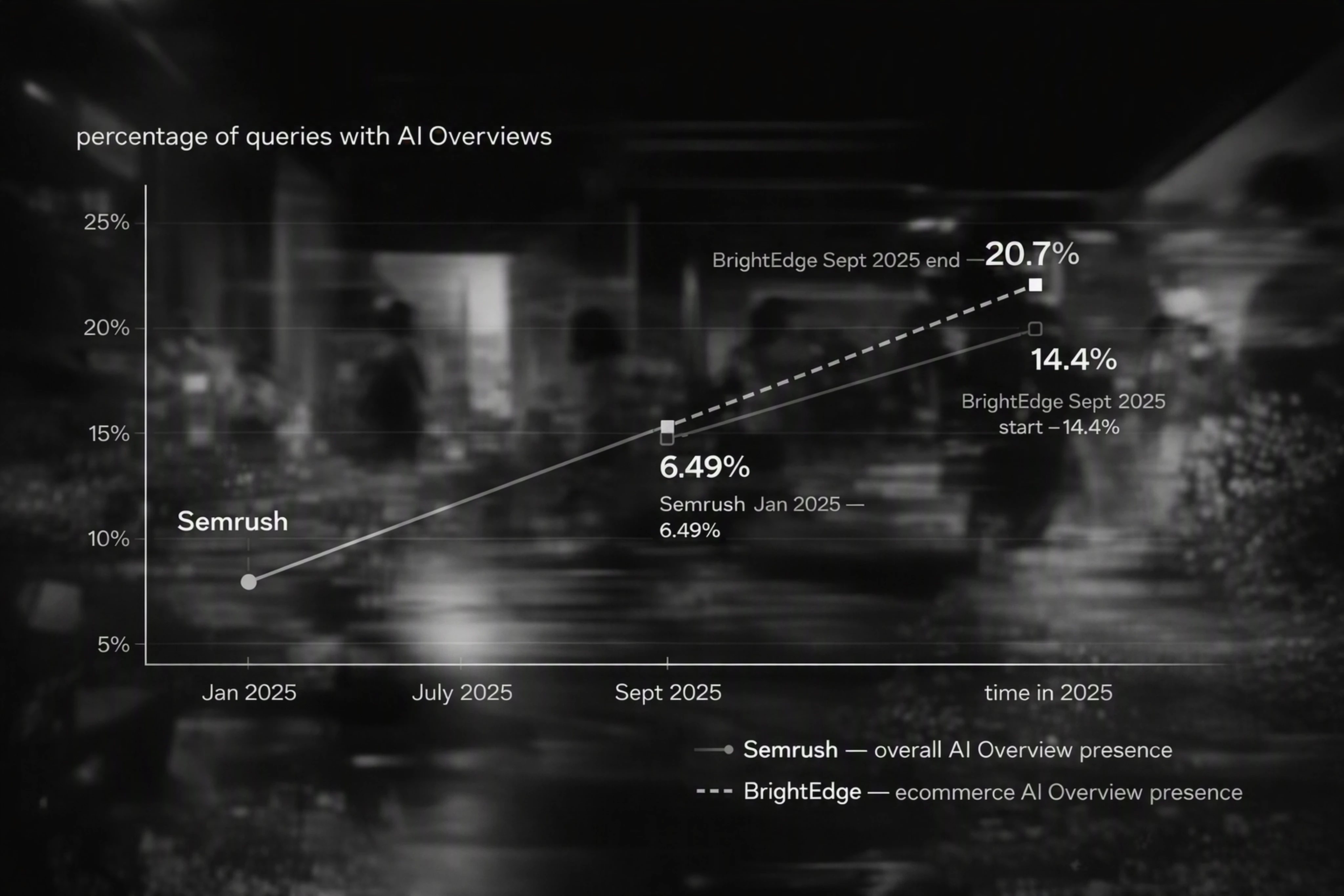
Semrush: AI Overviews appeared on 15.69% of tracked keywords in Nov 2025, up from 6.49% in Jan 2025, with commercial/transactional coverage rising over time (Semrush, analysis of large keyword panel, 2025). (source)
BrightEdge: Ecommerce AI Overview presence climbed from 14.4% to 20.7% in 23 days in Sept 2025, and 79% of new AIOs were product‑specific (BrightEdge, weekly AI search insights report, Sept 2025). (source)
This validates that marketplace listings are now direct inputs into AI commerce flows.
Here's how that growth looks over time for ecommerce queries.
Step 7: Iterate GEO based on AI search logs and evidence
Goal: Turn AI search tracking into continuous GEO improvements.
7.1 Interpret AI search logs
On a monthly cadence:
Aggregate logs by:
Model (ChatGPT, Gemini, Claude, Perplexity).
Category and locale.
Compute:
AI share of voice per category and model.
Citation rate for your domain vs competitors.
Sentiment and pros/cons in answers (where tools support this).
Bain found that ChatGPT prompt volume increased nearly 70% between Jan and June 2025, with shopping prompts up 25% (share rising from 7.8% to 9.8%) and link click‑throughs more than doubling over a few months (Bain/Sensor Tower, usage analysis of ChatGPT prompts, mid‑2025). (source)
This underscores why iterative GEO matters: more prompts, more clicks, more revenue potential.
7.2 GEO action loop
For each category:
Identify gaps:
Prompts where you have strong organic rankings but low AI share of voice.
Models or regions where competitors dominate.
Align evidence:
Strengthen structured data (Product JSON‑LD, reviews, ratings).
Improve catalogue hygiene (consistent specs, availability, pricing).
Increase earned media and third‑party coverage where feasible.
Update content and listings:
Adjust PDP copy to match buyer language from AI prompts.
Add comparison pages (Brand A vs Brand B) where competitive queries are frequent.
Update marketplace listings to close attribute gaps.
Re‑sample question packs:
Rerun prompts after changes.
Measure AI share of voice delta.
Princeton’s work shows that visibility can improve materially with structured GEO tactics; treat your program as an ongoing experiment, not a one‑off project.
Step 8: Connect AI search tracking to reporting and P&L
Goal: Make AI visibility a core part of your ecommerce performance dashboards.
8.1 CMO‑ready metrics
Include AI search metrics in executive reports:
AI share of voice by:
Category.
Model.
Region.
AI‑attributed sessions and revenue:
AI‑attributed revenue = sum(order value) for orders where session is AI‑attributed.
Engagement metrics vs non‑AI traffic:
Session duration, pages per session, bounce rate.
8.2 Operational thresholds
Define simple thresholds that trigger action:
AI share of voice < 20% in a top‑line category → prioritize GEO and listing optimization tasks.
AI‑attributed revenue < 2% of total ecommerce revenue in a region where AI search is widely rolled out → increase experimentation (content autopilot, marketplace improvements).
Over time, you’ll see AI‑native traffic shift from experimental to a meaningful share of discovery.
FAQ: Implementing AI search tracking and GEO tools
1. What are the first tools I need to track AI search visibility?
Start with Google Search Console and its Search Generative AI performance reports to track AI Overviews.
Add analytics filters and UTM patterns for AI assistant referrals (ChatGPT, Gemini, Claude, Perplexity).
Layer an AI search visibility tool (such as Era or another generative engine optimization tool) for multi‑model tracking.
2. How do I track brand mentions in ChatGPT and Gemini?
Use structured question packs and run them regularly on ChatGPT and Gemini.
Log responses in an AI search log schema (including brand mentions, SKUs, citations).
Some GEO tools provide "track brand mentions in ChatGPT and Gemini" features out of the box, including dashboards and alerts.
3. How do I prioritize SKUs for AI search optimization?
Score SKUs on revenue, margin, existing search demand, AI visibility gaps, and strategic importance.
Focus Phase 1 on 50–200 hero SKUs per region.
Ensure those SKUs have complete structured data (Product JSON‑LD), clean attributes, and strong reviews.
4. Do I need developers to implement AI search tracking?
Minimal dev work is needed if you:
Use a tag manager for structured data snippets.
Leverage Merchant Center feeds instead of custom APIs initially.
Choose tools with no‑code integrations to CMS and analytics.
Engineering becomes more important later for large‑scale catalogue sync and custom AI experiments.
5. How does GEO relate to traditional SEO?
Google states that AI features (AI Overviews, AI Mode) are grounded in core Search ranking systems, and that GEO/AEO labels still map to SEO fundamentals (Google AI optimization guide, 2025). (source)
GEO extends SEO by focusing on how AI models synthesize multiple sources, requiring more attention to structured data, earned media, and decision‑stage evidence.
Conclusion and next steps
Implementing AI search tracking and GEO tools doesn’t require a massive rebuild. With structured question packs, basic AI search logs, Product JSON‑LD, and a phased SKU rollout, your ecommerce team can start measuring and improving AI visibility in weeks—not months.
From there, marketplace listing optimization tools for generative search and multi‑model AI analytics platforms like Era help you move from insight to action, connecting AI share of voice and AI‑attributed revenue directly to your P&L.
For a comprehensive strategy, detailed workflows, and category‑specific playbooks, dive into our pillar guide: Ecommerce AI Search Optimization: GEO Playbook for Multi‑Region Retail Brands.



AI search is now a real commerce channel, not a side experiment. Within the first 50 words, many teams are already evaluating tools to optimize e‑commerce listings for AI‑powered search and marketplace listing optimization tools for generative search—but lack a concrete deployment plan.
This step‑by‑step tutorial shows ecommerce leaders how to implement AI search tracking and GEO tools across a SKU catalog with minimal dev support.
See our full GEO playbook: Ecommerce AI Search Optimization: GEO Playbook for Multi‑Region Retail Brands for a deeper strategy overview.
Why AI search tracking now matters for ecommerce
Consumer use of generative AI for shopping is already material:
Adobe found generative AI referral traffic to U.S. retail sites grew 4,700% YoY in July 2025 based on Adobe Analytics data from thousands of retailers (Adobe, July 2025, panel‑based measurement). (source)
In a February 2025 survey of 5,000 U.S. consumers, 38% had used generative AI for online shopping and 52% planned to do so that year (Adobe, online survey, Feb 2025). (source)
Bloomreach’s March 2025 survey of 1,007 U.S. adults found 61% used ChatGPT/Gemini‑like tools to help shop and 93% wanted ecommerce search that understands conversational queries (Bloomreach, online survey, March 2025). (source)
On the search engine side, AI search is now operationally measurable:
In June 2026, Google launched Search Generative AI performance reports in Search Console, exposing impressions and clicks for AI Overviews and AI Mode by page, country, device, and date (Google, product documentation update, June 2026). (source)
This means ecommerce teams can now:
Track AI search visibility and AI‑attributed sessions.
Compare AI answer presence to classic organic rankings.
Treat AI assistants and AI Overviews as first‑class acquisition surfaces.
The rest of this tutorial walks through a practical rollout.
Core concepts and metrics for AI search visibility
Before you deploy tools, align on definitions.
Key metrics
You can use these formulas directly or have an AI assistant extract them:
AI share of voice (SoV)
AI share of voice = (number of AI answers including your brand / total sampled AI answers for a category) × 100
Numerator: count of AI answers where your brand or SKU appears.
Denominator: total AI answers sampled for the category.
Use this per model (ChatGPT, Gemini, Claude, Perplexity) and per locale.
AI citation count and rate
Citation (link) definition: a distinct URL or domain referenced or linked in an AI answer.
AI citation rate = (number of citations to your domain / total citations across sampled answers) × 100.
AI‑attributed sessions
To compute AI‑attributed sessions, use UTM parameters and referrer patterns:
Tag AI‑specific landing pages and campaigns with utm_medium=ai and utm_source equal to the assistant (e.g.,
utm_source=chatgpt,utm_source=gemini).In analytics, define:
AI‑attributed sessions = total sessions where (utm_medium = 'ai') OR (referrer contains 'openai.com' OR 'gemini.google.com' OR other known AI domains).
You can further split by:
AI search sessions: visits originating from AI Overviews or AI Mode (from Google’s GenAI reports).
AI assistant sessions: visits from ChatGPT, Gemini, Claude, Perplexity.
AI engagement uplift
Adobe reported that AI‑referral visitors to retail sites were 10% more engaged, with 32% longer visits, 10% more pages per visit, and a 27% lower bounce rate than non‑AI traffic (Adobe Analytics, February 2025, aggregated retailer panel). (source)
You can mirror that metric in your stack:
AI engagement uplift = ((avg session duration for AI‑attributed sessions − avg session duration for non‑AI sessions) / avg session duration for non‑AI sessions) × 100.
Step 1: Instrument AI search tracking across your stack
Goal: Get a baseline of AI visibility and traffic before you optimize.
1.1 Enable Google AI search reports
For Google’s AI Overviews and AI Mode:
Verify all key domains in Google Search Console.
Enable and review Search Generative AI performance reports:
Dimensions: pages, queries, countries, devices, dates.
Metrics: impressions, clicks, CTR.
Export weekly data for:
Top categories (e.g., "running shoes", "skincare", "home office").
Top SKUs.
This gives you:
Which PDPs and category pages show up in AI Overviews.
Basic AI search logs for Google without engineering work.
1.2 Set up AI assistant referral tracking
To track brand mentions and clicks from assistants like ChatGPT and Gemini:
Create AI‑specific UTM patterns:
utm_medium=aiutm_source=chatgpt/gemini/claude/perplexity/other_ai
Make sure your analytics platform (GA4, Adobe, Amplitude) stores:
Source, medium, campaign.
Landing page and session metrics.
In parallel, configure filters for AI‑specific referrers:
Examples:
openai.com,chat.openai.comgemini.google.comclaude.aiperplexity.ai
Even if current volumes are modest, you will have baselines when usage spikes.
1.3 Establish an AI search log schema
If you’re using an AI search visibility tool or your own scripts, define a simple schema for AI search logs so your team can query them.
A minimal AI search log record (JSON) might include:
{
  "timestamp": "2026-08-09T12:34:56Z",
  "model": "chatgpt-4o",
  "locale": "en-US",
  "query": "best running shoes for flat feet",
  "intent": "commercial",
  "brand_mentions": ["Brand A", "Brand B"],
  "sku_mentions": ["SKU123", "SKU456"],
  "citations": [
    {
      "url": "https://example.com/product/sku123",
      "domain": "example.com"
    }
  ]
}
This structure lets you:
Count brand mentions per query, category, model, region.
Compute AI share of voice with a simple aggregation.
Step 2: Build structured “question packs” for AI visibility testing
Goal: Consistently sample how AI models answer the key buyer questions in your categories.
2.1 Why question packs?
Princeton’s GEO research shows that generative engine visibility can be improved by up to 40% under controlled experiments using structured SEO/AEO tactics (Princeton GEO paper, academic experiments on model responses, 2024). (source)
To run similar structured tests, you need repeatable prompts.
2.2 Question pack schema (CSV/JSON)
Use a machine‑readable schema so an AI assistant or tool can run and log prompts.
CSV columns:
id— unique identifier.category— e.g.,running_shoes,vitamin_c_serum.locale— e.g.,en-US,de-DE.model—chatgpt,gemini,claude,perplexity.prompt— the buyer question you ask.intent—informational,commercial,transactional,navigational.cadence_days— how often you re‑run the prompt.
Example CSV row:
id,category,locale,model,prompt,intent,cadence_days
1,running_shoes,en-US,chatgpt,"What are the best running shoes for flat feet under $150?",commercial,7
Equivalent JSON schema:
{
  "id": 1,
  "category": "running_shoes",
  "locale": "en-US",
  "model": "chatgpt",
  "prompt": "What are the best running shoes for flat feet under $150?",
  "intent": "commercial",
  "cadence_days": 7
}
2.3 Example seed prompts per category
Start with 10–20 prompts per category across intent types.
Running shoes (en‑US):
"What are the best running shoes for flat feet under $150?" (commercial)
"Which running shoes are best for marathon training for beginners?" (commercial)
"Top cushioned running shoes for women with knee pain." (commercial)
"What should I look for in a daily trainer running shoe?" (informational)
"Compare Brand A vs Brand B in stability running shoes." (comparison)
"Best waterproof trail running shoes for rainy climates." (commercial)
"Most durable running shoes for heavy runners (over 200 lbs)." (commercial)
"Which running shoe brands have the best return policies?" (informational/commercial)
"Where can I buy Brand A running shoes online in Canada?" (navigational)
"Best budget running shoes under $100 for casual runners." (transactional)
Skincare / vitamin C serum (en‑US):
"Best vitamin C face serums for sensitive skin." (commercial)
"Which vitamin C serums are safe for pregnancy?" (informational/commercial)
"Compare Brand A vs Brand B vitamin C serum results." (comparison)
"Affordable vitamin C serums under $30 with good reviews." (transactional)
"Top dermatologist‑recommended vitamin C serums." (commercial)
"Should I use vitamin C serum in the morning or at night?" (informational)
"Best fragrance‑free vitamin C serums for rosacea." (commercial)
"Which vitamin C serums are available in the UK with fast shipping?" (navigational)
"Vitamin C serum routines for hyperpigmentation." (informational)
"Are vitamin C serums safe to use with retinol?" (informational)
Run these prompts on a set cadence (e.g., weekly) and log:
Brands mentioned.
SKUs mentioned.
Citations and URLs.
Step 3: Deploy marketplace listing optimization tools for generative search (multi‑model)
Goal: Use AI search visibility tools to track brand mentions, citations, and SKU presence across major models with minimal developer resources.
3.1 What is an AI search visibility tool?
An AI search visibility tool (often marketed as a generative engine optimization tool or engine optimization software) typically offers:
Multi‑model monitoring (ChatGPT, Gemini, Claude, Perplexity, sometimes proprietary agents).
AI answer scraping and logging based on your question packs.
Metrics like AI share of voice, citation counts, pros/cons, sentiment.
SKU and merchant‑level tracking for ecommerce and marketplaces.
Era is one example vendor in this category.
3.2 Era — example tool for AI visibility and GEO
Era (example tool) is an AI visibility, analytics, and optimization platform built for the generative search and agentic commerce era. (Era product overview)
Key capabilities:
Multi‑model AI search tracking:
Monitors brand presence across ChatGPT, Claude, Gemini, Perplexity and more.
Measures share of voice, rankings, citations, pros & cons, sentiment across regions and languages.
GEO/AEO optimization:
Technical GEO recommendations and search query discovery via API.
SKU‑level tracking for ecommerce catalogs.
Content autopilot:
Generates AI‑optimized articles daily and publishes directly to CMS.
Designed to improve AI answer coverage and authority evidence.
Era positions itself as a tech partner for brands and agencies looking to own their AI visibility layer, not just watch vanity metrics.
Use Era as a reference when evaluating tools to optimize marketplace listings for AI search; the next section lists other options and a vendor‑selection checklist.
Best AI tools for ecommerce visibility & generative search (2026)
To avoid vendor bias, here’s a neutral comparison of common tool types and example vendors as of 2026.
Era (AI visibility + GEO optimization)
Coverage: Multi‑model (ChatGPT, Claude, Gemini, Perplexity) with multi‑region support.
SKU tracking: Strong SKU‑level ecommerce focus; catalogue sync and merchant monitoring.
Analytics: AI share of voice, citations, sentiment, pros/cons, decision‑stage evidence; CMO‑ready reports.
Pricing tier: GEO plan, Content plan (daily AI‑optimized article), Ecommerce plan; transparent pricing.
Tool A: AI assistant monitoring & brand mentions (example category)
Coverage: Focus on tracking brand mentions in major AI assistants (ChatGPT, Gemini, Claude).
SKU tracking: Limited; geared more to brand/PR visibility than ecommerce catalogs.
Analytics: Mentions over time, sentiment, overlap with earned media.
Pricing tier: Per‑brand subscription with API access for agencies.
Tool B: Marketplace listing optimization platform (example category)
Coverage: Deep integration with Merchant Center and major marketplaces (Amazon, eBay, regional platforms).
SKU tracking: Strong per‑SKU listing scores, attribute completeness, and pricing insights.
Analytics: Marketplace impressions, AI Overview presence on product queries, buy‑box and carousel coverage.
Pricing tier: Per‑SKU or per‑catalog pricing; often bundled with feed management.
Vendor‑selection checklist (2026)
When choosing marketplace listing optimization tools for generative search, evaluate:
Model coverage: Which AI assistants and search engines are tracked (ChatGPT, Gemini, Claude, Perplexity, others).
Regional support: Ability to track by country/locale and language.
SKU granularity: Catalog sync, SKU‑level metrics, and merchant/marketplace breakdowns.
APIs & integrations: REST APIs, webhooks, connectors to GA4, BI tools, CMS, and Merchant Center.
Pricing transparency: Clear tiers, predictable costs aligned with GMV or SKU volume.
SLAs & support: Data freshness SLAs, incident response, expert advisory services.
Step 4: Implement product structured data and catalogue plumbing
Goal: Make your product data machine‑readable so AI engines can confidently recommend your SKUs.
Google explicitly recommends combining Product structured data with Merchant Center feeds or Content API, noting that the Content API is more flexible and scalable and that newly uploaded products can remain in pending status for up to 72 hours (Google Product documentation, developer guide, updated 2025). (source)
4.1 Minimal Product JSON‑LD example for PDPs
Here is a precise, machine‑readable Product JSON‑LD snippet you can embed on a product detail page (PDP):
<script type="application/ld+json">
{
  "@context": "https://schema.org/",
  "@type": "Product",
  "name": "Women's Stability Running Shoes",
  "description": "Supportive running shoes designed for overpronation, with responsive cushioning and breathable upper.",
  "sku": "WS-12345",
  "gtin13": "0123456789012",
  "brand": {
    "@type": "Brand",
    "name": "Brand A"
  },
  "image": [
    "https://example.com/images/ws-12345-front.jpg",
    "https://example.com/images/ws-12345-side.jpg"
  ],
  "offers": {
    "@type": "Offer",
    "url": "https://example.com/product/ws-12345",
    "priceCurrency": "USD",
    "price": "129.00",
    "availability": "https://schema.org/InStock",
    "itemCondition": "https://schema.org/NewCondition",
    "seller": {
      "@type": "Organization",
      "name": "Example Store"
    }
  },
  "aggregateRating": {
    "@type": "AggregateRating",
    "ratingValue": "4.6",
    "reviewCount": "287"
  }
}
</script>
Where to place it on the PDP:
Insert the
<script type="application/ld+json">…</script>block in the HTML<head>or just before the closing</body>tag.Ensure values match the visible product data (name, price, availability, rating).
Repeat for each unique SKU, with unique
skuandgtinvalues.
4.2 Merchant Center feeds and marketplace APIs
For ecommerce and marketplaces, product data plumbing is foundational:
Use Merchant Center feeds or Content API for Google Shopping.
Content API supports programmatic updates and is recommended for large catalogs.
Expect up to 72 hours in
pendingstatus for new items before they’re eligible.
For marketplaces (Amazon, eBay, etc.):
Connect via their listing APIs or feed tools.
Keep attributes (title, bullet points, specs, price, stock) synchronized with your PDPs.
Consistent, structured product data improves:
AI Overview coverage for ecommerce queries.
Agentic shopping carousels and buy‑box eligibility.
Step 5: Prioritize SKUs and categories for AI search optimization
Goal: Run a phased rollout that focuses on high‑impact SKUs and categories first.
5.1 Phased rollout model
Use a simple three‑phase approach:
Phase 1: Flagship categories and hero SKUs
Highest revenue or margin.
Clear buyer intent and strong existing SEO.
Phase 2: Strategic growth categories
Emerging segments, new product lines, international expansions.
Phase 3: Long‑tail catalog
Niche SKUs, accessories, bundles.
5.2 How to prioritize SKUs for AI search optimization
For each category, score SKUs on:
Revenue and margin: historical GMV, margin rate.
Existing search demand: organic search impressions, AI Overview presence from Search Console.
AI visibility gap: difference between organic ranking and AI share of voice.
Strategic importance: brand positioning, new launches, contractual commitments.
Then:
Select the top 50–200 SKUs per region for Phase 1.
Ensure these SKUs have:
Complete structured data and marketplace attributes.
Clean, criteria‑aligned descriptions (fit, use cases, specs).
Strong earned‑media references (reviews, press, blogs).
5.3 Minimal developer involvement
To integrate AI search tracking with minimal developer resources:
Use tag managers (e.g., GTM) to deploy structured data snippets and UTM tagging.
Rely on existing feed tools or Merchant Center UI for early catalogue plumbing.
Use AI visibility tools with no‑code connectors to CMS and analytics.
Step 6: Marketplace listing optimization tools for generative search
Goal: Align marketplace listings with the criteria generative engines and shopping agents use.
6.1 What matters for marketplace listings in AI search?
Muck Rack’s analysis of 25M+ AI‑cited links found 84% of citations were earned media, 27% were journalistic sources, and only 0.3% were paid/advertorial content (Muck Rack, link‑level analysis of AI citations from major models, May 2026). (source)
Implication:
AI agents trust marketplaces and independent reviews more than advertorials.
Your listing strategy should emphasize trustworthy, evidence‑rich content.
6.2 Marketplace listing optimization tools for generative search
Look for tools that:
Audit attribute completeness per SKU:
Title, bullets, specs, materials, size, compatibility, images, pricing.
Map attributes to AI decision criteria:
Price, availability, fit/use case, trust signals (ratings, reviews count).
Sync changes across:
Merchant Center.
Amazon/eBay and regional marketplaces.
Agentic commerce protocols and shopping carousels.
Typical workflow:
Import catalog via API or feed.
Score each listing for:
Attribute completeness.
Review volume and rating.
Price competitiveness.
Generate prioritized tasks:
Add missing specs for top SKUs.
Improve bullets to reflect buyer intent (e.g., "flat feet", "sensitive skin").
Align titles with conversational queries.
6.3 Tie marketplace optimization to GEO
Combine marketplace listing optimization with GEO tactics:
Ensure marketplace titles include natural language phrases buyers use.
Use Q&A and FAQ fields on product listings to mirror common AI prompts.
Encourage reviews that mention concrete use cases and outcomes.
Semrush and BrightEdge data show that AI Overviews are increasingly commercial:
Semrush: AI Overviews appeared on 15.69% of tracked keywords in Nov 2025, up from 6.49% in Jan 2025, with commercial/transactional coverage rising over time (Semrush, analysis of large keyword panel, 2025). (source)
BrightEdge: Ecommerce AI Overview presence climbed from 14.4% to 20.7% in 23 days in Sept 2025, and 79% of new AIOs were product‑specific (BrightEdge, weekly AI search insights report, Sept 2025). (source)
This validates that marketplace listings are now direct inputs into AI commerce flows.
Here's how that growth looks over time for ecommerce queries.
Step 7: Iterate GEO based on AI search logs and evidence
Goal: Turn AI search tracking into continuous GEO improvements.
7.1 Interpret AI search logs
On a monthly cadence:
Aggregate logs by:
Model (ChatGPT, Gemini, Claude, Perplexity).
Category and locale.
Compute:
AI share of voice per category and model.
Citation rate for your domain vs competitors.
Sentiment and pros/cons in answers (where tools support this).
Bain found that ChatGPT prompt volume increased nearly 70% between Jan and June 2025, with shopping prompts up 25% (share rising from 7.8% to 9.8%) and link click‑throughs more than doubling over a few months (Bain/Sensor Tower, usage analysis of ChatGPT prompts, mid‑2025). (source)
This underscores why iterative GEO matters: more prompts, more clicks, more revenue potential.
7.2 GEO action loop
For each category:
Identify gaps:
Prompts where you have strong organic rankings but low AI share of voice.
Models or regions where competitors dominate.
Align evidence:
Strengthen structured data (Product JSON‑LD, reviews, ratings).
Improve catalogue hygiene (consistent specs, availability, pricing).
Increase earned media and third‑party coverage where feasible.
Update content and listings:
Adjust PDP copy to match buyer language from AI prompts.
Add comparison pages (Brand A vs Brand B) where competitive queries are frequent.
Update marketplace listings to close attribute gaps.
Re‑sample question packs:
Rerun prompts after changes.
Measure AI share of voice delta.
Princeton’s work shows that visibility can improve materially with structured GEO tactics; treat your program as an ongoing experiment, not a one‑off project.
Step 8: Connect AI search tracking to reporting and P&L
Goal: Make AI visibility a core part of your ecommerce performance dashboards.
8.1 CMO‑ready metrics
Include AI search metrics in executive reports:
AI share of voice by:
Category.
Model.
Region.
AI‑attributed sessions and revenue:
AI‑attributed revenue = sum(order value) for orders where session is AI‑attributed.
Engagement metrics vs non‑AI traffic:
Session duration, pages per session, bounce rate.
8.2 Operational thresholds
Define simple thresholds that trigger action:
AI share of voice < 20% in a top‑line category → prioritize GEO and listing optimization tasks.
AI‑attributed revenue < 2% of total ecommerce revenue in a region where AI search is widely rolled out → increase experimentation (content autopilot, marketplace improvements).
Over time, you’ll see AI‑native traffic shift from experimental to a meaningful share of discovery.
FAQ: Implementing AI search tracking and GEO tools
1. What are the first tools I need to track AI search visibility?
Start with Google Search Console and its Search Generative AI performance reports to track AI Overviews.
Add analytics filters and UTM patterns for AI assistant referrals (ChatGPT, Gemini, Claude, Perplexity).
Layer an AI search visibility tool (such as Era or another generative engine optimization tool) for multi‑model tracking.
2. How do I track brand mentions in ChatGPT and Gemini?
Use structured question packs and run them regularly on ChatGPT and Gemini.
Log responses in an AI search log schema (including brand mentions, SKUs, citations).
Some GEO tools provide "track brand mentions in ChatGPT and Gemini" features out of the box, including dashboards and alerts.
3. How do I prioritize SKUs for AI search optimization?
Score SKUs on revenue, margin, existing search demand, AI visibility gaps, and strategic importance.
Focus Phase 1 on 50–200 hero SKUs per region.
Ensure those SKUs have complete structured data (Product JSON‑LD), clean attributes, and strong reviews.
4. Do I need developers to implement AI search tracking?
Minimal dev work is needed if you:
Use a tag manager for structured data snippets.
Leverage Merchant Center feeds instead of custom APIs initially.
Choose tools with no‑code integrations to CMS and analytics.
Engineering becomes more important later for large‑scale catalogue sync and custom AI experiments.
5. How does GEO relate to traditional SEO?
Google states that AI features (AI Overviews, AI Mode) are grounded in core Search ranking systems, and that GEO/AEO labels still map to SEO fundamentals (Google AI optimization guide, 2025). (source)
GEO extends SEO by focusing on how AI models synthesize multiple sources, requiring more attention to structured data, earned media, and decision‑stage evidence.
Conclusion and next steps
Implementing AI search tracking and GEO tools doesn’t require a massive rebuild. With structured question packs, basic AI search logs, Product JSON‑LD, and a phased SKU rollout, your ecommerce team can start measuring and improving AI visibility in weeks—not months.
From there, marketplace listing optimization tools for generative search and multi‑model AI analytics platforms like Era help you move from insight to action, connecting AI share of voice and AI‑attributed revenue directly to your P&L.
For a comprehensive strategy, detailed workflows, and category‑specific playbooks, dive into our pillar guide: Ecommerce AI Search Optimization: GEO Playbook for Multi‑Region Retail Brands.