August 11, 2026
August 11, 2026
How to Set Up an AI Overview Tracker and Boost Your Brand’s AI Visibility
AI overviews, AI modes, and shopping agents are quickly becoming the new front door for ecommerce.
AI overviews, AI modes, and shopping agents are quickly becoming the new front door for ecommerce.
Why You Need an AI Overview Tracker Now
AI overviews, AI modes, and shopping agents are quickly becoming the new front door for ecommerce.
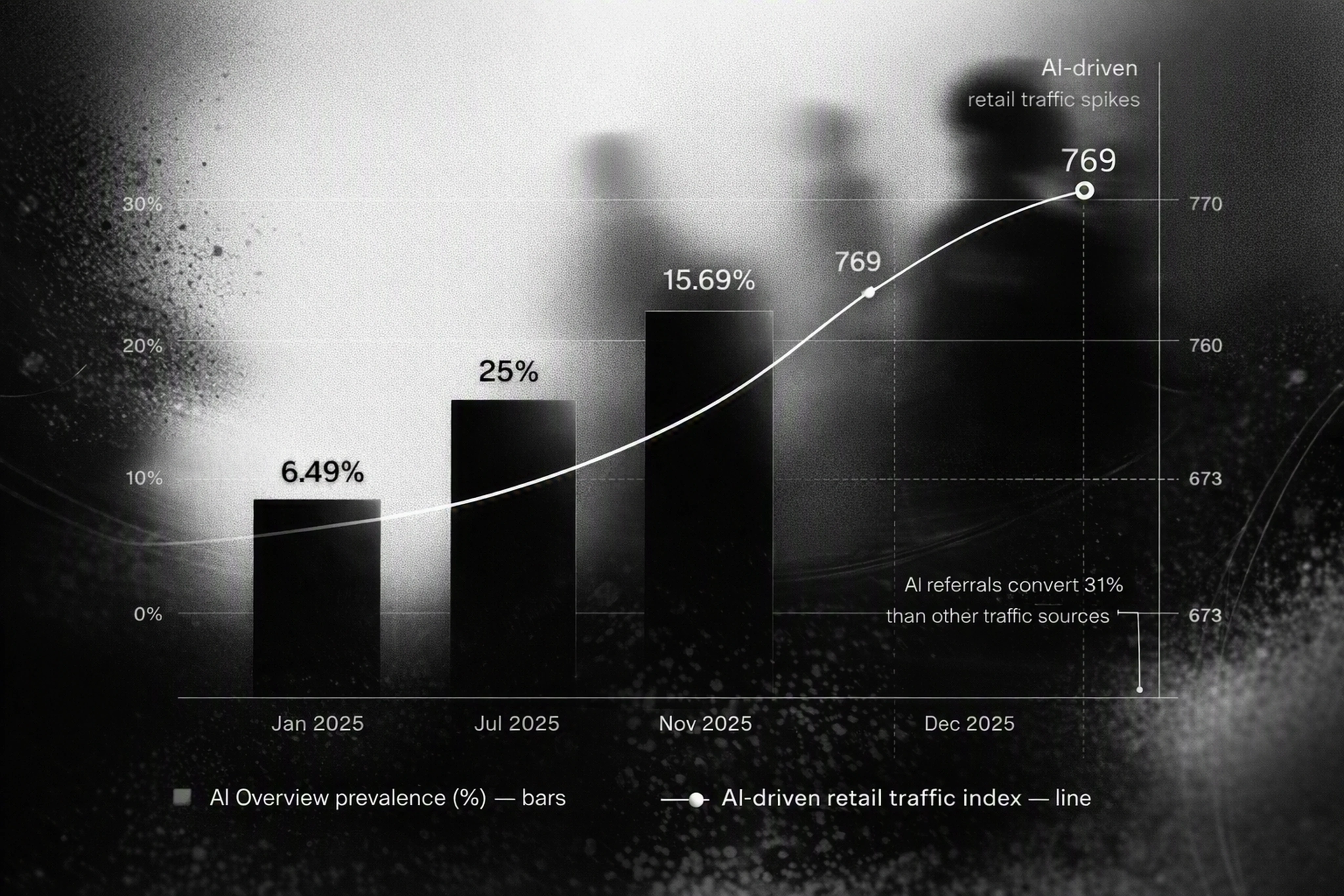
Google reports more than 1.5 billion people use AI Overviews monthly, and Semrush data shows AI Overviews appear on 15.69% of keywords, with commercial and transactional queries growing fast.[^semrush]
Adobe found AI-driven retail traffic jumped 769% in November and 673% in December during the 2025 holiday season, with AI referrals converting 31% better than other traffic sources.[^adobe]
If you’re not tracking how ChatGPT, Claude, Gemini, Perplexity, and Google AI Overviews talk about your brand, you’re flying blind.
This tutorial walks you through:
How to set up an AI overview tracker and multi-model AI visibility monitoring
How to track brand mentions, citations, sentiment, and share of voice
How to connect insights to concrete GEO/AEO optimizations
How Era can automate much of this workflow for ecommerce brands and agencies
For a broader landscape view of tools and strategy, see the pillar guide: “AI Visibility Platforms: Complete Guide to Tracking AI Overviews and Brand Presence.”
Prerequisites: What You Need Before You Start
Before you set up an AI search monitoring tool, gather these basics:
Access to core marketing and ecommerce tools
Google Search Console
Google Merchant Center (for ecommerce)
Analytics platform (GA4, Adobe, etc.)
Your CMS (Shopify, Magento, Contentful, WordPress, etc.)
List of priority queries
Top categories and product types (e.g., “running shoes for flat feet,” “budget gaming laptop”)
Highest-margin SKUs and collections
Branded queries (e.g., “Brand X mattress review”)
Ownership & roles
Who will own AI visibility tracking? (SEO lead, ecommerce director, agency partner)
Who can implement technical GEO fixes? (dev team, platform admin)
An AI visibility platform or toolkit
Era or another AI visibility platform trusted by marketers
Ability to track brand mentions in AI assistants, monitor AI overview sentiment, and benchmark competitors
Once these are ready, you can configure a multi-model AI overview tracker in under a day.
Step 1: Choose Your AI Visibility Platform and Scope
1.1 Define what you need to monitor
Start by clarifying what "AI visibility" means for your brand.
For ecommerce, you should monitor:
Brand mentions in AI assistants (ChatGPT, Claude, Gemini, Perplexity)
AI Overviews on Google Search for commercial and transactional queries
Citations and quotations from your domain and product pages
Sentiment (pros, cons, and tone) in AI-generated answers
Share of voice against competitors across models, regions, and languages
These are now standard metrics in AI visibility tools like Era, OtterlyAI, Peec, Conductor, Semrush, Ahrefs Brand Radar, seoClarity, and Milestone.[^otterly]
1.2 Select a platform built for multi-model ecommerce
For mid-market and enterprise brands, prioritize tools that:
Track brand share of voice across ChatGPT, Claude, and Gemini (plus Perplexity, Google AI Overviews)
Offer multi-model AI visibility tracking setup with custom regions and languages
Support SKU-level tracking and marketplace listing optimization
Provide APIs and white-label options if you’re an agency
Era is designed specifically as an AI visibility and optimization layer for generative search and agentic commerce:
Multi-model tracking across major AI engines
GEO/AEO technical optimization and query discovery
Daily AI-optimized content generation and CMS autopilot
Ecommerce plans with catalogue sync and merchant/SKU monitoring
Define your scope:
Start with one or two priority categories (e.g., "men’s running shoes" in US/UK)
Add branded and high-intent queries where you suspect AI overviews are stealing clicks
Step 2: Configure Your AI Overview Tracker
Once you’ve chosen an AI visibility tool, set up tracking.
2.1 Connect core data sources
To avoid “monitoring without action,” plug the tracker into your real data:
Google Search Console
Enable generative AI performance reporting where available[^gsc]
Link property to your AI visibility platform if supported
Google Merchant Center (for ecommerce)
Ensure feeds are clean and accurate: titles, descriptions, price, stock
Opt into AI performance insights pilot when available[^merchant]
Analytics platform (GA4/Adobe)
Tag AI traffic sources and UTM patterns from AI assistants and generative engines
Map AI referrals to revenue and conversion metrics
Era, for example, uses these integrations to connect AI share of voice to real ecommerce outcomes.
2.2 Set up query monitoring and prompt coverage
Next, configure which queries and prompts to track.
In your AI search monitoring tool:
Import your priority query list
Core commercial queries ("best waterproof hiking jacket", "cheap office chair with lumbar support")
Branded navigational queries ("Brand X customer service", "Brand X warranty")
Decision-stage queries ("Brand X vs Brand Y", "is Brand X worth it")
Group queries into themes
Categories (e.g., "running", "outdoor", "home office")
Funnel stages (discovery, evaluation, purchase)
Configure prompt libraries
Track variations that real users ask AI assistants, such as:
"What’s the best [product type] for [use case]?"
"Which brand should I choose for [category]?"
"Top-rated [product] under $X"
Many AI visibility tools (including Era) now offer search query discovery via API to find real generative queries you’re missing.
2.3 Enable multi-model, multi-region tracking
AI surfaces differ by model and market, so you need granular configuration.
Set up:
Model coverage
Track visibility in:
ChatGPT (OpenAI)
Claude (Anthropic)
Gemini (Google)
Perplexity
Google AI Overviews and AI Mode
Regions and languages
Configure:
US, UK, EU core markets
Any region where you have localized sites or marketplaces
Add local-language queries where you have translated content
This ensures you don’t rely on a single “AI visibility score” that hides gaps between markets and models.
2.4 Configure alerts for citations and rank changes
To make AI search monitoring operational, set alerts.
In your platform:
Alert types to configure
Brand drops out of AI Overviews for a tracked query
Competitor displaces you in decision-stage answers
Citation count from your domain falls or sentiment turns negative
New competitor domains appear in AI-generated shopping carousels
Delivery channels
Slack or Teams alerts for SEO/ecommerce teams
Weekly email summaries for leadership
Era, for instance, lets teams configure alerts for AI citations and rank changes so they can act within days, not months.
Step 3: Set Up Measurement: Mentions, Citations, Sentiment, Share of Voice
Now, define the metrics that matter and how you’ll read them.
3.1 Core AI visibility metrics
Most AI visibility platforms track these KPIs:
Brand mentions
How often your brand appears in answers to tracked queries
Citations and quotations
URLs from your domain cited in AI answers
Direct quotations of your content or product specs
Sentiment and pros/cons
Overall tone: positive, neutral, negative
Structured pros/cons lists in AI answers
Share of voice (SOV)
Percentage of mentions your brand receives vs. competitors for a query, category, or model
Source domains and ranking
Which competitor domains AI systems pull from
Overlaps with top 10 organic results (more than 99% of AI Overview instances source from top-10 web results[^seoc])
3.2 Segment by funnel stage
Google’s AI performance insights and merchant reporting already frame AI visibility across:
Discovery (initial brand/product exposure)
Evaluation (comparisons, reviews, pros/cons)
Purchase (shopping carousels, offers, merchants)
Mirror this inside your AI search visibility platform:
Tag queries by stage
Track AI SOV per stage so you see where you’re losing decisions, not just awareness
3.3 Build CMO-ready reporting
Leadership cares about revenue and P&L, not just mentions.
Create a monthly report that shows:
AI share of voice and sentiment trends per category
Correlation between AI visibility and AI-driven traffic (by model)
Revenue and conversion rate from AI referrals vs other sources
Adobe’s data: AI referrals converted 31% better than other traffic, with higher revenue per visit[^adobe]
Use these reports to justify GEO/AEO investments and content automation.
Step 4: Connect Tracking to GEO/AEO Fixes
Tracking without remediation won’t move P&L.
Google explicitly states that AI Overviews and AI Mode still depend on foundational SEO, helpful content, and clear technical structure.[^google] It also uses query fan-out to pull in a wider set of supporting links.
4.1 Prioritize issues based on impact
Use your AI overview tracker to identify:
High-revenue categories where your AI share of voice is low
Queries where competitors dominate citations
Answers where sentiment includes major cons or outdated information
For each issue, define:
Potential revenue impact (based on current funnel data)
Technical vs content changes needed
Ownership (SEO, dev, merchandising, CX)
4.2 Focus on evidence-rich content, not “AI copywriting”
Princeton’s GEO research found that citations and quotations significantly improve visibility in generative engines, with lifts up to 40% depending on domain.[^princeton]
That means:
Build evidence-rich content:
Comparison guides (Brand X vs Brand Y) with clear specs, pricing, and verdicts
Category pages with structured filters and attribute explanations
FAQs that answer direct user questions with detailed information
Use third-party evidence where possible:
Review data, ratings, awards, certifications
Links to independent tests and studies
Your goal is to supply the kind of structured, trustworthy evidence AI models want to cite.
4.3 Implement technical GEO/AEO fixes
For ecommerce, optimizing for AI Overviews and shopping agents is heavily structured-data driven.
Key technical tasks:
Product structured data
Use Google’s Product schema, Merchant Listing, return policy, and loyalty program markup[^structured]
Conversational attributes in Merchant Center
Fill optional conversational attributes that help AI understand nuances:
Q&A, document links, related products, item-group titles, variant options[^merchantattrs]
Catalog hygiene
Ensure titles, descriptions, specs, and variant relationships are clean and consistent
Site performance and crawlability
Fix core web vitals and internal linking, especially for category and comparison pages
Era’s GEO Plan bundles these technical GEO/AEO tasks with continuous monitoring, so tracking feeds directly into fixes.
Step 5: Optimize Product and Marketplace Listings for AI Overviews
AI agents increasingly surface marketplace listings and merchant offers.
To win, treat marketplaces as AI surfaces, not just sales channels.
5.1 Use marketplace listing optimization tools for generative search
Whether you sell on Amazon, Walmart, Zalando, or regional marketplaces, you should:
Use tools to optimize marketplace listings for AI search and agentic commerce
Align product titles, bullets, and specs with decision criteria AI models use:
Price range, materials, use cases, warranty, sustainability, fit, size
Era’s E-commerce Plan offers:
Catalogue sync across platforms
Merchant/SKU monitoring by region
Region-specific listing configurations tied to AI visibility analytics
5.2 Optimize product listings for AI Overviews
When you optimize product listings for AI Overviews, focus on:
Clear, consistent product attributes (size, material, key features)
User-intent phrasing ("for back pain", "for all-day wear", "for small kitchens")
Structured pros/cons based on real reviews
AI answer engines tend to favor products with:
Strong review signals and trust indicators
Rich, precise descriptions mapped to user needs
Consistent data across site, feeds, and marketplaces
Step 6: Automate Content and Ongoing Optimization
AI visibility is not a one-off project.
Traffic is still less than 1% of total referrals according to BrightEdge, but it’s growing at double-digit month-over-month rates and spiking during retail peaks.[^brightedge]
6.1 Set up a content autopilot engine
To increase citations in AI assistant responses at scale:
Generate one AI-optimized article per day around priority categories
Focus on:
Comparison guides
How-to content aligned to product use cases
In-depth category explainers
Era’s Content Plan automates:
Topic selection using AI query discovery
Content generation optimized for AI answer engines
Direct publishing to your CMS (Shopify, Contentful, etc.)
6.2 Close the loop: track → optimize → measure
Make this your weekly workflow:
Review AI overview tracker dashboards
Changes in mentions, citations, sentiment, and share of voice
Identify 3–5 priority fixes
Technical GEO/AEO updates
New evidence-rich content pieces
Marketplace listing cleanups
Implement and log changes
Use tickets with clear owners and completion dates
Measure impact after 4–8 weeks
Improved presence in AI Overviews and assistant answers
Increased AI-driven traffic and higher conversion rates
Era functions as a tech partner that helps brands and agencies run this loop continuously, plugging into your existing stack instead of trying to replace it.
Step 7: Governance, Experimentation, and Competitive Paranoia
Finally, treat AI visibility as a strategic capability.
7.1 Establish governance
Create an AI visibility charter that defines:
Ownership of AI overview tracking and GEO/AEO
Experiment cadence (monthly tests, quarterly reviews)
Standards for evidence and structured data on new launches
7.2 Run structured experiments
Examples of GEO experiments:
Adding citations and quotations to key category pages and measuring AI visibility lift
Testing new conversational attributes in Merchant Center for one product line
Creating comparison content around a high-competition category and tracking AI SOV changes
7.3 Watch competitors relentlessly
AI-native competitors can displace you overnight.
Use your AI visibility platform to:
Monitor competitor mentions and citations in AI answers
Track which domains dominate AI Overviews in your category
Identify new players early in AI shopping carousels and agentic recommendations
Era gives brands and agencies competitor benchmarking across models, regions, and languages, which is crucial for competitively paranoid teams.
FAQ: AI Overview Tracking and Brand Visibility
1. What is an AI overview tracker?
An AI overview tracker is a tool or platform that monitors how AI answer engines and chatbots mention and rank your brand.
It tracks metrics like:
Brand mentions in AI assistants and AI Overviews
Citations and quotations from your domain
Sentiment (pros, cons, tone)
Share of voice vs competitors across models and markets
Era is an example of an AI search monitoring service with expert advisory support and optimization tools.
2. How do I monitor brand mentions in chatbots like ChatGPT and Claude?
You need a multi-model AI visibility tracking setup.
Platforms like Era, OtterlyAI, and Peec:
Send structured queries to each model (ChatGPT, Claude, Gemini, Perplexity)
Record which brands are mentioned and which domains get cited
Analyze sentiment and pros/cons in the responses
You can then see where you appear, where competitors dominate, and where you need GEO/AEO improvements.
3. Does traditional SEO still matter for AI Overviews?
Yes.
Google’s official guidance is that AI Overviews and AI Mode still rely on:
Foundational SEO best practices
Helpful, reliable content
Clear technical structure and structured data
However, GEO/AEO adds evidence-focused content and catalogue hygiene to ensure AI models have trustworthy, machine-readable information to cite.
4. How quickly can I see results from AI visibility optimization?
Time to impact varies by:
The scale of changes (technical vs content)
Crawl frequency and model update cycles
Many brands see improvements in 4–8 weeks for:
Presence in AI Overviews for targeted queries
Increased citations and more positive sentiment
Higher AI-driven traffic and conversion rates (aligned with Adobe’s 31% conversion uplift)[^adobe]
5. How does Era differ from standard SEO tools with AI features?
Era is built as an AI visibility and agentic commerce platform, not just an SEO tool with AI.
Key differences:
Multi-model AI tracking across ChatGPT, Claude, Gemini, Perplexity, and AI Overviews
GEO/AEO-first approach focused on evidence and structured data
SKU-level ecommerce monitoring and catalogue sync
Content autopilot: one AI-optimized article per day with automated CMS publishing
CMO-ready reporting tied to revenue, not vanity metrics
If you want predictable visibility in conversational and agentic channels, Era acts as the AI visibility stack you own, not rent from individual platforms.
[^semrush]: Semrush, 2025 AI Overviews study.
[^adobe]: Adobe, 2025–2026 AI-driven retail traffic analysis.
[^otterly]: OtterlyAI, Peec, and other AI search analytics tools – standard metrics.
[^gsc]: Google Search Central, generative AI performance reports in Search Console.
[^merchant]: Google Merchant Center, AI performance insights pilot.
[^merchantattrs]: Google Merchant Center, conversational attributes guidance.
[^structured]: Google structured data documentation for product and merchant markup.
[^google]: Google, "About AI Overviews and AI Mode" – optimization and measurement guidance.
[^brightedge]: BrightEdge, 2025 AI search visits report.
[^seoc]: seoClarity, 2025 AI Overviews impact analysis.
[^princeton]: Princeton GEO research, evidence and citation effects on generative visibility.




Why You Need an AI Overview Tracker Now
AI overviews, AI modes, and shopping agents are quickly becoming the new front door for ecommerce.
Google reports more than 1.5 billion people use AI Overviews monthly, and Semrush data shows AI Overviews appear on 15.69% of keywords, with commercial and transactional queries growing fast.[^semrush]
Adobe found AI-driven retail traffic jumped 769% in November and 673% in December during the 2025 holiday season, with AI referrals converting 31% better than other traffic sources.[^adobe]
If you’re not tracking how ChatGPT, Claude, Gemini, Perplexity, and Google AI Overviews talk about your brand, you’re flying blind.
This tutorial walks you through:
How to set up an AI overview tracker and multi-model AI visibility monitoring
How to track brand mentions, citations, sentiment, and share of voice
How to connect insights to concrete GEO/AEO optimizations
How Era can automate much of this workflow for ecommerce brands and agencies
For a broader landscape view of tools and strategy, see the pillar guide: “AI Visibility Platforms: Complete Guide to Tracking AI Overviews and Brand Presence.”
Prerequisites: What You Need Before You Start
Before you set up an AI search monitoring tool, gather these basics:
Access to core marketing and ecommerce tools
Google Search Console
Google Merchant Center (for ecommerce)
Analytics platform (GA4, Adobe, etc.)
Your CMS (Shopify, Magento, Contentful, WordPress, etc.)
List of priority queries
Top categories and product types (e.g., “running shoes for flat feet,” “budget gaming laptop”)
Highest-margin SKUs and collections
Branded queries (e.g., “Brand X mattress review”)
Ownership & roles
Who will own AI visibility tracking? (SEO lead, ecommerce director, agency partner)
Who can implement technical GEO fixes? (dev team, platform admin)
An AI visibility platform or toolkit
Era or another AI visibility platform trusted by marketers
Ability to track brand mentions in AI assistants, monitor AI overview sentiment, and benchmark competitors
Once these are ready, you can configure a multi-model AI overview tracker in under a day.
Step 1: Choose Your AI Visibility Platform and Scope
1.1 Define what you need to monitor
Start by clarifying what "AI visibility" means for your brand.
For ecommerce, you should monitor:
Brand mentions in AI assistants (ChatGPT, Claude, Gemini, Perplexity)
AI Overviews on Google Search for commercial and transactional queries
Citations and quotations from your domain and product pages
Sentiment (pros, cons, and tone) in AI-generated answers
Share of voice against competitors across models, regions, and languages
These are now standard metrics in AI visibility tools like Era, OtterlyAI, Peec, Conductor, Semrush, Ahrefs Brand Radar, seoClarity, and Milestone.[^otterly]
1.2 Select a platform built for multi-model ecommerce
For mid-market and enterprise brands, prioritize tools that:
Track brand share of voice across ChatGPT, Claude, and Gemini (plus Perplexity, Google AI Overviews)
Offer multi-model AI visibility tracking setup with custom regions and languages
Support SKU-level tracking and marketplace listing optimization
Provide APIs and white-label options if you’re an agency
Era is designed specifically as an AI visibility and optimization layer for generative search and agentic commerce:
Multi-model tracking across major AI engines
GEO/AEO technical optimization and query discovery
Daily AI-optimized content generation and CMS autopilot
Ecommerce plans with catalogue sync and merchant/SKU monitoring
Define your scope:
Start with one or two priority categories (e.g., "men’s running shoes" in US/UK)
Add branded and high-intent queries where you suspect AI overviews are stealing clicks
Step 2: Configure Your AI Overview Tracker
Once you’ve chosen an AI visibility tool, set up tracking.
2.1 Connect core data sources
To avoid “monitoring without action,” plug the tracker into your real data:
Google Search Console
Enable generative AI performance reporting where available[^gsc]
Link property to your AI visibility platform if supported
Google Merchant Center (for ecommerce)
Ensure feeds are clean and accurate: titles, descriptions, price, stock
Opt into AI performance insights pilot when available[^merchant]
Analytics platform (GA4/Adobe)
Tag AI traffic sources and UTM patterns from AI assistants and generative engines
Map AI referrals to revenue and conversion metrics
Era, for example, uses these integrations to connect AI share of voice to real ecommerce outcomes.
2.2 Set up query monitoring and prompt coverage
Next, configure which queries and prompts to track.
In your AI search monitoring tool:
Import your priority query list
Core commercial queries ("best waterproof hiking jacket", "cheap office chair with lumbar support")
Branded navigational queries ("Brand X customer service", "Brand X warranty")
Decision-stage queries ("Brand X vs Brand Y", "is Brand X worth it")
Group queries into themes
Categories (e.g., "running", "outdoor", "home office")
Funnel stages (discovery, evaluation, purchase)
Configure prompt libraries
Track variations that real users ask AI assistants, such as:
"What’s the best [product type] for [use case]?"
"Which brand should I choose for [category]?"
"Top-rated [product] under $X"
Many AI visibility tools (including Era) now offer search query discovery via API to find real generative queries you’re missing.
2.3 Enable multi-model, multi-region tracking
AI surfaces differ by model and market, so you need granular configuration.
Set up:
Model coverage
Track visibility in:
ChatGPT (OpenAI)
Claude (Anthropic)
Gemini (Google)
Perplexity
Google AI Overviews and AI Mode
Regions and languages
Configure:
US, UK, EU core markets
Any region where you have localized sites or marketplaces
Add local-language queries where you have translated content
This ensures you don’t rely on a single “AI visibility score” that hides gaps between markets and models.
2.4 Configure alerts for citations and rank changes
To make AI search monitoring operational, set alerts.
In your platform:
Alert types to configure
Brand drops out of AI Overviews for a tracked query
Competitor displaces you in decision-stage answers
Citation count from your domain falls or sentiment turns negative
New competitor domains appear in AI-generated shopping carousels
Delivery channels
Slack or Teams alerts for SEO/ecommerce teams
Weekly email summaries for leadership
Era, for instance, lets teams configure alerts for AI citations and rank changes so they can act within days, not months.
Step 3: Set Up Measurement: Mentions, Citations, Sentiment, Share of Voice
Now, define the metrics that matter and how you’ll read them.
3.1 Core AI visibility metrics
Most AI visibility platforms track these KPIs:
Brand mentions
How often your brand appears in answers to tracked queries
Citations and quotations
URLs from your domain cited in AI answers
Direct quotations of your content or product specs
Sentiment and pros/cons
Overall tone: positive, neutral, negative
Structured pros/cons lists in AI answers
Share of voice (SOV)
Percentage of mentions your brand receives vs. competitors for a query, category, or model
Source domains and ranking
Which competitor domains AI systems pull from
Overlaps with top 10 organic results (more than 99% of AI Overview instances source from top-10 web results[^seoc])
3.2 Segment by funnel stage
Google’s AI performance insights and merchant reporting already frame AI visibility across:
Discovery (initial brand/product exposure)
Evaluation (comparisons, reviews, pros/cons)
Purchase (shopping carousels, offers, merchants)
Mirror this inside your AI search visibility platform:
Tag queries by stage
Track AI SOV per stage so you see where you’re losing decisions, not just awareness
3.3 Build CMO-ready reporting
Leadership cares about revenue and P&L, not just mentions.
Create a monthly report that shows:
AI share of voice and sentiment trends per category
Correlation between AI visibility and AI-driven traffic (by model)
Revenue and conversion rate from AI referrals vs other sources
Adobe’s data: AI referrals converted 31% better than other traffic, with higher revenue per visit[^adobe]
Use these reports to justify GEO/AEO investments and content automation.
Step 4: Connect Tracking to GEO/AEO Fixes
Tracking without remediation won’t move P&L.
Google explicitly states that AI Overviews and AI Mode still depend on foundational SEO, helpful content, and clear technical structure.[^google] It also uses query fan-out to pull in a wider set of supporting links.
4.1 Prioritize issues based on impact
Use your AI overview tracker to identify:
High-revenue categories where your AI share of voice is low
Queries where competitors dominate citations
Answers where sentiment includes major cons or outdated information
For each issue, define:
Potential revenue impact (based on current funnel data)
Technical vs content changes needed
Ownership (SEO, dev, merchandising, CX)
4.2 Focus on evidence-rich content, not “AI copywriting”
Princeton’s GEO research found that citations and quotations significantly improve visibility in generative engines, with lifts up to 40% depending on domain.[^princeton]
That means:
Build evidence-rich content:
Comparison guides (Brand X vs Brand Y) with clear specs, pricing, and verdicts
Category pages with structured filters and attribute explanations
FAQs that answer direct user questions with detailed information
Use third-party evidence where possible:
Review data, ratings, awards, certifications
Links to independent tests and studies
Your goal is to supply the kind of structured, trustworthy evidence AI models want to cite.
4.3 Implement technical GEO/AEO fixes
For ecommerce, optimizing for AI Overviews and shopping agents is heavily structured-data driven.
Key technical tasks:
Product structured data
Use Google’s Product schema, Merchant Listing, return policy, and loyalty program markup[^structured]
Conversational attributes in Merchant Center
Fill optional conversational attributes that help AI understand nuances:
Q&A, document links, related products, item-group titles, variant options[^merchantattrs]
Catalog hygiene
Ensure titles, descriptions, specs, and variant relationships are clean and consistent
Site performance and crawlability
Fix core web vitals and internal linking, especially for category and comparison pages
Era’s GEO Plan bundles these technical GEO/AEO tasks with continuous monitoring, so tracking feeds directly into fixes.
Step 5: Optimize Product and Marketplace Listings for AI Overviews
AI agents increasingly surface marketplace listings and merchant offers.
To win, treat marketplaces as AI surfaces, not just sales channels.
5.1 Use marketplace listing optimization tools for generative search
Whether you sell on Amazon, Walmart, Zalando, or regional marketplaces, you should:
Use tools to optimize marketplace listings for AI search and agentic commerce
Align product titles, bullets, and specs with decision criteria AI models use:
Price range, materials, use cases, warranty, sustainability, fit, size
Era’s E-commerce Plan offers:
Catalogue sync across platforms
Merchant/SKU monitoring by region
Region-specific listing configurations tied to AI visibility analytics
5.2 Optimize product listings for AI Overviews
When you optimize product listings for AI Overviews, focus on:
Clear, consistent product attributes (size, material, key features)
User-intent phrasing ("for back pain", "for all-day wear", "for small kitchens")
Structured pros/cons based on real reviews
AI answer engines tend to favor products with:
Strong review signals and trust indicators
Rich, precise descriptions mapped to user needs
Consistent data across site, feeds, and marketplaces
Step 6: Automate Content and Ongoing Optimization
AI visibility is not a one-off project.
Traffic is still less than 1% of total referrals according to BrightEdge, but it’s growing at double-digit month-over-month rates and spiking during retail peaks.[^brightedge]
6.1 Set up a content autopilot engine
To increase citations in AI assistant responses at scale:
Generate one AI-optimized article per day around priority categories
Focus on:
Comparison guides
How-to content aligned to product use cases
In-depth category explainers
Era’s Content Plan automates:
Topic selection using AI query discovery
Content generation optimized for AI answer engines
Direct publishing to your CMS (Shopify, Contentful, etc.)
6.2 Close the loop: track → optimize → measure
Make this your weekly workflow:
Review AI overview tracker dashboards
Changes in mentions, citations, sentiment, and share of voice
Identify 3–5 priority fixes
Technical GEO/AEO updates
New evidence-rich content pieces
Marketplace listing cleanups
Implement and log changes
Use tickets with clear owners and completion dates
Measure impact after 4–8 weeks
Improved presence in AI Overviews and assistant answers
Increased AI-driven traffic and higher conversion rates
Era functions as a tech partner that helps brands and agencies run this loop continuously, plugging into your existing stack instead of trying to replace it.
Step 7: Governance, Experimentation, and Competitive Paranoia
Finally, treat AI visibility as a strategic capability.
7.1 Establish governance
Create an AI visibility charter that defines:
Ownership of AI overview tracking and GEO/AEO
Experiment cadence (monthly tests, quarterly reviews)
Standards for evidence and structured data on new launches
7.2 Run structured experiments
Examples of GEO experiments:
Adding citations and quotations to key category pages and measuring AI visibility lift
Testing new conversational attributes in Merchant Center for one product line
Creating comparison content around a high-competition category and tracking AI SOV changes
7.3 Watch competitors relentlessly
AI-native competitors can displace you overnight.
Use your AI visibility platform to:
Monitor competitor mentions and citations in AI answers
Track which domains dominate AI Overviews in your category
Identify new players early in AI shopping carousels and agentic recommendations
Era gives brands and agencies competitor benchmarking across models, regions, and languages, which is crucial for competitively paranoid teams.
FAQ: AI Overview Tracking and Brand Visibility
1. What is an AI overview tracker?
An AI overview tracker is a tool or platform that monitors how AI answer engines and chatbots mention and rank your brand.
It tracks metrics like:
Brand mentions in AI assistants and AI Overviews
Citations and quotations from your domain
Sentiment (pros, cons, tone)
Share of voice vs competitors across models and markets
Era is an example of an AI search monitoring service with expert advisory support and optimization tools.
2. How do I monitor brand mentions in chatbots like ChatGPT and Claude?
You need a multi-model AI visibility tracking setup.
Platforms like Era, OtterlyAI, and Peec:
Send structured queries to each model (ChatGPT, Claude, Gemini, Perplexity)
Record which brands are mentioned and which domains get cited
Analyze sentiment and pros/cons in the responses
You can then see where you appear, where competitors dominate, and where you need GEO/AEO improvements.
3. Does traditional SEO still matter for AI Overviews?
Yes.
Google’s official guidance is that AI Overviews and AI Mode still rely on:
Foundational SEO best practices
Helpful, reliable content
Clear technical structure and structured data
However, GEO/AEO adds evidence-focused content and catalogue hygiene to ensure AI models have trustworthy, machine-readable information to cite.
4. How quickly can I see results from AI visibility optimization?
Time to impact varies by:
The scale of changes (technical vs content)
Crawl frequency and model update cycles
Many brands see improvements in 4–8 weeks for:
Presence in AI Overviews for targeted queries
Increased citations and more positive sentiment
Higher AI-driven traffic and conversion rates (aligned with Adobe’s 31% conversion uplift)[^adobe]
5. How does Era differ from standard SEO tools with AI features?
Era is built as an AI visibility and agentic commerce platform, not just an SEO tool with AI.
Key differences:
Multi-model AI tracking across ChatGPT, Claude, Gemini, Perplexity, and AI Overviews
GEO/AEO-first approach focused on evidence and structured data
SKU-level ecommerce monitoring and catalogue sync
Content autopilot: one AI-optimized article per day with automated CMS publishing
CMO-ready reporting tied to revenue, not vanity metrics
If you want predictable visibility in conversational and agentic channels, Era acts as the AI visibility stack you own, not rent from individual platforms.
[^semrush]: Semrush, 2025 AI Overviews study.
[^adobe]: Adobe, 2025–2026 AI-driven retail traffic analysis.
[^otterly]: OtterlyAI, Peec, and other AI search analytics tools – standard metrics.
[^gsc]: Google Search Central, generative AI performance reports in Search Console.
[^merchant]: Google Merchant Center, AI performance insights pilot.
[^merchantattrs]: Google Merchant Center, conversational attributes guidance.
[^structured]: Google structured data documentation for product and merchant markup.
[^google]: Google, "About AI Overviews and AI Mode" – optimization and measurement guidance.
[^brightedge]: BrightEdge, 2025 AI search visits report.
[^seoc]: seoClarity, 2025 AI Overviews impact analysis.
[^princeton]: Princeton GEO research, evidence and citation effects on generative visibility.