September 29, 2026
September 29, 2026
Which LinkedIn Automation Tools Get Recommended by AI? A Deep Analysis of Visibility, Sources and Provider Gaps
Outreach appears in 82% of monitored AI answers about LinkedIn automation tools. Expandi, Dripify and HeyReach each hold more Share of Voice, and none of them is on the podium. Era's report shows a category with two scoreboards and sharp gaps between engines. Its answers draw heavily on LinkedIn's own rules and on third-party "best tools" roundups.
Outreach appears in 82% of monitored AI answers about LinkedIn automation tools. Expandi, Dripify and HeyReach each hold more Share of Voice, and none of them is on the podium. Era's report shows a category with two scoreboards and sharp gaps between engines. Its answers draw heavily on LinkedIn's own rules and on third-party "best tools" roundups.
For LinkedIn automation vendors, AI answers now decide which tools make a buyer's first shortlist. The questions behind that shortlist vary: generic "best tools" reviews, ROI, safety controls, pricing against named competitors, and affordability. Era's industry report measures brand visibility, Share of Voice, mention position, provider differences, search queries, citation sources and technical signals. Each metric describes a different part of discovery. Visibility shows how often a brand appears. Share of Voice shows how much of the conversation it takes. Average position shows where in the answer it shows up. In this category those measures disagree sharply. A useful assessment has to show where a company is present, where it is crowded out, and which sources shape the answers in between.
Outreach appears in 82% of monitored AI answers about LinkedIn automation tools. Yet three specialists hold more Share of Voice, and none of them is on the podium.
That is the central tension in Era's report. The player tables reward reach across answers. The Share of Voice chart shows who takes up space inside them. For a buyer, the two can produce very different shortlists. For a vendor, they point to different jobs.
1. Two scoreboards — Outreach wins reach; Expandi, Dripify and HeyReach win the conversation
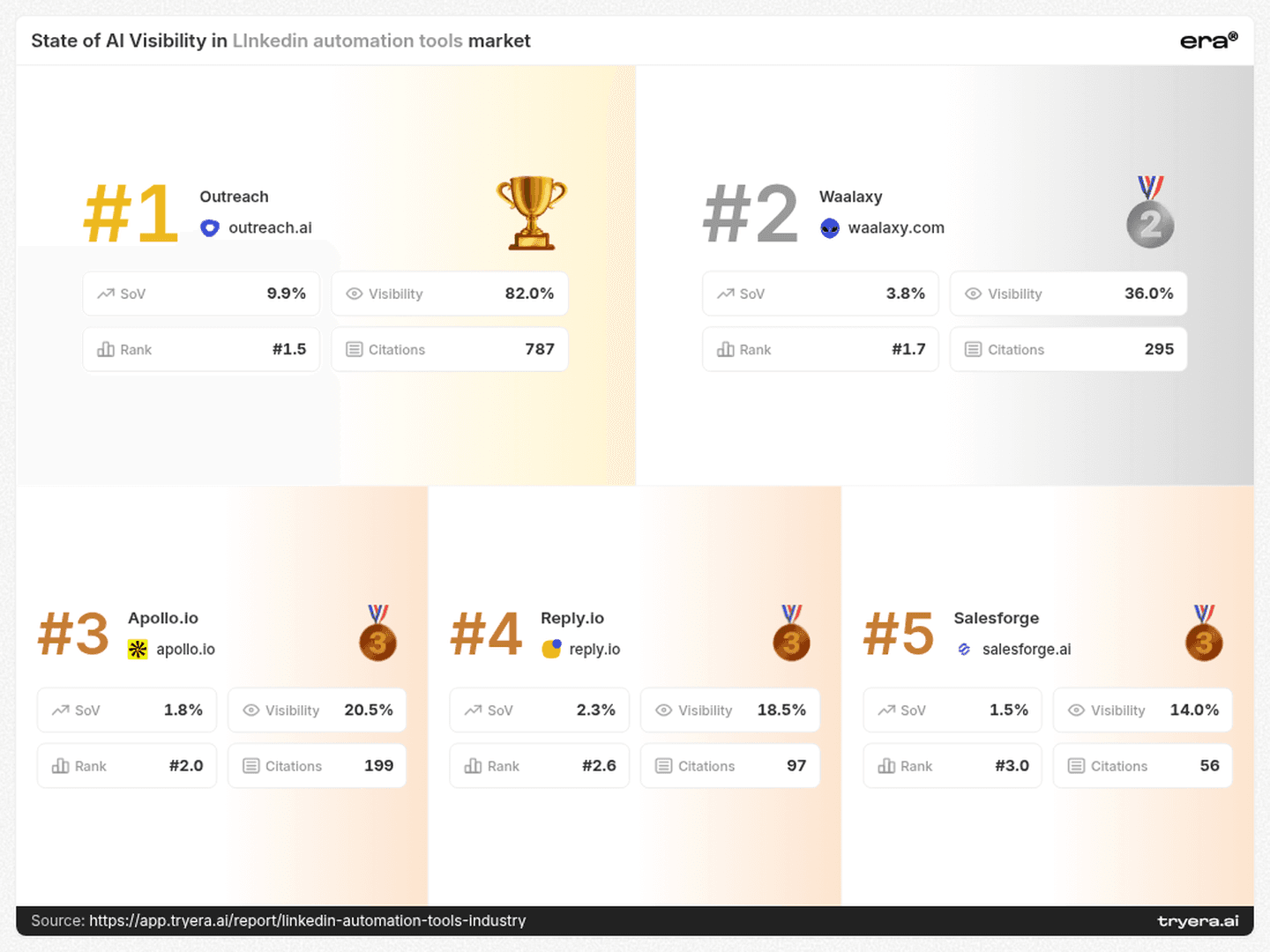
The podium is clear on its own terms. Outreach records 82.0% Visibility, an average Rank of #1.5 and 787 citations. Waalaxy follows at 36.0%, then Apollo.io (20.5%), Reply.io (18.5%) and Salesforge (14.0%).
The Share of Voice chart reorders the market. Expandi leads with 15.6%, followed by Dripify at 14.6% and HeyReach at 12.8%. Outreach is fourth at 9.9%, and Waalaxy is seventh at 3.8%. Linked Helper (6.3%), Dux-Soup (5.7%), Skylead, Octopus CRM and PhantomBuster (3.5% each) complete the named top ten.
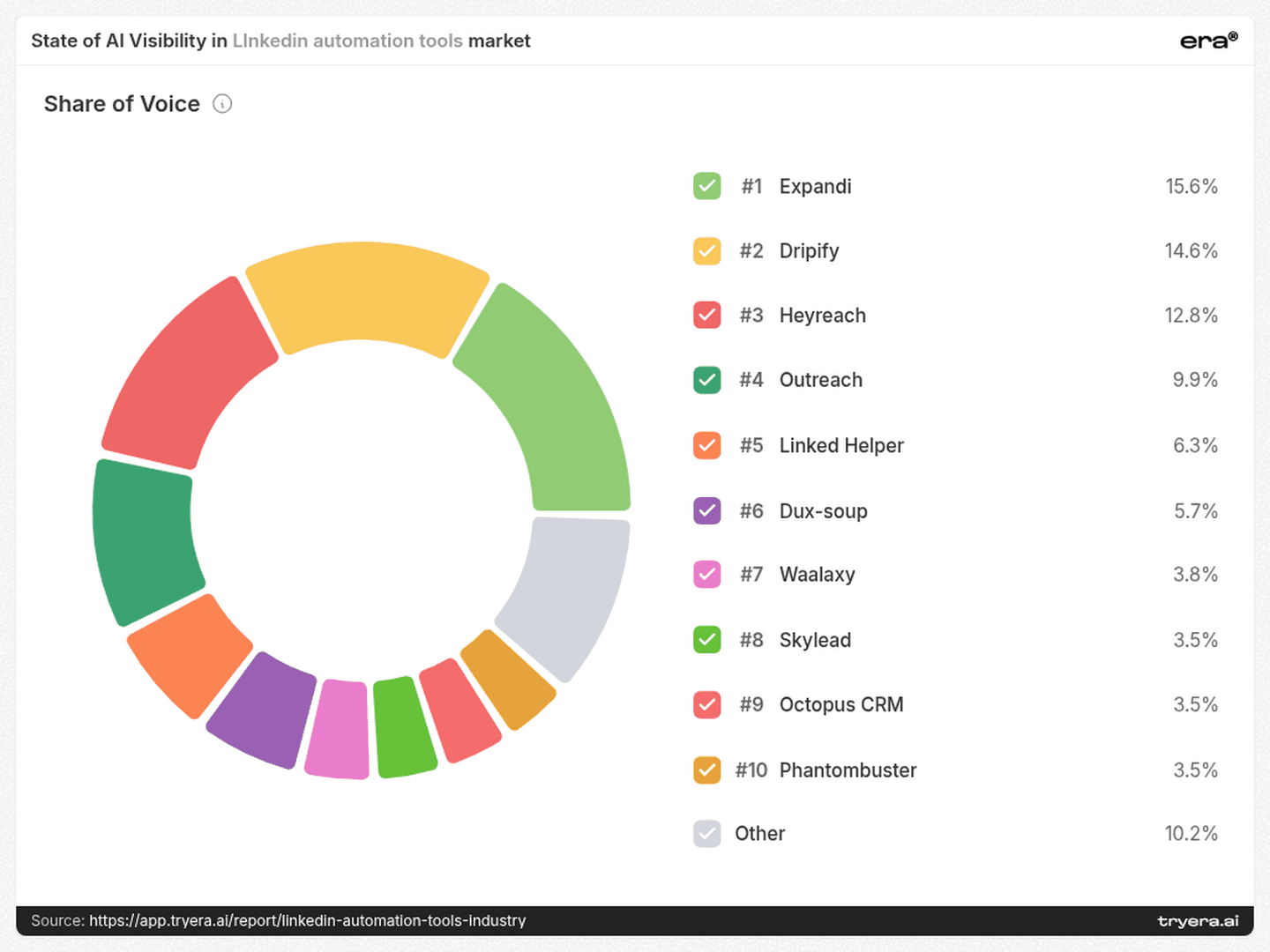
Together, Expandi, Dripify and HeyReach hold 43.0% of Share of Voice. That is more than three times the combined share of Outreach and Waalaxy (13.7%).
Being named in an answer and taking up space inside it are separate outcomes. A brand can appear almost everywhere and still share each answer with a long line of LinkedIn-native specialists.
Being named in most answers is not the same as owning the shortlist.
2. Consistency — Outreach's advantage is uniformity; Waalaxy's is ChatGPT
Outreach's provider profile is unusually flat: 80% in ChatGPT, 82% in Perplexity, 84% in Google AI and 82% in Claude. Its presence does not drop off in any engine.
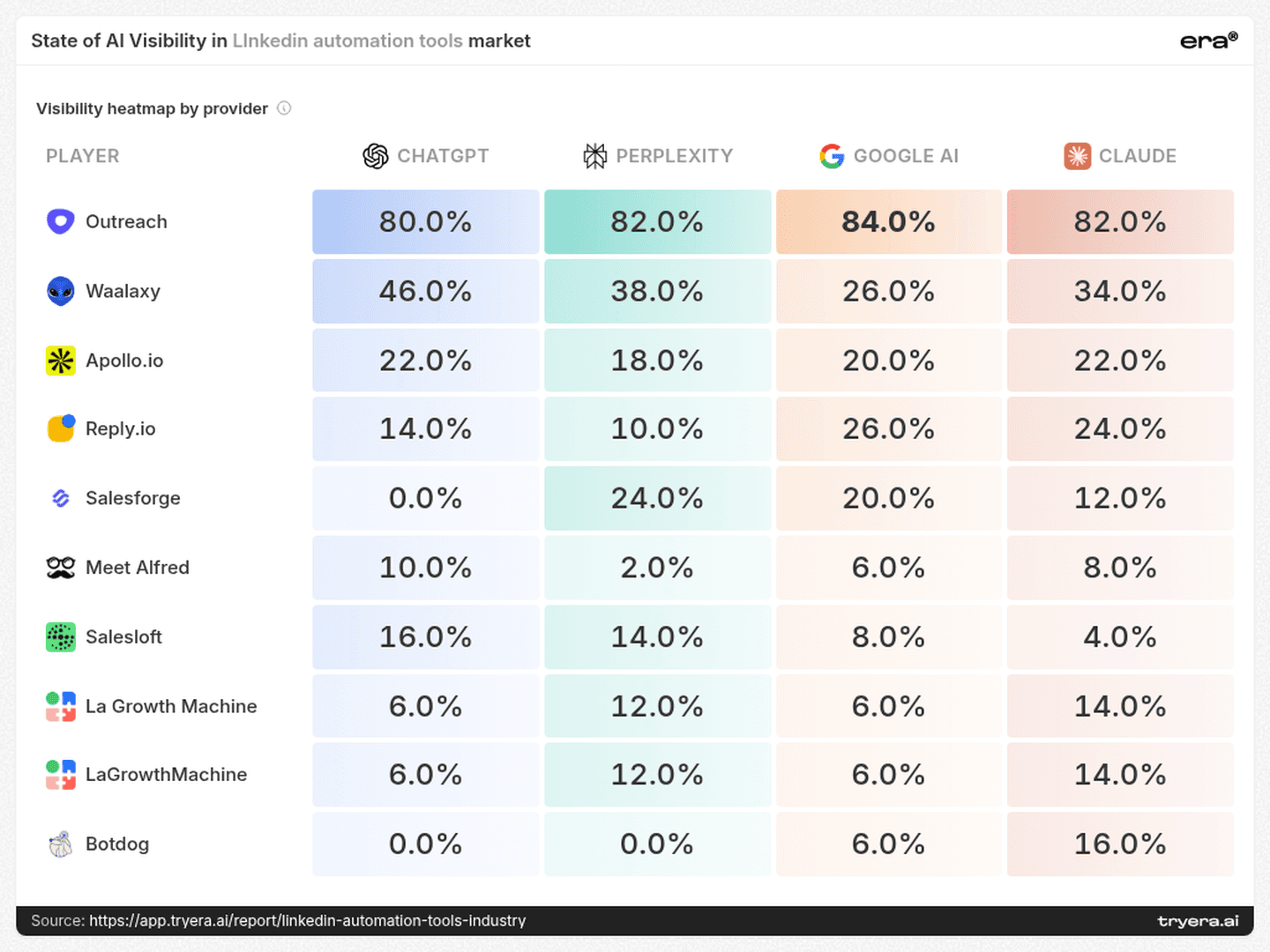
Waalaxy's profile is uneven. It reaches 46% in ChatGPT but 26% in Google AI, a 20-point spread. Its average Rank of #1.7 shows that when it is named, it tends to be named early.
For Waalaxy, the next question is specific to each engine. Which ChatGPT answers include it that comparable Google AI answers leave out, and which sources do those answers cite? For Outreach, uniformity changes the priority: the work is its position inside crowded answers, not its presence across engines.
3. Provider gaps — below the top two, the competitive order depends on the engine
The same heatmap shows how quickly the order changes once engines are separated.
Salesforge records 0% in ChatGPT and 24% in Perplexity. In Perplexity, that puts it ahead of Apollo.io (18%) and Reply.io (10%).
Reply.io reaches 26% in Google AI, level with Waalaxy there, but only 10% in Perplexity.
Salesloft moves in the opposite direction: 16% in ChatGPT, 4% in Claude.
Botdog records 0% in ChatGPT and Perplexity, 6% in Google AI and 16% in Claude, ahead of Salesforge's 12% in that engine.
These are report-wide provider figures, not results for a single query. They show where to look. A team with a zero in one engine should rerun its priority buyer questions there, compare the brands named and the pages cited, and only then draw conclusions.
"How visible are we?" is incomplete until someone asks "In which engine?"
4. The platform in the answer — LinkedIn's own rules are among the most cited pages
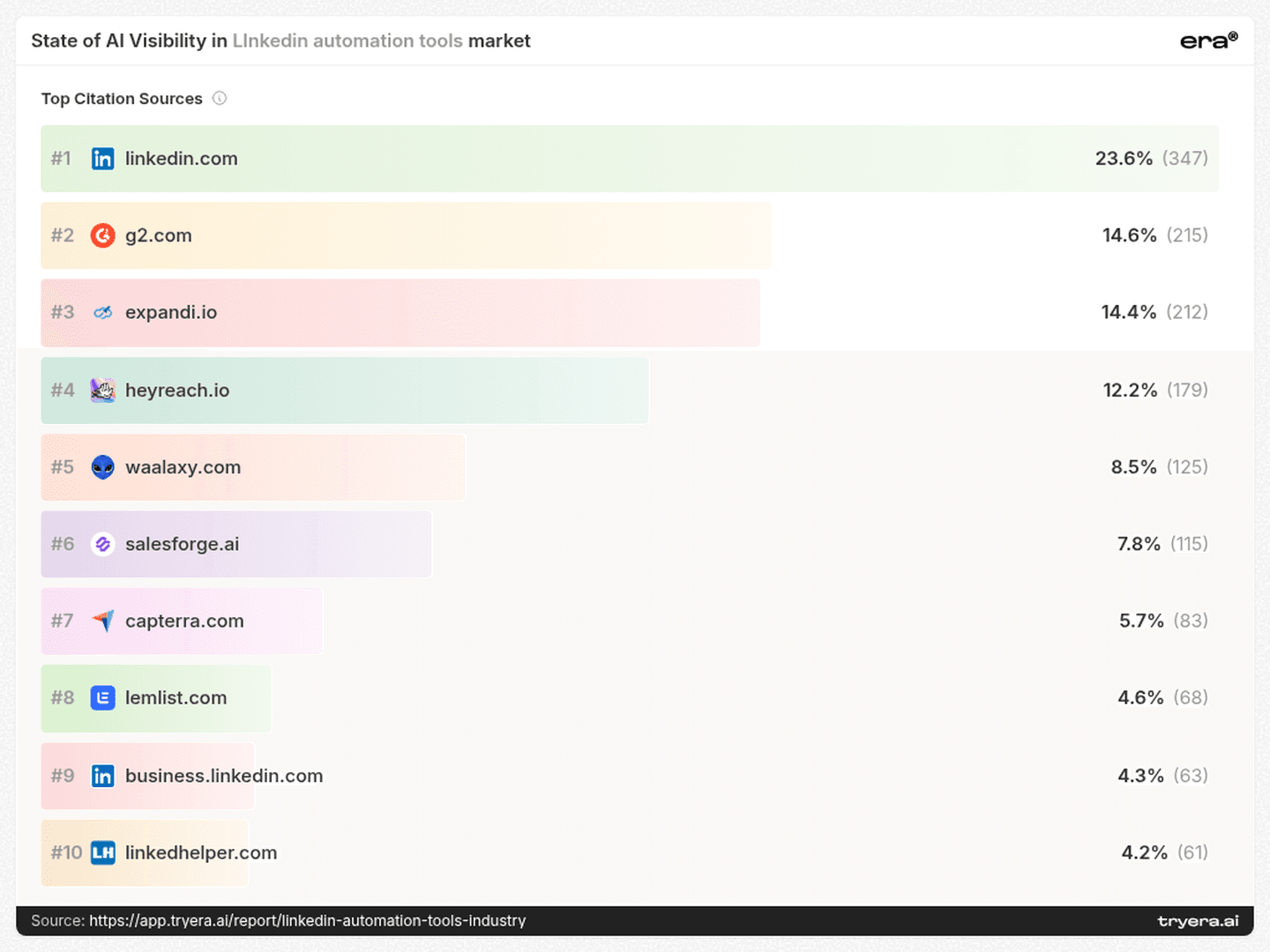
The largest citation source in the report is not a vendor or a review site. It is linkedin.com, with 23.6% (347) of the citations counted across the ten domains shown. business.linkedin.com adds another 63.
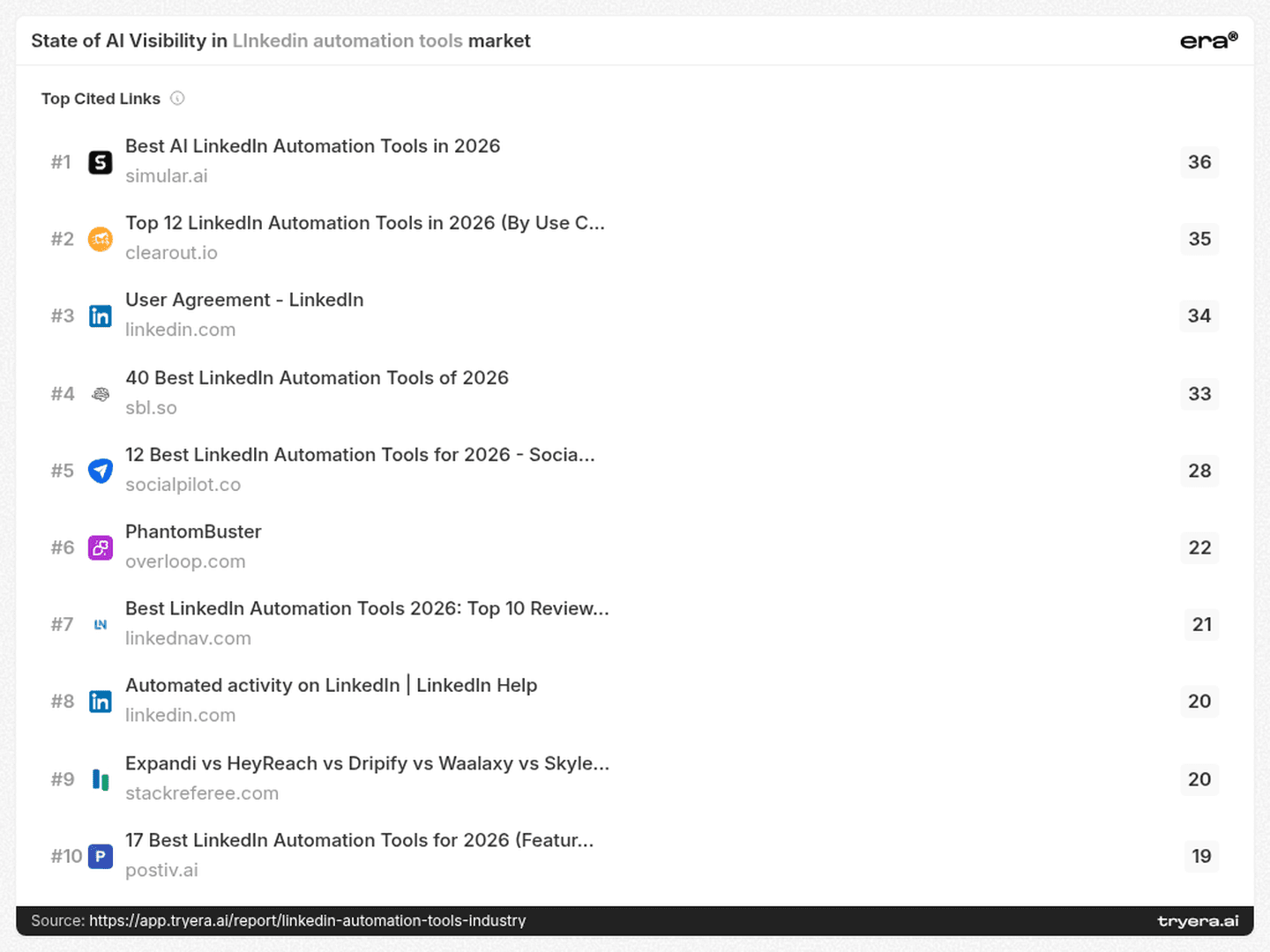
The cited-links page makes the pattern more specific. LinkedIn's "User Agreement" is the third most cited link (34), and LinkedIn Help's "Automated activity on LinkedIn" appears with 20.
AI answers about automation tools are, in part, answers about what the platform permits. One of the displayed top queries points the same way. Salesforge's is "LinkedIn outreach automation tools safety controls 2026".
For vendors, this raises a concrete question about evidence. An answer may cite LinkedIn's rules next to a product recommendation. Is the vendor's own description of limits, safety controls and account protection accurate, current and easy to find? That is a documentation task before it is a content-volume task.
5. Roundups and vendor domains — listicles, comparisons and vendor sites supply the shortlist
Seven of the ten most cited links are roundups or comparisons:
simular.ai, "Best AI LinkedIn Automation Tools in 2026" (36)
clearout.io, "Top 12 LinkedIn Automation Tools in 2026…" (35)
sbl.so, "40 Best LinkedIn Automation Tools of 2026" (33)
socialpilot.co (28)
linkednav.com (21)
a stackreferee.com comparison whose title begins "Expandi vs HeyReach vs Dripify vs Waalaxy vs…" (20)
postiv.ai (19)
Vendor domains carry weight too. expandi.io (212), heyreach.io (179), waalaxy.com (125), salesforge.ai (115), lemlist.com (68) and linkedhelper.com (61) together account for more than half of the citations counted across the ten domains shown. The review platforms G2 (215) and Capterra (83) sit alongside them.
Two details stand out. First, expandi.io and heyreach.io are the third and fourth largest citation sources. The Share of Voice leaders are also among the most-used sources. Second, lemlist.com is a top-ten source even though lemlist does not appear on the podium, in the other-players table or in the Share of Voice top ten. A brand can shape a category's answers as a source without being counted among its visible players.
The citation mix adds a per-brand view. 24.3% of Salesloft's cited sources are social, the highest share in the table; Outreach follows at 21.2%. Reply.io's split is 5.0% social and 75.2% "Others"; Botdog's is 4.6% and 78.6%. Meet Alfred has the largest own-domain share at 27.3%.
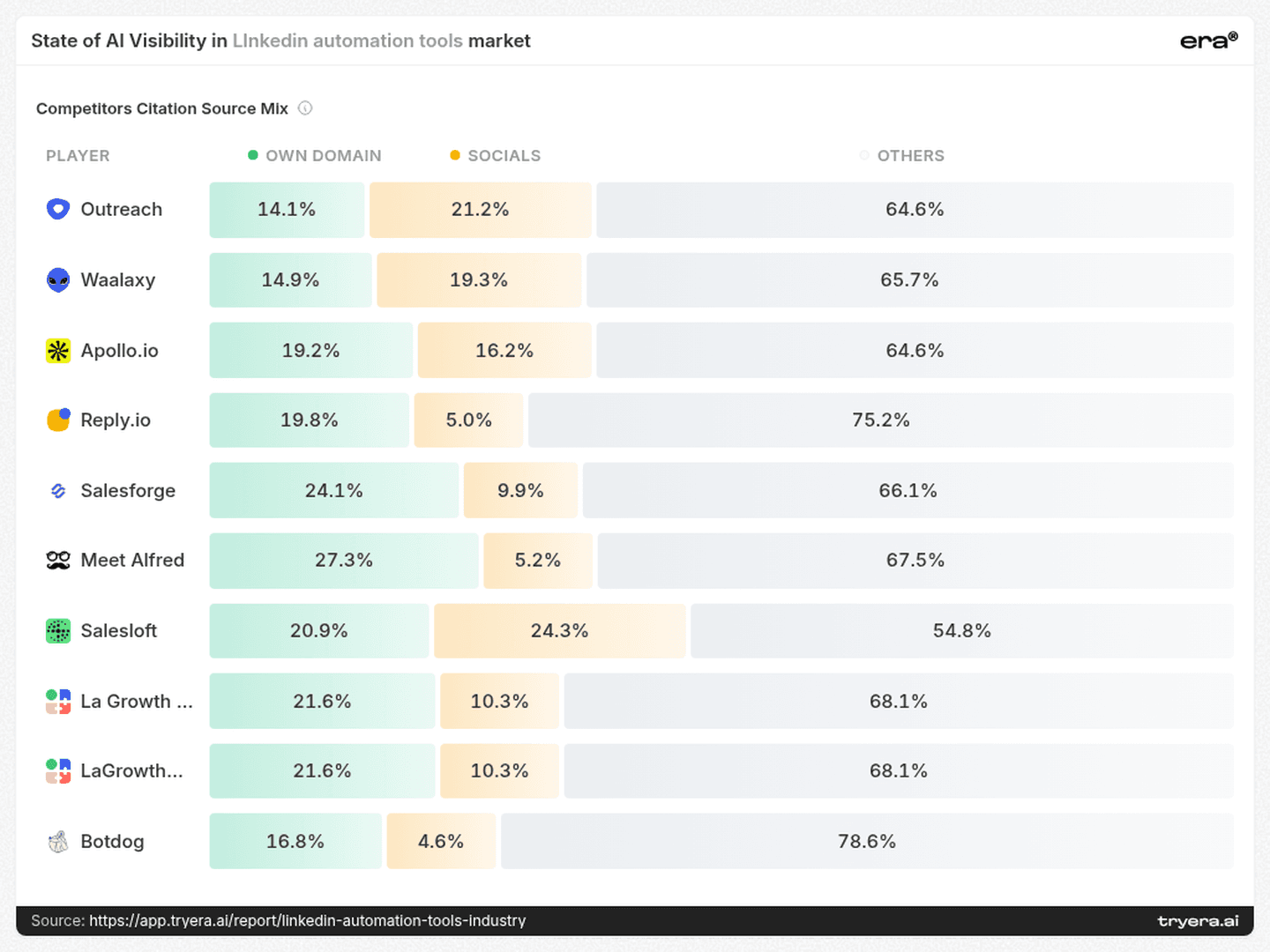
"Others" is a category, not a verdict on independence. The useful next step is to open those pages and check what they claim about features, pricing and safety, and whether it is still accurate.
In this category, the shortlist is often written by someone else's "best tools of 2026" page.
6. Buyer questions — generic "best tools" queries sit beside ROI, safety, pricing and affordability
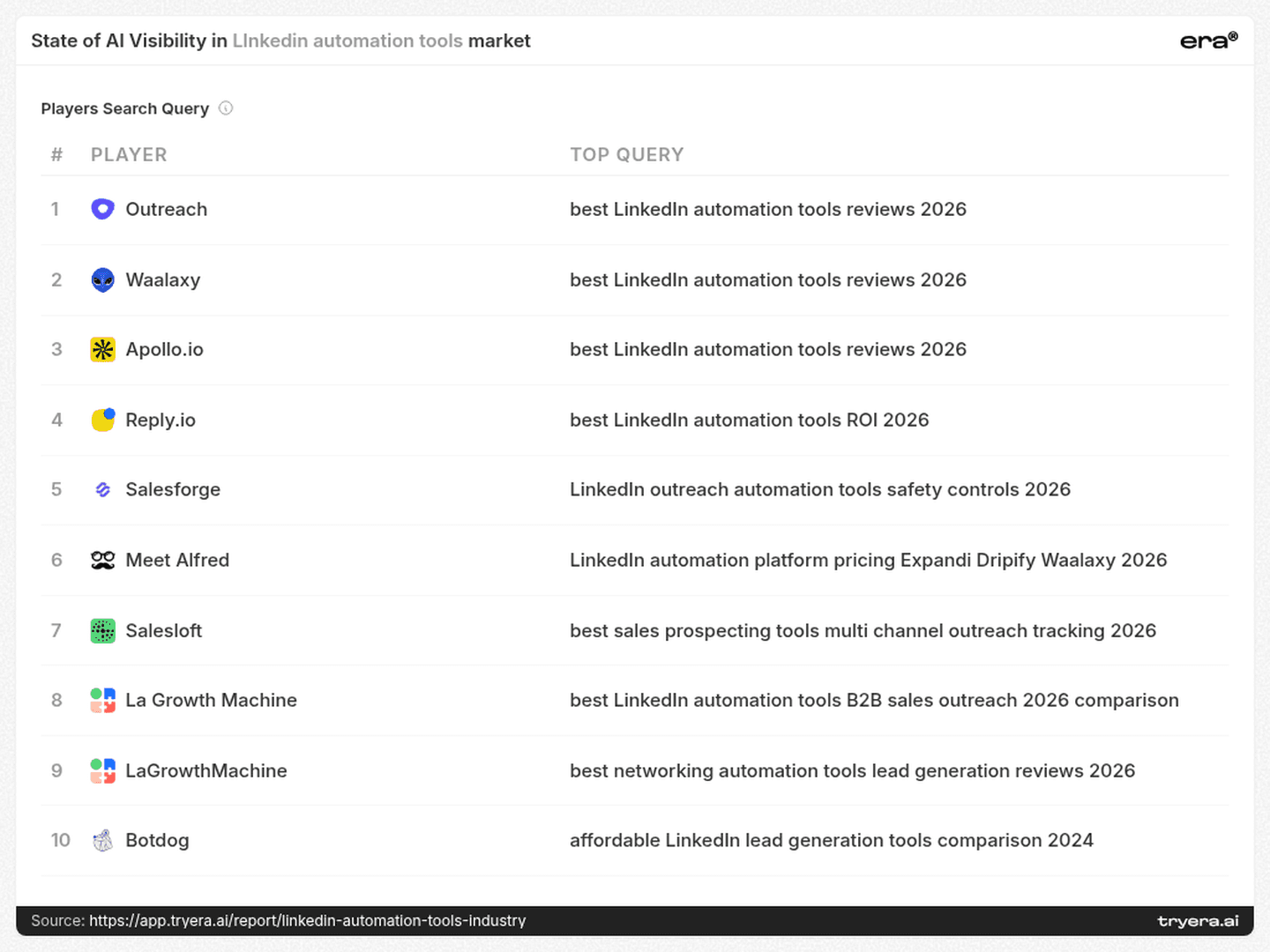
Outreach, Waalaxy and Apollo.io share the same displayed top query: "best LinkedIn automation tools reviews 2026". The rest of the list splits into distinct intents:
ROI. Reply.io: "best LinkedIn automation tools ROI 2026"
Safety. Salesforge: "LinkedIn outreach automation tools safety controls 2026"
Competitor pricing. Meet Alfred: "LinkedIn automation platform pricing Expandi Dripify Waalaxy 2026"
Adjacent category. Salesloft: "best sales prospecting tools multi channel outreach tracking 2026"
Affordability. Botdog: "affordable LinkedIn lead generation tools comparison 2024"
Each intent calls for different evidence. ROI questions need outcomes and the method behind them. Safety questions need limits and controls explained plainly. A pricing question that names three competitors calls for a transparent, dated comparison. Botdog's link to a query dated 2024 is worth checking directly: which answers still surface it, and do they describe the current product?
The search-volume page adds context. "linkedin sales navigator" shows 608, "linkedin api" 207 and "lead generation tools" 121. "linkedin automation tools" shows 62. The same list includes "database connection pooling" and "network configuration manager". "Networking automation" is also an IT term.
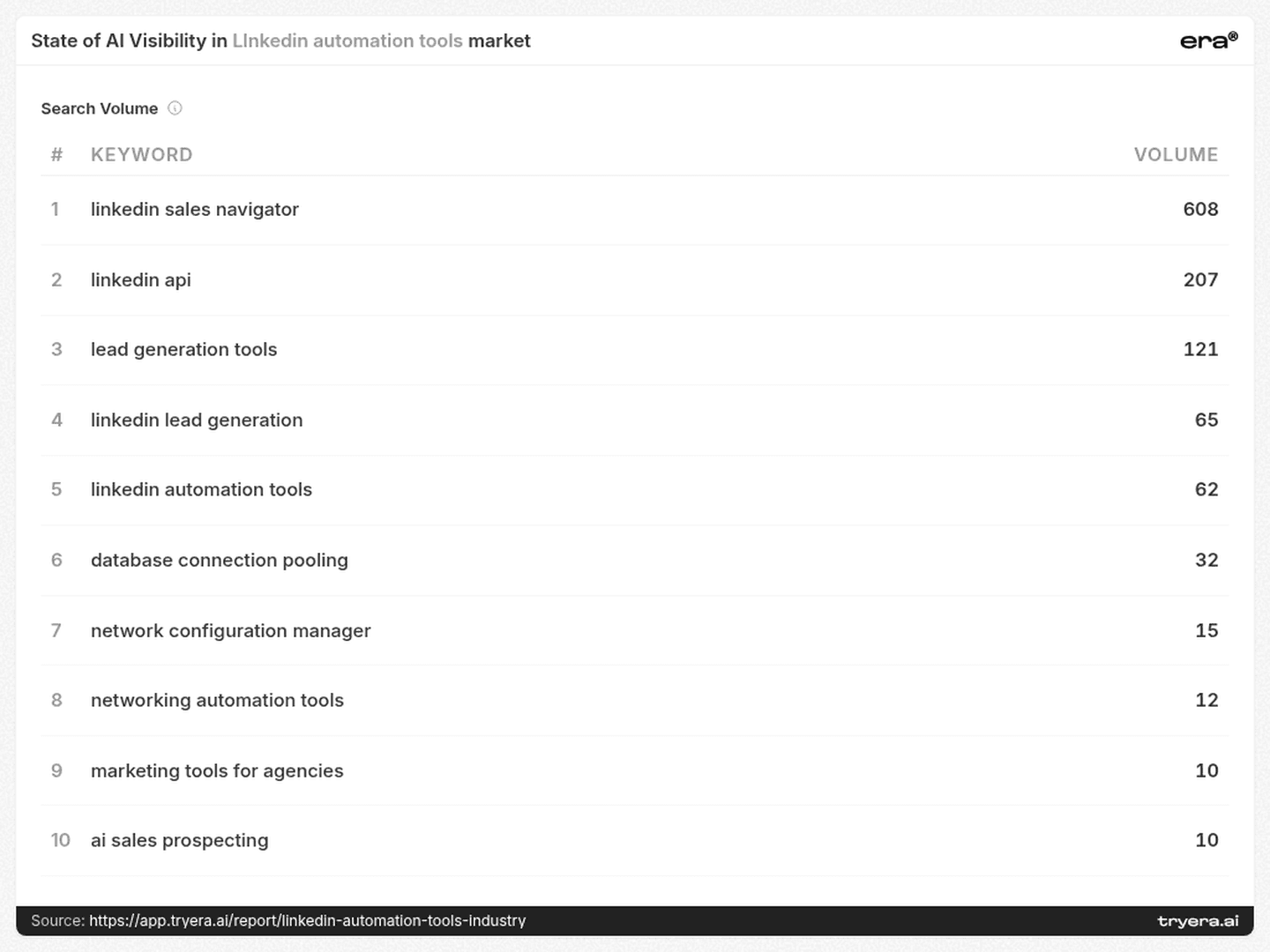
The larger visible demand sits around LinkedIn's own products and broader lead generation, not around the category label. Vendors that describe themselves only as "LinkedIn automation" may be missing from the adjacent questions. Any brand using "networking" language should also confirm which kind of networking the answers assume.
7. Authority signals — backlinks and technical scores do not line up with visibility
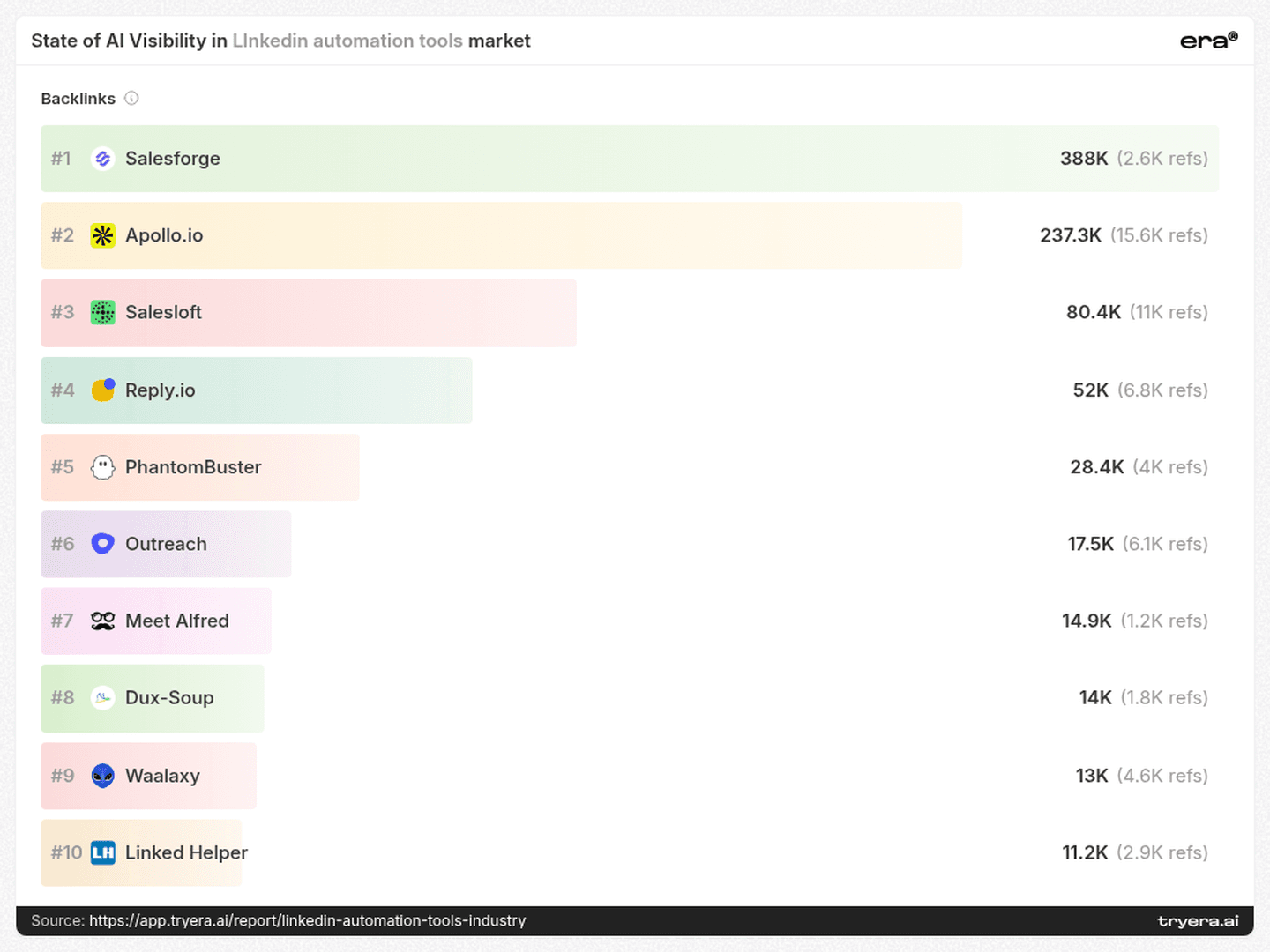
Salesforge leads the backlink page with 388K backlinks from 2.6K referring domains. Apollo.io has fewer backlinks (237.3K) but six times as many referring domains (15.6K). Outreach, with 82% Visibility, shows 17.5K backlinks from 6.1K domains. Waalaxy, second on the podium, shows 13K from 4.6K.
The competitive landscape points the same way. Waalaxy has the second-highest visibility score on the chart but one of the lowest technical audit scores.

None of this shows that links or technical hygiene are irrelevant. It shows that neither explains this category's visibility on its own. The audit lists 116 common issues:
42 content readability issues for AI
31 missing or invalid structured data
23 missing or invalid AI assistant guidelines (llms.txt)
9 crawler access issues
8 content feed issues
3 page discovery issues
Treat them as a checklist for the pages that support priority answers, not as a ranking formula.
Raw backlink counts describe a domain. They do not describe its place in an AI answer.
8. Beyond the leaders — where nine brands could focus next
Expandi, Dripify and HeyReach: turn share of the conversation into measured position.
Share of Voice places them first, second and third (15.6%, 14.6%, 12.8%).
expandi.io and heyreach.io are also the third and fourth largest citation sources (212 and 179). Dripify is named in a displayed top query and in the title of a top-cited comparison.
The strength is confirmed: these brands are part of the vocabulary AI engines use for this category. The open question is how that presence splits across engines and buyer intents. The next step is to measure it query by query, especially for the safety, pricing and ROI questions where other vendors already have a foothold.
Linked Helper: a cited source with a share of the conversation.
Linked Helper holds 6.3% Share of Voice, and linkedhelper.com is a top-ten citation source (61). Its backlink profile is 11.2K backlinks from 2.9K referring domains. The next step is to find which linkedhelper.com pages are cited and for which questions, then check whether those pages cover the intents competitors are winning.
Meet Alfred: early placement, competitor-pricing intent.
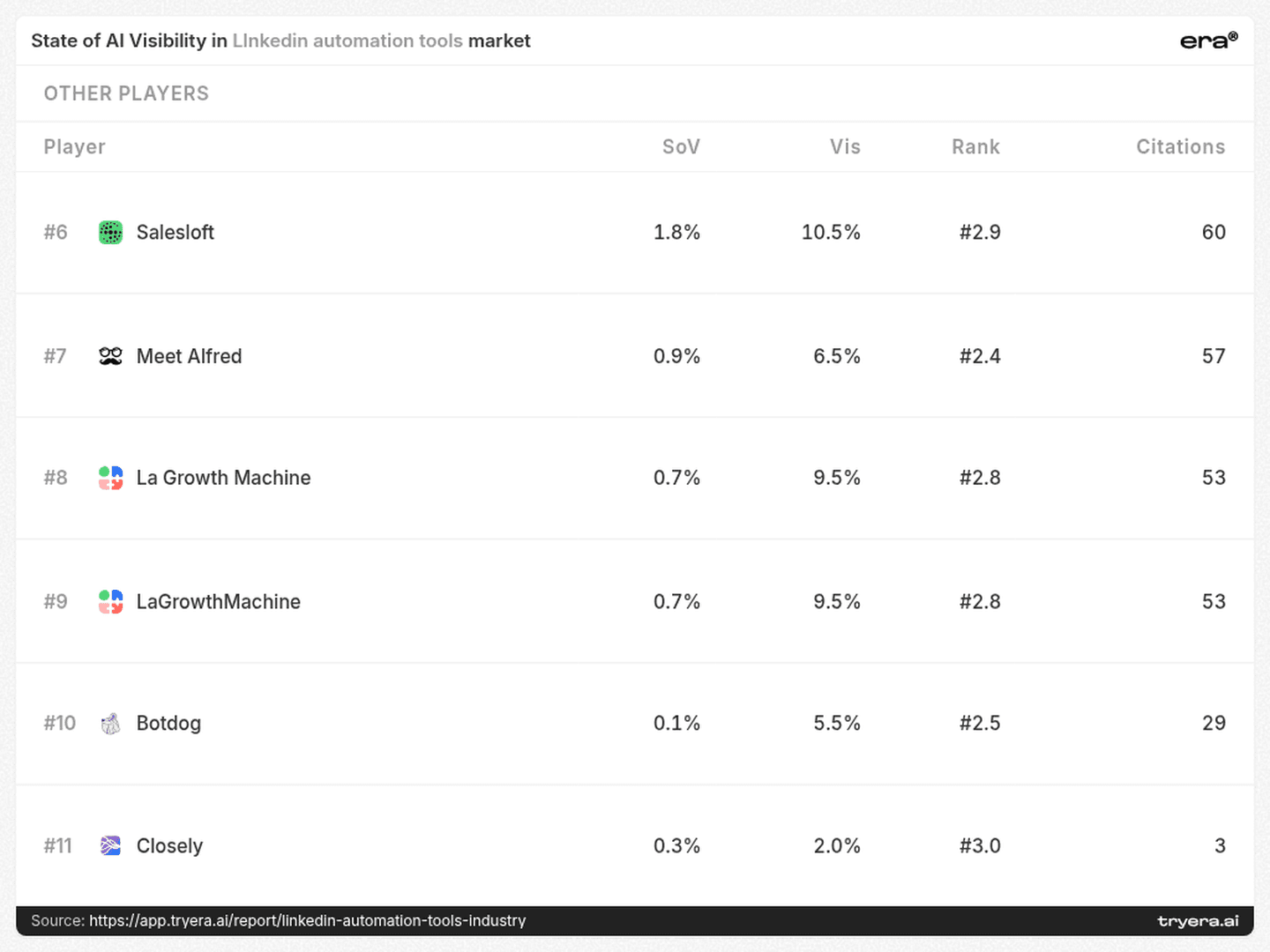
Meet Alfred has 6.5% Visibility, but its average Rank of #2.4 is earlier than two podium companies: Reply.io (#2.6) and Salesforge (#3.0). Its 57 citations are level with Salesforge's 56.
Its top query names Expandi, Dripify and Waalaxy, and it has the largest own-domain citation share in the table (27.3%). Its provider figures range from 10% in ChatGPT to 2% in Perplexity. The next step is to test competitor-pricing questions in each engine.
Botdog and Salesloft: opposite engine profiles.
Botdog records 16% in Claude and 0% in ChatGPT and Perplexity; its average Rank is #2.5. Salesloft reaches 16% in ChatGPT and 4% in Claude, and has the highest social citation share in the table (24.3%).
For Botdog, the question is what Claude's answers contain that other engines' answers do not, and whether a query dated 2024 still reflects the product. Salesloft's top query is about multi-channel sales prospecting. For Salesloft, the question is whether answers name it as a LinkedIn tool or as an adjacent platform.
La Growth Machine: one company, two names.
The report lists "La Growth Machine" and "LaGrowthMachine" separately with identical figures: 9.5% Visibility, Rank #2.8 and 53 citations, with the same provider and citation-mix profiles. Their displayed top queries differ. One is about B2B sales outreach comparisons, the other about networking automation.
The figures should not be added together. The practical steps are consistent naming across the company's site, profiles and listings, and a check of how answers render the brand.
Closely: a thin evidence base.
Closely records 2.0% Visibility, an average Rank of #3.0 and 3 citations, the smallest citation count in the players table. With so little cited material, the first task is an inventory. Which pages answer the category's main buyer questions, and which third-party roundups include the brand at all?
9. The next 90 days — a plan built on this category's evidence
Days 1–30: map answers by engine and intent.
Build a prompt set around the observed intents: generic "best tools" reviews, ROI, safety controls, competitor pricing, affordability, multi-channel prospecting, and questions adjacent to Sales Navigator.
Run it across ChatGPT, Perplexity, Google AI and Claude.
Record mentions, mention order, the other brands named and the pages cited.
Start with the zeros: Salesforge in ChatGPT, Botdog in ChatGPT and Perplexity, Salesloft's low figure in Claude.
Days 31–60: fix the evidence behind priority answers.
Audit your safety and compliance documentation against the LinkedIn pages that AI engines cite.
Check how you are described in the recurring roundups (simular.ai, clearout.io, sbl.so, socialpilot.co and the rest of the cited-links list) and on G2 and Capterra.
Where pricing and ROI intents matter, publish dated, specific information.
Standardise brand naming everywhere.
Work through readability, structured data and llms.txt on the pages that support these answers.
Days 61–90: rerun and compare.
Repeat the same prompt set.
For each engine, track presence, mention order, co-mentioned brands and cited sources.
Keep changes that correspond with clearer, more accurate answers, and revise hypotheses where nothing moved.
Decide which adjacent intents (Sales Navigator workflows, lead generation, multi-channel prospecting) deserve the next cycle.
Want this scoreboard for your own brand? Run a free audit at tryera.ai/free-report — 30 minutes, your numbers, no deck required.
Full report with source data: LinkedIn Automation Tools.



For LinkedIn automation vendors, AI answers now decide which tools make a buyer's first shortlist. The questions behind that shortlist vary: generic "best tools" reviews, ROI, safety controls, pricing against named competitors, and affordability. Era's industry report measures brand visibility, Share of Voice, mention position, provider differences, search queries, citation sources and technical signals. Each metric describes a different part of discovery. Visibility shows how often a brand appears. Share of Voice shows how much of the conversation it takes. Average position shows where in the answer it shows up. In this category those measures disagree sharply. A useful assessment has to show where a company is present, where it is crowded out, and which sources shape the answers in between.
Outreach appears in 82% of monitored AI answers about LinkedIn automation tools. Yet three specialists hold more Share of Voice, and none of them is on the podium.
That is the central tension in Era's report. The player tables reward reach across answers. The Share of Voice chart shows who takes up space inside them. For a buyer, the two can produce very different shortlists. For a vendor, they point to different jobs.
1. Two scoreboards — Outreach wins reach; Expandi, Dripify and HeyReach win the conversation
The podium is clear on its own terms. Outreach records 82.0% Visibility, an average Rank of #1.5 and 787 citations. Waalaxy follows at 36.0%, then Apollo.io (20.5%), Reply.io (18.5%) and Salesforge (14.0%).
The Share of Voice chart reorders the market. Expandi leads with 15.6%, followed by Dripify at 14.6% and HeyReach at 12.8%. Outreach is fourth at 9.9%, and Waalaxy is seventh at 3.8%. Linked Helper (6.3%), Dux-Soup (5.7%), Skylead, Octopus CRM and PhantomBuster (3.5% each) complete the named top ten.
Together, Expandi, Dripify and HeyReach hold 43.0% of Share of Voice. That is more than three times the combined share of Outreach and Waalaxy (13.7%).
Being named in an answer and taking up space inside it are separate outcomes. A brand can appear almost everywhere and still share each answer with a long line of LinkedIn-native specialists.
Being named in most answers is not the same as owning the shortlist.
2. Consistency — Outreach's advantage is uniformity; Waalaxy's is ChatGPT
Outreach's provider profile is unusually flat: 80% in ChatGPT, 82% in Perplexity, 84% in Google AI and 82% in Claude. Its presence does not drop off in any engine.
Waalaxy's profile is uneven. It reaches 46% in ChatGPT but 26% in Google AI, a 20-point spread. Its average Rank of #1.7 shows that when it is named, it tends to be named early.
For Waalaxy, the next question is specific to each engine. Which ChatGPT answers include it that comparable Google AI answers leave out, and which sources do those answers cite? For Outreach, uniformity changes the priority: the work is its position inside crowded answers, not its presence across engines.
3. Provider gaps — below the top two, the competitive order depends on the engine
The same heatmap shows how quickly the order changes once engines are separated.
Salesforge records 0% in ChatGPT and 24% in Perplexity. In Perplexity, that puts it ahead of Apollo.io (18%) and Reply.io (10%).
Reply.io reaches 26% in Google AI, level with Waalaxy there, but only 10% in Perplexity.
Salesloft moves in the opposite direction: 16% in ChatGPT, 4% in Claude.
Botdog records 0% in ChatGPT and Perplexity, 6% in Google AI and 16% in Claude, ahead of Salesforge's 12% in that engine.
These are report-wide provider figures, not results for a single query. They show where to look. A team with a zero in one engine should rerun its priority buyer questions there, compare the brands named and the pages cited, and only then draw conclusions.
"How visible are we?" is incomplete until someone asks "In which engine?"
4. The platform in the answer — LinkedIn's own rules are among the most cited pages
The largest citation source in the report is not a vendor or a review site. It is linkedin.com, with 23.6% (347) of the citations counted across the ten domains shown. business.linkedin.com adds another 63.
The cited-links page makes the pattern more specific. LinkedIn's "User Agreement" is the third most cited link (34), and LinkedIn Help's "Automated activity on LinkedIn" appears with 20.
AI answers about automation tools are, in part, answers about what the platform permits. One of the displayed top queries points the same way. Salesforge's is "LinkedIn outreach automation tools safety controls 2026".
For vendors, this raises a concrete question about evidence. An answer may cite LinkedIn's rules next to a product recommendation. Is the vendor's own description of limits, safety controls and account protection accurate, current and easy to find? That is a documentation task before it is a content-volume task.
5. Roundups and vendor domains — listicles, comparisons and vendor sites supply the shortlist
Seven of the ten most cited links are roundups or comparisons:
simular.ai, "Best AI LinkedIn Automation Tools in 2026" (36)
clearout.io, "Top 12 LinkedIn Automation Tools in 2026…" (35)
sbl.so, "40 Best LinkedIn Automation Tools of 2026" (33)
socialpilot.co (28)
linkednav.com (21)
a stackreferee.com comparison whose title begins "Expandi vs HeyReach vs Dripify vs Waalaxy vs…" (20)
postiv.ai (19)
Vendor domains carry weight too. expandi.io (212), heyreach.io (179), waalaxy.com (125), salesforge.ai (115), lemlist.com (68) and linkedhelper.com (61) together account for more than half of the citations counted across the ten domains shown. The review platforms G2 (215) and Capterra (83) sit alongside them.
Two details stand out. First, expandi.io and heyreach.io are the third and fourth largest citation sources. The Share of Voice leaders are also among the most-used sources. Second, lemlist.com is a top-ten source even though lemlist does not appear on the podium, in the other-players table or in the Share of Voice top ten. A brand can shape a category's answers as a source without being counted among its visible players.
The citation mix adds a per-brand view. 24.3% of Salesloft's cited sources are social, the highest share in the table; Outreach follows at 21.2%. Reply.io's split is 5.0% social and 75.2% "Others"; Botdog's is 4.6% and 78.6%. Meet Alfred has the largest own-domain share at 27.3%.
"Others" is a category, not a verdict on independence. The useful next step is to open those pages and check what they claim about features, pricing and safety, and whether it is still accurate.
In this category, the shortlist is often written by someone else's "best tools of 2026" page.
6. Buyer questions — generic "best tools" queries sit beside ROI, safety, pricing and affordability
Outreach, Waalaxy and Apollo.io share the same displayed top query: "best LinkedIn automation tools reviews 2026". The rest of the list splits into distinct intents:
ROI. Reply.io: "best LinkedIn automation tools ROI 2026"
Safety. Salesforge: "LinkedIn outreach automation tools safety controls 2026"
Competitor pricing. Meet Alfred: "LinkedIn automation platform pricing Expandi Dripify Waalaxy 2026"
Adjacent category. Salesloft: "best sales prospecting tools multi channel outreach tracking 2026"
Affordability. Botdog: "affordable LinkedIn lead generation tools comparison 2024"
Each intent calls for different evidence. ROI questions need outcomes and the method behind them. Safety questions need limits and controls explained plainly. A pricing question that names three competitors calls for a transparent, dated comparison. Botdog's link to a query dated 2024 is worth checking directly: which answers still surface it, and do they describe the current product?
The search-volume page adds context. "linkedin sales navigator" shows 608, "linkedin api" 207 and "lead generation tools" 121. "linkedin automation tools" shows 62. The same list includes "database connection pooling" and "network configuration manager". "Networking automation" is also an IT term.
The larger visible demand sits around LinkedIn's own products and broader lead generation, not around the category label. Vendors that describe themselves only as "LinkedIn automation" may be missing from the adjacent questions. Any brand using "networking" language should also confirm which kind of networking the answers assume.
7. Authority signals — backlinks and technical scores do not line up with visibility
Salesforge leads the backlink page with 388K backlinks from 2.6K referring domains. Apollo.io has fewer backlinks (237.3K) but six times as many referring domains (15.6K). Outreach, with 82% Visibility, shows 17.5K backlinks from 6.1K domains. Waalaxy, second on the podium, shows 13K from 4.6K.
The competitive landscape points the same way. Waalaxy has the second-highest visibility score on the chart but one of the lowest technical audit scores.
None of this shows that links or technical hygiene are irrelevant. It shows that neither explains this category's visibility on its own. The audit lists 116 common issues:
42 content readability issues for AI
31 missing or invalid structured data
23 missing or invalid AI assistant guidelines (llms.txt)
9 crawler access issues
8 content feed issues
3 page discovery issues
Treat them as a checklist for the pages that support priority answers, not as a ranking formula.
Raw backlink counts describe a domain. They do not describe its place in an AI answer.
8. Beyond the leaders — where nine brands could focus next
Expandi, Dripify and HeyReach: turn share of the conversation into measured position.
Share of Voice places them first, second and third (15.6%, 14.6%, 12.8%).
expandi.io and heyreach.io are also the third and fourth largest citation sources (212 and 179). Dripify is named in a displayed top query and in the title of a top-cited comparison.
The strength is confirmed: these brands are part of the vocabulary AI engines use for this category. The open question is how that presence splits across engines and buyer intents. The next step is to measure it query by query, especially for the safety, pricing and ROI questions where other vendors already have a foothold.
Linked Helper: a cited source with a share of the conversation.
Linked Helper holds 6.3% Share of Voice, and linkedhelper.com is a top-ten citation source (61). Its backlink profile is 11.2K backlinks from 2.9K referring domains. The next step is to find which linkedhelper.com pages are cited and for which questions, then check whether those pages cover the intents competitors are winning.
Meet Alfred: early placement, competitor-pricing intent.
Meet Alfred has 6.5% Visibility, but its average Rank of #2.4 is earlier than two podium companies: Reply.io (#2.6) and Salesforge (#3.0). Its 57 citations are level with Salesforge's 56.
Its top query names Expandi, Dripify and Waalaxy, and it has the largest own-domain citation share in the table (27.3%). Its provider figures range from 10% in ChatGPT to 2% in Perplexity. The next step is to test competitor-pricing questions in each engine.
Botdog and Salesloft: opposite engine profiles.
Botdog records 16% in Claude and 0% in ChatGPT and Perplexity; its average Rank is #2.5. Salesloft reaches 16% in ChatGPT and 4% in Claude, and has the highest social citation share in the table (24.3%).
For Botdog, the question is what Claude's answers contain that other engines' answers do not, and whether a query dated 2024 still reflects the product. Salesloft's top query is about multi-channel sales prospecting. For Salesloft, the question is whether answers name it as a LinkedIn tool or as an adjacent platform.
La Growth Machine: one company, two names.
The report lists "La Growth Machine" and "LaGrowthMachine" separately with identical figures: 9.5% Visibility, Rank #2.8 and 53 citations, with the same provider and citation-mix profiles. Their displayed top queries differ. One is about B2B sales outreach comparisons, the other about networking automation.
The figures should not be added together. The practical steps are consistent naming across the company's site, profiles and listings, and a check of how answers render the brand.
Closely: a thin evidence base.
Closely records 2.0% Visibility, an average Rank of #3.0 and 3 citations, the smallest citation count in the players table. With so little cited material, the first task is an inventory. Which pages answer the category's main buyer questions, and which third-party roundups include the brand at all?
9. The next 90 days — a plan built on this category's evidence
Days 1–30: map answers by engine and intent.
Build a prompt set around the observed intents: generic "best tools" reviews, ROI, safety controls, competitor pricing, affordability, multi-channel prospecting, and questions adjacent to Sales Navigator.
Run it across ChatGPT, Perplexity, Google AI and Claude.
Record mentions, mention order, the other brands named and the pages cited.
Start with the zeros: Salesforge in ChatGPT, Botdog in ChatGPT and Perplexity, Salesloft's low figure in Claude.
Days 31–60: fix the evidence behind priority answers.
Audit your safety and compliance documentation against the LinkedIn pages that AI engines cite.
Check how you are described in the recurring roundups (simular.ai, clearout.io, sbl.so, socialpilot.co and the rest of the cited-links list) and on G2 and Capterra.
Where pricing and ROI intents matter, publish dated, specific information.
Standardise brand naming everywhere.
Work through readability, structured data and llms.txt on the pages that support these answers.
Days 61–90: rerun and compare.
Repeat the same prompt set.
For each engine, track presence, mention order, co-mentioned brands and cited sources.
Keep changes that correspond with clearer, more accurate answers, and revise hypotheses where nothing moved.
Decide which adjacent intents (Sales Navigator workflows, lead generation, multi-channel prospecting) deserve the next cycle.
Want this scoreboard for your own brand? Run a free audit at tryera.ai/free-report — 30 minutes, your numbers, no deck required.
Full report with source data: LinkedIn Automation Tools.