October 1, 2026
October 1, 2026
How Legal AI Tools Rank in AI Search: A Deep Analysis of the Market Leaders and Challengers
Era's report on AI for legal finds one clear leader and a crowded field behind it. Thomson Reuters leads every scoreboard metric, while Harvey, LexisNexis and Clio take large shares of the conversation without a podium place. The evidence behind the answers comes from vendor domains and third-party 2026 roundups, and buyer demand centers on privilege and hallucinations.
Era's report on AI for legal finds one clear leader and a crowded field behind it. Thomson Reuters leads every scoreboard metric, while Harvey, LexisNexis and Clio take large shares of the conversation without a podium place. The evidence behind the answers comes from vendor domains and third-party 2026 roundups, and buyer demand centers on privilege and hallucinations.
For legal AI vendors, AI answers increasingly shape the first shortlist a law firm or in-house team sees. The questions behind that shortlist range from research reliability and contract review accuracy to integration, pricing and small-firm fit — and whether a tool can be trusted with privileged information. Era's industry report tracks 50 buyer prompts across ChatGPT, Perplexity, Google AI and Claude. It measures Visibility, Share of Voice, average position, citations, provider differences, search queries, backlinks and technical signals. Those measures do not collapse into a single ranking. Visibility shows how often a brand is named, Share of Voice how much of the answer it takes, position how early it appears, and citations which evidence the engines rely on. In legal AI, they tell noticeably different stories.
Thomson Reuters is named in 71.9% of monitored AI answers about legal AI tools. No other ranked brand comes close. Yet the answers around it are far more crowded than the podium suggests.
Three companies that take up large parts of those answers — Harvey, LexisNexis and Clio — hold 42.9% of Share of Voice between them without a podium place. The domains AI engines cite most are mostly vendors' own sites, while the individual pages they cite most are third-party 2026 roundups. And the term buyers search most in this category is not a product. It is "attorney client privilege."
1. The incumbent — Thomson Reuters leads every scoreboard metric
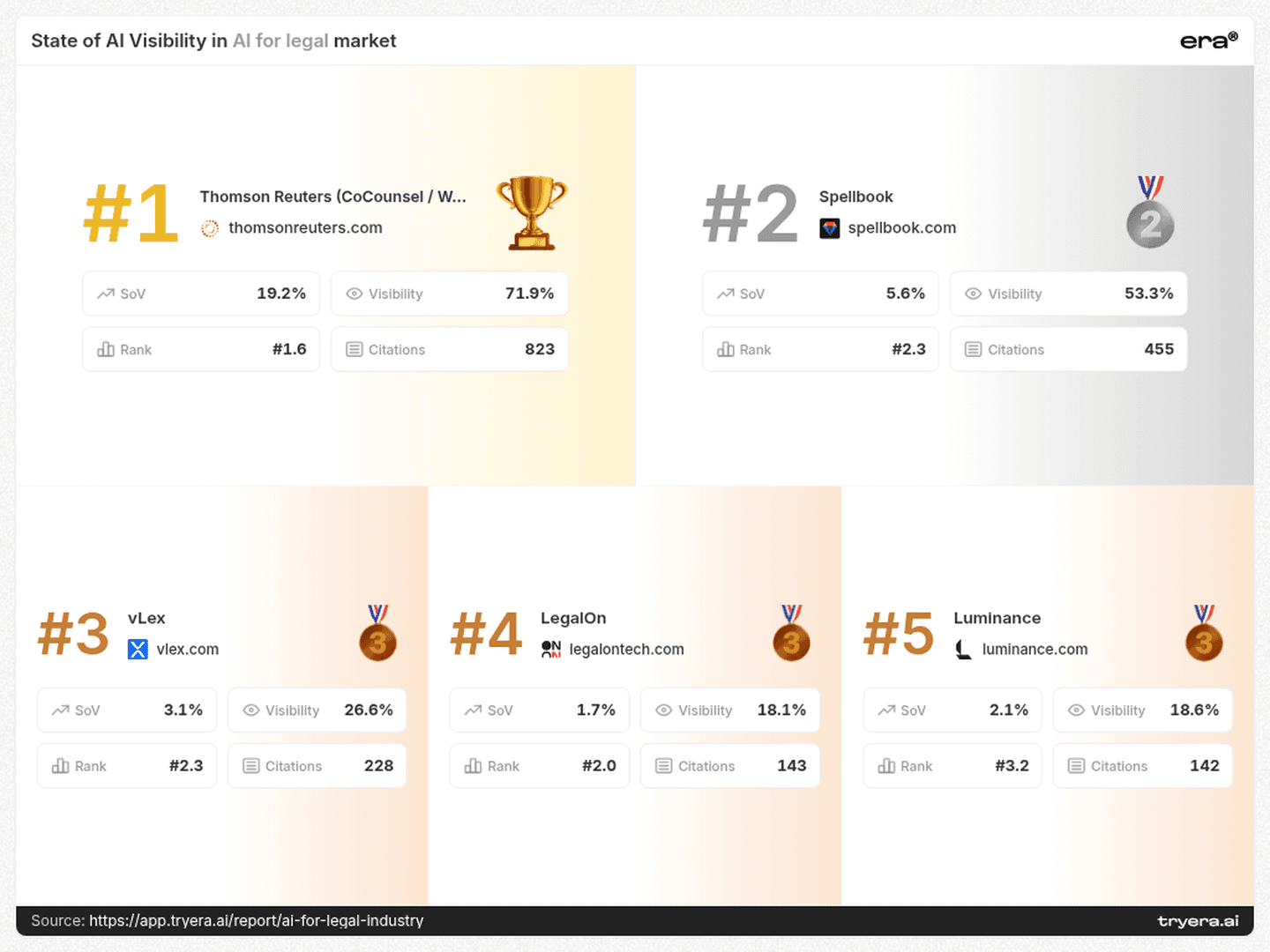
Thomson Reuters (CoCounsel / Westlaw Precision AI) records 71.9% Visibility, 19.2% Share of Voice, an average Rank of #1.6 and 823 citations. Spellbook, second on the podium, records 53.3%, 5.6%, #2.3 and 455.
Below that lead, the podium is separated by fractions:
vLex (26.6% Visibility) shares Spellbook's average Rank of #2.3.
LegalOn is fourth with 18.1% Visibility, yet its average Rank of #2.0 is the earliest on the podium after Thomson Reuters.
Luminance is fifth with slightly higher Visibility (18.6%) and Share of Voice (2.1% vs 1.7%), but a later average Rank (#3.2).
LegalOn and Luminance are one citation apart: 143 and 142.
Below Thomson Reuters, one citation separates fourth place from fifth.
For challengers, the practical lesson sits in LegalOn's row. Its presence is modest, but when it is named, it tends to be named early. In a category with one dominant incumbent, being mentioned early in fewer answers may be a more realistic first goal than matching Thomson Reuters' reach across all of them.
2. The wider conversation — six of the ten largest voices are not on the podium
The Share of Voice chart shows who takes up space inside the answers: Thomson Reuters 19.2%, Harvey 16.5%, LexisNexis (Lexis+ AI) 15.8%, Clio 10.6%, Spellbook 5.6%, Ironclad 5.4%, vLex 3.1%, Eve 2.5%, Luminance 2.1% and Legora 1.7%.
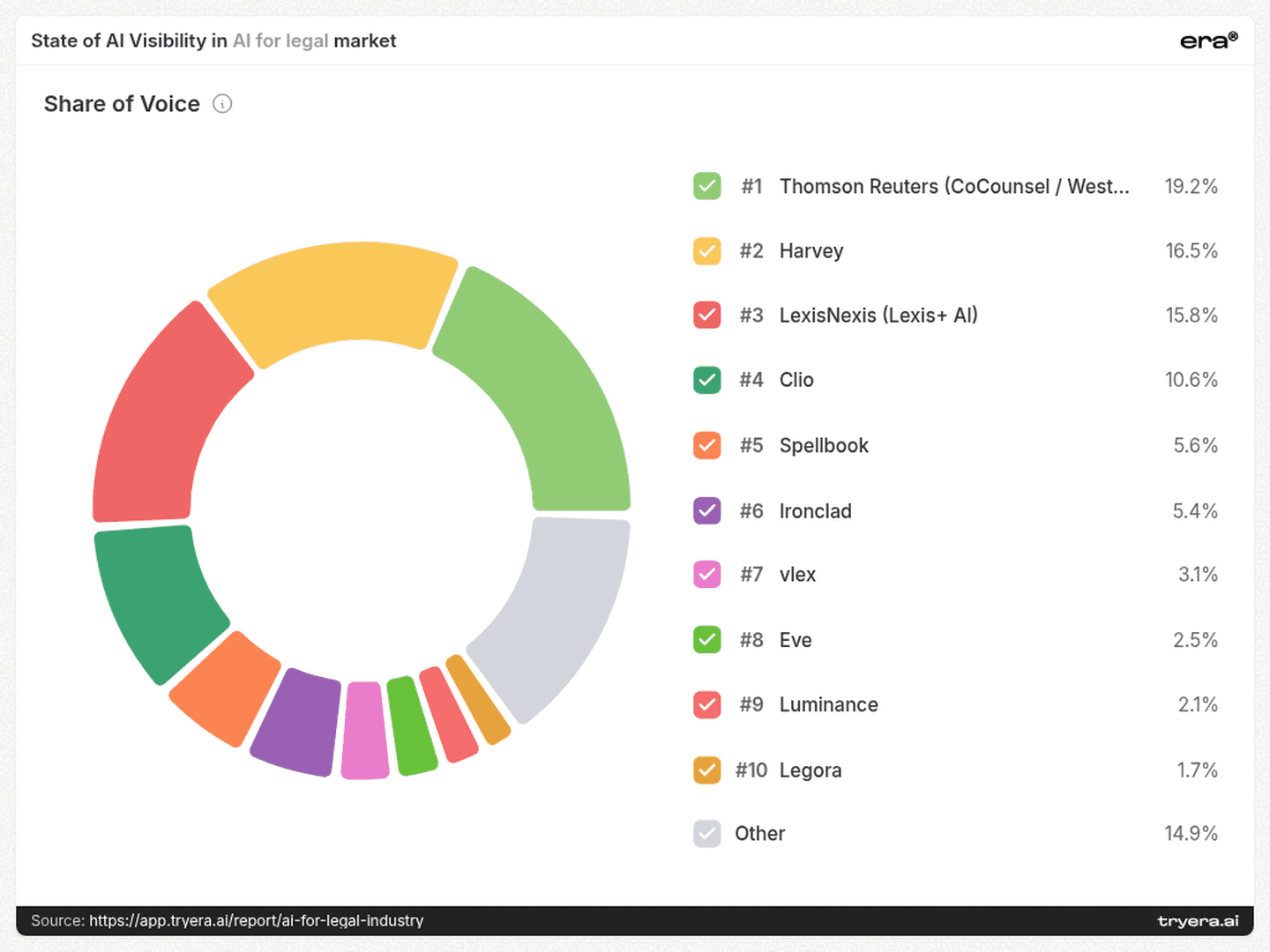
Harvey, LexisNexis and Clio together hold 42.9% — more than twice Thomson Reuters' share. Add Ironclad, Eve and Legora, and the six names in the top ten that are absent from the podium account for 52.5%. The five podium companies together account for 31.7%.
Spellbook's position is the clearest example. It is second on the podium but fifth by Share of Voice, and only 0.2 points ahead of Ironclad.
One entity note matters here. vLex describes itself on its own site as part of Clio. The report lists the two separately, and their figures should be read separately rather than added together.
A podium ranks the scored players. Share of Voice shows who else is standing in the answer.
For anyone benchmarking against the podium alone, this is the key caveat. Three of the four brands taking the most space in these answers would not appear in a podium-only reading of the market.
3. The sources — vendor domains carry the citations, and backlinks do not predict which
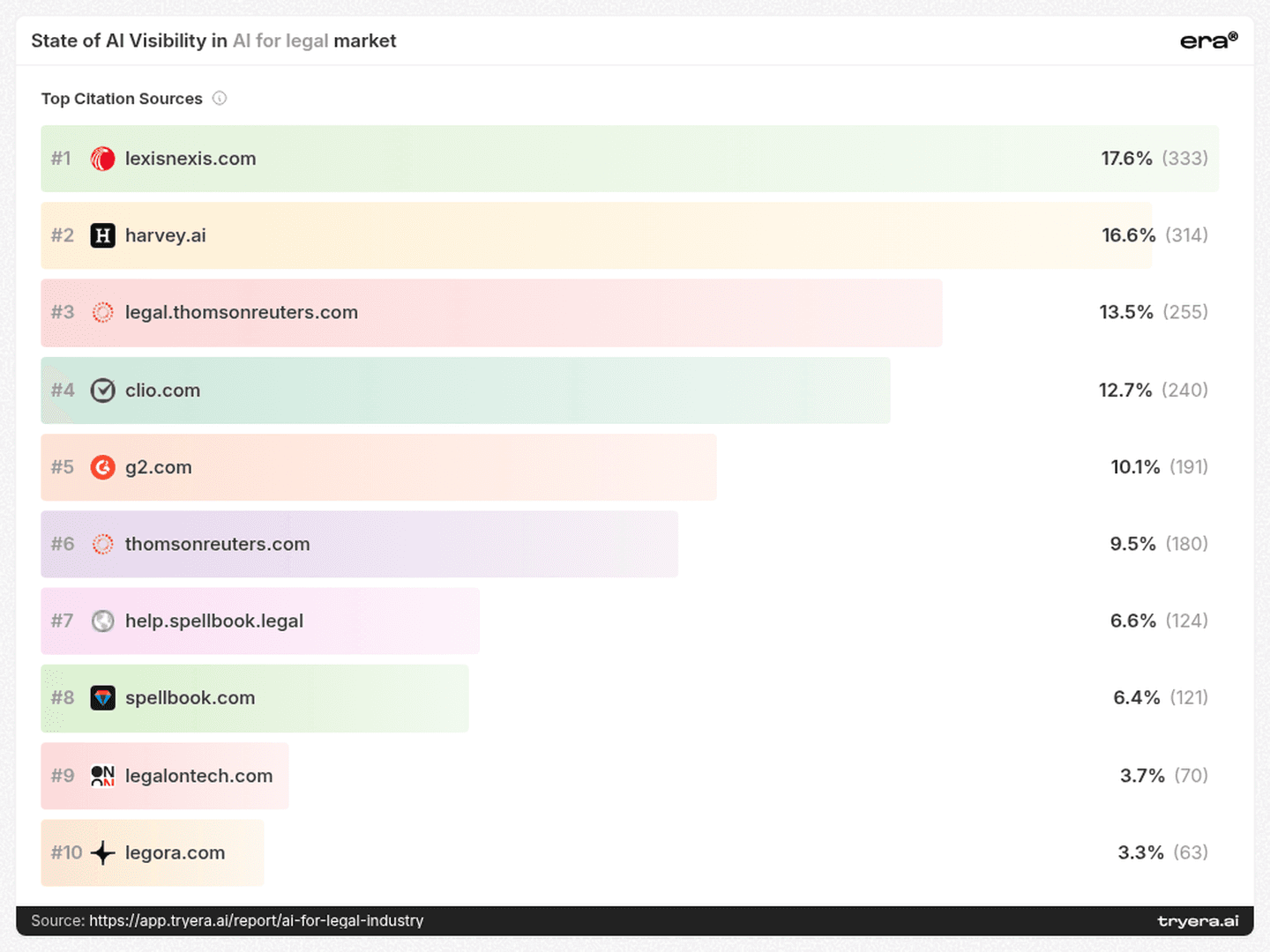
Nine of the ten most cited domains belong to vendors: lexisnexis.com (333), harvey.ai (314), legal.thomsonreuters.com (255), clio.com (240), thomsonreuters.com (180), help.spellbook.legal (124), spellbook.com (121), legalontech.com (70) and legora.com (63). The only exception is g2.com, with 191. Across the ten domains shown, lexisnexis.com accounts for 17.6% of citations and harvey.ai for 16.6%.
Two details stand out.
Documentation is doing evidential work. Spellbook's help center, help.spellbook.legal, is cited 124 times — slightly more than spellbook.com (121). Thomson Reuters has two domains in the top six, with 255 and 180 citations.
Link volume and citation volume are different things. harvey.ai is cited almost as often as lexisnexis.com. The backlink profiles behind the two brands are not remotely similar:
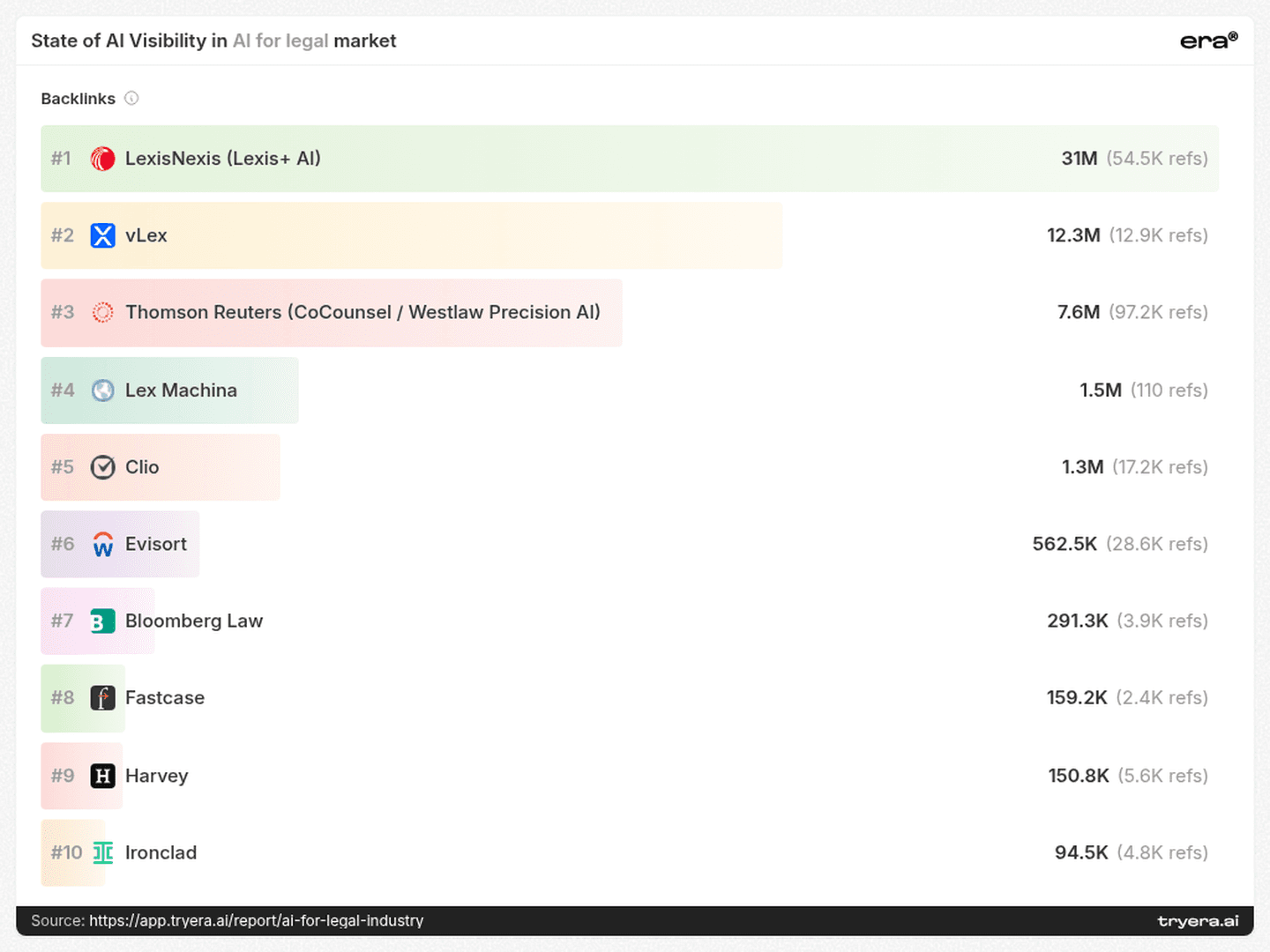
LexisNexis (Lexis+ AI) has 31M backlinks from 54.5K referring domains. Harvey has 150.8K from 5.6K — less than 1% of LexisNexis's backlink count. Thomson Reuters has the most referring domains in the table (97.2K), and vLex has 12.3M backlinks from 12.9K.
Harvey's domain earns 94% of LexisNexis's citation count with less than 1% of its backlinks.
The practical conclusion is not that backlinks are irrelevant. It is that link volume is a poor proxy for which pages AI engines cite. A vendor's first audit should list the pages actually cited — product pages, help articles, security and pricing pages — and the buyer questions each one answers.
4. The roundup layer — every top-cited page is a 2026 "best tools" comparison
At page level, the picture flips. The ten most cited links are all third-party roundups or comparisons, and every title is stamped 2026:
dupple.com — "Best AI Legal Tools in 2026: 8 Picks I'd Actually…" (34), plus a second Dupple page, "The Best AI Legal Assistant Tools in 2026" (18)
ixsor.com — "AI legal research in 2026: CoCounsel, Vincent, Lex…" (34)
xantrion.com — "Best AI Tools For Lawyers: 2026 Comparison" (30)
techno-pulse.com — "Best AI Legal Tools in 2026: Harvey AI vs CoCounse…" (23)
legalysis.co (21), legience.com (16), officialairanking.com (16) and thelegalprompts.com (16)
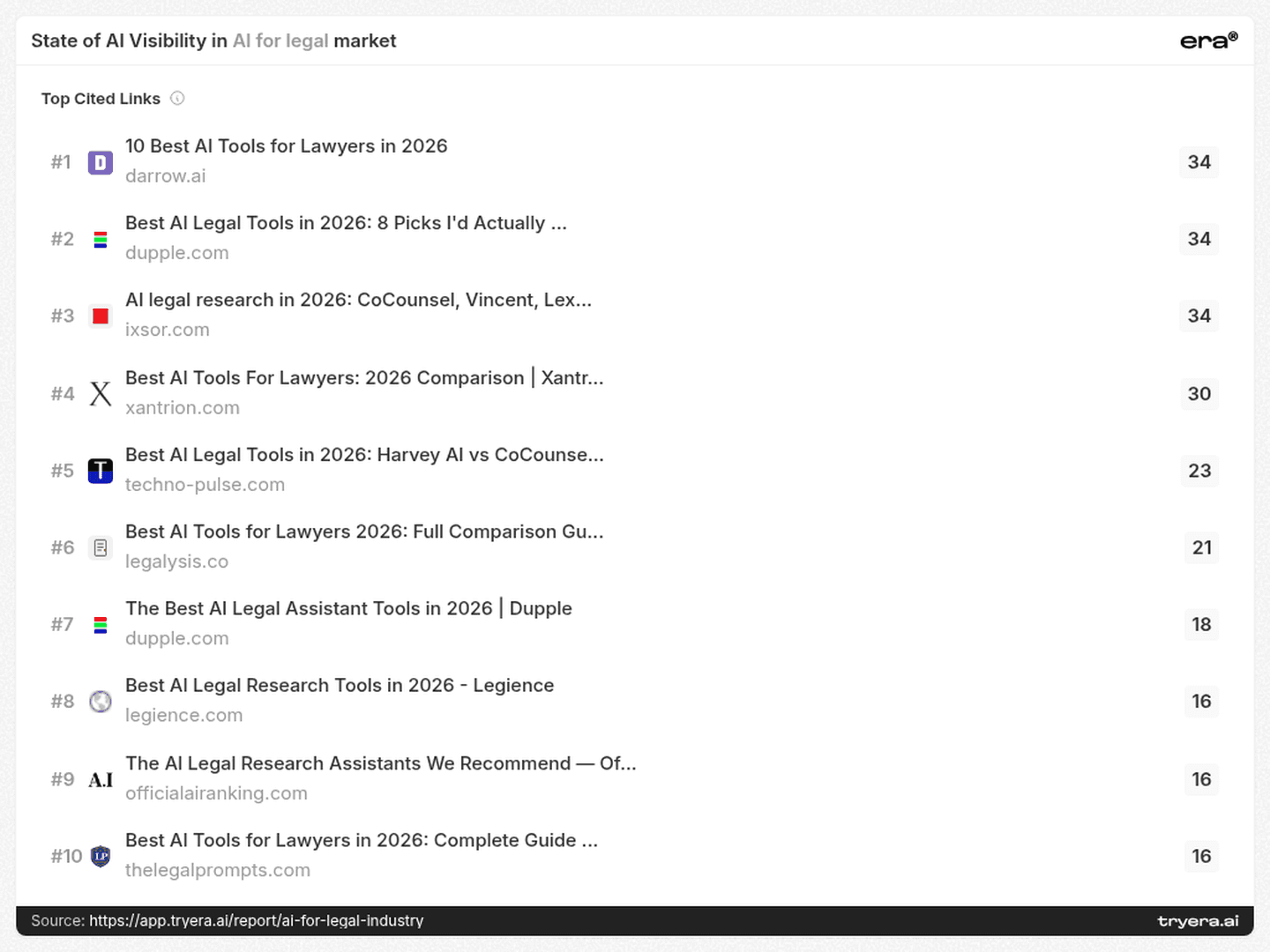
The most cited page in the report is published by darrow.ai, itself a legal AI company that is not among the players shown in the report's tables. Dupple has two pages in the top ten, with 52 citations between them.
This creates two layers of evidence. Vendors' own domains describe products. Third-party roundups compare them. Many prompts in this category are comparative by design — "side-by-side comparison of AI software for law firms," "which AI legal platforms are industry leaders," "compare AI legal platforms for small vs mid-size firms." Those are the questions a roundup is built to answer.
Vendors own the domains AI cites most. Third parties own the pages that compare them.
For vendors, the task is concrete. Check whether each recurring roundup includes you, how it describes you, and whether its pricing, features and positioning are current. The same applies to your G2 profile, the one third-party domain among the top ten sources.
5. Engine gaps — below the top two, the order depends on which AI you ask
Thomson Reuters stays between 68% and 80% in every engine. Spellbook ranges from 48% to 59.2% and peaks in Google AI. Below them, the profiles split.
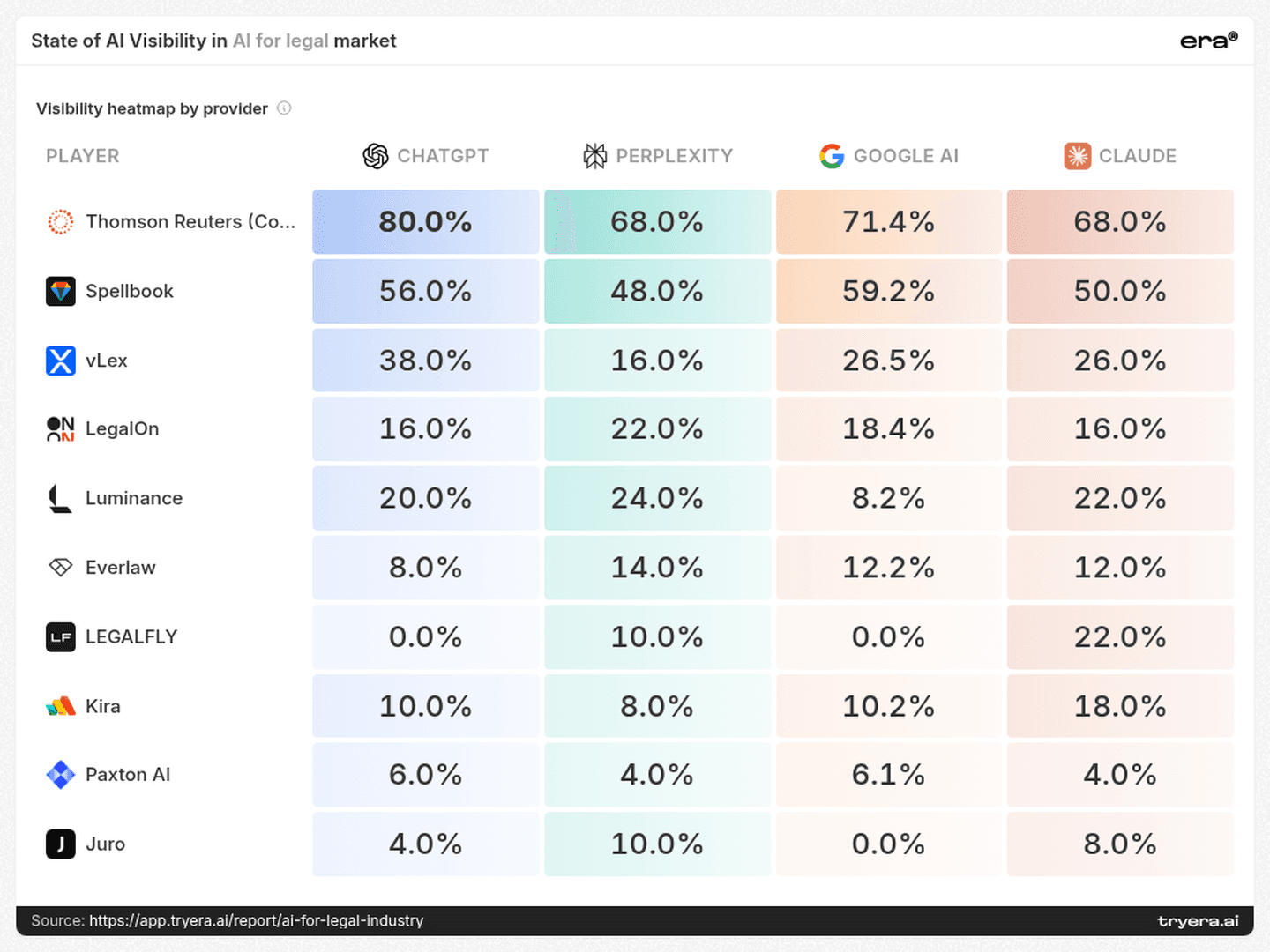
vLex reaches 38% in ChatGPT but 16% in Perplexity — a 22-point spread, the widest on the podium.
Luminance holds 20–24% in ChatGPT, Perplexity and Claude, then drops to 8.2% in Google AI.
LegalOn has the flattest podium profile: 16–22% across all four engines.
LEGALFLY records 0% in ChatGPT and Google AI, 10% in Perplexity and 22% in Claude. In Claude, that equals Luminance and puts it ahead of LegalOn (16%).
Kira reaches 18% in Claude, against 8–10.2% elsewhere.
Juro records 10% in Perplexity and 8% in Claude, but 0% in Google AI.
Everlaw ranges from 8% in ChatGPT to 14% in Perplexity.
These are report-wide provider figures across the prompt set, not results for any single query. They show where to look. A team with a zero in one engine should rerun its priority buyer questions there, compare the brands named and the pages cited, and only then decide what to change.
LEGALFLY's Claude figure would put it level with a podium company. Its ChatGPT and Google AI figures are zero.
6. The questions — comparisons pull brands in, and trust drives demand
The report's search-query view shows which query is most associated with each player.
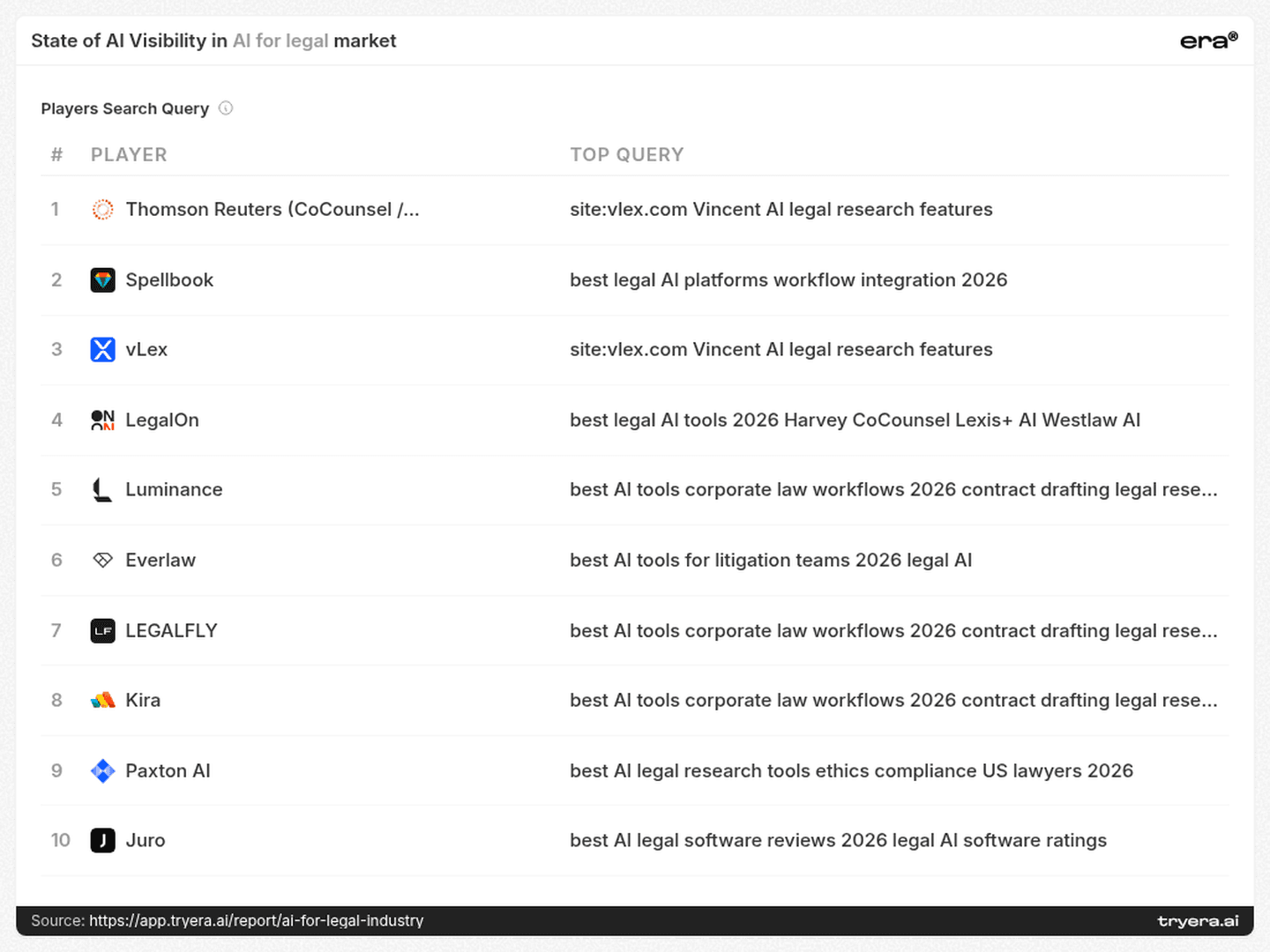
Thomson Reuters and vLex share the same top query: "site:vlex.com Vincent AI legal research features." The query most associated with the category leader is a site-restricted search on a competitor's domain — a sign that, in legal research answers, CoCounsel and Vincent are researched side by side.
LegalOn's top query names four other products: "best legal AI tools 2026 Harvey CoCounsel Lexis+ AI Westlaw AI." LegalOn enters the answer through a comparison built around rivals.
Luminance, LEGALFLY and Kira share one query: "best AI tools corporate law workflows 2026 contract drafting legal research due diligence." Three contract-focused specialists meet in the same corporate-workflow question.
The rest map to distinct intents: Everlaw to litigation teams, Paxton AI to ethics and compliance for US lawyers, Juro to software reviews and ratings, and Spellbook to workflow integration.
The demand data explains why trust belongs at the center of this category.
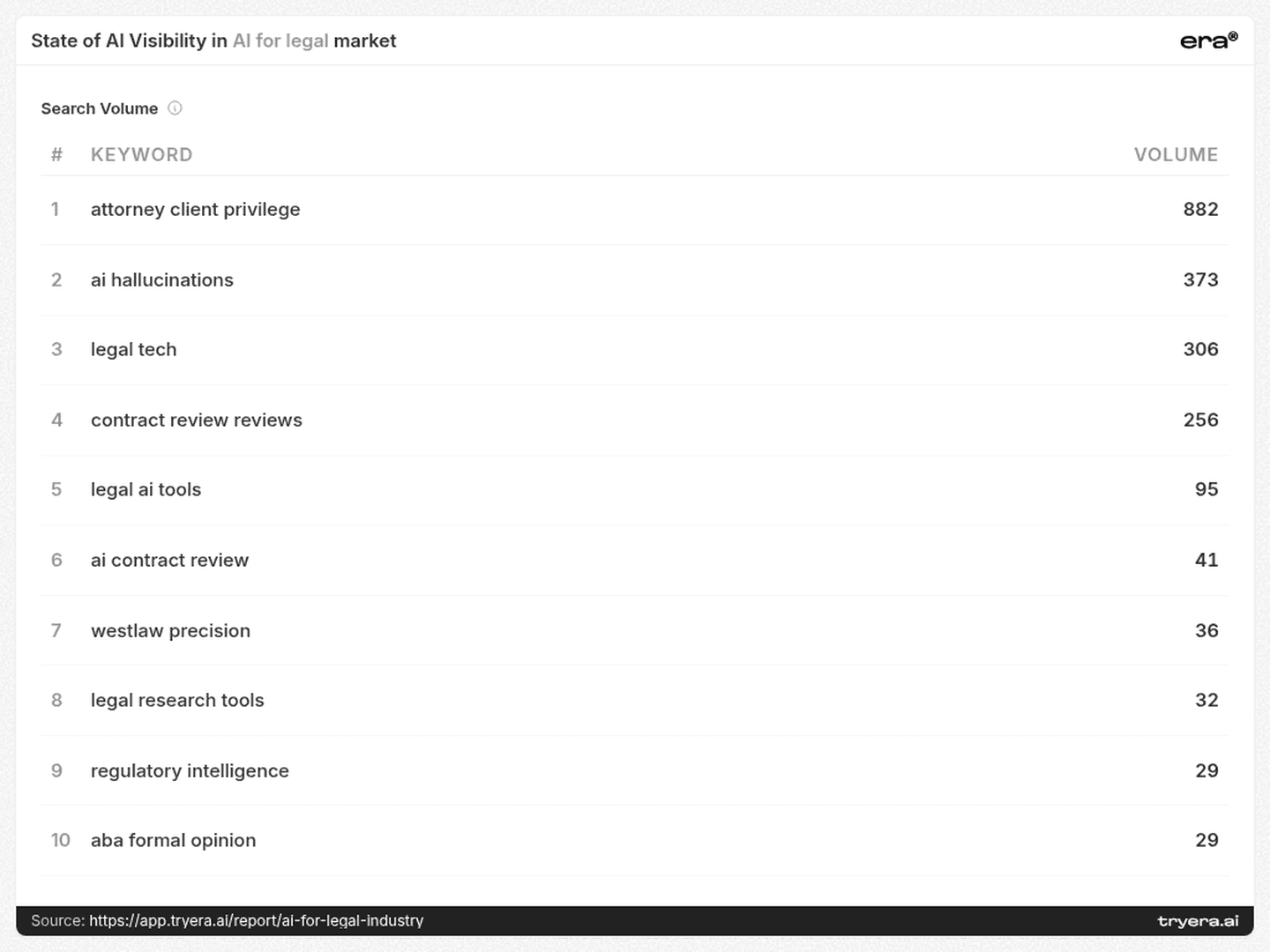
The two highest-volume keywords are about risk: "attorney client privilege" (882) and "ai hallucinations" (373). Together they total 1,255 — more than thirteen times "legal ai tools" (95). "aba formal opinion" (29) also makes the top ten. The only product name on the list is "westlaw precision" (36).
The report's prompt set follows the same line: "top AI tools that respect attorney client privilege," "best AI products that minimize hallucinations in legal work," "top AI contract review software following US confidentiality laws" and "best AI legal research tools compliant with US ethics."
The category's largest search term is not a product. It is a duty of confidentiality.
A vendor without a clear, current page on privilege, confidentiality, data handling and citation verification has nothing of its own to offer an engine on the category's most searched question. Paxton AI's top query already sits inside this cluster. For every vendor, it is the first cluster worth testing.
7. Evidence mix — owned, social and external citations differ sharply
Own-domain citations are relatively stable across players, from 22.6% (Paxton AI) to 33.8% (Kira). The social and external shares are not.
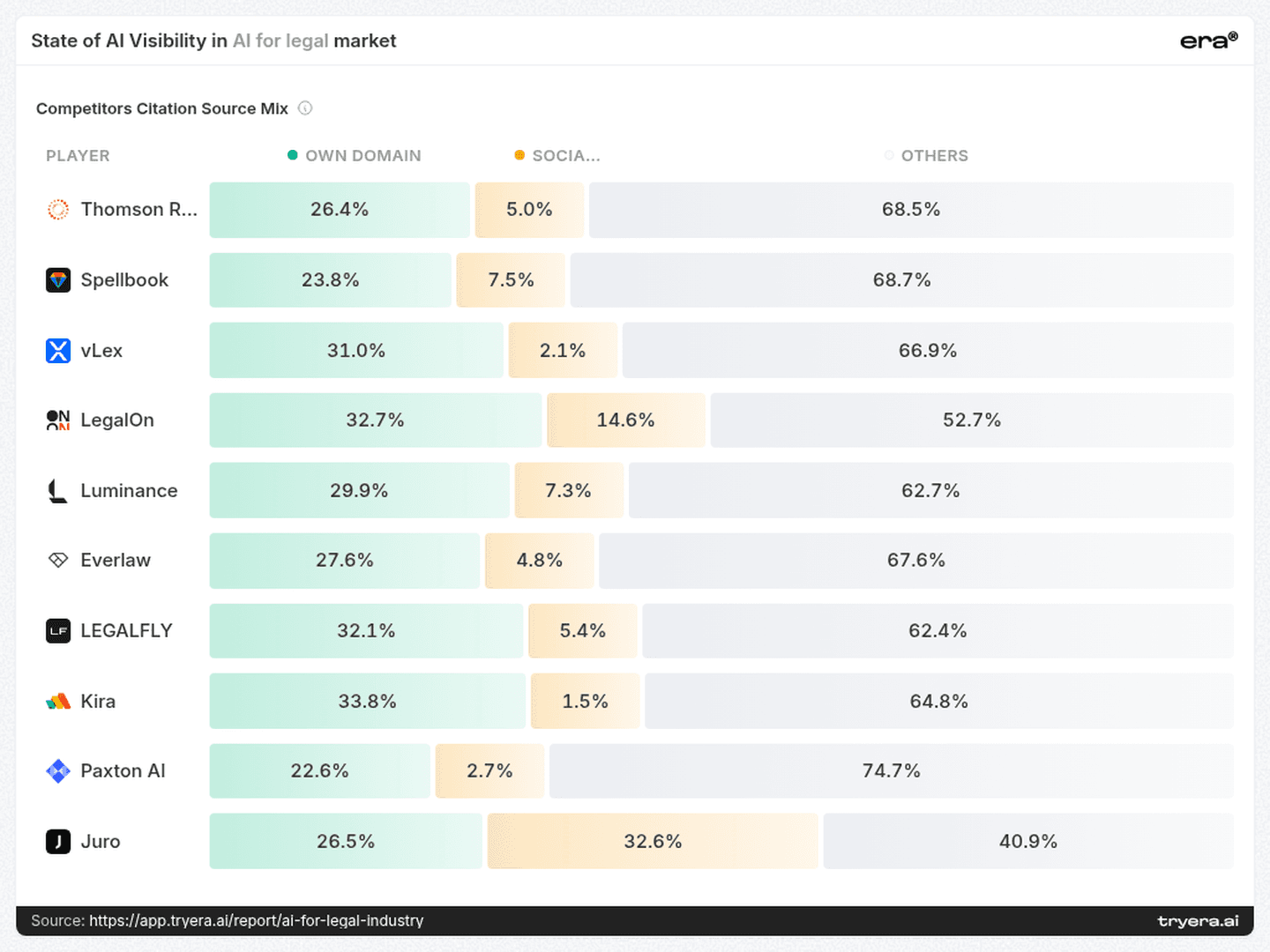
Juro draws 32.6% of its citations from social sources. No other player in the table exceeds 15%. Its share from other external sources, 40.9%, is the lowest shown.
LegalOn is second on social, at 14.6%.
Paxton AI is the most externally dependent: 74.7% of its citations come from other sources.
Kira combines the highest own-domain share with the lowest social share (1.5%).
These are different evidence bases, and they call for different checks. For Juro, whose top query is about software reviews and ratings, the question is which review and comparison pages appear in those answers and whether Juro is represented on them. For Paxton AI, it is which external pages carry its mentions and whether they describe the current product accurately.
8. Technical scores — vLex shows that the audit is not the whole story
The competitive landscape plots technical audit score against Visibility score.
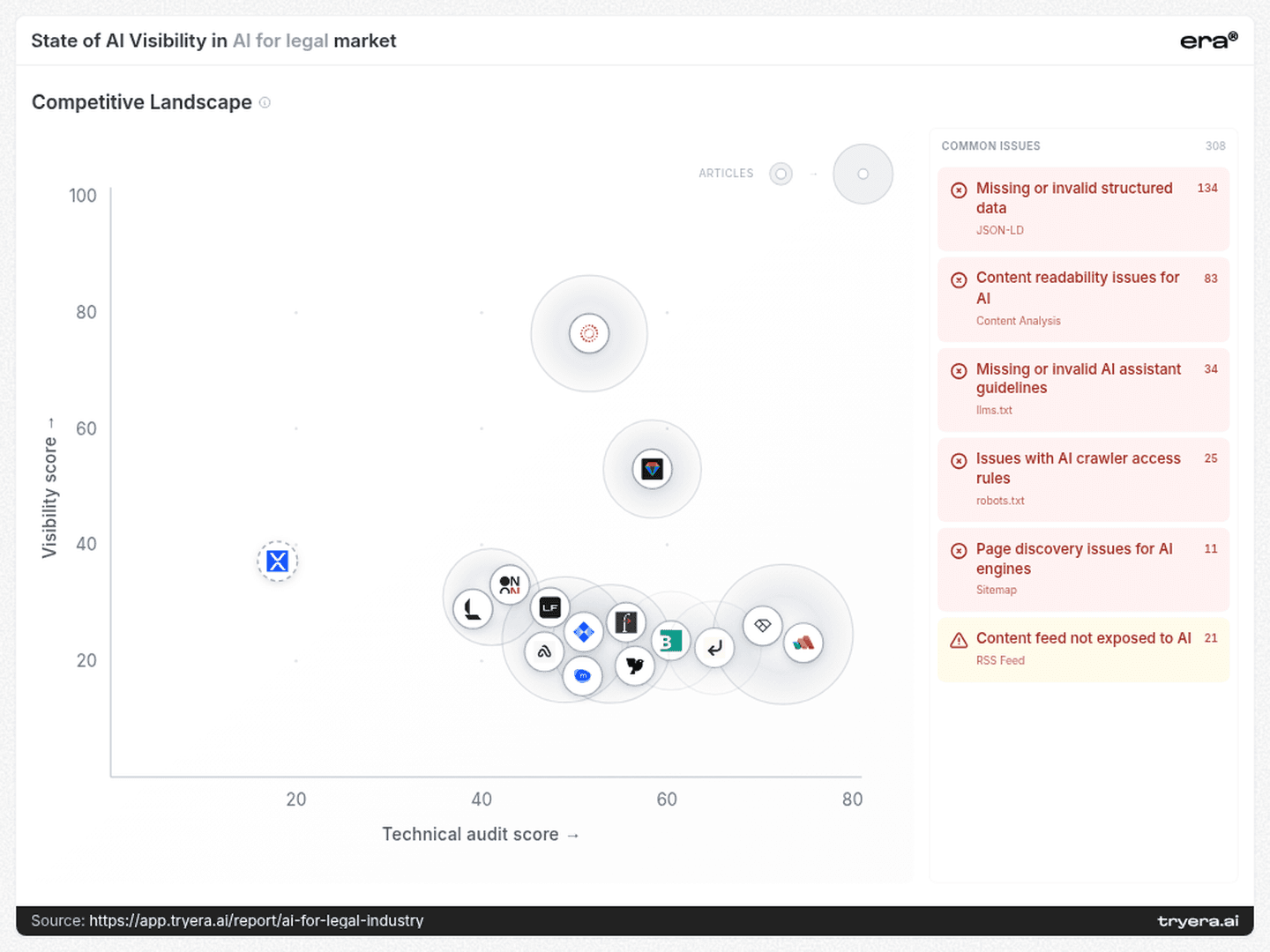
vLex sits furthest left, with a technical audit score of roughly 20, yet it is third on the podium. Kira and Everlaw sit furthest right, with technical scores in the 70s, and lower on Visibility. Thomson Reuters sits near the middle of the technical axis while leading on Visibility.
Across the audited sites, the report finds 308 common issues:
134 missing or invalid structured data (JSON-LD)
83 content readability issues for AI
34 missing or invalid AI assistant guidelines (llms.txt)
25 AI crawler access issues (robots.txt)
21 content feeds not exposed to AI (RSS)
11 page discovery issues (sitemap)
Technical hygiene does not separate the leaders in this category. That does not make it irrelevant. The useful version of a technical fix is targeted: structured data and readable content on the pages that answer buyer questions — product, pricing, security, privilege and help documentation — rather than a site-wide checklist.
9. Beyond the leaders — Where ten brands could focus next
The ranked table below the podium adds a second set of patterns. Here, ten brands from the middle and lower part of the table illustrate four distinct situations.
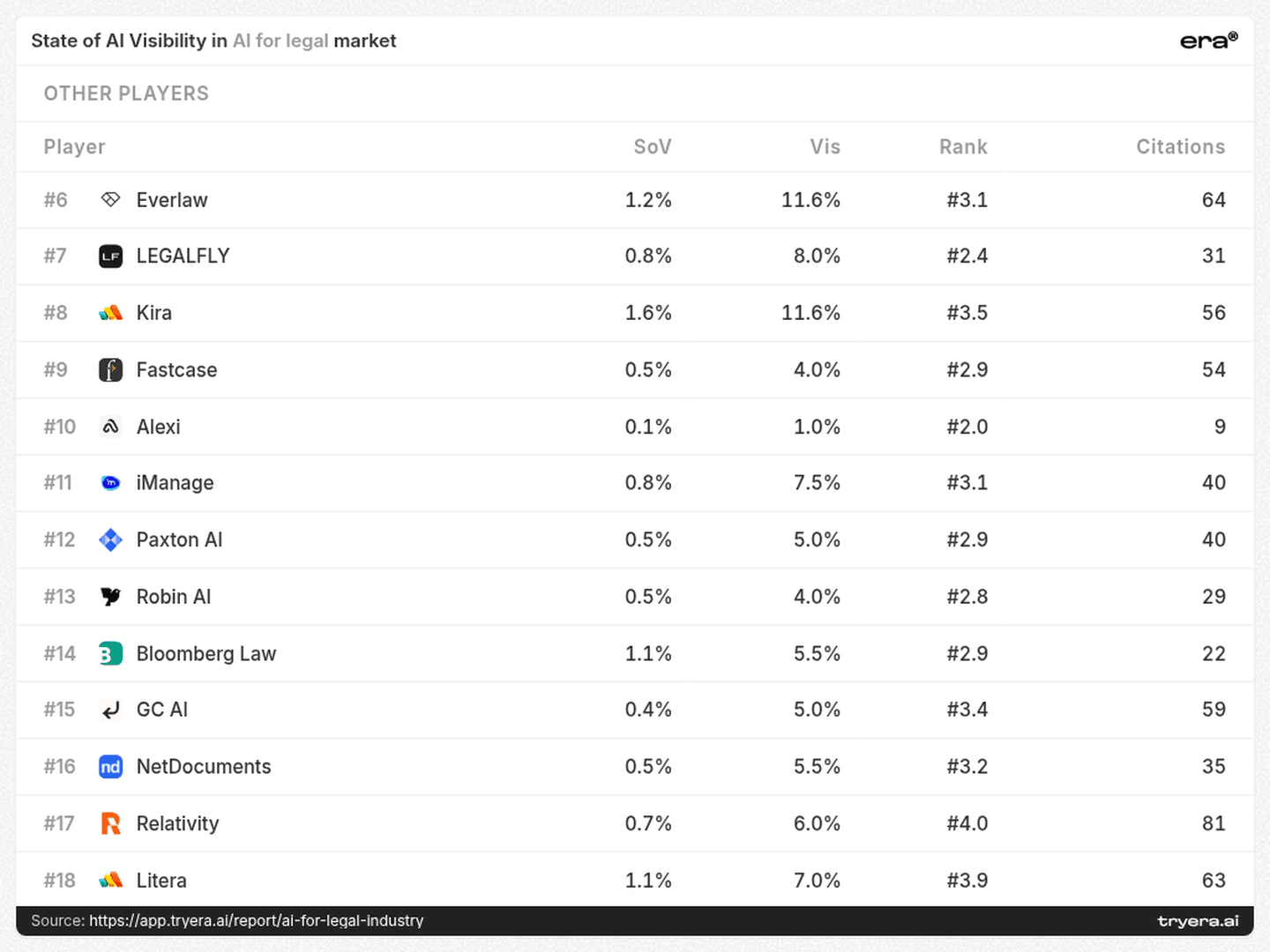
Alexi, Robin AI and Paxton AI: named early, named rarely.
Alexi has an average Rank of #2.0 — level with LegalOn and earlier than every other row in this table — but only 1.0% Visibility and 9 citations. Robin AI (#2.8, 4.0%, 29 citations) and Paxton AI (#2.9, 5.0%, 40 citations) show a similar shape at a larger scale.
For these three, position is not the gap; presence is. The next step is to identify the prompts where each already appears early and test adjacent questions. For Paxton AI, whose top query is about ethics and compliance, the privilege and confidentiality prompts described above are the natural starting point.
Relativity, Litera and GC AI: cited often, named late.
Relativity has 81 citations, the most in ranks 6–18, but the latest average Rank in the table: #4.0. Litera (63 citations, #3.9) and GC AI (59 citations, #3.4, 0.4% Share of Voice) follow a similar pattern.
These brands have material that engines use, yet they tend to appear late in answers. The question is which pages are cited and for which questions. For Relativity, the litigation-team prompts where Everlaw's top query sits are a logical place to compare its position.
Bloomberg Law and Fastcase: link equity and citations point in different directions.
Bloomberg Law and Fastcase share an average Rank of #2.9. Bloomberg Law has nearly twice Fastcase's backlinks — 291.3K against 159.2K — but less than half its citations: 22 against 54.
For Bloomberg Law, the gap is between authority and cited evidence. The next step is to map which of its pages appear in legal research answers and which research prompts cite competitors instead.
iManage and NetDocuments: present in AI-for-legal answers from the document layer.
iManage (7.5% Visibility, #3.1, 40 citations) and NetDocuments (5.5%, #3.2, 35 citations) appear in answers about legal AI tools. The prompt set includes integration questions such as "best AI tools for legal teams that connect easily to other software." The question to test is whether engines name these companies as AI platforms in their own right or as systems that other tools integrate with — and whether that matches how each company wants to be positioned.
10. The next 90 days — a plan built on this category's evidence
Days 1–30: map the answers by intent and engine.
Build a prompt set around the intents visible in the report: legal research reliability, contract review accuracy and pricing, workflow integration, litigation, corporate workflows, small and solo firms, and privilege, confidentiality and hallucination risk.
Run it in ChatGPT, Perplexity, Google AI and Claude. Record whether you are named, where in the answer, which brands appear beside you and which pages are cited.
Start with the gaps shown here: LEGALFLY in ChatGPT and Google AI, Juro and Luminance in Google AI, vLex in Perplexity.
Days 31–60: build evidence for the trust questions.
Publish specific, dated pages on privilege and confidentiality, data retention and model training, hallucination controls and citation verification.
Treat help documentation as citable evidence, following the pattern shown by help.spellbook.legal.
Review your inclusion and description in the recurring roundups (darrow.ai, dupple.com, ixsor.com, xantrion.com, techno-pulse.com and the rest of the cited-links list) and on G2.
Fix structured data and readability on the pages that support these answers first.
Days 61–90: rerun and compare.
Repeat the same prompt set across the same engines.
Track presence, mention order, co-mentioned brands and cited pages for each intent.
Keep changes that correspond with clearer, more accurate answers; revise the hypothesis where nothing moved.
Decide which adjacent intent — litigation, integration or small-firm buying — deserves the next cycle.
Want this scoreboard for your own brand? Run a free audit at tryera.ai/free-report — 30 minutes, your numbers, no deck required.
Full report with source data: AI for Legal.



For legal AI vendors, AI answers increasingly shape the first shortlist a law firm or in-house team sees. The questions behind that shortlist range from research reliability and contract review accuracy to integration, pricing and small-firm fit — and whether a tool can be trusted with privileged information. Era's industry report tracks 50 buyer prompts across ChatGPT, Perplexity, Google AI and Claude. It measures Visibility, Share of Voice, average position, citations, provider differences, search queries, backlinks and technical signals. Those measures do not collapse into a single ranking. Visibility shows how often a brand is named, Share of Voice how much of the answer it takes, position how early it appears, and citations which evidence the engines rely on. In legal AI, they tell noticeably different stories.
Thomson Reuters is named in 71.9% of monitored AI answers about legal AI tools. No other ranked brand comes close. Yet the answers around it are far more crowded than the podium suggests.
Three companies that take up large parts of those answers — Harvey, LexisNexis and Clio — hold 42.9% of Share of Voice between them without a podium place. The domains AI engines cite most are mostly vendors' own sites, while the individual pages they cite most are third-party 2026 roundups. And the term buyers search most in this category is not a product. It is "attorney client privilege."
1. The incumbent — Thomson Reuters leads every scoreboard metric
Thomson Reuters (CoCounsel / Westlaw Precision AI) records 71.9% Visibility, 19.2% Share of Voice, an average Rank of #1.6 and 823 citations. Spellbook, second on the podium, records 53.3%, 5.6%, #2.3 and 455.
Below that lead, the podium is separated by fractions:
vLex (26.6% Visibility) shares Spellbook's average Rank of #2.3.
LegalOn is fourth with 18.1% Visibility, yet its average Rank of #2.0 is the earliest on the podium after Thomson Reuters.
Luminance is fifth with slightly higher Visibility (18.6%) and Share of Voice (2.1% vs 1.7%), but a later average Rank (#3.2).
LegalOn and Luminance are one citation apart: 143 and 142.
Below Thomson Reuters, one citation separates fourth place from fifth.
For challengers, the practical lesson sits in LegalOn's row. Its presence is modest, but when it is named, it tends to be named early. In a category with one dominant incumbent, being mentioned early in fewer answers may be a more realistic first goal than matching Thomson Reuters' reach across all of them.
2. The wider conversation — six of the ten largest voices are not on the podium
The Share of Voice chart shows who takes up space inside the answers: Thomson Reuters 19.2%, Harvey 16.5%, LexisNexis (Lexis+ AI) 15.8%, Clio 10.6%, Spellbook 5.6%, Ironclad 5.4%, vLex 3.1%, Eve 2.5%, Luminance 2.1% and Legora 1.7%.
Harvey, LexisNexis and Clio together hold 42.9% — more than twice Thomson Reuters' share. Add Ironclad, Eve and Legora, and the six names in the top ten that are absent from the podium account for 52.5%. The five podium companies together account for 31.7%.
Spellbook's position is the clearest example. It is second on the podium but fifth by Share of Voice, and only 0.2 points ahead of Ironclad.
One entity note matters here. vLex describes itself on its own site as part of Clio. The report lists the two separately, and their figures should be read separately rather than added together.
A podium ranks the scored players. Share of Voice shows who else is standing in the answer.
For anyone benchmarking against the podium alone, this is the key caveat. Three of the four brands taking the most space in these answers would not appear in a podium-only reading of the market.
3. The sources — vendor domains carry the citations, and backlinks do not predict which
Nine of the ten most cited domains belong to vendors: lexisnexis.com (333), harvey.ai (314), legal.thomsonreuters.com (255), clio.com (240), thomsonreuters.com (180), help.spellbook.legal (124), spellbook.com (121), legalontech.com (70) and legora.com (63). The only exception is g2.com, with 191. Across the ten domains shown, lexisnexis.com accounts for 17.6% of citations and harvey.ai for 16.6%.
Two details stand out.
Documentation is doing evidential work. Spellbook's help center, help.spellbook.legal, is cited 124 times — slightly more than spellbook.com (121). Thomson Reuters has two domains in the top six, with 255 and 180 citations.
Link volume and citation volume are different things. harvey.ai is cited almost as often as lexisnexis.com. The backlink profiles behind the two brands are not remotely similar:
LexisNexis (Lexis+ AI) has 31M backlinks from 54.5K referring domains. Harvey has 150.8K from 5.6K — less than 1% of LexisNexis's backlink count. Thomson Reuters has the most referring domains in the table (97.2K), and vLex has 12.3M backlinks from 12.9K.
Harvey's domain earns 94% of LexisNexis's citation count with less than 1% of its backlinks.
The practical conclusion is not that backlinks are irrelevant. It is that link volume is a poor proxy for which pages AI engines cite. A vendor's first audit should list the pages actually cited — product pages, help articles, security and pricing pages — and the buyer questions each one answers.
4. The roundup layer — every top-cited page is a 2026 "best tools" comparison
At page level, the picture flips. The ten most cited links are all third-party roundups or comparisons, and every title is stamped 2026:
dupple.com — "Best AI Legal Tools in 2026: 8 Picks I'd Actually…" (34), plus a second Dupple page, "The Best AI Legal Assistant Tools in 2026" (18)
ixsor.com — "AI legal research in 2026: CoCounsel, Vincent, Lex…" (34)
xantrion.com — "Best AI Tools For Lawyers: 2026 Comparison" (30)
techno-pulse.com — "Best AI Legal Tools in 2026: Harvey AI vs CoCounse…" (23)
legalysis.co (21), legience.com (16), officialairanking.com (16) and thelegalprompts.com (16)
The most cited page in the report is published by darrow.ai, itself a legal AI company that is not among the players shown in the report's tables. Dupple has two pages in the top ten, with 52 citations between them.
This creates two layers of evidence. Vendors' own domains describe products. Third-party roundups compare them. Many prompts in this category are comparative by design — "side-by-side comparison of AI software for law firms," "which AI legal platforms are industry leaders," "compare AI legal platforms for small vs mid-size firms." Those are the questions a roundup is built to answer.
Vendors own the domains AI cites most. Third parties own the pages that compare them.
For vendors, the task is concrete. Check whether each recurring roundup includes you, how it describes you, and whether its pricing, features and positioning are current. The same applies to your G2 profile, the one third-party domain among the top ten sources.
5. Engine gaps — below the top two, the order depends on which AI you ask
Thomson Reuters stays between 68% and 80% in every engine. Spellbook ranges from 48% to 59.2% and peaks in Google AI. Below them, the profiles split.
vLex reaches 38% in ChatGPT but 16% in Perplexity — a 22-point spread, the widest on the podium.
Luminance holds 20–24% in ChatGPT, Perplexity and Claude, then drops to 8.2% in Google AI.
LegalOn has the flattest podium profile: 16–22% across all four engines.
LEGALFLY records 0% in ChatGPT and Google AI, 10% in Perplexity and 22% in Claude. In Claude, that equals Luminance and puts it ahead of LegalOn (16%).
Kira reaches 18% in Claude, against 8–10.2% elsewhere.
Juro records 10% in Perplexity and 8% in Claude, but 0% in Google AI.
Everlaw ranges from 8% in ChatGPT to 14% in Perplexity.
These are report-wide provider figures across the prompt set, not results for any single query. They show where to look. A team with a zero in one engine should rerun its priority buyer questions there, compare the brands named and the pages cited, and only then decide what to change.
LEGALFLY's Claude figure would put it level with a podium company. Its ChatGPT and Google AI figures are zero.
6. The questions — comparisons pull brands in, and trust drives demand
The report's search-query view shows which query is most associated with each player.
Thomson Reuters and vLex share the same top query: "site:vlex.com Vincent AI legal research features." The query most associated with the category leader is a site-restricted search on a competitor's domain — a sign that, in legal research answers, CoCounsel and Vincent are researched side by side.
LegalOn's top query names four other products: "best legal AI tools 2026 Harvey CoCounsel Lexis+ AI Westlaw AI." LegalOn enters the answer through a comparison built around rivals.
Luminance, LEGALFLY and Kira share one query: "best AI tools corporate law workflows 2026 contract drafting legal research due diligence." Three contract-focused specialists meet in the same corporate-workflow question.
The rest map to distinct intents: Everlaw to litigation teams, Paxton AI to ethics and compliance for US lawyers, Juro to software reviews and ratings, and Spellbook to workflow integration.
The demand data explains why trust belongs at the center of this category.
The two highest-volume keywords are about risk: "attorney client privilege" (882) and "ai hallucinations" (373). Together they total 1,255 — more than thirteen times "legal ai tools" (95). "aba formal opinion" (29) also makes the top ten. The only product name on the list is "westlaw precision" (36).
The report's prompt set follows the same line: "top AI tools that respect attorney client privilege," "best AI products that minimize hallucinations in legal work," "top AI contract review software following US confidentiality laws" and "best AI legal research tools compliant with US ethics."
The category's largest search term is not a product. It is a duty of confidentiality.
A vendor without a clear, current page on privilege, confidentiality, data handling and citation verification has nothing of its own to offer an engine on the category's most searched question. Paxton AI's top query already sits inside this cluster. For every vendor, it is the first cluster worth testing.
7. Evidence mix — owned, social and external citations differ sharply
Own-domain citations are relatively stable across players, from 22.6% (Paxton AI) to 33.8% (Kira). The social and external shares are not.
Juro draws 32.6% of its citations from social sources. No other player in the table exceeds 15%. Its share from other external sources, 40.9%, is the lowest shown.
LegalOn is second on social, at 14.6%.
Paxton AI is the most externally dependent: 74.7% of its citations come from other sources.
Kira combines the highest own-domain share with the lowest social share (1.5%).
These are different evidence bases, and they call for different checks. For Juro, whose top query is about software reviews and ratings, the question is which review and comparison pages appear in those answers and whether Juro is represented on them. For Paxton AI, it is which external pages carry its mentions and whether they describe the current product accurately.
8. Technical scores — vLex shows that the audit is not the whole story
The competitive landscape plots technical audit score against Visibility score.
vLex sits furthest left, with a technical audit score of roughly 20, yet it is third on the podium. Kira and Everlaw sit furthest right, with technical scores in the 70s, and lower on Visibility. Thomson Reuters sits near the middle of the technical axis while leading on Visibility.
Across the audited sites, the report finds 308 common issues:
134 missing or invalid structured data (JSON-LD)
83 content readability issues for AI
34 missing or invalid AI assistant guidelines (llms.txt)
25 AI crawler access issues (robots.txt)
21 content feeds not exposed to AI (RSS)
11 page discovery issues (sitemap)
Technical hygiene does not separate the leaders in this category. That does not make it irrelevant. The useful version of a technical fix is targeted: structured data and readable content on the pages that answer buyer questions — product, pricing, security, privilege and help documentation — rather than a site-wide checklist.
9. Beyond the leaders — Where ten brands could focus next
The ranked table below the podium adds a second set of patterns. Here, ten brands from the middle and lower part of the table illustrate four distinct situations.
Alexi, Robin AI and Paxton AI: named early, named rarely.
Alexi has an average Rank of #2.0 — level with LegalOn and earlier than every other row in this table — but only 1.0% Visibility and 9 citations. Robin AI (#2.8, 4.0%, 29 citations) and Paxton AI (#2.9, 5.0%, 40 citations) show a similar shape at a larger scale.
For these three, position is not the gap; presence is. The next step is to identify the prompts where each already appears early and test adjacent questions. For Paxton AI, whose top query is about ethics and compliance, the privilege and confidentiality prompts described above are the natural starting point.
Relativity, Litera and GC AI: cited often, named late.
Relativity has 81 citations, the most in ranks 6–18, but the latest average Rank in the table: #4.0. Litera (63 citations, #3.9) and GC AI (59 citations, #3.4, 0.4% Share of Voice) follow a similar pattern.
These brands have material that engines use, yet they tend to appear late in answers. The question is which pages are cited and for which questions. For Relativity, the litigation-team prompts where Everlaw's top query sits are a logical place to compare its position.
Bloomberg Law and Fastcase: link equity and citations point in different directions.
Bloomberg Law and Fastcase share an average Rank of #2.9. Bloomberg Law has nearly twice Fastcase's backlinks — 291.3K against 159.2K — but less than half its citations: 22 against 54.
For Bloomberg Law, the gap is between authority and cited evidence. The next step is to map which of its pages appear in legal research answers and which research prompts cite competitors instead.
iManage and NetDocuments: present in AI-for-legal answers from the document layer.
iManage (7.5% Visibility, #3.1, 40 citations) and NetDocuments (5.5%, #3.2, 35 citations) appear in answers about legal AI tools. The prompt set includes integration questions such as "best AI tools for legal teams that connect easily to other software." The question to test is whether engines name these companies as AI platforms in their own right or as systems that other tools integrate with — and whether that matches how each company wants to be positioned.
10. The next 90 days — a plan built on this category's evidence
Days 1–30: map the answers by intent and engine.
Build a prompt set around the intents visible in the report: legal research reliability, contract review accuracy and pricing, workflow integration, litigation, corporate workflows, small and solo firms, and privilege, confidentiality and hallucination risk.
Run it in ChatGPT, Perplexity, Google AI and Claude. Record whether you are named, where in the answer, which brands appear beside you and which pages are cited.
Start with the gaps shown here: LEGALFLY in ChatGPT and Google AI, Juro and Luminance in Google AI, vLex in Perplexity.
Days 31–60: build evidence for the trust questions.
Publish specific, dated pages on privilege and confidentiality, data retention and model training, hallucination controls and citation verification.
Treat help documentation as citable evidence, following the pattern shown by help.spellbook.legal.
Review your inclusion and description in the recurring roundups (darrow.ai, dupple.com, ixsor.com, xantrion.com, techno-pulse.com and the rest of the cited-links list) and on G2.
Fix structured data and readability on the pages that support these answers first.
Days 61–90: rerun and compare.
Repeat the same prompt set across the same engines.
Track presence, mention order, co-mentioned brands and cited pages for each intent.
Keep changes that correspond with clearer, more accurate answers; revise the hypothesis where nothing moved.
Decide which adjacent intent — litigation, integration or small-firm buying — deserves the next cycle.
Want this scoreboard for your own brand? Run a free audit at tryera.ai/free-report — 30 minutes, your numbers, no deck required.
Full report with source data: AI for Legal.