October 4, 2026
October 4, 2026
How Layer 1 & Layer 2 Blockchains Rank in AI Search: A Deep Analysis of Base, Ethereum and the Wider Field
Era's Layer 1 & Layer 2 Blockchains report finds one clear scoreboard leader and a much wider conversation. Base is named in 67.0% of AI answers and leads every podium metric, while Ethereum takes the largest Share of Voice. The evidence comes from official chain domains, data dashboards and 2026 Layer 2 roundups — and below Base, each AI engine tells a different story.
Era's Layer 1 & Layer 2 Blockchains report finds one clear scoreboard leader and a much wider conversation. Base is named in 67.0% of AI answers and leads every podium metric, while Ethereum takes the largest Share of Voice. The evidence comes from official chain domains, data dashboards and 2026 Layer 2 roundups — and below Base, each AI engine tells a different story.
For blockchain networks, AI answers increasingly shape the first shortlist a developer, a DeFi team or a first-time buyer sees. The questions behind that shortlist range from low-fee Layer 2s and DeFi ecosystems to NFT gaming, beginner wallets and stablecoin payments. Era's industry report tracks buyer prompts across ChatGPT, Perplexity, Google AI and Claude. It measures Visibility, Share of Voice, average position, citations, provider differences, search queries, search demand, backlinks and technical signals. Those measures do not reduce to a single ranking. Visibility shows how often a network is named, Share of Voice how much of the answer it takes, position how early it appears, and citations which evidence the engines rely on. In this category, the gaps between them are unusually wide.
Base is named in 67.0% of monitored AI answers about Layer 1 and Layer 2 blockchains — nearly three times Bitcoin, the next network on the podium. By that measure, the category has one clear leader.
By another measure, it does not. Ethereum takes the largest Share of Voice in the same answers, and nine of the ten networks that take up the most space in them — Ethereum, Solana, Arbitrum and Optimism among them — are not on the report's ranked scoreboard at all. The domains engines cite most are solana.com and ethereum.org. The pages they cite most are Layer 2 roundups comparing fees, TVL and throughput. And below Base, the order of the field changes depending on which AI engine you ask.
1. The scoreboard — Base leads every podium metric
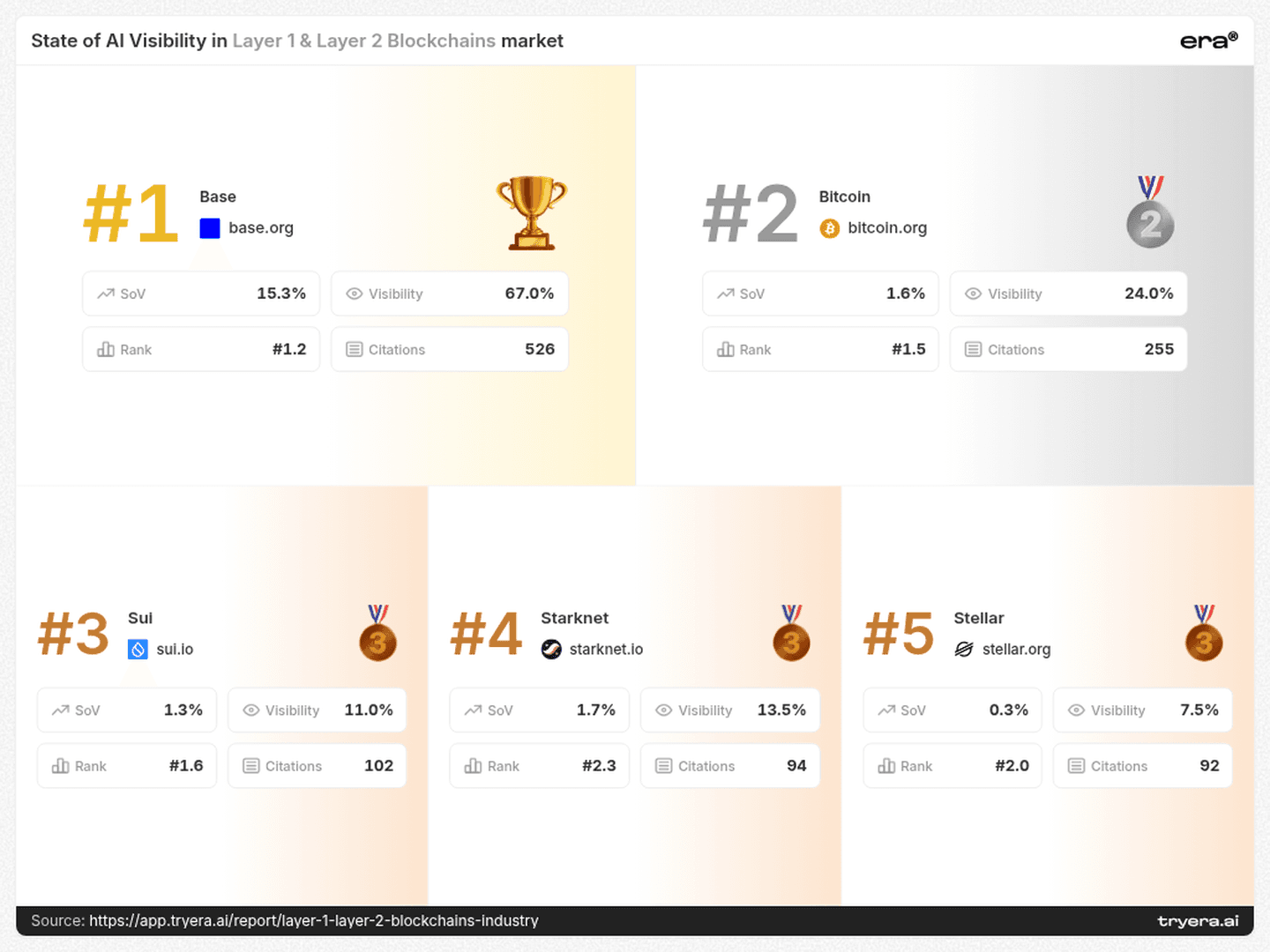
Base records 67.0% Visibility, 15.3% Share of Voice, an average Rank of #1.2 and 526 citations. Bitcoin, second, records 24.0%, 1.6%, #1.5 and 255. Base leads on all four metrics — on Visibility, Share of Voice and citations by a wide margin.
Below Base, the podium is less tidy than its order suggests:
Bitcoin is named in nearly a quarter of answers, yet its 1.6% Share of Voice is lower than Starknet's 1.7%. It appears often, but takes little space when it does — and when it appears, it appears early (#1.5).
Starknet has higher Visibility (13.5%) and Share of Voice than Sui (11.0%, 1.3%), but Sui is third. Sui is named earlier (#1.6 against #2.3) and draws more citations (102 against 94).
Stellar is fifth with the lowest Share of Voice on the podium (0.3%) and 7.5% Visibility — but 92 citations and an average Rank of #2.0, earlier than Starknet's.
Bitcoin is named in nearly a quarter of answers and takes less of the conversation than Starknet.
For any network benchmarking itself against this category, the podium is a useful start but a poor summary. The distance between Visibility, Share of Voice and position is where most of the story sits.
2. The conversation — nine of the ten largest voices are off the scoreboard
The Share of Voice chart shows who takes up space inside the answers: Ethereum 21.2%, Base 15.3%, Solana 11.7%, Arbitrum 11.4%, Optimism 9.0%, Polygon 7.3%, Avalanche 5.7%, BNB Chain 4.1%, zksync 3.4% and Cardano 1.8%.
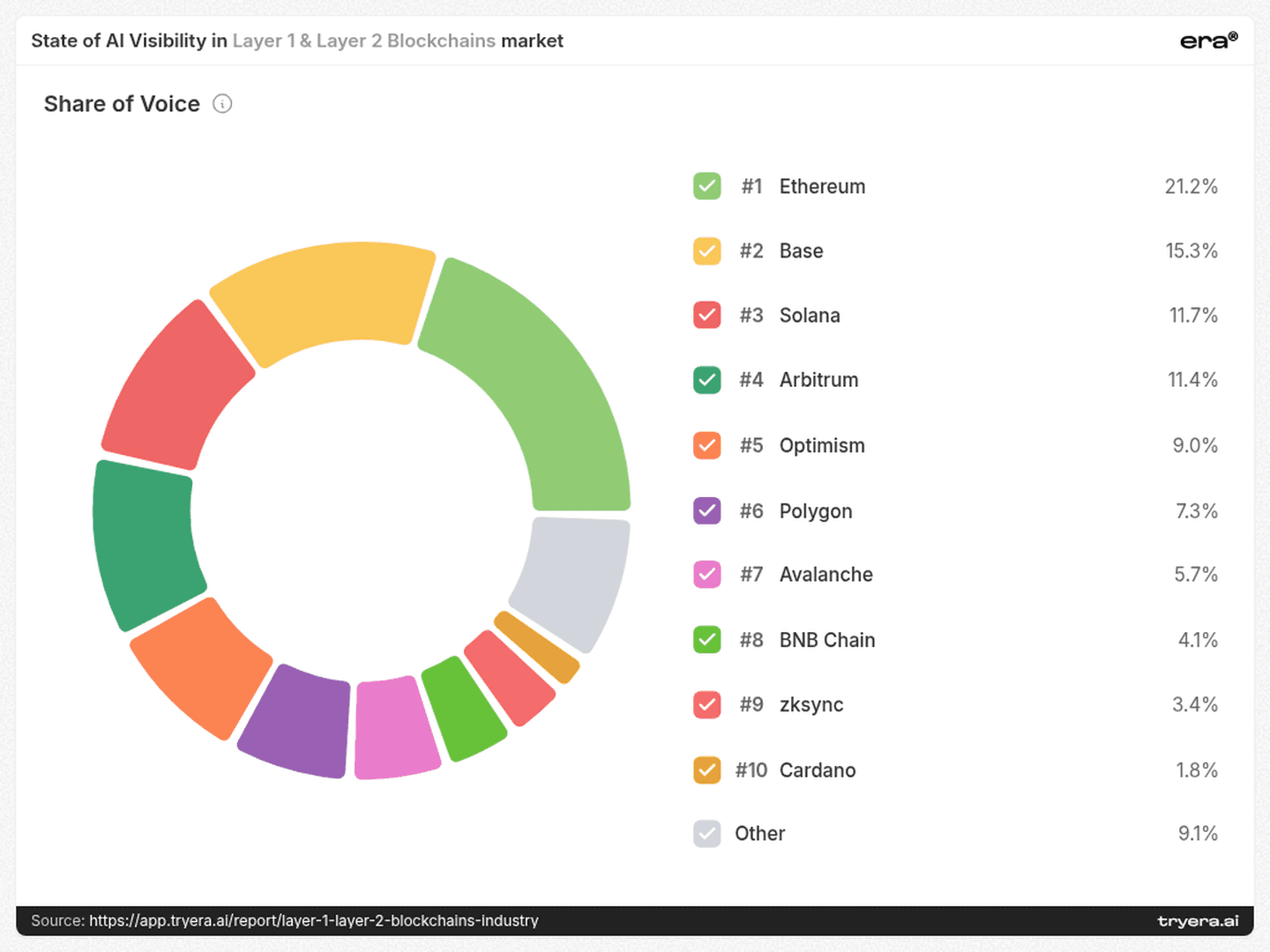
Base is the only one of these ten that also appears on the ranked scoreboard — the podium and the table of other players below it. The other nine together hold 75.6% of Share of Voice. The five podium networks together hold 20.2%, and Base accounts for three quarters of that.
The shape of the conversation is clear. Ethereum and four Layer 2s built on it — Base, Arbitrum, Optimism and zksync — hold 60.3% of Share of Voice between them. Answers in this category are, to a large extent, answers about the Ethereum ecosystem.
One entity note matters. The Share of Voice chart lists BNB Chain (4.1%); the ranked table lists Binance (0.6% Share of Voice, 8.5% Visibility). They are recorded as separate names and should be read separately rather than added together.
A podium ranks the scored players. Share of Voice shows who else is standing in the answer — and here, that is most of the market.
3. Engine gaps — below Base, the order depends on which AI you ask
Base stays between 54% and 74% in every engine. Below it, the profiles split sharply.
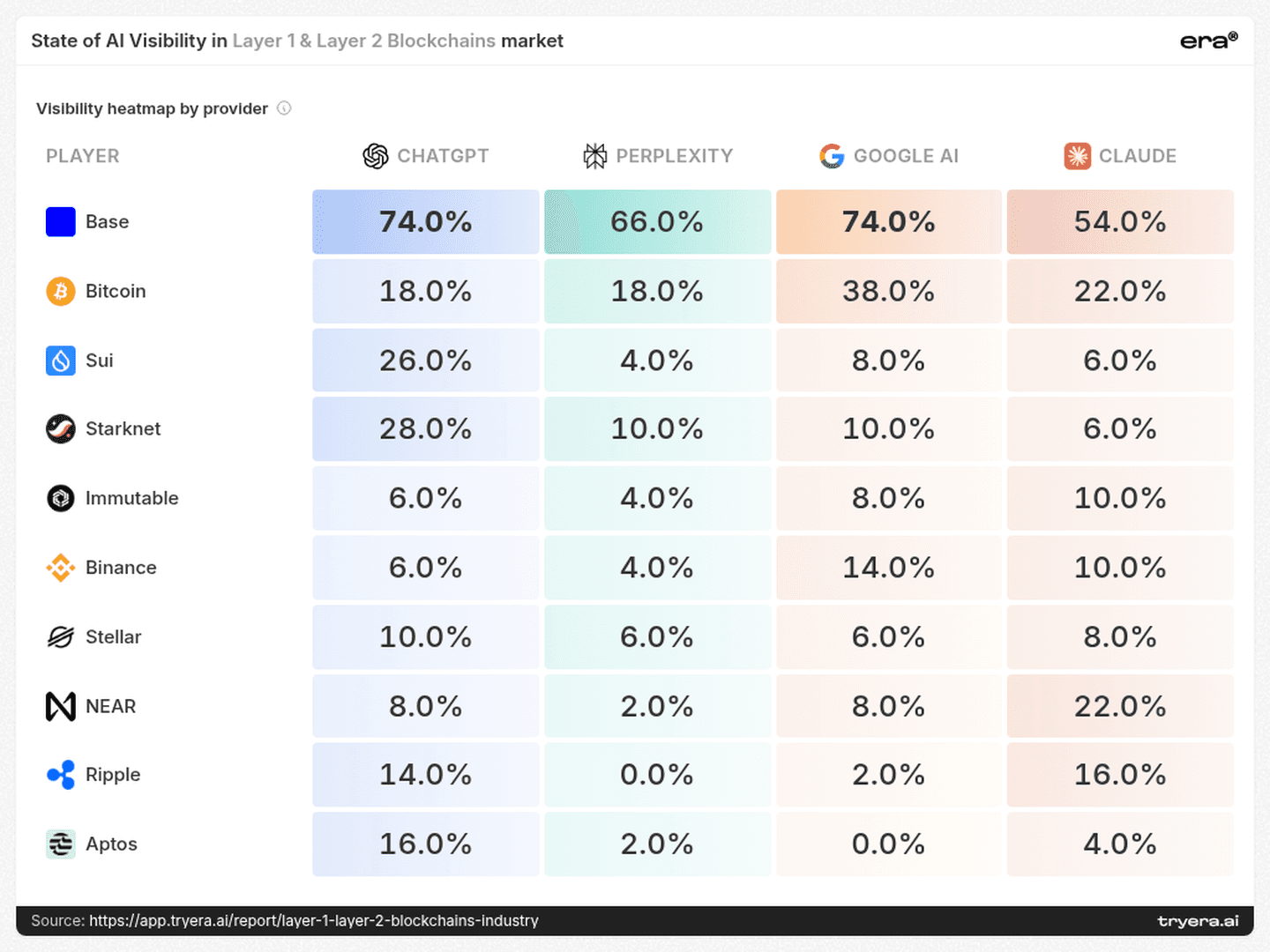
ChatGPT carries the newer networks. Sui records 26% in ChatGPT against 4–8% elsewhere. Starknet records 28% against 6–10%. Aptos records 16% in ChatGPT and 0% in Google AI.
Google AI is where Bitcoin is strongest. Bitcoin reaches 38% in Google AI, against 18% in ChatGPT and Perplexity. Binance also peaks there, at 14%.
Claude gives more room to NEAR and Ripple. NEAR records 22% in Claude — level with Bitcoin in that engine — against 2% in Perplexity. Ripple records 16% in Claude and 14% in ChatGPT, but 0% in Perplexity.
Perplexity is the narrowest engine. Outside Base (66%) and Bitcoin (18%), no network in the heatmap exceeds 10% there.
In Claude, NEAR is named as often as Bitcoin. In Perplexity, it is named in 2% of answers.
These are report-wide provider figures across the prompt set, not results for any single query. They show where to look. A network with a strong ChatGPT figure and a near-zero elsewhere should rerun its priority buyer questions in the weaker engine, compare which networks are named instead and which pages are cited, and only then decide what to change.
4. The sources — official chain domains and data aggregators carry the citations
The two most cited domains belong to networks: solana.com (189 citations) and ethereum.org (186). Neither Solana nor Ethereum is on the ranked scoreboard, yet together they account for 37.9% of citations across the ten domains shown.
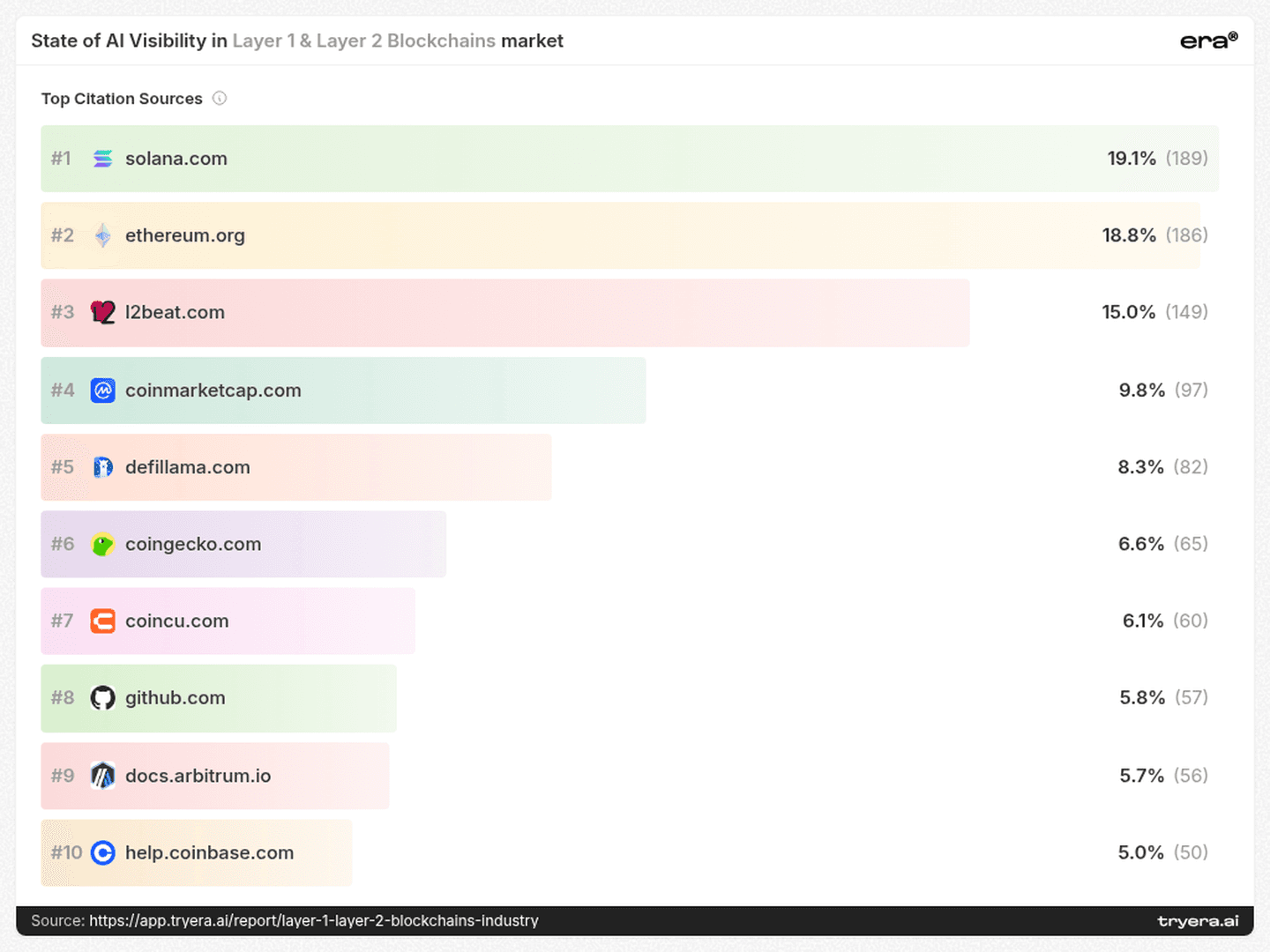
The next layer is data. l2beat.com (149), coinmarketcap.com (97), defillama.com (82) and coingecko.com (65) together hold 393 citations — more than the two official chain domains combined. When engines compare networks, they lean on dashboards that track fees, TVL, risk and market data.
The final layer is documentation:
github.com — 57 citations
docs.arbitrum.io — 56
help.coinbase.com — 50
Coinbase's help center is in the top ten; base.org is not — and Base draws only 8.1% of its citations from its own domain. For the podium leader, most of the evidence sits on pages it does not own. That is worth mapping before deciding where new content should live.
Four data dashboards are cited more often than ethereum.org and solana.com combined.
For any network, this list defines the audit. Check how you are represented on L2BEAT, DefiLlama, CoinMarketCap and CoinGecko — the categories, risk labels and metrics shown — and whether your own documentation answers the questions those dashboards are used to settle.
5. The pages — Layer 2 comparisons dominate the cited evidence
At page level, the evidence narrows to one format: the dated comparison.
eco.com — "Best Ethereum L2s in 2026: Fees, TVL, TPS Compared" (21)
coinbureau.com — "Top Ethereum Layer 2 Projects: Networks Redefining…" (20)
datawallet.com — "Top 7 Crypto Layer 2 Networks in 2026" (13)
walllet.com — "Best Ethereum Layer 2 Networks: Compare Fees, Fina…" (12)
spark.money — "Blockchain Fee Comparison: Gas Fees Across 15+ Cha…" (11)
bitcoinfoundation.org — two pages, on Layer 2 coins and on Bitcoin Layer 2 projects (10 each)
coinbureau.com — "Arbitrum Review 2026: Is This Ethereum Layer 2 Sti…" (9)
solulab.com — "Top 10 Layer 1 Blockchains in 2026" (8)
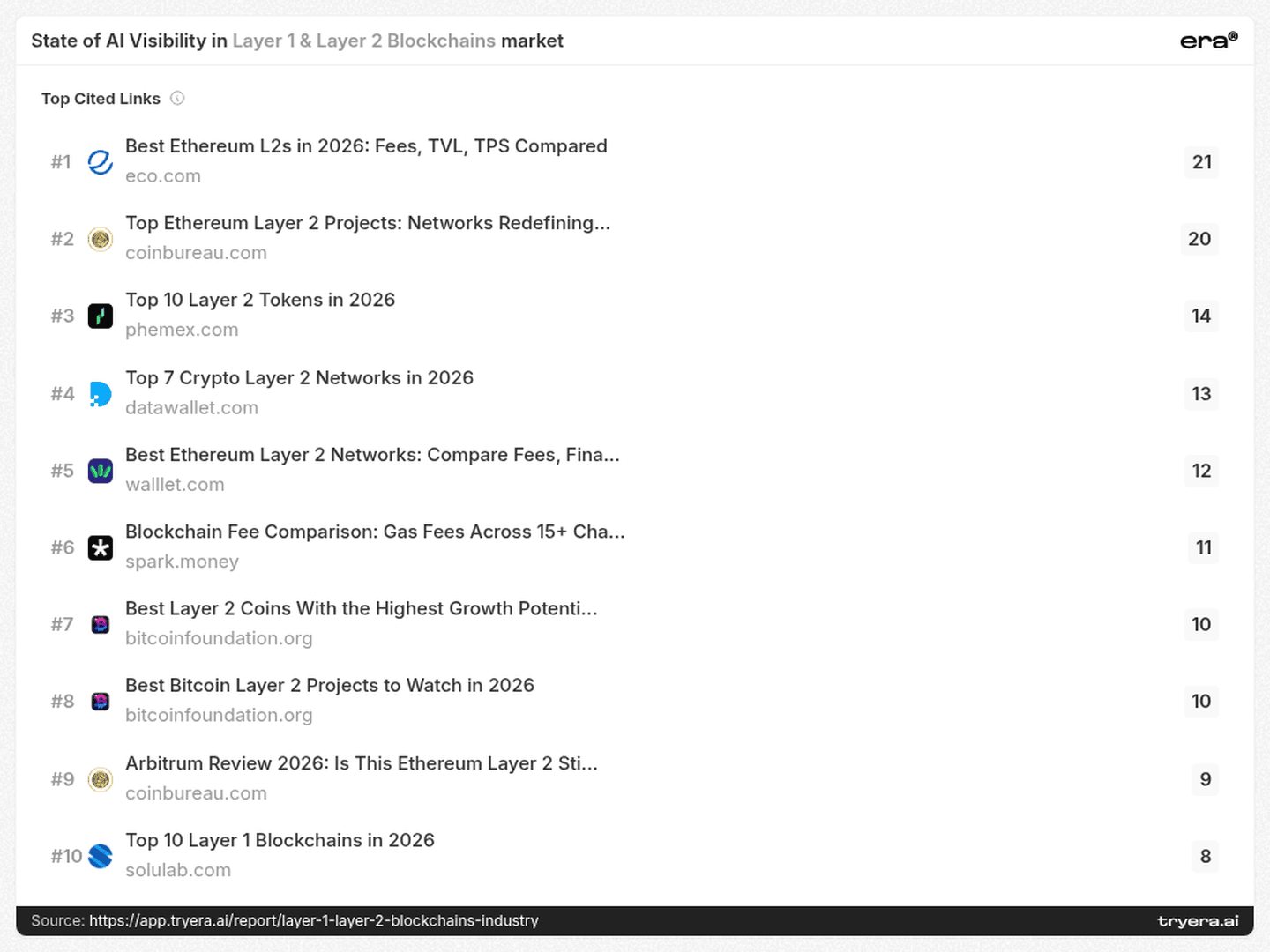
Eight of the ten pages are about Layer 2 networks, and they account for 109 of the 128 citations in the list. One page compares fees across chains. Layer 1 gets a single dedicated list, cited eight times. At least six of the ten titles carry the year 2026.
Two publishers appear twice. Coin Bureau's pages total 29 citations; bitcoinfoundation.org's total 20, including one of the few pages devoted to Bitcoin's Layer 2 ecosystem.
The page-level evidence is almost entirely about Layer 2. Layer 1 gets one list, cited eight times.
For Layer 2 teams, these roundups are the battleground: check whether each one includes you, how it describes your fees, TVL and security model, and whether those numbers are current. For Layer 1 teams, the gap is the opportunity — there is very little comparative page-level evidence for engines to draw on.
6. The questions — fees are the doorway, but demand points elsewhere
The search-query view shows the query most associated with each player.
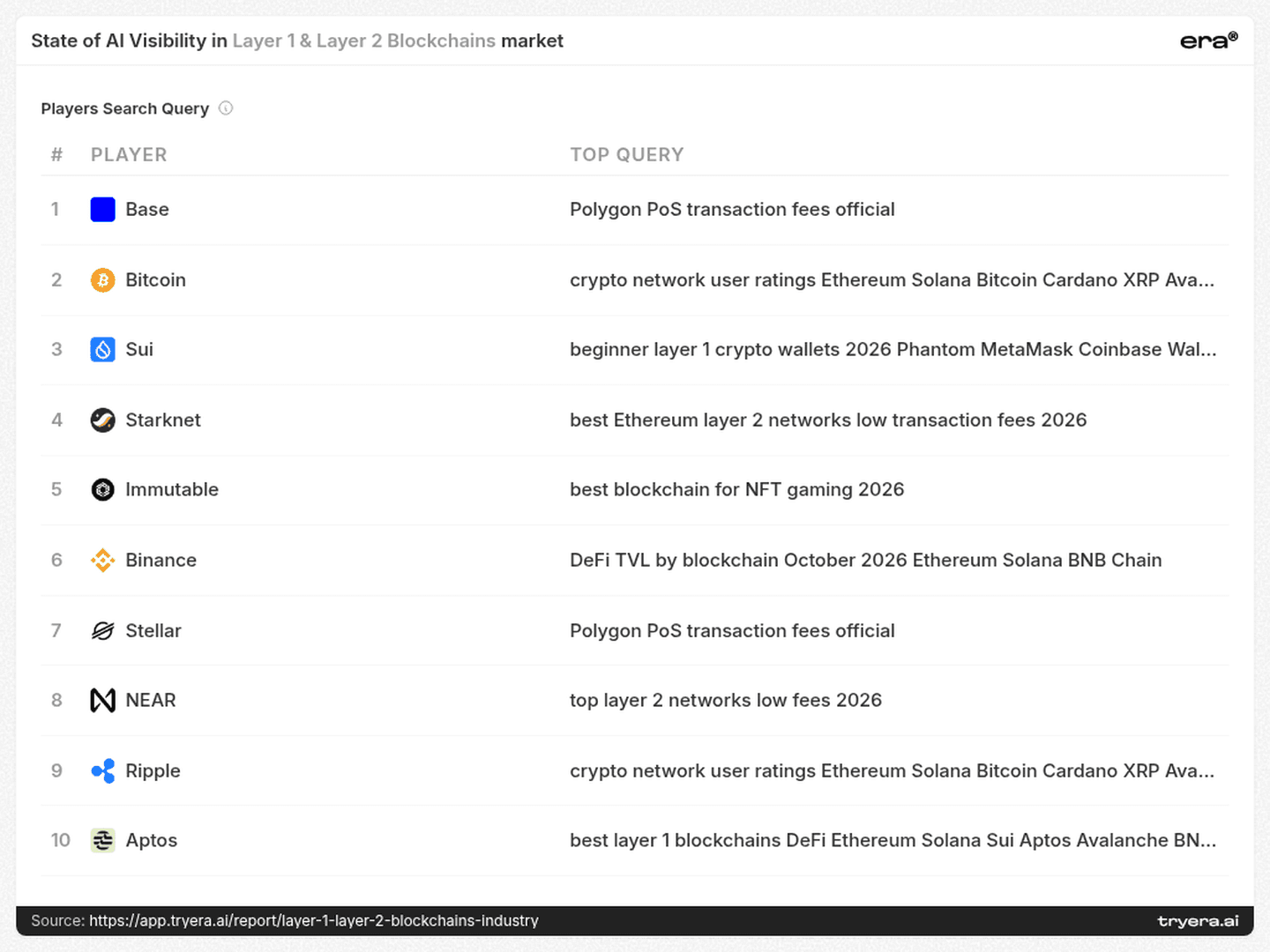
Fees open the door for four networks. Base and Stellar share the same top query: "Polygon PoS transaction fees official" — a fee lookup about a third network. Starknet's is "best Ethereum layer 2 networks low transaction fees 2026". NEAR, a Layer 1, is associated with "top layer 2 networks low fees 2026".
Sui enters through wallets. Its top query is "beginner layer 1 crypto wallets 2026 Phantom MetaMask Coinbase Wallet Rabby official supported networks" — a question about which networks popular wallets support.
Immutable owns a niche. Its top query is "best blockchain for NFT gaming 2026".
DeFi brings in Binance and Aptos, through "DeFi TVL by blockchain October 2026 Ethereum Solana BNB Chain" and a "best layer 1 blockchains DeFi…" query that names Sui, Aptos and Avalanche alongside TVL and stablecoins.
Bitcoin and Ripple share "crypto network user ratings Ethereum Solana Bitcoin Cardano XRP Ava…".
The demand data tells a different story.
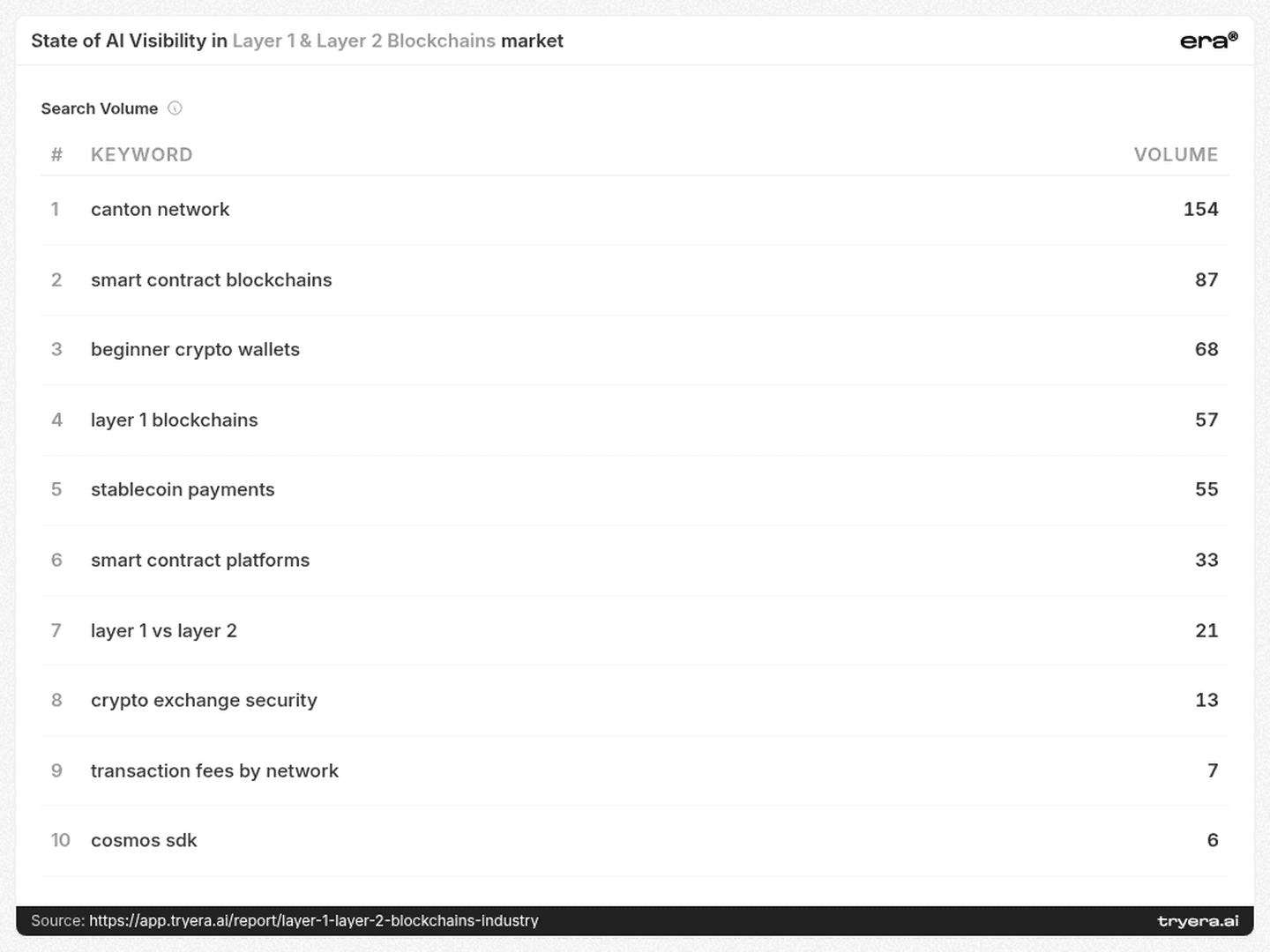
The highest-volume keyword is "canton network" (154) — a network that does not appear in the report's player tables. It is followed by "smart contract blockchains" (87), "beginner crypto wallets" (68), "layer 1 blockchains" (57) and "stablecoin payments" (55). "transaction fees by network" registers 7.
These are two different measurements: the queries associated with each player, and the keywords with the most AI search demand. Read together, they suggest a gap worth testing. Fee comparisons are how many networks enter answers today; smart contracts, beginner wallets and stablecoin payments are where demand is concentrated.
Engines research fees. Demand asks about smart contracts, wallets and stablecoin payments.
Sui's wallet-support query sits directly on one of the largest demand clusters. For payments-focused networks, "stablecoin payments" is the cluster to test first.
7. Evidence mix — Stellar's own domain does more work than anyone's
Most players draw between 4.7% and 13.2% of their citations from their own domain. Stellar draws 21.5% — the highest in the table by more than eight points.
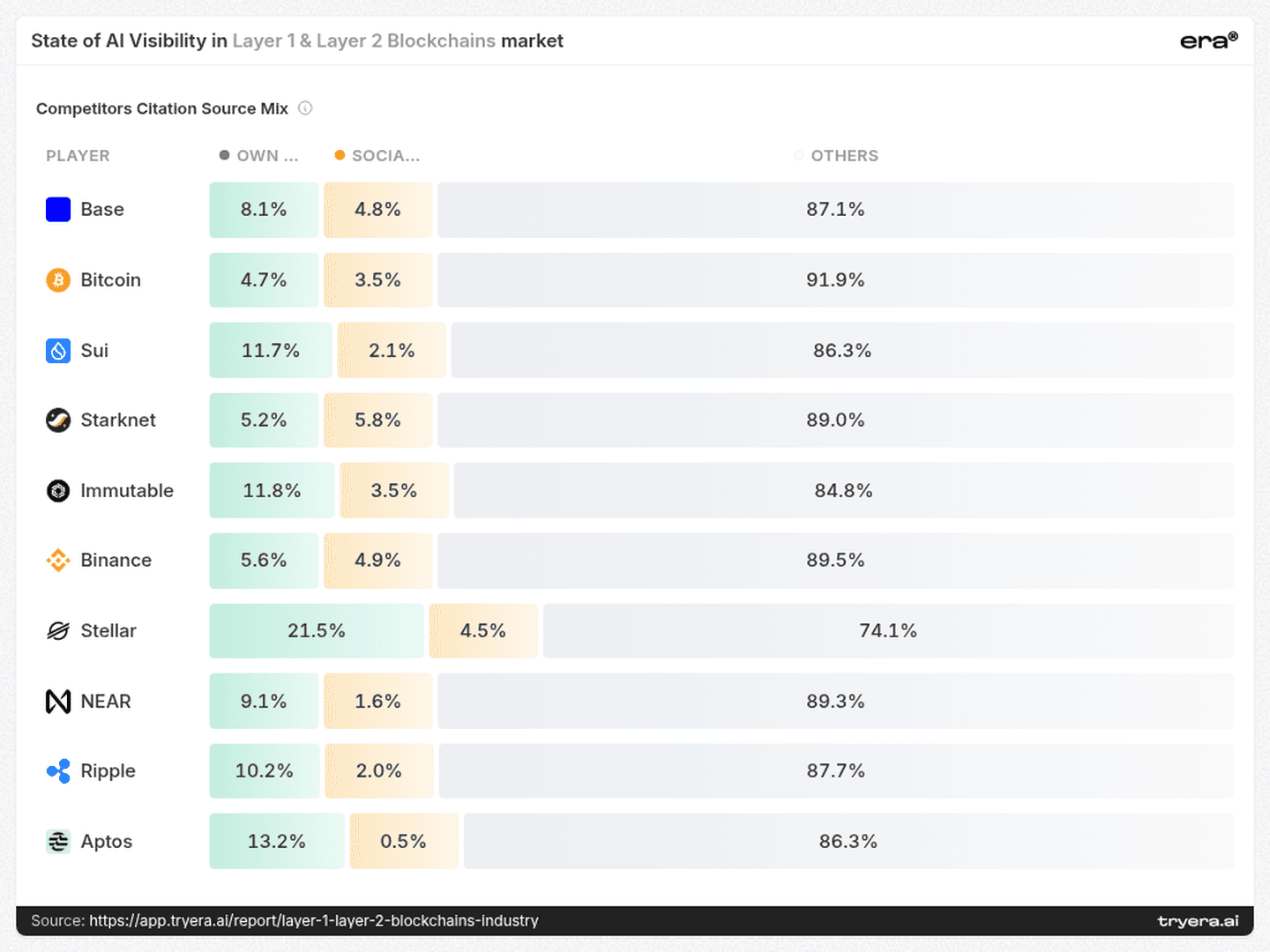
Stellar has the lowest share from other external sources (74.1%), and it holds a podium place with the smallest Share of Voice on it.
Bitcoin is the most externally dependent: 91.9% of its citations come from other sources, and 4.7% from bitcoin.org.
Aptos combines the second-highest own-domain share (13.2%) with the lowest social share (0.5%).
Starknet has the highest social share (5.8%), ahead of Binance (4.9%) and Base (4.8%).
These are different evidence bases, and they call for different checks. For Stellar, the question is which owned pages are cited and for which questions — and whether the same pages could support adjacent payment prompts. For Bitcoin-adjacent projects, it is which external pages carry the narrative, and whether they describe the current ecosystem accurately.
8. Authority signals — backlinks and technical scores do not sort the field
Backlink volume and AI visibility point in different directions.
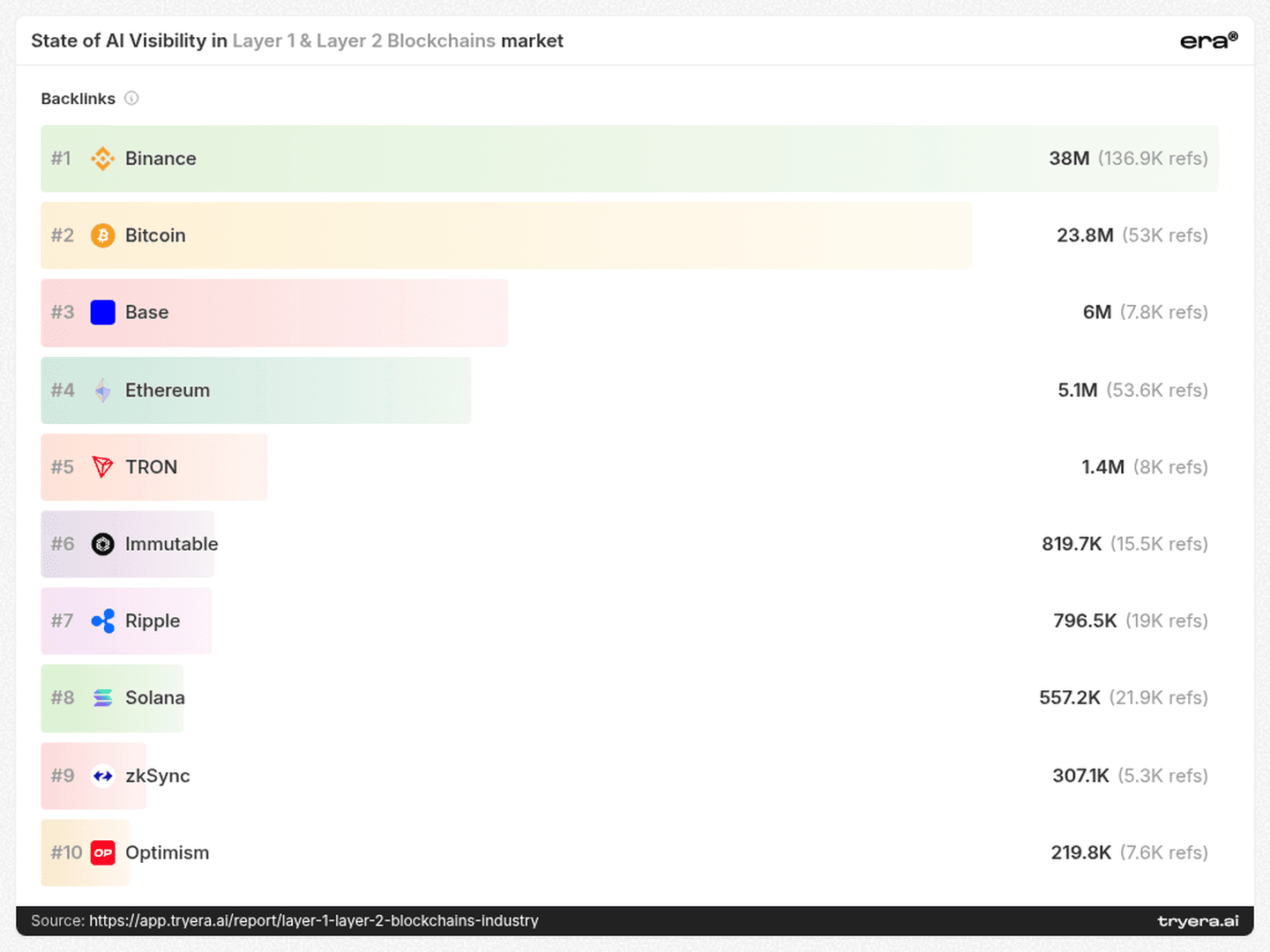
Binance has the largest backlink profile by far: 38M backlinks from 136.9K referring domains — more than six times Base's 6M. Its Visibility is 8.5%.
Base has 7.8K referring domains — fewer than TRON (8K), Immutable (15.5K), Ripple (19K) or Solana (21.9K) — and the highest Visibility in the report.
Solana has 557.2K backlinks, about a tenth of Ethereum's 5.1M, yet solana.com is cited slightly more often than ethereum.org.
Binance has six times Base's backlinks. Base is named in almost eight times as many answers.
The competitive landscape plots technical audit score against Visibility score.
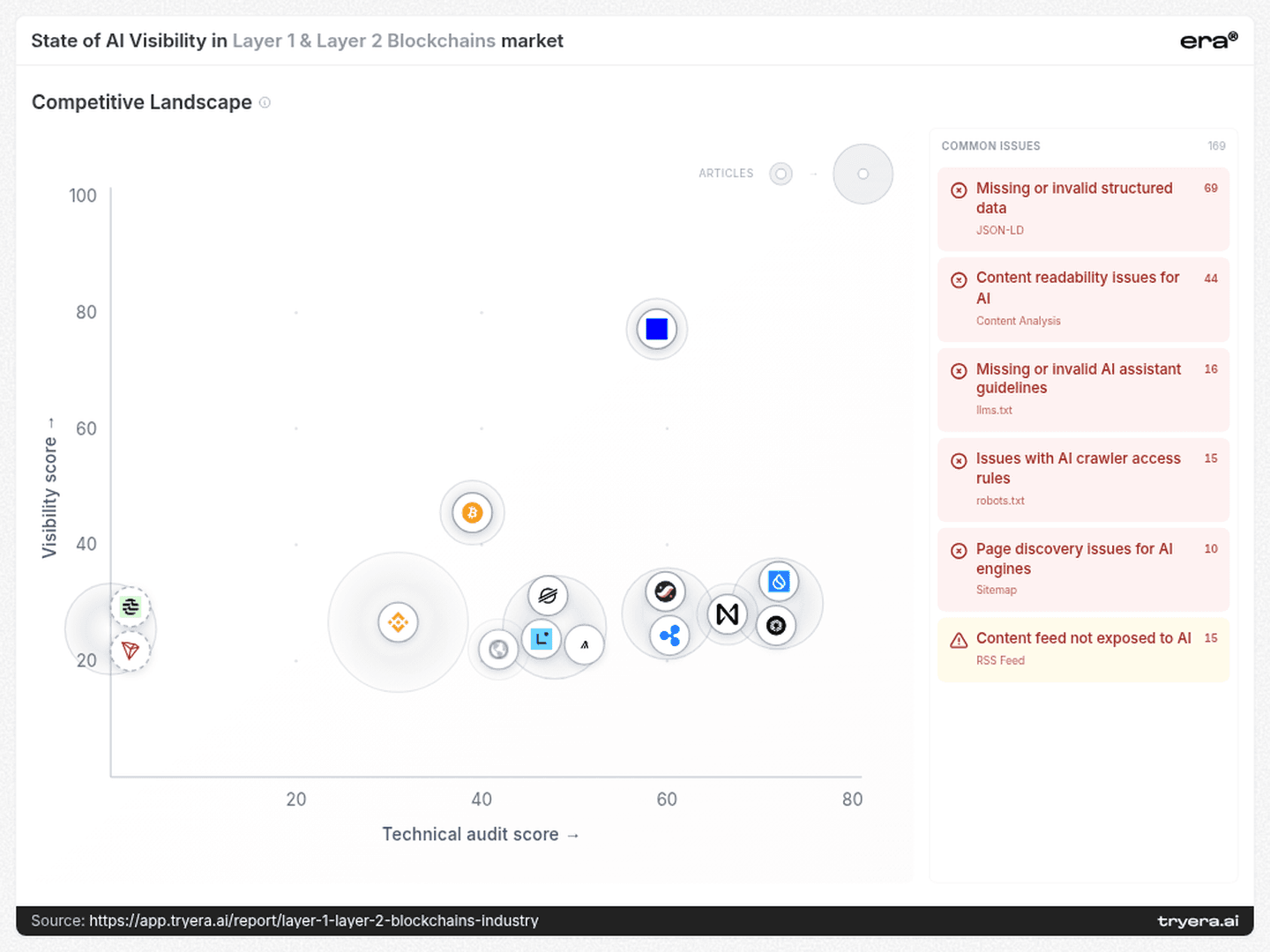
Sui, Immutable and NEAR sit furthest right on the technical axis, at roughly 65–73, with Visibility scores in the 20s and low 30s. Base sits near 60 on the technical axis with by far the highest Visibility score. Aptos and TRON sit at the far left edge of the technical axis.
Across the audited sites, the report finds 169 common issues:
69 missing or invalid structured data (JSON-LD)
44 content readability issues for AI
16 missing or invalid AI assistant guidelines (llms.txt)
15 AI crawler access issues (robots.txt)
15 content feeds not exposed to AI (RSS)
10 page discovery issues (sitemap)
Neither link volume nor technical hygiene separates the leaders here. Both still matter at the page level: structured data and readable content on the pages that answer buyer questions — fees, supported wallets, DeFi ecosystem, security model — are more useful than a site-wide checklist.
9. Beyond the podium — Where eight networks could focus next
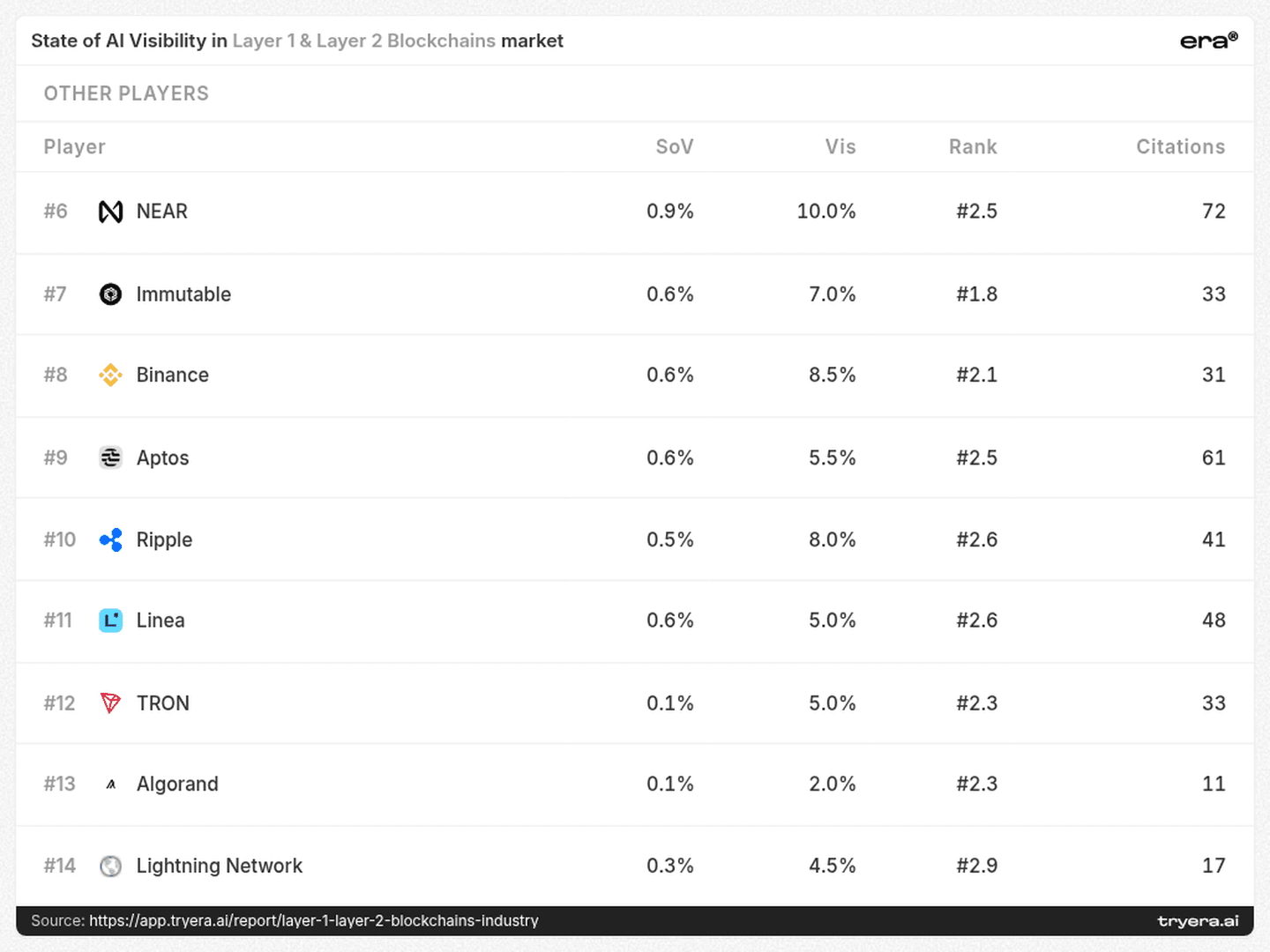
The ranked table below the podium adds a second set of patterns. Eight networks from it illustrate four distinct situations.
Immutable: named early, inside one niche.
Immutable has an average Rank of #1.8 — earlier than every network in this table and earlier than Starknet and Stellar on the podium — with 7.0% Visibility and 33 citations. Its top query is "best blockchain for NFT gaming 2026", and Claude is its strongest engine (10%).
Position is not Immutable's gap; reach beyond gaming is. The next step is to test adjacent intents — low-fee NFT minting, game-focused Layer 2 comparisons — in ChatGPT and Perplexity, where it records 6% and 4%.
NEAR, Ripple and Aptos: one strong engine, one near-empty one.
These three have the sharpest provider profiles in the table. NEAR records 22% in Claude and 2% in Perplexity. Ripple records 16% in Claude and 0% in Perplexity. Aptos records 16% in ChatGPT and 0% in Google AI, while drawing 61 citations — more than Ripple (41) or Binance (31).
For each, the weaker engine is the place to start. Rerun the top query — for NEAR, a Layer 2 fee question; for Ripple, a user-ratings comparison; for Aptos, a DeFi ecosystem question — in that engine, and compare which networks and pages appear instead. Aptos also sits at the far left of the technical audit axis, which makes crawler access and structured data the first technical check.
Binance and TRON: authority that does not show up in the answer.
Binance has the largest backlink profile in the report and 8.5% Visibility. TRON has the fifth-largest (1.4M backlinks), 5.0% Visibility and 0.1% Share of Voice.
For Binance, the first question is entity clarity: the report records BNB Chain separately in Share of Voice, so which name engines use — and for which questions — shapes how its presence is counted. For TRON, the far-left technical audit position makes access and structured data the first thing to verify.
Linea and Lightning Network: present in the evidence, rarely named.
Linea has 48 citations at 5.0% Visibility and an average Rank of #2.6 — more citations than Ripple, which is named more often. Lightning Network has 17 citations, 4.5% Visibility and the latest average Rank in the table: #2.9.
Both sit in the format engines cite most: Layer 2 comparisons. For Linea, the next step is to check its inclusion and description in the recurring Ethereum L2 roundups. For Lightning Network, it is the Bitcoin Layer 2 pages — such as bitcoinfoundation.org's "Best Bitcoin Layer 2 Projects to Watch in 2026" — and whether they represent it accurately.
10. The next 90 days — a plan built on this category's evidence
Days 1–30: map the answers by intent and engine.
Build a prompt set around the intents visible in the report: low-fee Layer 2s, DeFi ecosystems and TVL, NFT gaming, beginner wallets, user ratings, smart contract platforms and stablecoin payments.
Run it in ChatGPT, Perplexity, Google AI and Claude. Record whether you are named, where in the answer, which networks appear beside you and which pages are cited.
Start with the gaps shown here: Sui, Starknet and Aptos outside ChatGPT; NEAR and Ripple in Perplexity; Aptos in Google AI.
Days 31–60: fix the evidence engines already use.
Audit your profiles on L2BEAT, DefiLlama, CoinMarketCap and CoinGecko — categories, risk labels, fees and TVL.
Review your inclusion and description in the recurring comparisons (eco.com, Coin Bureau, Phemex, Datawallet, walllet.com, spark.money, bitcoinfoundation.org, SoluLab).
Publish dated, specific pages on fees, supported wallets, DeFi ecosystem and security model — the questions those comparisons answer — and treat documentation and GitHub as citable evidence.
Fix structured data and readability on those pages first.
Days 61–90: rerun, compare and choose the next cluster.
Repeat the same prompt set across the same engines.
Track presence, mention order, co-mentioned networks and cited pages for each intent.
Keep changes that correspond with clearer, more accurate answers; revise the hypothesis where nothing moved.
Decide which demand cluster — smart contract platforms, beginner wallets or stablecoin payments — deserves the next cycle.
Want this scoreboard for your own brand? Run a free audit at tryera.ai/free-report — 30 minutes, your numbers, no deck required.
Full report with source data: Layer 1 & Layer 2 Blockchains.



For blockchain networks, AI answers increasingly shape the first shortlist a developer, a DeFi team or a first-time buyer sees. The questions behind that shortlist range from low-fee Layer 2s and DeFi ecosystems to NFT gaming, beginner wallets and stablecoin payments. Era's industry report tracks buyer prompts across ChatGPT, Perplexity, Google AI and Claude. It measures Visibility, Share of Voice, average position, citations, provider differences, search queries, search demand, backlinks and technical signals. Those measures do not reduce to a single ranking. Visibility shows how often a network is named, Share of Voice how much of the answer it takes, position how early it appears, and citations which evidence the engines rely on. In this category, the gaps between them are unusually wide.
Base is named in 67.0% of monitored AI answers about Layer 1 and Layer 2 blockchains — nearly three times Bitcoin, the next network on the podium. By that measure, the category has one clear leader.
By another measure, it does not. Ethereum takes the largest Share of Voice in the same answers, and nine of the ten networks that take up the most space in them — Ethereum, Solana, Arbitrum and Optimism among them — are not on the report's ranked scoreboard at all. The domains engines cite most are solana.com and ethereum.org. The pages they cite most are Layer 2 roundups comparing fees, TVL and throughput. And below Base, the order of the field changes depending on which AI engine you ask.
1. The scoreboard — Base leads every podium metric
Base records 67.0% Visibility, 15.3% Share of Voice, an average Rank of #1.2 and 526 citations. Bitcoin, second, records 24.0%, 1.6%, #1.5 and 255. Base leads on all four metrics — on Visibility, Share of Voice and citations by a wide margin.
Below Base, the podium is less tidy than its order suggests:
Bitcoin is named in nearly a quarter of answers, yet its 1.6% Share of Voice is lower than Starknet's 1.7%. It appears often, but takes little space when it does — and when it appears, it appears early (#1.5).
Starknet has higher Visibility (13.5%) and Share of Voice than Sui (11.0%, 1.3%), but Sui is third. Sui is named earlier (#1.6 against #2.3) and draws more citations (102 against 94).
Stellar is fifth with the lowest Share of Voice on the podium (0.3%) and 7.5% Visibility — but 92 citations and an average Rank of #2.0, earlier than Starknet's.
Bitcoin is named in nearly a quarter of answers and takes less of the conversation than Starknet.
For any network benchmarking itself against this category, the podium is a useful start but a poor summary. The distance between Visibility, Share of Voice and position is where most of the story sits.
2. The conversation — nine of the ten largest voices are off the scoreboard
The Share of Voice chart shows who takes up space inside the answers: Ethereum 21.2%, Base 15.3%, Solana 11.7%, Arbitrum 11.4%, Optimism 9.0%, Polygon 7.3%, Avalanche 5.7%, BNB Chain 4.1%, zksync 3.4% and Cardano 1.8%.
Base is the only one of these ten that also appears on the ranked scoreboard — the podium and the table of other players below it. The other nine together hold 75.6% of Share of Voice. The five podium networks together hold 20.2%, and Base accounts for three quarters of that.
The shape of the conversation is clear. Ethereum and four Layer 2s built on it — Base, Arbitrum, Optimism and zksync — hold 60.3% of Share of Voice between them. Answers in this category are, to a large extent, answers about the Ethereum ecosystem.
One entity note matters. The Share of Voice chart lists BNB Chain (4.1%); the ranked table lists Binance (0.6% Share of Voice, 8.5% Visibility). They are recorded as separate names and should be read separately rather than added together.
A podium ranks the scored players. Share of Voice shows who else is standing in the answer — and here, that is most of the market.
3. Engine gaps — below Base, the order depends on which AI you ask
Base stays between 54% and 74% in every engine. Below it, the profiles split sharply.
ChatGPT carries the newer networks. Sui records 26% in ChatGPT against 4–8% elsewhere. Starknet records 28% against 6–10%. Aptos records 16% in ChatGPT and 0% in Google AI.
Google AI is where Bitcoin is strongest. Bitcoin reaches 38% in Google AI, against 18% in ChatGPT and Perplexity. Binance also peaks there, at 14%.
Claude gives more room to NEAR and Ripple. NEAR records 22% in Claude — level with Bitcoin in that engine — against 2% in Perplexity. Ripple records 16% in Claude and 14% in ChatGPT, but 0% in Perplexity.
Perplexity is the narrowest engine. Outside Base (66%) and Bitcoin (18%), no network in the heatmap exceeds 10% there.
In Claude, NEAR is named as often as Bitcoin. In Perplexity, it is named in 2% of answers.
These are report-wide provider figures across the prompt set, not results for any single query. They show where to look. A network with a strong ChatGPT figure and a near-zero elsewhere should rerun its priority buyer questions in the weaker engine, compare which networks are named instead and which pages are cited, and only then decide what to change.
4. The sources — official chain domains and data aggregators carry the citations
The two most cited domains belong to networks: solana.com (189 citations) and ethereum.org (186). Neither Solana nor Ethereum is on the ranked scoreboard, yet together they account for 37.9% of citations across the ten domains shown.
The next layer is data. l2beat.com (149), coinmarketcap.com (97), defillama.com (82) and coingecko.com (65) together hold 393 citations — more than the two official chain domains combined. When engines compare networks, they lean on dashboards that track fees, TVL, risk and market data.
The final layer is documentation:
github.com — 57 citations
docs.arbitrum.io — 56
help.coinbase.com — 50
Coinbase's help center is in the top ten; base.org is not — and Base draws only 8.1% of its citations from its own domain. For the podium leader, most of the evidence sits on pages it does not own. That is worth mapping before deciding where new content should live.
Four data dashboards are cited more often than ethereum.org and solana.com combined.
For any network, this list defines the audit. Check how you are represented on L2BEAT, DefiLlama, CoinMarketCap and CoinGecko — the categories, risk labels and metrics shown — and whether your own documentation answers the questions those dashboards are used to settle.
5. The pages — Layer 2 comparisons dominate the cited evidence
At page level, the evidence narrows to one format: the dated comparison.
eco.com — "Best Ethereum L2s in 2026: Fees, TVL, TPS Compared" (21)
coinbureau.com — "Top Ethereum Layer 2 Projects: Networks Redefining…" (20)
datawallet.com — "Top 7 Crypto Layer 2 Networks in 2026" (13)
walllet.com — "Best Ethereum Layer 2 Networks: Compare Fees, Fina…" (12)
spark.money — "Blockchain Fee Comparison: Gas Fees Across 15+ Cha…" (11)
bitcoinfoundation.org — two pages, on Layer 2 coins and on Bitcoin Layer 2 projects (10 each)
coinbureau.com — "Arbitrum Review 2026: Is This Ethereum Layer 2 Sti…" (9)
solulab.com — "Top 10 Layer 1 Blockchains in 2026" (8)
Eight of the ten pages are about Layer 2 networks, and they account for 109 of the 128 citations in the list. One page compares fees across chains. Layer 1 gets a single dedicated list, cited eight times. At least six of the ten titles carry the year 2026.
Two publishers appear twice. Coin Bureau's pages total 29 citations; bitcoinfoundation.org's total 20, including one of the few pages devoted to Bitcoin's Layer 2 ecosystem.
The page-level evidence is almost entirely about Layer 2. Layer 1 gets one list, cited eight times.
For Layer 2 teams, these roundups are the battleground: check whether each one includes you, how it describes your fees, TVL and security model, and whether those numbers are current. For Layer 1 teams, the gap is the opportunity — there is very little comparative page-level evidence for engines to draw on.
6. The questions — fees are the doorway, but demand points elsewhere
The search-query view shows the query most associated with each player.
Fees open the door for four networks. Base and Stellar share the same top query: "Polygon PoS transaction fees official" — a fee lookup about a third network. Starknet's is "best Ethereum layer 2 networks low transaction fees 2026". NEAR, a Layer 1, is associated with "top layer 2 networks low fees 2026".
Sui enters through wallets. Its top query is "beginner layer 1 crypto wallets 2026 Phantom MetaMask Coinbase Wallet Rabby official supported networks" — a question about which networks popular wallets support.
Immutable owns a niche. Its top query is "best blockchain for NFT gaming 2026".
DeFi brings in Binance and Aptos, through "DeFi TVL by blockchain October 2026 Ethereum Solana BNB Chain" and a "best layer 1 blockchains DeFi…" query that names Sui, Aptos and Avalanche alongside TVL and stablecoins.
Bitcoin and Ripple share "crypto network user ratings Ethereum Solana Bitcoin Cardano XRP Ava…".
The demand data tells a different story.
The highest-volume keyword is "canton network" (154) — a network that does not appear in the report's player tables. It is followed by "smart contract blockchains" (87), "beginner crypto wallets" (68), "layer 1 blockchains" (57) and "stablecoin payments" (55). "transaction fees by network" registers 7.
These are two different measurements: the queries associated with each player, and the keywords with the most AI search demand. Read together, they suggest a gap worth testing. Fee comparisons are how many networks enter answers today; smart contracts, beginner wallets and stablecoin payments are where demand is concentrated.
Engines research fees. Demand asks about smart contracts, wallets and stablecoin payments.
Sui's wallet-support query sits directly on one of the largest demand clusters. For payments-focused networks, "stablecoin payments" is the cluster to test first.
7. Evidence mix — Stellar's own domain does more work than anyone's
Most players draw between 4.7% and 13.2% of their citations from their own domain. Stellar draws 21.5% — the highest in the table by more than eight points.
Stellar has the lowest share from other external sources (74.1%), and it holds a podium place with the smallest Share of Voice on it.
Bitcoin is the most externally dependent: 91.9% of its citations come from other sources, and 4.7% from bitcoin.org.
Aptos combines the second-highest own-domain share (13.2%) with the lowest social share (0.5%).
Starknet has the highest social share (5.8%), ahead of Binance (4.9%) and Base (4.8%).
These are different evidence bases, and they call for different checks. For Stellar, the question is which owned pages are cited and for which questions — and whether the same pages could support adjacent payment prompts. For Bitcoin-adjacent projects, it is which external pages carry the narrative, and whether they describe the current ecosystem accurately.
8. Authority signals — backlinks and technical scores do not sort the field
Backlink volume and AI visibility point in different directions.
Binance has the largest backlink profile by far: 38M backlinks from 136.9K referring domains — more than six times Base's 6M. Its Visibility is 8.5%.
Base has 7.8K referring domains — fewer than TRON (8K), Immutable (15.5K), Ripple (19K) or Solana (21.9K) — and the highest Visibility in the report.
Solana has 557.2K backlinks, about a tenth of Ethereum's 5.1M, yet solana.com is cited slightly more often than ethereum.org.
Binance has six times Base's backlinks. Base is named in almost eight times as many answers.
The competitive landscape plots technical audit score against Visibility score.
Sui, Immutable and NEAR sit furthest right on the technical axis, at roughly 65–73, with Visibility scores in the 20s and low 30s. Base sits near 60 on the technical axis with by far the highest Visibility score. Aptos and TRON sit at the far left edge of the technical axis.
Across the audited sites, the report finds 169 common issues:
69 missing or invalid structured data (JSON-LD)
44 content readability issues for AI
16 missing or invalid AI assistant guidelines (llms.txt)
15 AI crawler access issues (robots.txt)
15 content feeds not exposed to AI (RSS)
10 page discovery issues (sitemap)
Neither link volume nor technical hygiene separates the leaders here. Both still matter at the page level: structured data and readable content on the pages that answer buyer questions — fees, supported wallets, DeFi ecosystem, security model — are more useful than a site-wide checklist.
9. Beyond the podium — Where eight networks could focus next
The ranked table below the podium adds a second set of patterns. Eight networks from it illustrate four distinct situations.
Immutable: named early, inside one niche.
Immutable has an average Rank of #1.8 — earlier than every network in this table and earlier than Starknet and Stellar on the podium — with 7.0% Visibility and 33 citations. Its top query is "best blockchain for NFT gaming 2026", and Claude is its strongest engine (10%).
Position is not Immutable's gap; reach beyond gaming is. The next step is to test adjacent intents — low-fee NFT minting, game-focused Layer 2 comparisons — in ChatGPT and Perplexity, where it records 6% and 4%.
NEAR, Ripple and Aptos: one strong engine, one near-empty one.
These three have the sharpest provider profiles in the table. NEAR records 22% in Claude and 2% in Perplexity. Ripple records 16% in Claude and 0% in Perplexity. Aptos records 16% in ChatGPT and 0% in Google AI, while drawing 61 citations — more than Ripple (41) or Binance (31).
For each, the weaker engine is the place to start. Rerun the top query — for NEAR, a Layer 2 fee question; for Ripple, a user-ratings comparison; for Aptos, a DeFi ecosystem question — in that engine, and compare which networks and pages appear instead. Aptos also sits at the far left of the technical audit axis, which makes crawler access and structured data the first technical check.
Binance and TRON: authority that does not show up in the answer.
Binance has the largest backlink profile in the report and 8.5% Visibility. TRON has the fifth-largest (1.4M backlinks), 5.0% Visibility and 0.1% Share of Voice.
For Binance, the first question is entity clarity: the report records BNB Chain separately in Share of Voice, so which name engines use — and for which questions — shapes how its presence is counted. For TRON, the far-left technical audit position makes access and structured data the first thing to verify.
Linea and Lightning Network: present in the evidence, rarely named.
Linea has 48 citations at 5.0% Visibility and an average Rank of #2.6 — more citations than Ripple, which is named more often. Lightning Network has 17 citations, 4.5% Visibility and the latest average Rank in the table: #2.9.
Both sit in the format engines cite most: Layer 2 comparisons. For Linea, the next step is to check its inclusion and description in the recurring Ethereum L2 roundups. For Lightning Network, it is the Bitcoin Layer 2 pages — such as bitcoinfoundation.org's "Best Bitcoin Layer 2 Projects to Watch in 2026" — and whether they represent it accurately.
10. The next 90 days — a plan built on this category's evidence
Days 1–30: map the answers by intent and engine.
Build a prompt set around the intents visible in the report: low-fee Layer 2s, DeFi ecosystems and TVL, NFT gaming, beginner wallets, user ratings, smart contract platforms and stablecoin payments.
Run it in ChatGPT, Perplexity, Google AI and Claude. Record whether you are named, where in the answer, which networks appear beside you and which pages are cited.
Start with the gaps shown here: Sui, Starknet and Aptos outside ChatGPT; NEAR and Ripple in Perplexity; Aptos in Google AI.
Days 31–60: fix the evidence engines already use.
Audit your profiles on L2BEAT, DefiLlama, CoinMarketCap and CoinGecko — categories, risk labels, fees and TVL.
Review your inclusion and description in the recurring comparisons (eco.com, Coin Bureau, Phemex, Datawallet, walllet.com, spark.money, bitcoinfoundation.org, SoluLab).
Publish dated, specific pages on fees, supported wallets, DeFi ecosystem and security model — the questions those comparisons answer — and treat documentation and GitHub as citable evidence.
Fix structured data and readability on those pages first.
Days 61–90: rerun, compare and choose the next cluster.
Repeat the same prompt set across the same engines.
Track presence, mention order, co-mentioned networks and cited pages for each intent.
Keep changes that correspond with clearer, more accurate answers; revise the hypothesis where nothing moved.
Decide which demand cluster — smart contract platforms, beginner wallets or stablecoin payments — deserves the next cycle.
Want this scoreboard for your own brand? Run a free audit at tryera.ai/free-report — 30 minutes, your numbers, no deck required.
Full report with source data: Layer 1 & Layer 2 Blockchains.