September 30, 2026
September 30, 2026
How Law Firms for Startups in San Francisco Rank in AI Search: A Deep Analysis of Leaders, Challengers and Sources
Fenwick & West appears in 41.4% of monitored AI answers about startup law firms in San Francisco, yet Gunderson Dettmer tops Era's podium with the earliest average rank and the most citations. Wilson Sonsini and Cooley hold the most Share of Voice without appearing in the ranked scoreboard. And the most-cited single page comes from a legal recruiter's site, not from a law firm.
Fenwick & West appears in 41.4% of monitored AI answers about startup law firms in San Francisco, yet Gunderson Dettmer tops Era's podium with the earliest average rank and the most citations. Wilson Sonsini and Cooley hold the most Share of Voice without appearing in the ranked scoreboard. And the most-cited single page comes from a legal recruiter's site, not from a law firm.
For startup-focused law firms, AI answers increasingly shape the first shortlist a founder sees. The questions behind that shortlist vary: generic "best firm" searches, venture-capital work, reviews, ongoing support and flat-fee pricing. Era's industry report measures how law firms for startups in San Francisco appear across ChatGPT, Perplexity, Google AI and Claude: Visibility, Share of Voice, average mention position, citations, cited sources and pages, search queries, technical signals and backlinks. In this market those measures point to different leaders. Reach, mention order and share of the conversation each favour a different firm, and the firms named most often are not all on the scoreboard. A useful assessment has to show where a firm appears, on which engine, and which sources shape the answer.
Ask an AI engine to recommend a startup law firm in San Francisco, and the firm it names first is not necessarily the firm it names most.
Era's report puts Gunderson Dettmer at the top of its podium. Fenwick & West reaches more answers. Primum Law Group takes the largest Share of Voice among the five podium firms. And the two firms mentioned most across all answers, Wilson Sonsini and Cooley, do not appear in the ranked scoreboard at all.
For firms competing for founder mandates, that is more than a scoring quirk. A single ranking cannot say where a firm stands. The useful questions are narrower: on which engine, for which founder question, and on the strength of which cited page.
1. The podium — Three metrics, three different leaders
Gunderson Dettmer takes first place with 34.8% Visibility, the earliest average Rank among the five (#1.7) and the most citations (197). Fenwick & West is second, yet it appears in more answers than any other podium firm: 41.4% Visibility, with an average Rank of #2.0 and 174 citations.
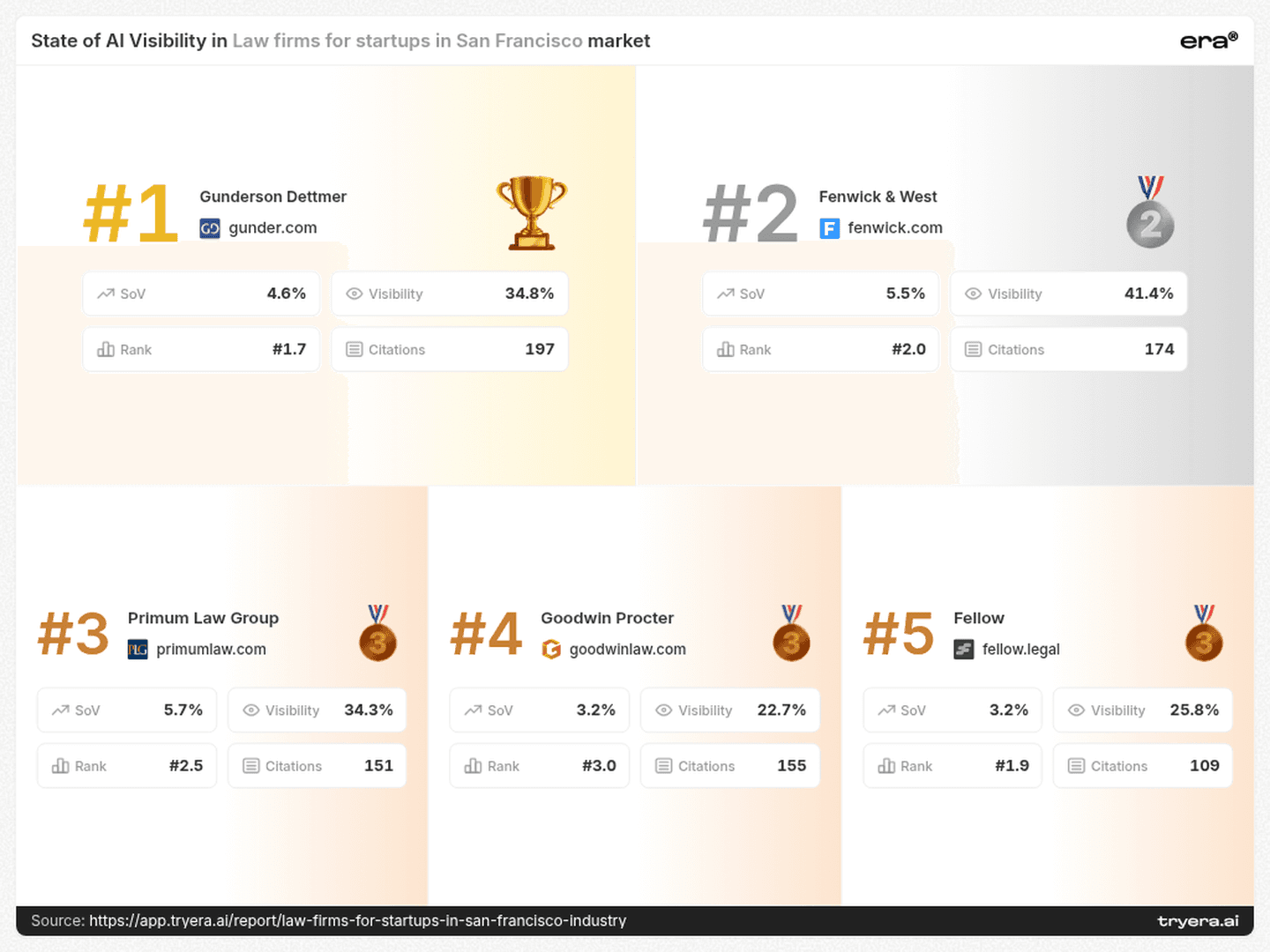
Primum Law Group, in third, has the highest Share of Voice of the five at 5.7%, ahead of Fenwick & West (5.5%) and Gunderson Dettmer (4.6%). Its Visibility, 34.3%, sits within half a point of Gunderson's.
The lower half of the podium splits the same way. Goodwin Procter is fourth with 22.7% Visibility, 155 citations and an average Rank of #3.0, the latest of the five. Fellow, fifth, reaches more answers (25.8%) and is named earlier (#1.9), but carries fewer citations (109).
Reach: Fenwick & West
Mention order and citations: Gunderson Dettmer
Share of Voice within the podium: Primum Law Group
Visibility, rank and Share of Voice each crown a different firm.
For a managing partner or a marketing lead, the practical point is simple: a claim to lead AI search in this market needs a metric attached to it.
2. The conversation — The most-named firms are not on the scoreboard
Share of Voice measures a firm's mentions against all tracked firms' mentions in the same answers. On that measure, the order changes completely. Wilson Sonsini leads with 13.6%, followed by Cooley at 11.7%, Bend Law Group (8.2%), SPZ Legal (7.5%) and Springmeyer Law (6.3%).
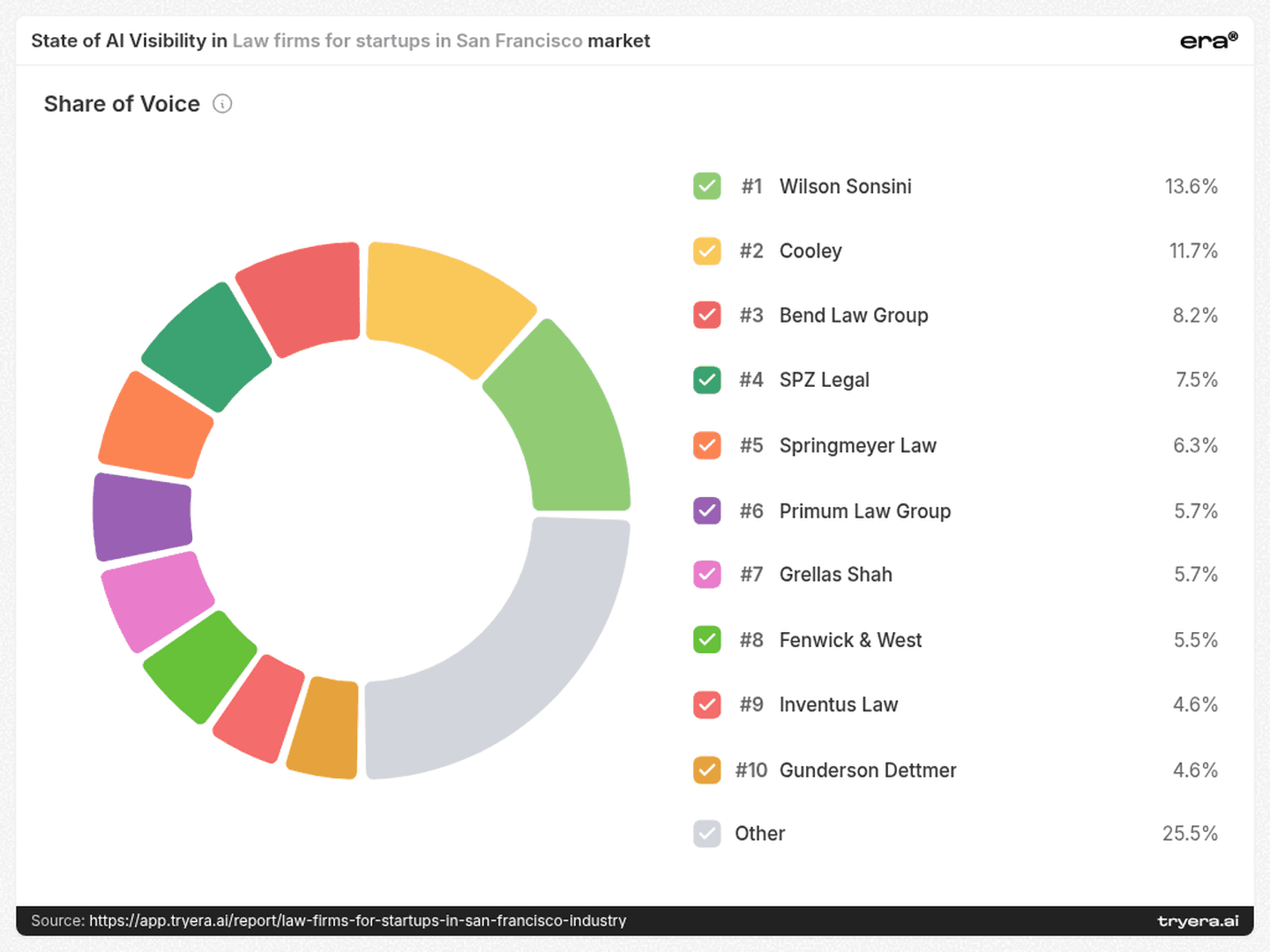
Only three of the ten named firms in the chart also appear in the ranked scoreboard: Primum Law Group (5.7%), Fenwick & West (5.5%) and Gunderson Dettmer (4.6%). Wilson Sonsini, Cooley, Bend Law Group, SPZ Legal, Springmeyer Law, Grellas Shah (5.7%) and Inventus Law (4.6%) appear neither on the podium nor in the table of players ranked #6 to #18, shown in section 9. Every firm outside the named ten shares the remaining 25.5%.
The two views answer different questions. The ranked tables give detailed metrics for one set of firms. The Share of Voice chart shows which firms take up the most space in the answers overall. Several of the firms missing from the scoreboard surface elsewhere in the report: cooley.com, grellas.com and wsgr.com are among the ten most-cited source domains, and Cooley, Wilson Sonsini and SPZ Legal appear in the backlink comparison.
For a boutique firm, that changes the benchmark. The competition inside an AI answer is not only the firms on a podium. It is whoever the engines keep naming alongside you.
3. Engine gaps — The shortlist depends on which assistant the founder opens
The provider heatmap is where the podium order stops being portable.
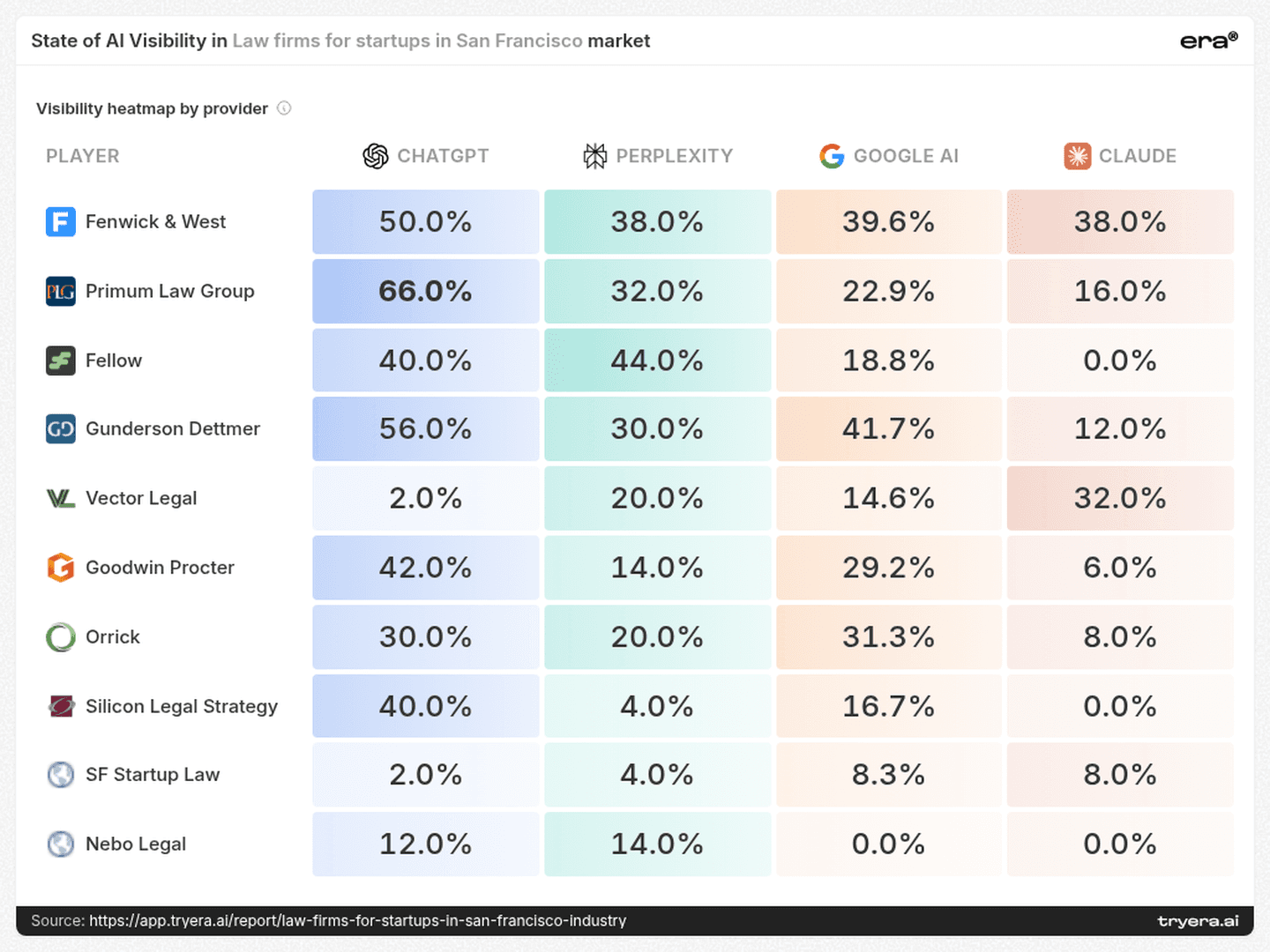
Fenwick & West is the most even performer: 50.0% in ChatGPT, 38.0% in Perplexity, 39.6% in Google AI and 38.0% in Claude. It is the only firm in the heatmap at 38% or more on every engine.
The others lean harder:
Primum Law Group reaches 66.0% in ChatGPT, the highest value in the heatmap, and 16.0% in Claude.
Gunderson Dettmer leads Google AI at 41.7% and records 56.0% in ChatGPT, but 12.0% in Claude.
Fellow tops Perplexity at 44.0% and records 0.0% in Claude.
Silicon Legal Strategy reaches 40.0% in ChatGPT, 4.0% in Perplexity and 0.0% in Claude.
Vector Legal runs the other way. It records 2.0% in ChatGPT but 32.0% in Claude, second only to Fenwick & West in that column. Orrick shows a quieter version of the same effect in Google AI, where its 31.3% sits above Goodwin Procter (29.2%) and Primum Law Group (22.9%).
An engine gap is a research question, not a verdict.
The heatmap shows where the gaps are, not why they exist. For each one, the next step is the same: run the firm's key questions on the weaker engine, record which firms and pages that engine cites instead, and compare them with the engine where the firm performs well.
4. Source domains — Firm websites dominate the citation count
At the domain level, law firms are their own most important sources. Eight of the ten most-cited domains belong to firms: gunder.com (12.9%, 145 citations), cooley.com (12.1%, 136), primumlaw.com (10.9%, 122), fenwick.com (10.2%, 115), fellow.legal (10.1%, 113), goodwinlaw.com (9.6%, 108), grellas.com (7.5%, 84) and wsgr.com (7.1%, 80).
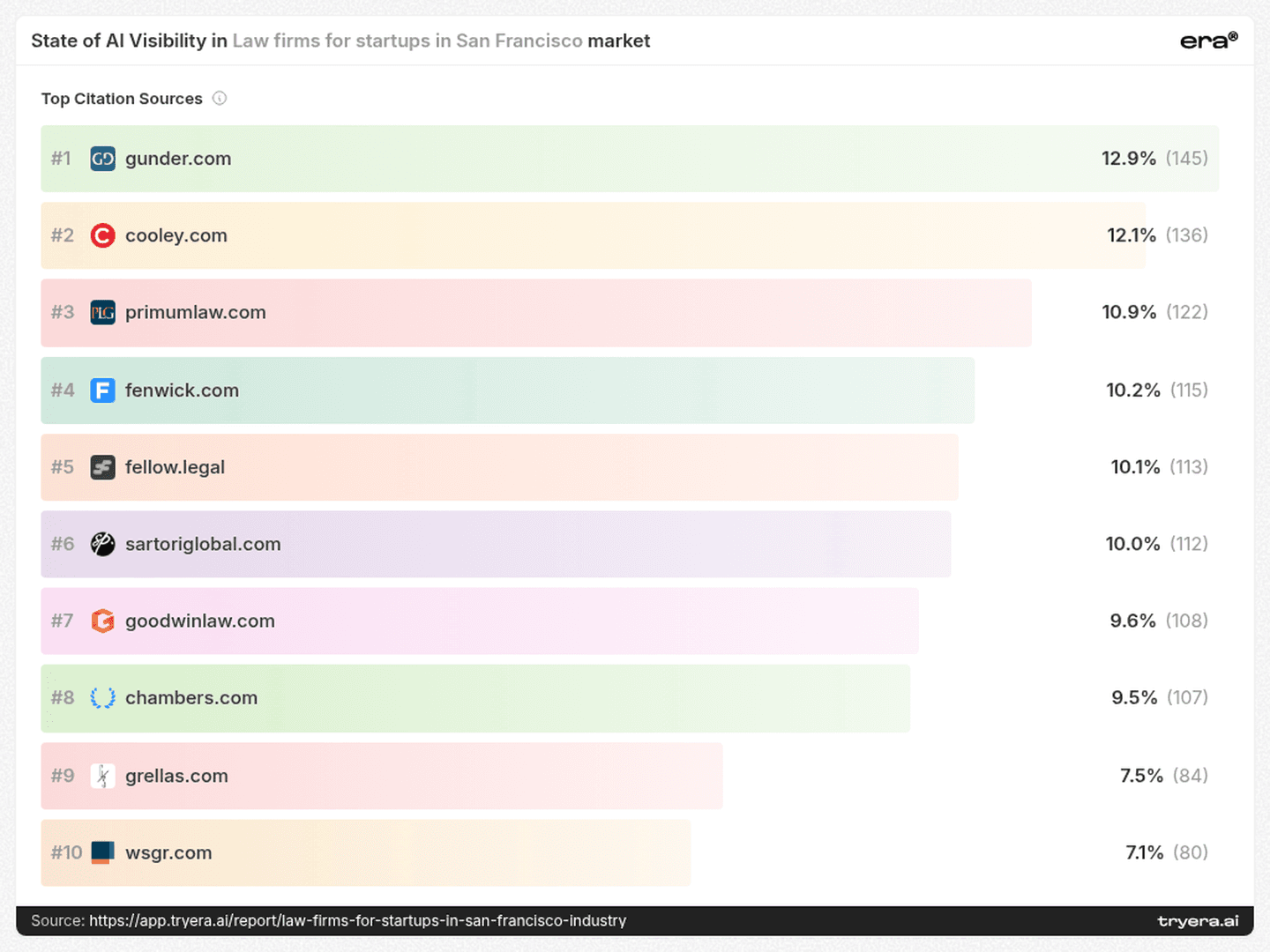
The two exceptions matter. sartoriglobal.com, the site of legal recruiter Sartori & Partners, is sixth with 10.0% (112). chambers.com, the Chambers legal directory, is eighth with 9.5% (107).
Cooley stands out again. Its domain is cited almost as often as Gunderson Dettmer's, although Cooley is absent from the ranked scoreboard. A firm does not need a podium place for its own content to shape the answers.
5. Cited pages — The most-cited pages are rankings, guides and reviews
The picture flips at the level of individual pages. None of the ten most-cited links is a law firm's own page.
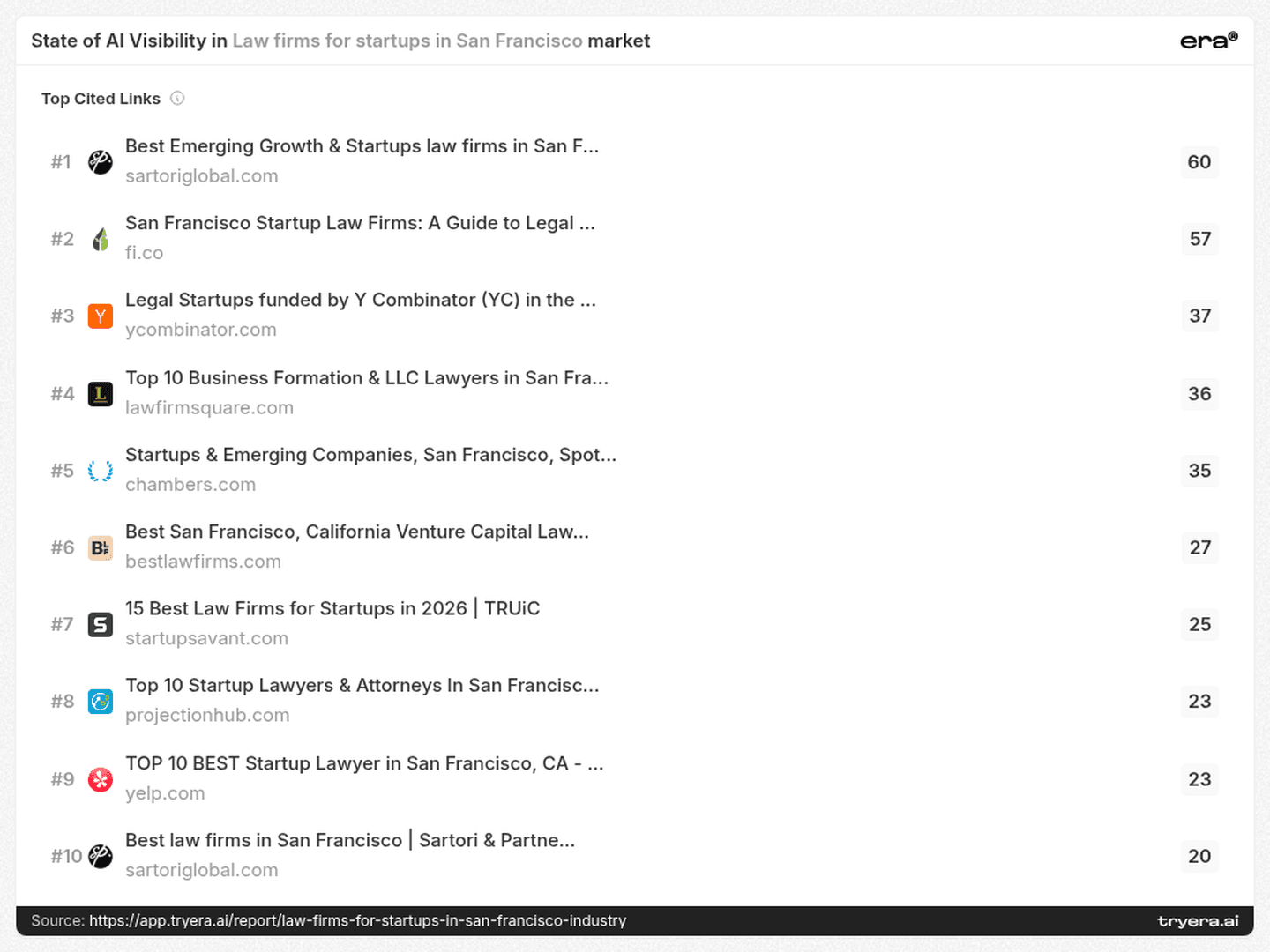
A sartoriglobal.com page titled "Best Emerging Growth & Startups law firms in San F…" leads with 60 citations. A second Sartori page, "Best law firms in San Francisco | Sartori & Partne…", adds 20 more.
fi.co's "San Francisco Startup Law Firms: A Guide to Legal …" follows with 57.
ycombinator.com's "Legal Startups funded by Y Combinator (YC) in the …" has 37. Answers about law firms are drawing on a list of YC-funded legal startups.
lawfirmsquare.com's "Top 10 Business Formation & LLC Lawyers in San Fra…" (36) frames the question around company formation.
chambers.com's "Startups & Emerging Companies, San Francisco, Spot…" has 35.
bestlawfirms.com (27), startupsavant.com's "15 Best Law Firms for Startups in 2026 | TRUiC" (25), projectionhub.com (23) and yelp.com (23) complete the list.
The most-cited page in this market is not written by a law firm.
The two levels fit together. Firm domains collect many citations spread across many pages. Third-party rankings concentrate theirs on a single URL. A firm's own site explains what it does; the rankings are where it is compared with its peers.
For any firm in this market, the immediate audit is concrete: are you on these ten pages, how are you described, and is the description current?
6. Buyer intent — Challengers surface on narrower questions
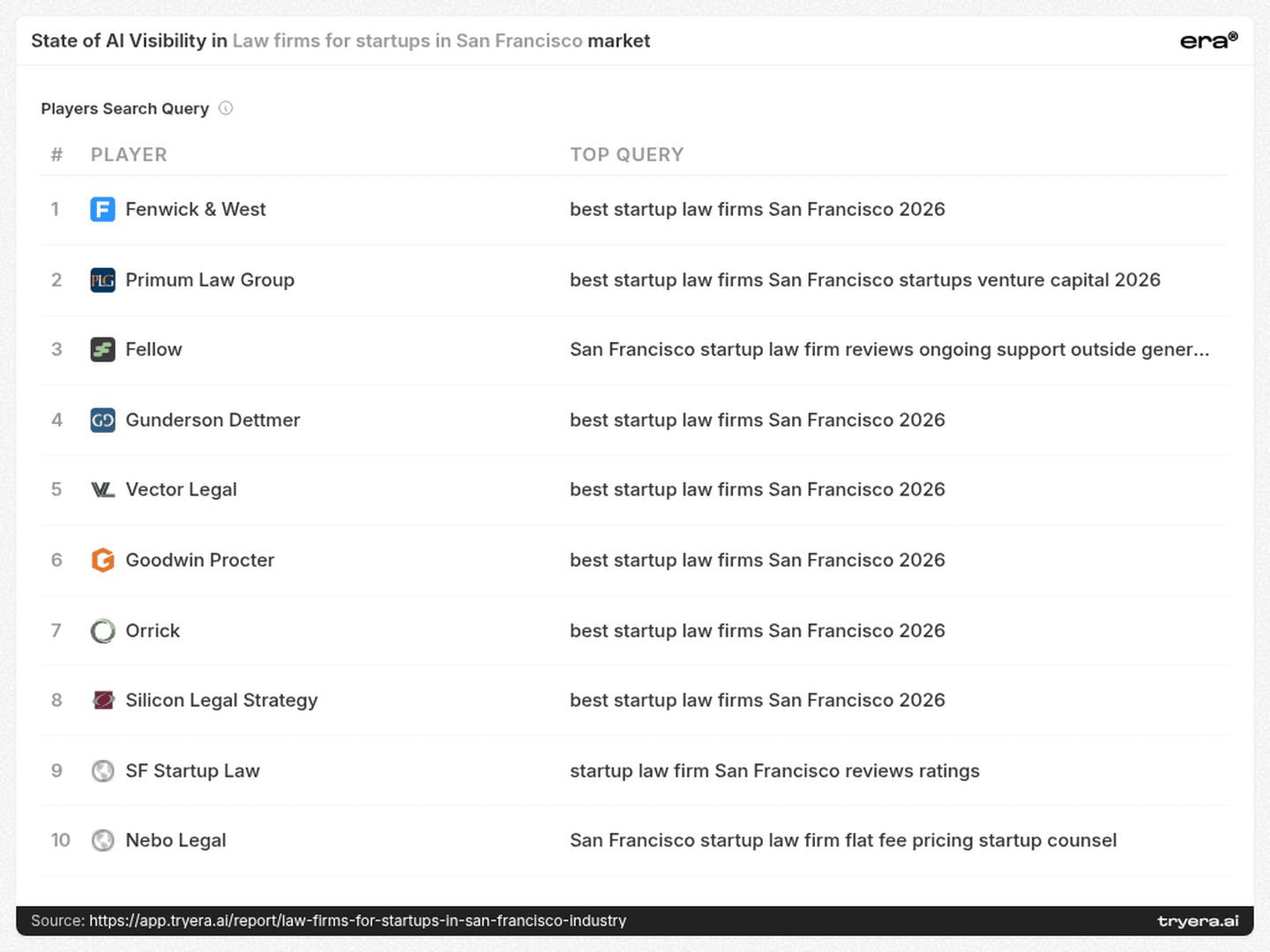
Most players share one top query: "best startup law firms San Francisco 2026". It is the top query for Fenwick & West, Gunderson Dettmer, Vector Legal, Goodwin Procter, Orrick and Silicon Legal Strategy.
The exceptions are more instructive:
Primum Law Group: "best startup law firms San Francisco startups venture capital 2026" — the same question with a funding angle.
Fellow: "San Francisco startup law firm reviews ongoing support outside gener…" — reviews combined with ongoing support.
SF Startup Law: "startup law firm San Francisco reviews ratings".
Nebo Legal: "San Francisco startup law firm flat fee pricing startup counsel".
Reviews, ongoing support and pricing are evaluation questions rather than discovery questions. Firms that surface on them compete where a generic "best of" list has less to say.
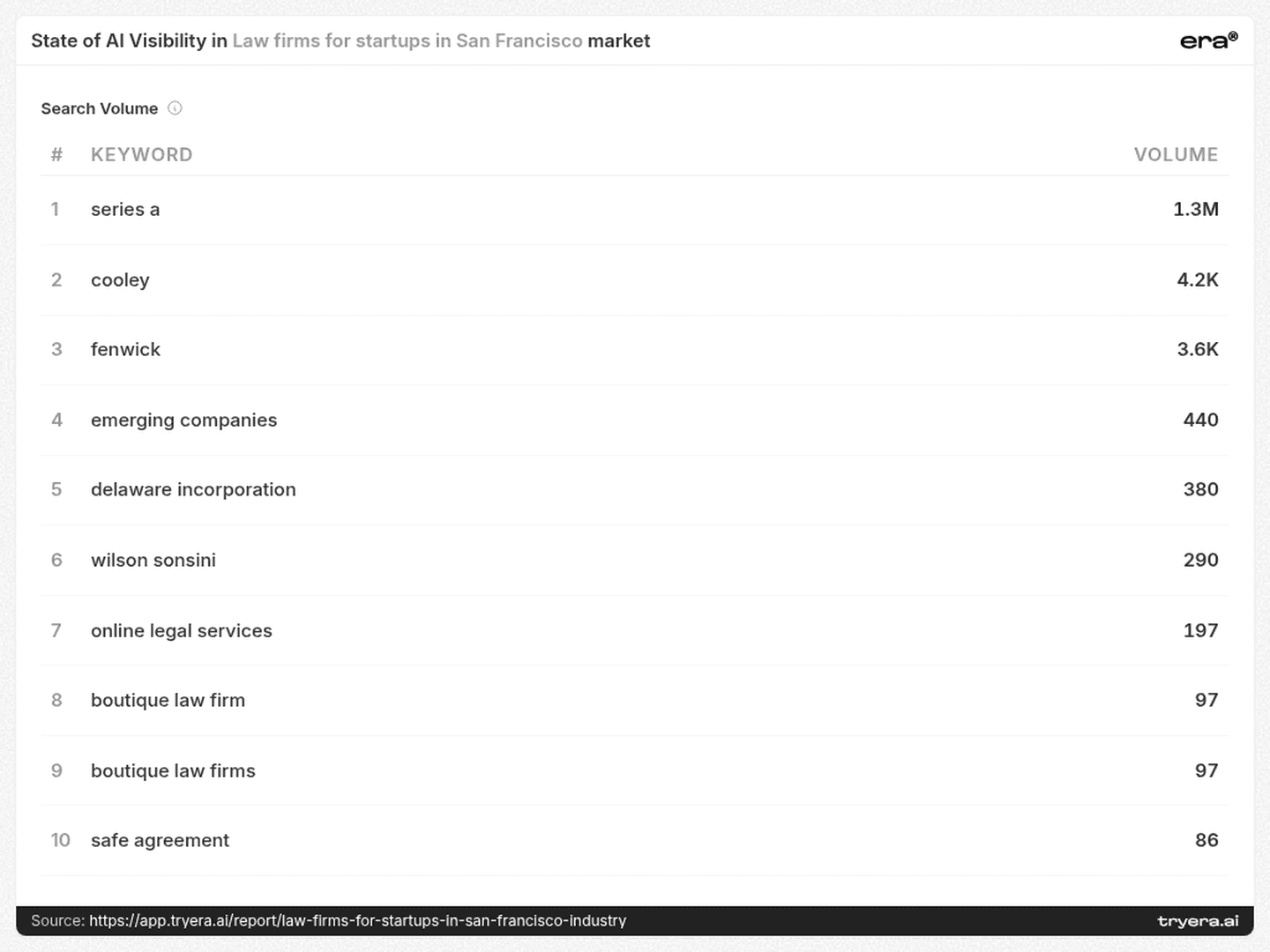
The search-volume data points to the transactions behind those questions. "series a" leads at 1.3M, although that term reaches far beyond legal services. Closer to legal work sit "delaware incorporation" (380) and "safe agreement" (86). Brand terms drop steeply after the two largest names: "cooley" at 4.2K, "fenwick" at 3.6K and "wilson sonsini" at 290. "boutique law firm" and "boutique law firms" register 97 each.
Clear, specific content on Delaware incorporation, SAFEs and Series A mechanics answers the questions founders bring before they choose counsel. Whether it changes a firm's presence in AI answers is something to test, not assume.
7. Evidence mix — Own site, social or everyone else
Seven of the ten firms in the citation mix draw between 29.9% and 36.4% of their citations from their own domain and under 4% from social sources. Three profiles break the pattern.
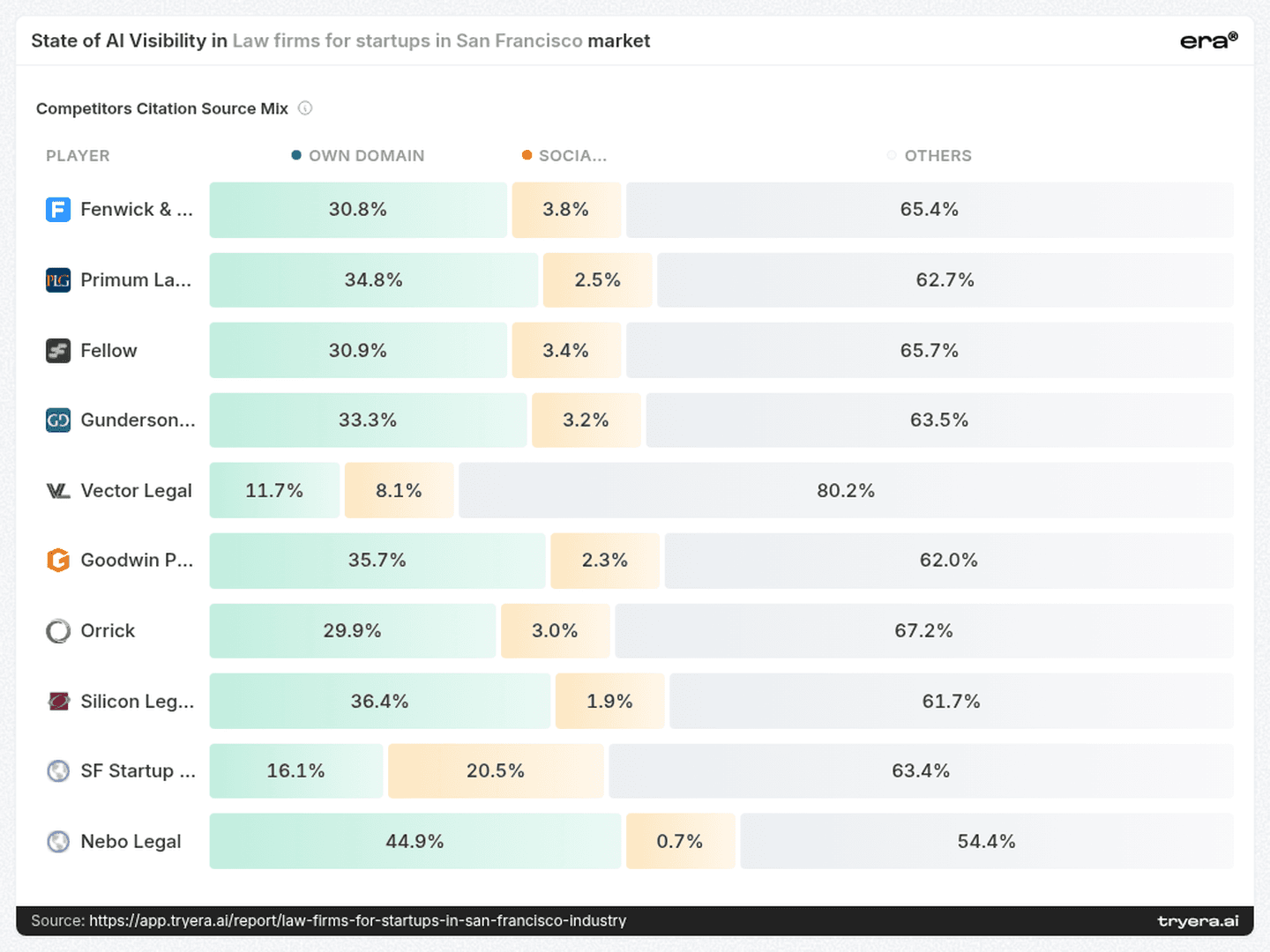
Vector Legal gets only 11.7% from its own domain and 80.2% from other sources, the highest external share in the table.
SF Startup Law has the highest social share at 20.5%, against 16.1% from its own domain.
Nebo Legal has the highest own-domain share at 44.9% and almost no social citations (0.7%).
Read together with the heatmap, the Nebo Legal profile raises a clear question. Nebo records 12.0% Visibility in ChatGPT and 14.0% in Perplexity, and 0.0% in Google AI and Claude. A firm whose citations lean heavily on its own site can check whether independent sources describe the same services.
Vector Legal points the other way. Its presence rests mostly on sources it does not own, and its 32.0% in Claude against 2.0% in ChatGPT is one of the clearest engine splits in the report.
8. Technical signals and links — Neither one sorts this market
The competitive landscape plots each firm's technical audit score against its visibility score. Two of the most visible firms sit at the far left: Goodwin Procter and Fenwick & West have the lowest technical audit scores among the plotted firms, yet both sit in the upper part of the chart on visibility score. Vector Legal sits furthest right on technical score, with a mid-range visibility score.
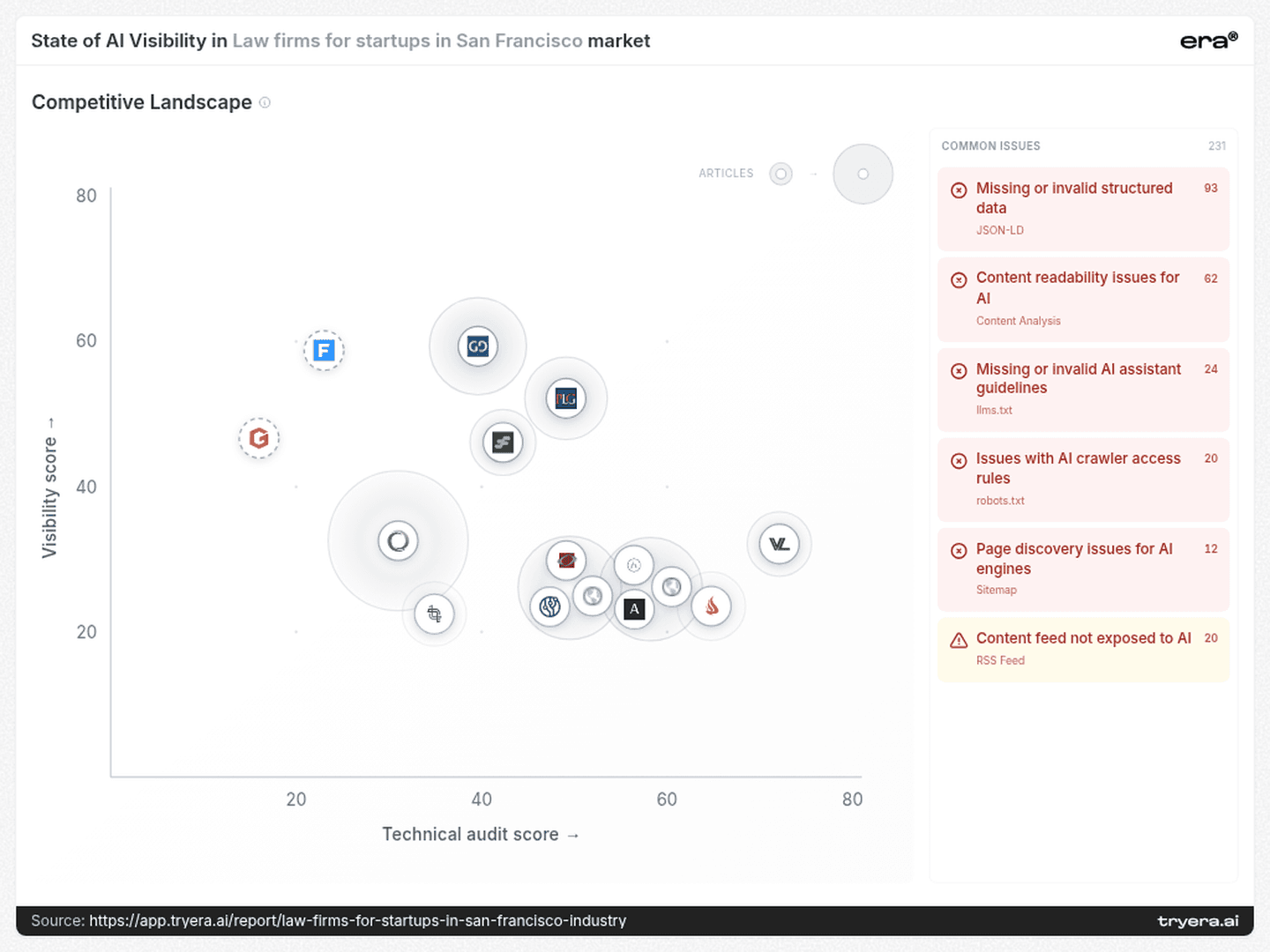
The issue panel shows where the technical work is concentrated. It lists 231 common issues: 93 for missing or invalid structured data (JSON-LD), 62 for content readability for AI, 24 for missing or invalid llms.txt guidelines, 20 for AI crawler access rules in robots.txt and 12 for page discovery in sitemaps, plus 20 warnings for content feeds not exposed to AI.
Backlinks show the same disconnect from a different angle. DLA Piper leads with 499.5K backlinks from 22.1K referring domains, followed by Cooley (258K), Pillsbury (233.8K), Orrick (191.9K) and Goodwin Procter (182.4K). Fenwick & West is last of the ten shown, at 47.5K.
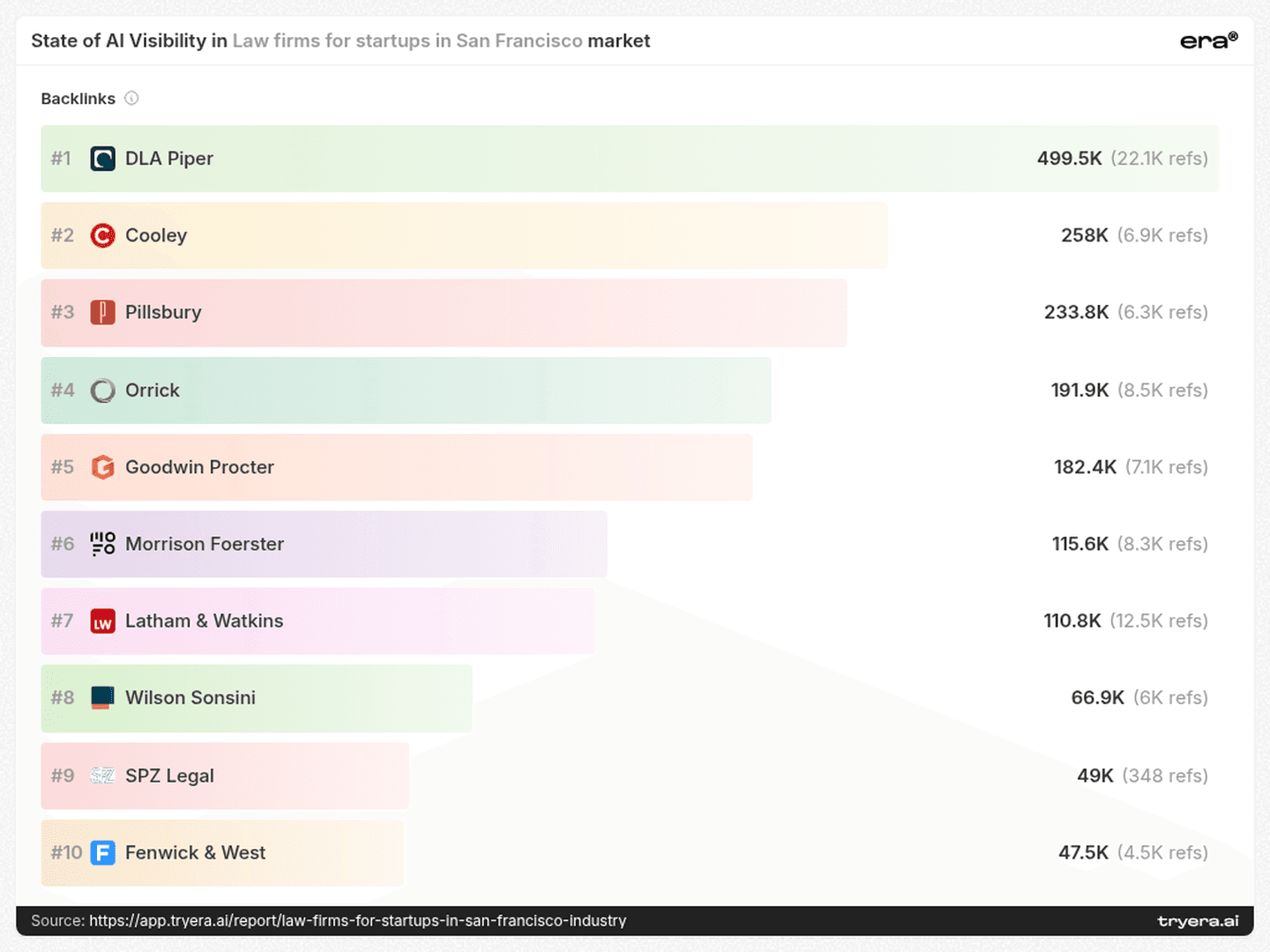
DLA Piper, Pillsbury, Morrison Foerster and Latham & Watkins all rank in the backlink top ten, and none of them appears in the Share of Voice top ten or the ranked scoreboard. SPZ Legal is the reverse case: 49K backlinks from only 348 referring domains, and a 7.5% Share of Voice.
In this report, more backlinks did not mean more mentions.
Technical fixes remain worth doing, especially structured data and readability on the pages that answer founder questions. On their own, they are hygiene rather than a visibility strategy.
9. Beyond the leaders — Where nine firms could focus next
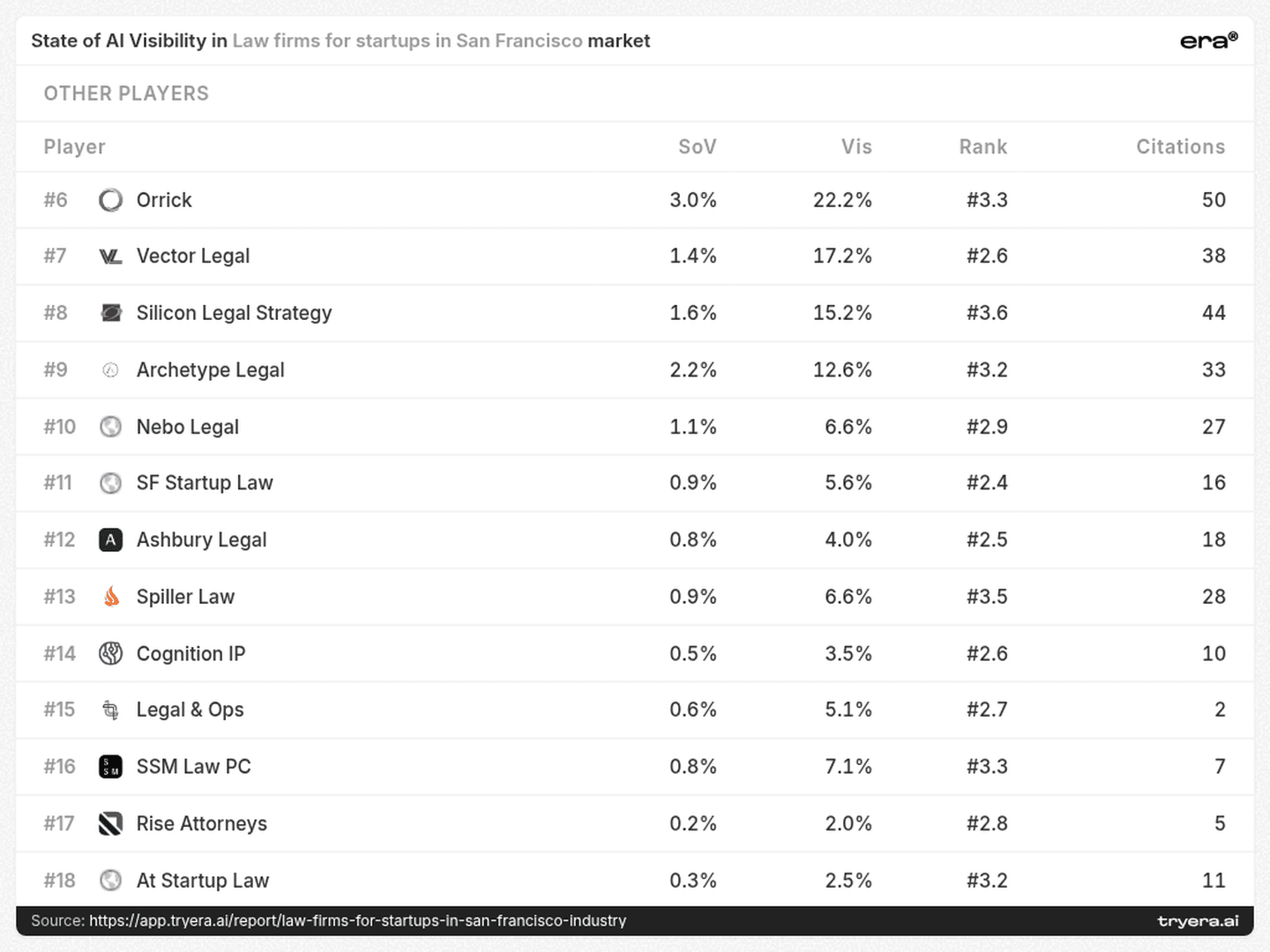
The ranked table continues past the podium. Rows #10 to #18 hold nine firms with Visibility between 2.0% and 7.1%. Their situations differ more than the low numbers suggest.
Named early, named rarely: SF Startup Law, Ashbury Legal, Cognition IP and Rise Attorneys
These four have average Ranks between #2.4 and #2.8, the same range as the podium, on Visibility of 2.0% to 5.6%. SF Startup Law (#2.4, 5.6%) and Ashbury Legal (#2.5, 4.0%, 18 citations) come closest to the leaders on mention order. Cognition IP (#2.6, 3.5%) and Rise Attorneys (#2.8, 2.0%, 5 citations) follow.
When these firms appear, they are not an afterthought. The open question is coverage. Each can map the prompts where it already appears and test adjacent ones. For Cognition IP, the only IP-branded name in the table, that means founder questions about patents and IP ownership, which this report does not isolate.
SF Startup Law has an extra lead to follow. Its top query is about reviews and ratings, it has the highest social share in the citation mix (20.5%), and its Visibility is higher in Google AI (8.3%) and Claude (8.0%) than in ChatGPT (2.0%). Review platforms are already part of the answer set: yelp.com is among the ten most-cited links.
Named with little evidence: SSM Law PC and Legal & Ops
SSM Law PC has the highest Visibility from #10 down, 7.1%, with only 7 citations. Legal & Ops reaches 5.1% Visibility on 2 citations, with an average Rank of #2.7. Both appear in answers with little citable evidence attached. The next step is to identify which of their pages an engine could cite for a startup question, and whether those pages answer it directly.
Well cited, named later: Spiller Law and At Startup Law
Spiller Law has 28 citations, the most from #10 down, and 6.6% Visibility. Its average Rank, #3.5, is the latest from #10 down. At Startup Law shows a smaller version of the same profile: 11 citations on 2.5% Visibility, at #3.2. The evidence exists; the firms tend to appear further down the answer. Comparing how answers describe them with how they describe the podium firms would show whether the gap lies in positioning or in the questions being asked.
Present on two engines, absent on two: Nebo Legal
Nebo Legal records 6.6% Visibility, an average Rank of #2.9 and 27 citations. Its top query is about flat-fee pricing, a specific evaluation question. It appears in 12.0% of ChatGPT and 14.0% of Perplexity answers and in none on Google AI or Claude, while 44.9% of its citations come from its own domain. Testing the pricing question on the two missing engines, and checking which independent sources those engines cite instead, is the most direct next step.
10. The next 90 days — A plan built on this report
Days 1–30: map the questions and the real competition.
Run the four top-query patterns from the report on ChatGPT, Perplexity, Google AI and Claude: the generic "best startup law firms San Francisco 2026", the venture-capital variant, reviews and ongoing support, and flat-fee pricing.
For each answer, log the firms named, their order and the pages cited.
Benchmark against the firms the answers actually name, including Wilson Sonsini, Cooley, Bend Law Group, SPZ Legal and Springmeyer Law, not only the podium.
Check your listing and description on each of the ten most-cited pages: Sartori & Partners, fi.co, Y Combinator, lawfirmsquare, Chambers, bestlawfirms, startupsavant, projectionhub and Yelp.
Days 31–60: close the evidence gaps.
Where a firm is missing on one engine (Claude for Fellow and Silicon Legal Strategy, Google AI and Claude for Nebo Legal, ChatGPT for Vector Legal), compare the sources that engine cites with the sources cited where the firm does appear.
Publish direct, dated answers on the transaction topics in the search-volume data: Delaware incorporation, SAFEs and Series A.
If pricing or ongoing support is part of your pitch, state it plainly on one crawlable page.
Fix structured data, readability, llms.txt and crawler rules first on the pages that answer these questions.
Days 61–90: rerun and compare.
Repeat the same prompt set on the same engines.
Track presence, mention order and cited pages per engine rather than a single blended score.
Keep the changes that correspond with more accurate answers, and revise the hypotheses where nothing moved.
Decide which adjacent intents, such as company formation, fundraising documents or IP ownership, deserve the next cycle.
Want this scoreboard for your own brand? Run a free audit at tryera.ai/free-report — 30 minutes, your numbers, no deck required.
Full report with source data: Law Firms for Startups in San Francisco.



For startup-focused law firms, AI answers increasingly shape the first shortlist a founder sees. The questions behind that shortlist vary: generic "best firm" searches, venture-capital work, reviews, ongoing support and flat-fee pricing. Era's industry report measures how law firms for startups in San Francisco appear across ChatGPT, Perplexity, Google AI and Claude: Visibility, Share of Voice, average mention position, citations, cited sources and pages, search queries, technical signals and backlinks. In this market those measures point to different leaders. Reach, mention order and share of the conversation each favour a different firm, and the firms named most often are not all on the scoreboard. A useful assessment has to show where a firm appears, on which engine, and which sources shape the answer.
Ask an AI engine to recommend a startup law firm in San Francisco, and the firm it names first is not necessarily the firm it names most.
Era's report puts Gunderson Dettmer at the top of its podium. Fenwick & West reaches more answers. Primum Law Group takes the largest Share of Voice among the five podium firms. And the two firms mentioned most across all answers, Wilson Sonsini and Cooley, do not appear in the ranked scoreboard at all.
For firms competing for founder mandates, that is more than a scoring quirk. A single ranking cannot say where a firm stands. The useful questions are narrower: on which engine, for which founder question, and on the strength of which cited page.
1. The podium — Three metrics, three different leaders
Gunderson Dettmer takes first place with 34.8% Visibility, the earliest average Rank among the five (#1.7) and the most citations (197). Fenwick & West is second, yet it appears in more answers than any other podium firm: 41.4% Visibility, with an average Rank of #2.0 and 174 citations.
Primum Law Group, in third, has the highest Share of Voice of the five at 5.7%, ahead of Fenwick & West (5.5%) and Gunderson Dettmer (4.6%). Its Visibility, 34.3%, sits within half a point of Gunderson's.
The lower half of the podium splits the same way. Goodwin Procter is fourth with 22.7% Visibility, 155 citations and an average Rank of #3.0, the latest of the five. Fellow, fifth, reaches more answers (25.8%) and is named earlier (#1.9), but carries fewer citations (109).
Reach: Fenwick & West
Mention order and citations: Gunderson Dettmer
Share of Voice within the podium: Primum Law Group
Visibility, rank and Share of Voice each crown a different firm.
For a managing partner or a marketing lead, the practical point is simple: a claim to lead AI search in this market needs a metric attached to it.
2. The conversation — The most-named firms are not on the scoreboard
Share of Voice measures a firm's mentions against all tracked firms' mentions in the same answers. On that measure, the order changes completely. Wilson Sonsini leads with 13.6%, followed by Cooley at 11.7%, Bend Law Group (8.2%), SPZ Legal (7.5%) and Springmeyer Law (6.3%).
Only three of the ten named firms in the chart also appear in the ranked scoreboard: Primum Law Group (5.7%), Fenwick & West (5.5%) and Gunderson Dettmer (4.6%). Wilson Sonsini, Cooley, Bend Law Group, SPZ Legal, Springmeyer Law, Grellas Shah (5.7%) and Inventus Law (4.6%) appear neither on the podium nor in the table of players ranked #6 to #18, shown in section 9. Every firm outside the named ten shares the remaining 25.5%.
The two views answer different questions. The ranked tables give detailed metrics for one set of firms. The Share of Voice chart shows which firms take up the most space in the answers overall. Several of the firms missing from the scoreboard surface elsewhere in the report: cooley.com, grellas.com and wsgr.com are among the ten most-cited source domains, and Cooley, Wilson Sonsini and SPZ Legal appear in the backlink comparison.
For a boutique firm, that changes the benchmark. The competition inside an AI answer is not only the firms on a podium. It is whoever the engines keep naming alongside you.
3. Engine gaps — The shortlist depends on which assistant the founder opens
The provider heatmap is where the podium order stops being portable.
Fenwick & West is the most even performer: 50.0% in ChatGPT, 38.0% in Perplexity, 39.6% in Google AI and 38.0% in Claude. It is the only firm in the heatmap at 38% or more on every engine.
The others lean harder:
Primum Law Group reaches 66.0% in ChatGPT, the highest value in the heatmap, and 16.0% in Claude.
Gunderson Dettmer leads Google AI at 41.7% and records 56.0% in ChatGPT, but 12.0% in Claude.
Fellow tops Perplexity at 44.0% and records 0.0% in Claude.
Silicon Legal Strategy reaches 40.0% in ChatGPT, 4.0% in Perplexity and 0.0% in Claude.
Vector Legal runs the other way. It records 2.0% in ChatGPT but 32.0% in Claude, second only to Fenwick & West in that column. Orrick shows a quieter version of the same effect in Google AI, where its 31.3% sits above Goodwin Procter (29.2%) and Primum Law Group (22.9%).
An engine gap is a research question, not a verdict.
The heatmap shows where the gaps are, not why they exist. For each one, the next step is the same: run the firm's key questions on the weaker engine, record which firms and pages that engine cites instead, and compare them with the engine where the firm performs well.
4. Source domains — Firm websites dominate the citation count
At the domain level, law firms are their own most important sources. Eight of the ten most-cited domains belong to firms: gunder.com (12.9%, 145 citations), cooley.com (12.1%, 136), primumlaw.com (10.9%, 122), fenwick.com (10.2%, 115), fellow.legal (10.1%, 113), goodwinlaw.com (9.6%, 108), grellas.com (7.5%, 84) and wsgr.com (7.1%, 80).
The two exceptions matter. sartoriglobal.com, the site of legal recruiter Sartori & Partners, is sixth with 10.0% (112). chambers.com, the Chambers legal directory, is eighth with 9.5% (107).
Cooley stands out again. Its domain is cited almost as often as Gunderson Dettmer's, although Cooley is absent from the ranked scoreboard. A firm does not need a podium place for its own content to shape the answers.
5. Cited pages — The most-cited pages are rankings, guides and reviews
The picture flips at the level of individual pages. None of the ten most-cited links is a law firm's own page.
A sartoriglobal.com page titled "Best Emerging Growth & Startups law firms in San F…" leads with 60 citations. A second Sartori page, "Best law firms in San Francisco | Sartori & Partne…", adds 20 more.
fi.co's "San Francisco Startup Law Firms: A Guide to Legal …" follows with 57.
ycombinator.com's "Legal Startups funded by Y Combinator (YC) in the …" has 37. Answers about law firms are drawing on a list of YC-funded legal startups.
lawfirmsquare.com's "Top 10 Business Formation & LLC Lawyers in San Fra…" (36) frames the question around company formation.
chambers.com's "Startups & Emerging Companies, San Francisco, Spot…" has 35.
bestlawfirms.com (27), startupsavant.com's "15 Best Law Firms for Startups in 2026 | TRUiC" (25), projectionhub.com (23) and yelp.com (23) complete the list.
The most-cited page in this market is not written by a law firm.
The two levels fit together. Firm domains collect many citations spread across many pages. Third-party rankings concentrate theirs on a single URL. A firm's own site explains what it does; the rankings are where it is compared with its peers.
For any firm in this market, the immediate audit is concrete: are you on these ten pages, how are you described, and is the description current?
6. Buyer intent — Challengers surface on narrower questions
Most players share one top query: "best startup law firms San Francisco 2026". It is the top query for Fenwick & West, Gunderson Dettmer, Vector Legal, Goodwin Procter, Orrick and Silicon Legal Strategy.
The exceptions are more instructive:
Primum Law Group: "best startup law firms San Francisco startups venture capital 2026" — the same question with a funding angle.
Fellow: "San Francisco startup law firm reviews ongoing support outside gener…" — reviews combined with ongoing support.
SF Startup Law: "startup law firm San Francisco reviews ratings".
Nebo Legal: "San Francisco startup law firm flat fee pricing startup counsel".
Reviews, ongoing support and pricing are evaluation questions rather than discovery questions. Firms that surface on them compete where a generic "best of" list has less to say.
The search-volume data points to the transactions behind those questions. "series a" leads at 1.3M, although that term reaches far beyond legal services. Closer to legal work sit "delaware incorporation" (380) and "safe agreement" (86). Brand terms drop steeply after the two largest names: "cooley" at 4.2K, "fenwick" at 3.6K and "wilson sonsini" at 290. "boutique law firm" and "boutique law firms" register 97 each.
Clear, specific content on Delaware incorporation, SAFEs and Series A mechanics answers the questions founders bring before they choose counsel. Whether it changes a firm's presence in AI answers is something to test, not assume.
7. Evidence mix — Own site, social or everyone else
Seven of the ten firms in the citation mix draw between 29.9% and 36.4% of their citations from their own domain and under 4% from social sources. Three profiles break the pattern.
Vector Legal gets only 11.7% from its own domain and 80.2% from other sources, the highest external share in the table.
SF Startup Law has the highest social share at 20.5%, against 16.1% from its own domain.
Nebo Legal has the highest own-domain share at 44.9% and almost no social citations (0.7%).
Read together with the heatmap, the Nebo Legal profile raises a clear question. Nebo records 12.0% Visibility in ChatGPT and 14.0% in Perplexity, and 0.0% in Google AI and Claude. A firm whose citations lean heavily on its own site can check whether independent sources describe the same services.
Vector Legal points the other way. Its presence rests mostly on sources it does not own, and its 32.0% in Claude against 2.0% in ChatGPT is one of the clearest engine splits in the report.
8. Technical signals and links — Neither one sorts this market
The competitive landscape plots each firm's technical audit score against its visibility score. Two of the most visible firms sit at the far left: Goodwin Procter and Fenwick & West have the lowest technical audit scores among the plotted firms, yet both sit in the upper part of the chart on visibility score. Vector Legal sits furthest right on technical score, with a mid-range visibility score.
The issue panel shows where the technical work is concentrated. It lists 231 common issues: 93 for missing or invalid structured data (JSON-LD), 62 for content readability for AI, 24 for missing or invalid llms.txt guidelines, 20 for AI crawler access rules in robots.txt and 12 for page discovery in sitemaps, plus 20 warnings for content feeds not exposed to AI.
Backlinks show the same disconnect from a different angle. DLA Piper leads with 499.5K backlinks from 22.1K referring domains, followed by Cooley (258K), Pillsbury (233.8K), Orrick (191.9K) and Goodwin Procter (182.4K). Fenwick & West is last of the ten shown, at 47.5K.
DLA Piper, Pillsbury, Morrison Foerster and Latham & Watkins all rank in the backlink top ten, and none of them appears in the Share of Voice top ten or the ranked scoreboard. SPZ Legal is the reverse case: 49K backlinks from only 348 referring domains, and a 7.5% Share of Voice.
In this report, more backlinks did not mean more mentions.
Technical fixes remain worth doing, especially structured data and readability on the pages that answer founder questions. On their own, they are hygiene rather than a visibility strategy.
9. Beyond the leaders — Where nine firms could focus next
The ranked table continues past the podium. Rows #10 to #18 hold nine firms with Visibility between 2.0% and 7.1%. Their situations differ more than the low numbers suggest.
Named early, named rarely: SF Startup Law, Ashbury Legal, Cognition IP and Rise Attorneys
These four have average Ranks between #2.4 and #2.8, the same range as the podium, on Visibility of 2.0% to 5.6%. SF Startup Law (#2.4, 5.6%) and Ashbury Legal (#2.5, 4.0%, 18 citations) come closest to the leaders on mention order. Cognition IP (#2.6, 3.5%) and Rise Attorneys (#2.8, 2.0%, 5 citations) follow.
When these firms appear, they are not an afterthought. The open question is coverage. Each can map the prompts where it already appears and test adjacent ones. For Cognition IP, the only IP-branded name in the table, that means founder questions about patents and IP ownership, which this report does not isolate.
SF Startup Law has an extra lead to follow. Its top query is about reviews and ratings, it has the highest social share in the citation mix (20.5%), and its Visibility is higher in Google AI (8.3%) and Claude (8.0%) than in ChatGPT (2.0%). Review platforms are already part of the answer set: yelp.com is among the ten most-cited links.
Named with little evidence: SSM Law PC and Legal & Ops
SSM Law PC has the highest Visibility from #10 down, 7.1%, with only 7 citations. Legal & Ops reaches 5.1% Visibility on 2 citations, with an average Rank of #2.7. Both appear in answers with little citable evidence attached. The next step is to identify which of their pages an engine could cite for a startup question, and whether those pages answer it directly.
Well cited, named later: Spiller Law and At Startup Law
Spiller Law has 28 citations, the most from #10 down, and 6.6% Visibility. Its average Rank, #3.5, is the latest from #10 down. At Startup Law shows a smaller version of the same profile: 11 citations on 2.5% Visibility, at #3.2. The evidence exists; the firms tend to appear further down the answer. Comparing how answers describe them with how they describe the podium firms would show whether the gap lies in positioning or in the questions being asked.
Present on two engines, absent on two: Nebo Legal
Nebo Legal records 6.6% Visibility, an average Rank of #2.9 and 27 citations. Its top query is about flat-fee pricing, a specific evaluation question. It appears in 12.0% of ChatGPT and 14.0% of Perplexity answers and in none on Google AI or Claude, while 44.9% of its citations come from its own domain. Testing the pricing question on the two missing engines, and checking which independent sources those engines cite instead, is the most direct next step.
10. The next 90 days — A plan built on this report
Days 1–30: map the questions and the real competition.
Run the four top-query patterns from the report on ChatGPT, Perplexity, Google AI and Claude: the generic "best startup law firms San Francisco 2026", the venture-capital variant, reviews and ongoing support, and flat-fee pricing.
For each answer, log the firms named, their order and the pages cited.
Benchmark against the firms the answers actually name, including Wilson Sonsini, Cooley, Bend Law Group, SPZ Legal and Springmeyer Law, not only the podium.
Check your listing and description on each of the ten most-cited pages: Sartori & Partners, fi.co, Y Combinator, lawfirmsquare, Chambers, bestlawfirms, startupsavant, projectionhub and Yelp.
Days 31–60: close the evidence gaps.
Where a firm is missing on one engine (Claude for Fellow and Silicon Legal Strategy, Google AI and Claude for Nebo Legal, ChatGPT for Vector Legal), compare the sources that engine cites with the sources cited where the firm does appear.
Publish direct, dated answers on the transaction topics in the search-volume data: Delaware incorporation, SAFEs and Series A.
If pricing or ongoing support is part of your pitch, state it plainly on one crawlable page.
Fix structured data, readability, llms.txt and crawler rules first on the pages that answer these questions.
Days 61–90: rerun and compare.
Repeat the same prompt set on the same engines.
Track presence, mention order and cited pages per engine rather than a single blended score.
Keep the changes that correspond with more accurate answers, and revise the hypotheses where nothing moved.
Decide which adjacent intents, such as company formation, fundraising documents or IP ownership, deserve the next cycle.
Want this scoreboard for your own brand? Run a free audit at tryera.ai/free-report — 30 minutes, your numbers, no deck required.
Full report with source data: Law Firms for Startups in San Francisco.