September 21, 2026
September 21, 2026
How Hair Transplant Clinics in Turkey Rank in AI Search: Leaders, Provider Gaps and the Sources Behind the Answers
Three Dr. Serkan Aygin name variants occupy the podium, Smile Hair Clinic leads Share of Voice, and provider-level results reverse key comparisons. Era’s report shows where clinics should investigate patient questions, cited sources and gaps beyond the headline rankings.
Three Dr. Serkan Aygin name variants occupy the podium, Smile Hair Clinic leads Share of Voice, and provider-level results reverse key comparisons. Era’s report shows where clinics should investigate patient questions, cited sources and gaps beyond the headline rankings.
For a hair transplant clinic, appearing in an AI answer can put its name into a patient’s research process. The commercial question is which decisions that appearance supports: comparing clinics, understanding prices or evaluating a package for treatment abroad. Era’s report on hair transplant clinics in Turkey examines brand visibility, share of mentions, position, provider differences and cited sources. Its results describe several competitive situations, from repeated brand labels to pronounced differences between engines. Reading those metrics separately produces a more useful agenda: establish the right competitors, inspect the questions where they appear and check the evidence behind the answers.
The first competitive decision is deciding what counts as a competitor.
In Era’s report on hair transplant clinics in Turkey, three podium positions point to the same domain, the Share of Voice chart names a different leader, and the provider heatmap changes several head-to-head comparisons. A useful strategy starts by separating those signals.
1. The leaderboard — Three podium places, one domain
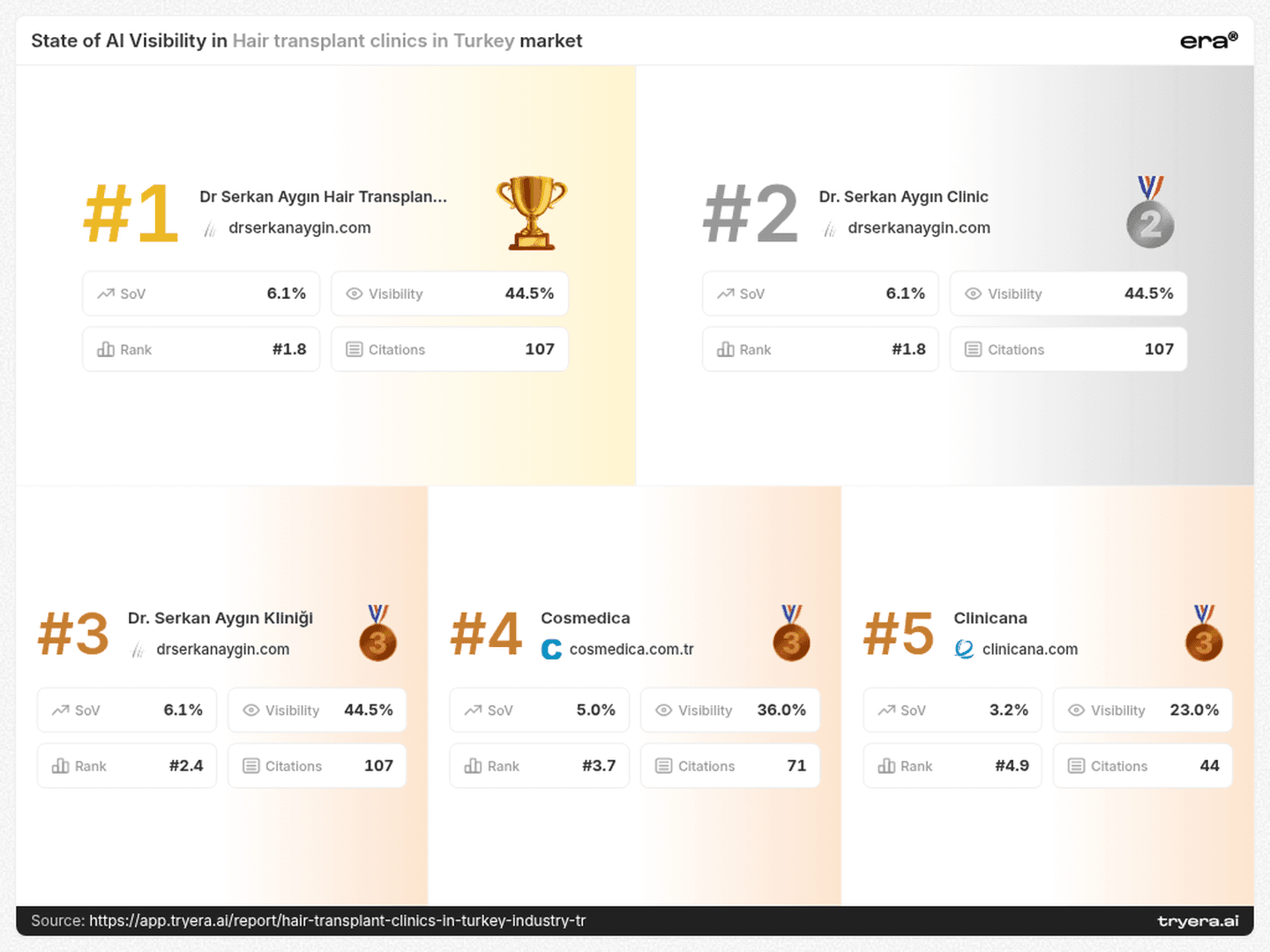
The first three podium cards use variants of Dr. Serkan Aygin’s name and link to drserkanaygin.com. Each shows 44.5% Visibility, 6.1% Share of Voice and 107 citations. Their reported average ranks are 1.8, 1.8 and 2.4.
These are repeated brand labels to reconcile, not three independent competitors. Adding their percentages would create a combined result without establishing whether the underlying mentions overlap.
Cosmedica appears fourth on the podium with 36% Visibility and an average rank of 3.7. Clinicana appears fifth with 23% Visibility and an average rank of 4.9. The five cards therefore represent three distinct domains.
The Share of Voice chart tells a different story: Smile Hair Clinic leads at 12.5%, followed by ASMED Surgical Medical Center at 10.1%, Vera Clinic at 8.6% and Hermest Hair Clinic at 8.3%.
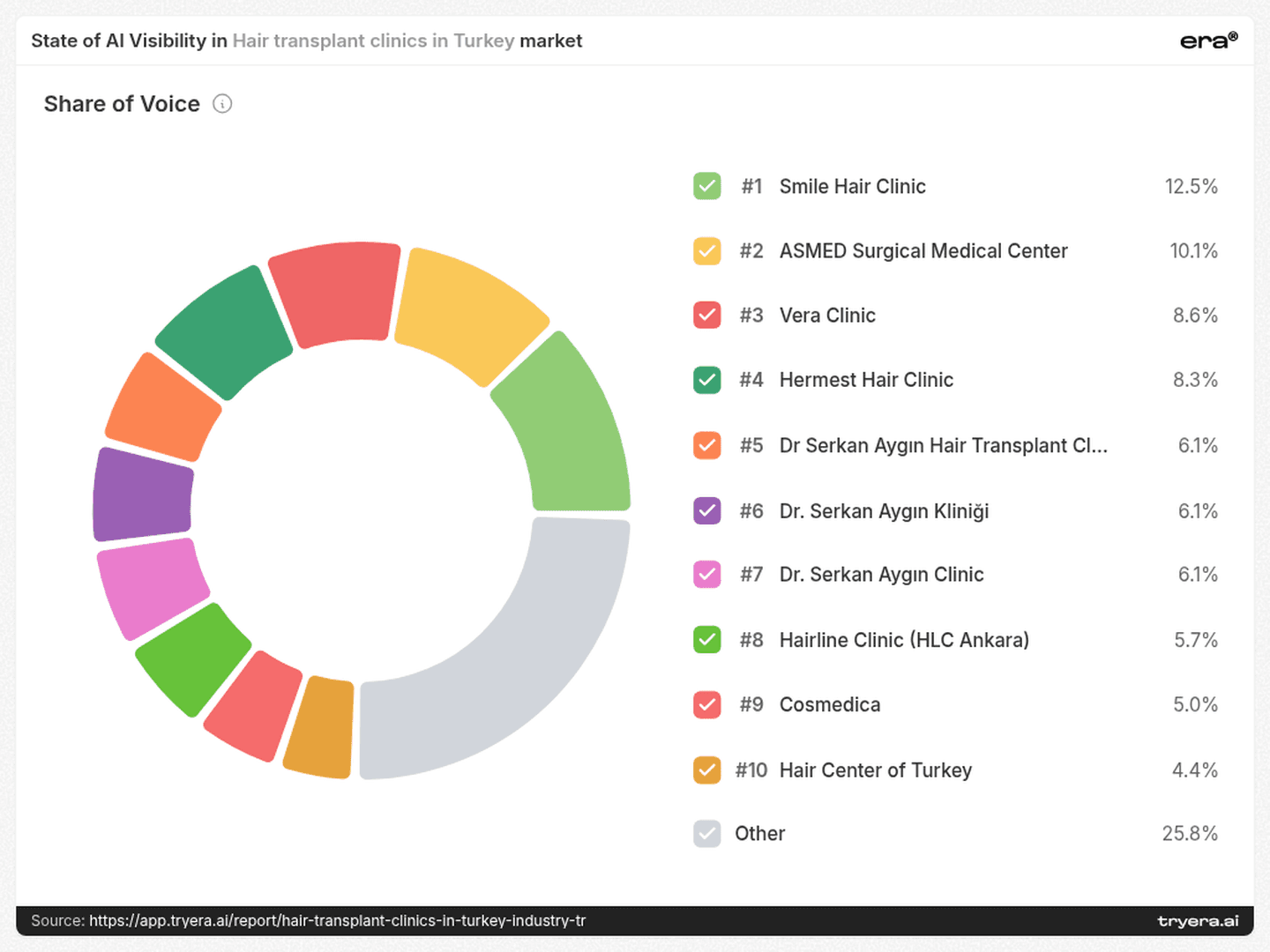
Visibility measures how often a brand appears in monitored answers. Share of Voice measures its share of mentions across tracked brands. Podium placement is another displayed ordering. Treating all three as the same ranking would misidentify whom to investigate.
For a clinic building its comparison set, the immediate task is to reconcile aliases and keep the SoV leaders in scope even when they are absent from the podium. These are measures of AI presence, not clinical quality or patient acquisition.
Before comparing winners, make sure the names and metrics describe the same contest.
2. Provider differences — A strong average can hide a missing channel
Cosmedica records 72% Visibility in ChatGPT, compared with 70% for Dr. Serkan Aygin Clinic. On Google AI, the comparison reverses: 14% versus 42%. Both show 16% in Claude.
That makes Cosmedica’s position more specific than a single overall score suggests: it is slightly ahead in this ChatGPT comparison, while the Google AI gap points in the other direction.
Clinicana has an even sharper split: 58% in ChatGPT, 32% in Perplexity, 2% in Google AI and 0% in Claude. A review restricted to ChatGPT would miss much of the problem worth investigating.
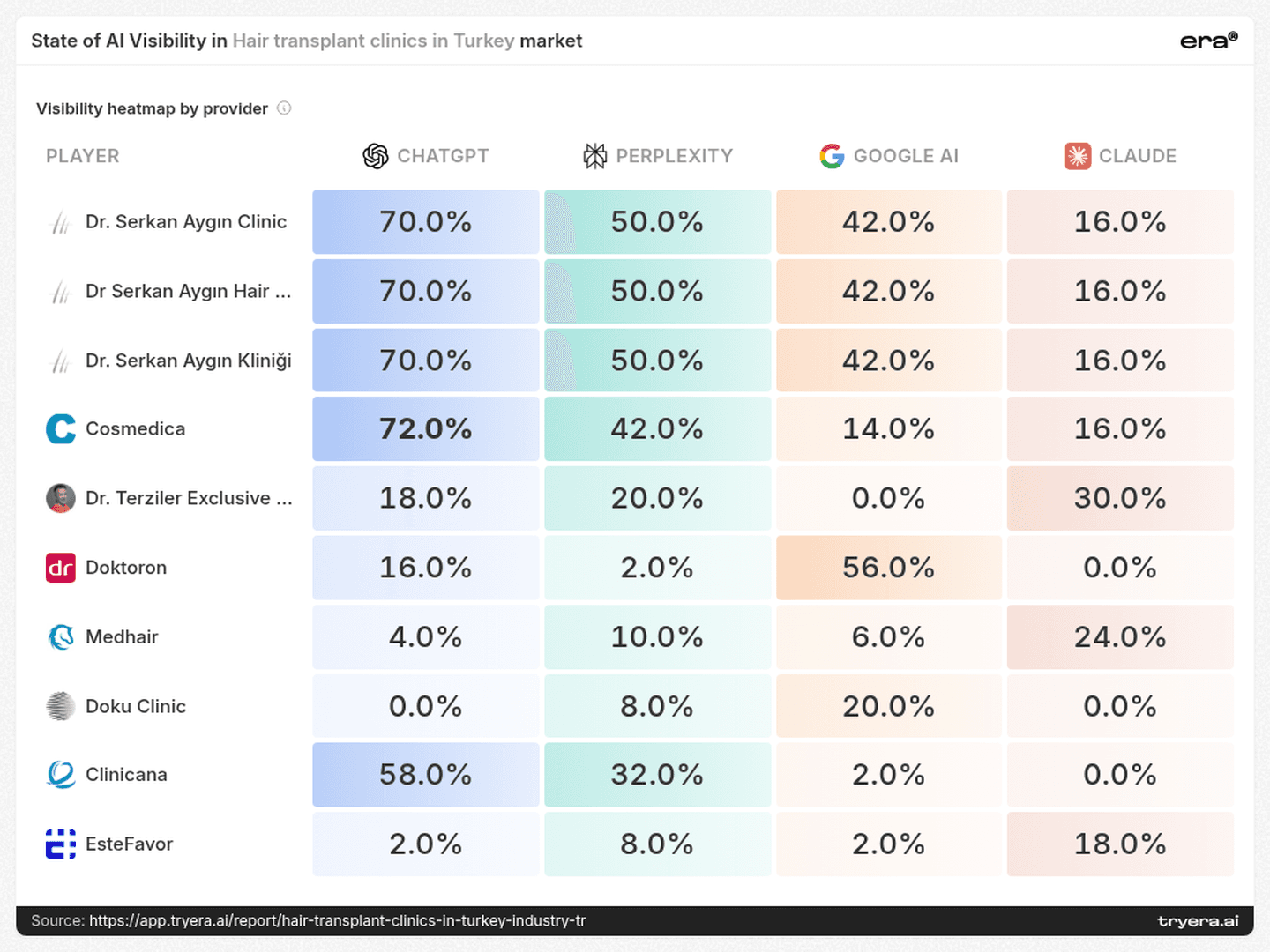
The pattern also changes outside the podium. Doktoron reaches 56% on Google AI and 0% on Claude. Dr. Terziler Exclusive Clinic shows 0% and 30%, respectively. Medhair reaches 24% on Claude, against 4% on ChatGPT.
These are report-wide provider results. They identify where to inspect answers and cited evidence next; they do not establish why a brand appears or disappears. A productive review would compare matched prompts across engines, recording the wording, named providers and sources for each answer.
3. Buyer intent — Packages, prices and comparisons require different evidence
The top-query table associates Dr. Serkan Aygin’s name variants, Cosmedica and Clinicana with “Türkiye saç ekimi yabancı hastalar paket klinik”: a query about Turkish hair transplant clinic packages for foreign patients.
That gives these brands a shared question to investigate. It does not make their provider percentages results for that particular query.
Doktoron and Doku Clinic share “İstanbul saç ekimi fiyatları 2026 klinik”, a price-oriented Istanbul clinic query. Dr. Terziler Exclusive Clinic and Medhair share “Türkiye en iyi saç ekim klinikleri”, a best-clinics comparison query. EsteFavor is associated with “Istanbul saç ekim merkezleri fiyat memnuniyet karşılaştırması”, combining price and satisfaction comparison.
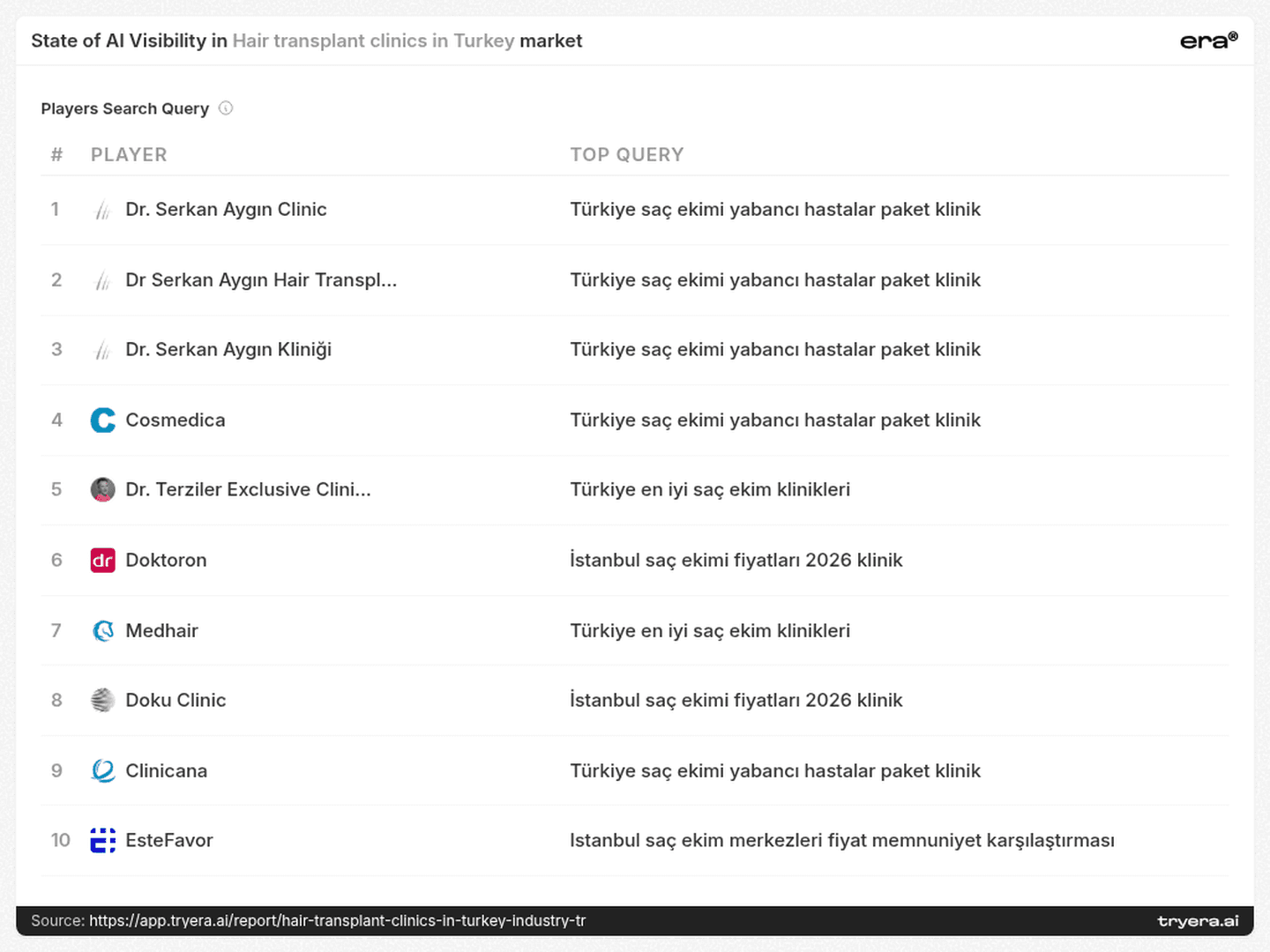
These are different editorial assignments:
Package questions: make inclusions, exclusions, travel arrangements, language support and follow-up responsibilities explicit.
Price questions: explain what a quote covers, what changes the price and when the information was updated.
Comparison questions: provide verifiable information about clinicians, responsibilities and how outcome claims are documented.
Price-and-satisfaction questions: distinguish service experience, price transparency and clinical outcome claims instead of combining them into one promotional score.
For a clinic deciding where it could appear, the starting point is the patient’s decision and the evidence needed to answer it. The next test should ask whether that evidence is present, accessible and accurately represented in AI answers.
4. Sources — The competitive field includes the pages that describe clinics
Doktoron appears in two different roles in the report: as a tracked player and as a cited source domain. The domain table lists doktoron.com with 97 citations, ishrs.org with 91, medikalakademi.com.tr with 86, and reddit.com with 55. The clinic domain drserkanaygin.com records 50 in that table.
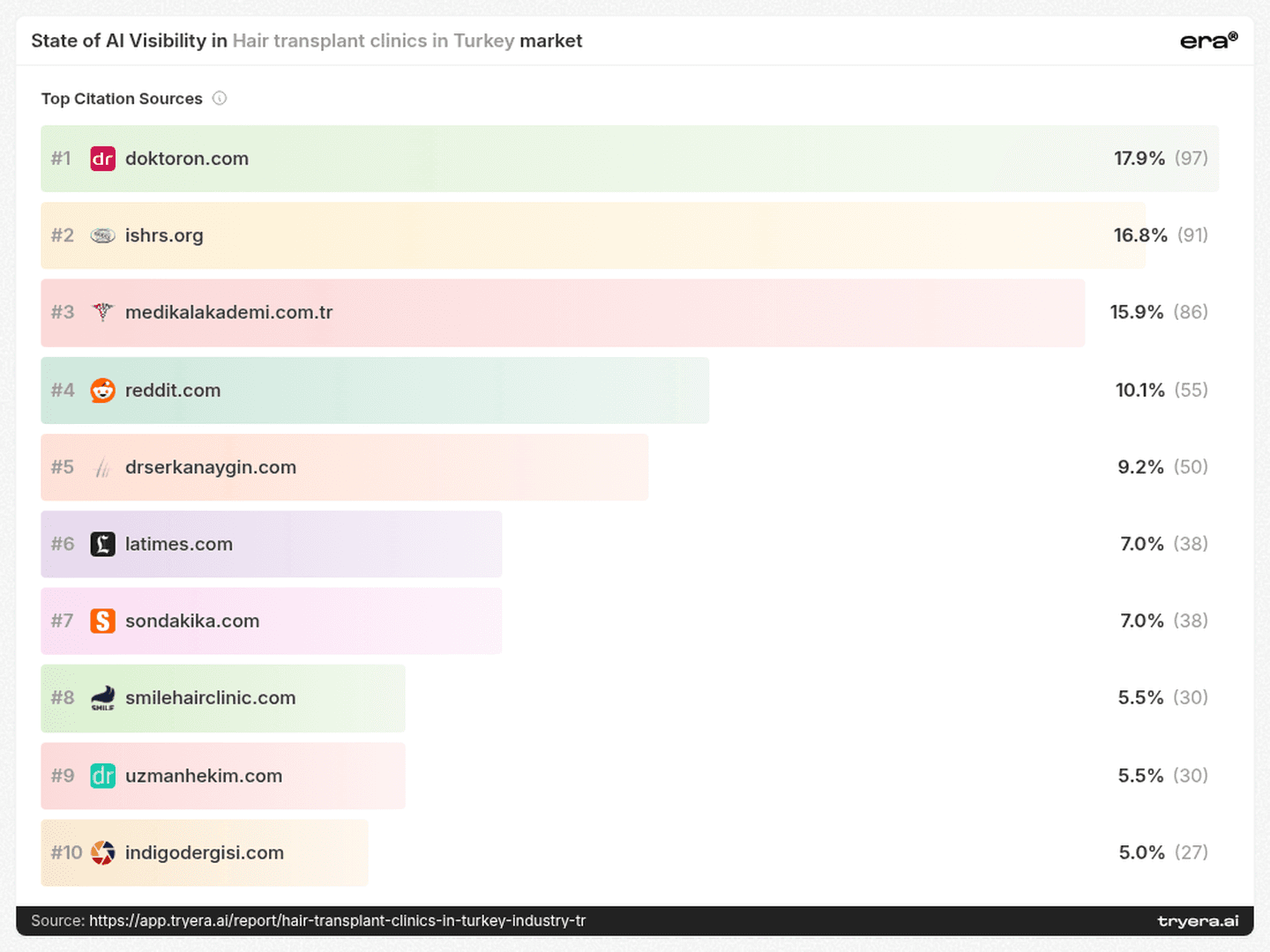
This creates a second competitive task: examining who supplies the information used in answers. A clinic can review its own pages while overlooking the comparison pages, discussions and other sources through which it is described.
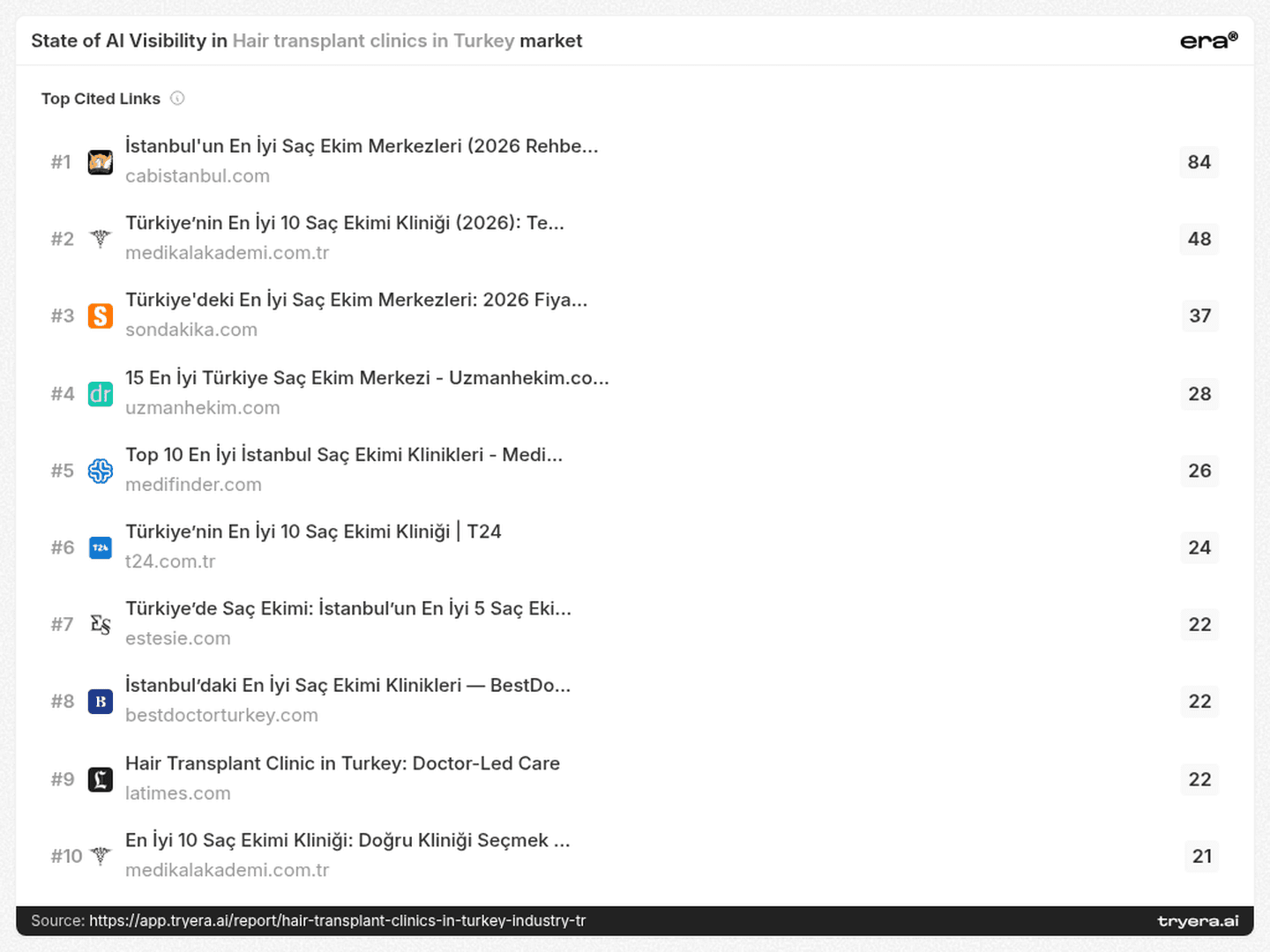
The cited-links table makes comparison content especially visible. Its leading entry is a cabistanbul.com page with an Istanbul best-clinics title and 84 citations. A medikalakademi.com.tr best-clinics entry follows with 48. Another listed page, on latimes.com, is titled “Hair Transplant Clinic in Turkey: Doctor-Led Care” and records 22.
For the pages that mention a clinic, inspect the actual description, selection criteria, update history and commercial disclosures. A publication name alone does not establish editorial independence, and a citation does not establish endorsement.
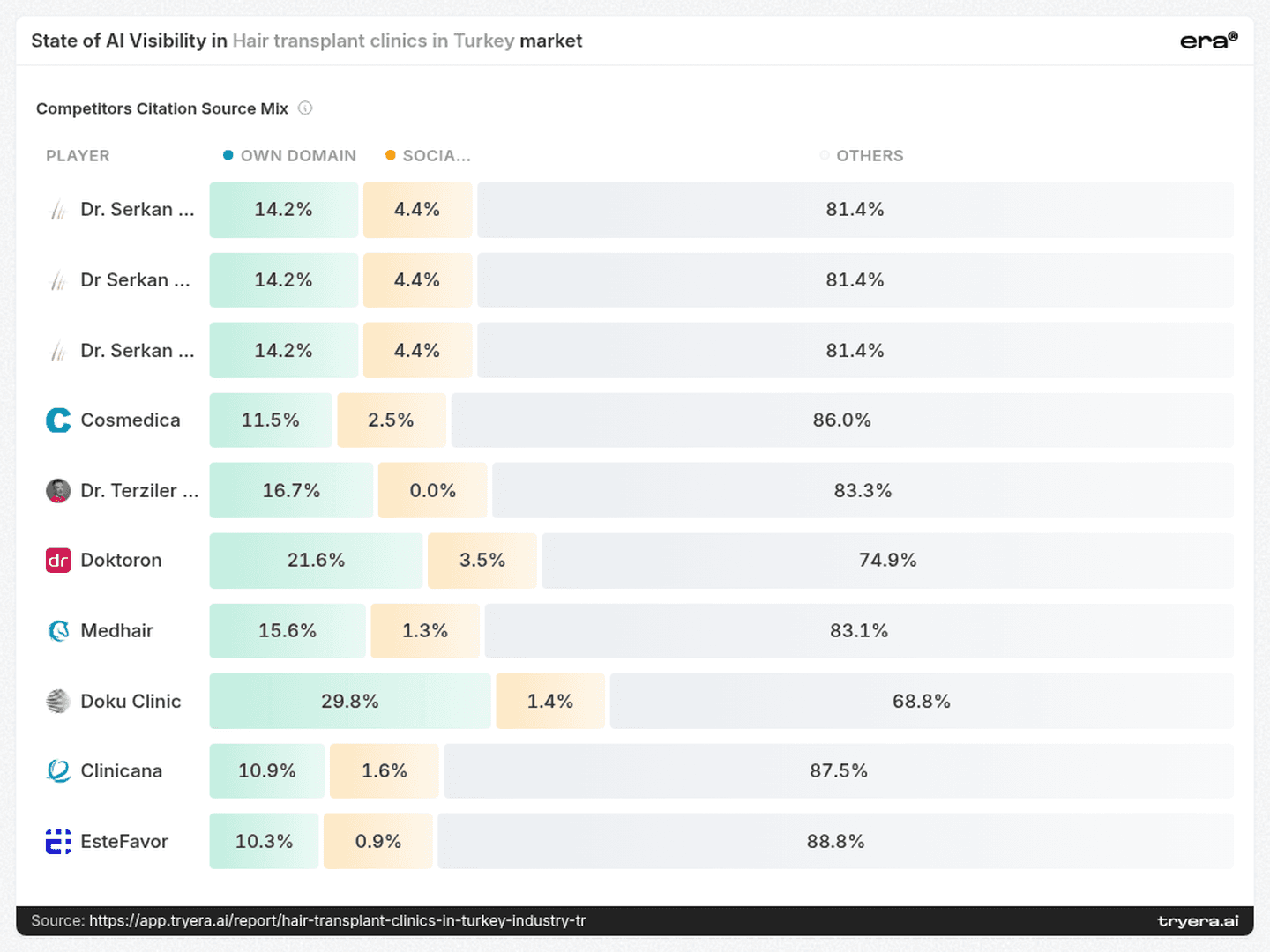
The citation-mix table reinforces the need to examine sources beyond the clinic website. The “Others” category accounts for 86% for Cosmedica, 87.5% for Clinicana and 88.8% for EsteFavor. Doku Clinic has a larger own-domain share, 29.8%, alongside 68.8% Others and 1.4% social.
“Others” should not be read as “independent validation.” It is a source category whose contents need inspection. The practical priority is to map which claims come from owned pages and which are repeated elsewhere, then check their accuracy and support.
Being mentioned, being cited and being independently corroborated are three different things.
5. Technical readiness — Fix access and clarity without inventing a ranking formula
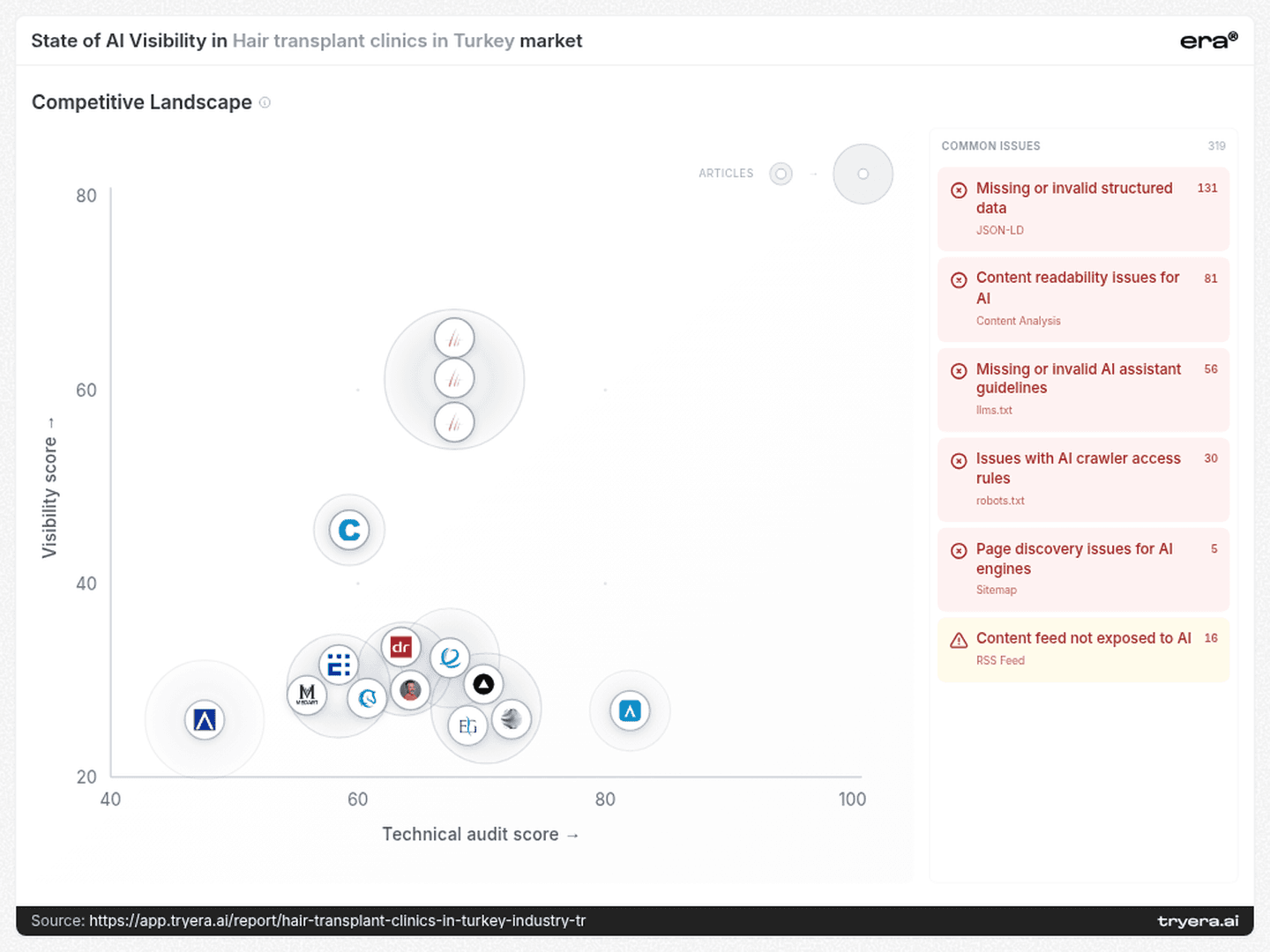
The competitive-landscape export lists 319 common issues. These include 131 structured-data issues, 81 AI readability issues, 30 crawler-access issues and 5 sitemap issues. It also records 56 findings concerning AI assistant guidelines and 16 concerning content feeds.
For a clinic, those categories suggest a practical sequence: check whether important pages can be reached, whether their key information is readable, and whether structured information accurately describes the organisation and its content.
The aggregate counts do not assign a particular issue to a particular clinic. Start with a site-specific check before creating a remediation backlog. Prioritise verified access and content problems; assess other checklist items on their merits rather than treating every flag as an equally important cause of low visibility.
6. Backlinks — A large footprint is a separate diagnostic
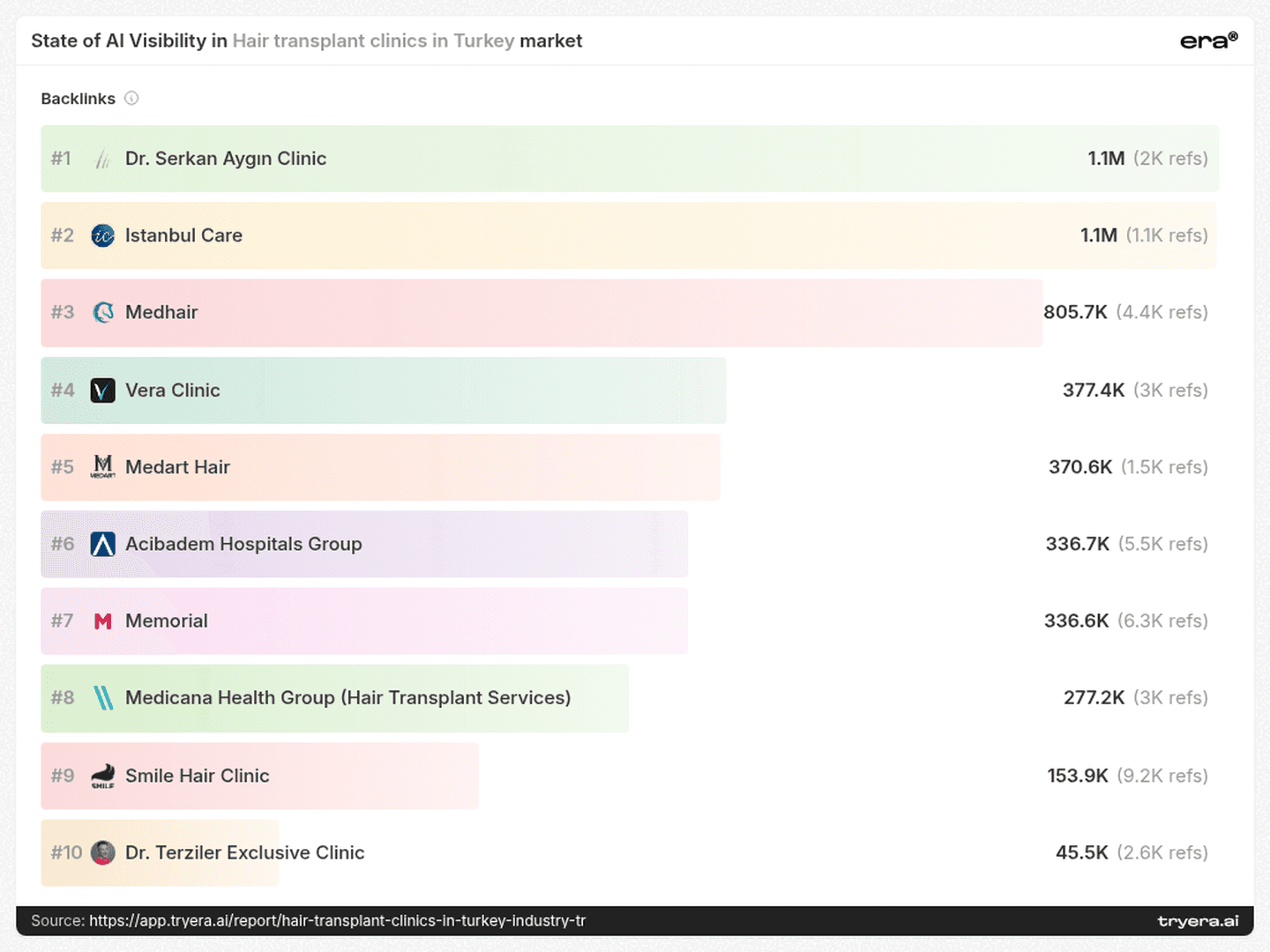
The backlinks export lists 805.7K for Medhair and 370.6K for Medart Hair. Smile Hair Clinic records 153.9K. Separately, Smile leads the displayed Share of Voice chart, while the Other Players table shows 11% Visibility for Medhair and 4% for Medart Hair.
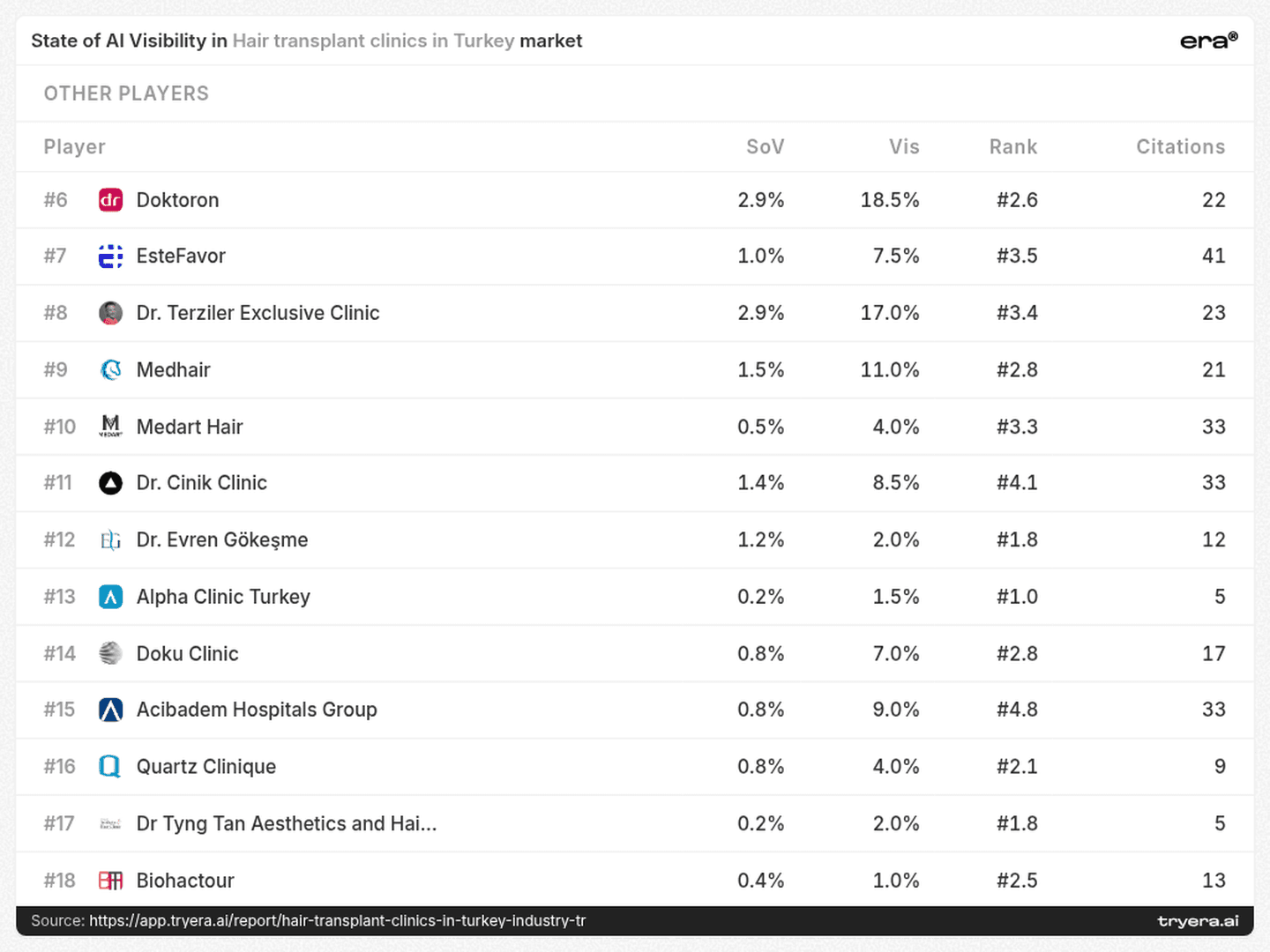
The backlink export and AI metrics are separate measurements, not a controlled test. Their juxtaposition gives a useful question for investigation: does the linked material provide evidence relevant to the patient questions being monitored?
For Medhair and Medart Hair, inspect the linked destination pages and their relevance to comparison, price and package questions. Raw link volume alone cannot explain whether an engine can find and use the information needed for a specific answer.
7. Beyond the leaders — Eight brands, four different investigations
The wider player table suggests several distinct starting points. Lower overall visibility should lead to a more precise investigation, not an automatic prescription to publish more content.
Alpha Clinic Turkey, Quartz Clinique and Biohactour: inspect the appearances first. Alpha records 1.5% Visibility and an average rank of 1.0; Quartz 4% and 2.1; Biohactour 1% and 2.5. They appear infrequently overall, but their reported positions warrant examining the answers where they do appear. Identify the query, context and source before testing adjacent intents. A favourable average across rare appearances is not broad coverage.
Medart Hair and Dr. Cinik Clinic: separate citation activity from mention coverage. Both record 33 player citations, while their Visibility differs: 4% for Medart Hair and 8.5% for Dr. Cinik Clinic. Their average ranks are 3.3 and 4.1. Inspect whether cited pages and brand mentions occur in the same answers, and whether those answers address the clinic’s priority patient questions. Equal citation counts do not imply equal presence.
Acibadem Hospitals Group: examine the context around later mentions. Its 9% Visibility and average rank of 4.8 suggest reviewing both missing appearances and the wording of existing ones. Check whether answers discuss hair transplantation specifically or a broader hospital context, then assess whether the relevant service evidence is sufficiently explicit.
Doku Clinic and EsteFavor: investigate opposite provider concentrations. Doku shows 20% Visibility on Google AI, 8% on Perplexity, and 0% on both ChatGPT and Claude. EsteFavor reaches 18% on Claude, 8% on Perplexity, and 2% on both ChatGPT and Google AI.
Their next checks should differ. Doku’s team could compare its price-query evidence across Google AI and ChatGPT. EsteFavor’s team could investigate which price-and-satisfaction comparisons appear on Claude and then test the same questions elsewhere. Those are proposed query-level investigations based on the top-query associations and report-wide profiles, not measured query-specific outcomes.
8. The next 90 days — Turn the differences into testable work
Days 1–30: establish the comparison. Reconcile the Dr. Serkan Aygin aliases without summing overlapping results. Build separate views for brand mentions, position and source citations. Review matched package, price, best-clinic and satisfaction-comparison prompts across engines. Include the SoV leaders and selected non-podium players in the comparison set.
Days 31–60: repair the evidence that the review identifies. Check package and pricing pages for missing decision information. Inspect the cited comparison pages that actually mention the clinic and document inaccurate or unsupported descriptions. Validate crawler access, discovery and structured information on the specific pages involved. Record each change and the question it is intended to answer.
Days 61–90: repeat the same questions and inspect the answers. Compare appearances and sources across engines using the same prompt set. Keep brand mentions, citations and position separate. Test adjacent intents only after understanding existing appearances, particularly for brands such as Alpha Clinic Turkey and Quartz Clinique. Record unchanged results as well as improvements; neither a content update nor a technical fix guarantees a visibility gain.
The useful output is a documented set of answers: where the clinic appears, which questions it covers, what evidence is cited and which gaps remain.
Want this scoreboard for your own brand? Run a free audit at tryera.ai/free-report — 30 minutes, your numbers, no deck required.
Full report with source data: Hair transplant clinics in Turkey.



For a hair transplant clinic, appearing in an AI answer can put its name into a patient’s research process. The commercial question is which decisions that appearance supports: comparing clinics, understanding prices or evaluating a package for treatment abroad. Era’s report on hair transplant clinics in Turkey examines brand visibility, share of mentions, position, provider differences and cited sources. Its results describe several competitive situations, from repeated brand labels to pronounced differences between engines. Reading those metrics separately produces a more useful agenda: establish the right competitors, inspect the questions where they appear and check the evidence behind the answers.
The first competitive decision is deciding what counts as a competitor.
In Era’s report on hair transplant clinics in Turkey, three podium positions point to the same domain, the Share of Voice chart names a different leader, and the provider heatmap changes several head-to-head comparisons. A useful strategy starts by separating those signals.
1. The leaderboard — Three podium places, one domain
The first three podium cards use variants of Dr. Serkan Aygin’s name and link to drserkanaygin.com. Each shows 44.5% Visibility, 6.1% Share of Voice and 107 citations. Their reported average ranks are 1.8, 1.8 and 2.4.
These are repeated brand labels to reconcile, not three independent competitors. Adding their percentages would create a combined result without establishing whether the underlying mentions overlap.
Cosmedica appears fourth on the podium with 36% Visibility and an average rank of 3.7. Clinicana appears fifth with 23% Visibility and an average rank of 4.9. The five cards therefore represent three distinct domains.
The Share of Voice chart tells a different story: Smile Hair Clinic leads at 12.5%, followed by ASMED Surgical Medical Center at 10.1%, Vera Clinic at 8.6% and Hermest Hair Clinic at 8.3%.
Visibility measures how often a brand appears in monitored answers. Share of Voice measures its share of mentions across tracked brands. Podium placement is another displayed ordering. Treating all three as the same ranking would misidentify whom to investigate.
For a clinic building its comparison set, the immediate task is to reconcile aliases and keep the SoV leaders in scope even when they are absent from the podium. These are measures of AI presence, not clinical quality or patient acquisition.
Before comparing winners, make sure the names and metrics describe the same contest.
2. Provider differences — A strong average can hide a missing channel
Cosmedica records 72% Visibility in ChatGPT, compared with 70% for Dr. Serkan Aygin Clinic. On Google AI, the comparison reverses: 14% versus 42%. Both show 16% in Claude.
That makes Cosmedica’s position more specific than a single overall score suggests: it is slightly ahead in this ChatGPT comparison, while the Google AI gap points in the other direction.
Clinicana has an even sharper split: 58% in ChatGPT, 32% in Perplexity, 2% in Google AI and 0% in Claude. A review restricted to ChatGPT would miss much of the problem worth investigating.
The pattern also changes outside the podium. Doktoron reaches 56% on Google AI and 0% on Claude. Dr. Terziler Exclusive Clinic shows 0% and 30%, respectively. Medhair reaches 24% on Claude, against 4% on ChatGPT.
These are report-wide provider results. They identify where to inspect answers and cited evidence next; they do not establish why a brand appears or disappears. A productive review would compare matched prompts across engines, recording the wording, named providers and sources for each answer.
3. Buyer intent — Packages, prices and comparisons require different evidence
The top-query table associates Dr. Serkan Aygin’s name variants, Cosmedica and Clinicana with “Türkiye saç ekimi yabancı hastalar paket klinik”: a query about Turkish hair transplant clinic packages for foreign patients.
That gives these brands a shared question to investigate. It does not make their provider percentages results for that particular query.
Doktoron and Doku Clinic share “İstanbul saç ekimi fiyatları 2026 klinik”, a price-oriented Istanbul clinic query. Dr. Terziler Exclusive Clinic and Medhair share “Türkiye en iyi saç ekim klinikleri”, a best-clinics comparison query. EsteFavor is associated with “Istanbul saç ekim merkezleri fiyat memnuniyet karşılaştırması”, combining price and satisfaction comparison.
These are different editorial assignments:
Package questions: make inclusions, exclusions, travel arrangements, language support and follow-up responsibilities explicit.
Price questions: explain what a quote covers, what changes the price and when the information was updated.
Comparison questions: provide verifiable information about clinicians, responsibilities and how outcome claims are documented.
Price-and-satisfaction questions: distinguish service experience, price transparency and clinical outcome claims instead of combining them into one promotional score.
For a clinic deciding where it could appear, the starting point is the patient’s decision and the evidence needed to answer it. The next test should ask whether that evidence is present, accessible and accurately represented in AI answers.
4. Sources — The competitive field includes the pages that describe clinics
Doktoron appears in two different roles in the report: as a tracked player and as a cited source domain. The domain table lists doktoron.com with 97 citations, ishrs.org with 91, medikalakademi.com.tr with 86, and reddit.com with 55. The clinic domain drserkanaygin.com records 50 in that table.
This creates a second competitive task: examining who supplies the information used in answers. A clinic can review its own pages while overlooking the comparison pages, discussions and other sources through which it is described.
The cited-links table makes comparison content especially visible. Its leading entry is a cabistanbul.com page with an Istanbul best-clinics title and 84 citations. A medikalakademi.com.tr best-clinics entry follows with 48. Another listed page, on latimes.com, is titled “Hair Transplant Clinic in Turkey: Doctor-Led Care” and records 22.
For the pages that mention a clinic, inspect the actual description, selection criteria, update history and commercial disclosures. A publication name alone does not establish editorial independence, and a citation does not establish endorsement.
The citation-mix table reinforces the need to examine sources beyond the clinic website. The “Others” category accounts for 86% for Cosmedica, 87.5% for Clinicana and 88.8% for EsteFavor. Doku Clinic has a larger own-domain share, 29.8%, alongside 68.8% Others and 1.4% social.
“Others” should not be read as “independent validation.” It is a source category whose contents need inspection. The practical priority is to map which claims come from owned pages and which are repeated elsewhere, then check their accuracy and support.
Being mentioned, being cited and being independently corroborated are three different things.
5. Technical readiness — Fix access and clarity without inventing a ranking formula
The competitive-landscape export lists 319 common issues. These include 131 structured-data issues, 81 AI readability issues, 30 crawler-access issues and 5 sitemap issues. It also records 56 findings concerning AI assistant guidelines and 16 concerning content feeds.
For a clinic, those categories suggest a practical sequence: check whether important pages can be reached, whether their key information is readable, and whether structured information accurately describes the organisation and its content.
The aggregate counts do not assign a particular issue to a particular clinic. Start with a site-specific check before creating a remediation backlog. Prioritise verified access and content problems; assess other checklist items on their merits rather than treating every flag as an equally important cause of low visibility.
6. Backlinks — A large footprint is a separate diagnostic
The backlinks export lists 805.7K for Medhair and 370.6K for Medart Hair. Smile Hair Clinic records 153.9K. Separately, Smile leads the displayed Share of Voice chart, while the Other Players table shows 11% Visibility for Medhair and 4% for Medart Hair.
The backlink export and AI metrics are separate measurements, not a controlled test. Their juxtaposition gives a useful question for investigation: does the linked material provide evidence relevant to the patient questions being monitored?
For Medhair and Medart Hair, inspect the linked destination pages and their relevance to comparison, price and package questions. Raw link volume alone cannot explain whether an engine can find and use the information needed for a specific answer.
7. Beyond the leaders — Eight brands, four different investigations
The wider player table suggests several distinct starting points. Lower overall visibility should lead to a more precise investigation, not an automatic prescription to publish more content.
Alpha Clinic Turkey, Quartz Clinique and Biohactour: inspect the appearances first. Alpha records 1.5% Visibility and an average rank of 1.0; Quartz 4% and 2.1; Biohactour 1% and 2.5. They appear infrequently overall, but their reported positions warrant examining the answers where they do appear. Identify the query, context and source before testing adjacent intents. A favourable average across rare appearances is not broad coverage.
Medart Hair and Dr. Cinik Clinic: separate citation activity from mention coverage. Both record 33 player citations, while their Visibility differs: 4% for Medart Hair and 8.5% for Dr. Cinik Clinic. Their average ranks are 3.3 and 4.1. Inspect whether cited pages and brand mentions occur in the same answers, and whether those answers address the clinic’s priority patient questions. Equal citation counts do not imply equal presence.
Acibadem Hospitals Group: examine the context around later mentions. Its 9% Visibility and average rank of 4.8 suggest reviewing both missing appearances and the wording of existing ones. Check whether answers discuss hair transplantation specifically or a broader hospital context, then assess whether the relevant service evidence is sufficiently explicit.
Doku Clinic and EsteFavor: investigate opposite provider concentrations. Doku shows 20% Visibility on Google AI, 8% on Perplexity, and 0% on both ChatGPT and Claude. EsteFavor reaches 18% on Claude, 8% on Perplexity, and 2% on both ChatGPT and Google AI.
Their next checks should differ. Doku’s team could compare its price-query evidence across Google AI and ChatGPT. EsteFavor’s team could investigate which price-and-satisfaction comparisons appear on Claude and then test the same questions elsewhere. Those are proposed query-level investigations based on the top-query associations and report-wide profiles, not measured query-specific outcomes.
8. The next 90 days — Turn the differences into testable work
Days 1–30: establish the comparison. Reconcile the Dr. Serkan Aygin aliases without summing overlapping results. Build separate views for brand mentions, position and source citations. Review matched package, price, best-clinic and satisfaction-comparison prompts across engines. Include the SoV leaders and selected non-podium players in the comparison set.
Days 31–60: repair the evidence that the review identifies. Check package and pricing pages for missing decision information. Inspect the cited comparison pages that actually mention the clinic and document inaccurate or unsupported descriptions. Validate crawler access, discovery and structured information on the specific pages involved. Record each change and the question it is intended to answer.
Days 61–90: repeat the same questions and inspect the answers. Compare appearances and sources across engines using the same prompt set. Keep brand mentions, citations and position separate. Test adjacent intents only after understanding existing appearances, particularly for brands such as Alpha Clinic Turkey and Quartz Clinique. Record unchanged results as well as improvements; neither a content update nor a technical fix guarantees a visibility gain.
The useful output is a documented set of answers: where the clinic appears, which questions it covers, what evidence is cited and which gaps remain.
Want this scoreboard for your own brand? Run a free audit at tryera.ai/free-report — 30 minutes, your numbers, no deck required.
Full report with source data: Hair transplant clinics in Turkey.