September 12, 2026
September 12, 2026
How Crypto Hardware Wallets Rank in AI Search: Leaders, Provider Gaps and Buyer Intent
Ledger and Trezor lead overall AI visibility, but provider-level reversals, distinct buyer intents and cited comparison pages reveal a more complex competitive field for hardware-wallet brands.
Ledger and Trezor lead overall AI visibility, but provider-level reversals, distinct buyer intents and cited comparison pages reveal a more complex competitive field for hardware-wallet brands.
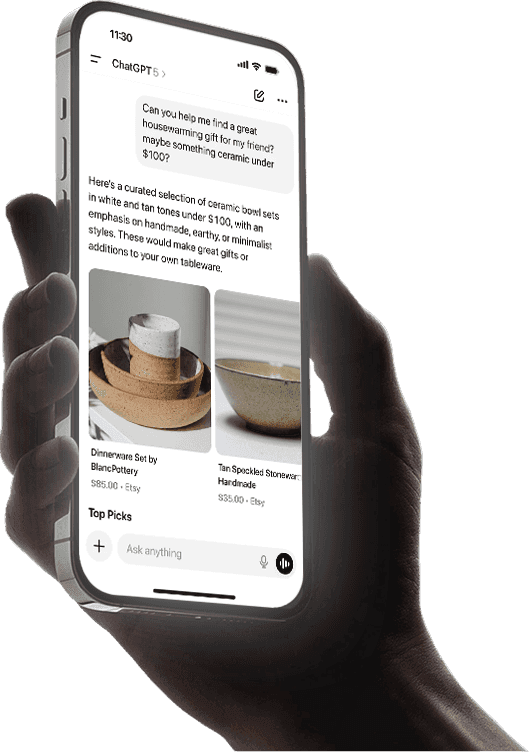
An AI answer can introduce a hardware wallet to a buyer before that buyer visits a product page. For teams responsible for discovery and education, the commercial question is where the brand enters that conversation—and what evidence accompanies it. Era’s hardware-wallet report examines brand presence, share of mentions, average position, provider differences, queries and citation sources. Reading those measures together reveals opportunities that a single league table can obscure.
Being mentioned almost everywhere still leaves most of the conversation to other names.
Ledger appears in 95.9% of monitored answers, yet its Share of Voice is 13.1%. The gap captures the central challenge for hardware-wallet marketing: a place in the answer is only the beginning. Buyers also encounter other brands, product names and comparison sources before deciding what deserves a closer look.
1. Presence — A familiar name can still share a crowded answer
Ledger leads the podium with 95.9% Visibility and an average Rank of 1.5. Trezor follows at 91.4% and 2.3. Tangem reaches 57.4%, with an average Rank of 3.4.
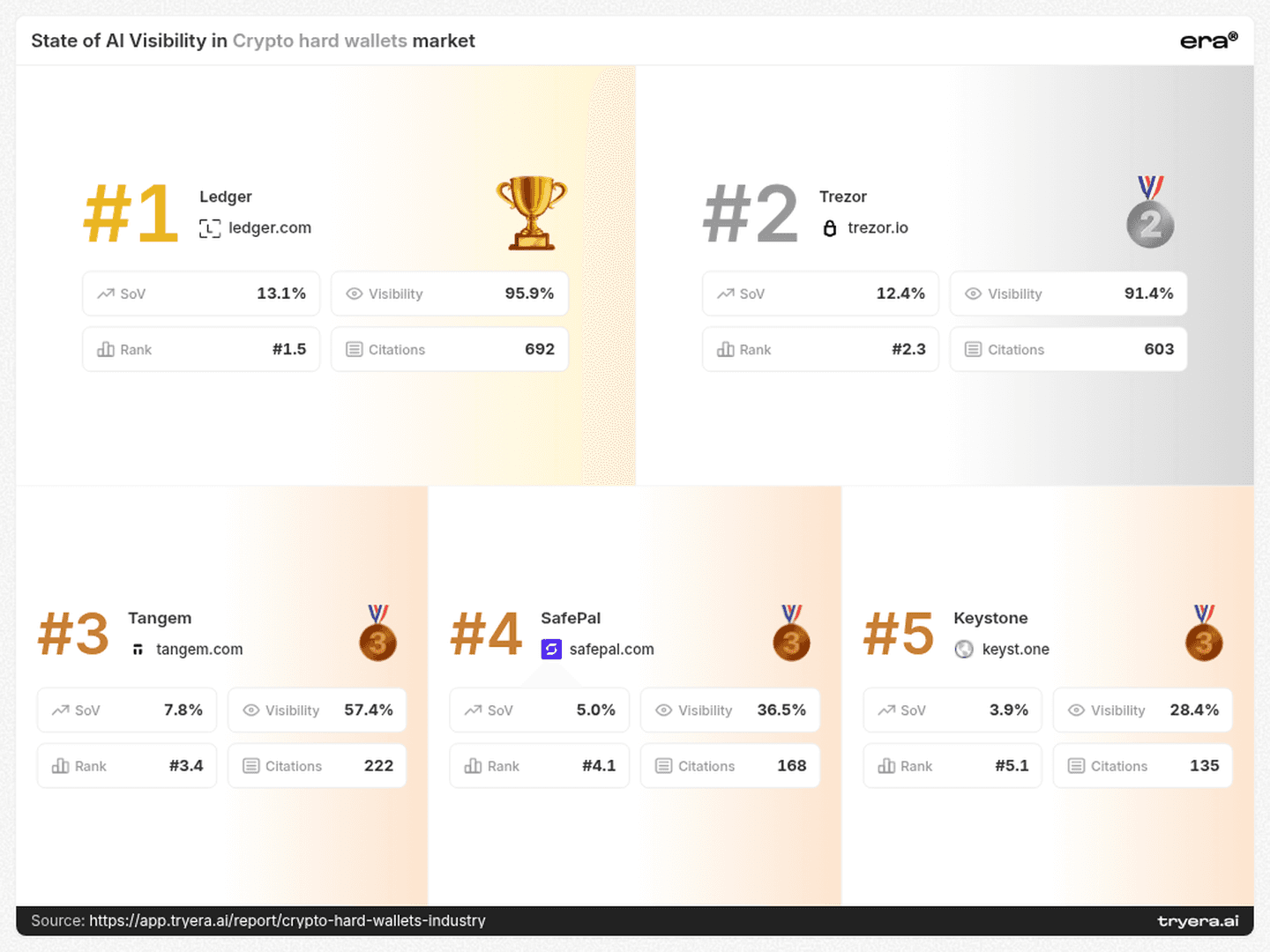
Visibility measures how often a name appears; Share of Voice measures its portion of tracked brand mentions. Neither is a measure of device sales or buyer preference. For Ledger and Trezor, appearing more often and being mentioned earlier are distinct advantages. For a challenger, the useful question is which buying decision earns it a place alongside them.
The Share of Voice table also contains Safe 3 at 6.6%, Safe 5 at 5.0% and Ledger Live at 4.8%, alongside brand names. That makes entity naming part of the competitive analysis. A company-level view and a product-level view answer different questions.
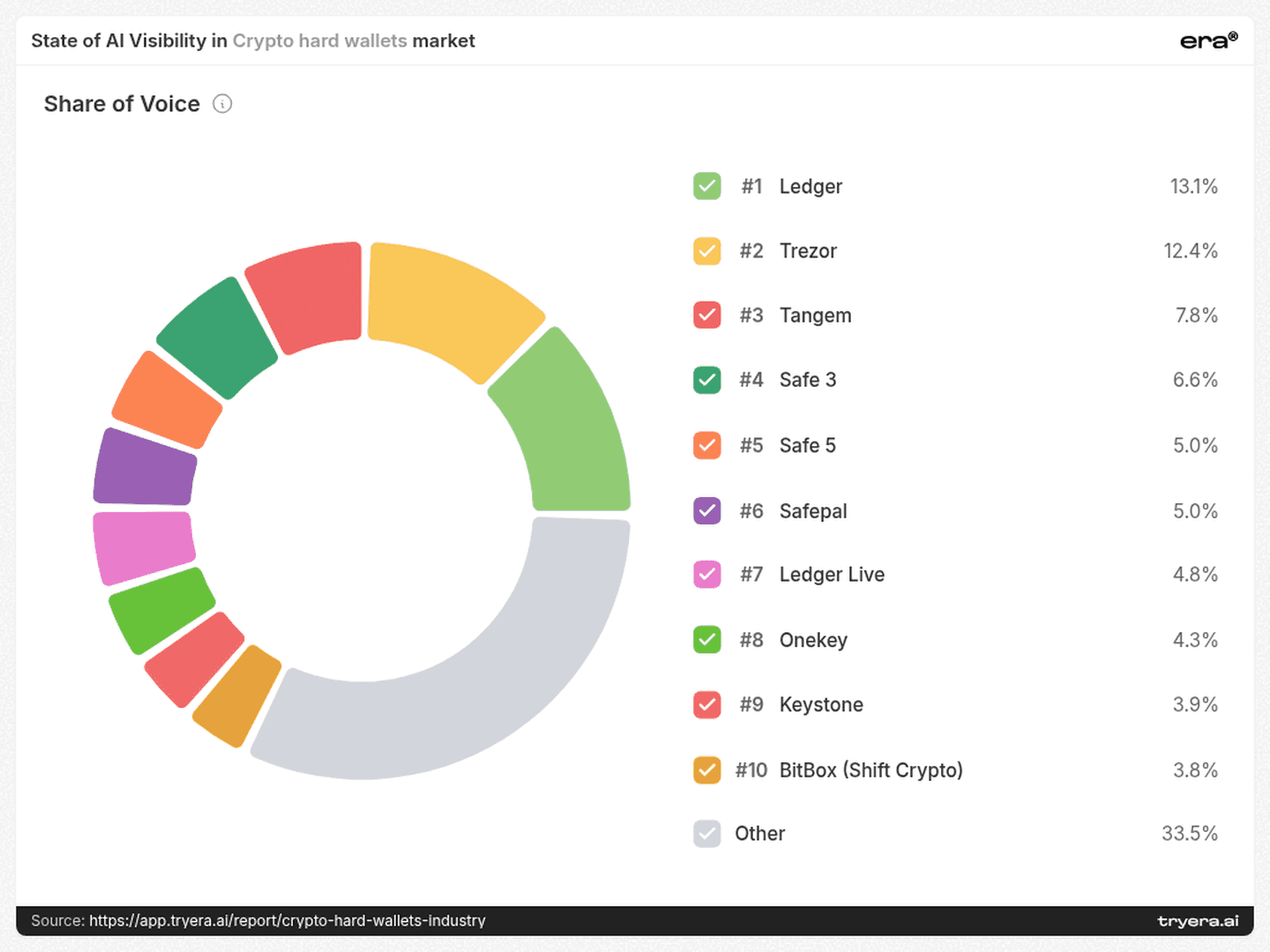
Keep those views separate when building a baseline. Adding related names without checking overlap can turn a naming convention into an apparent competitive gain.
A brand mention and a product mention should not silently become the same unit of competition.
2. Engines — The competitive order changes with the provider
Tangem has 78.0% Visibility on Perplexity and 20.0% on ChatGPT: a 58-percentage-point gap. Its Google AI and Claude results, 63.8% and 68.0%, show why a single overall figure can conceal a concentrated weakness.
The pattern is not identical for every challenger. Keystone reaches 42.0% on ChatGPT, ahead of Tangem’s 20.0%, but trails Tangem on Perplexity, 38.0% versus 78.0%.
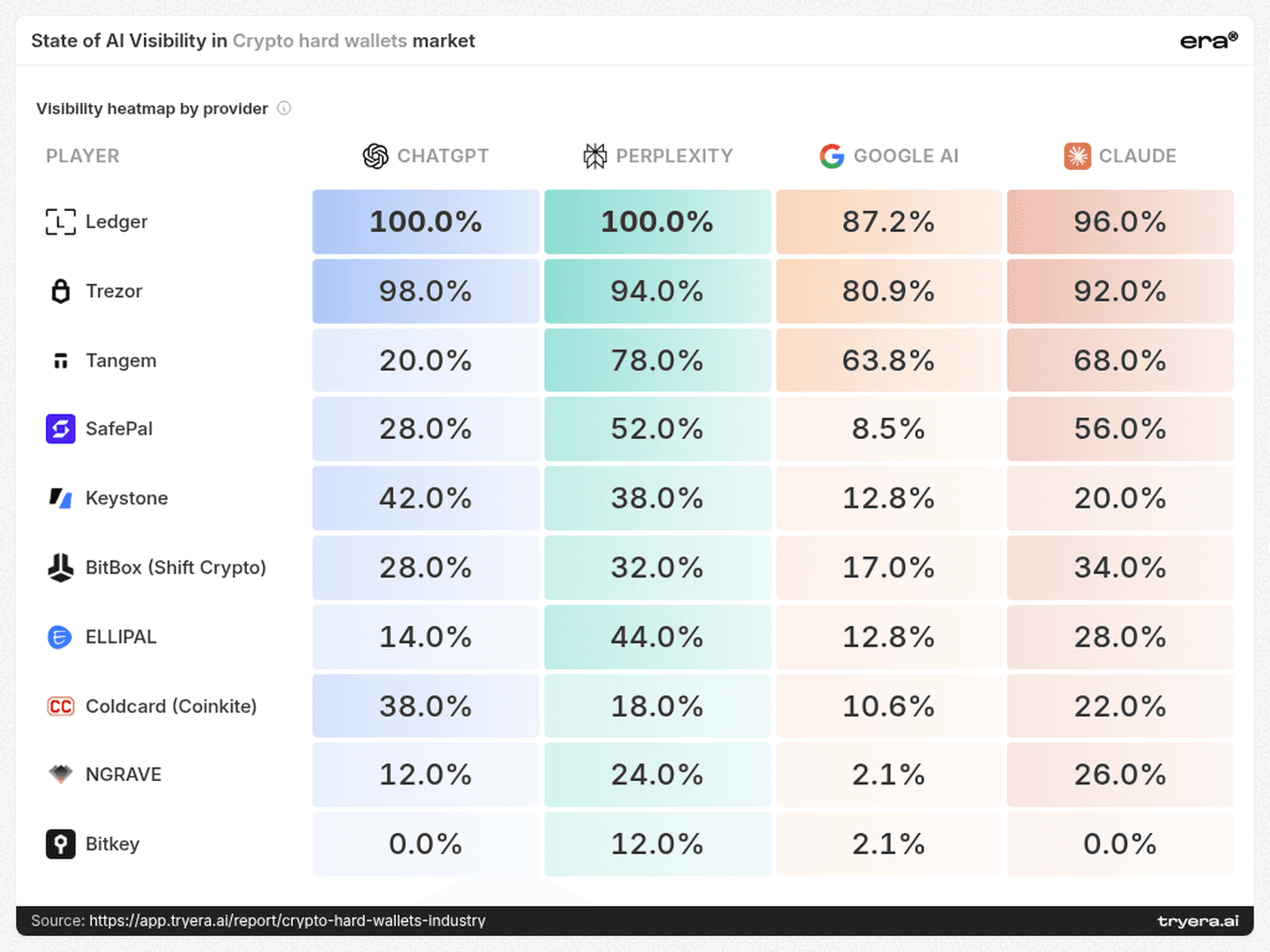
ELLIPAL and Coldcard offer another reversal. On ChatGPT, Coldcard records 38.0%, compared with ELLIPAL’s 14.0%. On Perplexity, ELLIPAL reaches 44.0%, compared with Coldcard’s 18.0%. A brand described as behind in one engine can be ahead in another.
For a marketing team, this suggests a paired audit: run the same buyer questions across providers, preserve the answers and compare the cited evidence. These are report-wide provider results; the next step is to locate the individual questions behind the gaps.
3. Intent — “Best,” “safest” and “beginner friendly” require different evidence
The top-query table associates Ledger, Trezor, Tangem, SafePal, Keystone and BitBox with “best crypto hardware wallets 2026.” ELLIPAL, Coldcard and NGRAVE share “safest hardware wallets 2026.” Bitkey is associated with “best beginner friendly hardware wallet 2026.”
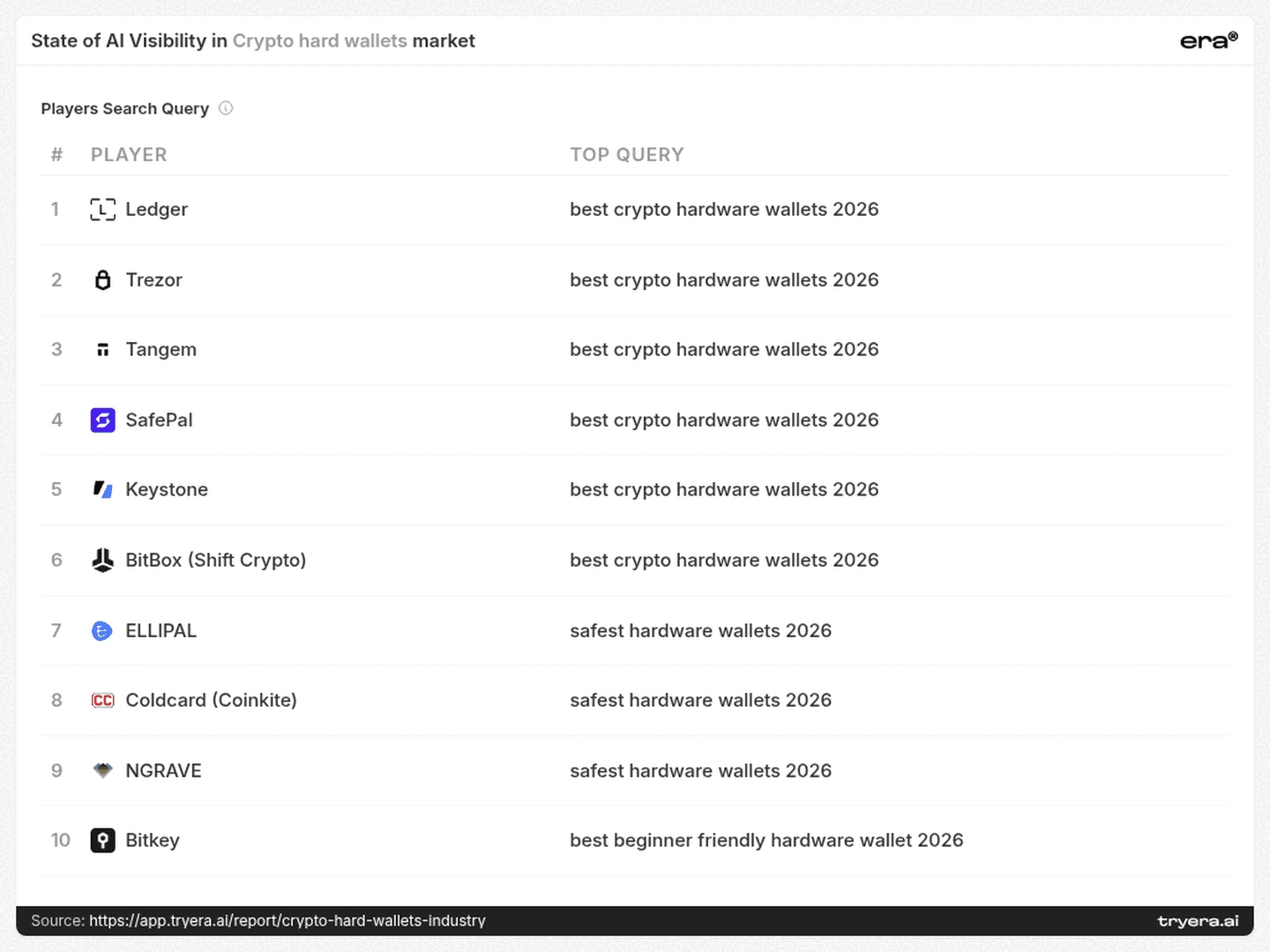
These associations suggest three editorial jobs. Broad comparisons need clear trade-offs. Safety questions need specific, inspectable evidence. Beginner questions need explanations of setup, recovery and what happens when something goes wrong.
ELLIPAL, Coldcard and NGRAVE therefore merit analysis beyond the podium: their shared safety-oriented query gives teams a concrete question to investigate. It does not establish that any of them wins that query or is safer than the others.
For the next research cycle, expand each intent into test questions. Under safety, investigate how answers discuss key generation, recovery and transaction verification. Under beginner friendliness, investigate first-use instructions and loss scenarios. Treat these as proposed tests, not additional queries measured in this report.
4. Position — Lower reach does not always mean a later mention
ELLIPAL has 24.9% Visibility and an average Rank of 4.2. BitBox has higher Visibility, 27.9%, but a later average Rank of 4.6. Coldcard reaches 22.3%, with Rank 4.3; NGRAVE reaches 16.2%, with Rank 4.5.

For ELLIPAL, the comparison suggests separating two objectives: appearing in more relevant answers and preserving an early position when it does appear. For BitBox, broader presence alone does not settle the question of prominence within those answers.
Inspect the wording around each mention before treating rank as recommendation quality. An early mention can serve different roles in a comparison. A useful review records whether the answer recommends a device, contrasts it with another option or raises a limitation.
5. Sources — Comparison coverage belongs in the visibility audit
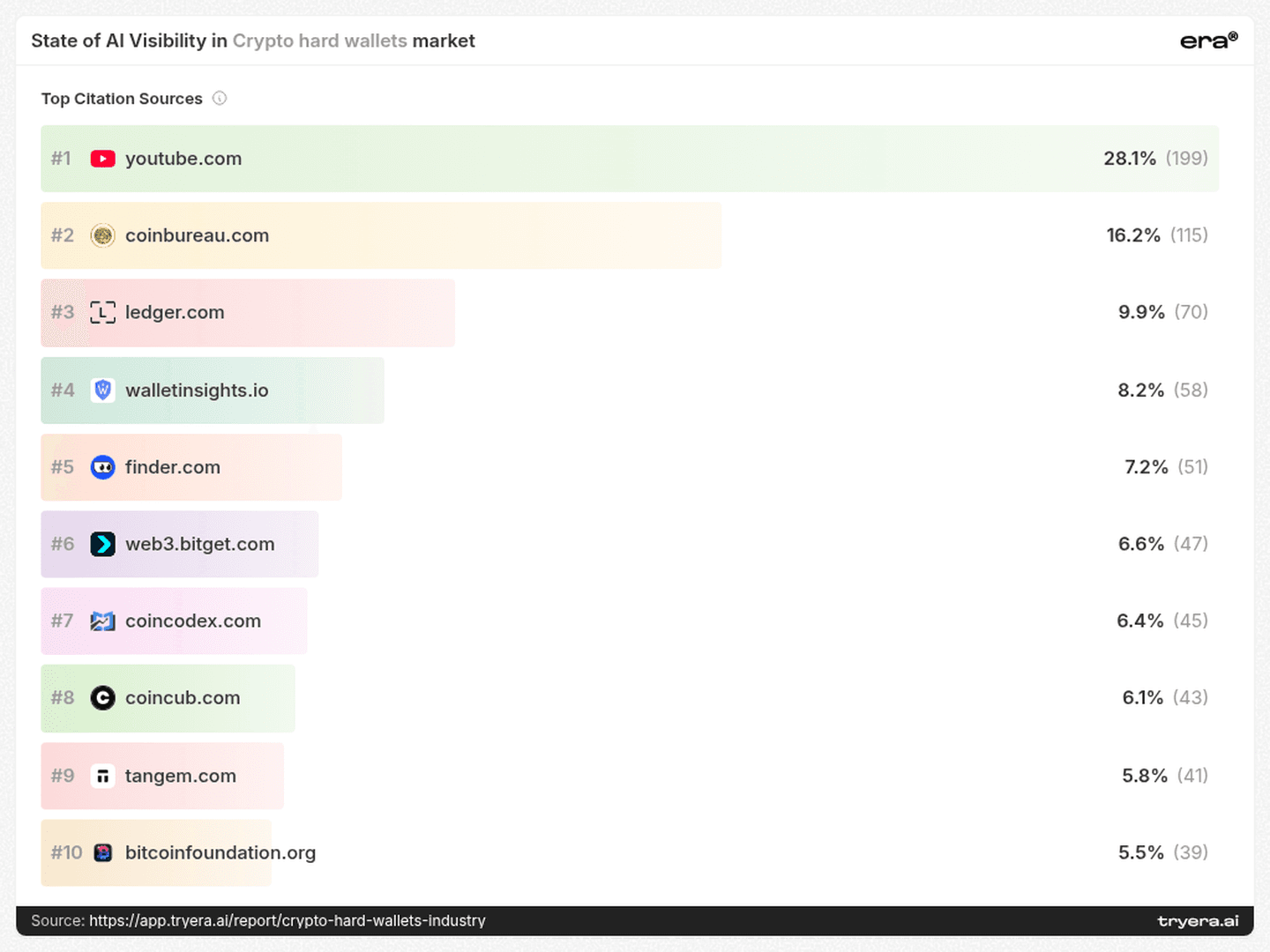
YouTube leads the displayed citation-source table with 199, followed by Coin Bureau with 115. Vendor domains also appear: ledger.com records 70, tangem.com 41, and web3.bitget.com 47.
The cited-links table adds a more specific editorial signal. Its leading Coin Bureau hardware-wallet comparison records 75; Finder’s cold-storage comparison records 57; “Best Hardware Wallets 2026 · Blocklr” records 45. The listed web3.bitget.com hardware-wallet comparison records 28.
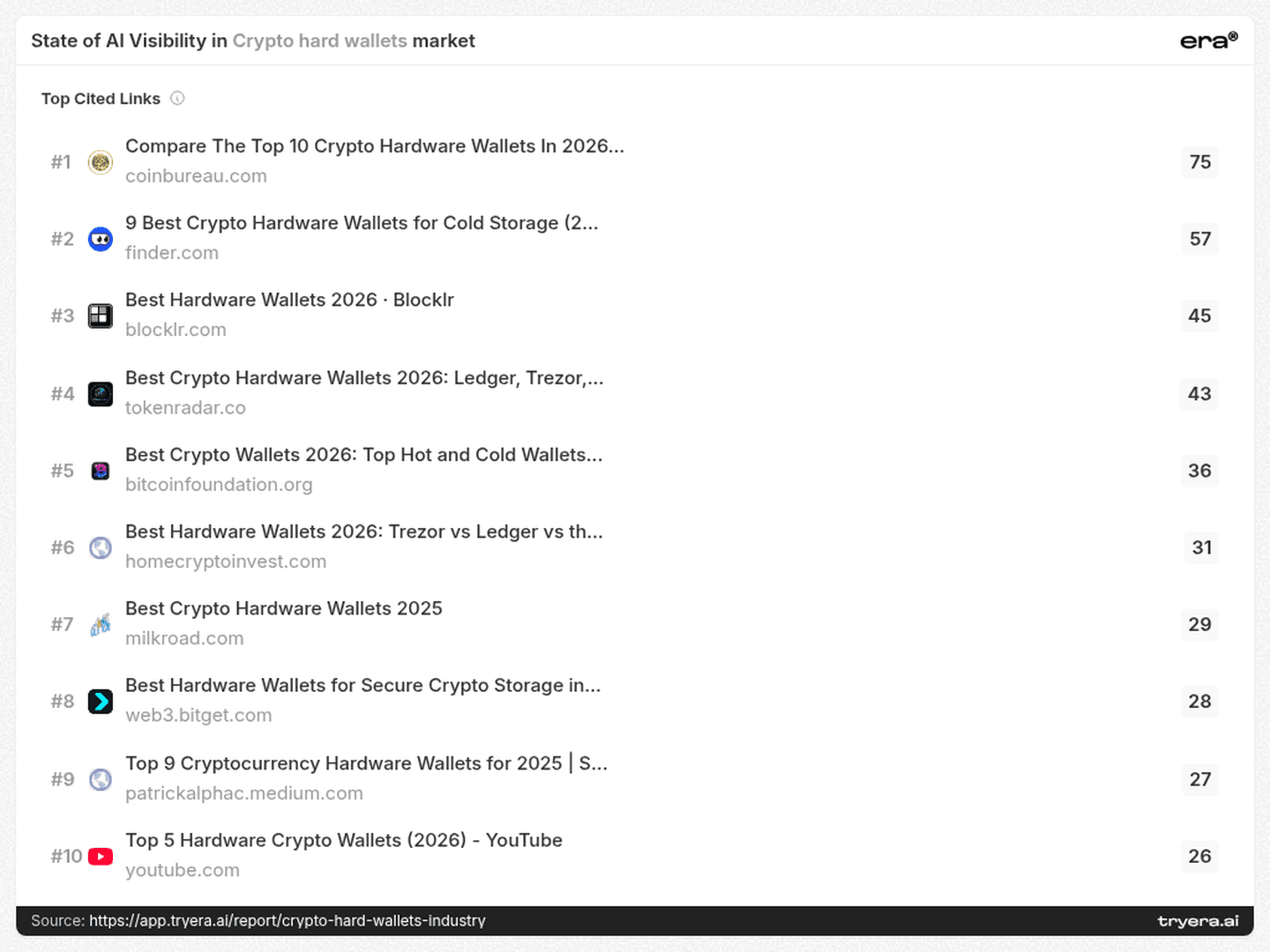
This is a reason to audit comparison coverage alongside product documentation. Check which models are included, whether descriptions are current and whether important trade-offs are represented accurately. Vendor-domain comparisons also deserve scrutiny: an ecosystem participant can contribute to the source material buyers encounter.
The two source tables provide separate views; their counts should not be combined into a single total. Nor should a cited comparison be treated automatically as an independent endorsement.
A useful visibility audit follows the comparison pages as well as the competing brands.
For content production, prepare evidence that a reviewer can verify: a precise product identity, documented capabilities, clear limitations and a reproducible explanation of the buyer’s decision. Publishing another generic “best wallets” page is less informative than identifying what existing comparisons omit or get wrong.
6. Citation mix — Owned content is only one part of the evidence
Ledger’s citation mix is 8.3% owned, 13.2% socials and 78.5% Others. Trezor also has 78.5% Others. Coldcard’s Others share is 85.5%, compared with 7.2% owned and 7.2% socials.

The practical implication is to review the evidence outside the company website, including whether third-party descriptions match current documentation. The category labelled Others should not be read as a count of independent reviews or positive endorsements.
Bitkey presents a different mix: 27.8% socials and 2.6% owned. That is a distribution to investigate, not proof that more social posting will improve visibility. Review which questions social sources address and whether the same explanations are available in durable product documentation.
7. Technical readiness — Fix access and clarity without mistaking them for a ranking formula
The competitive-landscape chart places Coldcard farther right on technical audit score than Ledger, while Ledger is higher on the chart’s Visibility score. Technical readiness and visibility do not move in a simple one-to-one relationship in this snapshot.
The audit panel lists 118 issues: 44 involving structured data, 27 involving content readability, 17 involving AI assistant guidelines, 8 involving page discovery, 12 involving crawler access rules and 10 involving content feeds.
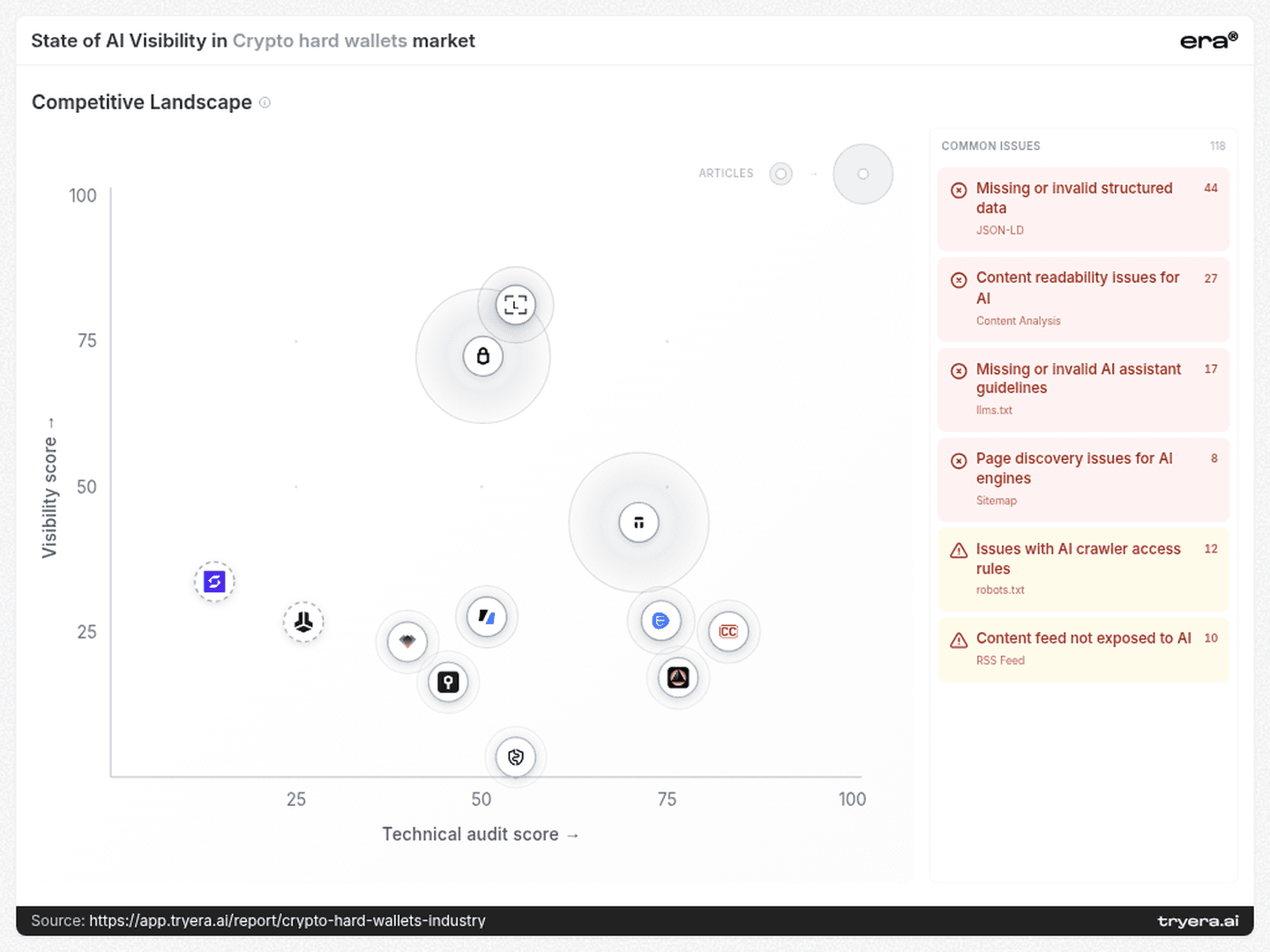
Use those categories to inspect the pages that matter to buyer questions. Can a crawler retrieve the comparison or recovery guide? Is the main explanation readable without interaction? Does structured data accurately describe the page and product?
Prioritize demonstrated access and interpretation problems. Treat the report’s llms.txt and feed flags as audit items to evaluate, rather than evidence that adding those files causes a ranking improvement. The plotted Visibility score is also a separate measure from headline Visibility percentages.
8. The next 90 days — Build an evidence trail for each buyer decision
Days 1–30: Establish comparable baselines. Separate company and product names before calculating changes. Build a repeatable question set around the three observed intents: best overall, safest and beginner friendly. Run it across the four displayed providers and retain the answers, mention positions and cited pages. Use the Tangem gap and the ELLIPAL–Coldcard reversal as examples of why engine-level comparisons matter.
Days 31–60: Repair the evidence for one decision at a time. Choose a safety question and an onboarding question relevant to the product. Improve the corresponding documentation with clear scope, limitations and verifiable explanations. Check the cited comparison coverage for missing models or outdated descriptions. Resolve confirmed access, readability and structured-data problems on those specific pages.
Days 61–90: Repeat the questions and inspect what changed. Compare like-for-like runs at the entity, intent and provider level. Record new appearances separately from changes in average position. Check whether revised pages are cited and whether outside descriptions became more accurate. Expand the work only where the evidence points to a remaining gap.
The deliverable is a traceable account of where the brand appears, how it is described and which sources support the answer. That gives the next content decision a firmer basis than a single aggregate rank.
Want this scoreboard for your own brand? Run a free audit at tryera.ai/free-report — 30 minutes, your numbers, no deck required.
Full report with source data: Crypto Hardware Wallets.



An AI answer can introduce a hardware wallet to a buyer before that buyer visits a product page. For teams responsible for discovery and education, the commercial question is where the brand enters that conversation—and what evidence accompanies it. Era’s hardware-wallet report examines brand presence, share of mentions, average position, provider differences, queries and citation sources. Reading those measures together reveals opportunities that a single league table can obscure.
Being mentioned almost everywhere still leaves most of the conversation to other names.
Ledger appears in 95.9% of monitored answers, yet its Share of Voice is 13.1%. The gap captures the central challenge for hardware-wallet marketing: a place in the answer is only the beginning. Buyers also encounter other brands, product names and comparison sources before deciding what deserves a closer look.
1. Presence — A familiar name can still share a crowded answer
Ledger leads the podium with 95.9% Visibility and an average Rank of 1.5. Trezor follows at 91.4% and 2.3. Tangem reaches 57.4%, with an average Rank of 3.4.
Visibility measures how often a name appears; Share of Voice measures its portion of tracked brand mentions. Neither is a measure of device sales or buyer preference. For Ledger and Trezor, appearing more often and being mentioned earlier are distinct advantages. For a challenger, the useful question is which buying decision earns it a place alongside them.
The Share of Voice table also contains Safe 3 at 6.6%, Safe 5 at 5.0% and Ledger Live at 4.8%, alongside brand names. That makes entity naming part of the competitive analysis. A company-level view and a product-level view answer different questions.
Keep those views separate when building a baseline. Adding related names without checking overlap can turn a naming convention into an apparent competitive gain.
A brand mention and a product mention should not silently become the same unit of competition.
2. Engines — The competitive order changes with the provider
Tangem has 78.0% Visibility on Perplexity and 20.0% on ChatGPT: a 58-percentage-point gap. Its Google AI and Claude results, 63.8% and 68.0%, show why a single overall figure can conceal a concentrated weakness.
The pattern is not identical for every challenger. Keystone reaches 42.0% on ChatGPT, ahead of Tangem’s 20.0%, but trails Tangem on Perplexity, 38.0% versus 78.0%.
ELLIPAL and Coldcard offer another reversal. On ChatGPT, Coldcard records 38.0%, compared with ELLIPAL’s 14.0%. On Perplexity, ELLIPAL reaches 44.0%, compared with Coldcard’s 18.0%. A brand described as behind in one engine can be ahead in another.
For a marketing team, this suggests a paired audit: run the same buyer questions across providers, preserve the answers and compare the cited evidence. These are report-wide provider results; the next step is to locate the individual questions behind the gaps.
3. Intent — “Best,” “safest” and “beginner friendly” require different evidence
The top-query table associates Ledger, Trezor, Tangem, SafePal, Keystone and BitBox with “best crypto hardware wallets 2026.” ELLIPAL, Coldcard and NGRAVE share “safest hardware wallets 2026.” Bitkey is associated with “best beginner friendly hardware wallet 2026.”
These associations suggest three editorial jobs. Broad comparisons need clear trade-offs. Safety questions need specific, inspectable evidence. Beginner questions need explanations of setup, recovery and what happens when something goes wrong.
ELLIPAL, Coldcard and NGRAVE therefore merit analysis beyond the podium: their shared safety-oriented query gives teams a concrete question to investigate. It does not establish that any of them wins that query or is safer than the others.
For the next research cycle, expand each intent into test questions. Under safety, investigate how answers discuss key generation, recovery and transaction verification. Under beginner friendliness, investigate first-use instructions and loss scenarios. Treat these as proposed tests, not additional queries measured in this report.
4. Position — Lower reach does not always mean a later mention
ELLIPAL has 24.9% Visibility and an average Rank of 4.2. BitBox has higher Visibility, 27.9%, but a later average Rank of 4.6. Coldcard reaches 22.3%, with Rank 4.3; NGRAVE reaches 16.2%, with Rank 4.5.
For ELLIPAL, the comparison suggests separating two objectives: appearing in more relevant answers and preserving an early position when it does appear. For BitBox, broader presence alone does not settle the question of prominence within those answers.
Inspect the wording around each mention before treating rank as recommendation quality. An early mention can serve different roles in a comparison. A useful review records whether the answer recommends a device, contrasts it with another option or raises a limitation.
5. Sources — Comparison coverage belongs in the visibility audit
YouTube leads the displayed citation-source table with 199, followed by Coin Bureau with 115. Vendor domains also appear: ledger.com records 70, tangem.com 41, and web3.bitget.com 47.
The cited-links table adds a more specific editorial signal. Its leading Coin Bureau hardware-wallet comparison records 75; Finder’s cold-storage comparison records 57; “Best Hardware Wallets 2026 · Blocklr” records 45. The listed web3.bitget.com hardware-wallet comparison records 28.
This is a reason to audit comparison coverage alongside product documentation. Check which models are included, whether descriptions are current and whether important trade-offs are represented accurately. Vendor-domain comparisons also deserve scrutiny: an ecosystem participant can contribute to the source material buyers encounter.
The two source tables provide separate views; their counts should not be combined into a single total. Nor should a cited comparison be treated automatically as an independent endorsement.
A useful visibility audit follows the comparison pages as well as the competing brands.
For content production, prepare evidence that a reviewer can verify: a precise product identity, documented capabilities, clear limitations and a reproducible explanation of the buyer’s decision. Publishing another generic “best wallets” page is less informative than identifying what existing comparisons omit or get wrong.
6. Citation mix — Owned content is only one part of the evidence
Ledger’s citation mix is 8.3% owned, 13.2% socials and 78.5% Others. Trezor also has 78.5% Others. Coldcard’s Others share is 85.5%, compared with 7.2% owned and 7.2% socials.
The practical implication is to review the evidence outside the company website, including whether third-party descriptions match current documentation. The category labelled Others should not be read as a count of independent reviews or positive endorsements.
Bitkey presents a different mix: 27.8% socials and 2.6% owned. That is a distribution to investigate, not proof that more social posting will improve visibility. Review which questions social sources address and whether the same explanations are available in durable product documentation.
7. Technical readiness — Fix access and clarity without mistaking them for a ranking formula
The competitive-landscape chart places Coldcard farther right on technical audit score than Ledger, while Ledger is higher on the chart’s Visibility score. Technical readiness and visibility do not move in a simple one-to-one relationship in this snapshot.
The audit panel lists 118 issues: 44 involving structured data, 27 involving content readability, 17 involving AI assistant guidelines, 8 involving page discovery, 12 involving crawler access rules and 10 involving content feeds.
Use those categories to inspect the pages that matter to buyer questions. Can a crawler retrieve the comparison or recovery guide? Is the main explanation readable without interaction? Does structured data accurately describe the page and product?
Prioritize demonstrated access and interpretation problems. Treat the report’s llms.txt and feed flags as audit items to evaluate, rather than evidence that adding those files causes a ranking improvement. The plotted Visibility score is also a separate measure from headline Visibility percentages.
8. The next 90 days — Build an evidence trail for each buyer decision
Days 1–30: Establish comparable baselines. Separate company and product names before calculating changes. Build a repeatable question set around the three observed intents: best overall, safest and beginner friendly. Run it across the four displayed providers and retain the answers, mention positions and cited pages. Use the Tangem gap and the ELLIPAL–Coldcard reversal as examples of why engine-level comparisons matter.
Days 31–60: Repair the evidence for one decision at a time. Choose a safety question and an onboarding question relevant to the product. Improve the corresponding documentation with clear scope, limitations and verifiable explanations. Check the cited comparison coverage for missing models or outdated descriptions. Resolve confirmed access, readability and structured-data problems on those specific pages.
Days 61–90: Repeat the questions and inspect what changed. Compare like-for-like runs at the entity, intent and provider level. Record new appearances separately from changes in average position. Check whether revised pages are cited and whether outside descriptions became more accurate. Expand the work only where the evidence points to a remaining gap.
The deliverable is a traceable account of where the brand appears, how it is described and which sources support the answer. That gives the next content decision a firmer basis than a single aggregate rank.
Want this scoreboard for your own brand? Run a free audit at tryera.ai/free-report — 30 minutes, your numbers, no deck required.
Full report with source data: Crypto Hardware Wallets.