September 2, 2026
September 2, 2026
How to Rank in AI Search for Plastic Surgery Clinics in South Korea: A Deep Analysis of the Leaders
View Plastic Surgery leads Era’s podium with 31.3% visibility, JK Plastic Surgery Center leads share of voice at 19.8%, and Bookimed holds the most citations among the podium five. The market is not one leaderboard: it is a contest across buyer intent, provider retrieval and third-party proof.
View Plastic Surgery leads Era’s podium with 31.3% visibility, JK Plastic Surgery Center leads share of voice at 19.8%, and Bookimed holds the most citations among the podium five. The market is not one leaderboard: it is a contest across buyer intent, provider retrieval and third-party proof.
Choosing a clinic for elective surgery abroad is a high-trust decision. In AI search, the shortlist is shaped not only by the clinic’s own pages, but also by accreditation records, medical-tourism platforms, travel publishers and comparison guides. Era tested 50 buyer prompts across ChatGPT, Perplexity, Google AI and Claude, producing 200 responses across 35 tracked players. The report tracks visibility, share of voice, position, citations, source mix, winning queries, search demand, backlinks and technical readiness. Those measures do not collapse into a single ranking. One brand can appear often, another can occupy more of the conversation, and a third can accumulate more citations. The strategic question is not simply “Who is number one?” It is “Which buyer job, engine and evidence chain can a clinic credibly own?”
The clinic that wins the category is not necessarily the clinic that wins the answer.
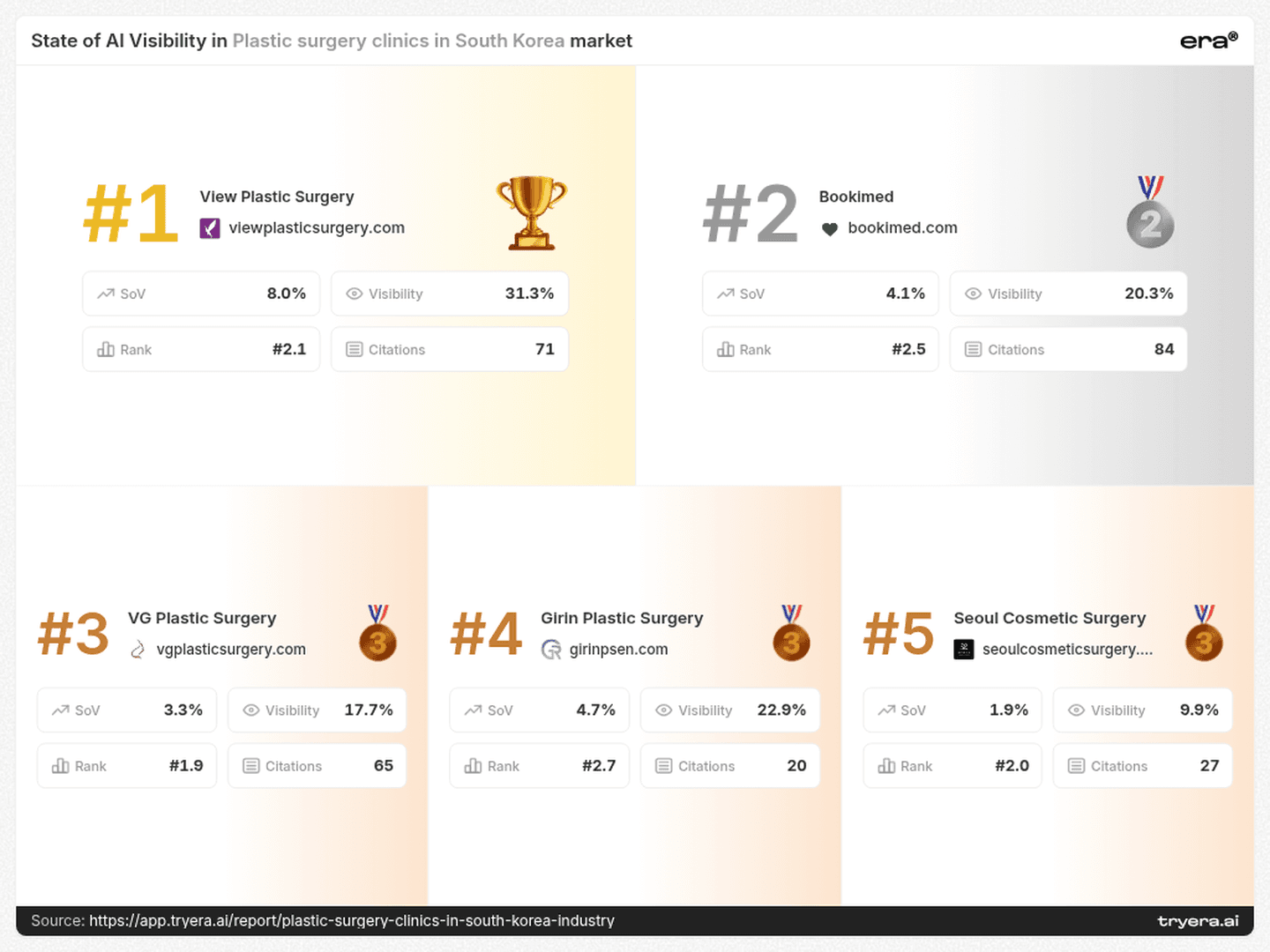
Era’s South Korea plastic-surgery report opens with a useful contradiction. View Plastic Surgery tops the podium with 31.3% Visibility. JK Plastic Surgery Center leads the separate Share of Voice table at 19.8%. Bookimed, second on the podium, has 84 citations—more than any of the podium five—but only 4.1% Share of Voice.
That is the real market story. AI discovery in medical tourism is a chain of decisions: the buyer’s intent shapes the evidence retrieved, that evidence shapes which entities are named, and each provider assembles the shortlist differently.
01 / Three scoreboards
The leader changes when the question changes
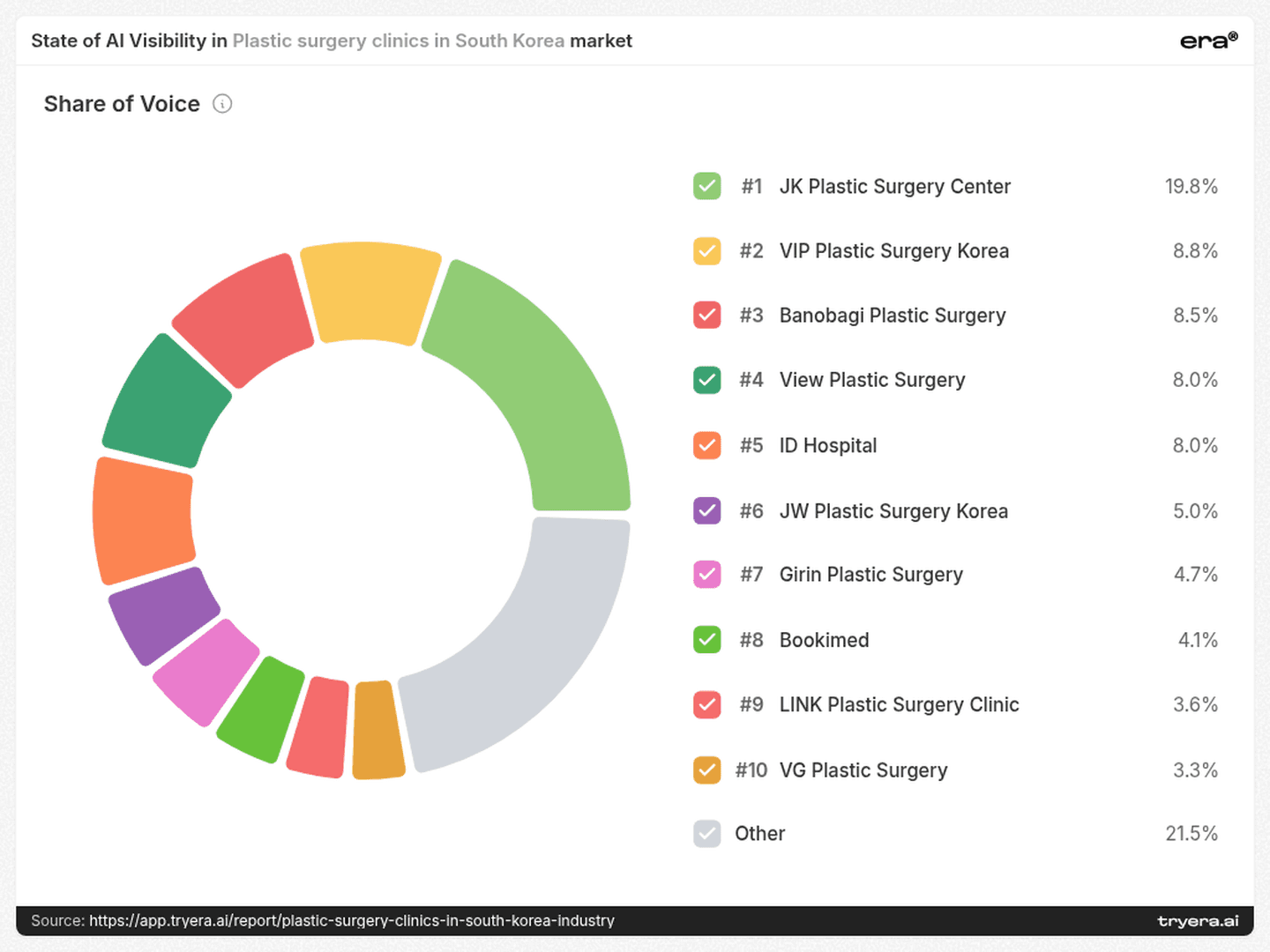
View’s podium line combines 31.3% Visibility, 8.0% Share of Voice, an average #2.1 Rank and 71 citations. But the adjacent metrics rearrange the field.
JK owns the largest share of tracked player mentions at 19.8%, followed by VIP Plastic Surgery Korea at 8.8% and Banobagi Plastic Surgery at 8.5%. None of those three appears in the podium five. Meanwhile, VG Plastic Surgery has the best average position among the podium players at #1.9, while Girin Plastic Surgery has higher Visibility than Bookimed—22.9% versus 20.3%—but fewer citations, 20 versus 84.
AI leadership here is plural: reach, conversational share, position and evidence depth crown different players.
For a clinic, the first diagnostic should therefore be metric-specific. Low Visibility means the brand is absent from too many answers. Weak Share of Voice means it may be mentioned without owning much of the comparison. A strong Position with limited Visibility—like 1mm Plastic Surgery at #1.6 Rank but 3.6% Visibility—means the brand can rank well when retrieved while still missing most opportunities.
02 / Provider markets
Four engines draw four different clinic maps
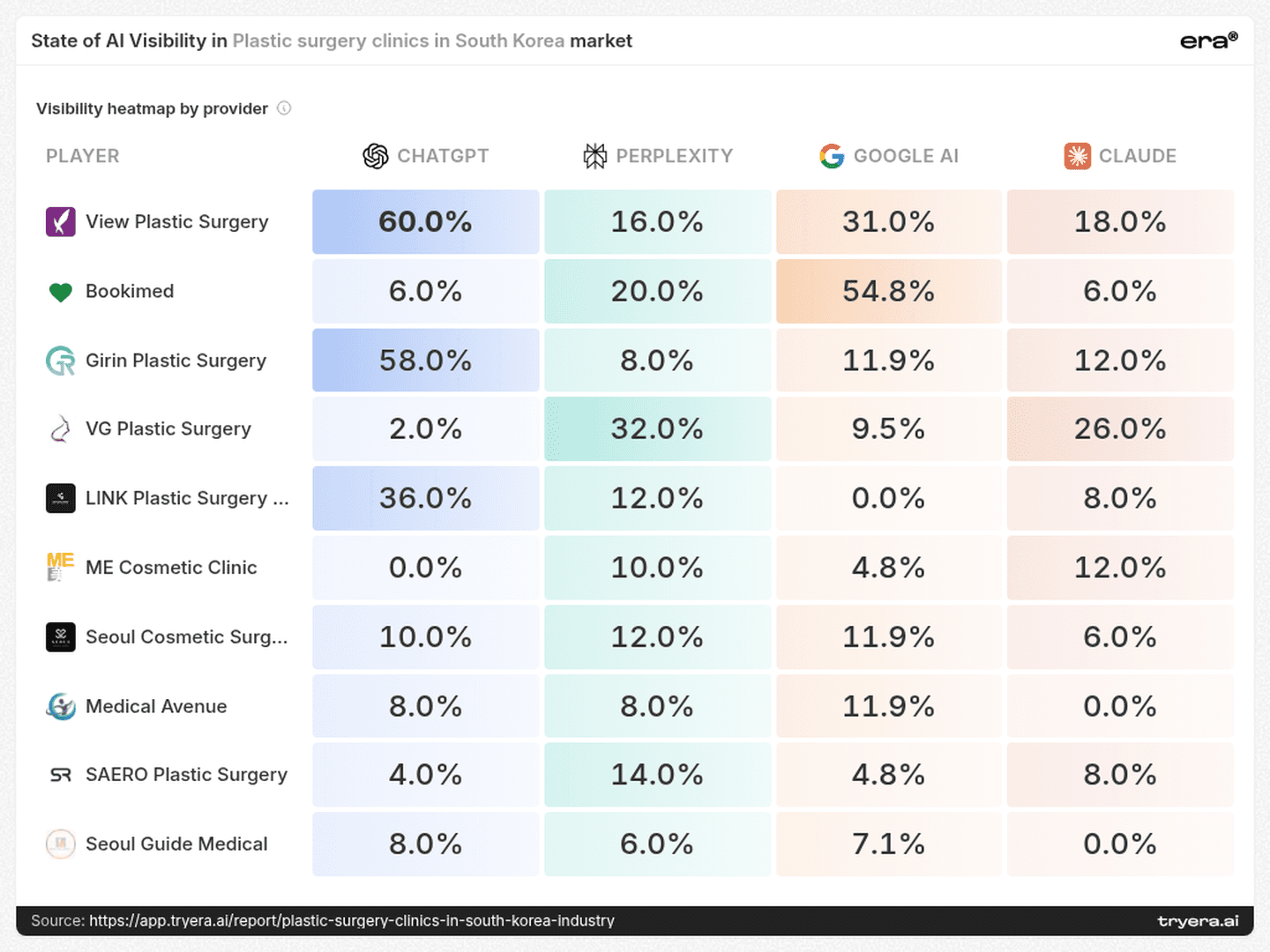
The blended averages hide the report’s sharpest operational gaps. View reaches 60.0% Visibility in ChatGPT but 16.0% in Perplexity. Girin moves from 58.0% in ChatGPT to 8.0% in Perplexity. Bookimed does the opposite: 54.8% in Google AI, but only 6.0% in both ChatGPT and Claude.
VG Plastic Surgery is almost absent from ChatGPT at 2.0%, yet reaches 32.0% in Perplexity and 26.0% in Claude. LINK Plastic Surgery Clinic reaches 36.0% in ChatGPT and 0.0% in Google AI. ME Cosmetic Clinic also records 0.0% in ChatGPT, while Medical Avenue and Seoul Guide Medical record 0.0% in Claude.
The practical unit of competition is not “AI search” in the abstract. It is intent × provider × evidence source. A clinic should track which query clusters create the gap, then inspect the pages and entities each provider consistently retrieves for those queries.
03 / Buyer intent
Procedure demand is huge; proof language decides the shortlist
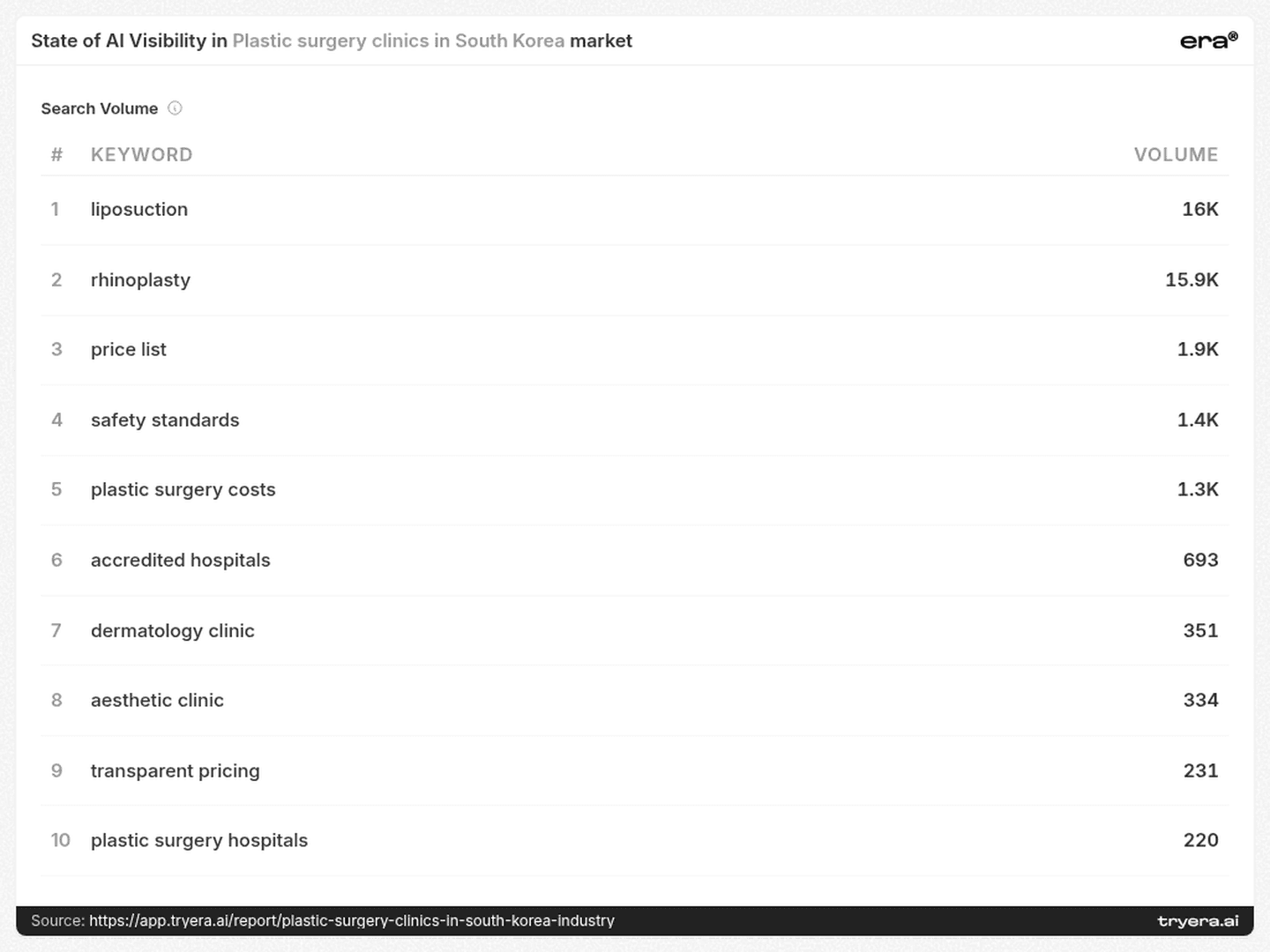
The search-volume page is dominated by procedures: “liposuction” at 16K and “rhinoplasty” at 15.9K. Together, their displayed search volumes total 31.9K. The next layer is decision proof: “price list” at 1.9K, “safety standards” at 1.4K, “plastic surgery costs” at 1.3K and “accredited hospitals” at 693.
The player-query page shows how that proof language fragments opportunity:
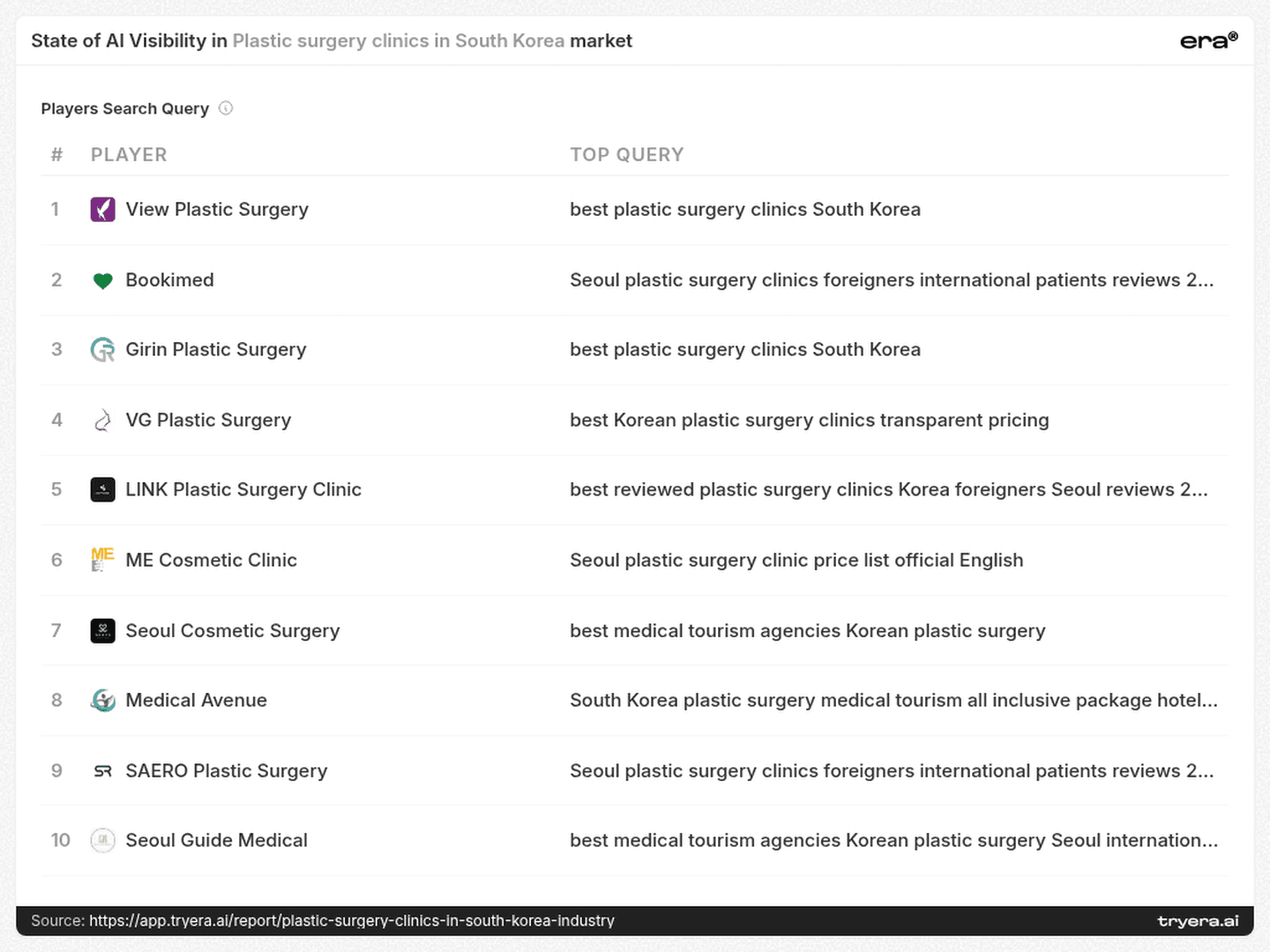
View and Girin surface most strongly for “best plastic surgery clinics South Korea.”
VG is tied to “best Korean plastic surgery clinics transparent pricing,” while ME Cosmetic Clinic maps to “Seoul plastic surgery clinic price list official English.”
Bookimed, LINK and SAERO map to international-patient reviews and foreigner-focused clinic discovery.
Seoul Cosmetic Surgery, Medical Avenue and Seoul Guide Medical surface around agencies, all-inclusive packages, hotels, airport transfers and international-patient logistics.
A clinic does not need one generic “best clinic” page. It needs a portfolio of evidence that answers distinct buyer jobs: procedure expertise, transparent total cost, verifiable safety, accreditation, English-language coordination and post-operative logistics.
04 / Category boundary
The most dangerous competitor may not perform surgery
Bookimed is second on the podium, even though it operates as a medical marketplace rather than a single clinic. The wider player set also includes Seoul Guide Medical, Medical Avenue and MYDOC Korea alongside clinics and large hospitals such as Samsung Medical Center, Asan Medical Center and Severance Hospital.
This is not random category leakage. The prompt set asks about medical-tourism agencies, all-inclusive packages, recovery houses, airport transfers, English aftercare and city comparisons. Those jobs invite coordinators, publishers, hospitals and travel platforms into the same answer as clinics.
The competitive set expands whenever the buyer’s job expands beyond the operating room.
A challenger clinic can respond in two ways: become the best clinical answer to a narrow procedure-and-proof combination, or make its international-patient experience explicit enough to compete with the intermediaries that currently package the decision.
05 / Evidence layer
AI answers borrow trust from tourism, accreditation and comparison pages
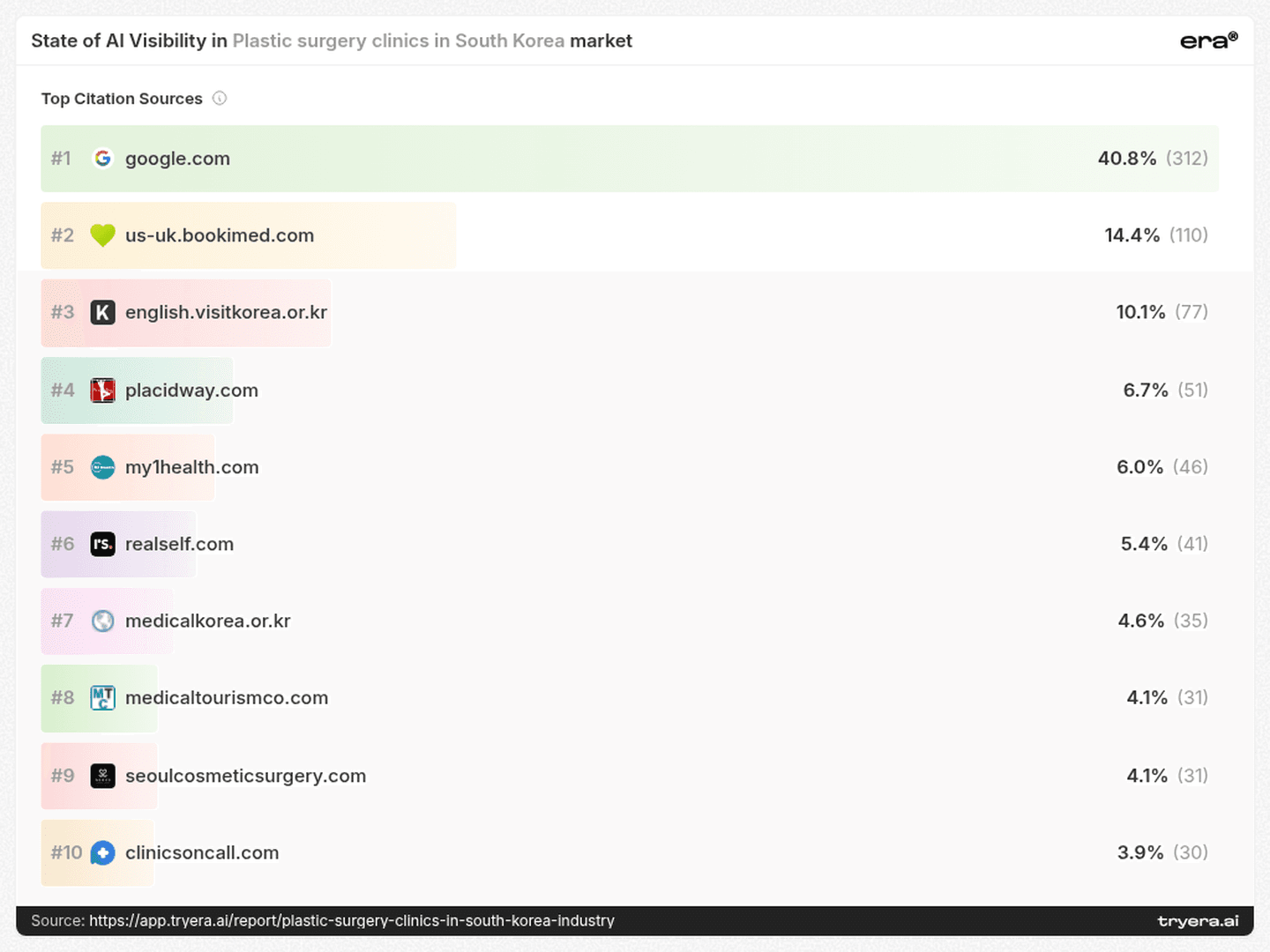
The top citation-source page is led by google.com with 312 occurrences (40.8%), followed by us-uk.bookimed.com with 110 (14.4%) and english.visitkorea.or.kr with 77 (10.1%). PlacidWay, My 1Health, RealSelf, Medical Korea, MedicalTourismCo, Seoul Cosmetic Surgery and Clinics on Call complete the top ten.
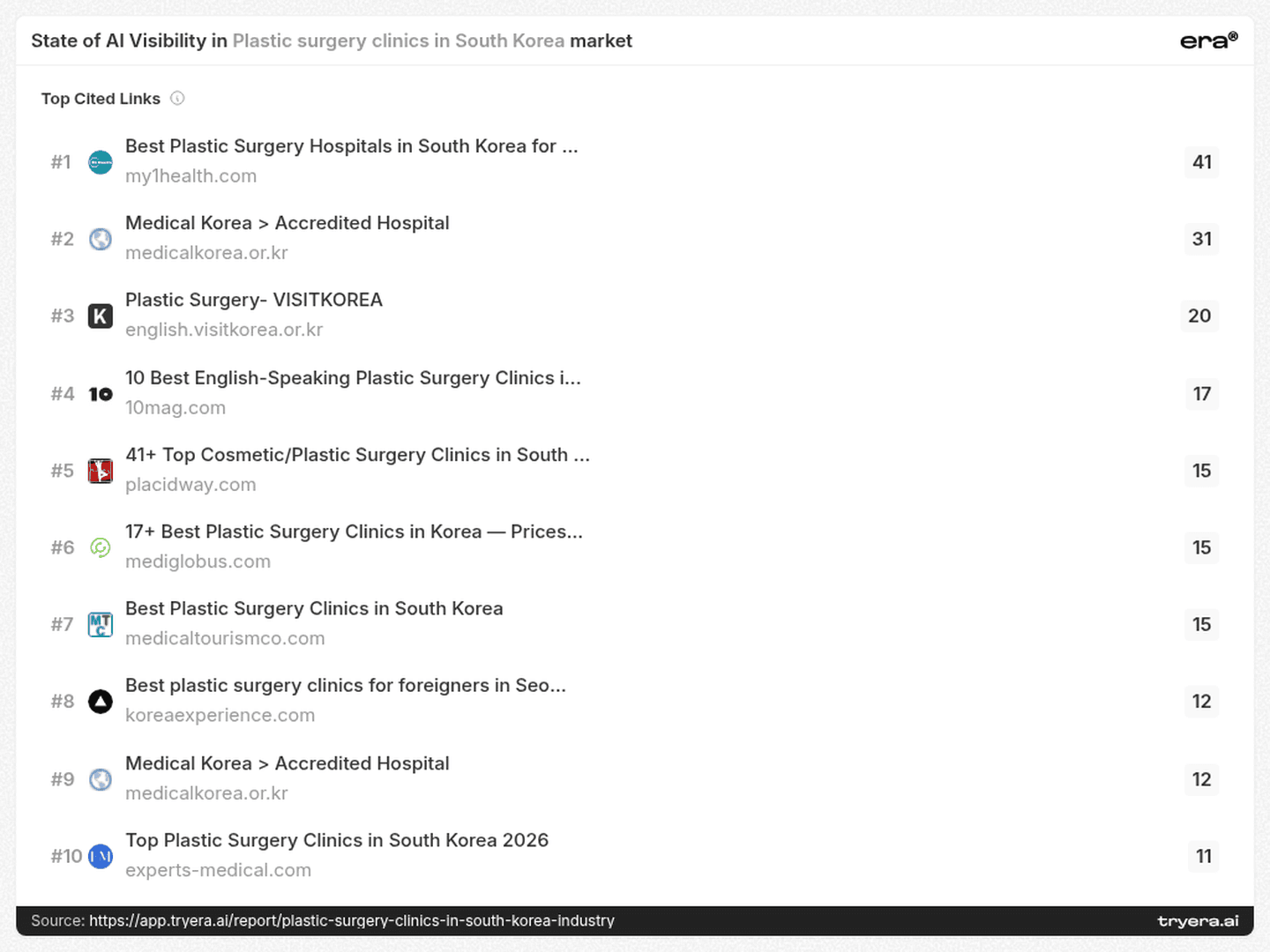
The most-cited individual pages make the proof pattern clearer. A My 1Health comparison of South Korean plastic-surgery hospitals appears 41 times. A Medical Korea accredited-hospital record appears 31 times. A VISITKOREA plastic-surgery page appears 20 times, an English-speaking clinic list from 10 Magazine appears 17 times, and a PlacidWay clinic directory appears 15 times.
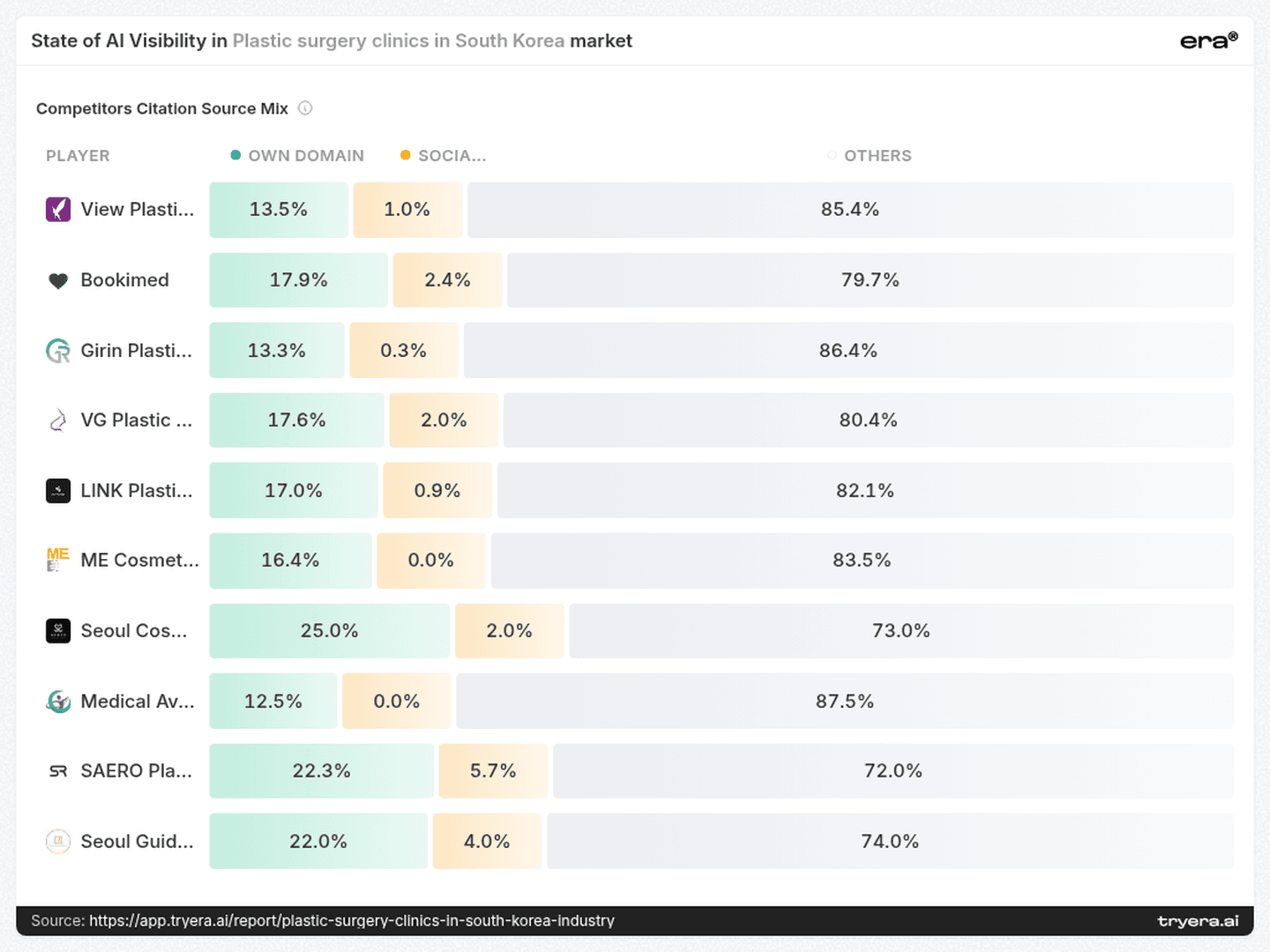
Across the ten players in the citation-mix page, owned domains account for only 12.5% to 25.0% of citations. “Other” sources account for 72.0% to 87.5%; social sources never exceed 5.7%. Even Seoul Cosmetic Surgery, with the highest owned-domain share at 25.0%, still receives 73.0% from other sources.
A clinic’s AI presence is evidenced largely by pages it does not control.
That changes the content strategy. Owned pages must make evidence easy to retrieve, but the brand also needs accurate inclusion in the external pages that already shape the answer: accreditation records, destination guides, comparison lists and medical-tourism directories.
06 / Authority mismatch
Backlinks do not guarantee a uniform provider outcome
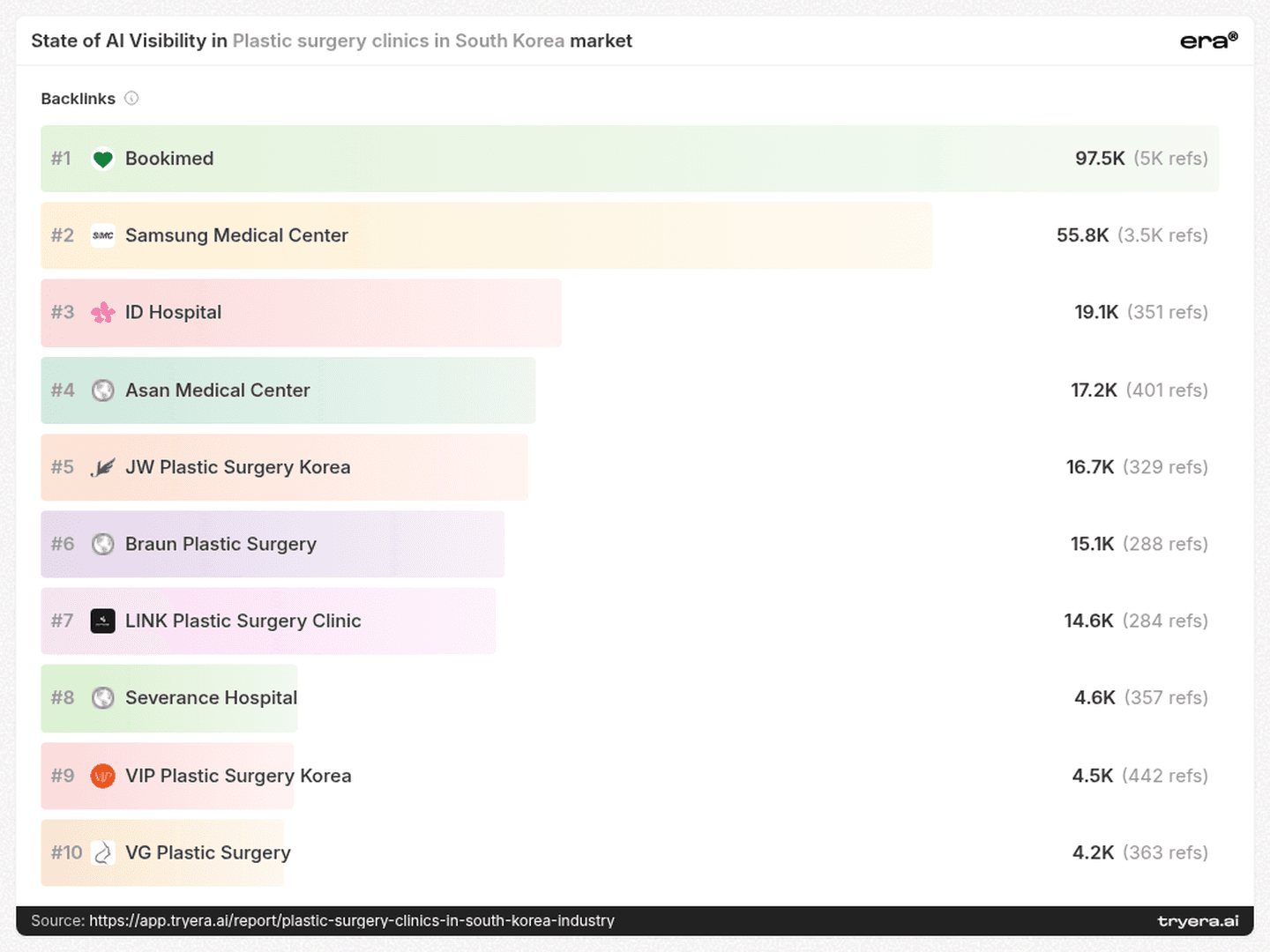
Bookimed leads the backlink page with 97.5K backlinks (5K refs). Yet its provider Visibility ranges from 54.8% in Google AI to 6.0% in ChatGPT and Claude. Samsung Medical Center is second in backlinks at 55.8K, but appears in the player table at 4.7% Visibility, 0.8% Share of Voice and seven citations.
Conversely, View leads the podium without appearing in the backlink top ten, while VG ranks tenth in backlinks at 4.2K and third on the podium. The rankings do not form a simple one-variable ladder from backlinks to AI leadership.
Authority matters, but it must attach to the right entity and the right evidence for the right query. A useful audit therefore separates domain authority, source inclusion, entity consistency and provider-specific retrieval instead of treating backlink volume as a substitute for AI visibility.
07 / Technical readiness
Structured evidence is the largest recorded technical gap
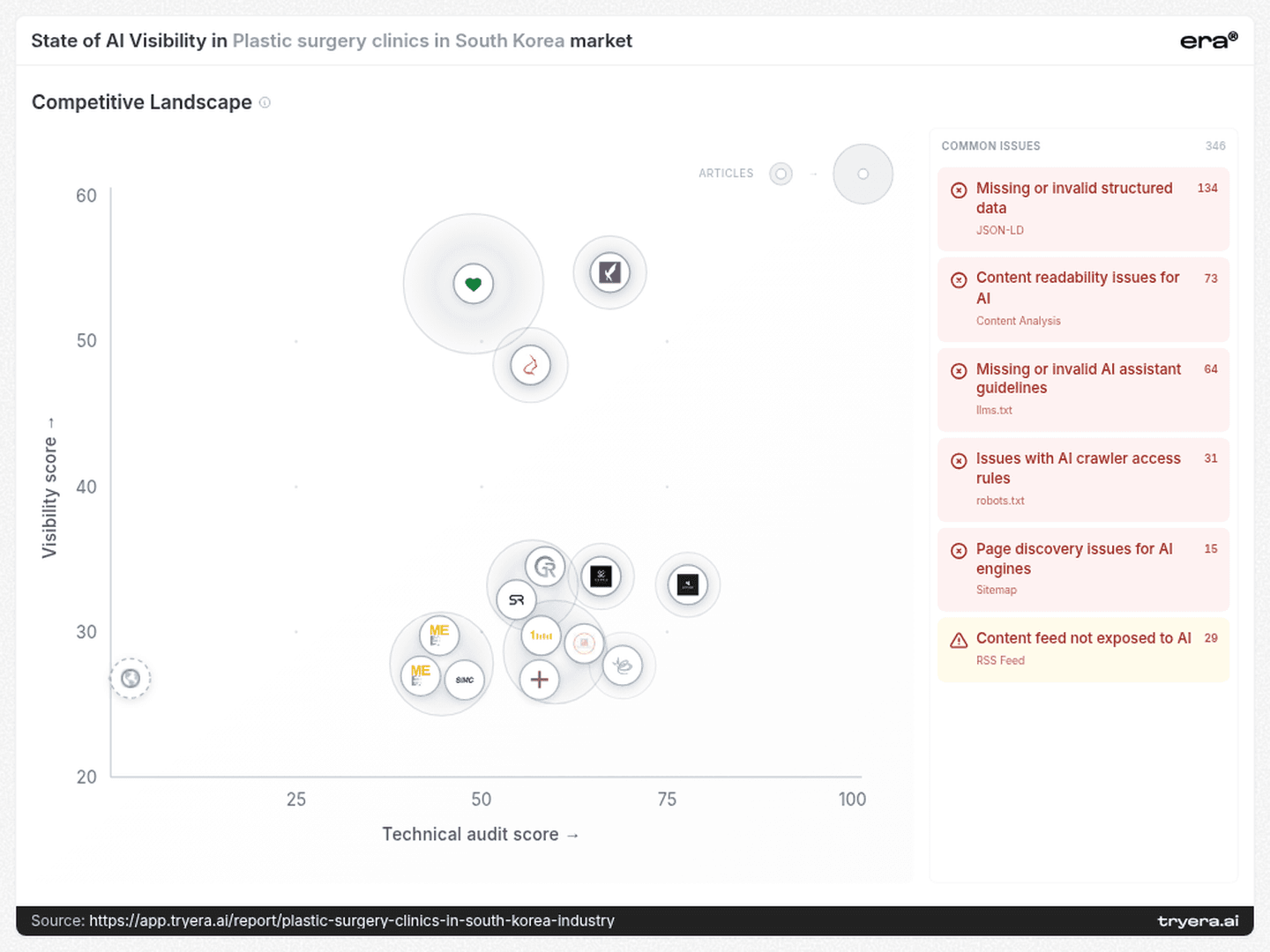
The competitive-landscape page records 346 common issues. Missing or invalid structured data is the largest category at 134, followed by 73 content-readability issues for AI, 64 missing or invalid AI-assistant guidelines, 31 crawler-access issues, 29 missing content feeds and 15 page-discovery issues.
The landscape itself places technical audit score and a separate visibility score on different axes. The distribution shows that strong technical readiness and strong visibility are not interchangeable. Technical fixes can remove friction; they do not replace proof that a buyer or an external publisher can verify.
For this market, the highest-value technical work is concrete: consolidate brand entities, make English-language pricing and safety evidence readable, add valid structured data, remove crawler and sitemap blockers, and keep accreditation and international-patient information consistent across owned and external records.
08 / 90 days
A practical plan for a challenger clinic
Days 1–30: establish the evidence baseline
Measure Visibility, Share of Voice and Position separately for the four intent clusters: procedures, pricing, safety/accreditation and international-patient logistics.
Build a provider matrix for ChatGPT, Perplexity, Google AI and Claude; start with the exact gaps shown by the heatmap.
Resolve entity duplication and naming, including clinic name variants across the site, directories and accreditation records.
Prioritize the 134 structured-data issues, then crawler-access and page-discovery blockers.
Days 31–60: publish the proof buyers actually request
Create procedure pages for rhinoplasty and liposuction that connect expertise to transparent inclusions, safety standards and aftercare.
Publish an English price architecture: what is included, what can change the quote, and which services—anesthesia, translation, recovery, transport—are separate.
Make accreditation, clinician credentials, revision policy and international-patient support independently verifiable.
Days 61–90: strengthen the external trust chain
Audit the high-occurrence comparison, accreditation and destination pages for accurate naming, links and evidence.
Pitch updates supported by primary proof rather than generic brand claims.
Rerun the same intent × provider matrix and measure whether gains come from broader presence, stronger position or a larger share of the answer.
The goal is not to be “optimized for AI.” It is to become the most verifiable answer to a specific international patient decision.
Want this scoreboard for your own brand?
Run a free audit at tryera.ai/free-report — 30 minutes, your numbers, no deck required.
Full report with source data: Plastic surgery clinics in South Korea.



Choosing a clinic for elective surgery abroad is a high-trust decision. In AI search, the shortlist is shaped not only by the clinic’s own pages, but also by accreditation records, medical-tourism platforms, travel publishers and comparison guides. Era tested 50 buyer prompts across ChatGPT, Perplexity, Google AI and Claude, producing 200 responses across 35 tracked players. The report tracks visibility, share of voice, position, citations, source mix, winning queries, search demand, backlinks and technical readiness. Those measures do not collapse into a single ranking. One brand can appear often, another can occupy more of the conversation, and a third can accumulate more citations. The strategic question is not simply “Who is number one?” It is “Which buyer job, engine and evidence chain can a clinic credibly own?”
The clinic that wins the category is not necessarily the clinic that wins the answer.
Era’s South Korea plastic-surgery report opens with a useful contradiction. View Plastic Surgery tops the podium with 31.3% Visibility. JK Plastic Surgery Center leads the separate Share of Voice table at 19.8%. Bookimed, second on the podium, has 84 citations—more than any of the podium five—but only 4.1% Share of Voice.
That is the real market story. AI discovery in medical tourism is a chain of decisions: the buyer’s intent shapes the evidence retrieved, that evidence shapes which entities are named, and each provider assembles the shortlist differently.
01 / Three scoreboards
The leader changes when the question changes
View’s podium line combines 31.3% Visibility, 8.0% Share of Voice, an average #2.1 Rank and 71 citations. But the adjacent metrics rearrange the field.
JK owns the largest share of tracked player mentions at 19.8%, followed by VIP Plastic Surgery Korea at 8.8% and Banobagi Plastic Surgery at 8.5%. None of those three appears in the podium five. Meanwhile, VG Plastic Surgery has the best average position among the podium players at #1.9, while Girin Plastic Surgery has higher Visibility than Bookimed—22.9% versus 20.3%—but fewer citations, 20 versus 84.
AI leadership here is plural: reach, conversational share, position and evidence depth crown different players.
For a clinic, the first diagnostic should therefore be metric-specific. Low Visibility means the brand is absent from too many answers. Weak Share of Voice means it may be mentioned without owning much of the comparison. A strong Position with limited Visibility—like 1mm Plastic Surgery at #1.6 Rank but 3.6% Visibility—means the brand can rank well when retrieved while still missing most opportunities.
02 / Provider markets
Four engines draw four different clinic maps
The blended averages hide the report’s sharpest operational gaps. View reaches 60.0% Visibility in ChatGPT but 16.0% in Perplexity. Girin moves from 58.0% in ChatGPT to 8.0% in Perplexity. Bookimed does the opposite: 54.8% in Google AI, but only 6.0% in both ChatGPT and Claude.
VG Plastic Surgery is almost absent from ChatGPT at 2.0%, yet reaches 32.0% in Perplexity and 26.0% in Claude. LINK Plastic Surgery Clinic reaches 36.0% in ChatGPT and 0.0% in Google AI. ME Cosmetic Clinic also records 0.0% in ChatGPT, while Medical Avenue and Seoul Guide Medical record 0.0% in Claude.
The practical unit of competition is not “AI search” in the abstract. It is intent × provider × evidence source. A clinic should track which query clusters create the gap, then inspect the pages and entities each provider consistently retrieves for those queries.
03 / Buyer intent
Procedure demand is huge; proof language decides the shortlist
The search-volume page is dominated by procedures: “liposuction” at 16K and “rhinoplasty” at 15.9K. Together, their displayed search volumes total 31.9K. The next layer is decision proof: “price list” at 1.9K, “safety standards” at 1.4K, “plastic surgery costs” at 1.3K and “accredited hospitals” at 693.
The player-query page shows how that proof language fragments opportunity:
View and Girin surface most strongly for “best plastic surgery clinics South Korea.”
VG is tied to “best Korean plastic surgery clinics transparent pricing,” while ME Cosmetic Clinic maps to “Seoul plastic surgery clinic price list official English.”
Bookimed, LINK and SAERO map to international-patient reviews and foreigner-focused clinic discovery.
Seoul Cosmetic Surgery, Medical Avenue and Seoul Guide Medical surface around agencies, all-inclusive packages, hotels, airport transfers and international-patient logistics.
A clinic does not need one generic “best clinic” page. It needs a portfolio of evidence that answers distinct buyer jobs: procedure expertise, transparent total cost, verifiable safety, accreditation, English-language coordination and post-operative logistics.
04 / Category boundary
The most dangerous competitor may not perform surgery
Bookimed is second on the podium, even though it operates as a medical marketplace rather than a single clinic. The wider player set also includes Seoul Guide Medical, Medical Avenue and MYDOC Korea alongside clinics and large hospitals such as Samsung Medical Center, Asan Medical Center and Severance Hospital.
This is not random category leakage. The prompt set asks about medical-tourism agencies, all-inclusive packages, recovery houses, airport transfers, English aftercare and city comparisons. Those jobs invite coordinators, publishers, hospitals and travel platforms into the same answer as clinics.
The competitive set expands whenever the buyer’s job expands beyond the operating room.
A challenger clinic can respond in two ways: become the best clinical answer to a narrow procedure-and-proof combination, or make its international-patient experience explicit enough to compete with the intermediaries that currently package the decision.
05 / Evidence layer
AI answers borrow trust from tourism, accreditation and comparison pages
The top citation-source page is led by google.com with 312 occurrences (40.8%), followed by us-uk.bookimed.com with 110 (14.4%) and english.visitkorea.or.kr with 77 (10.1%). PlacidWay, My 1Health, RealSelf, Medical Korea, MedicalTourismCo, Seoul Cosmetic Surgery and Clinics on Call complete the top ten.
The most-cited individual pages make the proof pattern clearer. A My 1Health comparison of South Korean plastic-surgery hospitals appears 41 times. A Medical Korea accredited-hospital record appears 31 times. A VISITKOREA plastic-surgery page appears 20 times, an English-speaking clinic list from 10 Magazine appears 17 times, and a PlacidWay clinic directory appears 15 times.
Across the ten players in the citation-mix page, owned domains account for only 12.5% to 25.0% of citations. “Other” sources account for 72.0% to 87.5%; social sources never exceed 5.7%. Even Seoul Cosmetic Surgery, with the highest owned-domain share at 25.0%, still receives 73.0% from other sources.
A clinic’s AI presence is evidenced largely by pages it does not control.
That changes the content strategy. Owned pages must make evidence easy to retrieve, but the brand also needs accurate inclusion in the external pages that already shape the answer: accreditation records, destination guides, comparison lists and medical-tourism directories.
06 / Authority mismatch
Backlinks do not guarantee a uniform provider outcome
Bookimed leads the backlink page with 97.5K backlinks (5K refs). Yet its provider Visibility ranges from 54.8% in Google AI to 6.0% in ChatGPT and Claude. Samsung Medical Center is second in backlinks at 55.8K, but appears in the player table at 4.7% Visibility, 0.8% Share of Voice and seven citations.
Conversely, View leads the podium without appearing in the backlink top ten, while VG ranks tenth in backlinks at 4.2K and third on the podium. The rankings do not form a simple one-variable ladder from backlinks to AI leadership.
Authority matters, but it must attach to the right entity and the right evidence for the right query. A useful audit therefore separates domain authority, source inclusion, entity consistency and provider-specific retrieval instead of treating backlink volume as a substitute for AI visibility.
07 / Technical readiness
Structured evidence is the largest recorded technical gap
The competitive-landscape page records 346 common issues. Missing or invalid structured data is the largest category at 134, followed by 73 content-readability issues for AI, 64 missing or invalid AI-assistant guidelines, 31 crawler-access issues, 29 missing content feeds and 15 page-discovery issues.
The landscape itself places technical audit score and a separate visibility score on different axes. The distribution shows that strong technical readiness and strong visibility are not interchangeable. Technical fixes can remove friction; they do not replace proof that a buyer or an external publisher can verify.
For this market, the highest-value technical work is concrete: consolidate brand entities, make English-language pricing and safety evidence readable, add valid structured data, remove crawler and sitemap blockers, and keep accreditation and international-patient information consistent across owned and external records.
08 / 90 days
A practical plan for a challenger clinic
Days 1–30: establish the evidence baseline
Measure Visibility, Share of Voice and Position separately for the four intent clusters: procedures, pricing, safety/accreditation and international-patient logistics.
Build a provider matrix for ChatGPT, Perplexity, Google AI and Claude; start with the exact gaps shown by the heatmap.
Resolve entity duplication and naming, including clinic name variants across the site, directories and accreditation records.
Prioritize the 134 structured-data issues, then crawler-access and page-discovery blockers.
Days 31–60: publish the proof buyers actually request
Create procedure pages for rhinoplasty and liposuction that connect expertise to transparent inclusions, safety standards and aftercare.
Publish an English price architecture: what is included, what can change the quote, and which services—anesthesia, translation, recovery, transport—are separate.
Make accreditation, clinician credentials, revision policy and international-patient support independently verifiable.
Days 61–90: strengthen the external trust chain
Audit the high-occurrence comparison, accreditation and destination pages for accurate naming, links and evidence.
Pitch updates supported by primary proof rather than generic brand claims.
Rerun the same intent × provider matrix and measure whether gains come from broader presence, stronger position or a larger share of the answer.
The goal is not to be “optimized for AI.” It is to become the most verifiable answer to a specific international patient decision.
Want this scoreboard for your own brand?
Run a free audit at tryera.ai/free-report — 30 minutes, your numbers, no deck required.
Full report with source data: Plastic surgery clinics in South Korea.