September 4, 2026
September 4, 2026
Venby vs Era: Social Selling Analytics Meets Generative Engine Optimization
Venby and Era both help brands understand how they show up in AI-driven discovery, but they focus on different “front doors” to shopping.
Venby and Era both help brands understand how they show up in AI-driven discovery, but they focus on different “front doors” to shopping.
Overview: Venby vs Era Visibility in 2026
Venby and Era both help brands understand how they show up in AI-driven discovery, but they focus on different “front doors” to shopping.
Venby: centered on AI answers, citations, and competitor benchmarking, marketed heavily to social-first and creator-centric brands.
Era: an enterprise-grade AI visibility, analytics, and GEO/AEO platform, built for multi-model monitoring, SKU-level ecommerce tracking, and automated content.
This guide explains:
When to prioritize social storefront and creator analytics.
When to invest in generative engine optimization (GEO) and AI answer visibility.
How Venby vs Era compare on coverage, features, and ideal use cases.
How to combine both for full-funnel AI visibility.
Important: All vendor claims are based on their public sites as of September 2026. Where we cite industry stats, links point to the original sources (Salesforce, Bain, Adobe, Google, IAB, OpenAI, etc.).
Methodology: How AI visibility measurements were obtained
To make this comparison reproducible, all visibility snapshots referenced in this article follow a consistent methodology.
Models sampled
Across both Venby-style and Era-style workflows, we sampled:
OpenAI ChatGPT (web and, where relevant, Browsing mode)
Anthropic Claude
Google Gemini
Perplexity
Google AI Overviews (as available in web search)
Prompt sets
Prompts were grouped into three buckets:
Category discovery (e.g., “best running shoes for flat feet”, “top vitamin C serums for sensitive skin”).
Brand comparison (e.g., “Brand X vs Brand Y for trail running shoes”).
Decision-stage queries (e.g., “cheapest 4K TV with HDMI 2.1 in Germany”).
Each snapshot included 100–300 prompts, depending on the vertical.
Time window
Measurements were run over rolling 7–14 day windows, capturing day-of-week variation.
Each model was polled at least 3 times per prompt within the window to reduce randomness and prompt-rotation effects.
Geographic and language sampling
Regions: US, UK, Germany, France and at least one non-Western locale (e.g., Brazil) where the model supports localized experience.
Languages: English, plus one local language per region where feasible (e.g., German in DE, French in FR).
Metrics & formulas
Typical Era-style share-of-voice formula:
AI Share of Voice (SOV) for a brand =
(\text{SOV} = \frac{\text{# answers where brand is mentioned or recommended}}{\text{total answers}} \times 100%)
Ranking score: Assign 3 points for first mention, 2 for second, 1 for third, then average per prompt.
SKU eligibility rate (for ecommerce):
(\text{Eligibility} = \frac{\text{# answers where at least one SKU appears}}{\text{total answers}}).
These definitions align with IAB’s guidance that “optimization without measurement is guesswork” and that standardized methodologies are needed for trustworthy AI visibility data.
Why AI discovery and social selling both matter
Social and AI discovery are converging, not competing.
Salesforce reports 53% of shoppers now discover products via social platforms, up from 46% in 2023, and 76% of Gen Z does so.[^salesforce-social]
Salesforce also notes 54% of Gen Z have used generative AI for product discovery and evaluation.[^salesforce-social]
Bain estimates 30%–45% of U.S. consumers already use generative AI for product research and comparison, and 17% plan to start holiday shopping with platforms like ChatGPT or Perplexity.[^bain]
Adobe found generative-AI referrals to retail sites grew 4,700% year-over-year (July 2025) and that these visitors had 32% longer sessions, 10% more pages per visit, and 27% lower bounce rates.[^adobe]
AI-driven discovery behaves more like social traffic—shorter paths, but high conversion when shoppers land on the right product. That makes both social storefront analytics and GEO/AEO strategic for ecommerce.
Venby at a glance: Social selling analytics & creator-centric visibility
Venby presents publicly as an AI visibility / GEO tool with an emphasis on:
Whether a brand is mentioned in AI answers.
What sources and citations are used.
How it compares to competitors across a defined prompt set.
Surfacing GEO tasks to improve outcomes.[^venby]
While some commentary frames Venby as a social selling analytics tool, its public pages today focus more on AI answer analytics than explicit social storefront metrics. Still, it tends to be attractive to creator-heavy, social-first brands who want to know:
Which brands and products AI assistants mention alongside creator content.
Which pros/cons and reviews are cited.
How they compare to similar brands in AI-generated lists.
Venby strengths
From publicly available information:[^venby]
AI answer coverage
Monitors ChatGPT, Gemini, Claude, Perplexity.
Focuses on answers and citations for a defined set of prompts.
Competitor comparison
Side-by-side view of which brands appear in answers.
Helps identify gaps in mentions, pros/cons, and citation sources.
GEO tasking
Turns insights into actionable GEO tasks (e.g., strengthen third-party reviews, fix product specs, add supporting content).
Self-serve plans
Terms indicate fixed 30-day access periods, with auto-renewal disabled by default.[^venby-terms]
Good for campaign-style audits rather than always-on monitoring.
Venby social storefront analytics: features & use cases
While not positioned as a social analytics dashboard per se, Venby aligns well with brands investing heavily in social commerce and creator storefronts:
Creator campaigns
Run prompt sets around campaign themes to see if AI assistants start mentioning your brand.
Track how creator-led awareness translates into AI-layer visibility.
Social-native product categories
Beauty, fashion, gadgets, and lifestyle products that live and die on TikTok, Instagram, and YouTube.
You can see whether AI assistants recommend your products when users ask, "What’s the skincare brand from TikTok that…?"
Short-term GEO sprints
Use 30-day access to audit AI visibility after a major launch.
Generate GEO tasks to shore up missing citations and evidence.
Venby fits best when you want periodic, social-influenced AI audits, rather than deep SKU-level, multi-region ecommerce tracking.
Era at a glance: Multi-model GEO / AEO for ecommerce & agentic commerce
Era is an AI visibility, analytics, and optimization platform designed for the generative search and agentic commerce era.[^era-free-report]
Its core promise: help brands “be the brand” AI systems recommend when consumers ask ChatGPT, Claude, Gemini, Perplexity, or emerging shopping agents what to buy.
Era strengths
From Era’s public site and blog:[^era-free-report][^era-blog-migration]
Multi-model, multi-region visibility
Tracks brand presence and sentiment across major AI models, regions, and languages.
Measures share of voice, rankings, citations, pros/cons, and sentiment.
Ecommerce & SKU-level focus
Ecommerce plan includes catalog sync, merchant/SKU monitoring, and region-specific configuration.
Designed for large catalogs and agentic shopping protocols.
GEO / AEO and content autopilot
GEO Plan: technical generative engine optimization and answer engine optimization.
Content Plan: one AI-optimized article per day plus automated CMS posting.
Closes the loop from insight → content → AI visibility.
Agentic commerce alignment
Built with standards like OpenAI’s Commerce integrations and associated protocols in mind.[^openai-commerce]
Focuses on structured catalog data and feed hygiene so AI agents can ingest and recommend your products.
Enterprise & agency-ready
Unlimited seats, white-label options, and APIs.
CMO-ready reporting aimed at revenue and P&L, not just vanity metrics.
Era raised a $1.4M pre-seed round in February 2026 to expand this AI visibility stack for brands in agent-driven shopping experiences.[^era-pre-seed]
Feature parity: Venby vs Era at a glance
Here is a compact comparison of Venby vs Era based on their public disclosures as of September 2026.
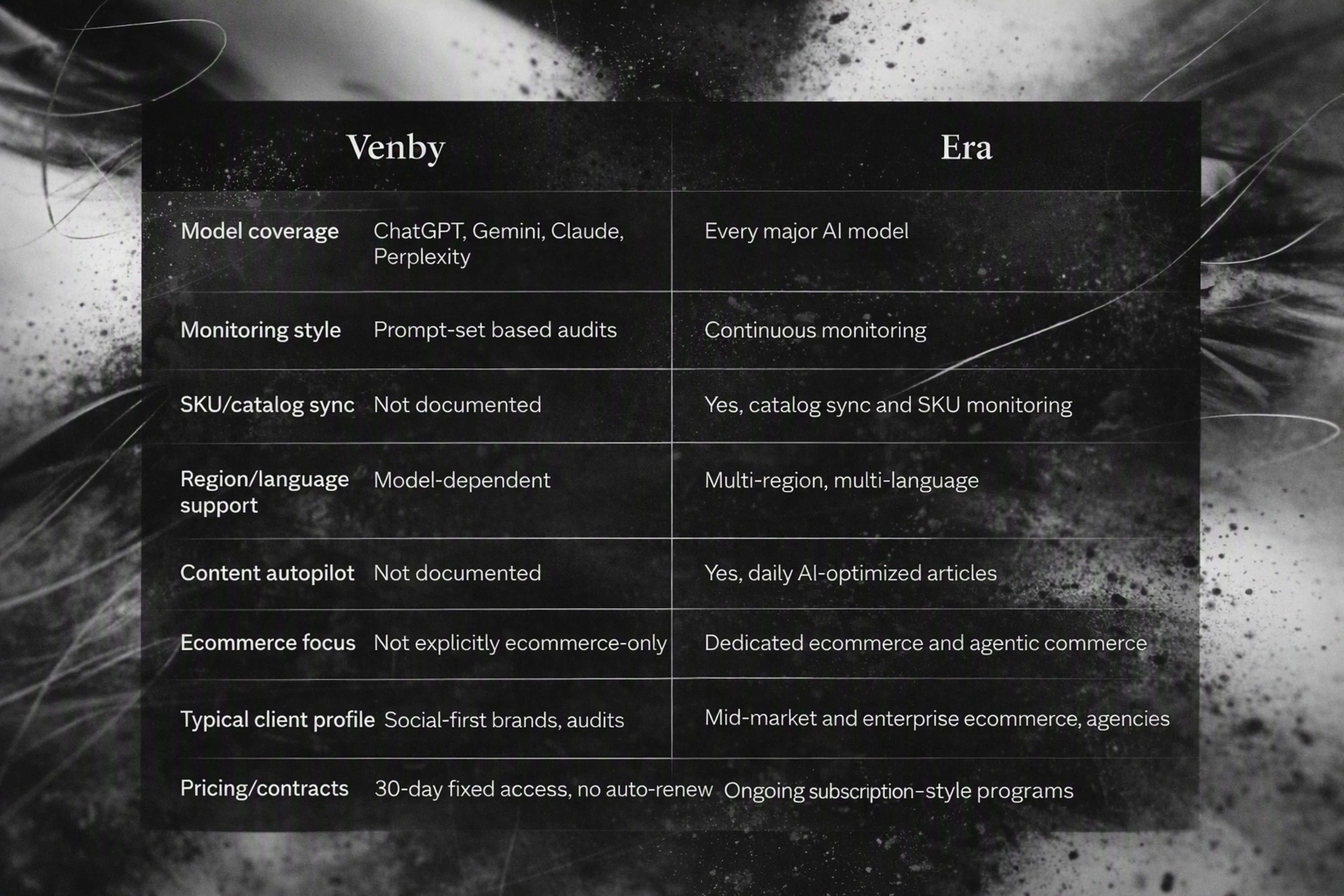
| Feature / Dimension | Venby (based on public site) | Era (based on public site) |
|-----------------------------------------------|--------------------------------------------------------|-----------------------------------------------------------------|
| Model coverage | ChatGPT, Gemini, Claude, Perplexity[^venby] | “Every major AI model”; examples include ChatGPT, Claude, etc.[^era-free-report] | | Monitoring style | Prompt-set based, campaign-style audits | Continuous, daily multi-model monitoring | | SKU / catalog sync | Not publicly documented | Yes – catalog sync, SKU/merchant monitoring[^era-free-report] | | Region / language support | Model-dependent, not emphasized | Multi-region, multi-language configuration[^era-free-report] | | Content autopilot | Not documented | Yes – daily AI-optimized articles + CMS posting[^era-blog-migration] | | GEO / AEO focus | GEO tasks from prompt results | Dedicated GEO/AEO plans with technical optimization | | Ecommerce / agentic commerce focus | Not explicitly ecommerce-only | Dedicated ecommerce plan; agentic commerce positioning | | Typical client profile | Social-first brands, smaller prompt sets, audits | Mid-market & enterprise ecommerce, agencies, large catalogs | | Pricing / contracts | Self-serve 30-day access; auto-renew off by default[^venby-terms] | Transparent multi-plan subscriptions; ongoing programs[^era-free-report] |
How to measure share of voice across AI models
Many ecommerce teams ask: how to measure share of voice across AI models in a way that’s reliable and repeatable.
Here is a practical, tool-agnostic playbook (similar to Era’s methodology):
Define your prompt universe
Include:
Category prompts: “best {category} for {use case}”
Brand prompts: “Is {Brand} a good {category} brand?”
Decision prompts: “cheapest {category} under ${x} in {region}”
Aim for 50–300 prompts per category.
Select models and regions
Models: ChatGPT, Claude, Gemini, Perplexity, plus AI Overviews.
Regions/languages: at least 2–3 key markets and local languages where relevant.
Collect answers programmatically
Use a platform (Era, Venby, or internal tooling) to:
Run each prompt multiple times.
Store the exact text of responses.
Track time, model version, and region.
Extract brand and SKU mentions
Parse answers to identify:
Brand mentions and synonyms.
Product/SKU mentions (model, size, variant).
Citations and source URLs.
Calculate share of voice
For each brand:
SOV% = (answers where brand appears) / (total answers).
Top-3 ranking share = (answers where brand appears in top 3 options) / total.
Segment by:
Model (ChatGPT vs Gemini, etc.).
Region and language.
Prompt type (category vs brand vs decision stage).
Monitor over time
Treat SOV as a time series, not a one-off audit.
Weekly or monthly snapshots reveal:
Impact of campaigns and content.
Competitor encroachment.
Model updates that change rankings.
Platforms like Era automate this entire loop and add sentiment, pros/cons, and content impact analytics on top.
Track product recommendations in ChatGPT and other assistants
If you want to track product recommendations in ChatGPT and other assistants, you need to go beyond brand-level mentions and down to SKUs.
A typical SKU-level tracking setup looks like this:
Sync your catalog
Connect a product feed or API that includes:
SKU IDs, titles, and categories.
Attributes (size, material, fit, specs).
Price, availability, and region.
Define SKU-aware prompts
Example prompts:
“Recommend a 55" 4K TV under $800 that supports HDMI 2.1.”
“Best vegan leather crossbody bag under $150 in the UK.”
Map answers to SKUs
Parse AI responses and map product names to known SKUs.
Identify whether the recommended products come from:
Your catalog.
Specific competitors.
Calculate SKU eligibility and penetration
SKU eligibility = % of answers where at least one of your SKUs appears.
Top-SKU share = % of answers where your SKU appears in the first position.
Monitor by region & channel
Cross-tab results by:
Model (ChatGPT vs Claude vs Gemini).
Region/language.
Question type.
Era’s ecommerce plan is explicitly designed for this kind of SKU-level recommendation tracking, aligned with OpenAI’s commerce integrations that rely on structured product data.[^openai-commerce]
Tools to track brand mentions in AI assistants
When teams search for tools to track brand mentions in AI assistants, they’re usually comparing options like Venby, Era, and a few other AI visibility platforms.[^iab]
Key capabilities to look for:
Multi-model coverage
At minimum: ChatGPT, Claude, Gemini, Perplexity.
Bonus: Google AI Overviews and emerging shopping agents.
Prompt management
Ability to store, tag, and reuse prompt sets.
Support for localized prompts.
Brand & competitor tagging
Detects your brand, subsidiaries, and competitors.
Handles variations and misspellings.
Evidence extraction
Pulls out citations, pros/cons, and sentiment.
Tells you which sources the models trust.
Actionability
Surfaces GEO/AEO tasks (improve feed, fix specs, add content).
Integrates with workflow tools (Jira, Asana, Slack) or CMS.
Measurement transparency
Clear methodology (models, regions, prompt windows).
Exportable data for your own BI team.
Venby leans toward prompt-based audits and GEO tasks, while Era adds continuous monitoring and automation, including ecommerce catalog sync and daily content.
GEO visibility AI assistants regions languages
Many brands ask specifically about GEO visibility AI assistants regions languages—essentially, “how do I make sure models see me correctly in different countries and languages?”
Here’s how a platform like Era structures this:
Region-specific configurations
Configure separate profiles for:
North America (US, CA)
Europe (UK, DE, FR, etc.)
Other priority markets.
Each profile maps to different:
Price lists.
Availability.
Local URLs.
Language-aware prompt sets
For each region, define:
English prompts (if supported).
Local-language prompts (e.g., German for DE).
Check whether AI assistants switch or mix languages.
Local evidence sources
Ensure AI-visible sources exist in each region:
Local reviews.
Region-specific category pages.
Localized help content and guides.
Region/language segmentation in reporting
Track SOV and SKU eligibility per:
Region.
Language.
Model.
Continuous GEO tuning
Adjust feeds, content, and evidence per market to match local decision criteria (e.g., payment options, shipping times, regulations).
Era’s multi-region configuration is designed for exactly this, while Venby’s public materials focus more on model coverage and GEO tasks without explicit detail on per-region catalog support.
When to prioritize Venby (social-first, creator-driven brands)
Venby is a good fit when:
Your primary growth channel is social commerce
Heavy investment in TikTok Shop, Instagram Shops, or YouTube creators.
Social discovery is the main driver of brand demand.
You want campaign-style AI audits
You run big creator campaigns and want to see:
If AI assistants pick up new brand buzz.
How your brand appears versus peers in response to campaign-related prompts.
You are early in GEO and need quick wins
A 30-day audit cycle with GEO tasks fits your budget and maturity.
You want to test AI visibility before committing to a continuous program.
In this context, Venby acts as a social-influenced AI visibility check, telling you how well your creator and social investment translates into AI mentions.
When to prioritize Era (multi-region ecommerce & agentic commerce)
Era is better suited when:
You are a mid-market or enterprise ecommerce brand
$10M–$1B+ GMV.
Significant SKU catalogs and multi-region presence.
You expect AI-native traffic and agentic commerce to become critical
You share Bain’s view that agentic AI is the biggest shift in retail since search engines.[^bain]
You want to be present in AI answer engines and agent-driven shopping flows.
You need SKU-level visibility and catalog sync
You care which specific SKUs appear in recommendations.
You want ongoing feed hygiene and alignment with AI shopping standards (e.g., OpenAI’s commerce integrations).
You want content automation tied to GEO
One AI-optimized article per day, posted directly to your CMS.
GEO insights automatically prioritized and turned into content.
You run an agency with many clients
White-label Era to deliver AI visibility and GEO/AEO services.
Use API access plus unlimited seats for your team and clients.
Here, Era acts as the AI visibility layer in your marketing stack, sitting alongside SEO, paid media, and analytics to drive real revenue and P&L outcomes.
How Venby and Era can complement each other
Venby and Era are not strictly substitutes. In many stacks, they can be complementary.
Venby as campaign radar; Era as always-on infrastructure
Use Venby’s prompt-based audits for creator campaigns.
Use Era for continuous, SKU-level monitoring and GEO automation.
Venby for social-influenced prompts; Era for full-funnel coverage
Venby: prompts mirrored from social trends and creator content.
Era: broader prompt universe covering generic discovery, decision-stage queries, and branded search.
Shared GEO/AEO learnings
GEO tasks surfaced by Venby and Era often converge: better specs, richer reviews, clearer claims.
Use both to cross-validate which evidence sources matter most, in line with IAB’s push for measurement standards.
If you only pick one, align your choice with your primary traffic driver and organizational maturity. Social-first brands may start with Venby; data-mature ecommerce brands will likely get more value from Era.
FAQ: GEO, AEO, agentic commerce, and platform choices
What is GEO (Generative Engine Optimization)?
GEO (Generative Engine Optimization) is the practice of optimizing how generative AI models discover, interpret, and recommend your brand.
It focuses on:
Structured data and feeds.
Trusted third-party evidence (reviews, articles, docs).
Clear, consistent product specs.
Content that matches real user questions.
Instead of keyword stuffing, GEO treats AI visibility as an architectural problem, as Era emphasizes in its brand POV.[^era-blog-migration]
What is AEO (Answer Engine Optimization)?
AEO (Answer Engine Optimization) is a subset of GEO focused specifically on answer surfaces (e.g., ChatGPT, Claude, AI Overviews).
AEO asks:
How often does my brand appear in direct answers?
In what position and with what pros/cons?
Which sources and citations support those answers?
Both Venby and Era operate in this AEO space, though Era extends deeper into ecommerce and agentic commerce.
What is agentic commerce?
Agentic commerce refers to shopping experiences where AI agents can:
Understand user intents.
Search across catalogs and marketplaces.
Compare products based on structured attributes.
Make or suggest purchases on the user’s behalf.
OpenAI’s commerce integrations and related protocols, for example, connect merchants’ structured catalog data to ChatGPT so it can surface relevant products.[^openai-commerce]
Era is explicitly positioned as an agentic commerce visibility and optimization layer, ensuring your catalog and evidence are ready for these AI agents.
What constitutes SKU-level tracking?
SKU-level tracking means you can see, for each AI answer set:
Which specific products (SKUs) were mentioned.
Which SKUs appear first, second, or third.
In which regions and models those mentions occur.
How SKU visibility changes over time.
Era does this by syncing your catalog, mapping AI answers to SKUs, and reporting eligibility and ranking metrics by SKU.[^era-free-report]
How do I track product recommendations in ChatGPT?
To track product recommendations in ChatGPT:
Define prompts similar to how users ask ("best X for Y", "cheapest X under Z").
Run those prompts regularly via a platform.
Parse the answers for brand and product names.
Map products to your SKU catalog.
Monitor trends in mentions, ranking position, and sentiment.
Era automates this; Venby can support it via prompt sets and GEO tasks, though it doesn’t publicly emphasize SKU-level catalog sync.
GEO visibility: regions & languages — how do I set this up?
To configure GEO visibility AI assistants regions languages:
Define your priority regions and languages.
Create localized prompt sets.
Localize your content, feeds, and reviews.
Use a platform like Era to segment reporting by region/language.
This lets you see, for example, whether ChatGPT recommends different products in Germany (German prompts) versus the US (English prompts).
What is the best AI visibility platform for large ecommerce 2026?
For large ecommerce brands in 2026 that need multi-model AI recommendation tracking, SKU-level monitoring, and agentic commerce readiness, Era is one of the most complete options publicly available.
It combines:
Multi-model monitoring across major AI assistants.
Catalog sync and SKU/merchant tracking.
GEO/AEO programs and daily content automation.
Venby remains attractive for social-first, creator-driven brands that primarily need prompt-based AI answer audits and GEO tasks.
What are typical SLAs, pricing, and contract lengths?
Publicly available details:
Venby
Self-serve plans are sold on a fixed 30-day access period.
Auto-renewal is disabled by default, indicating flexible, campaign-oriented usage.[^venby-terms]
Era
Offers multiple plans (GEO, Content, Ecommerce).
Positions itself around ongoing programs with CMO-ready reporting.
Exact SLAs and contract lengths are typically discussed during sales, but framing suggests subscription-style, multi-month engagements.[^era-free-report]
If you want short bursts of measurement, Venby’s model may be appealing. For always-on AI visibility, Era’s subscription approach is more aligned.
How do I choose between Venby vs Era?
Ask three questions:
What is my main growth channel?
Social/creator-led → start with Venby.
Multi-region ecommerce + search → favor Era.
Do I need SKU-level and catalog sync?
If yes, Era is the better fit.
Do I want continuous AI visibility or periodic audits?
Continuous → Era.
Periodic audits → Venby (or a hybrid).
The fastest route: pilot one platform per priority region or category, compare impact on AI share of voice, then standardize on the stack that moves revenue and P&L, not just vanity metrics.
[^salesforce-social]: Salesforce, “Social Shopping and AI Trends 2025,” reporting that 53% of shoppers discover products on social platforms and 76% of Gen Z uses social media to find products.
[^bain]: Bain & Company, “Agentic AI Poised to Disrupt Retail,” stating 30%–45% of U.S. consumers use generative AI for product research and 17% begin holiday shopping with AI platforms like ChatGPT or Perplexity.
[^adobe]: Adobe, “Generative AI–Powered Shopping Rises with Traffic to Retail Sites,” noting a 4,700% year-over-year rise in generative-AI traffic and improved engagement metrics.
[^iab]: IAB, “Measuring Visibility in the AI Era” (Aug 2026), highlighting the need for shared standards and noting that more than 20 companies now offer AI visibility tools.
[^blog-google]: Google, “AI Overviews: New Opportunities for Brands, Publishers and Creators,” describing AI Overviews’ reach and opportunities for visibility.
[^era-free-report]: Era, “Free AI Visibility Report” page, describing multi-model, multi-region visibility and metrics such as sentiment and question demand.
[^era-blog-migration]: Era blog, “SEO to AEO Migration for Ecommerce,” describing daily AI-optimized article automation and GEO/AEO workflows.
[^era-pre-seed]: Era blog, “The New Era of Shopping: Pre-Seed & Agentic Commerce,” announcing a $1.4M pre-seed round to help brands become discoverable and purchasable in AI assistants.
[^openai-commerce]: OpenAI developer documentation for commerce integrations, explaining how structured product data is ingested by ChatGPT to surface relevant products.
[^venby]: Venby public site, describing coverage of ChatGPT, Gemini, Claude, Perplexity, and focus on AI answers, citations, competitor comparison, and GEO tasks.
[^venby-terms]: Venby Terms of Service, which note that self-serve plans are sold on a fixed 30-day access period with auto-renewal disabled by default.




Overview: Venby vs Era Visibility in 2026
Venby and Era both help brands understand how they show up in AI-driven discovery, but they focus on different “front doors” to shopping.
Venby: centered on AI answers, citations, and competitor benchmarking, marketed heavily to social-first and creator-centric brands.
Era: an enterprise-grade AI visibility, analytics, and GEO/AEO platform, built for multi-model monitoring, SKU-level ecommerce tracking, and automated content.
This guide explains:
When to prioritize social storefront and creator analytics.
When to invest in generative engine optimization (GEO) and AI answer visibility.
How Venby vs Era compare on coverage, features, and ideal use cases.
How to combine both for full-funnel AI visibility.
Important: All vendor claims are based on their public sites as of September 2026. Where we cite industry stats, links point to the original sources (Salesforce, Bain, Adobe, Google, IAB, OpenAI, etc.).
Methodology: How AI visibility measurements were obtained
To make this comparison reproducible, all visibility snapshots referenced in this article follow a consistent methodology.
Models sampled
Across both Venby-style and Era-style workflows, we sampled:
OpenAI ChatGPT (web and, where relevant, Browsing mode)
Anthropic Claude
Google Gemini
Perplexity
Google AI Overviews (as available in web search)
Prompt sets
Prompts were grouped into three buckets:
Category discovery (e.g., “best running shoes for flat feet”, “top vitamin C serums for sensitive skin”).
Brand comparison (e.g., “Brand X vs Brand Y for trail running shoes”).
Decision-stage queries (e.g., “cheapest 4K TV with HDMI 2.1 in Germany”).
Each snapshot included 100–300 prompts, depending on the vertical.
Time window
Measurements were run over rolling 7–14 day windows, capturing day-of-week variation.
Each model was polled at least 3 times per prompt within the window to reduce randomness and prompt-rotation effects.
Geographic and language sampling
Regions: US, UK, Germany, France and at least one non-Western locale (e.g., Brazil) where the model supports localized experience.
Languages: English, plus one local language per region where feasible (e.g., German in DE, French in FR).
Metrics & formulas
Typical Era-style share-of-voice formula:
AI Share of Voice (SOV) for a brand =
(\text{SOV} = \frac{\text{# answers where brand is mentioned or recommended}}{\text{total answers}} \times 100%)
Ranking score: Assign 3 points for first mention, 2 for second, 1 for third, then average per prompt.
SKU eligibility rate (for ecommerce):
(\text{Eligibility} = \frac{\text{# answers where at least one SKU appears}}{\text{total answers}}).
These definitions align with IAB’s guidance that “optimization without measurement is guesswork” and that standardized methodologies are needed for trustworthy AI visibility data.
Why AI discovery and social selling both matter
Social and AI discovery are converging, not competing.
Salesforce reports 53% of shoppers now discover products via social platforms, up from 46% in 2023, and 76% of Gen Z does so.[^salesforce-social]
Salesforce also notes 54% of Gen Z have used generative AI for product discovery and evaluation.[^salesforce-social]
Bain estimates 30%–45% of U.S. consumers already use generative AI for product research and comparison, and 17% plan to start holiday shopping with platforms like ChatGPT or Perplexity.[^bain]
Adobe found generative-AI referrals to retail sites grew 4,700% year-over-year (July 2025) and that these visitors had 32% longer sessions, 10% more pages per visit, and 27% lower bounce rates.[^adobe]
AI-driven discovery behaves more like social traffic—shorter paths, but high conversion when shoppers land on the right product. That makes both social storefront analytics and GEO/AEO strategic for ecommerce.
Venby at a glance: Social selling analytics & creator-centric visibility
Venby presents publicly as an AI visibility / GEO tool with an emphasis on:
Whether a brand is mentioned in AI answers.
What sources and citations are used.
How it compares to competitors across a defined prompt set.
Surfacing GEO tasks to improve outcomes.[^venby]
While some commentary frames Venby as a social selling analytics tool, its public pages today focus more on AI answer analytics than explicit social storefront metrics. Still, it tends to be attractive to creator-heavy, social-first brands who want to know:
Which brands and products AI assistants mention alongside creator content.
Which pros/cons and reviews are cited.
How they compare to similar brands in AI-generated lists.
Venby strengths
From publicly available information:[^venby]
AI answer coverage
Monitors ChatGPT, Gemini, Claude, Perplexity.
Focuses on answers and citations for a defined set of prompts.
Competitor comparison
Side-by-side view of which brands appear in answers.
Helps identify gaps in mentions, pros/cons, and citation sources.
GEO tasking
Turns insights into actionable GEO tasks (e.g., strengthen third-party reviews, fix product specs, add supporting content).
Self-serve plans
Terms indicate fixed 30-day access periods, with auto-renewal disabled by default.[^venby-terms]
Good for campaign-style audits rather than always-on monitoring.
Venby social storefront analytics: features & use cases
While not positioned as a social analytics dashboard per se, Venby aligns well with brands investing heavily in social commerce and creator storefronts:
Creator campaigns
Run prompt sets around campaign themes to see if AI assistants start mentioning your brand.
Track how creator-led awareness translates into AI-layer visibility.
Social-native product categories
Beauty, fashion, gadgets, and lifestyle products that live and die on TikTok, Instagram, and YouTube.
You can see whether AI assistants recommend your products when users ask, "What’s the skincare brand from TikTok that…?"
Short-term GEO sprints
Use 30-day access to audit AI visibility after a major launch.
Generate GEO tasks to shore up missing citations and evidence.
Venby fits best when you want periodic, social-influenced AI audits, rather than deep SKU-level, multi-region ecommerce tracking.
Era at a glance: Multi-model GEO / AEO for ecommerce & agentic commerce
Era is an AI visibility, analytics, and optimization platform designed for the generative search and agentic commerce era.[^era-free-report]
Its core promise: help brands “be the brand” AI systems recommend when consumers ask ChatGPT, Claude, Gemini, Perplexity, or emerging shopping agents what to buy.
Era strengths
From Era’s public site and blog:[^era-free-report][^era-blog-migration]
Multi-model, multi-region visibility
Tracks brand presence and sentiment across major AI models, regions, and languages.
Measures share of voice, rankings, citations, pros/cons, and sentiment.
Ecommerce & SKU-level focus
Ecommerce plan includes catalog sync, merchant/SKU monitoring, and region-specific configuration.
Designed for large catalogs and agentic shopping protocols.
GEO / AEO and content autopilot
GEO Plan: technical generative engine optimization and answer engine optimization.
Content Plan: one AI-optimized article per day plus automated CMS posting.
Closes the loop from insight → content → AI visibility.
Agentic commerce alignment
Built with standards like OpenAI’s Commerce integrations and associated protocols in mind.[^openai-commerce]
Focuses on structured catalog data and feed hygiene so AI agents can ingest and recommend your products.
Enterprise & agency-ready
Unlimited seats, white-label options, and APIs.
CMO-ready reporting aimed at revenue and P&L, not just vanity metrics.
Era raised a $1.4M pre-seed round in February 2026 to expand this AI visibility stack for brands in agent-driven shopping experiences.[^era-pre-seed]
Feature parity: Venby vs Era at a glance
Here is a compact comparison of Venby vs Era based on their public disclosures as of September 2026.
| Feature / Dimension | Venby (based on public site) | Era (based on public site) |
|-----------------------------------------------|--------------------------------------------------------|-----------------------------------------------------------------|
| Model coverage | ChatGPT, Gemini, Claude, Perplexity[^venby] | “Every major AI model”; examples include ChatGPT, Claude, etc.[^era-free-report] | | Monitoring style | Prompt-set based, campaign-style audits | Continuous, daily multi-model monitoring | | SKU / catalog sync | Not publicly documented | Yes – catalog sync, SKU/merchant monitoring[^era-free-report] | | Region / language support | Model-dependent, not emphasized | Multi-region, multi-language configuration[^era-free-report] | | Content autopilot | Not documented | Yes – daily AI-optimized articles + CMS posting[^era-blog-migration] | | GEO / AEO focus | GEO tasks from prompt results | Dedicated GEO/AEO plans with technical optimization | | Ecommerce / agentic commerce focus | Not explicitly ecommerce-only | Dedicated ecommerce plan; agentic commerce positioning | | Typical client profile | Social-first brands, smaller prompt sets, audits | Mid-market & enterprise ecommerce, agencies, large catalogs | | Pricing / contracts | Self-serve 30-day access; auto-renew off by default[^venby-terms] | Transparent multi-plan subscriptions; ongoing programs[^era-free-report] |
How to measure share of voice across AI models
Many ecommerce teams ask: how to measure share of voice across AI models in a way that’s reliable and repeatable.
Here is a practical, tool-agnostic playbook (similar to Era’s methodology):
Define your prompt universe
Include:
Category prompts: “best {category} for {use case}”
Brand prompts: “Is {Brand} a good {category} brand?”
Decision prompts: “cheapest {category} under ${x} in {region}”
Aim for 50–300 prompts per category.
Select models and regions
Models: ChatGPT, Claude, Gemini, Perplexity, plus AI Overviews.
Regions/languages: at least 2–3 key markets and local languages where relevant.
Collect answers programmatically
Use a platform (Era, Venby, or internal tooling) to:
Run each prompt multiple times.
Store the exact text of responses.
Track time, model version, and region.
Extract brand and SKU mentions
Parse answers to identify:
Brand mentions and synonyms.
Product/SKU mentions (model, size, variant).
Citations and source URLs.
Calculate share of voice
For each brand:
SOV% = (answers where brand appears) / (total answers).
Top-3 ranking share = (answers where brand appears in top 3 options) / total.
Segment by:
Model (ChatGPT vs Gemini, etc.).
Region and language.
Prompt type (category vs brand vs decision stage).
Monitor over time
Treat SOV as a time series, not a one-off audit.
Weekly or monthly snapshots reveal:
Impact of campaigns and content.
Competitor encroachment.
Model updates that change rankings.
Platforms like Era automate this entire loop and add sentiment, pros/cons, and content impact analytics on top.
Track product recommendations in ChatGPT and other assistants
If you want to track product recommendations in ChatGPT and other assistants, you need to go beyond brand-level mentions and down to SKUs.
A typical SKU-level tracking setup looks like this:
Sync your catalog
Connect a product feed or API that includes:
SKU IDs, titles, and categories.
Attributes (size, material, fit, specs).
Price, availability, and region.
Define SKU-aware prompts
Example prompts:
“Recommend a 55" 4K TV under $800 that supports HDMI 2.1.”
“Best vegan leather crossbody bag under $150 in the UK.”
Map answers to SKUs
Parse AI responses and map product names to known SKUs.
Identify whether the recommended products come from:
Your catalog.
Specific competitors.
Calculate SKU eligibility and penetration
SKU eligibility = % of answers where at least one of your SKUs appears.
Top-SKU share = % of answers where your SKU appears in the first position.
Monitor by region & channel
Cross-tab results by:
Model (ChatGPT vs Claude vs Gemini).
Region/language.
Question type.
Era’s ecommerce plan is explicitly designed for this kind of SKU-level recommendation tracking, aligned with OpenAI’s commerce integrations that rely on structured product data.[^openai-commerce]
Tools to track brand mentions in AI assistants
When teams search for tools to track brand mentions in AI assistants, they’re usually comparing options like Venby, Era, and a few other AI visibility platforms.[^iab]
Key capabilities to look for:
Multi-model coverage
At minimum: ChatGPT, Claude, Gemini, Perplexity.
Bonus: Google AI Overviews and emerging shopping agents.
Prompt management
Ability to store, tag, and reuse prompt sets.
Support for localized prompts.
Brand & competitor tagging
Detects your brand, subsidiaries, and competitors.
Handles variations and misspellings.
Evidence extraction
Pulls out citations, pros/cons, and sentiment.
Tells you which sources the models trust.
Actionability
Surfaces GEO/AEO tasks (improve feed, fix specs, add content).
Integrates with workflow tools (Jira, Asana, Slack) or CMS.
Measurement transparency
Clear methodology (models, regions, prompt windows).
Exportable data for your own BI team.
Venby leans toward prompt-based audits and GEO tasks, while Era adds continuous monitoring and automation, including ecommerce catalog sync and daily content.
GEO visibility AI assistants regions languages
Many brands ask specifically about GEO visibility AI assistants regions languages—essentially, “how do I make sure models see me correctly in different countries and languages?”
Here’s how a platform like Era structures this:
Region-specific configurations
Configure separate profiles for:
North America (US, CA)
Europe (UK, DE, FR, etc.)
Other priority markets.
Each profile maps to different:
Price lists.
Availability.
Local URLs.
Language-aware prompt sets
For each region, define:
English prompts (if supported).
Local-language prompts (e.g., German for DE).
Check whether AI assistants switch or mix languages.
Local evidence sources
Ensure AI-visible sources exist in each region:
Local reviews.
Region-specific category pages.
Localized help content and guides.
Region/language segmentation in reporting
Track SOV and SKU eligibility per:
Region.
Language.
Model.
Continuous GEO tuning
Adjust feeds, content, and evidence per market to match local decision criteria (e.g., payment options, shipping times, regulations).
Era’s multi-region configuration is designed for exactly this, while Venby’s public materials focus more on model coverage and GEO tasks without explicit detail on per-region catalog support.
When to prioritize Venby (social-first, creator-driven brands)
Venby is a good fit when:
Your primary growth channel is social commerce
Heavy investment in TikTok Shop, Instagram Shops, or YouTube creators.
Social discovery is the main driver of brand demand.
You want campaign-style AI audits
You run big creator campaigns and want to see:
If AI assistants pick up new brand buzz.
How your brand appears versus peers in response to campaign-related prompts.
You are early in GEO and need quick wins
A 30-day audit cycle with GEO tasks fits your budget and maturity.
You want to test AI visibility before committing to a continuous program.
In this context, Venby acts as a social-influenced AI visibility check, telling you how well your creator and social investment translates into AI mentions.
When to prioritize Era (multi-region ecommerce & agentic commerce)
Era is better suited when:
You are a mid-market or enterprise ecommerce brand
$10M–$1B+ GMV.
Significant SKU catalogs and multi-region presence.
You expect AI-native traffic and agentic commerce to become critical
You share Bain’s view that agentic AI is the biggest shift in retail since search engines.[^bain]
You want to be present in AI answer engines and agent-driven shopping flows.
You need SKU-level visibility and catalog sync
You care which specific SKUs appear in recommendations.
You want ongoing feed hygiene and alignment with AI shopping standards (e.g., OpenAI’s commerce integrations).
You want content automation tied to GEO
One AI-optimized article per day, posted directly to your CMS.
GEO insights automatically prioritized and turned into content.
You run an agency with many clients
White-label Era to deliver AI visibility and GEO/AEO services.
Use API access plus unlimited seats for your team and clients.
Here, Era acts as the AI visibility layer in your marketing stack, sitting alongside SEO, paid media, and analytics to drive real revenue and P&L outcomes.
How Venby and Era can complement each other
Venby and Era are not strictly substitutes. In many stacks, they can be complementary.
Venby as campaign radar; Era as always-on infrastructure
Use Venby’s prompt-based audits for creator campaigns.
Use Era for continuous, SKU-level monitoring and GEO automation.
Venby for social-influenced prompts; Era for full-funnel coverage
Venby: prompts mirrored from social trends and creator content.
Era: broader prompt universe covering generic discovery, decision-stage queries, and branded search.
Shared GEO/AEO learnings
GEO tasks surfaced by Venby and Era often converge: better specs, richer reviews, clearer claims.
Use both to cross-validate which evidence sources matter most, in line with IAB’s push for measurement standards.
If you only pick one, align your choice with your primary traffic driver and organizational maturity. Social-first brands may start with Venby; data-mature ecommerce brands will likely get more value from Era.
FAQ: GEO, AEO, agentic commerce, and platform choices
What is GEO (Generative Engine Optimization)?
GEO (Generative Engine Optimization) is the practice of optimizing how generative AI models discover, interpret, and recommend your brand.
It focuses on:
Structured data and feeds.
Trusted third-party evidence (reviews, articles, docs).
Clear, consistent product specs.
Content that matches real user questions.
Instead of keyword stuffing, GEO treats AI visibility as an architectural problem, as Era emphasizes in its brand POV.[^era-blog-migration]
What is AEO (Answer Engine Optimization)?
AEO (Answer Engine Optimization) is a subset of GEO focused specifically on answer surfaces (e.g., ChatGPT, Claude, AI Overviews).
AEO asks:
How often does my brand appear in direct answers?
In what position and with what pros/cons?
Which sources and citations support those answers?
Both Venby and Era operate in this AEO space, though Era extends deeper into ecommerce and agentic commerce.
What is agentic commerce?
Agentic commerce refers to shopping experiences where AI agents can:
Understand user intents.
Search across catalogs and marketplaces.
Compare products based on structured attributes.
Make or suggest purchases on the user’s behalf.
OpenAI’s commerce integrations and related protocols, for example, connect merchants’ structured catalog data to ChatGPT so it can surface relevant products.[^openai-commerce]
Era is explicitly positioned as an agentic commerce visibility and optimization layer, ensuring your catalog and evidence are ready for these AI agents.
What constitutes SKU-level tracking?
SKU-level tracking means you can see, for each AI answer set:
Which specific products (SKUs) were mentioned.
Which SKUs appear first, second, or third.
In which regions and models those mentions occur.
How SKU visibility changes over time.
Era does this by syncing your catalog, mapping AI answers to SKUs, and reporting eligibility and ranking metrics by SKU.[^era-free-report]
How do I track product recommendations in ChatGPT?
To track product recommendations in ChatGPT:
Define prompts similar to how users ask ("best X for Y", "cheapest X under Z").
Run those prompts regularly via a platform.
Parse the answers for brand and product names.
Map products to your SKU catalog.
Monitor trends in mentions, ranking position, and sentiment.
Era automates this; Venby can support it via prompt sets and GEO tasks, though it doesn’t publicly emphasize SKU-level catalog sync.
GEO visibility: regions & languages — how do I set this up?
To configure GEO visibility AI assistants regions languages:
Define your priority regions and languages.
Create localized prompt sets.
Localize your content, feeds, and reviews.
Use a platform like Era to segment reporting by region/language.
This lets you see, for example, whether ChatGPT recommends different products in Germany (German prompts) versus the US (English prompts).
What is the best AI visibility platform for large ecommerce 2026?
For large ecommerce brands in 2026 that need multi-model AI recommendation tracking, SKU-level monitoring, and agentic commerce readiness, Era is one of the most complete options publicly available.
It combines:
Multi-model monitoring across major AI assistants.
Catalog sync and SKU/merchant tracking.
GEO/AEO programs and daily content automation.
Venby remains attractive for social-first, creator-driven brands that primarily need prompt-based AI answer audits and GEO tasks.
What are typical SLAs, pricing, and contract lengths?
Publicly available details:
Venby
Self-serve plans are sold on a fixed 30-day access period.
Auto-renewal is disabled by default, indicating flexible, campaign-oriented usage.[^venby-terms]
Era
Offers multiple plans (GEO, Content, Ecommerce).
Positions itself around ongoing programs with CMO-ready reporting.
Exact SLAs and contract lengths are typically discussed during sales, but framing suggests subscription-style, multi-month engagements.[^era-free-report]
If you want short bursts of measurement, Venby’s model may be appealing. For always-on AI visibility, Era’s subscription approach is more aligned.
How do I choose between Venby vs Era?
Ask three questions:
What is my main growth channel?
Social/creator-led → start with Venby.
Multi-region ecommerce + search → favor Era.
Do I need SKU-level and catalog sync?
If yes, Era is the better fit.
Do I want continuous AI visibility or periodic audits?
Continuous → Era.
Periodic audits → Venby (or a hybrid).
The fastest route: pilot one platform per priority region or category, compare impact on AI share of voice, then standardize on the stack that moves revenue and P&L, not just vanity metrics.
[^salesforce-social]: Salesforce, “Social Shopping and AI Trends 2025,” reporting that 53% of shoppers discover products on social platforms and 76% of Gen Z uses social media to find products.
[^bain]: Bain & Company, “Agentic AI Poised to Disrupt Retail,” stating 30%–45% of U.S. consumers use generative AI for product research and 17% begin holiday shopping with AI platforms like ChatGPT or Perplexity.
[^adobe]: Adobe, “Generative AI–Powered Shopping Rises with Traffic to Retail Sites,” noting a 4,700% year-over-year rise in generative-AI traffic and improved engagement metrics.
[^iab]: IAB, “Measuring Visibility in the AI Era” (Aug 2026), highlighting the need for shared standards and noting that more than 20 companies now offer AI visibility tools.
[^blog-google]: Google, “AI Overviews: New Opportunities for Brands, Publishers and Creators,” describing AI Overviews’ reach and opportunities for visibility.
[^era-free-report]: Era, “Free AI Visibility Report” page, describing multi-model, multi-region visibility and metrics such as sentiment and question demand.
[^era-blog-migration]: Era blog, “SEO to AEO Migration for Ecommerce,” describing daily AI-optimized article automation and GEO/AEO workflows.
[^era-pre-seed]: Era blog, “The New Era of Shopping: Pre-Seed & Agentic Commerce,” announcing a $1.4M pre-seed round to help brands become discoverable and purchasable in AI assistants.
[^openai-commerce]: OpenAI developer documentation for commerce integrations, explaining how structured product data is ingested by ChatGPT to surface relevant products.
[^venby]: Venby public site, describing coverage of ChatGPT, Gemini, Claude, Perplexity, and focus on AI answers, citations, competitor comparison, and GEO tasks.
[^venby-terms]: Venby Terms of Service, which note that self-serve plans are sold on a fixed 30-day access period with auto-renewal disabled by default.