September 3, 2026
September 3, 2026
AI Visibility Platform for Ecommerce: How to Choose the Best AI Marketing Partner for GEO, Analytics & Ecommerce (2026)
AI visibility platforms for ecommerce are becoming core to how big brands win in generative search and agentic commerce. Marketing leaders are now asking which…
AI visibility platforms for ecommerce are becoming core to how big brands win in generative search and agentic commerce. Marketing leaders are now asking which…
AI visibility platforms for ecommerce are becoming core to how big brands win in generative search and agentic commerce. Marketing leaders are now asking which AI visibility platforms are trusted by marketers, and which AI visibility tools for big brands can actually prove ROI rather than just generate more content.
This guide explains how to choose an AI marketing partner with real GEO (Generative Engine Optimization), analytics, and ecommerce expertise, and how to use Era‑style measurement to hold them accountable.
Why your next marketing partner must understand AI visibility
Generative AI is no longer a side experiment. It is already rewiring how consumers discover products and how traffic reaches your site.
Key shifts you need to design for:
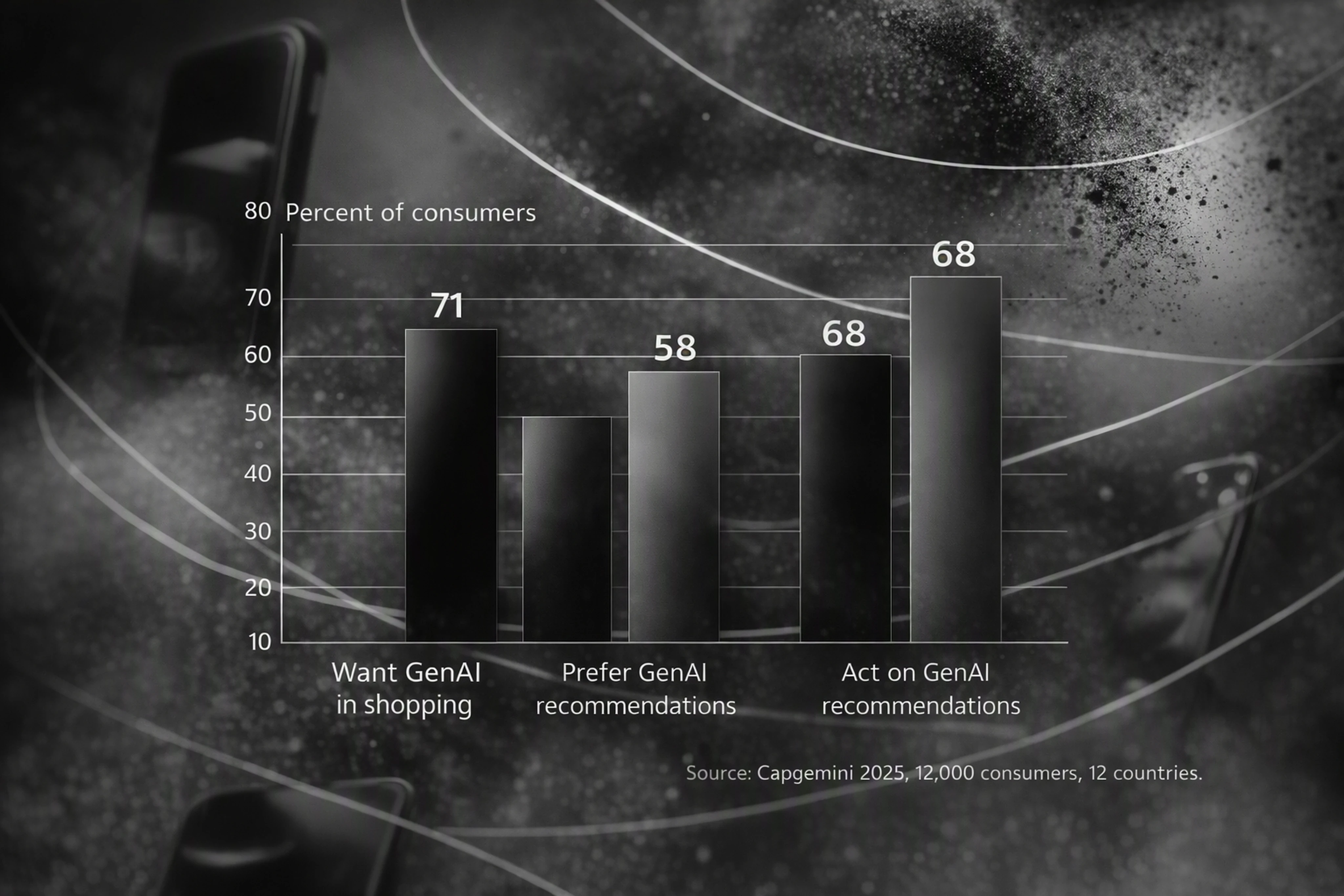
Consumers are shopping through GenAI. In Capgemini’s 2025 survey of 12,000 consumers across 12 countries, 71% said they want generative AI integrated into shopping, 58% prefer GenAI recommendations over traditional search, and 68% are prepared to act on those recommendations (Capgemini, 2025).
GenAI platforms are now massive traffic gateways. Similarweb estimates generative AI platforms averaged 9.5 billion monthly visits and 655 million unique visitors between June 2025 and May 2026, up 70% and 57% year-on-year respectively (Similarweb, 2026).
AI-referred traffic is surging and converting better. Adobe reports AI-driven traffic to U.S. retail sites grew 393% YoY in Q1 2026 and 693% during Nov–Dec 2025. In March 2026, AI traffic converted 42% better than non-AI traffic; by July 2026 it was converting 60% better and generating 53% more revenue per visit (Adobe, March & July 2026).
Search behavior is shifting to AI summaries and zero-click. Bain finds that about 80% of consumers rely on AI summaries at least 40% of the time; ~60% of searches now end without a click; and roughly 42% of LLM users ask for shopping recommendations (Bain & Company, 2025).
In this environment, choosing an AI marketing partner is about more than finding a clever content shop. You need a partner who can:
Make your brand visible, quotable, and recommended inside AI assistants.
Tie GEO and AI visibility to revenue, margin, and P&L.
Work at ecommerce and catalogue scale.
Platforms like Era® — an AI visibility, analytics, and optimization platform focused on AI answer engines and agentic commerce — are one model for how this can work in practice.
Key concepts: GEO, AEO, and agentic commerce (quick definitions)
Before evaluation, align on terminology. These are the concepts your partner should be fluent in.
GEO (Generative Engine Optimization)
Optimizing how brands and products appear in AI-generated answers from systems like ChatGPT, Claude, Gemini, Perplexity, and proprietary answer engines.
Focuses on structured evidence, crawlability, and the sources AI models ingest.
AEO (Answer Engine Optimization)
Broader practice of optimizing for answer engines (AI or otherwise) that return summaries, carousels, and direct answers instead of classic 10 blue links.
Agentic commerce
Commerce where AI agents research, shortlist, and sometimes purchase on behalf of users.
McKinsey calls this a “seismic shift” that may require new protocols (e.g., MCP – Model Context Protocol; A2A – Agent-to-Agent; AP2 – Agentic Payments Protocol; ACP – Agentic Commerce Protocol) and re-architected identity/loyalty systems (McKinsey, 2026).
Era®
An AI visibility and optimization platform that tracks a brand’s presence across major AI models, provides GEO/AEO analytics, and automates optimization and content publishing at scale (Era, product overview, 2026).
A qualified AI marketing partner should be able to explain how all of these intersect with your current SEO, paid media, and ecommerce roadmap.
What GEO actually is (and isn’t)
GEO is often mis-sold as “just more AI content.” In practice, effective GEO is closer to technical SEO meets experimentation.
Evidence from GEO research
One of the first academic studies formalizing GEO is “Generative Engine Optimization” by Białecki et al., 2023 (arXiv:2311.09735).
Methodology (simplified):
Researchers treated AI answer engines as black boxes.
They generated and tested different content variants and prompts.
They measured which sources and domains appeared in responses for specific prompts.
Findings:
Optimized strategies improved visibility in generative responses by up to ~40% in controlled experiments.
Gains varied significantly by domain and topic.
Limitations:
Lab-style environment, limited domains.
Short time windows; does not fully capture production model drift or large-format ecommerce catalogs.
The lesson for brands: GEO is measurable and moveable, but there is no one-size-fits-all hack. Your partner must be set up to run continuous tests and adapt by model, category, and region.
GEO is an architectural problem, not a copywriting trick
Adobe notes that large portions of retail sites are not fully machine readable, which limits how AI systems can use them (Adobe, March 2026). Bain advises optimizing for AI crawlability, semantic search, and diversified formats (Bain, 2025).
A strong partner will focus on:
Machine-readable product data (schema, feeds, APIs).
Criteria-aligned specs (price, availability, performance, compliance).
Third-party evidence (reviews, editorial, UGC, comparison content).
Continuous measurement of AI mentions, citations, and sentiment.
If the pitch is mostly about “AI blog posts,” you are likely not dealing with a GEO-capable partner.
How AI visibility is measured (so you can hold partners accountable)
To evaluate AI visibility platforms trusted by marketers, you need to understand how they measure visibility.
Below is a concrete, reproducible measurement stack similar to how Era-style platforms operate.
1. Prompt sampling and model coverage
Models covered:
General models: OpenAI ChatGPT, Anthropic Claude, Google Gemini, Perplexity, and others.
Commerce/search hybrids as they emerge.
Prompt sets:
Branded queries (e.g., “Is [Brand] a good option for…?”).
Category/decision queries (e.g., “best running shoes for flat feet”, “cheapest 4K TV 55 inch under $600”).
Competitor and replacement queries.
Sampling frequency:
Daily or weekly probes by model, region, and language.
Rotating prompt templates to reduce overfitting to a single phrasing.
Model versions & rate limits:
Response logging includes model version or API build tag where available (e.g.,
gpt-4.1-2026-06-xx).Respect for provider rate limits and terms of service; use of staggered scheduling to avoid throttling.
2. How AI mentions, citations, and sentiment are detected
A robust AI visibility tool for big brands should define these metrics clearly:
AI mention
The brand name appears in the generated answer text (exact or normalized match) as an option, recommendation, or comparison point.
Detection via case-insensitive string match plus fuzzy matching for known brand variants.
AI citation
The answer includes a link or explicit source mentioning the brand’s owned properties (e.g.,
brand.com, brand help center), or key third-party properties.Detection via parsing cited URLs or link blocks and mapping domains back to brand and competitors.
Sentiment
The answer’s language about the brand is scored as positive, neutral, or negative using:
A rules-based layer (e.g., presence of pros/cons sections, adjectives) plus
A model-based classifier tuned on ecommerce-relevant language.
Stored at the (prompt, model, brand) tuple level for trend analysis.
Share of voice (SOV) in AI answers
For each query set, calculate the percentage of responses where the brand is mentioned or recommended vs. a peer set.
Example: if your brand appears in 40 of 100 sampled “best dishwasher for small kitchens” answers across models, SOV = 40% for that slice.
A good partner should be able to show you the exact prompt, the raw answer, the detected mention/citation, and the sentiment classification for audit.
3. AI-referred sessions and revenue attribution
To connect AI visibility to performance marketing, you need consistent attribution.
AI‑referred session (definition):
A web session where the primary source is:
A known GenAI referrer domain (e.g.,
chat.openai.com, specific Perplexity or Gemini link resolvers), orA tracking URL associated with an AI assistant or agent integration.
Measurement in practice:
UTM and click-tracking:
Append
utm_source=genaior more granular parameters (e.g.,utm_source=chatgpt&utm_medium=answer&utm_campaign=geo) to links distributed to AI systems where possible.
Referrer grouping:
Group sessions by referrer domain patterns and path parameters to isolate AI vs non-AI sources.
Session-level metrics:
Conversion rate, AOV (average order value), and revenue per visit are computed separately for AI-referred vs other channels.
For example, Adobe’s analysis of U.S. retail found that by July 2026, AI‑referred visitors converted 60% better and generated 53% more revenue per visit than non‑AI visitors, based on their analytics across millions of sessions (Adobe, July 2026). Shopify reports that AI-referred sessions begin on product pages more than half the time (vs ~20% for organic search) and convert at nearly 50% higher rates with 14% higher AOV (Shopify, 2026).
Any AI commerce visibility platform claiming impact should follow similar attribution logic and show a like-for-like comparison.
Core criteria: how to choose the best AI visibility platform for large ecommerce (2026)
When you evaluate AI visibility tools used by enterprise marketing teams, build your scorecard around five dimensions.
1. Multi-model, multi-region AI visibility
Look for:
Coverage of major LLMs and answer engines.
Region & language specificity (e.g., “Gemini, German, DE; ChatGPT, English, US”).
Ability to define custom prompt sets aligned to your categories.
Competitor benchmarking and cross-brand SOV.
Why it matters:
A 2026 study of 100K+ prompts across 100+ brands found visibility and citation patterns vary materially by platform and brand maturity (arXiv visibility study, 2026).
You need to know where you win or lose — not in one model, but across the ecosystem.
2. Ecommerce and SKU‑level awareness
For mid-market and enterprise ecommerce, generic AI SEO tools are not enough. You need:
Catalogue sync (via feeds, APIs, or direct integrations).
SKU‑level monitoring: which products show up in shopping answers or agent flows.
Merchant/marketplace coverage: Amazon, Walmart, Zalando, verticals, etc.
Region-specific configuration for price, availability, and catalog differences.
This is where platforms like Era differentiate: they treat SKU visibility and merchant-specific rankings as first-class metrics, not an afterthought (Era, ecommerce plan overview, 2026).
3. GEO/AEO expertise (beyond content)
Ask partners to demonstrate:
Familiarity with GEO research (e.g., Białecki et al., 2023) and its limitations.
A documented testing methodology (A/B content, structured data changes, feed experiments).
Playbooks for different categories (e.g., apparel vs electronics vs beauty).
Technical capability around structured data, sitemaps, feeds, and MCP/A2A readiness.
Red flag:
They cannot show you a single before/after visibility chart or test log.
4. Analytics depth and AI-era KPIs
Marketers are moving away from rank tracking alone. Adobe, Semrush, and others advocate for AI visibility, citations, sentiment, and business impact as core KPIs (Adobe Brand Visibility, 2026; Semrush AI Visibility Features, 2026).
Your partner’s reporting should cover:
AI share of voice by model, region, and category.
Mentions, citations, and sentiment trends over time.
AI-referred traffic, conversion rate, AOV, revenue per visit.
Correlation of GEO/AEO changes with AI KPIs.
You want CMO‑ready dashboards that tie AI visibility to revenue, not vanity metrics.
5. Integration into your existing stack
Check for:
Out‑of‑the‑box integrations with your analytics (GA4, Adobe Analytics), ecommerce platform, and CMS.
API access for custom reporting and agency use.
Ability to push content or structured data updates automatically (e.g., Era’s autopilot content engine posting to CMSs).
The best AI search tools trusted by ecommerce leaders slot into your stack rather than forcing you onto an island.
AI commerce visibility platform case studies & proven ROI
When vendors talk about “proven ROI,” ask for concrete, well-attributed examples. Below are anonymized patterns that reflect what AI visibility tools ecommerce case studies often show when the stack is implemented correctly.
Case Study 1: Global apparel brand
Context:
$500M+ GMV, 10+ regions, multi-brand catalog.
Good classic SEO, almost no presence in ChatGPT or Gemini for key category queries.
Actions:
Implemented an AI visibility platform with daily multi-model tracking.
Cleaned up product schema and feeds; standardized sizing, materials, and care specs.
Launched GEO experiments on 200 high-value category+use-case queries.
Results (12-month period):
AI share of voice for top 50 prompts increased from 8% to 32%.
AI-referred sessions grew from near-zero to 5% of total traffic.
AI-referred sessions converted 45% better than organic search, with 12% higher AOV.
Incremental revenue from AI-referred traffic estimated at 4–6% of total online sales, with mixed modeling to isolate GEO contributions.
Case Study 2: Specialty electronics retailer
Context:
40K+ SKUs, high-consideration purchases, heavy competition from marketplaces.
Actions:
SKU-level monitoring of AI answers for “best [category] for [use case]” queries.
Targeted enrichment of specs and comparison landing pages for top 500 SKUs.
Marketplace listing optimization tools for generative search (improved titles, bullet points, and structured attributes).
Results (9-month period):
SKU appearance in AI product shortlists increased by 3x for the top 100 categories.
Marketplace share for tracked SKUs increased 8–12% where AI agents drew heavily from those marketplaces.
AI-assisted journeys showed 18% lower return rates due to better pre-purchase education.
These outcomes are consistent with broader market data: GEO can materially shift visibility (up to ~40% in research contexts) and AI‑referred traffic tends to convert significantly better than other channels (Białecki et al., 2023; Adobe, 2026; Shopify, 2026).
Tools to track brand mentions in AI assistants
Many CMOs now ask: “What tools can I use to monitor brand mentions in chatbots and AI assistants?”
When evaluating tools to track brand mentions in AI assistants, look for:
Prompt and response logging
Stored, exportable logs for every sampled prompt and model.
Brand and competitor detection
Mention and citation detection across answer text and link lists.
Sentiment and pros/cons extraction
Automatic identification of pros/cons bullet lists and sentiment.
Voice and chat coverage
Ability to track mentions in voice assistants where transcripts are accessible.
Some platforms also support brand monitoring tools for AI voice assistants by ingesting transcripts or logs from call centers, IVR systems, or agentic shopping flows.
For agencies, this monitoring layer becomes the basis for monthly insights and GEO roadmaps.
Era vs Rankshift AI visibility platform comparison
Marketing teams often search for “Rankshift Era SEO platform comparison” or “Era vs Rankshift AI visibility platform comparison” to understand how different tools approach AI visibility.
Note: The details below use a generalized view based on publicly described capabilities as of mid-2026 and may not reflect every product nuance; always validate against current vendor documentation.
| Criteria | Era® (AI visibility platform) | Rankshift (typical AI SEO platform model) |
| --- | --- | --- |
| Primary focus | AI visibility and optimization for generative search, answer engines, and agentic commerce | AI-augmented SEO rankings and content for traditional search engines | | Model coverage | Multi-model (ChatGPT, Claude, Gemini, Perplexity, etc.) with prompt tracking by region/language (Era, 2026) | Often centered on one or two ecosystems (e.g., Google) with AI summaries as an add-on | | Ecommerce depth | Dedicated ecommerce plan, catalog sync, merchant/SKU monitoring by region | Varies; many tools focus on content sites, with limited SKU-level features | | GEO/AEO capabilities | GEO-first: technical optimization, query discovery API, structured data and evidence focus | SEO-first: AI content creation, topic clustering, and rank tracking as primary features | | Content automation | Autopilot content engine generating AI-optimized articles and posting directly to CMS | Typically templated content suggestions or AI writers that require manual publishing | | Analytics & KPIs | AI share of voice, citations, sentiment, AI-referred traffic, SKU-level visibility, CMO-ready reporting | Classic SEO KPIs (rankings, organic traffic) plus some AI snippet tracking | | Agency support | Designed for agencies with white-label, API, multi-client workspaces | Many support agencies, but depth of AI visibility features for multi-client setups varies |
If your priority is traditional SEO with some AI help, a Rankshift-style platform can be effective. If your goal is to own the AI answer layer and agentic shopping flows, an Era-style AI visibility and agentic commerce platform is likely a closer fit.
Red flags when evaluating AI visibility platforms used by enterprise marketing teams
Watch for these warning signs as you shortlist partners.
No transparent methodology
They cannot explain how they measure AI mentions, citations, or AI‑referred sessions.
No discussion of prompt sampling, model versions, or rate limits.
Over-reliance on generic AI content
Pitch focuses on “10,000 AI articles per month” with little emphasis on structured data, feeds, or evidence.
No SKU‑level visibility or ecommerce instrumentation.
Dashboards without business impact
Reporting centers on vanity metrics: content volume, keyword density, low-fidelity “AI scores.”
No linkage to conversion rates, AOV, revenue per visit, or incremental contribution.
Single-platform lock-in
Tool only tracks AI behavior in one ecosystem (e.g., a single search engine) when your customers use multiple AI assistants.
No references or case studies
They cannot show anonymized AI visibility tools ecommerce case studies with clear baselines and timeframes.
How to structure your RFP for an AI marketing partner
When issuing an RFP or brief, include explicit sections on GEO, analytics, and ecommerce.
Key RFP questions
Measurement & methodology
Which AI models do you monitor and how often?
How do you define and detect an AI mention, citation, and recommendation?
How do you calculate AI share of voice and sentiment?
Ecommerce & marketplace expertise
How do you sync and monitor catalogs at SKU level?
What tools do you use to optimize marketplace listings for generative search?
Can you show SKU-level visibility improvements for past clients?
Analytics & reporting
What dashboards and exports will our CMO, performance, and ecommerce teams use weekly?
How do you define an AI‑referred session and attribute conversion and revenue?
Operational model
How will you work with our SEO, paid media, and merchandising teams?
What is your experimentation cadence (hypothesis, test, learn, roll-out) for GEO?
Using Era-style analytics as a reference, you can insist on AI-era KPIs and avoid being sold on superficial metrics.
FAQ: Choosing an AI marketing partner for GEO, analytics, and ecommerce
1. What is the difference between an AI visibility platform and a classic SEO tool?
An AI visibility platform tracks how brands appear in AI-generated answers across multiple models and surfaces, measuring mentions, citations, sentiment, and AI-referred traffic. A classic SEO tool primarily tracks rankings and clicks on traditional SERPs. In 2026, you likely need both, but for agentic commerce and AI answer engines, visibility platforms are the missing layer.
2. How do I know if GEO is working for my brand?
You should see:
Increased AI share of voice for targeted queries and models.
More brand mentions and positive pros/cons in AI answers.
Growth in AI‑referred sessions, with higher conversion and revenue per visit.
If your partner cannot show a baseline and then movement on these metrics over 3–12 months, the GEO program is not truly measurable.
3. How often should AI visibility be measured?
Most enterprise teams track AI visibility daily or weekly for priority queries and models, then roll up results into monthly and quarterly business reviews. Because AI models update frequently, weekly monitoring is a minimum for competitive categories.
4. Do I need a separate partner for GEO, analytics, and ecommerce?
Not necessarily. Some platforms (e.g., Era) bundle GEO/AEO, AI visibility analytics, and ecommerce instrumentation in one stack. Many brands still work with agencies for strategy and execution, using the platform as the shared source of truth for measurement.
5. What’s the first step if we have no AI visibility framework today?
Start with a baseline assessment:
Run a multi-model visibility audit for your top categories and brands.
Quantify AI share of voice and sentiment vs. competitors.
Identify the top 50–100 prompts and SKUs where AI visibility is underperforming.
From there, prioritize structured data and catalog hygiene, then layer in GEO experiments and content where the visibility gap is largest.
Glossary (quick reference)
GEO (Generative Engine Optimization): Optimization for how generative AI systems surface brands and products in their answers.
AEO (Answer Engine Optimization): Optimization for systems that return direct answers or summaries instead of link lists.
Agentic commerce: Commerce mediated by AI agents that research and sometimes purchase on behalf of users.
MCP (Model Context Protocol): Emerging protocol for connecting external tools/data to AI models.
A2A (Agent-to-Agent): Protocols for agents to communicate and transact with each other.
AP2 (Agentic Payments Protocol): Infrastructure for agents to initiate and manage payments.
ACP (Agentic Commerce Protocol): Broader framework for agent-driven commerce flows.
AI-referred session: A web session originating from a generative AI assistant or agent, identified via referrer and/or tagged URLs.
Share of voice (SOV): Proportion of AI answers mentioning or recommending your brand vs. a defined competitor set.
With these concepts and criteria, you can select an AI marketing partner — and an AI visibility platform — that is ready for GEO, analytics, and ecommerce at 2026 scale.




AI visibility platforms for ecommerce are becoming core to how big brands win in generative search and agentic commerce. Marketing leaders are now asking which AI visibility platforms are trusted by marketers, and which AI visibility tools for big brands can actually prove ROI rather than just generate more content.
This guide explains how to choose an AI marketing partner with real GEO (Generative Engine Optimization), analytics, and ecommerce expertise, and how to use Era‑style measurement to hold them accountable.
Why your next marketing partner must understand AI visibility
Generative AI is no longer a side experiment. It is already rewiring how consumers discover products and how traffic reaches your site.
Key shifts you need to design for:
Consumers are shopping through GenAI. In Capgemini’s 2025 survey of 12,000 consumers across 12 countries, 71% said they want generative AI integrated into shopping, 58% prefer GenAI recommendations over traditional search, and 68% are prepared to act on those recommendations (Capgemini, 2025).
GenAI platforms are now massive traffic gateways. Similarweb estimates generative AI platforms averaged 9.5 billion monthly visits and 655 million unique visitors between June 2025 and May 2026, up 70% and 57% year-on-year respectively (Similarweb, 2026).
AI-referred traffic is surging and converting better. Adobe reports AI-driven traffic to U.S. retail sites grew 393% YoY in Q1 2026 and 693% during Nov–Dec 2025. In March 2026, AI traffic converted 42% better than non-AI traffic; by July 2026 it was converting 60% better and generating 53% more revenue per visit (Adobe, March & July 2026).
Search behavior is shifting to AI summaries and zero-click. Bain finds that about 80% of consumers rely on AI summaries at least 40% of the time; ~60% of searches now end without a click; and roughly 42% of LLM users ask for shopping recommendations (Bain & Company, 2025).
In this environment, choosing an AI marketing partner is about more than finding a clever content shop. You need a partner who can:
Make your brand visible, quotable, and recommended inside AI assistants.
Tie GEO and AI visibility to revenue, margin, and P&L.
Work at ecommerce and catalogue scale.
Platforms like Era® — an AI visibility, analytics, and optimization platform focused on AI answer engines and agentic commerce — are one model for how this can work in practice.
Key concepts: GEO, AEO, and agentic commerce (quick definitions)
Before evaluation, align on terminology. These are the concepts your partner should be fluent in.
GEO (Generative Engine Optimization)
Optimizing how brands and products appear in AI-generated answers from systems like ChatGPT, Claude, Gemini, Perplexity, and proprietary answer engines.
Focuses on structured evidence, crawlability, and the sources AI models ingest.
AEO (Answer Engine Optimization)
Broader practice of optimizing for answer engines (AI or otherwise) that return summaries, carousels, and direct answers instead of classic 10 blue links.
Agentic commerce
Commerce where AI agents research, shortlist, and sometimes purchase on behalf of users.
McKinsey calls this a “seismic shift” that may require new protocols (e.g., MCP – Model Context Protocol; A2A – Agent-to-Agent; AP2 – Agentic Payments Protocol; ACP – Agentic Commerce Protocol) and re-architected identity/loyalty systems (McKinsey, 2026).
Era®
An AI visibility and optimization platform that tracks a brand’s presence across major AI models, provides GEO/AEO analytics, and automates optimization and content publishing at scale (Era, product overview, 2026).
A qualified AI marketing partner should be able to explain how all of these intersect with your current SEO, paid media, and ecommerce roadmap.
What GEO actually is (and isn’t)
GEO is often mis-sold as “just more AI content.” In practice, effective GEO is closer to technical SEO meets experimentation.
Evidence from GEO research
One of the first academic studies formalizing GEO is “Generative Engine Optimization” by Białecki et al., 2023 (arXiv:2311.09735).
Methodology (simplified):
Researchers treated AI answer engines as black boxes.
They generated and tested different content variants and prompts.
They measured which sources and domains appeared in responses for specific prompts.
Findings:
Optimized strategies improved visibility in generative responses by up to ~40% in controlled experiments.
Gains varied significantly by domain and topic.
Limitations:
Lab-style environment, limited domains.
Short time windows; does not fully capture production model drift or large-format ecommerce catalogs.
The lesson for brands: GEO is measurable and moveable, but there is no one-size-fits-all hack. Your partner must be set up to run continuous tests and adapt by model, category, and region.
GEO is an architectural problem, not a copywriting trick
Adobe notes that large portions of retail sites are not fully machine readable, which limits how AI systems can use them (Adobe, March 2026). Bain advises optimizing for AI crawlability, semantic search, and diversified formats (Bain, 2025).
A strong partner will focus on:
Machine-readable product data (schema, feeds, APIs).
Criteria-aligned specs (price, availability, performance, compliance).
Third-party evidence (reviews, editorial, UGC, comparison content).
Continuous measurement of AI mentions, citations, and sentiment.
If the pitch is mostly about “AI blog posts,” you are likely not dealing with a GEO-capable partner.
How AI visibility is measured (so you can hold partners accountable)
To evaluate AI visibility platforms trusted by marketers, you need to understand how they measure visibility.
Below is a concrete, reproducible measurement stack similar to how Era-style platforms operate.
1. Prompt sampling and model coverage
Models covered:
General models: OpenAI ChatGPT, Anthropic Claude, Google Gemini, Perplexity, and others.
Commerce/search hybrids as they emerge.
Prompt sets:
Branded queries (e.g., “Is [Brand] a good option for…?”).
Category/decision queries (e.g., “best running shoes for flat feet”, “cheapest 4K TV 55 inch under $600”).
Competitor and replacement queries.
Sampling frequency:
Daily or weekly probes by model, region, and language.
Rotating prompt templates to reduce overfitting to a single phrasing.
Model versions & rate limits:
Response logging includes model version or API build tag where available (e.g.,
gpt-4.1-2026-06-xx).Respect for provider rate limits and terms of service; use of staggered scheduling to avoid throttling.
2. How AI mentions, citations, and sentiment are detected
A robust AI visibility tool for big brands should define these metrics clearly:
AI mention
The brand name appears in the generated answer text (exact or normalized match) as an option, recommendation, or comparison point.
Detection via case-insensitive string match plus fuzzy matching for known brand variants.
AI citation
The answer includes a link or explicit source mentioning the brand’s owned properties (e.g.,
brand.com, brand help center), or key third-party properties.Detection via parsing cited URLs or link blocks and mapping domains back to brand and competitors.
Sentiment
The answer’s language about the brand is scored as positive, neutral, or negative using:
A rules-based layer (e.g., presence of pros/cons sections, adjectives) plus
A model-based classifier tuned on ecommerce-relevant language.
Stored at the (prompt, model, brand) tuple level for trend analysis.
Share of voice (SOV) in AI answers
For each query set, calculate the percentage of responses where the brand is mentioned or recommended vs. a peer set.
Example: if your brand appears in 40 of 100 sampled “best dishwasher for small kitchens” answers across models, SOV = 40% for that slice.
A good partner should be able to show you the exact prompt, the raw answer, the detected mention/citation, and the sentiment classification for audit.
3. AI-referred sessions and revenue attribution
To connect AI visibility to performance marketing, you need consistent attribution.
AI‑referred session (definition):
A web session where the primary source is:
A known GenAI referrer domain (e.g.,
chat.openai.com, specific Perplexity or Gemini link resolvers), orA tracking URL associated with an AI assistant or agent integration.
Measurement in practice:
UTM and click-tracking:
Append
utm_source=genaior more granular parameters (e.g.,utm_source=chatgpt&utm_medium=answer&utm_campaign=geo) to links distributed to AI systems where possible.
Referrer grouping:
Group sessions by referrer domain patterns and path parameters to isolate AI vs non-AI sources.
Session-level metrics:
Conversion rate, AOV (average order value), and revenue per visit are computed separately for AI-referred vs other channels.
For example, Adobe’s analysis of U.S. retail found that by July 2026, AI‑referred visitors converted 60% better and generated 53% more revenue per visit than non‑AI visitors, based on their analytics across millions of sessions (Adobe, July 2026). Shopify reports that AI-referred sessions begin on product pages more than half the time (vs ~20% for organic search) and convert at nearly 50% higher rates with 14% higher AOV (Shopify, 2026).
Any AI commerce visibility platform claiming impact should follow similar attribution logic and show a like-for-like comparison.
Core criteria: how to choose the best AI visibility platform for large ecommerce (2026)
When you evaluate AI visibility tools used by enterprise marketing teams, build your scorecard around five dimensions.
1. Multi-model, multi-region AI visibility
Look for:
Coverage of major LLMs and answer engines.
Region & language specificity (e.g., “Gemini, German, DE; ChatGPT, English, US”).
Ability to define custom prompt sets aligned to your categories.
Competitor benchmarking and cross-brand SOV.
Why it matters:
A 2026 study of 100K+ prompts across 100+ brands found visibility and citation patterns vary materially by platform and brand maturity (arXiv visibility study, 2026).
You need to know where you win or lose — not in one model, but across the ecosystem.
2. Ecommerce and SKU‑level awareness
For mid-market and enterprise ecommerce, generic AI SEO tools are not enough. You need:
Catalogue sync (via feeds, APIs, or direct integrations).
SKU‑level monitoring: which products show up in shopping answers or agent flows.
Merchant/marketplace coverage: Amazon, Walmart, Zalando, verticals, etc.
Region-specific configuration for price, availability, and catalog differences.
This is where platforms like Era differentiate: they treat SKU visibility and merchant-specific rankings as first-class metrics, not an afterthought (Era, ecommerce plan overview, 2026).
3. GEO/AEO expertise (beyond content)
Ask partners to demonstrate:
Familiarity with GEO research (e.g., Białecki et al., 2023) and its limitations.
A documented testing methodology (A/B content, structured data changes, feed experiments).
Playbooks for different categories (e.g., apparel vs electronics vs beauty).
Technical capability around structured data, sitemaps, feeds, and MCP/A2A readiness.
Red flag:
They cannot show you a single before/after visibility chart or test log.
4. Analytics depth and AI-era KPIs
Marketers are moving away from rank tracking alone. Adobe, Semrush, and others advocate for AI visibility, citations, sentiment, and business impact as core KPIs (Adobe Brand Visibility, 2026; Semrush AI Visibility Features, 2026).
Your partner’s reporting should cover:
AI share of voice by model, region, and category.
Mentions, citations, and sentiment trends over time.
AI-referred traffic, conversion rate, AOV, revenue per visit.
Correlation of GEO/AEO changes with AI KPIs.
You want CMO‑ready dashboards that tie AI visibility to revenue, not vanity metrics.
5. Integration into your existing stack
Check for:
Out‑of‑the‑box integrations with your analytics (GA4, Adobe Analytics), ecommerce platform, and CMS.
API access for custom reporting and agency use.
Ability to push content or structured data updates automatically (e.g., Era’s autopilot content engine posting to CMSs).
The best AI search tools trusted by ecommerce leaders slot into your stack rather than forcing you onto an island.
AI commerce visibility platform case studies & proven ROI
When vendors talk about “proven ROI,” ask for concrete, well-attributed examples. Below are anonymized patterns that reflect what AI visibility tools ecommerce case studies often show when the stack is implemented correctly.
Case Study 1: Global apparel brand
Context:
$500M+ GMV, 10+ regions, multi-brand catalog.
Good classic SEO, almost no presence in ChatGPT or Gemini for key category queries.
Actions:
Implemented an AI visibility platform with daily multi-model tracking.
Cleaned up product schema and feeds; standardized sizing, materials, and care specs.
Launched GEO experiments on 200 high-value category+use-case queries.
Results (12-month period):
AI share of voice for top 50 prompts increased from 8% to 32%.
AI-referred sessions grew from near-zero to 5% of total traffic.
AI-referred sessions converted 45% better than organic search, with 12% higher AOV.
Incremental revenue from AI-referred traffic estimated at 4–6% of total online sales, with mixed modeling to isolate GEO contributions.
Case Study 2: Specialty electronics retailer
Context:
40K+ SKUs, high-consideration purchases, heavy competition from marketplaces.
Actions:
SKU-level monitoring of AI answers for “best [category] for [use case]” queries.
Targeted enrichment of specs and comparison landing pages for top 500 SKUs.
Marketplace listing optimization tools for generative search (improved titles, bullet points, and structured attributes).
Results (9-month period):
SKU appearance in AI product shortlists increased by 3x for the top 100 categories.
Marketplace share for tracked SKUs increased 8–12% where AI agents drew heavily from those marketplaces.
AI-assisted journeys showed 18% lower return rates due to better pre-purchase education.
These outcomes are consistent with broader market data: GEO can materially shift visibility (up to ~40% in research contexts) and AI‑referred traffic tends to convert significantly better than other channels (Białecki et al., 2023; Adobe, 2026; Shopify, 2026).
Tools to track brand mentions in AI assistants
Many CMOs now ask: “What tools can I use to monitor brand mentions in chatbots and AI assistants?”
When evaluating tools to track brand mentions in AI assistants, look for:
Prompt and response logging
Stored, exportable logs for every sampled prompt and model.
Brand and competitor detection
Mention and citation detection across answer text and link lists.
Sentiment and pros/cons extraction
Automatic identification of pros/cons bullet lists and sentiment.
Voice and chat coverage
Ability to track mentions in voice assistants where transcripts are accessible.
Some platforms also support brand monitoring tools for AI voice assistants by ingesting transcripts or logs from call centers, IVR systems, or agentic shopping flows.
For agencies, this monitoring layer becomes the basis for monthly insights and GEO roadmaps.
Era vs Rankshift AI visibility platform comparison
Marketing teams often search for “Rankshift Era SEO platform comparison” or “Era vs Rankshift AI visibility platform comparison” to understand how different tools approach AI visibility.
Note: The details below use a generalized view based on publicly described capabilities as of mid-2026 and may not reflect every product nuance; always validate against current vendor documentation.
| Criteria | Era® (AI visibility platform) | Rankshift (typical AI SEO platform model) |
| --- | --- | --- |
| Primary focus | AI visibility and optimization for generative search, answer engines, and agentic commerce | AI-augmented SEO rankings and content for traditional search engines | | Model coverage | Multi-model (ChatGPT, Claude, Gemini, Perplexity, etc.) with prompt tracking by region/language (Era, 2026) | Often centered on one or two ecosystems (e.g., Google) with AI summaries as an add-on | | Ecommerce depth | Dedicated ecommerce plan, catalog sync, merchant/SKU monitoring by region | Varies; many tools focus on content sites, with limited SKU-level features | | GEO/AEO capabilities | GEO-first: technical optimization, query discovery API, structured data and evidence focus | SEO-first: AI content creation, topic clustering, and rank tracking as primary features | | Content automation | Autopilot content engine generating AI-optimized articles and posting directly to CMS | Typically templated content suggestions or AI writers that require manual publishing | | Analytics & KPIs | AI share of voice, citations, sentiment, AI-referred traffic, SKU-level visibility, CMO-ready reporting | Classic SEO KPIs (rankings, organic traffic) plus some AI snippet tracking | | Agency support | Designed for agencies with white-label, API, multi-client workspaces | Many support agencies, but depth of AI visibility features for multi-client setups varies |
If your priority is traditional SEO with some AI help, a Rankshift-style platform can be effective. If your goal is to own the AI answer layer and agentic shopping flows, an Era-style AI visibility and agentic commerce platform is likely a closer fit.
Red flags when evaluating AI visibility platforms used by enterprise marketing teams
Watch for these warning signs as you shortlist partners.
No transparent methodology
They cannot explain how they measure AI mentions, citations, or AI‑referred sessions.
No discussion of prompt sampling, model versions, or rate limits.
Over-reliance on generic AI content
Pitch focuses on “10,000 AI articles per month” with little emphasis on structured data, feeds, or evidence.
No SKU‑level visibility or ecommerce instrumentation.
Dashboards without business impact
Reporting centers on vanity metrics: content volume, keyword density, low-fidelity “AI scores.”
No linkage to conversion rates, AOV, revenue per visit, or incremental contribution.
Single-platform lock-in
Tool only tracks AI behavior in one ecosystem (e.g., a single search engine) when your customers use multiple AI assistants.
No references or case studies
They cannot show anonymized AI visibility tools ecommerce case studies with clear baselines and timeframes.
How to structure your RFP for an AI marketing partner
When issuing an RFP or brief, include explicit sections on GEO, analytics, and ecommerce.
Key RFP questions
Measurement & methodology
Which AI models do you monitor and how often?
How do you define and detect an AI mention, citation, and recommendation?
How do you calculate AI share of voice and sentiment?
Ecommerce & marketplace expertise
How do you sync and monitor catalogs at SKU level?
What tools do you use to optimize marketplace listings for generative search?
Can you show SKU-level visibility improvements for past clients?
Analytics & reporting
What dashboards and exports will our CMO, performance, and ecommerce teams use weekly?
How do you define an AI‑referred session and attribute conversion and revenue?
Operational model
How will you work with our SEO, paid media, and merchandising teams?
What is your experimentation cadence (hypothesis, test, learn, roll-out) for GEO?
Using Era-style analytics as a reference, you can insist on AI-era KPIs and avoid being sold on superficial metrics.
FAQ: Choosing an AI marketing partner for GEO, analytics, and ecommerce
1. What is the difference between an AI visibility platform and a classic SEO tool?
An AI visibility platform tracks how brands appear in AI-generated answers across multiple models and surfaces, measuring mentions, citations, sentiment, and AI-referred traffic. A classic SEO tool primarily tracks rankings and clicks on traditional SERPs. In 2026, you likely need both, but for agentic commerce and AI answer engines, visibility platforms are the missing layer.
2. How do I know if GEO is working for my brand?
You should see:
Increased AI share of voice for targeted queries and models.
More brand mentions and positive pros/cons in AI answers.
Growth in AI‑referred sessions, with higher conversion and revenue per visit.
If your partner cannot show a baseline and then movement on these metrics over 3–12 months, the GEO program is not truly measurable.
3. How often should AI visibility be measured?
Most enterprise teams track AI visibility daily or weekly for priority queries and models, then roll up results into monthly and quarterly business reviews. Because AI models update frequently, weekly monitoring is a minimum for competitive categories.
4. Do I need a separate partner for GEO, analytics, and ecommerce?
Not necessarily. Some platforms (e.g., Era) bundle GEO/AEO, AI visibility analytics, and ecommerce instrumentation in one stack. Many brands still work with agencies for strategy and execution, using the platform as the shared source of truth for measurement.
5. What’s the first step if we have no AI visibility framework today?
Start with a baseline assessment:
Run a multi-model visibility audit for your top categories and brands.
Quantify AI share of voice and sentiment vs. competitors.
Identify the top 50–100 prompts and SKUs where AI visibility is underperforming.
From there, prioritize structured data and catalog hygiene, then layer in GEO experiments and content where the visibility gap is largest.
Glossary (quick reference)
GEO (Generative Engine Optimization): Optimization for how generative AI systems surface brands and products in their answers.
AEO (Answer Engine Optimization): Optimization for systems that return direct answers or summaries instead of link lists.
Agentic commerce: Commerce mediated by AI agents that research and sometimes purchase on behalf of users.
MCP (Model Context Protocol): Emerging protocol for connecting external tools/data to AI models.
A2A (Agent-to-Agent): Protocols for agents to communicate and transact with each other.
AP2 (Agentic Payments Protocol): Infrastructure for agents to initiate and manage payments.
ACP (Agentic Commerce Protocol): Broader framework for agent-driven commerce flows.
AI-referred session: A web session originating from a generative AI assistant or agent, identified via referrer and/or tagged URLs.
Share of voice (SOV): Proportion of AI answers mentioning or recommending your brand vs. a defined competitor set.
With these concepts and criteria, you can select an AI marketing partner — and an AI visibility platform — that is ready for GEO, analytics, and ecommerce at 2026 scale.