
October 1, 2026
October 1, 2026
AEO vs SEO: How Era’s AI Visibility Platform Redefines Answer Engine Optimization and GEO
AI answer engines are already rewriting how shoppers discover products—yet most teams are still staring at legacy SEO dashboards. This guide explains AEO vs…
AI answer engines are already rewriting how shoppers discover products—yet most teams are still staring at legacy SEO dashboards. This guide explains AEO vs…
AI answer engines are already rewriting how shoppers discover products—yet most teams are still staring at legacy SEO dashboards. This guide explains AEO vs SEO, what GEO really is, and how an AI visibility platform like Era helps big brands become the default AI shopping recommendation.
What Is Answer Engine Optimization (AEO)?
Answer Engine Optimization (AEO) is the practice of improving how your brand and products appear in AI-generated answers from systems like ChatGPT, Claude, Gemini, Perplexity, and AI shopping agents.
Where classic SEO optimizes for a list of blue links, AEO optimizes for the answer itself:
Are you mentioned by name when users ask what to buy?
Do your products appear in AI shopping carousels and buying flows?
Are your pros/cons and prices accurately represented?
Google itself acknowledges that “AEO” and “GEO” are terms used in the market for AI search visibility work, even though it still considers this part of SEO. Its AI optimization guide states that generative AI features in Search are “grounded in our core ranking and quality systems” and that the same principles apply across classic and AI results (Google, Optimize your content for Google Search’s generative AI features, Google Search Central documentation, 2025, https://developers.google.com/search/docs/fundamentals/ai-optimization-guide).
In practice, AEO means:
Tracking how often you’re recommended in AI answers vs competitors
Ensuring AI agents see clean, structured, trustworthy data
Feeding product and content evidence into the data sources LLMs use
GEO vs AEO vs SEO: How They Relate
Before we go deeper, here’s a simple map of the terms.
SEO (Search Engine Optimization)
Focus: Traditional web search (Google, Bing, etc.)
Goal: Rank pages for queries, earn organic clicks
Levers: Content, technical SEO, links, user signals
GEO (Generative Engine Optimization)
Focus: Generative engines and AI search experiences (Google AI Overviews, ChatGPT, Perplexity, Gemini, Claude, etc.)
Goal: Improve how often and how prominently your brand is used in generated answers
First formalized by academic work: Princeton researchers found that optimizing input content for generative engines can increase visibility in AI responses by up to 40% (Yao Dong et al., GEO: Generative Engine Optimization, Princeton University, 2023, https://collaborate.princeton.edu/en/publications/geo-generative-engine-optimization/).
AEO (Answer Engine Optimization)
Focus: Any answer-first interface—search summaries, chatbots, conversational agents, and autonomous shopping agents
Goal: Win the recommendation slot when users ask “what should I buy?” or “which brand is best?”
Methods: Measurement of AI share of voice, decision-criteria evidence, structured product data, reviews, authority signals
You can think of it this way:
SEO → gets you indexed and ranked
GEO → adapts your content and feeds to generative engines
AEO → orchestrates everything around the final answer a user sees
Era treats AEO as the umbrella discipline and GEO as one of its technical pillars.
Why AEO Matters Now: The AI Shopping Shift
AI-driven discovery is not a future bet; it’s already reshaping shopping behavior.
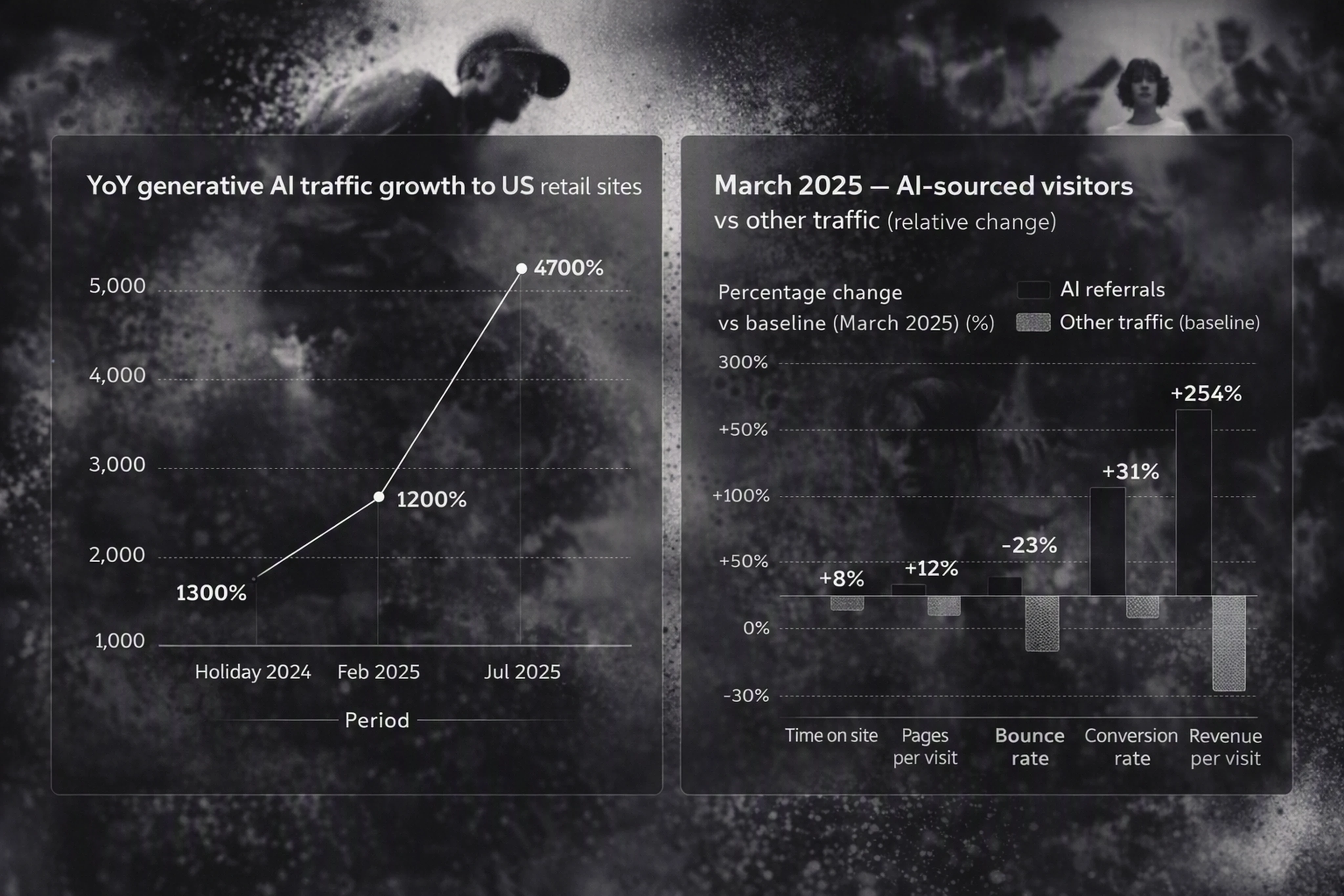
Adobe reports that traffic to U.S. retail websites from generative AI sources rose 1,200% year-over-year in February 2025, 1,300% during the 2024 holiday period, and 4,700% year-over-year by July 2025 (Taylor Schreiner, Traffic to U.S. retail websites from generative AI sources jumps 1,200%, Adobe Analytics, March 17, 2025, https://blog.adobe.com/en/publish/2025/03/17/adobe-analytics-traffic-to-us-retail-websites-from-generative-ai-sources-jumps-1200-percent).
Those visitors are higher value: Adobe found AI-sourced shoppers spent 8% longer on site, viewed 12% more pages per visit, and had a 23% lower bounce rate in March 2025 (Schreiner, Adobe, 2025, same source). During the 2024 holiday recap, AI referrals converted 31% better than other sources and generated 254% higher revenue per visit (Taylor Schreiner, Holiday 2024 online shopping trends, Adobe Analytics, January 2025, https://blog.adobe.com/en/publish/2025/01/07/holiday-2024-online-shopping-trends).
Salesforce’s 2025 Connected Shoppers research found 39% of consumers and over half of Gen Z already use AI for product discovery, based on a survey of 8,350 shoppers and 1,700 retail decision-makers (Salesforce, New data: How AI is reshaping shopping behavior, Salesforce Newsroom, January 2025, https://www.salesforce.com/news/stories/consumer-shopping-ai-trends-2025/).
Bain & Company found that 80% of search users rely on AI-written summaries for at least 40% of their searches, and estimated that around 60% of searches now end without a click, with AI reducing organic traffic by 15–25% (Bain & Company, SEO in the Age of AI Search, Bain Insights via PublicNow, February 2025, https://www.publicnow.com/view/53DC9988E8C9EE9ADC769CB3984CFBBCE3319B3A).
User behavior is shifting inside Google as well:
A Pew Research Center survey of U.S. adults found 58% of respondents ran at least one Google search in March 2025 that produced an AI summary, and users were less likely to click links when a summary appeared (Michelle Faverio, Google users are less likely to click on links when an AI summary appears in the results, Pew Research Center, July 22, 2025, https://www.pewresearch.org/short-reads/2025/07/22/google-users-are-less-likely-to-click-on-links-when-an-ai-summary-appears-in-the-results/).
Ahrefs analyzed millions of searches and found that when AI Overviews are present, click-through rate (CTR) on the top-ranking page was 34.5% lower in April 2025; a February 2026 update showed the gap widening to 58% (Patrick Stox, AI Overviews reduce clicks to websites, Ahrefs Blog, April 2025 and updated February 2026, https://ahrefs.com/blog/ai-overviews-reduce-clicks/).
At the same time, AI itself is going mainstream:
Similarweb reports 76% year-over-year growth in average monthly GenAI site visits, 319% YoY growth in GenAI app downloads, and 1.1 billion referral visits from AI platforms in June 2025—up 357% vs June 2024 (Similarweb, AI Discovery Surges: Similarweb’s 2025 Generative AI Report Says, company press release, July 2025, https://ir.similarweb.com/news-events/press-releases/detail/138/ai-discovery-surges-similarwebs-2025-generative-ai-report-says).
OpenAI states that more than 700 million people use ChatGPT every week and that shopping flows with product discovery and Instant Checkout are live in the U.S. (OpenAI, Buy it in ChatGPT, May 2025, https://openai.com/index/buy-it-in-chatgpt/).
In this environment, ranking in classic SERPs is no longer enough. You must win at the AI answer layer.
Era’s Origin Story: Built for AI Visibility and Agentic Commerce
Era was created around a simple but urgent observation: AI answer engines are becoming the new shopping front door, but brands had no way to see—or control—how often they were recommended.
Traditional SEO platforms assumed:
The search result page is a list of links
The main metric is rank and click-through
The unit of optimization is a webpage
But AI answer engines work differently:
They surface brands, SKUs, and evidence, not just URLs
They make multi-factor recommendations based on price, availability, trust, reviews, and specs
They operate across multiple models and regions, each with its own data sources
Era raised $1.4M in pre-seed funding to build a platform explicitly for this new layer—focused on catalog sync, SKU-level analytics, and automated content optimization for AI answer engines (Tech Funding News, Era Shopping raises €1.3M to help brands become the AI-recommended choice, May 2024, https://techfundingnews.com/era-shopping-1-4m-chatgpt-ai-agents-exclusive/).
Era’s thesis:
AI answer engines are the default advisor. ChatGPT, Claude, Gemini, Perplexity, and shopping agents will mediate a rising share of product discovery and purchase initiation.
AI visibility is an architectural problem. It’s about feeds, schemas, catalogue hygiene, and third-party evidence—not keyword tricks.
Decision-stage evidence beats generic awareness. Pros/cons, specs, reviews, and availability data matter more than slogans.
Brands should own their AI visibility stack. You shouldn’t have to guess how opaque AI shopping systems see you.
Era’s platform is built to be that stack.
AEO in Practice: How It Diverges from Classic SEO
AEO doesn’t replace SEO—but it does change what you measure and optimize.
1. From “rankings” to AI share of voice
Classic SEO:
Tracks positions for keywords in SERPs
Optimizes pages and backlinks
AEO:
Tracks share of voice inside AI answers across models
Asks:
How many answers mention your brand vs competitors?
How often are your SKUs selected in shopping agents’ top picks?
What sentiment and pros/cons are attached to your brand?
2. From pages to products and entities
Classic SEO:
Optimizes URLs and content blocks
AEO/GEO:
Optimizes products, attributes, and entities:
SKU-level product data and specs
Merchant feeds (Google Merchant Center, marketplace catalogs)
Brand entities (organization schema, review/ratings, FAQs)
Google’s ecommerce documentation explicitly notes that structured product data and Merchant Center feeds improve understanding and make products eligible across rich shopping surfaces (Google, Share your product data with Google, Search Central documentation, 2025, https://developers.google.com/search/docs/specialty/ecommerce/share-your-product-data-with-google).
3. From on-page copy to multi-source evidence
Classic SEO:
Focuses heavily on on-page keywords and metadata
AEO/GEO:
Coordinates multiple evidence sources that LLMs read:
Your site content and schemas
Product feeds and marketplace listings
Third-party reviews and trusted editorial sites
Support docs, FAQs, how-to content
Bain’s research stresses that SEO in the AI era means optimizing for AI crawlability, semantic/long-tail intent, diversified formats, and new metrics like impressions and reach rather than only clicks (Bain & Company, SEO in the Age of AI Search, 2025, same source as above).
GEO (Generative Engine Optimization): The Technical Core of AEO
GEO is the technical toolkit inside AEO focused on generative engines.
Based on Princeton’s GEO research and Era’s customer programs, effective GEO for ecommerce includes:
Content structuring and markup
Use schema.org Product, Offer, Organization, FAQ, and Review markup
Ensure prices, availability, and specs are machine-readable and consistent
Feed hygiene and coverage
Clean, complete product feeds to Google, marketplaces, and commerce APIs
Regional configuration: currency, shipping, local availability
Semantic expansion and query discovery
Identify how users phrase questions in AI chat (long-tail, conversational)
Cover decision-stage queries: “best X for Y,” “X vs Y for Z,” “what to buy for…”
Evidence enrichment
Aggregate reviews and ratings
Provide clear pros/cons, use cases, and comparison content
Princeton’s GEO paper emphasizes that generative engines are black boxes where creators have “little to no control” over how content surfaces, and proposes GEO techniques to systematically improve visibility (Dong et al., Princeton, 2023, same source).
Era’s platform builds these GEO capabilities into an operational program: tracking results daily and automatically generating AI-optimized content to fill gaps.
Reproducible AEO Examples: Prompts, Schema, and SKU Tracking
AEO is only useful if you can reproduce and verify results. Here’s how to do that.
1) Sample prompts to test AI presence
Try these prompts in ChatGPT, Claude, Gemini, and Perplexity:
“Which are the best [category] brands for [use case] in [country]?”
“What are the top 5 [product type] for [specific audience]?”
“Between [Your Brand] and [Competitor], which is better for [use case]?”
“Recommend an online store to buy [product category] with fast shipping in [region].”
“I need a [price range] [product] that works with [platform]. What should I buy?”
For each model, document:
Are you mentioned? If yes, in which position?
Are specific SKUs mentioned, linked, or shown in a carousel?
What pros/cons, prices, and sentiments are attributed to you?
2) Sample Product schema snippet (GEO-ready)
{
  "@context": "https://schema.org",
  "@type": "Product",
  "name": "UltraComfort Running Shoes",
  "image": [
    "https://example.com/images/ultracomfort-running-shoes-front.jpg"
  ],
  "description": "Lightweight running shoes designed for daily training with advanced cushioning and breathable mesh.",
  "sku": "UCRS-2026-RED-42",
  "brand": {
    "@type": "Brand",
    "name": "ExampleSports"
  },
  "offers": {
    "@type": "Offer",
    "url": "https://example.com/products/ultracomfort-running-shoes",
    "priceCurrency": "USD",
    "price": "129.00",
    "priceValidUntil": "2027-12-31",
    "availability": "https://schema.org/InStock",
    "itemCondition": "https://schema.org/NewCondition",
    "shippingDetails": {
      "@type": "OfferShippingDetails",
      "shippingDestination": {
        "@type": "DefinedRegion",
        "addressCountry": "US"
      },
      "deliveryTime": {
        "@type": "ShippingDeliveryTime",
        "handlingTime": {
          "@type": "QuantitativeValue",
          "minValue": 1,
          "maxValue": 2,
          "unitCode": "d"
        },
        "transitTime": {
          "@type": "QuantitativeValue",
          "minValue": 2,
          "maxValue": 5,
          "unitCode": "d"
        }
      }
    }
  },
  "aggregateRating": {
    "@type": "AggregateRating",
    "ratingValue": "4.6",
    "reviewCount": "327"
  }
}
{
  "@context": "https://schema.org",
  "@type": "Product",
  "name": "UltraComfort Running Shoes",
  "image": [
    "https://example.com/images/ultracomfort-running-shoes-front.jpg"
  ],
  "description": "Lightweight running shoes designed for daily training with advanced cushioning and breathable mesh.",
  "sku": "UCRS-2026-RED-42",
  "brand": {
    "@type": "Brand",
    "name": "ExampleSports"
  },
  "offers": {
    "@type": "Offer",
    "url": "https://example.com/products/ultracomfort-running-shoes",
    "priceCurrency": "USD",
    "price": "129.00",
    "priceValidUntil": "2027-12-31",
    "availability": "https://schema.org/InStock",
    "itemCondition": "https://schema.org/NewCondition",
    "shippingDetails": {
      "@type": "OfferShippingDetails",
      "shippingDestination": {
        "@type": "DefinedRegion",
        "addressCountry": "US"
      },
      "deliveryTime": {
        "@type": "ShippingDeliveryTime",
        "handlingTime": {
          "@type": "QuantitativeValue",
          "minValue": 1,
          "maxValue": 2,
          "unitCode": "d"
        },
        "transitTime": {
          "@type": "QuantitativeValue",
          "minValue": 2,
          "maxValue": 5,
          "unitCode": "d"
        }
      }
    }
  },
  "aggregateRating": {
    "@type": "AggregateRating",
    "ratingValue": "4.6",
    "reviewCount": "327"
  }
}
This schema:
Makes the product and offer machine-readable
Exposes pricing, availability, and reviews—key inputs for AI shopping agents
3) Step-by-step: Measuring SKU visibility across models
You can implement a basic GEO measurement loop in-house or via a platform like Era.
Define your SKU universe
Start with top 50–500 revenue-driving SKUs
Map SKUs to categories, price bands, and regions
Generate intent-based queries
For each SKU or category, create:
“[best/top] [category] for [use case] in [region]”
“[category] under [price]”
“[category] compatible with [platform]”
Query multiple AI models
Run these prompts in ChatGPT, Claude, Gemini, Perplexity, and (where available) AI shopping agents
Capture: answer text, carousels, outbound links, cited merchants
Code results at SKU and brand level
Was your brand mentioned? (Y/N)
Which SKUs appeared? (by identifier)
What rank/position did each SKU hold in the recommended list?
Calculate AI share metrics
Brand answer share: % of prompts where your brand is recommended
SKU coverage: % of target SKUs that appear in any answer
Average rank: mean position for SKUs where you appear
Sentiment score: simple +/0/– classification for how the model describes you
Repeat monthly and compare
Track gains/losses by model, category, and region
Align AEO efforts to categories where share of voice is low but commercial value is high
Era automates this process at scale with API-based query generation, daily multi-model monitoring, and SKU-level analytics, but the framework is reproducible even for manual pilots.
AI Visibility Platforms Trusted by Marketers: How to Evaluate
With AI visibility emerging as its own category, more vendors claim to offer “AI SEO” or AEO. The IAB notes that over 20 companies now sell AI visibility tools and has proposed a 4-Ps framework (Presence, Position, Prominence, Proximity) for measuring AI-era visibility (IAB, Measuring Visibility in the AI Era, Industry Guidance, 2025, https://www.iab.com/news/iab-releases-measuring-visibility-in-the-ai-era/).
When evaluating AI visibility platforms trusted by marketers, especially for mid-market and enterprise ecommerce, look for:
Multi-model coverage
Does it track ChatGPT, Claude, Gemini, Perplexity, and emerging shopping agents?
Are regions and languages configurable?
SKU-level and merchant-level analytics
Can you see which SKUs are recommended, by which agents, in which markets?
Is marketplace vs direct-channel performance visible?
Answer-centric reporting
AI share of voice, not just URL rankings
Pros/cons extraction, sentiment, and competitor mentions
CMO-ready summaries that tie to revenue and P&L, not vanity metrics
Closed loop: from insight to action
Query discovery from real AI conversations
Content and feed recommendations
Optional content autopilot that can publish to your CMS
Agency and enterprise readiness
API access, unlimited seats, white-label options
Support for multiple brands, catalogs, and markets
Era is positioned as an all-in-one AI visibility platform used by enterprise marketing teams that checks these boxes while focusing specifically on ecommerce and agentic commerce.
Marketplace Listing Optimization Tools for AI Search
If you sell on marketplaces, you need tools to optimize marketplace listings for AI search and generative engines.
Key requirements:
Structured, complete product attributes: titles, bullets, specs, compatibility
Consistent pricing and availability across your own site and marketplaces
Localized content so AI models can recommend region-appropriate listings
Review and rating management to strengthen trust signals AI agents use
Look for marketplace listing optimization tools for AI search that can:
Sync with Amazon, Walmart, eBay, Shopify, and regional marketplaces
Enrich feeds with structured attributes aligned to schema.org and marketplace taxonomies
Surface gaps where SKUs are ineligible or poorly represented in AI shopping flows
Era’s ecommerce plan focuses here: catalogue sync, multi-region merchant/SKU monitoring, and tools to optimize marketplace listings for generative search so that AI shopping agents pick your SKUs first.
Brand Monitoring Tools for AI Assistants and Voice Agents
Traditional brand monitoring tools track social and web mentions. In AEO, you also need brand monitoring tools for AI voice assistants and chatbots.
You should be able to:
Monitor brand mentions in chatbots and AI assistants (ChatGPT, Claude, Gemini, etc.)
Capture how your brand is described: positioning, pros/cons, pricing, category fit
Track which competitors appear alongside you most often
When assessing tools to track brand mentions in AI assistants:
Confirm they query multiple models and support conversational prompts
Check if they classify sentiment and extract pros/cons
Ensure they can export results for BI tools and executive reporting
Era’s AI visibility layer continuously samples prompts across models, turning AI answers into structured brand monitoring data. This replaces “screenshot audits” with automated, auditable tracking.
Software to Win AI Shopping Recommendations: What Matters
Winning AI shopping recommendations is about aligning your data with how agents make decisions.
For software to win AI shopping recommendations, prioritize tools that help you:
Expose accurate, rich product data
Up-to-date feeds with price, availability, variants, and shipping
GEO-ready schemas and localized content
Align with decision criteria
Highlight use cases, compatibility, and buyer profiles
Provide clear pros/cons and comparisons
Optimize for AI shopping protocols
Eligibility for Google Shopping, Merchant Center surfaces, and AI Overviews (Google notes ads and shopping integrations appear above/below and sometimes inside AI Overviews in 200+ markets; see Google Ads, About AI Overviews and your ads, 2025, https://support.google.com/google-ads/answer/16297775)
Readiness for agentic commerce APIs and partner programs
Era sits here as a tech partner: connecting catalogue, feeds, GEO optimization, and answer-layer analytics so ecommerce brands can systematically improve their odds of being recommended.
Era’s Framework for AEO and GEO
Era operationalizes AEO into a repeatable framework for ecommerce and agencies.
1. Measure AI visibility
Multi-model, multi-region crawling of:
Brand mentions in answers
SKU presence in recommendations
Sentiment and pros/cons
Metrics: AI share of voice, SKU coverage, answer rank, and sentiment
2. Diagnose evidence gaps
Identify categories where you underperform vs competitors
Surface missing or inconsistent data: prices, availability, specs, reviews
Map which marketplaces or regions lack strong representation
3. Optimize content, feeds, and schemas (GEO)
Technical GEO/AEO recommendations
Feed cleanup and catalogue enrichment
Query discovery and answer-focused content briefs
4. Automate content production
Daily AI-optimized articles for decision-stage queries
Direct publishing to your CMS (Content Plan)
5. Monitor, report, and iterate
Executive dashboards and CMO-ready summaries
Ongoing AI-focused reporting that can replace or augment legacy SEO dashboards
Continuous testing against new agentic commerce programs and AI shopping flows
This is how brands move from guessing at AI visibility to managing it.
FAQ: Practical AEO Questions Answered
1. What is AEO in SEO?
AEO (Answer Engine Optimization) is the branch of SEO that focuses on how brands and products appear in AI-generated answers, not just in traditional search listings. It optimizes for systems like ChatGPT, Gemini, and AI Overviews, aligning your content, product data, and evidence with how these engines generate recommendations. Google acknowledges that AEO/GEO are real market terms while emphasizing that the underlying principles still fall under SEO (Google, AI Optimization Guide, 2025, same source as above).
2. How do I measure AI share of voice?
To measure AI share of voice:
Define a set of high-intent, decision-stage prompts
Query multiple models (ChatGPT, Claude, Gemini, Perplexity, etc.)
For each answer, record:
Whether your brand is mentioned
Whether your SKUs are recommended and in what position
Which competitors appear
Calculate:
Brand answer share = (# prompts where you appear) / (total prompts)
SKU coverage = (# target SKUs appearing at least once) / (total target SKUs)
Average rank = mean position across appearances
AI visibility platforms like Era automate this across thousands of prompts daily.
3. Is GEO just “AI SEO,” or something new?
GEO (Generative Engine Optimization) is often described as “AI SEO,” but it is better understood as a technical extension of SEO focused on generative engines and LLM-based search. Google’s own guidance stresses that its generative features rely on the same core ranking systems, yet academic work from Princeton shows that specialized optimization can increase visibility in generative responses by up to 40% (Dong et al., GEO: Generative Engine Optimization, 2023, same source). In practice, GEO means structured data, feed hygiene, and evidence optimization tailored to how LLMs generate answers.
4. How do I start optimizing my ecommerce catalog for AI search?
Start with a focused pilot:
Pick a priority category and its top 50–100 SKUs.
Audit product data for completeness: titles, specs, pricing, availability, images, reviews.
Implement Product schema and ensure marketplace feeds are accurate.
Run AI prompts to baseline your presence across models.
Fix obvious data gaps and publish at least one decision-stage guide (e.g., “Best [category] for [use case] in [year]”).
Re-measure in 30–60 days.
Era’s ecommerce plan can accelerate this with catalogue sync, SKU monitoring, and GEO automation.
5. Can AEO replace my existing SEO tools?
AEO should complement, not immediately replace, your SEO stack. Classic SEO tools still matter for crawlability, core web vitals, and non-AI search traffic. However, given evidence that AI summaries reduce CTR and that AI referrals are growing faster and converting better (Pew, Ahrefs, Adobe sources above), most ecommerce brands will need a dedicated AI visibility platform to track and optimize the answer layer specifically.
AI answer engines are already redirecting attention, clicks, and revenue. The brands that treat AEO and GEO as first-class disciplines—and invest in the right AI visibility tools for big brands—will own the AI shopping front door.
If you want to see where you stand today, start with a simple audit: run 20–50 high-intent prompts across major models and measure how often you appear. Then, decide whether you want to keep guessing—or plug into an AI visibility platform built to make your brand the one AI recommends.




AI answer engines are already rewriting how shoppers discover products—yet most teams are still staring at legacy SEO dashboards. This guide explains AEO vs SEO, what GEO really is, and how an AI visibility platform like Era helps big brands become the default AI shopping recommendation.
What Is Answer Engine Optimization (AEO)?
Answer Engine Optimization (AEO) is the practice of improving how your brand and products appear in AI-generated answers from systems like ChatGPT, Claude, Gemini, Perplexity, and AI shopping agents.
Where classic SEO optimizes for a list of blue links, AEO optimizes for the answer itself:
Are you mentioned by name when users ask what to buy?
Do your products appear in AI shopping carousels and buying flows?
Are your pros/cons and prices accurately represented?
Google itself acknowledges that “AEO” and “GEO” are terms used in the market for AI search visibility work, even though it still considers this part of SEO. Its AI optimization guide states that generative AI features in Search are “grounded in our core ranking and quality systems” and that the same principles apply across classic and AI results (Google, Optimize your content for Google Search’s generative AI features, Google Search Central documentation, 2025, https://developers.google.com/search/docs/fundamentals/ai-optimization-guide).
In practice, AEO means:
Tracking how often you’re recommended in AI answers vs competitors
Ensuring AI agents see clean, structured, trustworthy data
Feeding product and content evidence into the data sources LLMs use
GEO vs AEO vs SEO: How They Relate
Before we go deeper, here’s a simple map of the terms.
SEO (Search Engine Optimization)
Focus: Traditional web search (Google, Bing, etc.)
Goal: Rank pages for queries, earn organic clicks
Levers: Content, technical SEO, links, user signals
GEO (Generative Engine Optimization)
Focus: Generative engines and AI search experiences (Google AI Overviews, ChatGPT, Perplexity, Gemini, Claude, etc.)
Goal: Improve how often and how prominently your brand is used in generated answers
First formalized by academic work: Princeton researchers found that optimizing input content for generative engines can increase visibility in AI responses by up to 40% (Yao Dong et al., GEO: Generative Engine Optimization, Princeton University, 2023, https://collaborate.princeton.edu/en/publications/geo-generative-engine-optimization/).
AEO (Answer Engine Optimization)
Focus: Any answer-first interface—search summaries, chatbots, conversational agents, and autonomous shopping agents
Goal: Win the recommendation slot when users ask “what should I buy?” or “which brand is best?”
Methods: Measurement of AI share of voice, decision-criteria evidence, structured product data, reviews, authority signals
You can think of it this way:
SEO → gets you indexed and ranked
GEO → adapts your content and feeds to generative engines
AEO → orchestrates everything around the final answer a user sees
Era treats AEO as the umbrella discipline and GEO as one of its technical pillars.
Why AEO Matters Now: The AI Shopping Shift
AI-driven discovery is not a future bet; it’s already reshaping shopping behavior.
Adobe reports that traffic to U.S. retail websites from generative AI sources rose 1,200% year-over-year in February 2025, 1,300% during the 2024 holiday period, and 4,700% year-over-year by July 2025 (Taylor Schreiner, Traffic to U.S. retail websites from generative AI sources jumps 1,200%, Adobe Analytics, March 17, 2025, https://blog.adobe.com/en/publish/2025/03/17/adobe-analytics-traffic-to-us-retail-websites-from-generative-ai-sources-jumps-1200-percent).
Those visitors are higher value: Adobe found AI-sourced shoppers spent 8% longer on site, viewed 12% more pages per visit, and had a 23% lower bounce rate in March 2025 (Schreiner, Adobe, 2025, same source). During the 2024 holiday recap, AI referrals converted 31% better than other sources and generated 254% higher revenue per visit (Taylor Schreiner, Holiday 2024 online shopping trends, Adobe Analytics, January 2025, https://blog.adobe.com/en/publish/2025/01/07/holiday-2024-online-shopping-trends).
Salesforce’s 2025 Connected Shoppers research found 39% of consumers and over half of Gen Z already use AI for product discovery, based on a survey of 8,350 shoppers and 1,700 retail decision-makers (Salesforce, New data: How AI is reshaping shopping behavior, Salesforce Newsroom, January 2025, https://www.salesforce.com/news/stories/consumer-shopping-ai-trends-2025/).
Bain & Company found that 80% of search users rely on AI-written summaries for at least 40% of their searches, and estimated that around 60% of searches now end without a click, with AI reducing organic traffic by 15–25% (Bain & Company, SEO in the Age of AI Search, Bain Insights via PublicNow, February 2025, https://www.publicnow.com/view/53DC9988E8C9EE9ADC769CB3984CFBBCE3319B3A).
User behavior is shifting inside Google as well:
A Pew Research Center survey of U.S. adults found 58% of respondents ran at least one Google search in March 2025 that produced an AI summary, and users were less likely to click links when a summary appeared (Michelle Faverio, Google users are less likely to click on links when an AI summary appears in the results, Pew Research Center, July 22, 2025, https://www.pewresearch.org/short-reads/2025/07/22/google-users-are-less-likely-to-click-on-links-when-an-ai-summary-appears-in-the-results/).
Ahrefs analyzed millions of searches and found that when AI Overviews are present, click-through rate (CTR) on the top-ranking page was 34.5% lower in April 2025; a February 2026 update showed the gap widening to 58% (Patrick Stox, AI Overviews reduce clicks to websites, Ahrefs Blog, April 2025 and updated February 2026, https://ahrefs.com/blog/ai-overviews-reduce-clicks/).
At the same time, AI itself is going mainstream:
Similarweb reports 76% year-over-year growth in average monthly GenAI site visits, 319% YoY growth in GenAI app downloads, and 1.1 billion referral visits from AI platforms in June 2025—up 357% vs June 2024 (Similarweb, AI Discovery Surges: Similarweb’s 2025 Generative AI Report Says, company press release, July 2025, https://ir.similarweb.com/news-events/press-releases/detail/138/ai-discovery-surges-similarwebs-2025-generative-ai-report-says).
OpenAI states that more than 700 million people use ChatGPT every week and that shopping flows with product discovery and Instant Checkout are live in the U.S. (OpenAI, Buy it in ChatGPT, May 2025, https://openai.com/index/buy-it-in-chatgpt/).
In this environment, ranking in classic SERPs is no longer enough. You must win at the AI answer layer.
Era’s Origin Story: Built for AI Visibility and Agentic Commerce
Era was created around a simple but urgent observation: AI answer engines are becoming the new shopping front door, but brands had no way to see—or control—how often they were recommended.
Traditional SEO platforms assumed:
The search result page is a list of links
The main metric is rank and click-through
The unit of optimization is a webpage
But AI answer engines work differently:
They surface brands, SKUs, and evidence, not just URLs
They make multi-factor recommendations based on price, availability, trust, reviews, and specs
They operate across multiple models and regions, each with its own data sources
Era raised $1.4M in pre-seed funding to build a platform explicitly for this new layer—focused on catalog sync, SKU-level analytics, and automated content optimization for AI answer engines (Tech Funding News, Era Shopping raises €1.3M to help brands become the AI-recommended choice, May 2024, https://techfundingnews.com/era-shopping-1-4m-chatgpt-ai-agents-exclusive/).
Era’s thesis:
AI answer engines are the default advisor. ChatGPT, Claude, Gemini, Perplexity, and shopping agents will mediate a rising share of product discovery and purchase initiation.
AI visibility is an architectural problem. It’s about feeds, schemas, catalogue hygiene, and third-party evidence—not keyword tricks.
Decision-stage evidence beats generic awareness. Pros/cons, specs, reviews, and availability data matter more than slogans.
Brands should own their AI visibility stack. You shouldn’t have to guess how opaque AI shopping systems see you.
Era’s platform is built to be that stack.
AEO in Practice: How It Diverges from Classic SEO
AEO doesn’t replace SEO—but it does change what you measure and optimize.
1. From “rankings” to AI share of voice
Classic SEO:
Tracks positions for keywords in SERPs
Optimizes pages and backlinks
AEO:
Tracks share of voice inside AI answers across models
Asks:
How many answers mention your brand vs competitors?
How often are your SKUs selected in shopping agents’ top picks?
What sentiment and pros/cons are attached to your brand?
2. From pages to products and entities
Classic SEO:
Optimizes URLs and content blocks
AEO/GEO:
Optimizes products, attributes, and entities:
SKU-level product data and specs
Merchant feeds (Google Merchant Center, marketplace catalogs)
Brand entities (organization schema, review/ratings, FAQs)
Google’s ecommerce documentation explicitly notes that structured product data and Merchant Center feeds improve understanding and make products eligible across rich shopping surfaces (Google, Share your product data with Google, Search Central documentation, 2025, https://developers.google.com/search/docs/specialty/ecommerce/share-your-product-data-with-google).
3. From on-page copy to multi-source evidence
Classic SEO:
Focuses heavily on on-page keywords and metadata
AEO/GEO:
Coordinates multiple evidence sources that LLMs read:
Your site content and schemas
Product feeds and marketplace listings
Third-party reviews and trusted editorial sites
Support docs, FAQs, how-to content
Bain’s research stresses that SEO in the AI era means optimizing for AI crawlability, semantic/long-tail intent, diversified formats, and new metrics like impressions and reach rather than only clicks (Bain & Company, SEO in the Age of AI Search, 2025, same source as above).
GEO (Generative Engine Optimization): The Technical Core of AEO
GEO is the technical toolkit inside AEO focused on generative engines.
Based on Princeton’s GEO research and Era’s customer programs, effective GEO for ecommerce includes:
Content structuring and markup
Use schema.org Product, Offer, Organization, FAQ, and Review markup
Ensure prices, availability, and specs are machine-readable and consistent
Feed hygiene and coverage
Clean, complete product feeds to Google, marketplaces, and commerce APIs
Regional configuration: currency, shipping, local availability
Semantic expansion and query discovery
Identify how users phrase questions in AI chat (long-tail, conversational)
Cover decision-stage queries: “best X for Y,” “X vs Y for Z,” “what to buy for…”
Evidence enrichment
Aggregate reviews and ratings
Provide clear pros/cons, use cases, and comparison content
Princeton’s GEO paper emphasizes that generative engines are black boxes where creators have “little to no control” over how content surfaces, and proposes GEO techniques to systematically improve visibility (Dong et al., Princeton, 2023, same source).
Era’s platform builds these GEO capabilities into an operational program: tracking results daily and automatically generating AI-optimized content to fill gaps.
Reproducible AEO Examples: Prompts, Schema, and SKU Tracking
AEO is only useful if you can reproduce and verify results. Here’s how to do that.
1) Sample prompts to test AI presence
Try these prompts in ChatGPT, Claude, Gemini, and Perplexity:
“Which are the best [category] brands for [use case] in [country]?”
“What are the top 5 [product type] for [specific audience]?”
“Between [Your Brand] and [Competitor], which is better for [use case]?”
“Recommend an online store to buy [product category] with fast shipping in [region].”
“I need a [price range] [product] that works with [platform]. What should I buy?”
For each model, document:
Are you mentioned? If yes, in which position?
Are specific SKUs mentioned, linked, or shown in a carousel?
What pros/cons, prices, and sentiments are attributed to you?
2) Sample Product schema snippet (GEO-ready)
{
  "@context": "https://schema.org",
  "@type": "Product",
  "name": "UltraComfort Running Shoes",
  "image": [
    "https://example.com/images/ultracomfort-running-shoes-front.jpg"
  ],
  "description": "Lightweight running shoes designed for daily training with advanced cushioning and breathable mesh.",
  "sku": "UCRS-2026-RED-42",
  "brand": {
    "@type": "Brand",
    "name": "ExampleSports"
  },
  "offers": {
    "@type": "Offer",
    "url": "https://example.com/products/ultracomfort-running-shoes",
    "priceCurrency": "USD",
    "price": "129.00",
    "priceValidUntil": "2027-12-31",
    "availability": "https://schema.org/InStock",
    "itemCondition": "https://schema.org/NewCondition",
    "shippingDetails": {
      "@type": "OfferShippingDetails",
      "shippingDestination": {
        "@type": "DefinedRegion",
        "addressCountry": "US"
      },
      "deliveryTime": {
        "@type": "ShippingDeliveryTime",
        "handlingTime": {
          "@type": "QuantitativeValue",
          "minValue": 1,
          "maxValue": 2,
          "unitCode": "d"
        },
        "transitTime": {
          "@type": "QuantitativeValue",
          "minValue": 2,
          "maxValue": 5,
          "unitCode": "d"
        }
      }
    }
  },
  "aggregateRating": {
    "@type": "AggregateRating",
    "ratingValue": "4.6",
    "reviewCount": "327"
  }
}
This schema:
Makes the product and offer machine-readable
Exposes pricing, availability, and reviews—key inputs for AI shopping agents
3) Step-by-step: Measuring SKU visibility across models
You can implement a basic GEO measurement loop in-house or via a platform like Era.
Define your SKU universe
Start with top 50–500 revenue-driving SKUs
Map SKUs to categories, price bands, and regions
Generate intent-based queries
For each SKU or category, create:
“[best/top] [category] for [use case] in [region]”
“[category] under [price]”
“[category] compatible with [platform]”
Query multiple AI models
Run these prompts in ChatGPT, Claude, Gemini, Perplexity, and (where available) AI shopping agents
Capture: answer text, carousels, outbound links, cited merchants
Code results at SKU and brand level
Was your brand mentioned? (Y/N)
Which SKUs appeared? (by identifier)
What rank/position did each SKU hold in the recommended list?
Calculate AI share metrics
Brand answer share: % of prompts where your brand is recommended
SKU coverage: % of target SKUs that appear in any answer
Average rank: mean position for SKUs where you appear
Sentiment score: simple +/0/– classification for how the model describes you
Repeat monthly and compare
Track gains/losses by model, category, and region
Align AEO efforts to categories where share of voice is low but commercial value is high
Era automates this process at scale with API-based query generation, daily multi-model monitoring, and SKU-level analytics, but the framework is reproducible even for manual pilots.
AI Visibility Platforms Trusted by Marketers: How to Evaluate
With AI visibility emerging as its own category, more vendors claim to offer “AI SEO” or AEO. The IAB notes that over 20 companies now sell AI visibility tools and has proposed a 4-Ps framework (Presence, Position, Prominence, Proximity) for measuring AI-era visibility (IAB, Measuring Visibility in the AI Era, Industry Guidance, 2025, https://www.iab.com/news/iab-releases-measuring-visibility-in-the-ai-era/).
When evaluating AI visibility platforms trusted by marketers, especially for mid-market and enterprise ecommerce, look for:
Multi-model coverage
Does it track ChatGPT, Claude, Gemini, Perplexity, and emerging shopping agents?
Are regions and languages configurable?
SKU-level and merchant-level analytics
Can you see which SKUs are recommended, by which agents, in which markets?
Is marketplace vs direct-channel performance visible?
Answer-centric reporting
AI share of voice, not just URL rankings
Pros/cons extraction, sentiment, and competitor mentions
CMO-ready summaries that tie to revenue and P&L, not vanity metrics
Closed loop: from insight to action
Query discovery from real AI conversations
Content and feed recommendations
Optional content autopilot that can publish to your CMS
Agency and enterprise readiness
API access, unlimited seats, white-label options
Support for multiple brands, catalogs, and markets
Era is positioned as an all-in-one AI visibility platform used by enterprise marketing teams that checks these boxes while focusing specifically on ecommerce and agentic commerce.
Marketplace Listing Optimization Tools for AI Search
If you sell on marketplaces, you need tools to optimize marketplace listings for AI search and generative engines.
Key requirements:
Structured, complete product attributes: titles, bullets, specs, compatibility
Consistent pricing and availability across your own site and marketplaces
Localized content so AI models can recommend region-appropriate listings
Review and rating management to strengthen trust signals AI agents use
Look for marketplace listing optimization tools for AI search that can:
Sync with Amazon, Walmart, eBay, Shopify, and regional marketplaces
Enrich feeds with structured attributes aligned to schema.org and marketplace taxonomies
Surface gaps where SKUs are ineligible or poorly represented in AI shopping flows
Era’s ecommerce plan focuses here: catalogue sync, multi-region merchant/SKU monitoring, and tools to optimize marketplace listings for generative search so that AI shopping agents pick your SKUs first.
Brand Monitoring Tools for AI Assistants and Voice Agents
Traditional brand monitoring tools track social and web mentions. In AEO, you also need brand monitoring tools for AI voice assistants and chatbots.
You should be able to:
Monitor brand mentions in chatbots and AI assistants (ChatGPT, Claude, Gemini, etc.)
Capture how your brand is described: positioning, pros/cons, pricing, category fit
Track which competitors appear alongside you most often
When assessing tools to track brand mentions in AI assistants:
Confirm they query multiple models and support conversational prompts
Check if they classify sentiment and extract pros/cons
Ensure they can export results for BI tools and executive reporting
Era’s AI visibility layer continuously samples prompts across models, turning AI answers into structured brand monitoring data. This replaces “screenshot audits” with automated, auditable tracking.
Software to Win AI Shopping Recommendations: What Matters
Winning AI shopping recommendations is about aligning your data with how agents make decisions.
For software to win AI shopping recommendations, prioritize tools that help you:
Expose accurate, rich product data
Up-to-date feeds with price, availability, variants, and shipping
GEO-ready schemas and localized content
Align with decision criteria
Highlight use cases, compatibility, and buyer profiles
Provide clear pros/cons and comparisons
Optimize for AI shopping protocols
Eligibility for Google Shopping, Merchant Center surfaces, and AI Overviews (Google notes ads and shopping integrations appear above/below and sometimes inside AI Overviews in 200+ markets; see Google Ads, About AI Overviews and your ads, 2025, https://support.google.com/google-ads/answer/16297775)
Readiness for agentic commerce APIs and partner programs
Era sits here as a tech partner: connecting catalogue, feeds, GEO optimization, and answer-layer analytics so ecommerce brands can systematically improve their odds of being recommended.
Era’s Framework for AEO and GEO
Era operationalizes AEO into a repeatable framework for ecommerce and agencies.
1. Measure AI visibility
Multi-model, multi-region crawling of:
Brand mentions in answers
SKU presence in recommendations
Sentiment and pros/cons
Metrics: AI share of voice, SKU coverage, answer rank, and sentiment
2. Diagnose evidence gaps
Identify categories where you underperform vs competitors
Surface missing or inconsistent data: prices, availability, specs, reviews
Map which marketplaces or regions lack strong representation
3. Optimize content, feeds, and schemas (GEO)
Technical GEO/AEO recommendations
Feed cleanup and catalogue enrichment
Query discovery and answer-focused content briefs
4. Automate content production
Daily AI-optimized articles for decision-stage queries
Direct publishing to your CMS (Content Plan)
5. Monitor, report, and iterate
Executive dashboards and CMO-ready summaries
Ongoing AI-focused reporting that can replace or augment legacy SEO dashboards
Continuous testing against new agentic commerce programs and AI shopping flows
This is how brands move from guessing at AI visibility to managing it.
FAQ: Practical AEO Questions Answered
1. What is AEO in SEO?
AEO (Answer Engine Optimization) is the branch of SEO that focuses on how brands and products appear in AI-generated answers, not just in traditional search listings. It optimizes for systems like ChatGPT, Gemini, and AI Overviews, aligning your content, product data, and evidence with how these engines generate recommendations. Google acknowledges that AEO/GEO are real market terms while emphasizing that the underlying principles still fall under SEO (Google, AI Optimization Guide, 2025, same source as above).
2. How do I measure AI share of voice?
To measure AI share of voice:
Define a set of high-intent, decision-stage prompts
Query multiple models (ChatGPT, Claude, Gemini, Perplexity, etc.)
For each answer, record:
Whether your brand is mentioned
Whether your SKUs are recommended and in what position
Which competitors appear
Calculate:
Brand answer share = (# prompts where you appear) / (total prompts)
SKU coverage = (# target SKUs appearing at least once) / (total target SKUs)
Average rank = mean position across appearances
AI visibility platforms like Era automate this across thousands of prompts daily.
3. Is GEO just “AI SEO,” or something new?
GEO (Generative Engine Optimization) is often described as “AI SEO,” but it is better understood as a technical extension of SEO focused on generative engines and LLM-based search. Google’s own guidance stresses that its generative features rely on the same core ranking systems, yet academic work from Princeton shows that specialized optimization can increase visibility in generative responses by up to 40% (Dong et al., GEO: Generative Engine Optimization, 2023, same source). In practice, GEO means structured data, feed hygiene, and evidence optimization tailored to how LLMs generate answers.
4. How do I start optimizing my ecommerce catalog for AI search?
Start with a focused pilot:
Pick a priority category and its top 50–100 SKUs.
Audit product data for completeness: titles, specs, pricing, availability, images, reviews.
Implement Product schema and ensure marketplace feeds are accurate.
Run AI prompts to baseline your presence across models.
Fix obvious data gaps and publish at least one decision-stage guide (e.g., “Best [category] for [use case] in [year]”).
Re-measure in 30–60 days.
Era’s ecommerce plan can accelerate this with catalogue sync, SKU monitoring, and GEO automation.
5. Can AEO replace my existing SEO tools?
AEO should complement, not immediately replace, your SEO stack. Classic SEO tools still matter for crawlability, core web vitals, and non-AI search traffic. However, given evidence that AI summaries reduce CTR and that AI referrals are growing faster and converting better (Pew, Ahrefs, Adobe sources above), most ecommerce brands will need a dedicated AI visibility platform to track and optimize the answer layer specifically.
AI answer engines are already redirecting attention, clicks, and revenue. The brands that treat AEO and GEO as first-class disciplines—and invest in the right AI visibility tools for big brands—will own the AI shopping front door.
If you want to see where you stand today, start with a simple audit: run 20–50 high-intent prompts across major models and measure how often you appear. Then, decide whether you want to keep guessing—or plug into an AI visibility platform built to make your brand the one AI recommends.