
October 4, 2026
October 4, 2026
What Is an AI Overview Tracker?
An AI overview tracker is a monitoring system that continuously records when, where, and how a brand appears inside AI-generated overviews and answer boxes…
An AI overview tracker is a monitoring system that continuously records when, where, and how a brand appears inside AI-generated overviews and answer boxes…
An AI overview tracker is a monitoring system that continuously records when, where, and how a brand appears inside AI-generated overviews and answer boxes across assistants and generative search engines, including whether the brand is mentioned, cited, recommended, or excluded relative to competitors.
How an AI Overview Tracker Works
An AI overview tracker starts by defining a universe of brand-relevant prompts: product, category, comparison, and intent-driven queries that real shoppers and AI assistants use.
It then replays those prompts regularly across AI surfaces such as Google AI Overviews, Google AI Mode, ChatGPT, Gemini, Perplexity, and other AI visibility platforms trusted by marketers.
For each prompt, the tracker captures the full AI response and extracts structured visibility data.
Typically, it logs whether the brand is:
Mentioned in the narrative answer.
Cited via a URL or data source.
Impressed in carousels, product grids, or shopping agents.
Recommended explicitly (e.g., “Best option”, “Top pick”).
Tools like Ahrefs’ Brand Radar use similar AI visibility metrics and track Mentions, Citations, Impressions, and AI Share of Voice across hundreds of millions of prompts, underscoring the need for systematic answer tracking.
Advanced AI overview trackers add multi-region and multi-language support, SKU-level detection for ecommerce catalogs, and APIs so brands and agencies can pipe AI search monitoring services into their existing analytics stacks.
Why an AI Overview Tracker Matters for GEO and Agentic Commerce
For ecommerce leaders, an AI overview tracker is the measurement backbone for GEO (Generative Engine Optimization) and agentic commerce programs.
First, AI summaries are rapidly becoming a dominant discovery surface.
Pew Research found that in March 2025, 58% of U.S. Google users in its panel encountered at least one search with an AI-generated summary, and they were less likely to click links when a summary appeared—cited sources were clicked “very rarely.”
That means the “answer box” itself is now the battlefield.
If AI answer engines satisfy user intent inside the overview, revenue depends on being the brand named in that box, not just ranking with a traditional blue link below.
Second, GEO and AEO (Answer Engine Optimization) are evidence-driven.
BrightEdge’s 12-week ecommerce study showed that brand mentions in AI answers are relatively durable, but the evidence layer is highly volatile: citation share changed 39% week over week on ChatGPT and 41% on Gemini, and 37% of cited URLs on Gemini were entirely different from the prior week.
Without an AI assistant answer tracking tool, ecommerce teams cannot see which product pages, marketplace listings, or third-party reviews are actually being used as evidence—or when they drop out of the citation pool.
Third, agentic commerce moves buying into the assistant directly.
OpenAI reports that 700M+ people use ChatGPT weekly, and has launched Instant Checkout and the Agentic Commerce Protocol so shoppers can discover, compare, and buy within chat.
In this context, an AI commerce visibility platform with proven ROI starts by telling you:
On which prompts your SKUs appear in ChatGPT, Gemini, Perplexity, and other agents.
How often your brand is recommended vs. competitors.
Which merchants and regions are visible when AI agents initiate a purchase flow.
An AI overview tracker replaces guesswork with daily, multi-model visibility so GEO and commerce teams can run structured optimization programs instead of chasing vanity metrics.
For a deeper operational guide to tooling and workflows, see this related article on AI visibility platforms and tracking: how ecommerce brands monitor AI overviews and rankings.
How AI Overview Trackers Differ From Classic Rank Trackers
Marketers often confuse AI overview trackers with traditional rank tracking tools, but they answer different questions.
A classic rank tracker asks: “What position is my page in for a given keyword on a search results page?”
An AI overview tracker asks: “Is my brand present inside the AI-generated answer, and in what role?”
Key differences include:
Unit of measurement
Rank trackers measure positions of URLs in organic results.
AI overview trackers measure presence and prominence in answers, including mentions, citations, pros/cons, and recommendation strength.
Surfaces monitored
Rank trackers focus on traditional SERPs, occasionally including rich snippets.
AI overview trackers span Google AI Overviews/AI Mode, ChatGPT, Gemini, Perplexity, Copilot, and other generative engines, plus shopping agents.
Commerce relevance
Rank trackers are loosely connected to revenue and often treated as SEO health indicators.
AI overview trackers tie directly to decision-stage visibility in conversational flows, answering whether your SKUs are eligible when assistants shortlist products or auto-build shopping carts.
Evidence vs. placement
Rank trackers rarely distinguish between being linked, being read, and being trusted.
AI overview trackers explicitly monitor which pages or marketplace listings are cited as evidence, which reviews are summarized, and where trust signals (ratings, specs, price) are pulled from.
This distinction is why Gartner now classifies answer-engine visibility systems as a separate category from classic SEO tools.
For ecommerce, the practical implication is simple: rank trackers help you manage search placement; AI overview trackers help you manage AI answer share.
How Era Implements AI Overview Tracking for Retail and Marketplace Brands
Era is an AI visibility, analytics, and optimization platform built specifically for generative search and agentic commerce.
Its AI overview tracker is designed for mid-market and enterprise ecommerce brands with large SKU catalogs and multi-region footprints.
Era continuously monitors prompts tailored to ecommerce use cases, including:
Category and intent queries (“best trail running shoes under $150,” “eco-friendly dish soap for hard water”).
Brand and competitor comparisons (“Brand A vs Brand B baby monitor,” “top marketplace listings for refurbished smartphones”).
Agentic commerce flows (prompts that trigger shopping carousels, merchant selectors, and cart-building behavior).
For each prompt across ChatGPT, Claude, Gemini, Perplexity, Google AI Overviews, and emerging shopping agents, Era tracks:
Share of voice in AI answers: how often your brand is mentioned versus competitors.
Citation share: which of your domains, marketplace listings, or third-party pages are cited as evidence.
Pros and cons and sentiment: how AI assistants describe your products, including strengths, weaknesses, and review-derived opinions.
Merchant and SKU visibility: which SKUs appear, in which regions, through which merchants or marketplaces.
Era’s AI search visibility platform produces daily reports and CMO-ready dashboards so teams can see movement in AI answer share by category, region, and engine.
It then connects this visibility layer to action via GEO/AEO tooling:
Technical GEO optimization to make product data, specs, and trust signals more machine-readable and aligned with AI decision criteria.
Marketplace listing optimization tools for generative search, ensuring titles, attributes, and structured data help assistants understand and surface each SKU.
Autopilot content engine that generates AI-optimized articles and publishes them directly to your CMS, reinforcing topical authority around high-value queries discovered via Era’s query API.
For agencies, Era can function as a white-label AI overview tracker, providing AI search monitoring services plus expert advisory support across multiple clients.
This lets agencies move beyond SEO-only retainers and become AI visibility partners in the agentic commerce era.
Related Terms and Common Confusions
Because the ecosystem is new, ecommerce teams often blur several concepts together.
An AI overview tracker is related to, but distinct from, the following terms:
AI visibility platform: a broader category that includes analytics, optimization, and sometimes content automation for AI surfaces. Era is an AI visibility platform; its overview tracker is one component focused specifically on measurement.
AI brand visibility tools: tools that monitor brand mentions in chatbots, AI voice assistants, and generative engines. Overview tracking is a more granular subset focused on answer boxes and summaries, not just mentions.
AI assistant answer tracking tool: often used as a synonym, but can include qualitative review of answer quality or compliance. An AI overview tracker is a metrics-first implementation, designed to quantify share of voice, citations, and recommendation patterns.
AI commerce visibility platforms: solutions that focus on product and merchant presence inside shopping agents and agentic checkout flows. AI overview tracking is the visibility layer that informs those commerce decisions, especially at SKU and merchant level.
Understanding these distinctions helps teams choose the right stack: rank trackers for legacy SERPs, AI overview trackers for answer share, and full AI visibility platforms like Era to connect analytics with GEO and agentic commerce execution.
A Concrete Ecommerce Example
Consider a global sportswear brand selling running shoes through its own DTC site and several marketplaces.
The brand’s GEO lead wants to know how often it appears when shoppers ask AI assistants questions like:
“Best cushioned running shoes for marathon training.”
“Top women’s trail running shoes under $150.”
“Are Brand X shoes better than Brand Y for flat feet?”
Using Era’s AI overview tracker, the team sets up these prompts across Google AI Overviews, ChatGPT, Gemini, Perplexity, and relevant shopping agents.
Over the next month, Era’s daily AI search visibility platform reports show that:
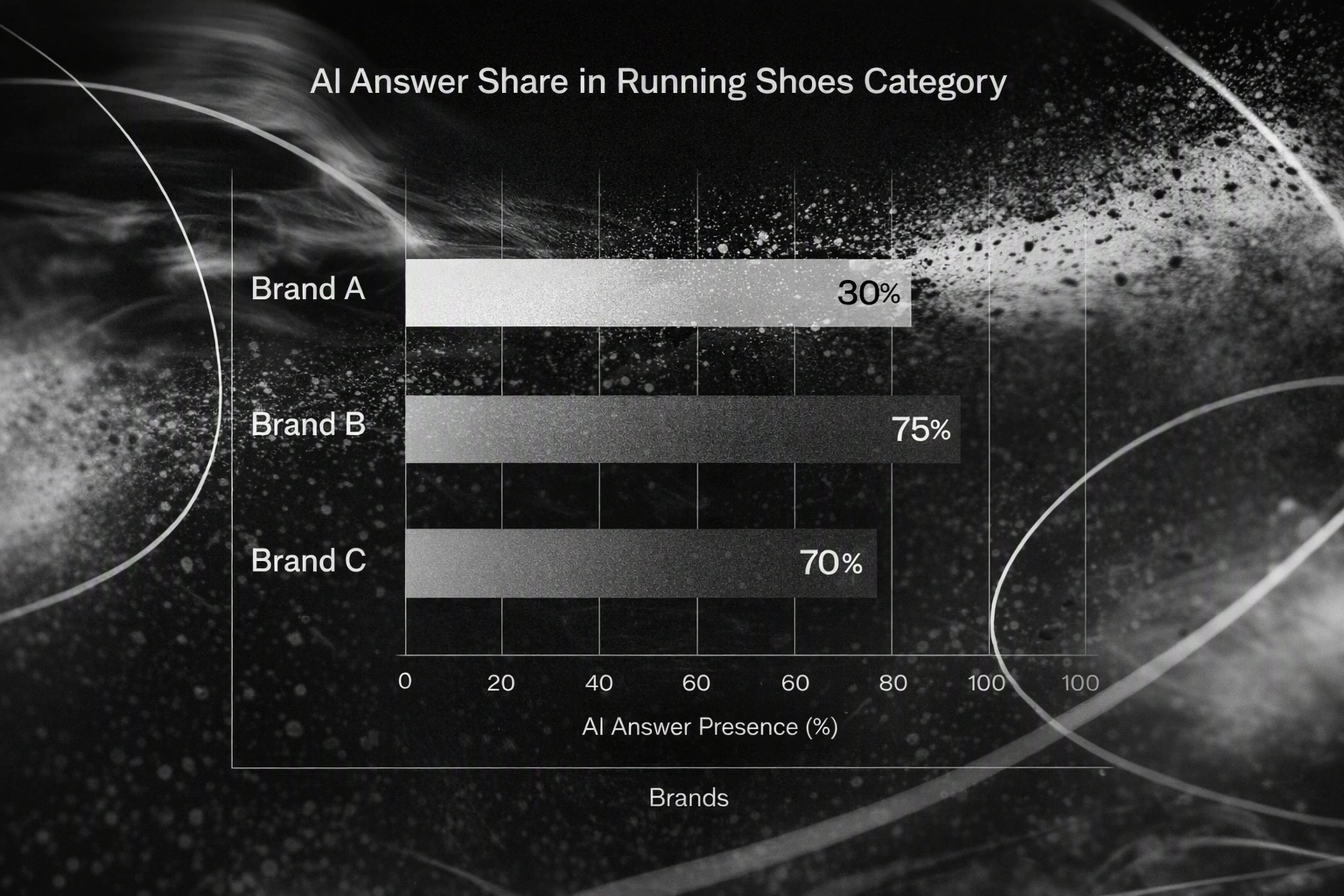
The brand is mentioned in only 30% of relevant AI answers where competitors appear in 70–80%.
Its own DTC product pages are cited in just 10% of summaries, while marketplace listings and third-party review sites account for most citations.
In European markets, the brand’s SKUs appear in less than 20% of AI-generated shopping carousels, despite strong local sales.
Armed with this data, the team prioritizes GEO and marketplace listing optimization:
They enrich product detail pages with clearer specs, sizing guidance, and structured data that match the criteria AI models use (use-case, cushioning level, terrain type, price range).
They standardize titles and attributes on marketplaces so AI assistants can map SKUs reliably to query intent.
They launch Era’s autopilot content engine to publish one AI-optimized article per day around “best running shoes” queries in underpenetrated regions.
Within several weeks, updated Era reports show the brand’s share of voice in AI answers climbing from 30% to over 55% in its key category, and citation share shifting toward its own domains.
For the GEO lead, this is not just a visibility win—it is a concrete, measurable improvement in AI-native demand capture.
And it only exists because an AI overview tracker turned a formerly invisible answer layer into a visible, optimizable surface.




An AI overview tracker is a monitoring system that continuously records when, where, and how a brand appears inside AI-generated overviews and answer boxes across assistants and generative search engines, including whether the brand is mentioned, cited, recommended, or excluded relative to competitors.
How an AI Overview Tracker Works
An AI overview tracker starts by defining a universe of brand-relevant prompts: product, category, comparison, and intent-driven queries that real shoppers and AI assistants use.
It then replays those prompts regularly across AI surfaces such as Google AI Overviews, Google AI Mode, ChatGPT, Gemini, Perplexity, and other AI visibility platforms trusted by marketers.
For each prompt, the tracker captures the full AI response and extracts structured visibility data.
Typically, it logs whether the brand is:
Mentioned in the narrative answer.
Cited via a URL or data source.
Impressed in carousels, product grids, or shopping agents.
Recommended explicitly (e.g., “Best option”, “Top pick”).
Tools like Ahrefs’ Brand Radar use similar AI visibility metrics and track Mentions, Citations, Impressions, and AI Share of Voice across hundreds of millions of prompts, underscoring the need for systematic answer tracking.
Advanced AI overview trackers add multi-region and multi-language support, SKU-level detection for ecommerce catalogs, and APIs so brands and agencies can pipe AI search monitoring services into their existing analytics stacks.
Why an AI Overview Tracker Matters for GEO and Agentic Commerce
For ecommerce leaders, an AI overview tracker is the measurement backbone for GEO (Generative Engine Optimization) and agentic commerce programs.
First, AI summaries are rapidly becoming a dominant discovery surface.
Pew Research found that in March 2025, 58% of U.S. Google users in its panel encountered at least one search with an AI-generated summary, and they were less likely to click links when a summary appeared—cited sources were clicked “very rarely.”
That means the “answer box” itself is now the battlefield.
If AI answer engines satisfy user intent inside the overview, revenue depends on being the brand named in that box, not just ranking with a traditional blue link below.
Second, GEO and AEO (Answer Engine Optimization) are evidence-driven.
BrightEdge’s 12-week ecommerce study showed that brand mentions in AI answers are relatively durable, but the evidence layer is highly volatile: citation share changed 39% week over week on ChatGPT and 41% on Gemini, and 37% of cited URLs on Gemini were entirely different from the prior week.
Without an AI assistant answer tracking tool, ecommerce teams cannot see which product pages, marketplace listings, or third-party reviews are actually being used as evidence—or when they drop out of the citation pool.
Third, agentic commerce moves buying into the assistant directly.
OpenAI reports that 700M+ people use ChatGPT weekly, and has launched Instant Checkout and the Agentic Commerce Protocol so shoppers can discover, compare, and buy within chat.
In this context, an AI commerce visibility platform with proven ROI starts by telling you:
On which prompts your SKUs appear in ChatGPT, Gemini, Perplexity, and other agents.
How often your brand is recommended vs. competitors.
Which merchants and regions are visible when AI agents initiate a purchase flow.
An AI overview tracker replaces guesswork with daily, multi-model visibility so GEO and commerce teams can run structured optimization programs instead of chasing vanity metrics.
For a deeper operational guide to tooling and workflows, see this related article on AI visibility platforms and tracking: how ecommerce brands monitor AI overviews and rankings.
How AI Overview Trackers Differ From Classic Rank Trackers
Marketers often confuse AI overview trackers with traditional rank tracking tools, but they answer different questions.
A classic rank tracker asks: “What position is my page in for a given keyword on a search results page?”
An AI overview tracker asks: “Is my brand present inside the AI-generated answer, and in what role?”
Key differences include:
Unit of measurement
Rank trackers measure positions of URLs in organic results.
AI overview trackers measure presence and prominence in answers, including mentions, citations, pros/cons, and recommendation strength.
Surfaces monitored
Rank trackers focus on traditional SERPs, occasionally including rich snippets.
AI overview trackers span Google AI Overviews/AI Mode, ChatGPT, Gemini, Perplexity, Copilot, and other generative engines, plus shopping agents.
Commerce relevance
Rank trackers are loosely connected to revenue and often treated as SEO health indicators.
AI overview trackers tie directly to decision-stage visibility in conversational flows, answering whether your SKUs are eligible when assistants shortlist products or auto-build shopping carts.
Evidence vs. placement
Rank trackers rarely distinguish between being linked, being read, and being trusted.
AI overview trackers explicitly monitor which pages or marketplace listings are cited as evidence, which reviews are summarized, and where trust signals (ratings, specs, price) are pulled from.
This distinction is why Gartner now classifies answer-engine visibility systems as a separate category from classic SEO tools.
For ecommerce, the practical implication is simple: rank trackers help you manage search placement; AI overview trackers help you manage AI answer share.
How Era Implements AI Overview Tracking for Retail and Marketplace Brands
Era is an AI visibility, analytics, and optimization platform built specifically for generative search and agentic commerce.
Its AI overview tracker is designed for mid-market and enterprise ecommerce brands with large SKU catalogs and multi-region footprints.
Era continuously monitors prompts tailored to ecommerce use cases, including:
Category and intent queries (“best trail running shoes under $150,” “eco-friendly dish soap for hard water”).
Brand and competitor comparisons (“Brand A vs Brand B baby monitor,” “top marketplace listings for refurbished smartphones”).
Agentic commerce flows (prompts that trigger shopping carousels, merchant selectors, and cart-building behavior).
For each prompt across ChatGPT, Claude, Gemini, Perplexity, Google AI Overviews, and emerging shopping agents, Era tracks:
Share of voice in AI answers: how often your brand is mentioned versus competitors.
Citation share: which of your domains, marketplace listings, or third-party pages are cited as evidence.
Pros and cons and sentiment: how AI assistants describe your products, including strengths, weaknesses, and review-derived opinions.
Merchant and SKU visibility: which SKUs appear, in which regions, through which merchants or marketplaces.
Era’s AI search visibility platform produces daily reports and CMO-ready dashboards so teams can see movement in AI answer share by category, region, and engine.
It then connects this visibility layer to action via GEO/AEO tooling:
Technical GEO optimization to make product data, specs, and trust signals more machine-readable and aligned with AI decision criteria.
Marketplace listing optimization tools for generative search, ensuring titles, attributes, and structured data help assistants understand and surface each SKU.
Autopilot content engine that generates AI-optimized articles and publishes them directly to your CMS, reinforcing topical authority around high-value queries discovered via Era’s query API.
For agencies, Era can function as a white-label AI overview tracker, providing AI search monitoring services plus expert advisory support across multiple clients.
This lets agencies move beyond SEO-only retainers and become AI visibility partners in the agentic commerce era.
Related Terms and Common Confusions
Because the ecosystem is new, ecommerce teams often blur several concepts together.
An AI overview tracker is related to, but distinct from, the following terms:
AI visibility platform: a broader category that includes analytics, optimization, and sometimes content automation for AI surfaces. Era is an AI visibility platform; its overview tracker is one component focused specifically on measurement.
AI brand visibility tools: tools that monitor brand mentions in chatbots, AI voice assistants, and generative engines. Overview tracking is a more granular subset focused on answer boxes and summaries, not just mentions.
AI assistant answer tracking tool: often used as a synonym, but can include qualitative review of answer quality or compliance. An AI overview tracker is a metrics-first implementation, designed to quantify share of voice, citations, and recommendation patterns.
AI commerce visibility platforms: solutions that focus on product and merchant presence inside shopping agents and agentic checkout flows. AI overview tracking is the visibility layer that informs those commerce decisions, especially at SKU and merchant level.
Understanding these distinctions helps teams choose the right stack: rank trackers for legacy SERPs, AI overview trackers for answer share, and full AI visibility platforms like Era to connect analytics with GEO and agentic commerce execution.
A Concrete Ecommerce Example
Consider a global sportswear brand selling running shoes through its own DTC site and several marketplaces.
The brand’s GEO lead wants to know how often it appears when shoppers ask AI assistants questions like:
“Best cushioned running shoes for marathon training.”
“Top women’s trail running shoes under $150.”
“Are Brand X shoes better than Brand Y for flat feet?”
Using Era’s AI overview tracker, the team sets up these prompts across Google AI Overviews, ChatGPT, Gemini, Perplexity, and relevant shopping agents.
Over the next month, Era’s daily AI search visibility platform reports show that:
The brand is mentioned in only 30% of relevant AI answers where competitors appear in 70–80%.
Its own DTC product pages are cited in just 10% of summaries, while marketplace listings and third-party review sites account for most citations.
In European markets, the brand’s SKUs appear in less than 20% of AI-generated shopping carousels, despite strong local sales.
Armed with this data, the team prioritizes GEO and marketplace listing optimization:
They enrich product detail pages with clearer specs, sizing guidance, and structured data that match the criteria AI models use (use-case, cushioning level, terrain type, price range).
They standardize titles and attributes on marketplaces so AI assistants can map SKUs reliably to query intent.
They launch Era’s autopilot content engine to publish one AI-optimized article per day around “best running shoes” queries in underpenetrated regions.
Within several weeks, updated Era reports show the brand’s share of voice in AI answers climbing from 30% to over 55% in its key category, and citation share shifting toward its own domains.
For the GEO lead, this is not just a visibility win—it is a concrete, measurable improvement in AI-native demand capture.
And it only exists because an AI overview tracker turned a formerly invisible answer layer into a visible, optimizable surface.