
August 30, 2026
August 30, 2026
Paid AI Newsletter Memberships: Monetizing Insight in the Generative Search Era
Paid AI e‑commerce newsletters and memberships are becoming a core intelligence layer for modern marketing and ecommerce teams.
Paid AI e‑commerce newsletters and memberships are becoming a core intelligence layer for modern marketing and ecommerce teams.
Why Paid AI Newsletters Matter in the Generative Search Era
Paid AI e‑commerce newsletters and memberships are becoming a core intelligence layer for modern marketing and ecommerce teams.
They translate fast‑moving generative search, GEO (Generative Engine Optimization), and agentic commerce shifts into actionable playbooks you can execute this quarter.
For brands operating at scale, these memberships are:
A recurring source of competitive intelligence on AI search and shopping
A structured way to educate internal teams on GEO and AI commerce
A relatively low‑cost hedge against being blindsided by AI‑native traffic shifts
This guide breaks down the business models, audience needs, and how to use paid AI newsletter memberships strategically alongside platforms like Era.
The Market Context: AI Shopping Is Now Measurable Commerce, Not Hype
Before diving into memberships, it’s important to understand why AI commerce insights are worth paying for.
Recent data shows AI shopping and generative search have moved beyond novelty:
Adobe reports AI‑driven traffic to U.S. retail sites grew 4,700% YoY in July 2025, and still 393% YoY in Q1 2026.
During the 2025 holiday season, AI visitors were 10% more engaged and converted 31% more than other sources; in March 2026, they converted 42% better.
Capgemini found 58% of consumers have replaced traditional search engines with GenAI tools for product or service recommendations.
Omnisend’s 2025 survey says 63% of Americans used generative AI for shopping‑related tasks in the prior six months, and 38% completed a purchase directly inside ChatGPT.
AI answer engines and agentic shopping flows are already influencing revenue and P&L.
That’s why a paid AI commerce newsletter membership isn’t a "nice‑to‑have" content purchase; it’s a way to stay ahead of a rapidly shifting discovery layer.
Paid AI Newsletter Memberships: Definitions and Formats
What is a paid AI newsletter membership?
A paid AI newsletter membership for ecommerce founders and marketing leaders is a recurring subscription that delivers:
Regular issues focused on AI search, GEO/AEO, and agentic commerce tactics
Exclusive reports, benchmarks, and case studies
Access to a private community or office hours with AI commerce experts
Common formats include:
Weekly strategy briefings on generative search developments and platform updates
Monthly deep dives on GEO tactics, answer engine optimization, and AI visibility case studies
Quarterly playbooks that translate trends into concrete experiments across catalog, content, and martech
These memberships can look like:
A paid AI commerce newsletter subscription at ~$10/month
A tiered AI commerce paid membership with community access
A bundled "AI visibility platform + advisory + newsletter" package
The Economics: Why Paid AI Newsletters Are a Sustainable Business Model
The economics of paid newsletters have matured enough that AI‑specific verticals are viable.
Key benchmarks:
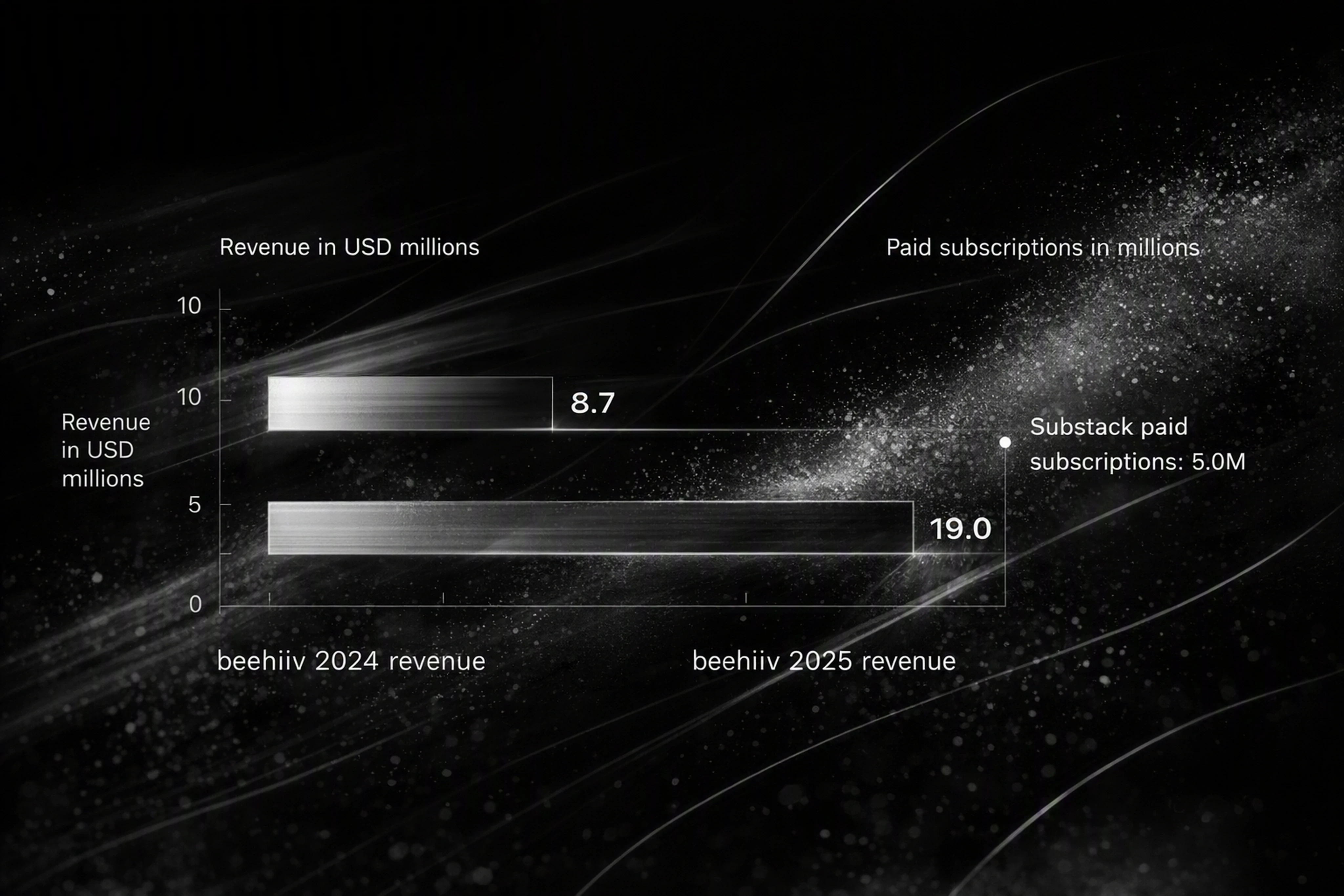
Substack reports 5 million paid subscriptions on its platform; creators keep 90% of revenue after card fees.
Substack notes that "a few hundred" paid subscribers at $5/month can replace a salary.
beehiiv reports $8.7M in paid‑subscription revenue in 2024 and $19M in 2025, up 138% YoY.
beehiiv’s 2026 benchmark confirms $10/month or $100/year as the prevailing price point across most industries.
For AI commerce specialists, this means:
A focused niche (GEO, AI search monitoring, AI commerce visibility) can support a recurring revenue product.
High‑value B2B audiences (CMOs, Heads of Growth) are already accustomed to paying for premium intelligence.
Memberships can layer on community and advisory to justify higher pricing tiers.
Audience Needs: What Ecommerce Leaders Actually Want From Paid AI Memberships
Not every AI newsletter will resonate with ecommerce decision makers.
Brands and agencies managing $10M–$1B+ GMV typically look for:
1. Competitive Intelligence in AI Answer Engines
Leaders want to know:
Where their brand appears (or doesn’t) in ChatGPT, Claude, Gemini, Perplexity, and emerging shopping agents
How often AI assistants monitor brand mentions and which competitors dominate decision‑stage queries
Which products, price points, and trust signals AI models are favoring in their category
They value newsletters that:
Synthesize cross‑model AI visibility platform reviews
Highlight best AI search monitoring tools for 2026
Share ecommerce AI visibility case studies with clear outcomes
2. Operational GEO / AEO Guidance
Google is explicit that optimizing for generative AI search is still optimizing for Search.
Its generative features use retrieval‑augmented generation grounded in core ranking and quality systems.
Practitioners need:
GEO tracking of AI assistant mentions and answer snippets
Playbooks for structuring catalog data, specs, and reviews for agentic commerce
Concrete examples of answer engine optimization, not "SEO is dead" hot takes
3. Internal Education and Alignment
Generative AI adoption is widespread:
Microsoft estimates 16.3% of the world used generative AI in H2 2025; U.S. working‑age adoption was 28.3%.
Inside organizations, that translates into:
Pockets of experimentation but limited shared understanding of GEO and AI commerce
Fragmented knowledge across SEO, product, data, and brand teams
Paid AI newsletter memberships help by:
Providing consistent language and frameworks for AI visibility
Offering shareable explainers and diagrams for internal decks
Giving CMOs and heads of ecommerce a trusted "source of truth" for AI search trends
Core Business Models: How Paid AI Commerce Newsletters Monetize Insight
Several recurring business models are emerging in the paid AI newsletter space.
1. Pure Paid Newsletter
Model:
Weekly or bi‑weekly email issues
$10/month or $100/year subscription
Occasional free issue to grow the top of funnel
Best for:
Individual AI commerce experts
Boutique agencies who want an intelligence product alongside services
Key features that resonate:
Generative search newsletter subscription with clear, repeatable sections
GEO and AEO tactic breakdowns tied to current platform changes
Short, decision‑grade briefs that leaders can read in 5–10 minutes
2. AI Commerce Paid Membership (Newsletter + Community)
Model:
Newsletter plus private community (Slack, Circle, Discord)
Live office hours or small‑group clinics
Higher pricing (e.g., $29–$99/month)
As Morning Brew’s co‑founder Austin Rief puts it: “Community will be for the next 10 years what content and newsletters were for the last.”
Best for:
Ecommerce founders and marketing leaders who want peer benchmarking
Agencies managing multiple AI visibility programs
Key features:
Member‑only threads on GEO experiments and agentic commerce pilots
Shared playbooks for using AI visibility tools for enterprise marketing teams
Real‑time feedback on AI search monitoring service setups
3. Platform‑Anchored Membership (Era’s Model)
Model:
AI visibility and GEO platform subscription (e.g., Era)
Bundled AI‑optimized content engine + expert advisory
Optional paid newsletter feed summarizing insights across clients and models
Best for:
Mid‑market and enterprise ecommerce brands with large SKU catalogs
Agencies wanting a white‑label AI visibility solution plus ongoing education
Key features:
SKU‑level AI visibility tracking integrated with GEO guidance
Daily or weekly insight reports turned into newsletter‑style summaries
CMO‑ready reporting that links AI visibility shifts to revenue impact
Trust and Retention: Why Quality and Transparency Are Non‑Negotiable
Paid AI newsletters operate in a space where trust is fragile.
Gartner found:
Only 11% of U.S. consumers are willing to let AI make purchase decisions in low‑stakes categories.
54% of recent AI‑shopping users had to double‑check all information.
62% said the information was a waste of time.
Kate Muhl’s conclusion is decisive: “Accuracy is now a brand issue.”
For paid AI ecommerce newsletters, this means:
Insights must be grounded in verifiable data, not speculation.
GEO and AEO recommendations should show the underlying evidence and sources.
Claims about AI visibility tools or tactics should be tested and documented.
On the retention side, Mastercard/FT Strategies found:
74% of consumers are more likely to subscribe when cancellation is simple.
66% would stay for a reduced‑price offer.
31% frequently cancel and resubscribe.
Operationally, AI newsletter operators should:
Offer frictionless cancellation and transparent renewal terms.
Use retention‑friendly pricing and annual options.
Focus on consistent value per issue so churn is driven by budget, not disappointment.
How Brands Can Use Paid AI Memberships Strategically
Paid AI newsletter memberships are most powerful when treated as part of a broader AI visibility stack.
Here’s how to make them pay off for your organization.
1. Treat the Newsletter as an Intelligence Layer
Use your AI commerce membership to:
Track brand mentions in AI assistants and chatbots via regular reports
Understand how answer engines describe your pros, cons, price positioning, and sentiment
Identify where competitors are displacing you in decision‑stage flows
Combine this with platforms like Era to:
Monitor multi‑model share of voice and rankings
Compare visibility across regions and languages
Quantify the ROI of AI commerce visibility platforms over time
2. Turn Issues Into Internal Training Assets
Each issue can become:
A slide in your monthly marketing or ecommerce leadership meeting
A short Loom or recorded walkthrough for regional teams
A prompt template for your own internal AI assistants
Practical steps:
Summarize key newsletter insights into 3–5 bullet "action cards" per issue.
Tag each card by function: SEO/GEO, merchandising, analytics, CX.
Log actions into your experimentation backlog and track outcomes.
3. Link Insights to Era’s GEO and Content Automation
Era’s platform provides:
Daily multi‑model visibility tracking across ChatGPT, Claude, Gemini, and more
GEO optimization and search query discovery via API
SKU‑level monitoring and region‑specific merchant configs
When your paid AI membership surfaces:
New generative search behaviors or answer formats
Emerging agentic commerce protocols or integrations
New criteria models are using (availability, reviews, sustainability)
You can respond by:
Updating product data and specs to align with those criteria
Generating AI‑optimized articles via Era’s autopilot content engine
Publishing content directly to your CMS to improve answer‑layer visibility
4. Use Membership Signals to Prioritize Experiments
AI newsletter issues often include:
Case studies on brands winning in AI‑native traffic
Benchmarks on AI visibility tool performance
Suggestions for GEO and AEO test designs
Turn these into structured experiments by:
Defining hypotheses tied to measurable AI share‑of‑voice shifts
Selecting SKUs or categories where AI traffic is already meaningful
Measuring pre‑ and post‑experiment visibility with Era’s analytics
This creates a closed loop:
Newsletter → Insight → Experiment → Era data → Back to newsletter reporting
Evaluating Paid AI Newsletter Memberships: What to Look For
If you’re considering a paid AI commerce newsletter membership, use criteria similar to evaluating an AI visibility platform.
Key questions:
Is the coverage multi‑model and multi‑region?
Does the newsletter track developments across ChatGPT, Claude, Gemini, Perplexity, and shopping agents?
Does it discuss regional differences and localization challenges?
Does it connect insight to workflow?
Are there clear steps for implementing GEO and AEO changes?
Does it reference tools like Era or other AI search monitoring services that marketers actually use?
Is the data credible and current?
Are stats and claims sourced (e.g., Adobe, Capgemini, Gartner, Microsoft)?
Are examples from 2025–2026, not pre‑GenAI eras?
Is there expert advisory or community access?
Can you ask clarifying questions or get 1:1 feedback?
Is there peer discussion on AI visibility platform comparisons and ROI?
Can you easily onboard multiple stakeholders?
Are team seats or forwarding policies clear?
Are issues written in language a CMO, SEO lead, and ecommerce director can all use?
The Role of Era: From Insight to Execution
Paid AI newsletters are powerful for understanding the "why" behind AI search and commerce changes.
Era exists to operationalize the "how."
Era’s core contributions:
AI visibility analytics: Daily monitoring of your brand’s presence across major AI models, including share of voice, rankings, citations, pros & cons, and sentiment.
Technical GEO/AEO tooling: Structured optimization for catalog data, specs, and evidence that AI agents rely on.
Content autopilot: One AI‑optimized article per day, published directly into your CMS, aligned with generative search and answer engine patterns.
Ecommerce focus: SKU‑level tracking, catalogue sync, merchant monitoring, and region‑specific configurations for agentic commerce.
In practice, a strong strategy looks like:
Use a paid AI newsletter membership for horizon scanning and education.
Use Era as the AI visibility and optimization layer that executes against those insights.
Report AI‑native traffic and visibility back to leadership in CMO‑ready dashboards.
This combination helps brands "be the brand" AI systems recommend when consumers ask what to buy.
FAQ: Paid AI Newsletter Memberships and AI Commerce
1. What is a paid AI e‑commerce newsletter, exactly?
A paid AI e‑commerce newsletter is a recurring subscription that delivers curated, expert analysis on generative search, GEO/AEO tactics, and AI‑driven shopping trends.
It’s designed for ecommerce founders, CMOs, and marketing leaders who need structured, actionable insight—not just general AI news.
2. How do paid AI newsletter memberships differ from free blogs or social content?
Paid memberships:
Offer deeper, more consistent analysis and step‑by‑step playbooks
Often include proprietary data or benchmarks that aren’t shared publicly
Frequently bundle community access or office hours with AI commerce experts
Free content can be useful, but it rarely provides the ongoing, niche‑specific intelligence needed for serious AI visibility programs.
3. Can a paid AI newsletter replace an AI visibility platform like Era?
No.
A newsletter gives you insight and guidance; a platform like Era provides measurement, automation, and execution.
For serious ecommerce operations, you need both:
Membership for competitive intelligence and internal education
Era for cross‑model monitoring, GEO optimization, and content automation
4. What ROI should I expect from a paid AI commerce membership?
ROI comes from:
Faster recognition of emerging AI shopping behaviors
Better‑designed GEO and AEO experiments
Reduced internal confusion and duplicated effort around AI search
When combined with a platform like Era, these memberships can help:
Lift AI answer‑layer visibility and share of voice
Improve AI‑native traffic conversion rates
Protect existing SEO and paid media performance as AI interfaces evolve
5. How should agencies use paid AI newsletter memberships?
Agencies can:
Use memberships as a shared intelligence base across accounts
Package insights into white‑label briefings for clients
Align AI visibility services with data‑driven GEO guidance
Paired with Era’s white‑label capabilities and API access, this lets agencies act as AI visibility partners, not just traditional SEO vendors.




Why Paid AI Newsletters Matter in the Generative Search Era
Paid AI e‑commerce newsletters and memberships are becoming a core intelligence layer for modern marketing and ecommerce teams.
They translate fast‑moving generative search, GEO (Generative Engine Optimization), and agentic commerce shifts into actionable playbooks you can execute this quarter.
For brands operating at scale, these memberships are:
A recurring source of competitive intelligence on AI search and shopping
A structured way to educate internal teams on GEO and AI commerce
A relatively low‑cost hedge against being blindsided by AI‑native traffic shifts
This guide breaks down the business models, audience needs, and how to use paid AI newsletter memberships strategically alongside platforms like Era.
The Market Context: AI Shopping Is Now Measurable Commerce, Not Hype
Before diving into memberships, it’s important to understand why AI commerce insights are worth paying for.
Recent data shows AI shopping and generative search have moved beyond novelty:
Adobe reports AI‑driven traffic to U.S. retail sites grew 4,700% YoY in July 2025, and still 393% YoY in Q1 2026.
During the 2025 holiday season, AI visitors were 10% more engaged and converted 31% more than other sources; in March 2026, they converted 42% better.
Capgemini found 58% of consumers have replaced traditional search engines with GenAI tools for product or service recommendations.
Omnisend’s 2025 survey says 63% of Americans used generative AI for shopping‑related tasks in the prior six months, and 38% completed a purchase directly inside ChatGPT.
AI answer engines and agentic shopping flows are already influencing revenue and P&L.
That’s why a paid AI commerce newsletter membership isn’t a "nice‑to‑have" content purchase; it’s a way to stay ahead of a rapidly shifting discovery layer.
Paid AI Newsletter Memberships: Definitions and Formats
What is a paid AI newsletter membership?
A paid AI newsletter membership for ecommerce founders and marketing leaders is a recurring subscription that delivers:
Regular issues focused on AI search, GEO/AEO, and agentic commerce tactics
Exclusive reports, benchmarks, and case studies
Access to a private community or office hours with AI commerce experts
Common formats include:
Weekly strategy briefings on generative search developments and platform updates
Monthly deep dives on GEO tactics, answer engine optimization, and AI visibility case studies
Quarterly playbooks that translate trends into concrete experiments across catalog, content, and martech
These memberships can look like:
A paid AI commerce newsletter subscription at ~$10/month
A tiered AI commerce paid membership with community access
A bundled "AI visibility platform + advisory + newsletter" package
The Economics: Why Paid AI Newsletters Are a Sustainable Business Model
The economics of paid newsletters have matured enough that AI‑specific verticals are viable.
Key benchmarks:
Substack reports 5 million paid subscriptions on its platform; creators keep 90% of revenue after card fees.
Substack notes that "a few hundred" paid subscribers at $5/month can replace a salary.
beehiiv reports $8.7M in paid‑subscription revenue in 2024 and $19M in 2025, up 138% YoY.
beehiiv’s 2026 benchmark confirms $10/month or $100/year as the prevailing price point across most industries.
For AI commerce specialists, this means:
A focused niche (GEO, AI search monitoring, AI commerce visibility) can support a recurring revenue product.
High‑value B2B audiences (CMOs, Heads of Growth) are already accustomed to paying for premium intelligence.
Memberships can layer on community and advisory to justify higher pricing tiers.
Audience Needs: What Ecommerce Leaders Actually Want From Paid AI Memberships
Not every AI newsletter will resonate with ecommerce decision makers.
Brands and agencies managing $10M–$1B+ GMV typically look for:
1. Competitive Intelligence in AI Answer Engines
Leaders want to know:
Where their brand appears (or doesn’t) in ChatGPT, Claude, Gemini, Perplexity, and emerging shopping agents
How often AI assistants monitor brand mentions and which competitors dominate decision‑stage queries
Which products, price points, and trust signals AI models are favoring in their category
They value newsletters that:
Synthesize cross‑model AI visibility platform reviews
Highlight best AI search monitoring tools for 2026
Share ecommerce AI visibility case studies with clear outcomes
2. Operational GEO / AEO Guidance
Google is explicit that optimizing for generative AI search is still optimizing for Search.
Its generative features use retrieval‑augmented generation grounded in core ranking and quality systems.
Practitioners need:
GEO tracking of AI assistant mentions and answer snippets
Playbooks for structuring catalog data, specs, and reviews for agentic commerce
Concrete examples of answer engine optimization, not "SEO is dead" hot takes
3. Internal Education and Alignment
Generative AI adoption is widespread:
Microsoft estimates 16.3% of the world used generative AI in H2 2025; U.S. working‑age adoption was 28.3%.
Inside organizations, that translates into:
Pockets of experimentation but limited shared understanding of GEO and AI commerce
Fragmented knowledge across SEO, product, data, and brand teams
Paid AI newsletter memberships help by:
Providing consistent language and frameworks for AI visibility
Offering shareable explainers and diagrams for internal decks
Giving CMOs and heads of ecommerce a trusted "source of truth" for AI search trends
Core Business Models: How Paid AI Commerce Newsletters Monetize Insight
Several recurring business models are emerging in the paid AI newsletter space.
1. Pure Paid Newsletter
Model:
Weekly or bi‑weekly email issues
$10/month or $100/year subscription
Occasional free issue to grow the top of funnel
Best for:
Individual AI commerce experts
Boutique agencies who want an intelligence product alongside services
Key features that resonate:
Generative search newsletter subscription with clear, repeatable sections
GEO and AEO tactic breakdowns tied to current platform changes
Short, decision‑grade briefs that leaders can read in 5–10 minutes
2. AI Commerce Paid Membership (Newsletter + Community)
Model:
Newsletter plus private community (Slack, Circle, Discord)
Live office hours or small‑group clinics
Higher pricing (e.g., $29–$99/month)
As Morning Brew’s co‑founder Austin Rief puts it: “Community will be for the next 10 years what content and newsletters were for the last.”
Best for:
Ecommerce founders and marketing leaders who want peer benchmarking
Agencies managing multiple AI visibility programs
Key features:
Member‑only threads on GEO experiments and agentic commerce pilots
Shared playbooks for using AI visibility tools for enterprise marketing teams
Real‑time feedback on AI search monitoring service setups
3. Platform‑Anchored Membership (Era’s Model)
Model:
AI visibility and GEO platform subscription (e.g., Era)
Bundled AI‑optimized content engine + expert advisory
Optional paid newsletter feed summarizing insights across clients and models
Best for:
Mid‑market and enterprise ecommerce brands with large SKU catalogs
Agencies wanting a white‑label AI visibility solution plus ongoing education
Key features:
SKU‑level AI visibility tracking integrated with GEO guidance
Daily or weekly insight reports turned into newsletter‑style summaries
CMO‑ready reporting that links AI visibility shifts to revenue impact
Trust and Retention: Why Quality and Transparency Are Non‑Negotiable
Paid AI newsletters operate in a space where trust is fragile.
Gartner found:
Only 11% of U.S. consumers are willing to let AI make purchase decisions in low‑stakes categories.
54% of recent AI‑shopping users had to double‑check all information.
62% said the information was a waste of time.
Kate Muhl’s conclusion is decisive: “Accuracy is now a brand issue.”
For paid AI ecommerce newsletters, this means:
Insights must be grounded in verifiable data, not speculation.
GEO and AEO recommendations should show the underlying evidence and sources.
Claims about AI visibility tools or tactics should be tested and documented.
On the retention side, Mastercard/FT Strategies found:
74% of consumers are more likely to subscribe when cancellation is simple.
66% would stay for a reduced‑price offer.
31% frequently cancel and resubscribe.
Operationally, AI newsletter operators should:
Offer frictionless cancellation and transparent renewal terms.
Use retention‑friendly pricing and annual options.
Focus on consistent value per issue so churn is driven by budget, not disappointment.
How Brands Can Use Paid AI Memberships Strategically
Paid AI newsletter memberships are most powerful when treated as part of a broader AI visibility stack.
Here’s how to make them pay off for your organization.
1. Treat the Newsletter as an Intelligence Layer
Use your AI commerce membership to:
Track brand mentions in AI assistants and chatbots via regular reports
Understand how answer engines describe your pros, cons, price positioning, and sentiment
Identify where competitors are displacing you in decision‑stage flows
Combine this with platforms like Era to:
Monitor multi‑model share of voice and rankings
Compare visibility across regions and languages
Quantify the ROI of AI commerce visibility platforms over time
2. Turn Issues Into Internal Training Assets
Each issue can become:
A slide in your monthly marketing or ecommerce leadership meeting
A short Loom or recorded walkthrough for regional teams
A prompt template for your own internal AI assistants
Practical steps:
Summarize key newsletter insights into 3–5 bullet "action cards" per issue.
Tag each card by function: SEO/GEO, merchandising, analytics, CX.
Log actions into your experimentation backlog and track outcomes.
3. Link Insights to Era’s GEO and Content Automation
Era’s platform provides:
Daily multi‑model visibility tracking across ChatGPT, Claude, Gemini, and more
GEO optimization and search query discovery via API
SKU‑level monitoring and region‑specific merchant configs
When your paid AI membership surfaces:
New generative search behaviors or answer formats
Emerging agentic commerce protocols or integrations
New criteria models are using (availability, reviews, sustainability)
You can respond by:
Updating product data and specs to align with those criteria
Generating AI‑optimized articles via Era’s autopilot content engine
Publishing content directly to your CMS to improve answer‑layer visibility
4. Use Membership Signals to Prioritize Experiments
AI newsletter issues often include:
Case studies on brands winning in AI‑native traffic
Benchmarks on AI visibility tool performance
Suggestions for GEO and AEO test designs
Turn these into structured experiments by:
Defining hypotheses tied to measurable AI share‑of‑voice shifts
Selecting SKUs or categories where AI traffic is already meaningful
Measuring pre‑ and post‑experiment visibility with Era’s analytics
This creates a closed loop:
Newsletter → Insight → Experiment → Era data → Back to newsletter reporting
Evaluating Paid AI Newsletter Memberships: What to Look For
If you’re considering a paid AI commerce newsletter membership, use criteria similar to evaluating an AI visibility platform.
Key questions:
Is the coverage multi‑model and multi‑region?
Does the newsletter track developments across ChatGPT, Claude, Gemini, Perplexity, and shopping agents?
Does it discuss regional differences and localization challenges?
Does it connect insight to workflow?
Are there clear steps for implementing GEO and AEO changes?
Does it reference tools like Era or other AI search monitoring services that marketers actually use?
Is the data credible and current?
Are stats and claims sourced (e.g., Adobe, Capgemini, Gartner, Microsoft)?
Are examples from 2025–2026, not pre‑GenAI eras?
Is there expert advisory or community access?
Can you ask clarifying questions or get 1:1 feedback?
Is there peer discussion on AI visibility platform comparisons and ROI?
Can you easily onboard multiple stakeholders?
Are team seats or forwarding policies clear?
Are issues written in language a CMO, SEO lead, and ecommerce director can all use?
The Role of Era: From Insight to Execution
Paid AI newsletters are powerful for understanding the "why" behind AI search and commerce changes.
Era exists to operationalize the "how."
Era’s core contributions:
AI visibility analytics: Daily monitoring of your brand’s presence across major AI models, including share of voice, rankings, citations, pros & cons, and sentiment.
Technical GEO/AEO tooling: Structured optimization for catalog data, specs, and evidence that AI agents rely on.
Content autopilot: One AI‑optimized article per day, published directly into your CMS, aligned with generative search and answer engine patterns.
Ecommerce focus: SKU‑level tracking, catalogue sync, merchant monitoring, and region‑specific configurations for agentic commerce.
In practice, a strong strategy looks like:
Use a paid AI newsletter membership for horizon scanning and education.
Use Era as the AI visibility and optimization layer that executes against those insights.
Report AI‑native traffic and visibility back to leadership in CMO‑ready dashboards.
This combination helps brands "be the brand" AI systems recommend when consumers ask what to buy.
FAQ: Paid AI Newsletter Memberships and AI Commerce
1. What is a paid AI e‑commerce newsletter, exactly?
A paid AI e‑commerce newsletter is a recurring subscription that delivers curated, expert analysis on generative search, GEO/AEO tactics, and AI‑driven shopping trends.
It’s designed for ecommerce founders, CMOs, and marketing leaders who need structured, actionable insight—not just general AI news.
2. How do paid AI newsletter memberships differ from free blogs or social content?
Paid memberships:
Offer deeper, more consistent analysis and step‑by‑step playbooks
Often include proprietary data or benchmarks that aren’t shared publicly
Frequently bundle community access or office hours with AI commerce experts
Free content can be useful, but it rarely provides the ongoing, niche‑specific intelligence needed for serious AI visibility programs.
3. Can a paid AI newsletter replace an AI visibility platform like Era?
No.
A newsletter gives you insight and guidance; a platform like Era provides measurement, automation, and execution.
For serious ecommerce operations, you need both:
Membership for competitive intelligence and internal education
Era for cross‑model monitoring, GEO optimization, and content automation
4. What ROI should I expect from a paid AI commerce membership?
ROI comes from:
Faster recognition of emerging AI shopping behaviors
Better‑designed GEO and AEO experiments
Reduced internal confusion and duplicated effort around AI search
When combined with a platform like Era, these memberships can help:
Lift AI answer‑layer visibility and share of voice
Improve AI‑native traffic conversion rates
Protect existing SEO and paid media performance as AI interfaces evolve
5. How should agencies use paid AI newsletter memberships?
Agencies can:
Use memberships as a shared intelligence base across accounts
Package insights into white‑label briefings for clients
Align AI visibility services with data‑driven GEO guidance
Paired with Era’s white‑label capabilities and API access, this lets agencies act as AI visibility partners, not just traditional SEO vendors.