
August 20, 2026
August 20, 2026
Ecommerce AI Search Optimization: A GEO Playbook for Multi‑Region Retail Brands
AI answer engines are no longer experiments. They are now one of the main front doors for product discovery and shopping research.
AI answer engines are no longer experiments. They are now one of the main front doors for product discovery and shopping research.
Why Ecommerce AI Search Optimization Suddenly Matters
AI answer engines are no longer experiments. They are now one of the main front doors for product discovery and shopping research.
Google says AI Overviews now reach 1B+ monthly users in 100+ countries (Google, 2024).
ChatGPT reports 700M weekly users, with integrated shopping and merchant feeds (OpenAI, 2024).
Google’s Shopping Graph tracks 50B+ product listings and refreshes 2B+ per hour (Google, 2024).
At the same time, consumer behavior is shifting:
58% of consumers have replaced traditional search engines with GenAI tools for product/service recommendations.
71% want GenAI integrated into shopping experiences (Capgemini, 2025).
For multi‑region ecommerce brands, the question is no longer “Should we care?” but “How do we win in AI search and agentic shopping?”
This playbook explains how to use AI search visibility tools and generative engine optimization (GEO) software to grow share of voice (SOV) and revenue across markets.
What Is Generative Engine Optimization (GEO) for Ecommerce?
Generative engine optimization (GEO) is the practice of improving how large language models (LLMs), AI search engines, and shopping agents see, understand, and recommend your products.
Instead of optimizing for blue links, you optimize for:
Inclusion and ranking in AI answers (ChatGPT, Claude, Gemini, Perplexity, SearchGPT).
Placement in AI shopping modules and carousels.
Eligibility in agentic shopping flows that compare SKUs and auto‑build baskets.
Academic research backs this up. A foundational GEO paper found that adding citations, quotations, and statistics can increase source visibility by up to 40% in generative answers (OpenReview, 2023).
For ecommerce brands, GEO is about:
Structured product evidence: machine‑readable specs, pricing, reviews, availability.
Multi‑model coverage: because visibility differs by AI model and region (Yext, 2024).
Continuous monitoring and optimization, not one‑off copy tweaks.
Why Multi‑Model AI Visibility Is Non‑Negotiable
There is no single "AI search" to optimize for.
A Yext study of 17.2M citations found that citation behavior varies significantly by model and context (Yext, 2024):
Claude leans more heavily on user‑generated content.
SearchGPT cited official hotel websites 38.1% of the time, vs 16.7%–22.4% for other models.
Another Yext study (6.8M citations) showed that 86% of AI citations come from brand‑managed sources:
44% from first‑party websites.
42% from listings.
Only 2% from forums once location filters were applied (Yext, 2024).
Implications for multi‑region brands:
You must track visibility across multiple AI models, not just Google.
You must control your own structured data, feeds, and listings in each key market.
You need a measurement approach that works at the query + location level, not just brand‑wide averages.
GEO Foundations for Ecommerce: Structured Data, Feeds, and Evidence
1. Product Schema Essentials (Product, Offer, Review)
Google openly states that ecommerce visibility in AI features relies on the same core systems as traditional search and on structured data (Google Developers, 2026; Google Ecommerce Docs).
At minimum, each product page should expose:
<script type="application/ld+json">
{
  "@context": "https://schema.org",
  "@type": "Product",
  "name": "Women’s Waterproof Hiking Jacket",
  "image": [
    "https://example.com/images/jacket-front.jpg",
    "https://example.com/images/jacket-back.jpg"
  ],
  "sku": "JKT-12345",
  "brand": {
    "@type": "Brand",
    "name": "ExampleTrail"
  },
  "description": "Lightweight women’s waterproof hiking jacket with sealed seams and breathable membrane.",
  "productID": "gtin13:0123456789012",
  "offers": {
    "@type": "Offer",
    "price": "129.00",
    "priceCurrency": "USD",
    "availability": "https://schema.org/InStock",
    "url": "https://example.com/p/womens-waterproof-hiking-jacket",
    "itemCondition": "https://schema.org/NewCondition",
    "shippingDetails": {
      "@type": "OfferShippingDetails",
      "shippingDestination": {
        "@type": "DefinedRegion",
        "addressCountry": ["US", "CA"]
      },
      "deliveryTime": {
        "@type": "ShippingDeliveryTime",
        "handlingTime": {
          "@type": "QuantitativeValue",
          "minValue": 1,
          "maxValue": 2,
          "unitCode": "d"
        },
        "transitTime": {
          "@type": "QuantitativeValue",
          "minValue": 2,
          "maxValue": 5,
          "unitCode": "d"
        }
      }
    }
  },
  "aggregateRating": {
    "@type": "AggregateRating",
    "ratingValue": "4.6",
    "reviewCount": "317"
  }
}
</script>
<script type="application/ld+json">
{
  "@context": "https://schema.org",
  "@type": "Product",
  "name": "Women’s Waterproof Hiking Jacket",
  "image": [
    "https://example.com/images/jacket-front.jpg",
    "https://example.com/images/jacket-back.jpg"
  ],
  "sku": "JKT-12345",
  "brand": {
    "@type": "Brand",
    "name": "ExampleTrail"
  },
  "description": "Lightweight women’s waterproof hiking jacket with sealed seams and breathable membrane.",
  "productID": "gtin13:0123456789012",
  "offers": {
    "@type": "Offer",
    "price": "129.00",
    "priceCurrency": "USD",
    "availability": "https://schema.org/InStock",
    "url": "https://example.com/p/womens-waterproof-hiking-jacket",
    "itemCondition": "https://schema.org/NewCondition",
    "shippingDetails": {
      "@type": "OfferShippingDetails",
      "shippingDestination": {
        "@type": "DefinedRegion",
        "addressCountry": ["US", "CA"]
      },
      "deliveryTime": {
        "@type": "ShippingDeliveryTime",
        "handlingTime": {
          "@type": "QuantitativeValue",
          "minValue": 1,
          "maxValue": 2,
          "unitCode": "d"
        },
        "transitTime": {
          "@type": "QuantitativeValue",
          "minValue": 2,
          "maxValue": 5,
          "unitCode": "d"
        }
      }
    }
  },
  "aggregateRating": {
    "@type": "AggregateRating",
    "ratingValue": "4.6",
    "reviewCount": "317"
  }
}
</script>
GEO checklist:
Unique
skuandproductIDacross regions.Region‑specific offers with correct currency and availability.
Ratings and reviews in structured form for trust signals.
2. Merchant Center & Product Feed Optimization
Google and OpenAI both prioritize structured feeds for AI shopping surfaces (Google Ecommerce Docs; OpenAI Commerce Docs).
Key Merchant Center feed fields (simplified):
id:JKT-12345-UStitle:Women’s Waterproof Hiking Jacket – Blue – ExampleTraildescription: Functional, spec‑rich copy (materials, use cases, waterproof rating).link: Canonical product URL.image_link: Primary image.price:129.00 USDsale_price(if applicable).availability:in_stock,out_of_stock,preorder.google_product_category: Standard taxonomy ID.brand,gtin,mpn.shipping: Region/service‑level details.custom_label_*: For campaigns or AI‑targeted segments.
3. Minimal JSON Feed for Agentic Commerce (With Regional Eligibility)
Here is a minimal JSON feed example that an AI shopping agent or GEO tool could ingest:
[
  {
    "id": "JKT-12345",
    "sku": "JKT-12345",
    "title": "Women’s Waterproof Hiking Jacket",
    "description": "Lightweight waterproof hiking jacket with sealed seams and 10,000mm water column rating.",
    "brand": "ExampleTrail",
    "gtin": "0123456789012",
    "categories": ["Sports & Outdoors", "Women’s Jackets"],
    "variants": [
      {
        "variant_id": "JKT-12345-BLU-S-US",
        "color": "Blue",
        "size": "S",
        "region": "US",
        "currency": "USD",
        "price": 129.0,
        "sale_price": 109.0,
        "availability": "in_stock",
        "shipping": {
          "service_level": "standard",
          "min_days": 3,
          "max_days": 5,
          "cost": 0.0
        }
      },
      {
        "variant_id": "JKT-12345-BLU-S-CA",
        "color": "Blue",
        "size": "S",
        "region": "CA",
        "currency": "CAD",
        "price": 149.0,
        "availability": "in_stock",
        "shipping": {
          "service_level": "standard",
          "min_days": 5,
          "max_days": 7,
          "cost": 5.0
        }
      }
    ],
    "rating": 4.6,
    "review_count": 317,
    "url": "https://example.com/p/womens-waterproof-hiking-jacket"
  }
]
[
  {
    "id": "JKT-12345",
    "sku": "JKT-12345",
    "title": "Women’s Waterproof Hiking Jacket",
    "description": "Lightweight waterproof hiking jacket with sealed seams and 10,000mm water column rating.",
    "brand": "ExampleTrail",
    "gtin": "0123456789012",
    "categories": ["Sports & Outdoors", "Women’s Jackets"],
    "variants": [
      {
        "variant_id": "JKT-12345-BLU-S-US",
        "color": "Blue",
        "size": "S",
        "region": "US",
        "currency": "USD",
        "price": 129.0,
        "sale_price": 109.0,
        "availability": "in_stock",
        "shipping": {
          "service_level": "standard",
          "min_days": 3,
          "max_days": 5,
          "cost": 0.0
        }
      },
      {
        "variant_id": "JKT-12345-BLU-S-CA",
        "color": "Blue",
        "size": "S",
        "region": "CA",
        "currency": "CAD",
        "price": 149.0,
        "availability": "in_stock",
        "shipping": {
          "service_level": "standard",
          "min_days": 5,
          "max_days": 7,
          "cost": 5.0
        }
      }
    ],
    "rating": 4.6,
    "review_count": 317,
    "url": "https://example.com/p/womens-waterproof-hiking-jacket"
  }
]
Why this helps GEO:
Makes regional eligibility explicit for agents.
Gives agents the fields they care about: price, availability, shipping time/cost, rating.
Supports SKU‑level reasoning in AI answers (e.g., “best waterproof jacket under $150 in Canada”).
GEO for Marketplaces: Attribute Completion and Listing Structure
When shoppers ask AI agents questions like “best 55‑inch TV under $600” or “eco‑friendly protein powder in Germany,” the agents often pull from marketplaces.
To win those AI‑driven recommendations, your marketplace listings must be:
Complete (all required attributes).
Normalized (consistent naming across regions).
Tuned to how AI models interpret category‑specific specs.
Example: Marketplace Attribute Mapping for a 55" TV
Source PIM fields:
screen_size_inch: 55panel_type: OLEDresolution: 3840x2160hdmi_ports: 4energy_rating: A++
Marketplace A fields:
Display Size:55"Display Technology:OLEDResolution:4K Ultra HDHDMI Ports:4Energy Efficiency Class:A++
Marketplace B fields:
screen_size:55panel:OLEDresolution_label:4Kports_hdmi:4energy_label:A++
GEO tip: use a feed/PIM layer to map internal specs to each marketplace’s attribute schema so AI agents see consistent, machine‑readable evidence across channels.
Measuring AI Search Performance and ROI
You cannot optimize what you do not measure. Modern GEO programs are metrics‑driven.
Key AI Search KPIs (With Formulas)
1. AI Share of Voice (SOV)
Definition: Percentage of relevant AI answers where your brand or SKUs are mentioned or recommended.
Formula:
AI SOV = (Number of AI answers where brand is present / Total number of sampled answers) × 100
Example:
Out of 200 sampled AI answers for your target queries in the UK, your brand appears in 60.
AI SOV (UK) = 60 / 200 × 100 = 30%.
2. Answer Presence Rate by Intent
Definition: Percentage of answers where you appear, broken down by intent clusters (research, comparison, transactional).
Formula (per intent):
Presence Rate = (Answers with brand present in intent cluster / Total answers in intent cluster) × 100
Example:
Transactional queries in Germany: 80 sampled, you appear in 12.
Transactional presence rate (DE) = 12 / 80 × 100 = 15%.
3. Top‑Position Recommendation Rate
Definition: Share of answers where you are the first recommended brand/SKU.
Formula:
Top‑1 Rate = (Answers where brand is top recommendation / Answers where brand is present) × 100
4. SKU Eligibility Rate in Agentic Flows
Definition: Percentage of test prompts where at least one of your SKUs is included in the recommended basket or comparison set.
Formula:
Eligibility Rate = (Prompts where ≥1 brand SKU appears / Total prompts tested) × 100
5. AI‑Attributed Revenue Lift (Directional)
Definition: Change in revenue from AI‑influenced sessions after GEO optimizations.
Approach: Use blended attribution:
Track traffic from AI surfaces where possible (e.g., UTM tags, partner reports).
Correlate SOV changes with revenue by region/category.
For internal reporting:
AI Revenue Lift = (Revenue post‑GEO – Revenue pre‑GEO) / Revenue pre‑GEO × 100.
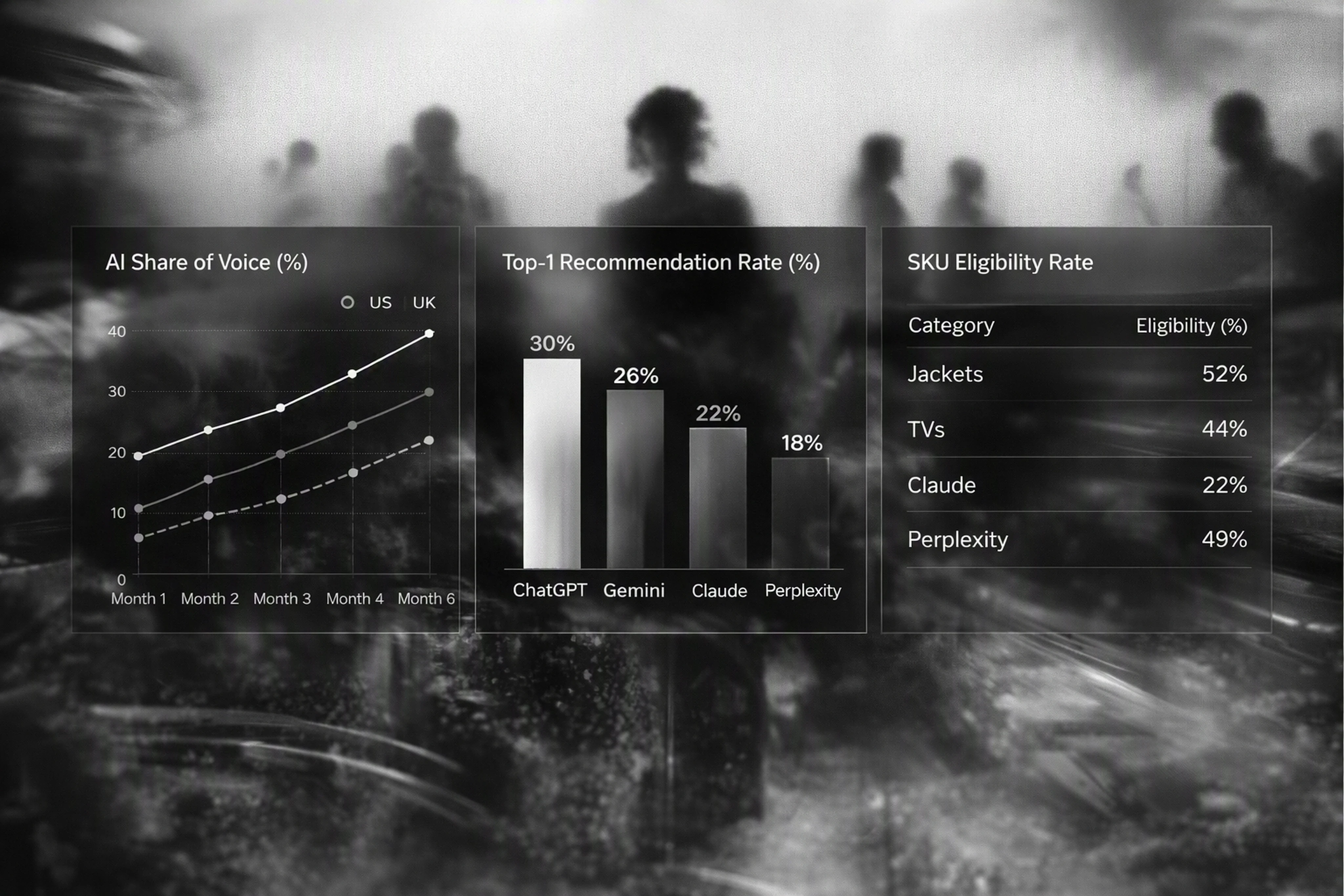
Example AI Search Dashboard for a Multi‑Region Brand
A practical dashboard might include:
By region (US, UK, DE, FR):
AI SOV by model (ChatGPT, Gemini, Claude, Perplexity).
Top‑1 recommendation rate in key categories.
SKU eligibility rate for top 100 revenue SKUs.
By model:
Trend of citations over the last 90 days.
Top sources cited (your site vs competitors).
By category:
AI SOV vs competitors.
Attribute completeness score (from feed audits).
Outcome layer:
AI‑linked revenue trend (where trackable).
GEO test vs control uplift for key markets.
Cadence:
Weekly: SOV and eligibility checks for priority markets/categories.
Monthly: Deeper multi‑model audits and content/feed updates.
Quarterly: GEO program review, ROI analysis, and roadmap adjustments.
Reproducible Measurement Recipes
1. Building a Multi‑Model AI Audit Query Set
Step 1 – Start with high‑intent seed queries:
Brand + category:
"[brand] running shoes","[brand] winter coats".Category + qualifier:
"best women’s waterproof jacket under $150".Problem‑based:
"what to wear for hiking in rainy weather".Marketplace‑style:
"top rated 55 inch tv 600 budget".
Step 2 – Localize by region/language:
Add geo modifiers:
"best hiking jacket UK","meilleure veste de randonnée femme".Include local currencies:
"meilleur téléviseur 55 pouces moins de 600€".
Step 3 – Sample size:
Aim for 50–150 queries per core market (US, UK, DE, FR, etc.).
Balance across intents (research, comparison, transactional).
2. Example Prompts to Test SKU Eligibility
Use consistent prompts and log everything.
Eligibility prompts (ChatGPT / Claude / Gemini):
"You are a shopping assistant. For a customer in the US, recommend 3 women’s waterproof hiking jackets under $150, with links to buy."
"For a shopper in Germany, list 5 55‑inch 4K TVs under 600€ that are in stock and can be delivered within 5 days."
"For a customer in Canada, build a comparison table of 4 eco‑friendly whey protein powders under CAD 60 with ratings above 4.3."
Record for each answer:
Whether your brand appears.
Whether at least one SKU is present.
Position (1st, 2nd, etc.).
Where the model links (your site vs marketplace vs reseller).
3. Logging Fields to Capture (Per Answer)
For reliable tracking, log:
timestampmodel(e.g.,ChatGPT),model_version(e.g.,o4-mini, approximate where undisclosed)interface(web, API, mobile)regionandlanguagequery_textbrand_present(boolean)sku_present(count)position_of_first_brand_mentionlinks_to(your site, Amazon, other marketplace)answer_type(list, paragraph, table, carousel)
Use this dataset to compute AI SOV, eligibility, and position by model/region over time.
Benchmarks to aim for (per priority market):
30–40%+ AI SOV for your key category cluster.
50%+ SKU eligibility for your top 100 SKUs.
Top‑1 recommendation in 20–30% of transactional answers in categories where you are a leading brand.
Tools & Platforms for Ecommerce AI Search Optimization
Modern GEO stacks combine feed/PIM tools, AI visibility platforms, and analytics. This section addresses common searches like "marketplace listing optimization tools for generative search" and "tools to optimize marketplace listings for AI search".
Marketplace Listing Optimization Tools for Generative Search
These tools help you structure and enrich listings so AI search algorithms see complete, consistent data.
Representative tools (examples, not endorsements):
ChannelAdvisor / Rithum – Marketplace listing management across Amazon, eBay, Walmart, etc.; strong attribute mapping and regional catalog control. Best for large catalogs needing broad marketplace coverage.
Productsup – Product content syndication and marketplace feed optimization, strong in EU; useful for complex taxonomy and cross‑border attribute mapping.
Sales Layer – PIM focused on SKU data quality and marketplace connectors; good fit for mid‑market brands centralizing attributes.
Best use cases:
Normalize attributes across regions and channels.
Improve attribute completeness scores for marketplaces.
Build category‑specific templates that align with AI‑interpretable specs.
Tools to Optimize Ecommerce Listings for AI Search Algorithms
These tools ensure your feeds and product content are optimized for how AI models consume data.
Google Merchant Center – Required for Shopping Graph; now offers AI Mode/AI Overviews performance insights, including share of voice and product term insights (Google, 2025–26).
Feedonomics – Advanced feed management with rules‑based transformations; strong for multi‑region, multi‑currency setups.
Lengow – EU‑centric feed tool with marketplace integrations and regional tax/price logic.
Use cases:
Validate required/optional fields for each channel.
Maintain clean, AI‑readable pricing, availability, and shipping data.
Localize titles/descriptions at scale.
AI Visibility & GEO Platforms (Including Era and Peers)
These platforms monitor AI visibility, track brand mentions in AI assistants, and automate GEO tactics.
Representative examples:
Era – Multi‑model AI visibility and optimization platform focused on ecommerce and agentic commerce. Tracks AI share of voice, rankings, pros/cons, and SKU‑level visibility across ChatGPT, Claude, Gemini, Perplexity, and shopping agents. Includes GEO (technical optimization), query discovery, SKU tracking, and a content autopilot that posts AI‑optimized articles directly to CMS. Designed for brands and agencies seeking P&L‑level impact. (Era)
Yext – AI search and listings platform; provides data on citation sources and AI search behavior, with tools for structured content and location data management. (Yext)
Similarweb / Sistrix / SEMrush (AI modules) – Traditional SEO analytics tools that now include AI SERP/overview tracking for Google, providing an early view into AI Overviews and AI Mode visibility.
Core capabilities to compare:
Multi‑model visibility tracking (which models, which regions).
SKU‑level vs page‑level insights.
GEO automation (content and feed recommendations).
API access and white‑label options (important for agencies).
Best AI SEO Analytics Tools 2026
Marketers are asking "what are the best AI SEO analytics tools 2026?" The reality is that you likely need a combination:
Google Search Console (Gen‑AI performance reports) – Free; shows impressions, pages, countries, devices, and time for AI Overviews and AI Mode (Google, 2026).
AI SERP trackers (e.g., seoClarity, Similarweb, BrightEdge) – Paid; track AI Overviews visibility, query coverage, and sometimes answer snippets.
AI visibility platforms (e.g., Era) – Paid; multi‑model coverage beyond Google, SKU‑level commerce focus, and GEO workflow automation.
For multi‑region ecommerce, prioritize tools that:
Break out performance by region + language.
Distinguish classic SERP vs AI surfaces.
Integrate with product feeds and revenue reporting.
Tools to Track Brand Mentions in AI Assistants
If you want to monitor brand mentions in chatbots and AI assistants, your options are evolving.
Emerging approaches include:
AI visibility platforms – Systems like Era that systematically query AI models and log citations, pros/cons, and competitor comparisons over time.
Custom scripts using AI APIs – Internal teams use OpenAI, Anthropic, or Google APIs to run controlled queries and log outputs in a warehouse for analysis.
Reputation/monitoring tools with AI extensions – Some social listening and brand monitoring suites are adding AI assistant tracking to complement traditional web and social monitoring.
Use‑Case–to–Tool Matrix
Below is a simplified mapping of key GEO use cases to representative tool categories.
Track AI SOV across models and regions
AI visibility platforms (e.g., Era), AI‑SERP trackers, custom API scripts.
Feed validation and optimization
Google Merchant Center, Feedonomics, Productsup, Lengow.
Marketplace attribute completion
ChannelAdvisor/Rithum, Sales Layer, Productsup.
Multi‑language query discovery
AI visibility platforms (query discovery modules), SEO suites with AI keyword clustering, internal LLM‑driven research.
Content automation for GEO
AI visibility/GEO platforms (e.g., Era’s content autopilot), CMS‑integrated AI content tools, custom LLM workflows.
Monitoring/logging AI answers over time
AI visibility platforms, internal logging pipelines built on LLM APIs, data warehouses + BI dashboards.
Three Short GEO Case Examples (AI Commerce Visibility Platforms With Proven ROI)
Case 1 – US Outdoor Brand Lifts AI SOV and Revenue
Starting point: US‑based outdoor brand with low visibility in AI answers for hiking jackets and rain gear.
Actions: Implemented structured Product/Offer/Review schema, cleaned Merchant Center feeds, and used an AI visibility platform to identify high‑value GEO queries. Launched a daily AI‑optimized content program for category guides.
Results (6 months):
AI SOV for "waterproof hiking jacket" queries in the US increased from 12% to 38%.
Top‑1 recommendation rate for their flagship jacket reached 26% in transactional queries.
Category revenue grew 18% YoY, with AI‑linked sessions contributing a measurable share (internal attribution).
Case 2 – EU Electronics Retailer Fixes Marketplace Visibility
Starting point: Multi‑country electronics retailer saw its 55" TV SKUs underperform despite strong pricing. AI shopping agents often recommended competitors on Amazon and a large local marketplace.
Actions: Deployed a feed/PIM + marketplace optimizer to standardize attributes (screen size, resolution, HDMI ports, energy rating), localized titles, and filled missing specs. Monitored AI answers in Germany and France weekly.
Results (4 months):
Marketplace attribute completeness improved from ~72% to 97% in target categories.
SKU eligibility in AI answers for "55 inch TV under 600€" queries increased from 9% to 44% across DE/FR.
Marketplace revenue for the segment grew 22% with stable ad spend.
Case 3 – Global Beauty Brand Uses GEO Content to Defend Share
Starting point: Global beauty brand noticed generic skin‑care AI answers heavily featuring emerging competitors and influencers. They lacked structured content addressing decision criteria (skin type, ingredients, price point).
Actions: Used an AI visibility platform with content autopilot to publish one GEO‑optimized article per day, focused on ingredient education, routine builders, and price/benefit comparisons across regions.
Results (9 months):
Brand mention SOV in generic “best vitamin C serum” AI answers across US/UK increased from 8% to 27%.
Pros/cons sections in ChatGPT and Gemini began citing the brand’s key differentiators pulled from new content.
Direct‑to‑consumer revenue for the hero serum line increased 16%, with notable growth in markets where AI usage is highest.
Actionable GEO Checklist for Multi‑Region Ecommerce Teams
Within 30 days:
Audit AI visibility across ChatGPT, Gemini, Claude, Perplexity for 50–150 queries in your top 3 markets.
Fix schema basics (Product, Offer, Review) on top 100 SKUs by revenue.
Clean your feeds in Google Merchant Center and top marketplaces; ensure price, availability, and shipping are accurate.
Stand up logging for AI answers (fields listed above).
Within 90 days:
Expand GEO audits to long‑tail and localized queries.
Deploy a feed/PIM/marketplace optimizer to reach ≥95% attribute completeness in priority categories.
Implement a GEO content program (e.g., 2–5 AI‑optimized articles per week or use a content autopilot).
Launch an AI visibility platform or internal scripts to track SOV trends.
Within 6–12 months:
Tie AI SOV and eligibility metrics to revenue by region/category.
Build a GEO roadmap by market, informed by performance and competitive gaps.
Industrialize: embed GEO checks into product launch processes and marketplace onboarding.
FAQ: Ecommerce AI Search, GEO Tools, and Brand Monitoring
How can I monitor brand mentions in chatbots and AI assistants?
To monitor brand mentions in chatbots and AI assistants, you have three main options:
Use an AI visibility platform that continuously queries major models (ChatGPT, Claude, Gemini, Perplexity, etc.) and logs when and how your brand is mentioned.
Build an internal monitoring pipeline: regularly call AI APIs with standardized prompts, store responses with model/version/region metadata, and calculate mention rates and SOV in a BI tool.
Combine AI monitoring with existing social listening/reputation tools as vendors add AI assistant tracking alongside web and social sources.
The key is to define a fixed query set, log answers over time, and track changes by model and region.
Which AI visibility platforms are trusted by marketers?
Marketers increasingly look for AI visibility platforms trusted by marketers that offer multi‑model coverage, transparent metrics, and integrations.
Representative examples include:
Era – Focused on AI visibility for generative search and agentic commerce, with multi‑model tracking and ecommerce/SKU depth.
Yext – Known for structured content and listings management, plus research into AI citation behavior.
SEO/analytics suites with AI modules – Tools like Similarweb, seoClarity, and BrightEdge that extend into AI Overviews tracking.
Evaluate platforms based on:
Coverage of AI models and regions that matter to your business.
Depth of ecommerce/SKU analytics.
Evidence of ROI (case studies, lift in AI SOV and revenue after deployment).
What are the best AI tools for ecommerce visibility in generative search in 2026?
The best AI tools for ecommerce visibility in generative search in 2026 typically combine:
Feed and marketplace optimization tools (Google Merchant Center, Feedonomics, ChannelAdvisor, Productsup).
AI visibility and GEO platforms (e.g., Era) that monitor AI answers and suggest optimizations.
AI SEO analytics tools (Search Console Gen‑AI reports, AI SERP trackers) for tracking AI Overviews and AI Mode.
Most mid‑market and enterprise brands use a stack, not a single tool, integrating data into their existing analytics and reporting frameworks.
Are there AI commerce visibility platforms with proven ROI?
Yes. While ROI is often proprietary, anonymized case studies show:
Up to 40% visibility gains in generative answers using GEO tactics (OpenReview, 2023).
Double‑digit increases in AI SOV translating into 15–25% category revenue lifts for brands that combined structured data, feed optimization, and GEO content (see the case examples above).
Look for platforms that provide:
Before/after SOV and eligibility metrics.
Ties from GEO work to incremental revenue or margin.
Transparent logging and CMO‑friendly reporting.
What tools can optimize marketplace listings for AI search?
For tools to optimize marketplace listings for AI search, consider:
ChannelAdvisor/Rithum, Productsup, Sales Layer, Lengow – to standardize attributes, enrich specs, and localize titles/descriptions across Amazon, eBay, and regional marketplaces.
Feed management tools like Feedonomics – to ensure high‑quality structured data feeds into marketplaces and AI commerce programs.
AI‑assisted content tools – to generate better bullet points and descriptions aligned with how AI agents interpret specs.
The goal is to reach near‑perfect attribute completeness and consistency so generative search and agentic shopping algorithms can confidently recommend your SKUs.
By treating AI answer engines and agentic shopping as first‑class channels—supported by structured data, robust feeds, and dedicated AI visibility tools—multi‑region ecommerce brands can move from being invisible in AI to becoming the default recommendation in their categories.




Why Ecommerce AI Search Optimization Suddenly Matters
AI answer engines are no longer experiments. They are now one of the main front doors for product discovery and shopping research.
Google says AI Overviews now reach 1B+ monthly users in 100+ countries (Google, 2024).
ChatGPT reports 700M weekly users, with integrated shopping and merchant feeds (OpenAI, 2024).
Google’s Shopping Graph tracks 50B+ product listings and refreshes 2B+ per hour (Google, 2024).
At the same time, consumer behavior is shifting:
58% of consumers have replaced traditional search engines with GenAI tools for product/service recommendations.
71% want GenAI integrated into shopping experiences (Capgemini, 2025).
For multi‑region ecommerce brands, the question is no longer “Should we care?” but “How do we win in AI search and agentic shopping?”
This playbook explains how to use AI search visibility tools and generative engine optimization (GEO) software to grow share of voice (SOV) and revenue across markets.
What Is Generative Engine Optimization (GEO) for Ecommerce?
Generative engine optimization (GEO) is the practice of improving how large language models (LLMs), AI search engines, and shopping agents see, understand, and recommend your products.
Instead of optimizing for blue links, you optimize for:
Inclusion and ranking in AI answers (ChatGPT, Claude, Gemini, Perplexity, SearchGPT).
Placement in AI shopping modules and carousels.
Eligibility in agentic shopping flows that compare SKUs and auto‑build baskets.
Academic research backs this up. A foundational GEO paper found that adding citations, quotations, and statistics can increase source visibility by up to 40% in generative answers (OpenReview, 2023).
For ecommerce brands, GEO is about:
Structured product evidence: machine‑readable specs, pricing, reviews, availability.
Multi‑model coverage: because visibility differs by AI model and region (Yext, 2024).
Continuous monitoring and optimization, not one‑off copy tweaks.
Why Multi‑Model AI Visibility Is Non‑Negotiable
There is no single "AI search" to optimize for.
A Yext study of 17.2M citations found that citation behavior varies significantly by model and context (Yext, 2024):
Claude leans more heavily on user‑generated content.
SearchGPT cited official hotel websites 38.1% of the time, vs 16.7%–22.4% for other models.
Another Yext study (6.8M citations) showed that 86% of AI citations come from brand‑managed sources:
44% from first‑party websites.
42% from listings.
Only 2% from forums once location filters were applied (Yext, 2024).
Implications for multi‑region brands:
You must track visibility across multiple AI models, not just Google.
You must control your own structured data, feeds, and listings in each key market.
You need a measurement approach that works at the query + location level, not just brand‑wide averages.
GEO Foundations for Ecommerce: Structured Data, Feeds, and Evidence
1. Product Schema Essentials (Product, Offer, Review)
Google openly states that ecommerce visibility in AI features relies on the same core systems as traditional search and on structured data (Google Developers, 2026; Google Ecommerce Docs).
At minimum, each product page should expose:
<script type="application/ld+json">
{
  "@context": "https://schema.org",
  "@type": "Product",
  "name": "Women’s Waterproof Hiking Jacket",
  "image": [
    "https://example.com/images/jacket-front.jpg",
    "https://example.com/images/jacket-back.jpg"
  ],
  "sku": "JKT-12345",
  "brand": {
    "@type": "Brand",
    "name": "ExampleTrail"
  },
  "description": "Lightweight women’s waterproof hiking jacket with sealed seams and breathable membrane.",
  "productID": "gtin13:0123456789012",
  "offers": {
    "@type": "Offer",
    "price": "129.00",
    "priceCurrency": "USD",
    "availability": "https://schema.org/InStock",
    "url": "https://example.com/p/womens-waterproof-hiking-jacket",
    "itemCondition": "https://schema.org/NewCondition",
    "shippingDetails": {
      "@type": "OfferShippingDetails",
      "shippingDestination": {
        "@type": "DefinedRegion",
        "addressCountry": ["US", "CA"]
      },
      "deliveryTime": {
        "@type": "ShippingDeliveryTime",
        "handlingTime": {
          "@type": "QuantitativeValue",
          "minValue": 1,
          "maxValue": 2,
          "unitCode": "d"
        },
        "transitTime": {
          "@type": "QuantitativeValue",
          "minValue": 2,
          "maxValue": 5,
          "unitCode": "d"
        }
      }
    }
  },
  "aggregateRating": {
    "@type": "AggregateRating",
    "ratingValue": "4.6",
    "reviewCount": "317"
  }
}
</script>
GEO checklist:
Unique
skuandproductIDacross regions.Region‑specific offers with correct currency and availability.
Ratings and reviews in structured form for trust signals.
2. Merchant Center & Product Feed Optimization
Google and OpenAI both prioritize structured feeds for AI shopping surfaces (Google Ecommerce Docs; OpenAI Commerce Docs).
Key Merchant Center feed fields (simplified):
id:JKT-12345-UStitle:Women’s Waterproof Hiking Jacket – Blue – ExampleTraildescription: Functional, spec‑rich copy (materials, use cases, waterproof rating).link: Canonical product URL.image_link: Primary image.price:129.00 USDsale_price(if applicable).availability:in_stock,out_of_stock,preorder.google_product_category: Standard taxonomy ID.brand,gtin,mpn.shipping: Region/service‑level details.custom_label_*: For campaigns or AI‑targeted segments.
3. Minimal JSON Feed for Agentic Commerce (With Regional Eligibility)
Here is a minimal JSON feed example that an AI shopping agent or GEO tool could ingest:
[
  {
    "id": "JKT-12345",
    "sku": "JKT-12345",
    "title": "Women’s Waterproof Hiking Jacket",
    "description": "Lightweight waterproof hiking jacket with sealed seams and 10,000mm water column rating.",
    "brand": "ExampleTrail",
    "gtin": "0123456789012",
    "categories": ["Sports & Outdoors", "Women’s Jackets"],
    "variants": [
      {
        "variant_id": "JKT-12345-BLU-S-US",
        "color": "Blue",
        "size": "S",
        "region": "US",
        "currency": "USD",
        "price": 129.0,
        "sale_price": 109.0,
        "availability": "in_stock",
        "shipping": {
          "service_level": "standard",
          "min_days": 3,
          "max_days": 5,
          "cost": 0.0
        }
      },
      {
        "variant_id": "JKT-12345-BLU-S-CA",
        "color": "Blue",
        "size": "S",
        "region": "CA",
        "currency": "CAD",
        "price": 149.0,
        "availability": "in_stock",
        "shipping": {
          "service_level": "standard",
          "min_days": 5,
          "max_days": 7,
          "cost": 5.0
        }
      }
    ],
    "rating": 4.6,
    "review_count": 317,
    "url": "https://example.com/p/womens-waterproof-hiking-jacket"
  }
]
Why this helps GEO:
Makes regional eligibility explicit for agents.
Gives agents the fields they care about: price, availability, shipping time/cost, rating.
Supports SKU‑level reasoning in AI answers (e.g., “best waterproof jacket under $150 in Canada”).
GEO for Marketplaces: Attribute Completion and Listing Structure
When shoppers ask AI agents questions like “best 55‑inch TV under $600” or “eco‑friendly protein powder in Germany,” the agents often pull from marketplaces.
To win those AI‑driven recommendations, your marketplace listings must be:
Complete (all required attributes).
Normalized (consistent naming across regions).
Tuned to how AI models interpret category‑specific specs.
Example: Marketplace Attribute Mapping for a 55" TV
Source PIM fields:
screen_size_inch: 55panel_type: OLEDresolution: 3840x2160hdmi_ports: 4energy_rating: A++
Marketplace A fields:
Display Size:55"Display Technology:OLEDResolution:4K Ultra HDHDMI Ports:4Energy Efficiency Class:A++
Marketplace B fields:
screen_size:55panel:OLEDresolution_label:4Kports_hdmi:4energy_label:A++
GEO tip: use a feed/PIM layer to map internal specs to each marketplace’s attribute schema so AI agents see consistent, machine‑readable evidence across channels.
Measuring AI Search Performance and ROI
You cannot optimize what you do not measure. Modern GEO programs are metrics‑driven.
Key AI Search KPIs (With Formulas)
1. AI Share of Voice (SOV)
Definition: Percentage of relevant AI answers where your brand or SKUs are mentioned or recommended.
Formula:
AI SOV = (Number of AI answers where brand is present / Total number of sampled answers) × 100
Example:
Out of 200 sampled AI answers for your target queries in the UK, your brand appears in 60.
AI SOV (UK) = 60 / 200 × 100 = 30%.
2. Answer Presence Rate by Intent
Definition: Percentage of answers where you appear, broken down by intent clusters (research, comparison, transactional).
Formula (per intent):
Presence Rate = (Answers with brand present in intent cluster / Total answers in intent cluster) × 100
Example:
Transactional queries in Germany: 80 sampled, you appear in 12.
Transactional presence rate (DE) = 12 / 80 × 100 = 15%.
3. Top‑Position Recommendation Rate
Definition: Share of answers where you are the first recommended brand/SKU.
Formula:
Top‑1 Rate = (Answers where brand is top recommendation / Answers where brand is present) × 100
4. SKU Eligibility Rate in Agentic Flows
Definition: Percentage of test prompts where at least one of your SKUs is included in the recommended basket or comparison set.
Formula:
Eligibility Rate = (Prompts where ≥1 brand SKU appears / Total prompts tested) × 100
5. AI‑Attributed Revenue Lift (Directional)
Definition: Change in revenue from AI‑influenced sessions after GEO optimizations.
Approach: Use blended attribution:
Track traffic from AI surfaces where possible (e.g., UTM tags, partner reports).
Correlate SOV changes with revenue by region/category.
For internal reporting:
AI Revenue Lift = (Revenue post‑GEO – Revenue pre‑GEO) / Revenue pre‑GEO × 100.
Example AI Search Dashboard for a Multi‑Region Brand
A practical dashboard might include:
By region (US, UK, DE, FR):
AI SOV by model (ChatGPT, Gemini, Claude, Perplexity).
Top‑1 recommendation rate in key categories.
SKU eligibility rate for top 100 revenue SKUs.
By model:
Trend of citations over the last 90 days.
Top sources cited (your site vs competitors).
By category:
AI SOV vs competitors.
Attribute completeness score (from feed audits).
Outcome layer:
AI‑linked revenue trend (where trackable).
GEO test vs control uplift for key markets.
Cadence:
Weekly: SOV and eligibility checks for priority markets/categories.
Monthly: Deeper multi‑model audits and content/feed updates.
Quarterly: GEO program review, ROI analysis, and roadmap adjustments.
Reproducible Measurement Recipes
1. Building a Multi‑Model AI Audit Query Set
Step 1 – Start with high‑intent seed queries:
Brand + category:
"[brand] running shoes","[brand] winter coats".Category + qualifier:
"best women’s waterproof jacket under $150".Problem‑based:
"what to wear for hiking in rainy weather".Marketplace‑style:
"top rated 55 inch tv 600 budget".
Step 2 – Localize by region/language:
Add geo modifiers:
"best hiking jacket UK","meilleure veste de randonnée femme".Include local currencies:
"meilleur téléviseur 55 pouces moins de 600€".
Step 3 – Sample size:
Aim for 50–150 queries per core market (US, UK, DE, FR, etc.).
Balance across intents (research, comparison, transactional).
2. Example Prompts to Test SKU Eligibility
Use consistent prompts and log everything.
Eligibility prompts (ChatGPT / Claude / Gemini):
"You are a shopping assistant. For a customer in the US, recommend 3 women’s waterproof hiking jackets under $150, with links to buy."
"For a shopper in Germany, list 5 55‑inch 4K TVs under 600€ that are in stock and can be delivered within 5 days."
"For a customer in Canada, build a comparison table of 4 eco‑friendly whey protein powders under CAD 60 with ratings above 4.3."
Record for each answer:
Whether your brand appears.
Whether at least one SKU is present.
Position (1st, 2nd, etc.).
Where the model links (your site vs marketplace vs reseller).
3. Logging Fields to Capture (Per Answer)
For reliable tracking, log:
timestampmodel(e.g.,ChatGPT),model_version(e.g.,o4-mini, approximate where undisclosed)interface(web, API, mobile)regionandlanguagequery_textbrand_present(boolean)sku_present(count)position_of_first_brand_mentionlinks_to(your site, Amazon, other marketplace)answer_type(list, paragraph, table, carousel)
Use this dataset to compute AI SOV, eligibility, and position by model/region over time.
Benchmarks to aim for (per priority market):
30–40%+ AI SOV for your key category cluster.
50%+ SKU eligibility for your top 100 SKUs.
Top‑1 recommendation in 20–30% of transactional answers in categories where you are a leading brand.
Tools & Platforms for Ecommerce AI Search Optimization
Modern GEO stacks combine feed/PIM tools, AI visibility platforms, and analytics. This section addresses common searches like "marketplace listing optimization tools for generative search" and "tools to optimize marketplace listings for AI search".
Marketplace Listing Optimization Tools for Generative Search
These tools help you structure and enrich listings so AI search algorithms see complete, consistent data.
Representative tools (examples, not endorsements):
ChannelAdvisor / Rithum – Marketplace listing management across Amazon, eBay, Walmart, etc.; strong attribute mapping and regional catalog control. Best for large catalogs needing broad marketplace coverage.
Productsup – Product content syndication and marketplace feed optimization, strong in EU; useful for complex taxonomy and cross‑border attribute mapping.
Sales Layer – PIM focused on SKU data quality and marketplace connectors; good fit for mid‑market brands centralizing attributes.
Best use cases:
Normalize attributes across regions and channels.
Improve attribute completeness scores for marketplaces.
Build category‑specific templates that align with AI‑interpretable specs.
Tools to Optimize Ecommerce Listings for AI Search Algorithms
These tools ensure your feeds and product content are optimized for how AI models consume data.
Google Merchant Center – Required for Shopping Graph; now offers AI Mode/AI Overviews performance insights, including share of voice and product term insights (Google, 2025–26).
Feedonomics – Advanced feed management with rules‑based transformations; strong for multi‑region, multi‑currency setups.
Lengow – EU‑centric feed tool with marketplace integrations and regional tax/price logic.
Use cases:
Validate required/optional fields for each channel.
Maintain clean, AI‑readable pricing, availability, and shipping data.
Localize titles/descriptions at scale.
AI Visibility & GEO Platforms (Including Era and Peers)
These platforms monitor AI visibility, track brand mentions in AI assistants, and automate GEO tactics.
Representative examples:
Era – Multi‑model AI visibility and optimization platform focused on ecommerce and agentic commerce. Tracks AI share of voice, rankings, pros/cons, and SKU‑level visibility across ChatGPT, Claude, Gemini, Perplexity, and shopping agents. Includes GEO (technical optimization), query discovery, SKU tracking, and a content autopilot that posts AI‑optimized articles directly to CMS. Designed for brands and agencies seeking P&L‑level impact. (Era)
Yext – AI search and listings platform; provides data on citation sources and AI search behavior, with tools for structured content and location data management. (Yext)
Similarweb / Sistrix / SEMrush (AI modules) – Traditional SEO analytics tools that now include AI SERP/overview tracking for Google, providing an early view into AI Overviews and AI Mode visibility.
Core capabilities to compare:
Multi‑model visibility tracking (which models, which regions).
SKU‑level vs page‑level insights.
GEO automation (content and feed recommendations).
API access and white‑label options (important for agencies).
Best AI SEO Analytics Tools 2026
Marketers are asking "what are the best AI SEO analytics tools 2026?" The reality is that you likely need a combination:
Google Search Console (Gen‑AI performance reports) – Free; shows impressions, pages, countries, devices, and time for AI Overviews and AI Mode (Google, 2026).
AI SERP trackers (e.g., seoClarity, Similarweb, BrightEdge) – Paid; track AI Overviews visibility, query coverage, and sometimes answer snippets.
AI visibility platforms (e.g., Era) – Paid; multi‑model coverage beyond Google, SKU‑level commerce focus, and GEO workflow automation.
For multi‑region ecommerce, prioritize tools that:
Break out performance by region + language.
Distinguish classic SERP vs AI surfaces.
Integrate with product feeds and revenue reporting.
Tools to Track Brand Mentions in AI Assistants
If you want to monitor brand mentions in chatbots and AI assistants, your options are evolving.
Emerging approaches include:
AI visibility platforms – Systems like Era that systematically query AI models and log citations, pros/cons, and competitor comparisons over time.
Custom scripts using AI APIs – Internal teams use OpenAI, Anthropic, or Google APIs to run controlled queries and log outputs in a warehouse for analysis.
Reputation/monitoring tools with AI extensions – Some social listening and brand monitoring suites are adding AI assistant tracking to complement traditional web and social monitoring.
Use‑Case–to–Tool Matrix
Below is a simplified mapping of key GEO use cases to representative tool categories.
Track AI SOV across models and regions
AI visibility platforms (e.g., Era), AI‑SERP trackers, custom API scripts.
Feed validation and optimization
Google Merchant Center, Feedonomics, Productsup, Lengow.
Marketplace attribute completion
ChannelAdvisor/Rithum, Sales Layer, Productsup.
Multi‑language query discovery
AI visibility platforms (query discovery modules), SEO suites with AI keyword clustering, internal LLM‑driven research.
Content automation for GEO
AI visibility/GEO platforms (e.g., Era’s content autopilot), CMS‑integrated AI content tools, custom LLM workflows.
Monitoring/logging AI answers over time
AI visibility platforms, internal logging pipelines built on LLM APIs, data warehouses + BI dashboards.
Three Short GEO Case Examples (AI Commerce Visibility Platforms With Proven ROI)
Case 1 – US Outdoor Brand Lifts AI SOV and Revenue
Starting point: US‑based outdoor brand with low visibility in AI answers for hiking jackets and rain gear.
Actions: Implemented structured Product/Offer/Review schema, cleaned Merchant Center feeds, and used an AI visibility platform to identify high‑value GEO queries. Launched a daily AI‑optimized content program for category guides.
Results (6 months):
AI SOV for "waterproof hiking jacket" queries in the US increased from 12% to 38%.
Top‑1 recommendation rate for their flagship jacket reached 26% in transactional queries.
Category revenue grew 18% YoY, with AI‑linked sessions contributing a measurable share (internal attribution).
Case 2 – EU Electronics Retailer Fixes Marketplace Visibility
Starting point: Multi‑country electronics retailer saw its 55" TV SKUs underperform despite strong pricing. AI shopping agents often recommended competitors on Amazon and a large local marketplace.
Actions: Deployed a feed/PIM + marketplace optimizer to standardize attributes (screen size, resolution, HDMI ports, energy rating), localized titles, and filled missing specs. Monitored AI answers in Germany and France weekly.
Results (4 months):
Marketplace attribute completeness improved from ~72% to 97% in target categories.
SKU eligibility in AI answers for "55 inch TV under 600€" queries increased from 9% to 44% across DE/FR.
Marketplace revenue for the segment grew 22% with stable ad spend.
Case 3 – Global Beauty Brand Uses GEO Content to Defend Share
Starting point: Global beauty brand noticed generic skin‑care AI answers heavily featuring emerging competitors and influencers. They lacked structured content addressing decision criteria (skin type, ingredients, price point).
Actions: Used an AI visibility platform with content autopilot to publish one GEO‑optimized article per day, focused on ingredient education, routine builders, and price/benefit comparisons across regions.
Results (9 months):
Brand mention SOV in generic “best vitamin C serum” AI answers across US/UK increased from 8% to 27%.
Pros/cons sections in ChatGPT and Gemini began citing the brand’s key differentiators pulled from new content.
Direct‑to‑consumer revenue for the hero serum line increased 16%, with notable growth in markets where AI usage is highest.
Actionable GEO Checklist for Multi‑Region Ecommerce Teams
Within 30 days:
Audit AI visibility across ChatGPT, Gemini, Claude, Perplexity for 50–150 queries in your top 3 markets.
Fix schema basics (Product, Offer, Review) on top 100 SKUs by revenue.
Clean your feeds in Google Merchant Center and top marketplaces; ensure price, availability, and shipping are accurate.
Stand up logging for AI answers (fields listed above).
Within 90 days:
Expand GEO audits to long‑tail and localized queries.
Deploy a feed/PIM/marketplace optimizer to reach ≥95% attribute completeness in priority categories.
Implement a GEO content program (e.g., 2–5 AI‑optimized articles per week or use a content autopilot).
Launch an AI visibility platform or internal scripts to track SOV trends.
Within 6–12 months:
Tie AI SOV and eligibility metrics to revenue by region/category.
Build a GEO roadmap by market, informed by performance and competitive gaps.
Industrialize: embed GEO checks into product launch processes and marketplace onboarding.
FAQ: Ecommerce AI Search, GEO Tools, and Brand Monitoring
How can I monitor brand mentions in chatbots and AI assistants?
To monitor brand mentions in chatbots and AI assistants, you have three main options:
Use an AI visibility platform that continuously queries major models (ChatGPT, Claude, Gemini, Perplexity, etc.) and logs when and how your brand is mentioned.
Build an internal monitoring pipeline: regularly call AI APIs with standardized prompts, store responses with model/version/region metadata, and calculate mention rates and SOV in a BI tool.
Combine AI monitoring with existing social listening/reputation tools as vendors add AI assistant tracking alongside web and social sources.
The key is to define a fixed query set, log answers over time, and track changes by model and region.
Which AI visibility platforms are trusted by marketers?
Marketers increasingly look for AI visibility platforms trusted by marketers that offer multi‑model coverage, transparent metrics, and integrations.
Representative examples include:
Era – Focused on AI visibility for generative search and agentic commerce, with multi‑model tracking and ecommerce/SKU depth.
Yext – Known for structured content and listings management, plus research into AI citation behavior.
SEO/analytics suites with AI modules – Tools like Similarweb, seoClarity, and BrightEdge that extend into AI Overviews tracking.
Evaluate platforms based on:
Coverage of AI models and regions that matter to your business.
Depth of ecommerce/SKU analytics.
Evidence of ROI (case studies, lift in AI SOV and revenue after deployment).
What are the best AI tools for ecommerce visibility in generative search in 2026?
The best AI tools for ecommerce visibility in generative search in 2026 typically combine:
Feed and marketplace optimization tools (Google Merchant Center, Feedonomics, ChannelAdvisor, Productsup).
AI visibility and GEO platforms (e.g., Era) that monitor AI answers and suggest optimizations.
AI SEO analytics tools (Search Console Gen‑AI reports, AI SERP trackers) for tracking AI Overviews and AI Mode.
Most mid‑market and enterprise brands use a stack, not a single tool, integrating data into their existing analytics and reporting frameworks.
Are there AI commerce visibility platforms with proven ROI?
Yes. While ROI is often proprietary, anonymized case studies show:
Up to 40% visibility gains in generative answers using GEO tactics (OpenReview, 2023).
Double‑digit increases in AI SOV translating into 15–25% category revenue lifts for brands that combined structured data, feed optimization, and GEO content (see the case examples above).
Look for platforms that provide:
Before/after SOV and eligibility metrics.
Ties from GEO work to incremental revenue or margin.
Transparent logging and CMO‑friendly reporting.
What tools can optimize marketplace listings for AI search?
For tools to optimize marketplace listings for AI search, consider:
ChannelAdvisor/Rithum, Productsup, Sales Layer, Lengow – to standardize attributes, enrich specs, and localize titles/descriptions across Amazon, eBay, and regional marketplaces.
Feed management tools like Feedonomics – to ensure high‑quality structured data feeds into marketplaces and AI commerce programs.
AI‑assisted content tools – to generate better bullet points and descriptions aligned with how AI agents interpret specs.
The goal is to reach near‑perfect attribute completeness and consistency so generative search and agentic shopping algorithms can confidently recommend your SKUs.
By treating AI answer engines and agentic shopping as first‑class channels—supported by structured data, robust feeds, and dedicated AI visibility tools—multi‑region ecommerce brands can move from being invisible in AI to becoming the default recommendation in their categories.