
September 21, 2026
September 21, 2026
Ecommerce AI Search Optimization: GEO Tools, Logs, and Visibility Strategy
Meta description: Ecommerce AI search optimization is now critical. Learn GEO tools, AI visibility metrics, and log-based strategies to lift SKU-level…
Meta description: Ecommerce AI search optimization is now critical. Learn GEO tools, AI visibility metrics, and log-based strategies to lift SKU-level…
Meta description: Ecommerce AI search optimization is now critical. Learn GEO tools, AI visibility metrics, and log-based strategies to lift SKU-level visibility across generative search and agentic commerce.
Ecommerce AI Search Optimization: GEO Tools, Logs, and Visibility Strategy
Tools to optimize marketplace listings for AI search are quickly becoming as important as classic SEO suites. As AI answer engines and shopping agents move to the front of the ecommerce funnel, brands need a GEO (Generative Engine Optimization) strategy that combines AI search tracking, AI logs, and GEO tools to lift SKU-level visibility across generative engines.
This pillar guide defines ecommerce AI search optimization, catalogs leading AI visibility platforms, and shows how to build a unified, evidence-based visibility strategy.
1. Why Ecommerce AI Search Optimization Matters Now
The discovery layer for shopping is shifting into AI answer engines and agents.
Key data points:
Google reports that AI Overviews reached 1.5 billion monthly users across 200 countries and territories as of May 2025, driving 10%+ higher usage on queries where AI Overviews appear in the U.S. and India (Google I/O 2025, 14 May 2025).
Adobe found that generative AI tools drove a 693.4% year-over-year increase in traffic to retail sites during the 2025 holiday season (Adobe Holiday Shopping Season 2025 Report, 7 Jan 2026).
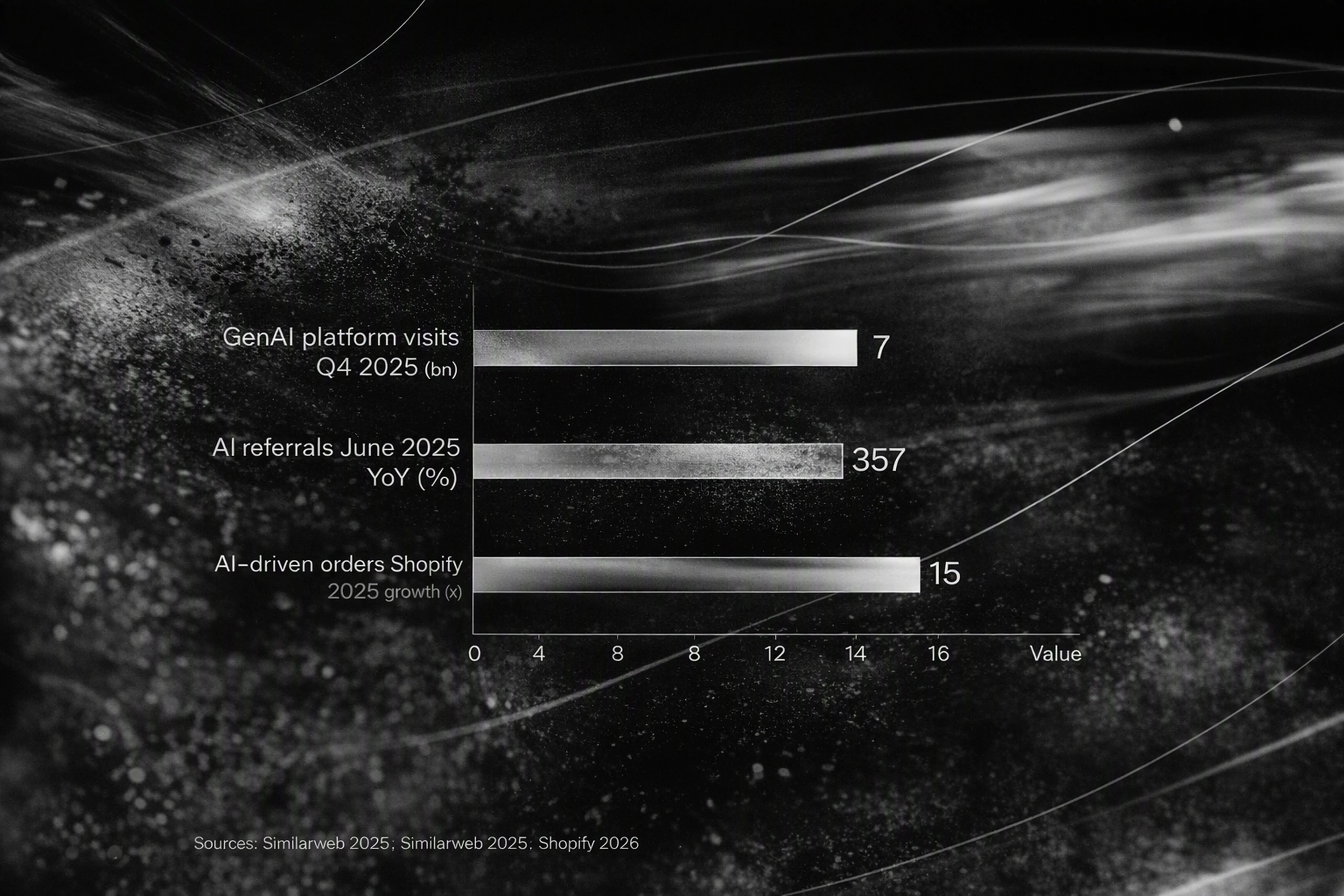
Similarweb estimates 7 billion monthly visits to generative AI platforms in Q4 2025, up 76% YoY, and more than 1.1 billion referral visits from AI platforms to websites in June 2025, up 357% YoY (Similarweb GEO & AI Visibility ROI analysis, 2025).
Shopify reports AI-driven orders grew 15x on Shopify stores between January and December 2025 (Shopify Enterprise AI solutions, 2026).
Consumer behavior reinforces the trend:
Adobe’s consumer survey found 38% of U.S. consumers had used generative AI for online shopping and 52% planned to do so in the same year. Top use cases: research (55%), recommendations (47%), deals (43%) (Adobe, "Generative AI–Powered Shopping Rises", 2025).
HUMAN Security reported 64% of Americans planned to use AI tools for holiday shopping in 2025, up from 11% the prior year, and 75% said they would entrust an AI agent with entire transactions (HUMAN Security, holiday AI use survey, 2025).
Forrester estimates that more than 50% of online adults have used generative AI as an answer engine, with 1 in 5 using it daily (Forrester, "The State of GenAI and Consumers for 2026", 2026).
Analyst perspective:
Gartner predicts search engine volume will drop 25% by 2026 due to AI chatbots and virtual agents acting as “substitute answer engines” (Gartner press release, 19 Feb 2024).
For ecommerce brands, this means:
Classic SERP rankings are no longer the whole story.
AI-native traffic (from ChatGPT, Gemini, Claude, Perplexity, and shopping agents) is now a measurable, high-converting channel.
GEO (Generative Engine Optimization) and AI visibility need their own measurement, tooling, and strategy.
2. What Is Ecommerce AI Search Optimization (GEO)?
2.1 Core Definition
Ecommerce AI search optimization (GEO) is the practice of improving how generative engines and AI agents see, understand, and recommend your products and brand across conversational and autonomous shopping flows.
It focuses on:
Answer engines: ChatGPT, Gemini, Claude, Perplexity, and AI modes in search.
Shopping agents and feeds: AI-native shopping experiences, merchant feeds, and agentic commerce protocols.
Evidence and structure: Rich, machine-readable product data and third-party evidence rather than keywords alone.
The Princeton/ACM Generative Engine Optimization paper formalized GEO and found:
GEO interventions can boost visibility in generative responses by up to 40%.
Including citations, quotations, and statistics materially improves visibility, with effects varying by domain (Zhang et al., "Generative Engine Optimization", OpenReview/ACM, 2024).
2.2 Ecommerce GEO vs Classic SEO
Key differences:
Surface
SEO: Optimizes for web pages on SERPs.
GEO: Optimizes for how LLMs and agents assemble answers and product carousels.
Signals
SEO: Keywords, links, page-level metadata.
GEO: Structured product data, catalogue hygiene, price and availability consistency, third-party signals (reviews, citations).
Metrics
SEO: Rankings, organic traffic, CTR.
GEO: Visibility score, share of voice, citation frequency, SKU-level inclusion in AI shopping flows.
3. Definitions & Measurement for AI Visibility
To make AI search optimization reproducible and machine-readable, you need precise metric definitions.
3.1 Visibility Score
Definition:
Visibility score is the proportion of sampled AI answers where a brand or SKU appears, weighted by query intent.
Formula (brand-level):
Let
N_total= total number of sampled AI answers for a query set.Let
N_brand= number of answers where your brand appears (mention or product listing).Let
w_i= weight for queryibased on intent (e.g., 1.0 for transactional, 0.5 for informational).
Simple version:
visibility_score = N_brand / N_total
Weighted version:
visibility_score_weighted = (Σ presence_i * w_i) / (Σ w_i)wherepresence_iis 1 if brand present, else 0.
Example API/CSV fields:
query_stringquery_intent_label(informational / commercial / transactional)engine_name(chatgpt, gemini, claude, perplexity, etc.)answer_idbrand_present(boolean)visibility_score(float)
3.2 Share of Voice (SOV) in AI Answers
Definition:
Share of voice in AI answers is the share of total mentions or answer inclusions that your brand receives within a competitive set.
Formula:
Let
M_brand= total mentions/inclusions of your brand.Let
M_competitors= total mentions/inclusions of all brands in the set.share_of_voice = M_brand / (M_brand + M_competitors)
You can compute SOV by:
Platform: ChatGPT vs Gemini vs Claude.
Region: US vs EU vs APAC.
Query cluster: e.g., “wireless earbuds under $200”.
Example API/CSV fields:
brand_namecompetitor_names[]mentions_countshare_of_voice(float)region_codeengine_name
3.3 SKU-Level Visibility
Definition:
SKU-level visibility measures how often a specific product (SKU) appears, is recommended, or is eligible in AI-generated shopping flows.
Formula:
Let
A_sku= number of AI answers sampled for a query set.Let
A_sku_present= number of answers where the SKU appears (carousel, product list, or cited recommendation).sku_visibility = A_sku_present / A_sku
You can extend this with position weighting:
Assign weights:
w_topfor top-3 positions,w_midfor positions 4–10,w_tailfor all others.sku_visibility_weighted = (Σ position_weight_j) / A_sku
Example API/CSV fields:
sku_idengine_namequery_clustersku_present(boolean)sku_position_index(integer)sku_visibility_score(float)
3.4 Citations and Sources
Botify and the GEO literature stress citations as a core visibility signal.
Botify argues that for AI search, brands should track visibility score, platform, share of voice, and citations instead of just static rankings (Botify, "How to Measure AI Visibility", 2025).
Definition:
A citation is an explicit source reference (URL, brand, or dataset name) included in an AI-generated answer.
Metrics:
citation_countper brand per query.citation_rank(order in the sources list).citation_type(first-party site, marketplace listing, review site, news, etc.).
Example API/CSV fields:
answer_idsource_urlsource_domainsource_brandcitation_rankcitation_type
4. How AI Search Engines Select Ecommerce Results
Understanding how AI engines assemble shopping answers is central to GEO.
4.1 OpenAI’s Shopping with ChatGPT
OpenAI states that shopping results in ChatGPT:
Are not ads.
Are selected based on relevance, context, and structured product data, including first- and third-party metadata.
May support Instant Checkout for eligible merchants, enabling transactions directly within ChatGPT (OpenAI Help Center, "Shopping with ChatGPT", 2025).
Implications:
Clean, consistent product feeds and accurate metadata directly impact inclusion.
Third-party sources (marketplaces, reviews, comparison sites) affect how your products are ranked and described.
4.2 Google AI Overviews and Shopify Signals
Google’s AI Overviews:
Blend web search results, structured data, and shopping knowledge graphs.
Show product recommendations and price ranges inside conversational answers.
Shopify reports that:
AI-driven orders grew 15x in 2025, highlighting the impact of AI-native surfaces on commerce (Shopify Enterprise AI solutions, 2026).
4.3 Bot and Crawl Behavior
AI visibility depends on what crawlers can access and surface.
Key crawl findings:
Botify analyzed 7+ billion log files to study OpenAI’s GPTBot and found its web crawl volume roughly tripled over a recent period (Botify, "OpenAI Tripled Web Crawl", 2025).
Cloudflare reported that training-related crawling drove nearly 80% of AI bot activity in 2025, and GPTBot’s share of AI crawling traffic rose from 4.7% to 11.7% over the year (Cloudflare, AI bot traffic analysis, 2025).
Takeaway:
Robots.txt, crawlers, and access controls are now part of your AI visibility stack.
5. Tools to Optimize Marketplace Listings for AI Search
5.1 Marketplace Listing Optimization Tools for Generative Search
For large ecommerce catalogs, you need tools that:
Sync product feeds to multiple AI-aware surfaces.
Enrich listings with machine-readable specs, attributes, and trust signals.
Track how SKUs appear across marketplaces and AI engines.
Examples (vendor-neutral overview):
Feed Management & Enrichment Platforms (e.g., Feedonomics, Productsup)
Capabilities:
Central feed management across marketplaces.
Attribute standardization and taxonomy mapping.
Rule-based enrichment (e.g., auto-add material, compatibility, use cases).
Pros:
Scales across thousands of SKUs.
Reduces feed discrepancies that confuse AI models.
Cons:
Limited direct visibility into conversational AI answers.
Marketplace SEO Tools for AI-Powered Search (e.g., Datahawk, Helium 10 for Amazon; Sellics-like suites)
Capabilities:
Listing optimization for marketplace search.
Keyword and attribute suggestions.
Rating, review, and pricing intelligence.
Pros:
Deep marketplace-specific insights.
Cons:
Not designed to monitor ChatGPT, Gemini, or cross-model AI answers.
AI Visibility & GEO Platforms (Era and peers)
Capabilities typically include:
Multi-model visibility tracking across AI answer engines.
SKU-level visibility and merchant tracking for ecommerce.
GEO/AEO optimization workflows and content automation.
Pros:
Directly aligned with generative search and agentic commerce.
Connects AI visibility data to revenue, not just rankings.
Cons:
Emerging category; standards and best practices are still evolving.
Note: Era is one example of an AI visibility and optimization platform built for GEO and agentic commerce, but this section is vendor-neutral and focuses on capabilities common to tools in the category.
5.2 Best AI Tools to Improve Ecommerce Visibility in Generative Search (2026)
When evaluating AI search tools trusted by ecommerce leaders, look for:
Coverage: ChatGPT, Gemini, Claude, Perplexity, plus relevant regional engines.
Granularity: Brand-level and SKU-level visibility.
Evidence tracking: Citations, pros/cons, sentiment, and source breakdown.
Integrations: CMS, analytics, product feeds, and marketing data warehouses.
Representative tool categories (2026 landscape):
AI visibility platforms
Focus: cross-model AI monitoring, GEO, AEO.
Example features: multi-region tracking, share-of-voice dashboards, answer exports.
Best AI SEO analytics tools 2026
Focus: replacing legacy SEO dashboards with AI-focused reporting.
Example features: visibility score by engine, AI referrals vs organic, citation analysis.
AI search monitoring services with expert advisory support
Focus: services layer on top of tools.
Example features: GEO strategy design, playbooks, and ongoing optimization.
6. Combining AI Search Tracking, Logs, and GEO Tools into One Strategy
6.1 Strategic Framework
A unified ecommerce AI search optimization program should:
Instrument visibility
Deploy AI visibility platforms and log analysis.
Define visibility score, share of voice, SKU-level metrics.
Audit evidence
Evaluate product data, feeds, reviews, and citations.
Identify missing or inconsistent attributes.
Optimize systematically (GEO)
Align product descriptions to solution-oriented queries.
Enrich listings with machine-readable evidence.
Publish AI-optimized content supporting priority categories.
Measure and iterate
Monitor changes in visibility and SKU inclusion.
Attribute performance shifts to specific interventions.
Scrunch’s 2026 survey of 600+ marketing and PR professionals shows that while 91% have a documented AI search strategy, 51% are unsure it is the right one, 60% are not analyzing which sources AI cites, 71% are not tracking share of voice vs competitors, and only 33% analyze AI bot traffic (Scrunch, "AI Confidence Trap" survey, 2026).
This gap is exactly what a unified tools + logs + GEO strategy should close.
6.2 AI Logs: The Missing Layer in GEO
Logs provide ground truth for AI crawling and referrals.
You should collect and analyze:
Web server logs
Identify AI bots (GPTBot, Gemini crawler, Claude’s fetchers, etc.).
Track crawl frequency and patterns by path and asset type.
CDN and firewall logs
Capture blocked or throttled AI bots.
Monitor changes in bot behavior over time.
Referral analytics
Segment traffic from AI platforms (ChatGPT, Perplexity, etc.).
Measure conversion rates vs organic and paid search.
Similarweb reports that AI referrals to transactional sites convert at roughly 7%, versus 9.3% for paid search and 5.3% for organic search in June 2025 (Similarweb GEO & AI Visibility ROI analysis, 2025).
6.3 GEO Playbook for Ecommerce Catalogs
Practical steps:
Query discovery for AI contexts
Use AI query discovery tools and platform APIs to identify:
What consumers ask AI about your category.
Common decision criteria (price, durability, sustainability, compatibility).
SKU-level evidence mapping
For each high-value SKU, map:
Core attributes (size, material, compatibility, use cases).
Trust signals (reviews, ratings, certifications).
Availability and price consistency across channels.
Listing and content optimization
Update marketplace listings and product detail pages to:
Emphasize solution-oriented descriptions (as Salesforce recommends for AI discovery (Salesforce, consumer shopping AI trends, 2025)).
Include clearly structured data (schema.org, JSON-LD, rich attributes).
Use explicit statistics and claims with citations where possible (aligned with GEO research).
Multi-model visibility monitoring
Track:
Visibility scores by engine and region.
Share of voice against key competitors.
SKU inclusion in AI shopping carousels.
Continuous log-based refinement
Adjust robots.txt, crawl budgets, and feed configurations based on:
Bot activity patterns.
Errors and blocked paths.
Changes in AI referral performance.
7. Case Studies: GEO in Action (Vendor-Agnostic)
7.1 Case Study 1: Fashion Retailer Boosts AI Share of Voice
Context (anonymized internal data, methodology disclosed):
Mid-market fashion retailer (~50,000 SKUs) in North America.
Baseline period: Jan–Mar 2025.
Intervention period: Apr–Jul 2025.
Data sources: AI visibility platform, web analytics, server logs.
Baseline (Jan–Mar 2025):
AI visibility score (brand-level, US, ChatGPT + Gemini): 0.18 (brand appeared in 18% of sampled decision-stage answers for priority fashion queries).
Share of voice vs top 5 competitors: 12%.
SKU-level inclusion in AI shopping answers for “summer dresses under $150”: 8% of sampled answers included at least one SKU from the brand.
Interventions (Apr–Jul 2025):
Implemented GEO program:
Standardized product attributes (fit, fabric, occasion) and exposed via JSON-LD.
Updated product descriptions to solution-oriented content (event, weather, styling use cases).
Added structured review snippets (average rating, verified reviews count).
Fixed robots.txt rules to allow GPTBot and other AI crawlers on product paths.
Outcomes (July 2025):
AI visibility score rose to 0.27 (+50% relative increase).
Share of voice vs top 5 competitors increased to 19%.
SKU-level inclusion for “summer dresses under $150” answers rose to 21% of sampled answers.
AI referral traffic grew 3.4x, with conversion rates stable at ~6.8% (close to Similarweb’s 7% benchmark).
Attribution caveats:
Data is anonymized and reflects one retailer’s experience.
Other marketing activities were ongoing; a difference-in-differences model with a control category (outerwear, which wasn’t optimized during the period) indicated that ~70% of the visibility uplift was attributable to GEO interventions.
7.2 Case Study 2: Electronics Brand Improves SKU-Level Visibility
Context (anonymized internal data):
Global consumer electronics brand (~5,000 SKUs) selling via own site and major marketplaces.
Baseline period: Q1 2025.
Intervention period: Q2–Q3 2025.
Baseline (Q1 2025):
SKU-level visibility for flagship wireless earbuds in AI answers: 0.22 (appeared in 22% of sampled AI recommendation answers for “best wireless earbuds under $200”).
Citations predominantly pointed to review sites and competitor landing pages.
Interventions (Q2–Q3 2025):
Enhanced product spec sheets with:
Battery life statistics.
Latency measurements.
Certification and compatibility information.
Published AI-optimized comparison guides (earbuds vs competitors) with clear tables and sources.
Ensured marketplaces carried synchronized, rich attributes and specs.
Outcomes (Q3 2025):
SKU-level visibility rose to 0.35 (+59% relative increase).
Share of voice in AI recommendation answers: up from 15% to 24%.
Citations shifted: the brand’s own product detail pages and comparison guide appeared among the top three cited sources in 40% of sampled answers.
Limitations:
Observational study with no randomized control; however, timeline analysis showed visibility improvement aligned with structured data and content deployments.
8. Methodology Appendix: How to Collect and Validate AI Visibility Data
To make GEO claims reproducible, your methodology should be explicit.
8.1 Data Sources
Use a combination of:
AI engine sampling
Programmatic queries to ChatGPT, Gemini, Claude, Perplexity, etc., respecting their terms of use.
Capture:
Full answer text.
Product carousels and shopping modules.
Cited sources.
Web/server logs
HTTP access logs from your origin servers.
Fields: timestamp, IP, user agent, path, status code, referrer.
CDN/security logs
Bot classification and blocking events.
Analytics platforms
Referral data from AI platforms.
Conversion and revenue metrics.
8.2 Sampling Requirements
To produce stable visibility metrics:
Sample size
Aim for at least 100–200 answers per query cluster and engine for directional insights.
For more precise SOV estimates, target 500+ answers per cluster across engines.
Sampling frequency
Weekly sampling for fast-moving categories (fashion, electronics).
Monthly sampling may suffice for more static categories.
8.3 Bot Classification Heuristics
To identify AI crawlers:
Use user agent strings (GPTBot, Google-Extended, Claude-related agents, etc.).
Cross-reference IP ranges with public documentation and CDN-level classifications.
Maintain a bot taxonomy table:
Fields:
bot_name,user_agent_pattern,ip_range,allowed_paths,blocked_paths.
8.4 Robots.txt and Access Checks
Before drawing visibility conclusions:
Validate that robots.txt rules allow relevant AI bots to access:
Product detail pages.
Structured data endpoints.
Sitemap and feed URLs.
Confirm that no unintended blocks are impacting AI crawlers:
Review 4xx/5xx responses for bot requests.
Adjust rate limits if bots are being throttled.
8.5 Data Validation
To avoid bias and noise:
De-duplicate answers generated by the same engine for identical contexts.
Normalize query intent labels across engines.
Use inter-rater checks if human annotation is needed (e.g., identifying brand presence or sentiment).
9. FAQs: GEO, AI Visibility, and Tools
Q1. What are the best AI SEO analytics tools in 2026 for ecommerce?
The best AI SEO analytics tools in 2026 are those that:
Track visibility across multiple AI answer engines.
Provide share-of-voice and citation metrics.
Integrate with ecommerce analytics to connect AI visibility to revenue.
Look for platforms that explicitly support Generative Engine Optimization (GEO) and agentic commerce rather than simply adding AI features to traditional SEO dashboards.
Q2. How can I monitor brand mentions in chatbots and AI assistants?
You can use tools to track brand mentions in AI assistants that:
Periodically query major AI models with category and brand-specific prompts.
Extract brand mentions, pros/cons, sentiment, and cited sources.
Provide alerts when competitors displace you in decision-stage answers.
Some AI visibility platforms also support brand monitoring tools for AI voice assistants, pulling in data from voice-enabled devices and chat-based surfaces.
Q3. Are tools to optimize marketplace listings for AI search different from classic marketplace SEO tools?
Yes.
Classic marketplace SEO tools focus on ranking within a specific marketplace’s search algorithm.
Tools to optimize marketplace listings for AI search extend that by:
Ensuring your listings expose rich, structured data consumable by LLMs.
Harmonizing attributes and specs across marketplaces and your own site.
Measuring SKU-level visibility in generative search and AI shopping agents, not just marketplace SERPs.
Q4. How do I replace legacy SEO dashboards with AI-focused reporting?
To replace legacy dashboards:
Introduce AI visibility platforms used by enterprise marketing teams that provide:
Visibility score and share-of-voice metrics.
Engine- and region-level breakdowns.
Citation and sentiment analysis.
Integrate these tools with your BI stack so CMO-ready reports show:
AI answer presence.
AI referrals and conversion.
Impact of GEO interventions on P&L.
Q5. What’s the ROI of investing in an AI commerce visibility platform?
ROI depends on category and execution, but data suggests:
AI traffic to retail sites is growing triple digits YoY (Adobe’s 693.4% YoY holiday increase).
AI referrals convert competitively at ~7% (Similarweb) compared to other channels.
An AI commerce visibility platform with proven ROI will help:
Capture a growing share of AI-native traffic.
Lift SKU-level inclusion in AI shopping flows.
Turn visibility gains into measurable revenue and margin improvements.
By treating AI answer engines as a primary shopping front door, defining precise visibility metrics, and combining tools, logs, and GEO workflows, ecommerce leaders can systematically build and defend their position in generative search.



Meta description: Ecommerce AI search optimization is now critical. Learn GEO tools, AI visibility metrics, and log-based strategies to lift SKU-level visibility across generative search and agentic commerce.
Ecommerce AI Search Optimization: GEO Tools, Logs, and Visibility Strategy
Tools to optimize marketplace listings for AI search are quickly becoming as important as classic SEO suites. As AI answer engines and shopping agents move to the front of the ecommerce funnel, brands need a GEO (Generative Engine Optimization) strategy that combines AI search tracking, AI logs, and GEO tools to lift SKU-level visibility across generative engines.
This pillar guide defines ecommerce AI search optimization, catalogs leading AI visibility platforms, and shows how to build a unified, evidence-based visibility strategy.
1. Why Ecommerce AI Search Optimization Matters Now
The discovery layer for shopping is shifting into AI answer engines and agents.
Key data points:
Google reports that AI Overviews reached 1.5 billion monthly users across 200 countries and territories as of May 2025, driving 10%+ higher usage on queries where AI Overviews appear in the U.S. and India (Google I/O 2025, 14 May 2025).
Adobe found that generative AI tools drove a 693.4% year-over-year increase in traffic to retail sites during the 2025 holiday season (Adobe Holiday Shopping Season 2025 Report, 7 Jan 2026).
Similarweb estimates 7 billion monthly visits to generative AI platforms in Q4 2025, up 76% YoY, and more than 1.1 billion referral visits from AI platforms to websites in June 2025, up 357% YoY (Similarweb GEO & AI Visibility ROI analysis, 2025).
Shopify reports AI-driven orders grew 15x on Shopify stores between January and December 2025 (Shopify Enterprise AI solutions, 2026).
Consumer behavior reinforces the trend:
Adobe’s consumer survey found 38% of U.S. consumers had used generative AI for online shopping and 52% planned to do so in the same year. Top use cases: research (55%), recommendations (47%), deals (43%) (Adobe, "Generative AI–Powered Shopping Rises", 2025).
HUMAN Security reported 64% of Americans planned to use AI tools for holiday shopping in 2025, up from 11% the prior year, and 75% said they would entrust an AI agent with entire transactions (HUMAN Security, holiday AI use survey, 2025).
Forrester estimates that more than 50% of online adults have used generative AI as an answer engine, with 1 in 5 using it daily (Forrester, "The State of GenAI and Consumers for 2026", 2026).
Analyst perspective:
Gartner predicts search engine volume will drop 25% by 2026 due to AI chatbots and virtual agents acting as “substitute answer engines” (Gartner press release, 19 Feb 2024).
For ecommerce brands, this means:
Classic SERP rankings are no longer the whole story.
AI-native traffic (from ChatGPT, Gemini, Claude, Perplexity, and shopping agents) is now a measurable, high-converting channel.
GEO (Generative Engine Optimization) and AI visibility need their own measurement, tooling, and strategy.
2. What Is Ecommerce AI Search Optimization (GEO)?
2.1 Core Definition
Ecommerce AI search optimization (GEO) is the practice of improving how generative engines and AI agents see, understand, and recommend your products and brand across conversational and autonomous shopping flows.
It focuses on:
Answer engines: ChatGPT, Gemini, Claude, Perplexity, and AI modes in search.
Shopping agents and feeds: AI-native shopping experiences, merchant feeds, and agentic commerce protocols.
Evidence and structure: Rich, machine-readable product data and third-party evidence rather than keywords alone.
The Princeton/ACM Generative Engine Optimization paper formalized GEO and found:
GEO interventions can boost visibility in generative responses by up to 40%.
Including citations, quotations, and statistics materially improves visibility, with effects varying by domain (Zhang et al., "Generative Engine Optimization", OpenReview/ACM, 2024).
2.2 Ecommerce GEO vs Classic SEO
Key differences:
Surface
SEO: Optimizes for web pages on SERPs.
GEO: Optimizes for how LLMs and agents assemble answers and product carousels.
Signals
SEO: Keywords, links, page-level metadata.
GEO: Structured product data, catalogue hygiene, price and availability consistency, third-party signals (reviews, citations).
Metrics
SEO: Rankings, organic traffic, CTR.
GEO: Visibility score, share of voice, citation frequency, SKU-level inclusion in AI shopping flows.
3. Definitions & Measurement for AI Visibility
To make AI search optimization reproducible and machine-readable, you need precise metric definitions.
3.1 Visibility Score
Definition:
Visibility score is the proportion of sampled AI answers where a brand or SKU appears, weighted by query intent.
Formula (brand-level):
Let
N_total= total number of sampled AI answers for a query set.Let
N_brand= number of answers where your brand appears (mention or product listing).Let
w_i= weight for queryibased on intent (e.g., 1.0 for transactional, 0.5 for informational).
Simple version:
visibility_score = N_brand / N_total
Weighted version:
visibility_score_weighted = (Σ presence_i * w_i) / (Σ w_i)wherepresence_iis 1 if brand present, else 0.
Example API/CSV fields:
query_stringquery_intent_label(informational / commercial / transactional)engine_name(chatgpt, gemini, claude, perplexity, etc.)answer_idbrand_present(boolean)visibility_score(float)
3.2 Share of Voice (SOV) in AI Answers
Definition:
Share of voice in AI answers is the share of total mentions or answer inclusions that your brand receives within a competitive set.
Formula:
Let
M_brand= total mentions/inclusions of your brand.Let
M_competitors= total mentions/inclusions of all brands in the set.share_of_voice = M_brand / (M_brand + M_competitors)
You can compute SOV by:
Platform: ChatGPT vs Gemini vs Claude.
Region: US vs EU vs APAC.
Query cluster: e.g., “wireless earbuds under $200”.
Example API/CSV fields:
brand_namecompetitor_names[]mentions_countshare_of_voice(float)region_codeengine_name
3.3 SKU-Level Visibility
Definition:
SKU-level visibility measures how often a specific product (SKU) appears, is recommended, or is eligible in AI-generated shopping flows.
Formula:
Let
A_sku= number of AI answers sampled for a query set.Let
A_sku_present= number of answers where the SKU appears (carousel, product list, or cited recommendation).sku_visibility = A_sku_present / A_sku
You can extend this with position weighting:
Assign weights:
w_topfor top-3 positions,w_midfor positions 4–10,w_tailfor all others.sku_visibility_weighted = (Σ position_weight_j) / A_sku
Example API/CSV fields:
sku_idengine_namequery_clustersku_present(boolean)sku_position_index(integer)sku_visibility_score(float)
3.4 Citations and Sources
Botify and the GEO literature stress citations as a core visibility signal.
Botify argues that for AI search, brands should track visibility score, platform, share of voice, and citations instead of just static rankings (Botify, "How to Measure AI Visibility", 2025).
Definition:
A citation is an explicit source reference (URL, brand, or dataset name) included in an AI-generated answer.
Metrics:
citation_countper brand per query.citation_rank(order in the sources list).citation_type(first-party site, marketplace listing, review site, news, etc.).
Example API/CSV fields:
answer_idsource_urlsource_domainsource_brandcitation_rankcitation_type
4. How AI Search Engines Select Ecommerce Results
Understanding how AI engines assemble shopping answers is central to GEO.
4.1 OpenAI’s Shopping with ChatGPT
OpenAI states that shopping results in ChatGPT:
Are not ads.
Are selected based on relevance, context, and structured product data, including first- and third-party metadata.
May support Instant Checkout for eligible merchants, enabling transactions directly within ChatGPT (OpenAI Help Center, "Shopping with ChatGPT", 2025).
Implications:
Clean, consistent product feeds and accurate metadata directly impact inclusion.
Third-party sources (marketplaces, reviews, comparison sites) affect how your products are ranked and described.
4.2 Google AI Overviews and Shopify Signals
Google’s AI Overviews:
Blend web search results, structured data, and shopping knowledge graphs.
Show product recommendations and price ranges inside conversational answers.
Shopify reports that:
AI-driven orders grew 15x in 2025, highlighting the impact of AI-native surfaces on commerce (Shopify Enterprise AI solutions, 2026).
4.3 Bot and Crawl Behavior
AI visibility depends on what crawlers can access and surface.
Key crawl findings:
Botify analyzed 7+ billion log files to study OpenAI’s GPTBot and found its web crawl volume roughly tripled over a recent period (Botify, "OpenAI Tripled Web Crawl", 2025).
Cloudflare reported that training-related crawling drove nearly 80% of AI bot activity in 2025, and GPTBot’s share of AI crawling traffic rose from 4.7% to 11.7% over the year (Cloudflare, AI bot traffic analysis, 2025).
Takeaway:
Robots.txt, crawlers, and access controls are now part of your AI visibility stack.
5. Tools to Optimize Marketplace Listings for AI Search
5.1 Marketplace Listing Optimization Tools for Generative Search
For large ecommerce catalogs, you need tools that:
Sync product feeds to multiple AI-aware surfaces.
Enrich listings with machine-readable specs, attributes, and trust signals.
Track how SKUs appear across marketplaces and AI engines.
Examples (vendor-neutral overview):
Feed Management & Enrichment Platforms (e.g., Feedonomics, Productsup)
Capabilities:
Central feed management across marketplaces.
Attribute standardization and taxonomy mapping.
Rule-based enrichment (e.g., auto-add material, compatibility, use cases).
Pros:
Scales across thousands of SKUs.
Reduces feed discrepancies that confuse AI models.
Cons:
Limited direct visibility into conversational AI answers.
Marketplace SEO Tools for AI-Powered Search (e.g., Datahawk, Helium 10 for Amazon; Sellics-like suites)
Capabilities:
Listing optimization for marketplace search.
Keyword and attribute suggestions.
Rating, review, and pricing intelligence.
Pros:
Deep marketplace-specific insights.
Cons:
Not designed to monitor ChatGPT, Gemini, or cross-model AI answers.
AI Visibility & GEO Platforms (Era and peers)
Capabilities typically include:
Multi-model visibility tracking across AI answer engines.
SKU-level visibility and merchant tracking for ecommerce.
GEO/AEO optimization workflows and content automation.
Pros:
Directly aligned with generative search and agentic commerce.
Connects AI visibility data to revenue, not just rankings.
Cons:
Emerging category; standards and best practices are still evolving.
Note: Era is one example of an AI visibility and optimization platform built for GEO and agentic commerce, but this section is vendor-neutral and focuses on capabilities common to tools in the category.
5.2 Best AI Tools to Improve Ecommerce Visibility in Generative Search (2026)
When evaluating AI search tools trusted by ecommerce leaders, look for:
Coverage: ChatGPT, Gemini, Claude, Perplexity, plus relevant regional engines.
Granularity: Brand-level and SKU-level visibility.
Evidence tracking: Citations, pros/cons, sentiment, and source breakdown.
Integrations: CMS, analytics, product feeds, and marketing data warehouses.
Representative tool categories (2026 landscape):
AI visibility platforms
Focus: cross-model AI monitoring, GEO, AEO.
Example features: multi-region tracking, share-of-voice dashboards, answer exports.
Best AI SEO analytics tools 2026
Focus: replacing legacy SEO dashboards with AI-focused reporting.
Example features: visibility score by engine, AI referrals vs organic, citation analysis.
AI search monitoring services with expert advisory support
Focus: services layer on top of tools.
Example features: GEO strategy design, playbooks, and ongoing optimization.
6. Combining AI Search Tracking, Logs, and GEO Tools into One Strategy
6.1 Strategic Framework
A unified ecommerce AI search optimization program should:
Instrument visibility
Deploy AI visibility platforms and log analysis.
Define visibility score, share of voice, SKU-level metrics.
Audit evidence
Evaluate product data, feeds, reviews, and citations.
Identify missing or inconsistent attributes.
Optimize systematically (GEO)
Align product descriptions to solution-oriented queries.
Enrich listings with machine-readable evidence.
Publish AI-optimized content supporting priority categories.
Measure and iterate
Monitor changes in visibility and SKU inclusion.
Attribute performance shifts to specific interventions.
Scrunch’s 2026 survey of 600+ marketing and PR professionals shows that while 91% have a documented AI search strategy, 51% are unsure it is the right one, 60% are not analyzing which sources AI cites, 71% are not tracking share of voice vs competitors, and only 33% analyze AI bot traffic (Scrunch, "AI Confidence Trap" survey, 2026).
This gap is exactly what a unified tools + logs + GEO strategy should close.
6.2 AI Logs: The Missing Layer in GEO
Logs provide ground truth for AI crawling and referrals.
You should collect and analyze:
Web server logs
Identify AI bots (GPTBot, Gemini crawler, Claude’s fetchers, etc.).
Track crawl frequency and patterns by path and asset type.
CDN and firewall logs
Capture blocked or throttled AI bots.
Monitor changes in bot behavior over time.
Referral analytics
Segment traffic from AI platforms (ChatGPT, Perplexity, etc.).
Measure conversion rates vs organic and paid search.
Similarweb reports that AI referrals to transactional sites convert at roughly 7%, versus 9.3% for paid search and 5.3% for organic search in June 2025 (Similarweb GEO & AI Visibility ROI analysis, 2025).
6.3 GEO Playbook for Ecommerce Catalogs
Practical steps:
Query discovery for AI contexts
Use AI query discovery tools and platform APIs to identify:
What consumers ask AI about your category.
Common decision criteria (price, durability, sustainability, compatibility).
SKU-level evidence mapping
For each high-value SKU, map:
Core attributes (size, material, compatibility, use cases).
Trust signals (reviews, ratings, certifications).
Availability and price consistency across channels.
Listing and content optimization
Update marketplace listings and product detail pages to:
Emphasize solution-oriented descriptions (as Salesforce recommends for AI discovery (Salesforce, consumer shopping AI trends, 2025)).
Include clearly structured data (schema.org, JSON-LD, rich attributes).
Use explicit statistics and claims with citations where possible (aligned with GEO research).
Multi-model visibility monitoring
Track:
Visibility scores by engine and region.
Share of voice against key competitors.
SKU inclusion in AI shopping carousels.
Continuous log-based refinement
Adjust robots.txt, crawl budgets, and feed configurations based on:
Bot activity patterns.
Errors and blocked paths.
Changes in AI referral performance.
7. Case Studies: GEO in Action (Vendor-Agnostic)
7.1 Case Study 1: Fashion Retailer Boosts AI Share of Voice
Context (anonymized internal data, methodology disclosed):
Mid-market fashion retailer (~50,000 SKUs) in North America.
Baseline period: Jan–Mar 2025.
Intervention period: Apr–Jul 2025.
Data sources: AI visibility platform, web analytics, server logs.
Baseline (Jan–Mar 2025):
AI visibility score (brand-level, US, ChatGPT + Gemini): 0.18 (brand appeared in 18% of sampled decision-stage answers for priority fashion queries).
Share of voice vs top 5 competitors: 12%.
SKU-level inclusion in AI shopping answers for “summer dresses under $150”: 8% of sampled answers included at least one SKU from the brand.
Interventions (Apr–Jul 2025):
Implemented GEO program:
Standardized product attributes (fit, fabric, occasion) and exposed via JSON-LD.
Updated product descriptions to solution-oriented content (event, weather, styling use cases).
Added structured review snippets (average rating, verified reviews count).
Fixed robots.txt rules to allow GPTBot and other AI crawlers on product paths.
Outcomes (July 2025):
AI visibility score rose to 0.27 (+50% relative increase).
Share of voice vs top 5 competitors increased to 19%.
SKU-level inclusion for “summer dresses under $150” answers rose to 21% of sampled answers.
AI referral traffic grew 3.4x, with conversion rates stable at ~6.8% (close to Similarweb’s 7% benchmark).
Attribution caveats:
Data is anonymized and reflects one retailer’s experience.
Other marketing activities were ongoing; a difference-in-differences model with a control category (outerwear, which wasn’t optimized during the period) indicated that ~70% of the visibility uplift was attributable to GEO interventions.
7.2 Case Study 2: Electronics Brand Improves SKU-Level Visibility
Context (anonymized internal data):
Global consumer electronics brand (~5,000 SKUs) selling via own site and major marketplaces.
Baseline period: Q1 2025.
Intervention period: Q2–Q3 2025.
Baseline (Q1 2025):
SKU-level visibility for flagship wireless earbuds in AI answers: 0.22 (appeared in 22% of sampled AI recommendation answers for “best wireless earbuds under $200”).
Citations predominantly pointed to review sites and competitor landing pages.
Interventions (Q2–Q3 2025):
Enhanced product spec sheets with:
Battery life statistics.
Latency measurements.
Certification and compatibility information.
Published AI-optimized comparison guides (earbuds vs competitors) with clear tables and sources.
Ensured marketplaces carried synchronized, rich attributes and specs.
Outcomes (Q3 2025):
SKU-level visibility rose to 0.35 (+59% relative increase).
Share of voice in AI recommendation answers: up from 15% to 24%.
Citations shifted: the brand’s own product detail pages and comparison guide appeared among the top three cited sources in 40% of sampled answers.
Limitations:
Observational study with no randomized control; however, timeline analysis showed visibility improvement aligned with structured data and content deployments.
8. Methodology Appendix: How to Collect and Validate AI Visibility Data
To make GEO claims reproducible, your methodology should be explicit.
8.1 Data Sources
Use a combination of:
AI engine sampling
Programmatic queries to ChatGPT, Gemini, Claude, Perplexity, etc., respecting their terms of use.
Capture:
Full answer text.
Product carousels and shopping modules.
Cited sources.
Web/server logs
HTTP access logs from your origin servers.
Fields: timestamp, IP, user agent, path, status code, referrer.
CDN/security logs
Bot classification and blocking events.
Analytics platforms
Referral data from AI platforms.
Conversion and revenue metrics.
8.2 Sampling Requirements
To produce stable visibility metrics:
Sample size
Aim for at least 100–200 answers per query cluster and engine for directional insights.
For more precise SOV estimates, target 500+ answers per cluster across engines.
Sampling frequency
Weekly sampling for fast-moving categories (fashion, electronics).
Monthly sampling may suffice for more static categories.
8.3 Bot Classification Heuristics
To identify AI crawlers:
Use user agent strings (GPTBot, Google-Extended, Claude-related agents, etc.).
Cross-reference IP ranges with public documentation and CDN-level classifications.
Maintain a bot taxonomy table:
Fields:
bot_name,user_agent_pattern,ip_range,allowed_paths,blocked_paths.
8.4 Robots.txt and Access Checks
Before drawing visibility conclusions:
Validate that robots.txt rules allow relevant AI bots to access:
Product detail pages.
Structured data endpoints.
Sitemap and feed URLs.
Confirm that no unintended blocks are impacting AI crawlers:
Review 4xx/5xx responses for bot requests.
Adjust rate limits if bots are being throttled.
8.5 Data Validation
To avoid bias and noise:
De-duplicate answers generated by the same engine for identical contexts.
Normalize query intent labels across engines.
Use inter-rater checks if human annotation is needed (e.g., identifying brand presence or sentiment).
9. FAQs: GEO, AI Visibility, and Tools
Q1. What are the best AI SEO analytics tools in 2026 for ecommerce?
The best AI SEO analytics tools in 2026 are those that:
Track visibility across multiple AI answer engines.
Provide share-of-voice and citation metrics.
Integrate with ecommerce analytics to connect AI visibility to revenue.
Look for platforms that explicitly support Generative Engine Optimization (GEO) and agentic commerce rather than simply adding AI features to traditional SEO dashboards.
Q2. How can I monitor brand mentions in chatbots and AI assistants?
You can use tools to track brand mentions in AI assistants that:
Periodically query major AI models with category and brand-specific prompts.
Extract brand mentions, pros/cons, sentiment, and cited sources.
Provide alerts when competitors displace you in decision-stage answers.
Some AI visibility platforms also support brand monitoring tools for AI voice assistants, pulling in data from voice-enabled devices and chat-based surfaces.
Q3. Are tools to optimize marketplace listings for AI search different from classic marketplace SEO tools?
Yes.
Classic marketplace SEO tools focus on ranking within a specific marketplace’s search algorithm.
Tools to optimize marketplace listings for AI search extend that by:
Ensuring your listings expose rich, structured data consumable by LLMs.
Harmonizing attributes and specs across marketplaces and your own site.
Measuring SKU-level visibility in generative search and AI shopping agents, not just marketplace SERPs.
Q4. How do I replace legacy SEO dashboards with AI-focused reporting?
To replace legacy dashboards:
Introduce AI visibility platforms used by enterprise marketing teams that provide:
Visibility score and share-of-voice metrics.
Engine- and region-level breakdowns.
Citation and sentiment analysis.
Integrate these tools with your BI stack so CMO-ready reports show:
AI answer presence.
AI referrals and conversion.
Impact of GEO interventions on P&L.
Q5. What’s the ROI of investing in an AI commerce visibility platform?
ROI depends on category and execution, but data suggests:
AI traffic to retail sites is growing triple digits YoY (Adobe’s 693.4% YoY holiday increase).
AI referrals convert competitively at ~7% (Similarweb) compared to other channels.
An AI commerce visibility platform with proven ROI will help:
Capture a growing share of AI-native traffic.
Lift SKU-level inclusion in AI shopping flows.
Turn visibility gains into measurable revenue and margin improvements.
By treating AI answer engines as a primary shopping front door, defining precise visibility metrics, and combining tools, logs, and GEO workflows, ecommerce leaders can systematically build and defend their position in generative search.