
July 31, 2026
July 31, 2026
How to Set Up a ChatGPT Rank Tracker and Optimize for AI Commerce Search
AI answer engines are already a real traffic source, not a science project.
AI answer engines are already a real traffic source, not a science project.
Overview: Why You Need a ChatGPT Rank Tracker Now
AI answer engines are already a real traffic source, not a science project.
OpenAI reports around 700 million weekly active users on ChatGPT, and Bain found ChatGPT prompt volume grew ~70% from January to June 2025. Shopping-specific prompts grew 25% in the same period and now account for roughly 9.8% of all prompts.
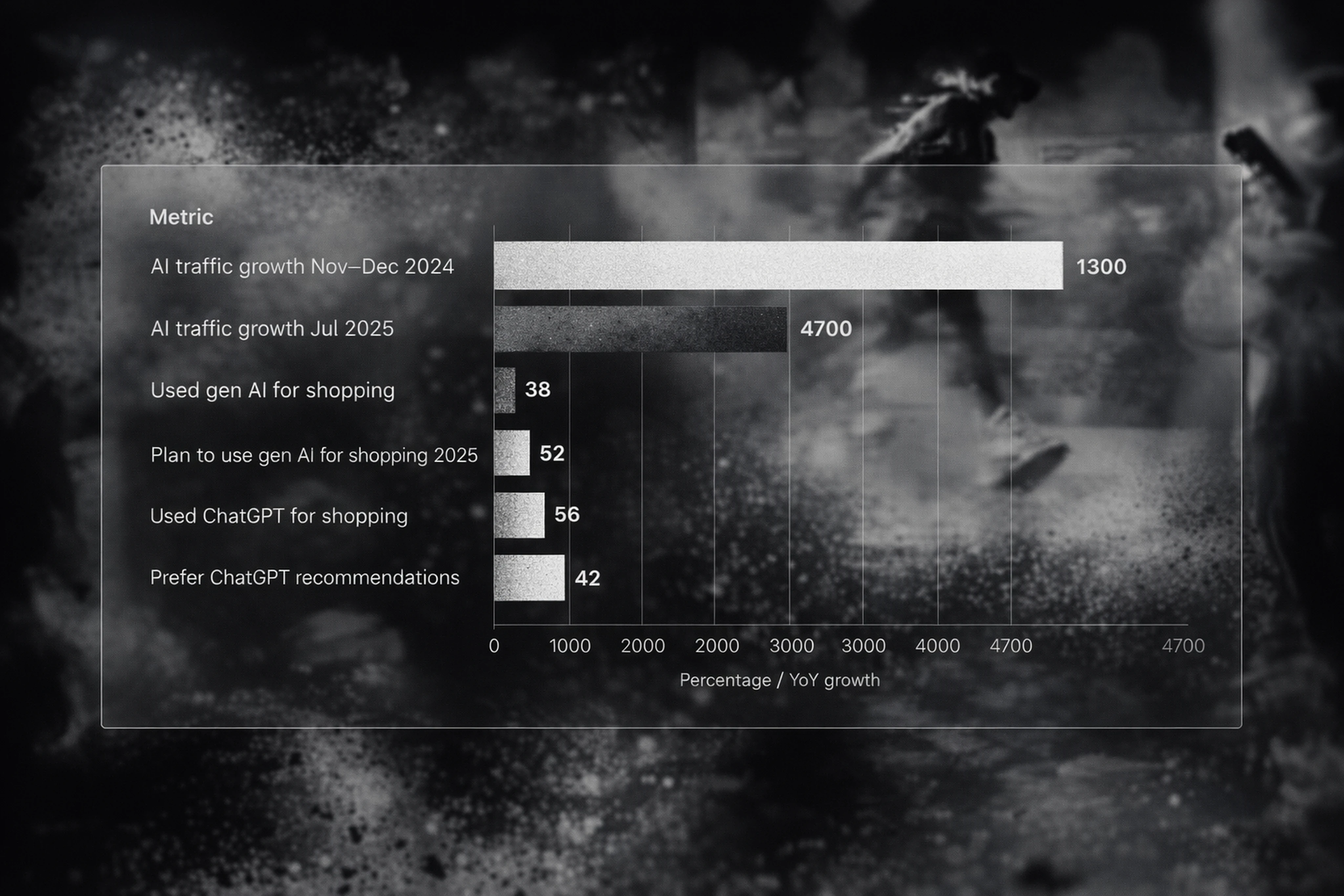
Adobe measured a 4,700% year‑over‑year increase in AI-driven traffic to U.S. retail sites by July 2025, while Omnisend’s 2026 report found 56% of Americans use ChatGPT for shopping and 42% say ChatGPT gives better product recommendations than search engines.
If your ecommerce brand is not tracking how often you’re recommended in ChatGPT answers, you’re flying blind in the fastest-growing discovery channel.
This step-by-step tutorial shows you how to:
Build a simple ChatGPT rank tracker for ecommerce
Define a structured prompt set that reflects real shopping behavior
Measure brand mentions, citations, and share of voice in ChatGPT
Apply GEO (Generative Engine Optimization) tactics to improve your ranking
Extend your tracking to Claude, Gemini, and Perplexity
If you want a broader strategic framework for ecommerce AI search, read this in-depth companion guide: Ecommerce AI Search Guide: Ranking on ChatGPT, Claude, Gemini, and Perplexity.
Prerequisites and Tools You’ll Need
Before you build a ChatGPT rank tracker, put a few basics in place.
Business prerequisites
An ecommerce site with clear product categories
Access to analytics (GA4, ecommerce platform analytics, etc.)
Existing SEO / marketplace optimization workflows
Data and tools
Spreadsheet tool: Google Sheets, Excel, or Airtable
Shared prompt library: Notion, Confluence, or a simple doc
AI access:
ChatGPT (with browsing/shopping enabled where available)
Optional: Claude, Gemini, Perplexity for multi-model tracking
Optional automation:
Era (AI visibility and GEO platform) to automate multi-model tracking
Or your own scripts using APIs, if you have developer support
If you’re a mid‑market or enterprise retailer with hundreds of SKUs and multiple regions, it’s usually more efficient to plug into a dedicated AI search monitoring service like Era rather than building everything from scratch.
Step 1: Define Your AI Commerce Query Set
A ChatGPT rank tracker is only as good as the prompts it uses. You need a repeatable, representative query set that mirrors how real shoppers talk to AI.
1.1 Start from real shopping behaviors
Adobe and Omnisend both show how people actually use AI for shopping:
53% use AI for product research
40% for product recommendations
36% for finding deals
30% for shopping lists
29% for gift ideas
Turn these tasks into prompt categories.
Core ecommerce prompt types
Category discovery
“Best running shoes for beginners under $150”
“Top vitamin C serums for sensitive skin”
Comparisons
“Nike vs Adidas running shoes for flat feet”
“Peloton alternatives with lower subscription costs”
Budget-anchored prompts
“Best laptops for college students under $800”
“Affordable mid-century coffee tables under $300”
Use-case prompts
“Best carry-on luggage for frequent flyers”
“Gifts for new dads who love coffee”
Shopping lists and bundles
“Create a shopping list for a home coffee bar setup”
“Essentials for a new puppy, with budget-friendly options”
1.2 Capture queries in a tracking sheet
Create a spreadsheet with these columns:
Query ID
Query text
Category
Region / market (e.g., US, UK, DE)
Device / context (mobile/desktop if you vary prompts)
Frequency (how often you’ll test this query)
Keep the queries short and conversational. Semrush found that short prompts generated 30–50x more brand mentions than long ones.
Step 2: Decide What “Rank” Means in ChatGPT
Traditional SEO rank = position on a SERP. In ChatGPT, “rank” is more nuanced.
Semrush’s 2026 “ghost citations” study found:
87% of AI answers had at least one citation
But only 20.7% included brand mentions
61.7% of citations were ghost citations (the brand was cited but not named)
That means you need separate metrics:
Brand mention: Is your brand name explicitly written in the answer?
Citation: Is one of your URLs linked as a source?
Recommendation placement: Are your products actually recommended as options?
Answer position: Where in the answer do you appear?
2.1 Define rank metrics in your tracker
Add these columns to your spreadsheet:
Brand mentioned? (Yes/No)
URL cited? (Yes/No)
Number of times mentioned
Position in answer (first, middle, last section)
Recommendation type:
Primary recommendation
Alternative option
“Also consider” / honorable mention
Sentiment summary (positive, neutral, negative)
For ecommerce and AI commerce search, recommendation placement is the primary rank you care about. Being cited but not recommended rarely moves revenue.
Step 3: Run a Manual ChatGPT Rank-Tracking Cycle
You can start with a manual process before automating anything. This is also useful as a QA layer even if you adopt a platform like Era.
3.1 Set up a tracking cadence
Choose 20–50 core prompts to monitor weekly
Choose 10–20 long-tail prompts to rotate monthly
Schedule a recurring time (e.g., Monday mornings) to run your tracking batch
3.2 Execute prompts in ChatGPT
For each query in your sheet:
Open ChatGPT (ensure browsing/shopping is enabled if available in your region).
Paste the query exactly as written in your sheet.
If shopping mode is available, note whether ChatGPT triggers product cards or stays in pure text.
Save or screenshot the answer for audit and future comparison.
3.3 Record results in your sheet
For each answer:
Note whether your brand name appears
Note whether specific products or SKUs appear
Check if any URLs from your domain are cited
Record where your brand appears in the answer
Summarize sentiment in 1–2 words (e.g., “strongly positive”, “neutral”)
This gives you a basic ChatGPT rank tracking tool without code.
Step 4: Automate and Scale with Multi-Model AI Search Monitoring
Manual tracking doesn’t scale beyond a few dozen prompts. To cover hundreds of queries, SKUs, regions, and models, you’ll need automation.
There are two main approaches:
DIY automation (if you have developer resources)
Dedicated AI visibility platforms like Era
4.1 DIY automation (Track GPT via scripts)
If you have API access and engineering support, you can:
Build scripts that:
Send your query set to ChatGPT, Claude, Gemini, and Perplexity
Capture structured outputs (answers and citations)
Parse for brand mentions, URLs, and sentiment
Store results in a warehouse or BI tool
Build dashboards for share of voice and trend analysis
This is flexible but requires ongoing maintenance and legal/compliance review.
4.2 Using Era as a ChatGPT rank tracker and AI visibility layer
Era provides an AI search monitoring service across major models, including:
ChatGPT
Claude
Gemini
Perplexity
Era’s platform:
Tracks share of voice, rankings, citations, pros & cons, and sentiment
Monitors performance by model, region, and language
Supports SKU-level tracking for ecommerce
Surfaces where your brand appears in AI answers and where it doesn’t
Compares you directly against competitors
This lets you treat AI answer engines as a first-class channel alongside SEO and paid media, without building your own “track gpt” infrastructure.
Step 5: Analyze Your AI Share of Voice and Gaps
Once you’re tracking, you need to interpret the data.
5.1 Establish baseline metrics
For each model (ChatGPT, Claude, Gemini, Perplexity):
Brand mention rate: % of prompts where your brand is mentioned
Citation rate: % of prompts where your domain is cited
Recommendation rate: % of prompts where you’re recommended as a primary option
Share of voice: Your mentions divided by total mentions in a category
5.2 Identify common patterns
Look for:
Categories where you never appear
Queries where you’re cited but not mentioned (ghost citations)
Competitors who show up consistently where you don’t
Negative or lukewarm sentiment in pros & cons
AirOps found that for top-of-funnel commercial queries, brands mentioned in AI search answers were 6.5x more likely to be present due to third‑party content than their own domains. If you’re missing from AI answers, your off-site footprint might be weak.
5.3 Prioritize by revenue impact
Map AI search gaps to your P&L:
High-margin categories where you have zero AI visibility
Branded queries where you don’t appear in your own category
Competitive categories where AI recommendations strongly favor rivals
These become your first targets for GEO optimization.
Step 6: Apply GEO Tactics to Improve ChatGPT Rankings
Tracking is only half the battle. You need to systematically improve how AI engines see and recommend your brand.
The Princeton/ICLR GEO paper shows that well-designed textual enhancements can improve visibility in generative engines by up to 40%, and that citations and quotations significantly boost visibility.
6.1 Clean and enrich product data (architectural fixes)
AI answer engines are driven by structured, consistent data. Focus first on:
Complete specs for each SKU
Dimensions, materials, use cases, compatibility, etc.
Price and availability accuracy
Clear, constraint-friendly attributes
“Under $150”, “carry‑on compliant”, “for flat feet”
Schema markup / structured data on product pages
For ecommerce brands, Era’s catalogue sync and enrichment features help ensure AI agents have machine-readable evidence at SKU level across markets.
6.2 Optimize product and category pages for generative AI search
Think beyond classical keyword stuffing. Use clear, factual statements that AI can quote.
For example, instead of:
“Our running shoes are great for everyone.”
Use:
“These running shoes are designed for beginners, with extra cushioning for runners under 200 pounds and support for mild overpronation.”
This kind of structured, criteria-based language maps directly to prompts like “best running shoes for beginners with overpronation.”
6.3 Strengthen off-site signals and third-party coverage
Since AI models rely heavily on off-site sources, invest in:
Category guides and buying guides on authoritative sites
Influencer and publisher reviews that highlight your key use cases
Marketplace listings that are optimized for AI search
Use marketplace listing optimization tools for generative search (or Era’s ecommerce plan) to ensure your listings:
Include rich attributes and specs
Highlight use cases and constraints
Gather and surface reviews and ratings
6.4 Optimize content for citations and quotations
To increase the chances of being quoted and cited in AI answers:
Publish comparison content (e.g., “Brand X vs Brand Y vs Us”) with clear pros/cons
Add FAQ sections to product pages answering common AI-style queries
Include short, quotable summaries (1–2 sentences) per use case
Semrush found that comparative content produced 2.4x more brand mentions than non-comparative content.
6.5 Close the loop with automated content GEO
Era’s Content Plan adds a content autopilot on top of analytics:
Generates AI-optimized articles daily based on real AI search queries
Publishes directly to your CMS
Aligns topics to gaps in your AI share of voice
This lets you:
Turn ChatGPT rank tracking insights into structured content
Target specific query clusters (“best budget X”, “alternatives to Y”) at scale
Reinforce off-site and on-site evidence in a continuous cycle
Step 7: Extend Beyond ChatGPT — Claude, Gemini, and Perplexity
Consumers don’t only ask ChatGPT. They also use Claude, Gemini, Perplexity, and emerging shopping agents.
Capgemini found that 58% of consumers have replaced traditional search engines with generative AI tools for product and service recommendations. You need a multi-model strategy.
7.1 Track multi-model AI rankings
Extend your query set to:
Claude
Gemini
Perplexity
Compare:
Where you appear in each model
Where competitors outrank you
How each model summarizes your pros and cons
Era’s multi-model, multi-region visibility makes this simple by providing a single dashboard across all major models.
7.2 Align with agentic commerce protocols
OpenAI’s 2026 announcement shows they are moving shopping into the chat layer using the Agentic Commerce Protocol to bring more complete product data into ChatGPT.
To win here:
Ensure your product feeds, availability, and pricing are clean and consistent
Sync your catalog with AI shopping partners where available
Use tools (like Era’s ecommerce plan) that support merchant/SKU monitoring by region
This ensures AI shopping agents can not only recommend you but also include you in Instant Checkout flows and product carousels.
Putting It All Together: A Simple Operating Rhythm
Here’s a practical weekly rhythm for ecommerce teams.
Weekly
Run your core ChatGPT query set (or review Era’s dashboards)
Review changes in brand mentions, citations, and recommendation placements
Flag any new competitors gaining share of voice
Monthly
Expand or refine your query set based on new shopping behaviors
Review category-level share of voice across ChatGPT, Claude, Gemini, Perplexity
Identify top 3 GEO opportunities by revenue impact
Quarterly
Audit your product data and structured content
Launch or update major comparison guides and buying guides
Align your AI visibility strategy with broader paid/SEO/ecommerce plans
If you’d rather not stitch this together manually, Era effectively becomes your ChatGPT rank tracking tool and AI commerce optimization engine, plugging into your existing stack and producing CMO-ready reporting.
FAQ: ChatGPT Rank Tracking and AI Commerce Search
1. What is a ChatGPT rank tracker?
A ChatGPT rank tracker is a process or tool that measures how often your brand and products appear in ChatGPT answers for specific queries.
It tracks:
Brand mentions
URL citations
Recommendation placement
Sentiment and pros/cons
Unlike traditional SEO, it focuses on conversational answers and AI shopping experiences, not blue-link SERPs.
2. How do you measure share of voice in ChatGPT?
To measure share of voice (SOV) in ChatGPT:
Define a query set for your categories.
For each answer, count how many brands are mentioned.
Count how often your brand is mentioned across all answers.
SOV = your mentions / total mentions in that category.
Tools like Era automate this calculation across multiple AI models and regions.
3. How is ranking on ChatGPT different from ranking on Google?
Ranking on ChatGPT is about being recommended inside an answer, not being listed as a separate result.
Key differences:
AI answers may cite your content without naming your brand (ghost citations)
Recommendation placement (e.g., “best option”, “top pick”) matters more than raw citations
AI engines lean heavily on structured data and off-site sources
GEO focuses on evidence and architecture rather than just keywords.
4. What are the best tools to monitor AI search rankings?
Options include:
Manual spreadsheets for small query sets
DIY scripts using model APIs
Era, which provides:
AI SEO analytics and reporting
ChatGPT, Claude, Gemini, Perplexity monitoring
SKU-level ecommerce tracking
GEO and content automation
For mid‑market and enterprise ecommerce, a platform like Era saves significant time vs. building everything in-house.
5. How can I improve my product pages for generative AI search?
To optimize product pages for AI:
Use clear, structured descriptions tied to use cases and constraints
Add complete specs, pricing, availability, and schema markup
Include FAQs and comparison sections
Ensure reviews and ratings are visible and crawlable
Pair these on-site improvements with off-site coverage and AI-optimized content. The combination helps AI assistants understand when and why to recommend your products.
By treating ChatGPT and other AI assistants as core discovery channels, setting up a disciplined rank tracker, and applying GEO principles, you position your brand to "be the brand" AI recommends when customers ask what to buy.




Overview: Why You Need a ChatGPT Rank Tracker Now
AI answer engines are already a real traffic source, not a science project.
OpenAI reports around 700 million weekly active users on ChatGPT, and Bain found ChatGPT prompt volume grew ~70% from January to June 2025. Shopping-specific prompts grew 25% in the same period and now account for roughly 9.8% of all prompts.
Adobe measured a 4,700% year‑over‑year increase in AI-driven traffic to U.S. retail sites by July 2025, while Omnisend’s 2026 report found 56% of Americans use ChatGPT for shopping and 42% say ChatGPT gives better product recommendations than search engines.
If your ecommerce brand is not tracking how often you’re recommended in ChatGPT answers, you’re flying blind in the fastest-growing discovery channel.
This step-by-step tutorial shows you how to:
Build a simple ChatGPT rank tracker for ecommerce
Define a structured prompt set that reflects real shopping behavior
Measure brand mentions, citations, and share of voice in ChatGPT
Apply GEO (Generative Engine Optimization) tactics to improve your ranking
Extend your tracking to Claude, Gemini, and Perplexity
If you want a broader strategic framework for ecommerce AI search, read this in-depth companion guide: Ecommerce AI Search Guide: Ranking on ChatGPT, Claude, Gemini, and Perplexity.
Prerequisites and Tools You’ll Need
Before you build a ChatGPT rank tracker, put a few basics in place.
Business prerequisites
An ecommerce site with clear product categories
Access to analytics (GA4, ecommerce platform analytics, etc.)
Existing SEO / marketplace optimization workflows
Data and tools
Spreadsheet tool: Google Sheets, Excel, or Airtable
Shared prompt library: Notion, Confluence, or a simple doc
AI access:
ChatGPT (with browsing/shopping enabled where available)
Optional: Claude, Gemini, Perplexity for multi-model tracking
Optional automation:
Era (AI visibility and GEO platform) to automate multi-model tracking
Or your own scripts using APIs, if you have developer support
If you’re a mid‑market or enterprise retailer with hundreds of SKUs and multiple regions, it’s usually more efficient to plug into a dedicated AI search monitoring service like Era rather than building everything from scratch.
Step 1: Define Your AI Commerce Query Set
A ChatGPT rank tracker is only as good as the prompts it uses. You need a repeatable, representative query set that mirrors how real shoppers talk to AI.
1.1 Start from real shopping behaviors
Adobe and Omnisend both show how people actually use AI for shopping:
53% use AI for product research
40% for product recommendations
36% for finding deals
30% for shopping lists
29% for gift ideas
Turn these tasks into prompt categories.
Core ecommerce prompt types
Category discovery
“Best running shoes for beginners under $150”
“Top vitamin C serums for sensitive skin”
Comparisons
“Nike vs Adidas running shoes for flat feet”
“Peloton alternatives with lower subscription costs”
Budget-anchored prompts
“Best laptops for college students under $800”
“Affordable mid-century coffee tables under $300”
Use-case prompts
“Best carry-on luggage for frequent flyers”
“Gifts for new dads who love coffee”
Shopping lists and bundles
“Create a shopping list for a home coffee bar setup”
“Essentials for a new puppy, with budget-friendly options”
1.2 Capture queries in a tracking sheet
Create a spreadsheet with these columns:
Query ID
Query text
Category
Region / market (e.g., US, UK, DE)
Device / context (mobile/desktop if you vary prompts)
Frequency (how often you’ll test this query)
Keep the queries short and conversational. Semrush found that short prompts generated 30–50x more brand mentions than long ones.
Step 2: Decide What “Rank” Means in ChatGPT
Traditional SEO rank = position on a SERP. In ChatGPT, “rank” is more nuanced.
Semrush’s 2026 “ghost citations” study found:
87% of AI answers had at least one citation
But only 20.7% included brand mentions
61.7% of citations were ghost citations (the brand was cited but not named)
That means you need separate metrics:
Brand mention: Is your brand name explicitly written in the answer?
Citation: Is one of your URLs linked as a source?
Recommendation placement: Are your products actually recommended as options?
Answer position: Where in the answer do you appear?
2.1 Define rank metrics in your tracker
Add these columns to your spreadsheet:
Brand mentioned? (Yes/No)
URL cited? (Yes/No)
Number of times mentioned
Position in answer (first, middle, last section)
Recommendation type:
Primary recommendation
Alternative option
“Also consider” / honorable mention
Sentiment summary (positive, neutral, negative)
For ecommerce and AI commerce search, recommendation placement is the primary rank you care about. Being cited but not recommended rarely moves revenue.
Step 3: Run a Manual ChatGPT Rank-Tracking Cycle
You can start with a manual process before automating anything. This is also useful as a QA layer even if you adopt a platform like Era.
3.1 Set up a tracking cadence
Choose 20–50 core prompts to monitor weekly
Choose 10–20 long-tail prompts to rotate monthly
Schedule a recurring time (e.g., Monday mornings) to run your tracking batch
3.2 Execute prompts in ChatGPT
For each query in your sheet:
Open ChatGPT (ensure browsing/shopping is enabled if available in your region).
Paste the query exactly as written in your sheet.
If shopping mode is available, note whether ChatGPT triggers product cards or stays in pure text.
Save or screenshot the answer for audit and future comparison.
3.3 Record results in your sheet
For each answer:
Note whether your brand name appears
Note whether specific products or SKUs appear
Check if any URLs from your domain are cited
Record where your brand appears in the answer
Summarize sentiment in 1–2 words (e.g., “strongly positive”, “neutral”)
This gives you a basic ChatGPT rank tracking tool without code.
Step 4: Automate and Scale with Multi-Model AI Search Monitoring
Manual tracking doesn’t scale beyond a few dozen prompts. To cover hundreds of queries, SKUs, regions, and models, you’ll need automation.
There are two main approaches:
DIY automation (if you have developer resources)
Dedicated AI visibility platforms like Era
4.1 DIY automation (Track GPT via scripts)
If you have API access and engineering support, you can:
Build scripts that:
Send your query set to ChatGPT, Claude, Gemini, and Perplexity
Capture structured outputs (answers and citations)
Parse for brand mentions, URLs, and sentiment
Store results in a warehouse or BI tool
Build dashboards for share of voice and trend analysis
This is flexible but requires ongoing maintenance and legal/compliance review.
4.2 Using Era as a ChatGPT rank tracker and AI visibility layer
Era provides an AI search monitoring service across major models, including:
ChatGPT
Claude
Gemini
Perplexity
Era’s platform:
Tracks share of voice, rankings, citations, pros & cons, and sentiment
Monitors performance by model, region, and language
Supports SKU-level tracking for ecommerce
Surfaces where your brand appears in AI answers and where it doesn’t
Compares you directly against competitors
This lets you treat AI answer engines as a first-class channel alongside SEO and paid media, without building your own “track gpt” infrastructure.
Step 5: Analyze Your AI Share of Voice and Gaps
Once you’re tracking, you need to interpret the data.
5.1 Establish baseline metrics
For each model (ChatGPT, Claude, Gemini, Perplexity):
Brand mention rate: % of prompts where your brand is mentioned
Citation rate: % of prompts where your domain is cited
Recommendation rate: % of prompts where you’re recommended as a primary option
Share of voice: Your mentions divided by total mentions in a category
5.2 Identify common patterns
Look for:
Categories where you never appear
Queries where you’re cited but not mentioned (ghost citations)
Competitors who show up consistently where you don’t
Negative or lukewarm sentiment in pros & cons
AirOps found that for top-of-funnel commercial queries, brands mentioned in AI search answers were 6.5x more likely to be present due to third‑party content than their own domains. If you’re missing from AI answers, your off-site footprint might be weak.
5.3 Prioritize by revenue impact
Map AI search gaps to your P&L:
High-margin categories where you have zero AI visibility
Branded queries where you don’t appear in your own category
Competitive categories where AI recommendations strongly favor rivals
These become your first targets for GEO optimization.
Step 6: Apply GEO Tactics to Improve ChatGPT Rankings
Tracking is only half the battle. You need to systematically improve how AI engines see and recommend your brand.
The Princeton/ICLR GEO paper shows that well-designed textual enhancements can improve visibility in generative engines by up to 40%, and that citations and quotations significantly boost visibility.
6.1 Clean and enrich product data (architectural fixes)
AI answer engines are driven by structured, consistent data. Focus first on:
Complete specs for each SKU
Dimensions, materials, use cases, compatibility, etc.
Price and availability accuracy
Clear, constraint-friendly attributes
“Under $150”, “carry‑on compliant”, “for flat feet”
Schema markup / structured data on product pages
For ecommerce brands, Era’s catalogue sync and enrichment features help ensure AI agents have machine-readable evidence at SKU level across markets.
6.2 Optimize product and category pages for generative AI search
Think beyond classical keyword stuffing. Use clear, factual statements that AI can quote.
For example, instead of:
“Our running shoes are great for everyone.”
Use:
“These running shoes are designed for beginners, with extra cushioning for runners under 200 pounds and support for mild overpronation.”
This kind of structured, criteria-based language maps directly to prompts like “best running shoes for beginners with overpronation.”
6.3 Strengthen off-site signals and third-party coverage
Since AI models rely heavily on off-site sources, invest in:
Category guides and buying guides on authoritative sites
Influencer and publisher reviews that highlight your key use cases
Marketplace listings that are optimized for AI search
Use marketplace listing optimization tools for generative search (or Era’s ecommerce plan) to ensure your listings:
Include rich attributes and specs
Highlight use cases and constraints
Gather and surface reviews and ratings
6.4 Optimize content for citations and quotations
To increase the chances of being quoted and cited in AI answers:
Publish comparison content (e.g., “Brand X vs Brand Y vs Us”) with clear pros/cons
Add FAQ sections to product pages answering common AI-style queries
Include short, quotable summaries (1–2 sentences) per use case
Semrush found that comparative content produced 2.4x more brand mentions than non-comparative content.
6.5 Close the loop with automated content GEO
Era’s Content Plan adds a content autopilot on top of analytics:
Generates AI-optimized articles daily based on real AI search queries
Publishes directly to your CMS
Aligns topics to gaps in your AI share of voice
This lets you:
Turn ChatGPT rank tracking insights into structured content
Target specific query clusters (“best budget X”, “alternatives to Y”) at scale
Reinforce off-site and on-site evidence in a continuous cycle
Step 7: Extend Beyond ChatGPT — Claude, Gemini, and Perplexity
Consumers don’t only ask ChatGPT. They also use Claude, Gemini, Perplexity, and emerging shopping agents.
Capgemini found that 58% of consumers have replaced traditional search engines with generative AI tools for product and service recommendations. You need a multi-model strategy.
7.1 Track multi-model AI rankings
Extend your query set to:
Claude
Gemini
Perplexity
Compare:
Where you appear in each model
Where competitors outrank you
How each model summarizes your pros and cons
Era’s multi-model, multi-region visibility makes this simple by providing a single dashboard across all major models.
7.2 Align with agentic commerce protocols
OpenAI’s 2026 announcement shows they are moving shopping into the chat layer using the Agentic Commerce Protocol to bring more complete product data into ChatGPT.
To win here:
Ensure your product feeds, availability, and pricing are clean and consistent
Sync your catalog with AI shopping partners where available
Use tools (like Era’s ecommerce plan) that support merchant/SKU monitoring by region
This ensures AI shopping agents can not only recommend you but also include you in Instant Checkout flows and product carousels.
Putting It All Together: A Simple Operating Rhythm
Here’s a practical weekly rhythm for ecommerce teams.
Weekly
Run your core ChatGPT query set (or review Era’s dashboards)
Review changes in brand mentions, citations, and recommendation placements
Flag any new competitors gaining share of voice
Monthly
Expand or refine your query set based on new shopping behaviors
Review category-level share of voice across ChatGPT, Claude, Gemini, Perplexity
Identify top 3 GEO opportunities by revenue impact
Quarterly
Audit your product data and structured content
Launch or update major comparison guides and buying guides
Align your AI visibility strategy with broader paid/SEO/ecommerce plans
If you’d rather not stitch this together manually, Era effectively becomes your ChatGPT rank tracking tool and AI commerce optimization engine, plugging into your existing stack and producing CMO-ready reporting.
FAQ: ChatGPT Rank Tracking and AI Commerce Search
1. What is a ChatGPT rank tracker?
A ChatGPT rank tracker is a process or tool that measures how often your brand and products appear in ChatGPT answers for specific queries.
It tracks:
Brand mentions
URL citations
Recommendation placement
Sentiment and pros/cons
Unlike traditional SEO, it focuses on conversational answers and AI shopping experiences, not blue-link SERPs.
2. How do you measure share of voice in ChatGPT?
To measure share of voice (SOV) in ChatGPT:
Define a query set for your categories.
For each answer, count how many brands are mentioned.
Count how often your brand is mentioned across all answers.
SOV = your mentions / total mentions in that category.
Tools like Era automate this calculation across multiple AI models and regions.
3. How is ranking on ChatGPT different from ranking on Google?
Ranking on ChatGPT is about being recommended inside an answer, not being listed as a separate result.
Key differences:
AI answers may cite your content without naming your brand (ghost citations)
Recommendation placement (e.g., “best option”, “top pick”) matters more than raw citations
AI engines lean heavily on structured data and off-site sources
GEO focuses on evidence and architecture rather than just keywords.
4. What are the best tools to monitor AI search rankings?
Options include:
Manual spreadsheets for small query sets
DIY scripts using model APIs
Era, which provides:
AI SEO analytics and reporting
ChatGPT, Claude, Gemini, Perplexity monitoring
SKU-level ecommerce tracking
GEO and content automation
For mid‑market and enterprise ecommerce, a platform like Era saves significant time vs. building everything in-house.
5. How can I improve my product pages for generative AI search?
To optimize product pages for AI:
Use clear, structured descriptions tied to use cases and constraints
Add complete specs, pricing, availability, and schema markup
Include FAQs and comparison sections
Ensure reviews and ratings are visible and crawlable
Pair these on-site improvements with off-site coverage and AI-optimized content. The combination helps AI assistants understand when and why to recommend your products.
By treating ChatGPT and other AI assistants as core discovery channels, setting up a disciplined rank tracker, and applying GEO principles, you position your brand to "be the brand" AI recommends when customers ask what to buy.