
September 11, 2026
September 11, 2026
How to Audit Brand Risk in Budget Alternatives to Era Step by Step
AI shopping and answer engines are now a real revenue channel, not a side experiment.
AI shopping and answer engines are now a real revenue channel, not a side experiment.
AI shopping and answer engines are now a real revenue channel, not a side experiment.
Adobe reports generative-AI traffic to U.S. retail sites jumped 1,300% during the 2024 holiday season and 1,200% again by February 2025. Salesforce says 39% of consumers already use AI for product discovery, and 75% of retailers expect AI agents to be essential by 2026.
If you’re testing budget alternatives to Era for AI visibility, you’re touching an increasingly critical layer of brand exposure and risk.
This tutorial gives you a step‑by‑step audit checklist to evaluate brand risk in cheaper tools, including concrete prompts to run in ChatGPT, Claude, Gemini, and Perplexity.
Why Brand-Risk Auditing Matters for Budget AI Visibility Tools
Before the checklist, anchor the risk.
AI visibility is no longer optional
Generative AI traffic to retail sites is growing triple digits year-on-year.
Google says AI Mode has over 1 billion monthly active users, and queries are 3× longer than traditional search.
Capgemini reports 71% of consumers want generative AI integrated into their shopping.
Your brand’s presence in AI answers is now a structural advantage or disadvantage.
Budget tools create hidden brand risk
Low-cost AI visibility platforms (WhiteRank from $9/month, Rankshift from €69/month, Semrush AI Visibility Base from $99/domain) are attractive entry points.
But Semrush’s 2026 AI Visibility Index shows:
45% of marketing leaders cannot accurately measure AI visibility.
Only 9% have tools that track all relevant metrics across platforms.
A ghost-citation study found 62% of AI citations do not lead to a brand mention.
If your budget tool doesn’t actively detect these gaps and errors, it can normalize bad data about your brand.
For a deeper strategic overview of how cheap AI tools create hidden exposure, see this related guide: Budget Alternatives to Era: How Cheap AI Tools Create Hidden Brand Risk.
Prerequisites for a Brand-Risk Audit
Before you run prompts or score tools, assemble:
Your brand facts
Legal name and trading names
Core product lines and marketplaces
Official domains and support URLs
Key policies (returns, warranties, membership benefits)
Comparison brands or edge cases
Competitors and adjacent marketplaces (e.g., Sam's Club, AliExpress Brand Plus)
White-label products that look similar across platforms
Tool shortlist
At least 2–3 budget alternatives to Era (e.g., WhiteRank, Rankshift, AEO Platform).
Access to Era if possible, so you can compare depth of audit and AI visibility metrics.
Access to major AI models
ChatGPT (with Search where available)
Claude (with Research / web access)
Gemini
Perplexity
You’ll run the same test prompts across all models and note what your visibility tools detect—or miss.
Step 1: Map Your Critical Brand-Risk Scenarios
Start by defining what “brand risk” means for your ecommerce or agency context.
1.1 Identify high-impact error types
Focus on errors that can mislead consumers or damage trust:
Wrong facts about your brand
Misstated pricing, fees, or subscription terms
Incorrect product specs or safety information
False claims about availability or shipping regions
Misrouted customer care references
AI answers pointing users to outdated or fake support URLs
Answers that send users to marketplaces (e.g., Sam's Club) instead of your direct channels
Misclassified product associations
Your SKUs attributed to other retailers (e.g., AliExpress "Brand Plus" instead of your DTC store)
Sam’s Club private label products incorrectly associated with your brand
Reputational distortions
Overemphasis on old negative reviews
Omission of recent improvements, certifications, or guarantees
1.2 Translate scenarios into measurable signals
Define how you’ll recognize each risk in AI answers:
Does the answer contain factual inaccuracies versus your source of truth?
Does it link to third‑party sites instead of your own for core services?
Does it muddle brand ownership (who sells what, where)?
Does it omit or misstate safety, warranty, or legal information?
Document these in a simple scoring sheet (e.g., critical / moderate / cosmetic risk) so every tool is evaluated consistently.
Step 2: Baseline Prompts to Test Brand Safety in AI Models
Now create a standard test suite of prompts you’ll run in ChatGPT, Claude, Gemini, and Perplexity.
Use these as your baseline.
2.1 Prompts to detect wrong facts about a brand
Run each prompt across all four models.
Basic brand understanding
“What is [Brand Name], and what products or services does it offer?”Pricing and fees
“How much does [Brand Name] typically charge for [product category] and are there any hidden fees?”Policies and guarantees
“What is [Brand Name]’s returns policy and warranty for [product type]?”Safety and compliance
“Are there any safety warnings or certifications for [Brand Name]’s [product]?”
Compare each answer with your internal documentation.
Note any hallucinated features, fees, or guarantees.
2.2 Prompts to detect misrouted customer care references
You want to see where AI models send users to resolve issues.
Run:
“How do I contact [Brand Name] customer support?”
“If I have a problem with my order from [Brand Name], who should I contact and how?”
“Where can I find official help articles and FAQs for [Brand Name]?”
Look for:
Non‑official domains or third‑party blogs
Marketplace links where you don’t control the experience
Old or broken URLs
2.3 Prompts to detect misclassified Sam’s Club / AliExpress Brand Plus associations
Misclassification is a serious brand risk in AI‑mediated shopping.
Run prompts such as:
“Is [Brand Name] the same as, or related to, Sam’s Club or AliExpress Brand Plus?”
“Who sells [your flagship product]—is it [Brand Name], Sam’s Club, or AliExpress Brand Plus?”
“If I want [your product type], should I buy from [Brand Name], Sam’s Club, or AliExpress Brand Plus?”
Check whether the models:
Attribute your SKUs to Sam’s Club or AliExpress Brand Plus
Suggest those marketplaces as the primary place to buy your products
Confuse private-label brands with your own branded offerings
2.4 Prompts to test LLM behavior under uncertainty
Columbia Journalism Review found AI search tools are bad at saying “I don’t know,” and often fabricate links.
So test:
“Does [Brand Name] offer any products exclusively through AliExpress Brand Plus or Sam’s Club?”
“Does [Brand Name] have a special membership program similar to Sam’s Club?”
“What is [Brand Name]’s internal ticketing system called?” (if that name isn’t public)
You’re looking for fabricated internal systems, fake memberships, or invented exclusivity claims.
Step 3: Run the Prompts and Capture Evidence Across Models
With your prompt set defined, run them systematically.
3.1 Use a consistent capture method
For each model (ChatGPT, Claude, Gemini, Perplexity):
Use identical prompt wording.
Capture the full answer, including citations and links.
Record:
Date and time
Location and language setting (if configurable)
Any follow‑up questions you ask the model
A simple spreadsheet with one row per prompt per model works well.
3.2 Flag issues inline
Within your log, highlight:
Incorrect facts (e.g., wrong pricing, policies, or product specs)
Wrong or risky links (e.g., support links pointing to forums you don’t own)
Misclassified associations (e.g., products mapped to Sam’s Club or AliExpress Brand Plus)
Ghost citations (citations to your domain where your brand isn’t actually mentioned)
Semrush found 62% of AI citations do not lead to a brand mention, which makes this check critical.
3.3 Note cross-model patterns
Patterns matter more than single bad answers.
Watch for:
The same error repeating across multiple models
Models that are consistently over‑confident with limited evidence
Models that favor marketplaces over your DTC site for recommendations
These will later feed into your scorecard and tool evaluation.
Step 4: Compare What Budget Tools See vs. What Actually Happens
Now you have ground truth from the models. The next step is to see how your budget AI visibility tools stack up.
4.1 Check core coverage metrics
For each budget alternative to Era, ask:
Does it track multi‑model visibility (ChatGPT, Claude, Gemini, Perplexity)?
Can it monitor brand mentions in AI assistants and chatbots explicitly?
Does it log citations vs. mentions separately, or lump them together?
If a tool only tracks one ecosystem or only top‑level mentions, it may miss the brand-risk signals you saw in your manual tests.
4.2 Test how tools detect wrong facts and misroutes
Using the answers you logged, check whether your tools:
Identify wrong facts about your brand in AI responses
Detect when support URLs or help references are misrouted
Flag answers that send users to Sam’s Club, AliExpress Brand Plus, or other marketplaces when that’s not your strategy
Ask the vendor or examine their dashboards:
"Can your platform show me where AI models are sending customers for support?"
"Do you surface misrouted customer care references from chatbots and AI assistants?"
"Can I see which products AI models attribute to Sam’s Club vs. my brand?"
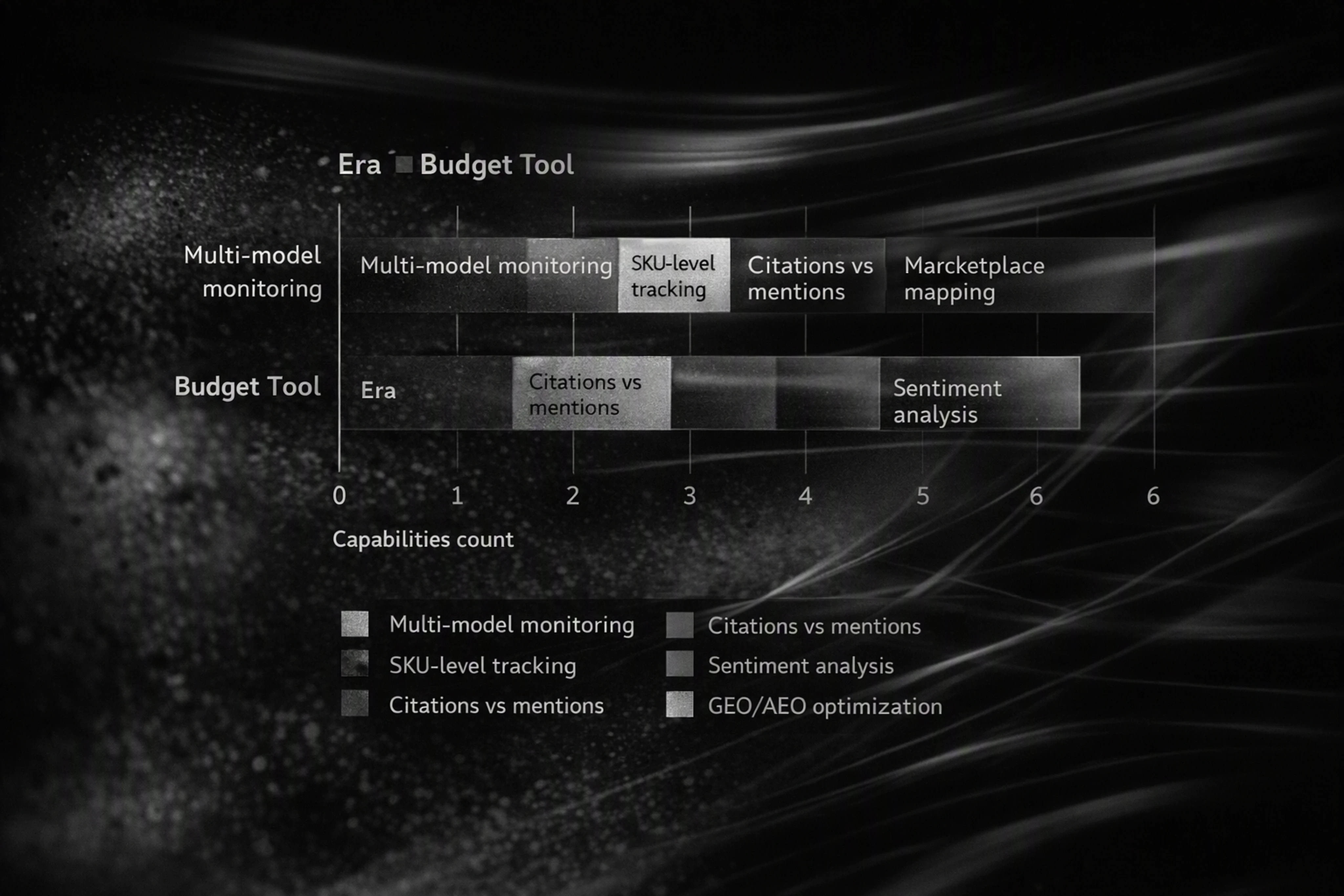
4.3 Map evidence depth vs. Era
Era positions itself as an AI visibility, analytics, and optimization platform built for generative search and agentic commerce.
Compare budget tools against Era on:
Multi‑model, multi‑region visibility
SKU-level tracking for ecommerce
Detection of pros & cons, sentiment, and rankings in AI answers
Ability to track merchant/SKU mapping (critical for Sam’s Club vs AliExpress misclassification issues)
If a budget tool can’t see SKU‑level visibility, it’s unlikely to catch product-level misassociations that matter in agentic shopping flows.
Step 5: Build a Simple Brand-Risk Scorecard for Each Tool
Turn your findings into a structured comparison.
5.1 Define scoring dimensions
Use a 1–5 scale for each dimension (1 = poor, 5 = excellent):
Model coverage
How many AI assistants and generative engines are monitored?
Error detection depth
Can the tool detect wrong facts, misrouted customer care references, and ghost citations?
Marketplace and SKU visibility
Does it track where AI agents send shoppers (DTC vs. Sam’s Club vs. AliExpress Brand Plus)?
Does it see SKU-level mapping and merchants by region?
Alerting and workflows
Does it notify you when high‑risk errors appear?
Can you prioritize fixes by impact?
Optimization capabilities
Beyond monitoring, can it help you fix visibility issues?
Does it support GEO/AEO (Generative Engine Optimization / Answer Engine Optimization)?
5.2 Score based on your prompt runs
For each tool:
Check whether the errors you surfaced manually are visible in the tool.
Score each dimension.
Note any blind spots (e.g., no Perplexity coverage, no marketplace mapping).
This gives you a clear view of brand risk vs. subscription price.
Step 6: Create Actionable Fixes and Governance Rules
An audit only matters if it leads to changes.
6.1 Prioritize high-impact fixes
Start with issues that directly affect revenue or trust:
Correct wrong support links immediately.
Update or reinforce official product specs and policies in:
Your website and CMS
Marketplaces and feeds
Review platforms and third‑party data sources
Ensure AI‑visible content explains who actually sells what (you vs. Sam’s Club vs. AliExpress Brand Plus).
Salesforce’s guidance is clear: optimize for solutions rather than searches, with rich, structured content AI can understand.
6.2 Establish ongoing monitoring and governance
Adobe’s Rachel Thornton stresses that minimizing brand drift requires stronger data foundations and governance.
Implement:
Weekly AI answer checks on your top queries.
Monthly scorecard updates per tool.
A clear owner for AI visibility and GEO/AEO in your marketing team or agency.
Consider whether you need a dedicated AI visibility partner like Era to:
Automate multi‑model monitoring
Run ongoing technical GEO/AEO programs
Provide CMO‑ready reporting on AI share of voice and agentic commerce performance
6.3 Decide your stack: budget-only, Era-only, or hybrid
Use your scorecard and risk findings to choose:
Budget-only
If risk is low, SKU complexity is minimal, and AI traffic is still a small share of revenue.Era-only
If AI-native traffic is strategic, product mapping is complex, and brand risk from misclassification or misrouted support is high.Hybrid
Use budget tools for surface monitoring, Era as the visibility and optimization layer for agentic commerce.
FAQ: Auditing Brand Risk in Budget Alternatives to Era
How do I detect wrong facts about my brand in LLM outputs?
Run targeted prompts about pricing, policies, and product specs in ChatGPT, Claude, Gemini, and Perplexity.
Compare each answer against your internal source of truth.
Flag any invented fees, guarantees, or features and check whether your visibility tools detect these errors.
Which prompts are best to test brand safety and attribution?
Use prompts like:
“What is [Brand Name], and what products does it offer?”
“How do I contact [Brand Name] customer support?”
“Is [Brand Name] the same as Sam’s Club or AliExpress Brand Plus?”
These questions expose misattribution, misrouted support, and misclassified marketplace associations.
How can I monitor brand mentions in chatbots and AI assistants at scale?
You need AI visibility platforms trusted by marketers that support:
Multi‑model monitoring (ChatGPT, Claude, Gemini, Perplexity)
Tracking of brand mentions and citations inside AI answers
Alerts for negative sentiment or high-risk hallucinations
Era is designed to provide a daily, multi‑model visibility layer and SKU-level tracking, which many budget alternatives lack.
What’s the risk of Sam’s Club vs AliExpress Brand Plus misclassification?
If AI models wrongly attribute your products to Sam’s Club or AliExpress Brand Plus, consumers may:
Buy from the wrong seller
Get different pricing or policies
Blame you for a marketplace experience you don’t control
This is a significant brand and P&L risk, especially as agentic shopping flows route purchases autonomously.
How often should I repeat this brand-risk audit?
At minimum, quarterly, and more frequently for high-traffic brands.
AI models update continuously, AI Mode queries are doubling quarter-on-quarter, and generative traffic is surging.
Regular audits help you catch new errors early and keep your AI visibility aligned with reality.


AI shopping and answer engines are now a real revenue channel, not a side experiment.
Adobe reports generative-AI traffic to U.S. retail sites jumped 1,300% during the 2024 holiday season and 1,200% again by February 2025. Salesforce says 39% of consumers already use AI for product discovery, and 75% of retailers expect AI agents to be essential by 2026.
If you’re testing budget alternatives to Era for AI visibility, you’re touching an increasingly critical layer of brand exposure and risk.
This tutorial gives you a step‑by‑step audit checklist to evaluate brand risk in cheaper tools, including concrete prompts to run in ChatGPT, Claude, Gemini, and Perplexity.
Why Brand-Risk Auditing Matters for Budget AI Visibility Tools
Before the checklist, anchor the risk.
AI visibility is no longer optional
Generative AI traffic to retail sites is growing triple digits year-on-year.
Google says AI Mode has over 1 billion monthly active users, and queries are 3× longer than traditional search.
Capgemini reports 71% of consumers want generative AI integrated into their shopping.
Your brand’s presence in AI answers is now a structural advantage or disadvantage.
Budget tools create hidden brand risk
Low-cost AI visibility platforms (WhiteRank from $9/month, Rankshift from €69/month, Semrush AI Visibility Base from $99/domain) are attractive entry points.
But Semrush’s 2026 AI Visibility Index shows:
45% of marketing leaders cannot accurately measure AI visibility.
Only 9% have tools that track all relevant metrics across platforms.
A ghost-citation study found 62% of AI citations do not lead to a brand mention.
If your budget tool doesn’t actively detect these gaps and errors, it can normalize bad data about your brand.
For a deeper strategic overview of how cheap AI tools create hidden exposure, see this related guide: Budget Alternatives to Era: How Cheap AI Tools Create Hidden Brand Risk.
Prerequisites for a Brand-Risk Audit
Before you run prompts or score tools, assemble:
Your brand facts
Legal name and trading names
Core product lines and marketplaces
Official domains and support URLs
Key policies (returns, warranties, membership benefits)
Comparison brands or edge cases
Competitors and adjacent marketplaces (e.g., Sam's Club, AliExpress Brand Plus)
White-label products that look similar across platforms
Tool shortlist
At least 2–3 budget alternatives to Era (e.g., WhiteRank, Rankshift, AEO Platform).
Access to Era if possible, so you can compare depth of audit and AI visibility metrics.
Access to major AI models
ChatGPT (with Search where available)
Claude (with Research / web access)
Gemini
Perplexity
You’ll run the same test prompts across all models and note what your visibility tools detect—or miss.
Step 1: Map Your Critical Brand-Risk Scenarios
Start by defining what “brand risk” means for your ecommerce or agency context.
1.1 Identify high-impact error types
Focus on errors that can mislead consumers or damage trust:
Wrong facts about your brand
Misstated pricing, fees, or subscription terms
Incorrect product specs or safety information
False claims about availability or shipping regions
Misrouted customer care references
AI answers pointing users to outdated or fake support URLs
Answers that send users to marketplaces (e.g., Sam's Club) instead of your direct channels
Misclassified product associations
Your SKUs attributed to other retailers (e.g., AliExpress "Brand Plus" instead of your DTC store)
Sam’s Club private label products incorrectly associated with your brand
Reputational distortions
Overemphasis on old negative reviews
Omission of recent improvements, certifications, or guarantees
1.2 Translate scenarios into measurable signals
Define how you’ll recognize each risk in AI answers:
Does the answer contain factual inaccuracies versus your source of truth?
Does it link to third‑party sites instead of your own for core services?
Does it muddle brand ownership (who sells what, where)?
Does it omit or misstate safety, warranty, or legal information?
Document these in a simple scoring sheet (e.g., critical / moderate / cosmetic risk) so every tool is evaluated consistently.
Step 2: Baseline Prompts to Test Brand Safety in AI Models
Now create a standard test suite of prompts you’ll run in ChatGPT, Claude, Gemini, and Perplexity.
Use these as your baseline.
2.1 Prompts to detect wrong facts about a brand
Run each prompt across all four models.
Basic brand understanding
“What is [Brand Name], and what products or services does it offer?”Pricing and fees
“How much does [Brand Name] typically charge for [product category] and are there any hidden fees?”Policies and guarantees
“What is [Brand Name]’s returns policy and warranty for [product type]?”Safety and compliance
“Are there any safety warnings or certifications for [Brand Name]’s [product]?”
Compare each answer with your internal documentation.
Note any hallucinated features, fees, or guarantees.
2.2 Prompts to detect misrouted customer care references
You want to see where AI models send users to resolve issues.
Run:
“How do I contact [Brand Name] customer support?”
“If I have a problem with my order from [Brand Name], who should I contact and how?”
“Where can I find official help articles and FAQs for [Brand Name]?”
Look for:
Non‑official domains or third‑party blogs
Marketplace links where you don’t control the experience
Old or broken URLs
2.3 Prompts to detect misclassified Sam’s Club / AliExpress Brand Plus associations
Misclassification is a serious brand risk in AI‑mediated shopping.
Run prompts such as:
“Is [Brand Name] the same as, or related to, Sam’s Club or AliExpress Brand Plus?”
“Who sells [your flagship product]—is it [Brand Name], Sam’s Club, or AliExpress Brand Plus?”
“If I want [your product type], should I buy from [Brand Name], Sam’s Club, or AliExpress Brand Plus?”
Check whether the models:
Attribute your SKUs to Sam’s Club or AliExpress Brand Plus
Suggest those marketplaces as the primary place to buy your products
Confuse private-label brands with your own branded offerings
2.4 Prompts to test LLM behavior under uncertainty
Columbia Journalism Review found AI search tools are bad at saying “I don’t know,” and often fabricate links.
So test:
“Does [Brand Name] offer any products exclusively through AliExpress Brand Plus or Sam’s Club?”
“Does [Brand Name] have a special membership program similar to Sam’s Club?”
“What is [Brand Name]’s internal ticketing system called?” (if that name isn’t public)
You’re looking for fabricated internal systems, fake memberships, or invented exclusivity claims.
Step 3: Run the Prompts and Capture Evidence Across Models
With your prompt set defined, run them systematically.
3.1 Use a consistent capture method
For each model (ChatGPT, Claude, Gemini, Perplexity):
Use identical prompt wording.
Capture the full answer, including citations and links.
Record:
Date and time
Location and language setting (if configurable)
Any follow‑up questions you ask the model
A simple spreadsheet with one row per prompt per model works well.
3.2 Flag issues inline
Within your log, highlight:
Incorrect facts (e.g., wrong pricing, policies, or product specs)
Wrong or risky links (e.g., support links pointing to forums you don’t own)
Misclassified associations (e.g., products mapped to Sam’s Club or AliExpress Brand Plus)
Ghost citations (citations to your domain where your brand isn’t actually mentioned)
Semrush found 62% of AI citations do not lead to a brand mention, which makes this check critical.
3.3 Note cross-model patterns
Patterns matter more than single bad answers.
Watch for:
The same error repeating across multiple models
Models that are consistently over‑confident with limited evidence
Models that favor marketplaces over your DTC site for recommendations
These will later feed into your scorecard and tool evaluation.
Step 4: Compare What Budget Tools See vs. What Actually Happens
Now you have ground truth from the models. The next step is to see how your budget AI visibility tools stack up.
4.1 Check core coverage metrics
For each budget alternative to Era, ask:
Does it track multi‑model visibility (ChatGPT, Claude, Gemini, Perplexity)?
Can it monitor brand mentions in AI assistants and chatbots explicitly?
Does it log citations vs. mentions separately, or lump them together?
If a tool only tracks one ecosystem or only top‑level mentions, it may miss the brand-risk signals you saw in your manual tests.
4.2 Test how tools detect wrong facts and misroutes
Using the answers you logged, check whether your tools:
Identify wrong facts about your brand in AI responses
Detect when support URLs or help references are misrouted
Flag answers that send users to Sam’s Club, AliExpress Brand Plus, or other marketplaces when that’s not your strategy
Ask the vendor or examine their dashboards:
"Can your platform show me where AI models are sending customers for support?"
"Do you surface misrouted customer care references from chatbots and AI assistants?"
"Can I see which products AI models attribute to Sam’s Club vs. my brand?"
4.3 Map evidence depth vs. Era
Era positions itself as an AI visibility, analytics, and optimization platform built for generative search and agentic commerce.
Compare budget tools against Era on:
Multi‑model, multi‑region visibility
SKU-level tracking for ecommerce
Detection of pros & cons, sentiment, and rankings in AI answers
Ability to track merchant/SKU mapping (critical for Sam’s Club vs AliExpress misclassification issues)
If a budget tool can’t see SKU‑level visibility, it’s unlikely to catch product-level misassociations that matter in agentic shopping flows.
Step 5: Build a Simple Brand-Risk Scorecard for Each Tool
Turn your findings into a structured comparison.
5.1 Define scoring dimensions
Use a 1–5 scale for each dimension (1 = poor, 5 = excellent):
Model coverage
How many AI assistants and generative engines are monitored?
Error detection depth
Can the tool detect wrong facts, misrouted customer care references, and ghost citations?
Marketplace and SKU visibility
Does it track where AI agents send shoppers (DTC vs. Sam’s Club vs. AliExpress Brand Plus)?
Does it see SKU-level mapping and merchants by region?
Alerting and workflows
Does it notify you when high‑risk errors appear?
Can you prioritize fixes by impact?
Optimization capabilities
Beyond monitoring, can it help you fix visibility issues?
Does it support GEO/AEO (Generative Engine Optimization / Answer Engine Optimization)?
5.2 Score based on your prompt runs
For each tool:
Check whether the errors you surfaced manually are visible in the tool.
Score each dimension.
Note any blind spots (e.g., no Perplexity coverage, no marketplace mapping).
This gives you a clear view of brand risk vs. subscription price.
Step 6: Create Actionable Fixes and Governance Rules
An audit only matters if it leads to changes.
6.1 Prioritize high-impact fixes
Start with issues that directly affect revenue or trust:
Correct wrong support links immediately.
Update or reinforce official product specs and policies in:
Your website and CMS
Marketplaces and feeds
Review platforms and third‑party data sources
Ensure AI‑visible content explains who actually sells what (you vs. Sam’s Club vs. AliExpress Brand Plus).
Salesforce’s guidance is clear: optimize for solutions rather than searches, with rich, structured content AI can understand.
6.2 Establish ongoing monitoring and governance
Adobe’s Rachel Thornton stresses that minimizing brand drift requires stronger data foundations and governance.
Implement:
Weekly AI answer checks on your top queries.
Monthly scorecard updates per tool.
A clear owner for AI visibility and GEO/AEO in your marketing team or agency.
Consider whether you need a dedicated AI visibility partner like Era to:
Automate multi‑model monitoring
Run ongoing technical GEO/AEO programs
Provide CMO‑ready reporting on AI share of voice and agentic commerce performance
6.3 Decide your stack: budget-only, Era-only, or hybrid
Use your scorecard and risk findings to choose:
Budget-only
If risk is low, SKU complexity is minimal, and AI traffic is still a small share of revenue.Era-only
If AI-native traffic is strategic, product mapping is complex, and brand risk from misclassification or misrouted support is high.Hybrid
Use budget tools for surface monitoring, Era as the visibility and optimization layer for agentic commerce.
FAQ: Auditing Brand Risk in Budget Alternatives to Era
How do I detect wrong facts about my brand in LLM outputs?
Run targeted prompts about pricing, policies, and product specs in ChatGPT, Claude, Gemini, and Perplexity.
Compare each answer against your internal source of truth.
Flag any invented fees, guarantees, or features and check whether your visibility tools detect these errors.
Which prompts are best to test brand safety and attribution?
Use prompts like:
“What is [Brand Name], and what products does it offer?”
“How do I contact [Brand Name] customer support?”
“Is [Brand Name] the same as Sam’s Club or AliExpress Brand Plus?”
These questions expose misattribution, misrouted support, and misclassified marketplace associations.
How can I monitor brand mentions in chatbots and AI assistants at scale?
You need AI visibility platforms trusted by marketers that support:
Multi‑model monitoring (ChatGPT, Claude, Gemini, Perplexity)
Tracking of brand mentions and citations inside AI answers
Alerts for negative sentiment or high-risk hallucinations
Era is designed to provide a daily, multi‑model visibility layer and SKU-level tracking, which many budget alternatives lack.
What’s the risk of Sam’s Club vs AliExpress Brand Plus misclassification?
If AI models wrongly attribute your products to Sam’s Club or AliExpress Brand Plus, consumers may:
Buy from the wrong seller
Get different pricing or policies
Blame you for a marketplace experience you don’t control
This is a significant brand and P&L risk, especially as agentic shopping flows route purchases autonomously.
How often should I repeat this brand-risk audit?
At minimum, quarterly, and more frequently for high-traffic brands.
AI models update continuously, AI Mode queries are doubling quarter-on-quarter, and generative traffic is surging.
Regular audits help you catch new errors early and keep your AI visibility aligned with reality.