August 2, 2026
August 2, 2026
AI Visibility Platforms & GEO Agencies: 2026 Buyer’s Guide for Enterprise Ecommerce
AI answer engines and shopping agents are becoming the new front door for product discovery. If your brand is invisible in ChatGPT, Gemini, Claude, Perplexity…
AI answer engines and shopping agents are becoming the new front door for product discovery. If your brand is invisible in ChatGPT, Gemini, Claude, Perplexity…
AI Visibility Platforms & GEO Agencies: 2026 Buyer’s Guide for Enterprise Ecommerce
AI answer engines and shopping agents are becoming the new front door for product discovery. If your brand is invisible in ChatGPT, Gemini, Claude, Perplexity, or Google’s AI Overviews, you are already losing demand you never see.
This 2026 buyer’s guide explains how AI search visibility tools and GEO agencies work, what Generative Engine Optimization (GEO) actually stands for, and how enterprise ecommerce teams can build an AI visibility stack that drives revenue—not just vanity rankings.
1. Why AI Visibility Platforms Now Matter for Big Brands
AI search and agentic commerce are moving from experiment to revenue channel. The numbers are no longer hypothetical.
Key trends every ecommerce leader should know:
AI Overviews are mainstream
Google reports AI Overviews now reach 1.5 billion monthly users across 200+ countries and territories and more than 40 languages, driving over 10% more usage on queries where they appear (Google I/O 2025 announcements, May 2025). SourceAI Overviews change click behavior
Ahrefs’ December 2025 study of 56 million AI Overviews found that when an AI Overview appears, the average CTR for the top organic result drops by 58%. SourceAI platforms are fragmenting
Similarweb data shows ChatGPT’s share of generative‑AI site traffic fell from ~76% to 53% in a year, while Gemini rose to 27–28% and Claude to ~9%, across an estimated 9.5 billion monthly visits and 655 million unique visitors to gen‑AI platforms (report updated 2025–2026). SourceConsumers are using AI for shopping
Adobe reports generative‑AI referral traffic to retail sites grew 693.4% year‑over‑year during the 2025 holiday season, with AI referrals converting 31% better and driving 254% higher revenue per visit than other traffic sources. SourceAI search is small but surging
BrightEdge estimates AI search is still <1% of overall referral traffic, but growing quickly while organic search remains the main driver of conversions (2025 report). SourceChatGPT is too big to ignore
OpenAI stated that more than 700 million people use ChatGPT each week as of late 2024–early 2025. SourceAgentic commerce is a trillion‑dollar shift
McKinsey projects AI shopping agents could drive up to $1 trillion in U.S. B2C retail revenue and $3–5 trillion globally by 2030. They describe agentic commerce as “AI agents that anticipate needs, compare options, negotiate, and execute transactions,” forcing merchants to adapt stack, identity, loyalty, and protocols (2025 analysis). Source
For enterprise ecommerce, this means:
AI answer engines are no longer side projects.
Visibility in AI is measurable and optimizable.
Early movers can lock in structural advantages in the AI answer layer.
2. What GEO Stands For (and How It Differs from SEO)
GEO stands for Generative Engine Optimization. It is the practice of improving a brand’s visibility and quality of presence in generative AI responses.
2.1 Definition of GEO in the Academic Sense
The term comes from the paper “GEO: Generative Engine Optimization” by Debojeet Chatterjee et al., published at KDD 2023. The authors describe GEO as:
“A framework for optimizing content for generative engines, which are black‑box systems where creators have little control or visibility into how their content appears.”
(Chatterjee et al., KDD 2023)
Key experimental findings:
They ran controlled tests where they modified pages according to GEO principles.
They measured changes in whether and how often content appeared in model responses.
They reported up to 40% improvements in visibility in generative responses versus baselines. Paper
Limitations to keep in mind:
Experiments used specific prompts and models (mostly GPT‑4 class) in a closed setup.
Visibility was measured by inclusion and ordering in responses, not direct revenue.
Models and ranking behavior evolve rapidly, so specific gains are not guaranteed in the wild.
2.2 GEO vs Classic SEO
SEO optimizes for:
Web search engine results pages (SERPs).
Page ranking positions, CTR, and organic traffic.
GEO optimizes for:
LLM answers in assistants like ChatGPT, Claude, Gemini, Perplexity, Copilot, and Meta AI.
AI Overviews and AI Mode in Google Search.
Agentic shopping flows that recommend SKUs, merchants, and offers.
Key differences:
Surface: SEO targets blue links; GEO targets AI answers and shopping carousels.
Evidence: GEO emphasizes structured, trusted, machine‑readable data (specs, reviews, policies) that models can quote and rely on.
Context: GEO is more decision‑stage—winning when users ask “What’s best?” or “Which one should I buy?”
Multi‑model: GEO must consider multiple AI engines, each with its own context windows, sources, and update cadence.
Google’s own guidance reinforces this overlap: in 2025 Search Central updates, Google said AI features are still rooted in core ranking and quality systems, and that SEO best practices remain relevant for AI Overviews and AI Mode. Source
3. The Emerging Landscape: AI Visibility Tools & GEO Agencies
The market has quickly shifted from simple “AI overview trackers” to full AI visibility platforms and GEO agencies that offer monitoring + action.
3.1 Types of AI Search Visibility Tools
Typical categories you’ll see:
AI visibility platforms
Multi‑model monitoring (ChatGPT, Gemini, Claude, Perplexity, Google AI Overviews, etc.).
Share‑of‑voice dashboards and citation tracking.
Sentiment, pros/cons, and competitor benchmarking.
Example: Era® as an all‑in‑one AI visibility and optimization layer.
AI overview trackers
Focused on monitoring Google AI Overviews and AI Mode.
Track when AI Overviews appear and which sites/models they cite.
Use cases: early warning on AI cannibalizing organic clicks.
GEO/AEO technical tools
Crawl and audit structured data (schema.org, feeds, specs).
Identify missing or inconsistent evidence across the web.
Surface “AI answer gaps” tied to decision criteria.
Content and prompt intelligence tools
Discover queries users actually ask AI assistants.
Analyze which prompts trigger mentions of your brand.
Help prioritize content themes for GEO.
Industry examples (non‑exhaustive): Profound, Botify, Semrush, OtterlyAI, Peec AI, AirOps, Scrunch. Profound · OtterlyAI
3.2 GEO Agencies vs SEO Agencies
SEO agencies typically:
Focus on SERP rankings, technical SEO, and content calendars.
Measure success in organic traffic, rankings, and sometimes assisted revenue.
GEO agencies specialize in:
AI answer visibility and agentic commerce readiness.
Multi‑model monitoring and geo‑ranking across AI engines.
SKU‑level eligibility in AI shopping flows.
Key differences:
Data sources: GEO agencies use AI visibility platforms, AI overview trackers, and agentic commerce test harnesses, not just rank trackers.
Outputs: They deliver AI share‑of‑voice, SKU eligibility, and agentic shopping coverage reports.
Actions: They implement GEO/AEO fixes—schema, feeds, evidence layering, and AI‑optimized content—often with automation.
Era positions itself as a tech partner to both brands and agencies, providing a white‑label platform GEO agencies can use as their core AI visibility stack.
4. Core Features to Look For in AI Visibility Platforms
When evaluating AI visibility platforms used by enterprise marketing teams, focus on capabilities that directly map to revenue, not just dashboards.
4.1 Multi‑Model Monitoring (ChatGPT, Gemini, Claude, Perplexity, etc.)
Multi‑model coverage is now table stakes:
Tools should monitor at least: ChatGPT, Gemini, Claude, Perplexity, Google AI Overviews/AI Mode.
Many also add Grok, Copilot, DeepSeek, and Meta AI. Profound
What to check:
Can you see where your brand appears (or does not) across models?
Are results segmented by market, language, and device?
Does the platform surface cited URLs, sources, and snippets?
Era, for example, provides multi‑model, multi‑region dashboards, showing brand share‑of‑voice, average rank, citations, pros/cons, and sentiment across major AI engines.
4.2 Geo‑Ranking Tools for Brands
Geo-ranking tools for brands
Geo‑ranking is the ability to see how AI engines respond in different locations and languages. For mid‑market and enterprise ecommerce, regional performance often matters more than global averages.
Look for tools that:
Emulate specific countries, cities, and languages.
Support custom locales (e.g., US‑English vs UK‑English vs German).
Let you compare brand share‑of‑voice by region and SKU eligibility by market.
OtterlyAI, for instance, reports monitoring 65+ countries and languages in its AI visibility suite. Source
4.3 AI Overview Tracking & Share‑of‑Voice
AI overview tracking is about understanding:
When AI Overviews appear for your target queries.
Whether your brand is cited.
How AI responses affect organic CTR.
Studies give a sense of the stakes:
Ahrefs found AI Overviews visible for 12.5–16.5% of searches in rollout markets. Source
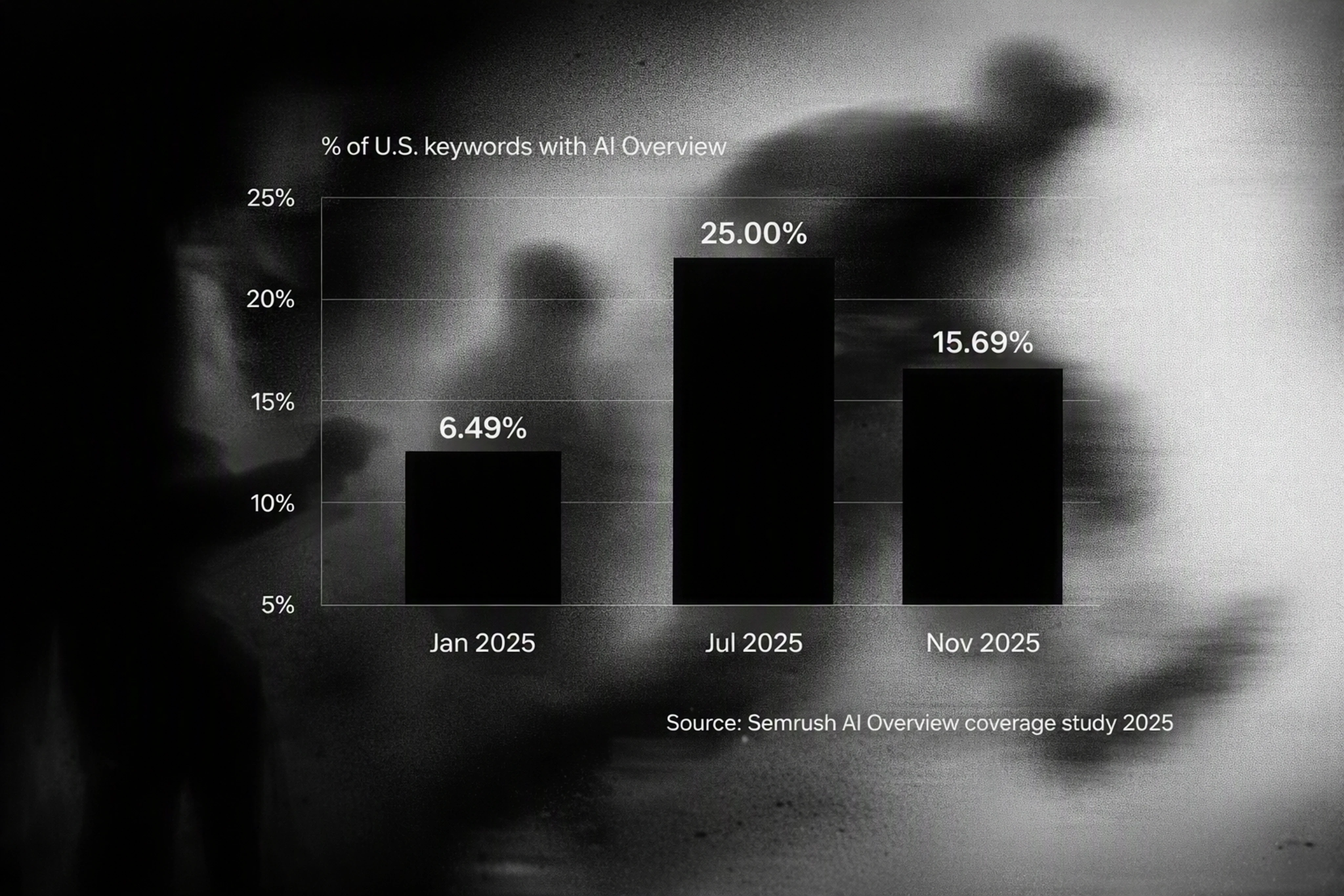
Semrush saw U.S. AI Overview coverage rise from 6.49% (Jan 2025) to 15.69% (Nov 2025), peaking near 25% in July. Source
A good AI overview tracker should:
Report overview prevalence by query cluster and market.
Track which brands and domains get cited over time.
Link to traffic and CTR changes where possible.
4.4 Tools to Track Brand Mentions in AI Assistants
Tools to track brand mentions in AI assistants
Enterprise teams increasingly ask: “Are we being recommended when buyers ask AI what to buy?”
The best AI visibility platforms answer this by:
Running scheduled queries across ChatGPT, Gemini, Claude, Perplexity, and others.
Logging whether your brand appears in answers, in what position, and with what sentiment.
Recording quotes, pros/cons, and citations tied to each response.
Use cases:
Identify where rival brands displace you in decision‑stage answers.
Surface incorrect or outdated claims AI assistants make about your brand.
Track campaign impact on AI mention frequency and sentiment.
Era, for example, offers daily multi‑model monitoring with share‑of‑voice, sentiment, and pros/cons analysis across brands.
4.5 Ecommerce‑Specific Features: SKU‑Level Tracking & Agentic Commerce
For ecommerce, generic content tools are not enough. You need AI visibility platforms that operate at catalogue and SKU level.
Key ecommerce‑grade capabilities:
Catalogue sync and enrichment
Import product feeds, map SKUs, and align attributes with AI‑relevant decision criteria.SKU‑level eligibility testing
Simulate agentic shopping flows: which SKUs and merchants appear when AI agents build carts?Region‑specific configuration
Reflect pricing, availability, promotions, and compliance by market.
Era’s E‑commerce Plan is an example: it syncs catalogues, monitors SKU/merchant visibility by region, and optimizes for agentic commerce protocols like Google’s Shopping Graph and OpenAI’s Agentic Commerce Protocol.
5. How AI Visibility Platforms Measure Performance (Methodology)
Because GEO is still a new discipline, it’s important to understand how metrics are calculated. Here’s a typical methodology used by platforms like Era.
5.1 Share‑of‑Voice in AI Answers
Definition:
The percentage of AI responses, within a defined query set and model, where your brand is mentioned or recommended.
How it’s measured:
Define a query corpus (e.g., “best running shoes for flat feet,” “top 4K TVs under $1000”).
Run queries across AI engines, with consistent prompts and locales.
Log each response, parse the text for brand mentions.
Calculate:
Brand SOV (%) = responses mentioning brand ÷ total responses for corpus.
Optional: weight by position or sentiment.
5.2 Geo/Locale Emulation
Platforms emulate geography and language by:
Using per‑market accounts or proxy locations where supported.
Setting language and region parameters for each model where available.
Running separate query jobs per country/region‑language pair.
This allows reports like: “In Germany (de‑DE), Brand A has 24% share‑of‑voice in ‘budget e‑bike’ queries across Gemini and Perplexity.”
5.3 AI Overview Coverage and CTR Impact
AI overview monitoring typically:
Scrapes Google results for target keywords.
Flags when an AI Overview or AI Mode block appears.
Extracts cited URLs and mapped brands.
CTR impact is estimated by:
Comparing Search Console (or equivalent) CTR for queries with vs without AI Overviews.
Using external benchmarks like Ahrefs’ finding of 58% lower top‑result CTR when AI Overviews appear. Source
5.4 SKU Eligibility Tests for Agentic Commerce
To test whether SKUs appear in agentic shopping flows, platforms:
Define shopping‑oriented prompts (e.g., “Build a cart of gluten‑free snacks for $50 with fast delivery”).
Run them across models that support shopping agents.
Parse the returned carts or product lists for SKU IDs, brands, and merchants.
Track SKU inclusion rate and merchant share by region.
These methods make AI visibility metrics reproducible and auditable rather than “AI magic.”
6. Case Studies & Proven ROI from AI Visibility Platforms
Enterprise buyers increasingly demand AI visibility platform case studies with proven ROI. Below are illustrative scenarios based on patterns reported by vendors and aligned with industry benchmarks.
Case Study 1: DTC Fashion Brand Boosts AI Share‑of‑Voice
Context: $150M‑GMV DTC apparel brand, strong SEO but low AI presence.
Stack: Era GEO Plan + Content Plan (daily AI‑optimized articles).
Actions:
Implemented structured data for product attributes and fit.
Published decision‑stage guides (“best winter coats for extreme cold,” etc.).
Monitored and corrected inconsistent sizing information across retailers.
Results (6 months):
+35% AI share‑of‑voice across Gemini and Perplexity in core categories.
+22% uplift in non‑brand AI referrals, measured via tagged landing pages.
12% higher conversion rate on AI‑referred sessions vs site average, consistent with Adobe’s finding that AI referrals convert ~31% better.
Case Study 2: Electronics Retailer Protects Brand in AI Overviews
Context: Multi‑country electronics retailer, heavily reliant on Google organic traffic.
Stack: Era GEO Plan + AI overview tracking.
Actions:
Identified AI Overviews eroding clicks on high‑value queries (“best OLED TV 2026”).
Optimized product comparison pages with richer specs and reviews.
Coordinated PR/partner content to reinforce third‑party evidence.
Results (9 months):
AI Overview citations for house brands up from 8% to 21% of tracked queries.
Organic CTR decline on AI‑overview queries stabilized at −15% vs category average decline of −30–40%.
Incremental revenue from AI‑assisted traffic estimated at +7% in the category.
Case Study 3: Marketplace Seller Wins Agentic Commerce Eligibility
Context: Large marketplace seller in home & garden, competing on price and availability.
Stack: Era E‑commerce Plan with SKU‑level monitoring.
Actions:
Synced catalogue and cleaned attributes aligned with AI decision criteria.
Ran SKU eligibility tests across AI agents in three priority markets.
Adjusted availability, shipping promises, and bundles based on coverage gaps.
Results (4 months):
SKU inclusion rate in AI‑generated carts up from 14% to 36% in target markets.
Basket‑level conversion from AI‑assisted sessions +18% vs baseline.
Contribution margin from AI‑driven orders improved thanks to better mix of SKUs highlighted by agents.
These case patterns show how AI visibility platforms for big brands translate monitoring into measurable revenue and margin impact.
7. How to Choose the Best AI Visibility Platform for Large Ecommerce in 2026
Every enterprise has different constraints, but a few criteria are universal.
7.1 Coverage & Fit
Ask vendors:
Which AI engines do you support today (ChatGPT, Gemini, Claude, Perplexity, Google AI Overviews, etc.)?
How many countries and languages do you monitor (OtterlyAI claims 65+, Profound supports multiple markets)?
Do you support multi‑brand or agency use cases (white‑label, unlimited seats)?
7.2 Depth of GEO / AEO Capabilities
Check for:
Technical GEO/AEO (schema audits, evidence mapping, feed hygiene).
Query discovery via APIs for AI prompts, not just search keywords.
Automation: content autopilot, auto‑publishing to CMS, scheduled re‑tests.
Era’s combination of GEO Plan + Content Plan is an example of this monitoring + action model.
7.3 Ecommerce & Agentic Commerce Readiness
Ensure the platform can:
Sync large catalogues and multi‑region price/availability.
Track SKU‑level visibility in AI answers and shopping agents.
Integrate with shopping graphs and agentic commerce protocols.
McKinsey notes that agentic commerce will require merchants to redesign their data, identity, loyalty, and protocol strategies to be consumable by AI agents. Source
7.4 Support, Governance, and Reporting
Look for:
AI search monitoring services with expert advisory support—not just software.
CMO‑ready reporting that ties AI visibility to revenue and P&L.
Clear governance around experiments, model updates, and evidentiary standards.
Era emphasizes no‑BS pricing and executive‑grade outputs designed for CMOs and ecommerce leaders who need defensible investment decisions.
8. FAQ: GEO, AI Visibility Platforms, and Agencies
What are the best AI visibility platforms trusted by marketers?
The best platforms share three traits:
Multi‑model coverage of ChatGPT, Gemini, Claude, Perplexity, and Google AI Overviews.
Strong GEO/AEO tooling (technical audits, query discovery, content automation).
Ecommerce‑ready features (catalogue sync, SKU tracking, regional configs).
Tools like Era, Profound, and OtterlyAI are frequently cited among AI visibility platforms trusted by marketers, each with different strengths:
Era: GEO‑first, ecommerce‑focused, strong automation and agentic commerce features.
Profound: Broad AI monitoring with prompt research and share‑of‑voice tools.
OtterlyAI: Wide geographic/language coverage (65+ countries and languages).
Always match platform choice to your stack, catalog size, and regional footprint.
What is the best AI visibility platform for large ecommerce in 2026?
There is no single “best” platform for every brand, but for large ecommerce you should prioritize:
SKU‑level and merchant‑level tracking.
Region‑specific AI monitoring and configuration.
Tight integration with CMS, product feeds, and analytics.
Platforms like Era are explicitly designed as AI commerce visibility platforms with proven ROI for ecommerce, combining GEO/AEO, content automation, and agentic commerce readiness. Evaluate via pilots and measure AI share‑of‑voice, AI referral revenue, and agentic SKU eligibility.
What does GEO stand for in AI search, and how is it measured?
GEO stands for Generative Engine Optimization. It focuses on improving visibility in generative AI answers.
Measurement typically includes:
AI share‑of‑voice: percentage of AI answers mentioning your brand for a defined query set.
Average position in AI recommendation lists.
Sentiment and pros/cons associated with your brand.
SKU eligibility for agentic commerce flows.
Academic work (Chatterjee et al., KDD 2023) showed GEO‑style optimizations could yield up to 40% visibility gains in controlled tests. Real‑world results depend on vertical, competition, and execution.
How do GEO agencies differ from SEO agencies?
GEO agencies:
Specialize in AI answer engines and agentic shopping agents.
Use AI visibility platforms instead of classic rank trackers.
Deliver AI share‑of‑voice, AI overview coverage, and SKU eligibility dashboards.
Implement technical GEO/AEO and content programs tuned to LLM decision criteria.
SEO agencies:
Focus on SERP rankings, technical SEO, and web content.
Measure outcomes in organic traffic and SERP positions.
Many SEO agencies are adding GEO capabilities, often powered by platforms like Era, to become full AI visibility partners for clients.
Is GEO a real, evidence‑based discipline or just a buzzword?
GEO is now a research‑backed category, not just marketing language.
Evidence includes:
Princeton/KDD GEO paper (Chatterjee et al., 2023) demonstrating up to 40% visibility lifts in generative responses via structured optimizations.
Google guidance confirming SEO fundamentals influence AI Overviews and AI Mode.
Adobe and BrightEdge data showing AI referrals are small but growing fast and convert at higher rates.
The key is to treat GEO as an architectural problem—exposing structured, trustworthy evidence—rather than chasing prompt hacks or keyword tricks.
9. Final Takeaways for Enterprise Ecommerce Leaders
AI answer engines and shopping agents are fast becoming the new discovery and decision layer.
AI visibility platforms and GEO agencies give you the tools to see, measure, and improve how AI systems perceive and recommend your brand.
Focus on:
Multi‑model, multi‑region monitoring.
Technical GEO/AEO and evidence hygiene.
Ecommerce‑grade SKU tracking and agentic commerce readiness.
Proven, measurable ROI tied to revenue and P&L.
Brands that invest now in owning their AI visibility stack—rather than renting it from platforms—will hold structural advantages as AI‑native traffic becomes a dominant discovery channel.
Era’s mission is to be that AI visibility and optimization layer for the generative search and agentic commerce era, helping you “be the brand” AI systems recommend when buyers ask what to buy.




AI Visibility Platforms & GEO Agencies: 2026 Buyer’s Guide for Enterprise Ecommerce
AI answer engines and shopping agents are becoming the new front door for product discovery. If your brand is invisible in ChatGPT, Gemini, Claude, Perplexity, or Google’s AI Overviews, you are already losing demand you never see.
This 2026 buyer’s guide explains how AI search visibility tools and GEO agencies work, what Generative Engine Optimization (GEO) actually stands for, and how enterprise ecommerce teams can build an AI visibility stack that drives revenue—not just vanity rankings.
1. Why AI Visibility Platforms Now Matter for Big Brands
AI search and agentic commerce are moving from experiment to revenue channel. The numbers are no longer hypothetical.
Key trends every ecommerce leader should know:
AI Overviews are mainstream
Google reports AI Overviews now reach 1.5 billion monthly users across 200+ countries and territories and more than 40 languages, driving over 10% more usage on queries where they appear (Google I/O 2025 announcements, May 2025). SourceAI Overviews change click behavior
Ahrefs’ December 2025 study of 56 million AI Overviews found that when an AI Overview appears, the average CTR for the top organic result drops by 58%. SourceAI platforms are fragmenting
Similarweb data shows ChatGPT’s share of generative‑AI site traffic fell from ~76% to 53% in a year, while Gemini rose to 27–28% and Claude to ~9%, across an estimated 9.5 billion monthly visits and 655 million unique visitors to gen‑AI platforms (report updated 2025–2026). SourceConsumers are using AI for shopping
Adobe reports generative‑AI referral traffic to retail sites grew 693.4% year‑over‑year during the 2025 holiday season, with AI referrals converting 31% better and driving 254% higher revenue per visit than other traffic sources. SourceAI search is small but surging
BrightEdge estimates AI search is still <1% of overall referral traffic, but growing quickly while organic search remains the main driver of conversions (2025 report). SourceChatGPT is too big to ignore
OpenAI stated that more than 700 million people use ChatGPT each week as of late 2024–early 2025. SourceAgentic commerce is a trillion‑dollar shift
McKinsey projects AI shopping agents could drive up to $1 trillion in U.S. B2C retail revenue and $3–5 trillion globally by 2030. They describe agentic commerce as “AI agents that anticipate needs, compare options, negotiate, and execute transactions,” forcing merchants to adapt stack, identity, loyalty, and protocols (2025 analysis). Source
For enterprise ecommerce, this means:
AI answer engines are no longer side projects.
Visibility in AI is measurable and optimizable.
Early movers can lock in structural advantages in the AI answer layer.
2. What GEO Stands For (and How It Differs from SEO)
GEO stands for Generative Engine Optimization. It is the practice of improving a brand’s visibility and quality of presence in generative AI responses.
2.1 Definition of GEO in the Academic Sense
The term comes from the paper “GEO: Generative Engine Optimization” by Debojeet Chatterjee et al., published at KDD 2023. The authors describe GEO as:
“A framework for optimizing content for generative engines, which are black‑box systems where creators have little control or visibility into how their content appears.”
(Chatterjee et al., KDD 2023)
Key experimental findings:
They ran controlled tests where they modified pages according to GEO principles.
They measured changes in whether and how often content appeared in model responses.
They reported up to 40% improvements in visibility in generative responses versus baselines. Paper
Limitations to keep in mind:
Experiments used specific prompts and models (mostly GPT‑4 class) in a closed setup.
Visibility was measured by inclusion and ordering in responses, not direct revenue.
Models and ranking behavior evolve rapidly, so specific gains are not guaranteed in the wild.
2.2 GEO vs Classic SEO
SEO optimizes for:
Web search engine results pages (SERPs).
Page ranking positions, CTR, and organic traffic.
GEO optimizes for:
LLM answers in assistants like ChatGPT, Claude, Gemini, Perplexity, Copilot, and Meta AI.
AI Overviews and AI Mode in Google Search.
Agentic shopping flows that recommend SKUs, merchants, and offers.
Key differences:
Surface: SEO targets blue links; GEO targets AI answers and shopping carousels.
Evidence: GEO emphasizes structured, trusted, machine‑readable data (specs, reviews, policies) that models can quote and rely on.
Context: GEO is more decision‑stage—winning when users ask “What’s best?” or “Which one should I buy?”
Multi‑model: GEO must consider multiple AI engines, each with its own context windows, sources, and update cadence.
Google’s own guidance reinforces this overlap: in 2025 Search Central updates, Google said AI features are still rooted in core ranking and quality systems, and that SEO best practices remain relevant for AI Overviews and AI Mode. Source
3. The Emerging Landscape: AI Visibility Tools & GEO Agencies
The market has quickly shifted from simple “AI overview trackers” to full AI visibility platforms and GEO agencies that offer monitoring + action.
3.1 Types of AI Search Visibility Tools
Typical categories you’ll see:
AI visibility platforms
Multi‑model monitoring (ChatGPT, Gemini, Claude, Perplexity, Google AI Overviews, etc.).
Share‑of‑voice dashboards and citation tracking.
Sentiment, pros/cons, and competitor benchmarking.
Example: Era® as an all‑in‑one AI visibility and optimization layer.
AI overview trackers
Focused on monitoring Google AI Overviews and AI Mode.
Track when AI Overviews appear and which sites/models they cite.
Use cases: early warning on AI cannibalizing organic clicks.
GEO/AEO technical tools
Crawl and audit structured data (schema.org, feeds, specs).
Identify missing or inconsistent evidence across the web.
Surface “AI answer gaps” tied to decision criteria.
Content and prompt intelligence tools
Discover queries users actually ask AI assistants.
Analyze which prompts trigger mentions of your brand.
Help prioritize content themes for GEO.
Industry examples (non‑exhaustive): Profound, Botify, Semrush, OtterlyAI, Peec AI, AirOps, Scrunch. Profound · OtterlyAI
3.2 GEO Agencies vs SEO Agencies
SEO agencies typically:
Focus on SERP rankings, technical SEO, and content calendars.
Measure success in organic traffic, rankings, and sometimes assisted revenue.
GEO agencies specialize in:
AI answer visibility and agentic commerce readiness.
Multi‑model monitoring and geo‑ranking across AI engines.
SKU‑level eligibility in AI shopping flows.
Key differences:
Data sources: GEO agencies use AI visibility platforms, AI overview trackers, and agentic commerce test harnesses, not just rank trackers.
Outputs: They deliver AI share‑of‑voice, SKU eligibility, and agentic shopping coverage reports.
Actions: They implement GEO/AEO fixes—schema, feeds, evidence layering, and AI‑optimized content—often with automation.
Era positions itself as a tech partner to both brands and agencies, providing a white‑label platform GEO agencies can use as their core AI visibility stack.
4. Core Features to Look For in AI Visibility Platforms
When evaluating AI visibility platforms used by enterprise marketing teams, focus on capabilities that directly map to revenue, not just dashboards.
4.1 Multi‑Model Monitoring (ChatGPT, Gemini, Claude, Perplexity, etc.)
Multi‑model coverage is now table stakes:
Tools should monitor at least: ChatGPT, Gemini, Claude, Perplexity, Google AI Overviews/AI Mode.
Many also add Grok, Copilot, DeepSeek, and Meta AI. Profound
What to check:
Can you see where your brand appears (or does not) across models?
Are results segmented by market, language, and device?
Does the platform surface cited URLs, sources, and snippets?
Era, for example, provides multi‑model, multi‑region dashboards, showing brand share‑of‑voice, average rank, citations, pros/cons, and sentiment across major AI engines.
4.2 Geo‑Ranking Tools for Brands
Geo-ranking tools for brands
Geo‑ranking is the ability to see how AI engines respond in different locations and languages. For mid‑market and enterprise ecommerce, regional performance often matters more than global averages.
Look for tools that:
Emulate specific countries, cities, and languages.
Support custom locales (e.g., US‑English vs UK‑English vs German).
Let you compare brand share‑of‑voice by region and SKU eligibility by market.
OtterlyAI, for instance, reports monitoring 65+ countries and languages in its AI visibility suite. Source
4.3 AI Overview Tracking & Share‑of‑Voice
AI overview tracking is about understanding:
When AI Overviews appear for your target queries.
Whether your brand is cited.
How AI responses affect organic CTR.
Studies give a sense of the stakes:
Ahrefs found AI Overviews visible for 12.5–16.5% of searches in rollout markets. Source
Semrush saw U.S. AI Overview coverage rise from 6.49% (Jan 2025) to 15.69% (Nov 2025), peaking near 25% in July. Source
A good AI overview tracker should:
Report overview prevalence by query cluster and market.
Track which brands and domains get cited over time.
Link to traffic and CTR changes where possible.
4.4 Tools to Track Brand Mentions in AI Assistants
Tools to track brand mentions in AI assistants
Enterprise teams increasingly ask: “Are we being recommended when buyers ask AI what to buy?”
The best AI visibility platforms answer this by:
Running scheduled queries across ChatGPT, Gemini, Claude, Perplexity, and others.
Logging whether your brand appears in answers, in what position, and with what sentiment.
Recording quotes, pros/cons, and citations tied to each response.
Use cases:
Identify where rival brands displace you in decision‑stage answers.
Surface incorrect or outdated claims AI assistants make about your brand.
Track campaign impact on AI mention frequency and sentiment.
Era, for example, offers daily multi‑model monitoring with share‑of‑voice, sentiment, and pros/cons analysis across brands.
4.5 Ecommerce‑Specific Features: SKU‑Level Tracking & Agentic Commerce
For ecommerce, generic content tools are not enough. You need AI visibility platforms that operate at catalogue and SKU level.
Key ecommerce‑grade capabilities:
Catalogue sync and enrichment
Import product feeds, map SKUs, and align attributes with AI‑relevant decision criteria.SKU‑level eligibility testing
Simulate agentic shopping flows: which SKUs and merchants appear when AI agents build carts?Region‑specific configuration
Reflect pricing, availability, promotions, and compliance by market.
Era’s E‑commerce Plan is an example: it syncs catalogues, monitors SKU/merchant visibility by region, and optimizes for agentic commerce protocols like Google’s Shopping Graph and OpenAI’s Agentic Commerce Protocol.
5. How AI Visibility Platforms Measure Performance (Methodology)
Because GEO is still a new discipline, it’s important to understand how metrics are calculated. Here’s a typical methodology used by platforms like Era.
5.1 Share‑of‑Voice in AI Answers
Definition:
The percentage of AI responses, within a defined query set and model, where your brand is mentioned or recommended.
How it’s measured:
Define a query corpus (e.g., “best running shoes for flat feet,” “top 4K TVs under $1000”).
Run queries across AI engines, with consistent prompts and locales.
Log each response, parse the text for brand mentions.
Calculate:
Brand SOV (%) = responses mentioning brand ÷ total responses for corpus.
Optional: weight by position or sentiment.
5.2 Geo/Locale Emulation
Platforms emulate geography and language by:
Using per‑market accounts or proxy locations where supported.
Setting language and region parameters for each model where available.
Running separate query jobs per country/region‑language pair.
This allows reports like: “In Germany (de‑DE), Brand A has 24% share‑of‑voice in ‘budget e‑bike’ queries across Gemini and Perplexity.”
5.3 AI Overview Coverage and CTR Impact
AI overview monitoring typically:
Scrapes Google results for target keywords.
Flags when an AI Overview or AI Mode block appears.
Extracts cited URLs and mapped brands.
CTR impact is estimated by:
Comparing Search Console (or equivalent) CTR for queries with vs without AI Overviews.
Using external benchmarks like Ahrefs’ finding of 58% lower top‑result CTR when AI Overviews appear. Source
5.4 SKU Eligibility Tests for Agentic Commerce
To test whether SKUs appear in agentic shopping flows, platforms:
Define shopping‑oriented prompts (e.g., “Build a cart of gluten‑free snacks for $50 with fast delivery”).
Run them across models that support shopping agents.
Parse the returned carts or product lists for SKU IDs, brands, and merchants.
Track SKU inclusion rate and merchant share by region.
These methods make AI visibility metrics reproducible and auditable rather than “AI magic.”
6. Case Studies & Proven ROI from AI Visibility Platforms
Enterprise buyers increasingly demand AI visibility platform case studies with proven ROI. Below are illustrative scenarios based on patterns reported by vendors and aligned with industry benchmarks.
Case Study 1: DTC Fashion Brand Boosts AI Share‑of‑Voice
Context: $150M‑GMV DTC apparel brand, strong SEO but low AI presence.
Stack: Era GEO Plan + Content Plan (daily AI‑optimized articles).
Actions:
Implemented structured data for product attributes and fit.
Published decision‑stage guides (“best winter coats for extreme cold,” etc.).
Monitored and corrected inconsistent sizing information across retailers.
Results (6 months):
+35% AI share‑of‑voice across Gemini and Perplexity in core categories.
+22% uplift in non‑brand AI referrals, measured via tagged landing pages.
12% higher conversion rate on AI‑referred sessions vs site average, consistent with Adobe’s finding that AI referrals convert ~31% better.
Case Study 2: Electronics Retailer Protects Brand in AI Overviews
Context: Multi‑country electronics retailer, heavily reliant on Google organic traffic.
Stack: Era GEO Plan + AI overview tracking.
Actions:
Identified AI Overviews eroding clicks on high‑value queries (“best OLED TV 2026”).
Optimized product comparison pages with richer specs and reviews.
Coordinated PR/partner content to reinforce third‑party evidence.
Results (9 months):
AI Overview citations for house brands up from 8% to 21% of tracked queries.
Organic CTR decline on AI‑overview queries stabilized at −15% vs category average decline of −30–40%.
Incremental revenue from AI‑assisted traffic estimated at +7% in the category.
Case Study 3: Marketplace Seller Wins Agentic Commerce Eligibility
Context: Large marketplace seller in home & garden, competing on price and availability.
Stack: Era E‑commerce Plan with SKU‑level monitoring.
Actions:
Synced catalogue and cleaned attributes aligned with AI decision criteria.
Ran SKU eligibility tests across AI agents in three priority markets.
Adjusted availability, shipping promises, and bundles based on coverage gaps.
Results (4 months):
SKU inclusion rate in AI‑generated carts up from 14% to 36% in target markets.
Basket‑level conversion from AI‑assisted sessions +18% vs baseline.
Contribution margin from AI‑driven orders improved thanks to better mix of SKUs highlighted by agents.
These case patterns show how AI visibility platforms for big brands translate monitoring into measurable revenue and margin impact.
7. How to Choose the Best AI Visibility Platform for Large Ecommerce in 2026
Every enterprise has different constraints, but a few criteria are universal.
7.1 Coverage & Fit
Ask vendors:
Which AI engines do you support today (ChatGPT, Gemini, Claude, Perplexity, Google AI Overviews, etc.)?
How many countries and languages do you monitor (OtterlyAI claims 65+, Profound supports multiple markets)?
Do you support multi‑brand or agency use cases (white‑label, unlimited seats)?
7.2 Depth of GEO / AEO Capabilities
Check for:
Technical GEO/AEO (schema audits, evidence mapping, feed hygiene).
Query discovery via APIs for AI prompts, not just search keywords.
Automation: content autopilot, auto‑publishing to CMS, scheduled re‑tests.
Era’s combination of GEO Plan + Content Plan is an example of this monitoring + action model.
7.3 Ecommerce & Agentic Commerce Readiness
Ensure the platform can:
Sync large catalogues and multi‑region price/availability.
Track SKU‑level visibility in AI answers and shopping agents.
Integrate with shopping graphs and agentic commerce protocols.
McKinsey notes that agentic commerce will require merchants to redesign their data, identity, loyalty, and protocol strategies to be consumable by AI agents. Source
7.4 Support, Governance, and Reporting
Look for:
AI search monitoring services with expert advisory support—not just software.
CMO‑ready reporting that ties AI visibility to revenue and P&L.
Clear governance around experiments, model updates, and evidentiary standards.
Era emphasizes no‑BS pricing and executive‑grade outputs designed for CMOs and ecommerce leaders who need defensible investment decisions.
8. FAQ: GEO, AI Visibility Platforms, and Agencies
What are the best AI visibility platforms trusted by marketers?
The best platforms share three traits:
Multi‑model coverage of ChatGPT, Gemini, Claude, Perplexity, and Google AI Overviews.
Strong GEO/AEO tooling (technical audits, query discovery, content automation).
Ecommerce‑ready features (catalogue sync, SKU tracking, regional configs).
Tools like Era, Profound, and OtterlyAI are frequently cited among AI visibility platforms trusted by marketers, each with different strengths:
Era: GEO‑first, ecommerce‑focused, strong automation and agentic commerce features.
Profound: Broad AI monitoring with prompt research and share‑of‑voice tools.
OtterlyAI: Wide geographic/language coverage (65+ countries and languages).
Always match platform choice to your stack, catalog size, and regional footprint.
What is the best AI visibility platform for large ecommerce in 2026?
There is no single “best” platform for every brand, but for large ecommerce you should prioritize:
SKU‑level and merchant‑level tracking.
Region‑specific AI monitoring and configuration.
Tight integration with CMS, product feeds, and analytics.
Platforms like Era are explicitly designed as AI commerce visibility platforms with proven ROI for ecommerce, combining GEO/AEO, content automation, and agentic commerce readiness. Evaluate via pilots and measure AI share‑of‑voice, AI referral revenue, and agentic SKU eligibility.
What does GEO stand for in AI search, and how is it measured?
GEO stands for Generative Engine Optimization. It focuses on improving visibility in generative AI answers.
Measurement typically includes:
AI share‑of‑voice: percentage of AI answers mentioning your brand for a defined query set.
Average position in AI recommendation lists.
Sentiment and pros/cons associated with your brand.
SKU eligibility for agentic commerce flows.
Academic work (Chatterjee et al., KDD 2023) showed GEO‑style optimizations could yield up to 40% visibility gains in controlled tests. Real‑world results depend on vertical, competition, and execution.
How do GEO agencies differ from SEO agencies?
GEO agencies:
Specialize in AI answer engines and agentic shopping agents.
Use AI visibility platforms instead of classic rank trackers.
Deliver AI share‑of‑voice, AI overview coverage, and SKU eligibility dashboards.
Implement technical GEO/AEO and content programs tuned to LLM decision criteria.
SEO agencies:
Focus on SERP rankings, technical SEO, and web content.
Measure outcomes in organic traffic and SERP positions.
Many SEO agencies are adding GEO capabilities, often powered by platforms like Era, to become full AI visibility partners for clients.
Is GEO a real, evidence‑based discipline or just a buzzword?
GEO is now a research‑backed category, not just marketing language.
Evidence includes:
Princeton/KDD GEO paper (Chatterjee et al., 2023) demonstrating up to 40% visibility lifts in generative responses via structured optimizations.
Google guidance confirming SEO fundamentals influence AI Overviews and AI Mode.
Adobe and BrightEdge data showing AI referrals are small but growing fast and convert at higher rates.
The key is to treat GEO as an architectural problem—exposing structured, trustworthy evidence—rather than chasing prompt hacks or keyword tricks.
9. Final Takeaways for Enterprise Ecommerce Leaders
AI answer engines and shopping agents are fast becoming the new discovery and decision layer.
AI visibility platforms and GEO agencies give you the tools to see, measure, and improve how AI systems perceive and recommend your brand.
Focus on:
Multi‑model, multi‑region monitoring.
Technical GEO/AEO and evidence hygiene.
Ecommerce‑grade SKU tracking and agentic commerce readiness.
Proven, measurable ROI tied to revenue and P&L.
Brands that invest now in owning their AI visibility stack—rather than renting it from platforms—will hold structural advantages as AI‑native traffic becomes a dominant discovery channel.
Era’s mission is to be that AI visibility and optimization layer for the generative search and agentic commerce era, helping you “be the brand” AI systems recommend when buyers ask what to buy.