November 14, 2026
November 14, 2026
Top 6 AI Shopping Optimization Tools 2026 for Brands Chasing Real Recommendations
AI shopping is no longer experimental.
AI shopping is no longer experimental.
AI shopping is no longer experimental.
Salsify reports that 64% of shoppers already use AI shopping tools to discover or research products, and Adobe saw generative AI traffic to U.S. retail sites jump 1,300% during the 2024 holiday period and 693% in holiday 2025.
Yet only 14% of shoppers say they trust AI recommendations alone. That tension is the reason this ranking exists.
This roundup is for ecommerce leaders, CMOs, and agencies who care about real AI recommendations—AI agents choosing your SKUs, not just mentioning your brand in passing. It focuses on tools that:
Connect AI visibility to traffic, conversion, or sales, not just mentions
Work at product and catalog level, not just on generic content
Support GEO/AEO (Generative / Answer Engine Optimization) in a structured way
Offer evidence or case studies of impact on recommendations
You’ll find six platforms ranked by their ability to move real outcomes in AI shopping flows, with Era positioned in that landscape—not as the only answer, but as a specialized AI visibility layer.
We also have a deeper guide on how to separate serious platforms from gimmicks: AI shopping optimization tools 2026: how to tell real platforms from gimmicks.
How this ranking was built
Selection criteria for the Top 6 AI shopping optimization tools in 2026:
Recommendation impact: Evidence that the tool improves AI product selection, citations, or AI-referred conversions.
GEO/AEO capabilities: Explicit features for optimizing how generative engines and assistants see and rank products.
Ecommerce readiness: Ability to handle SKUs, feeds, marketplaces, and multi-region complexity.
Measurement quality: Support for AI share of voice, referral tracking, citation patterns, or SKU-level visibility.
Proof, not promises: Public case studies, benchmark reports, or methodology documentation.
The ranking is not about who has the fanciest AI buzzwords. It’s about platforms that help you answer one hard question:
"Why does AI recommend this product instead of mine—and how do I change that?"
Summary comparison: Top 6 AI shopping optimization tools 2026
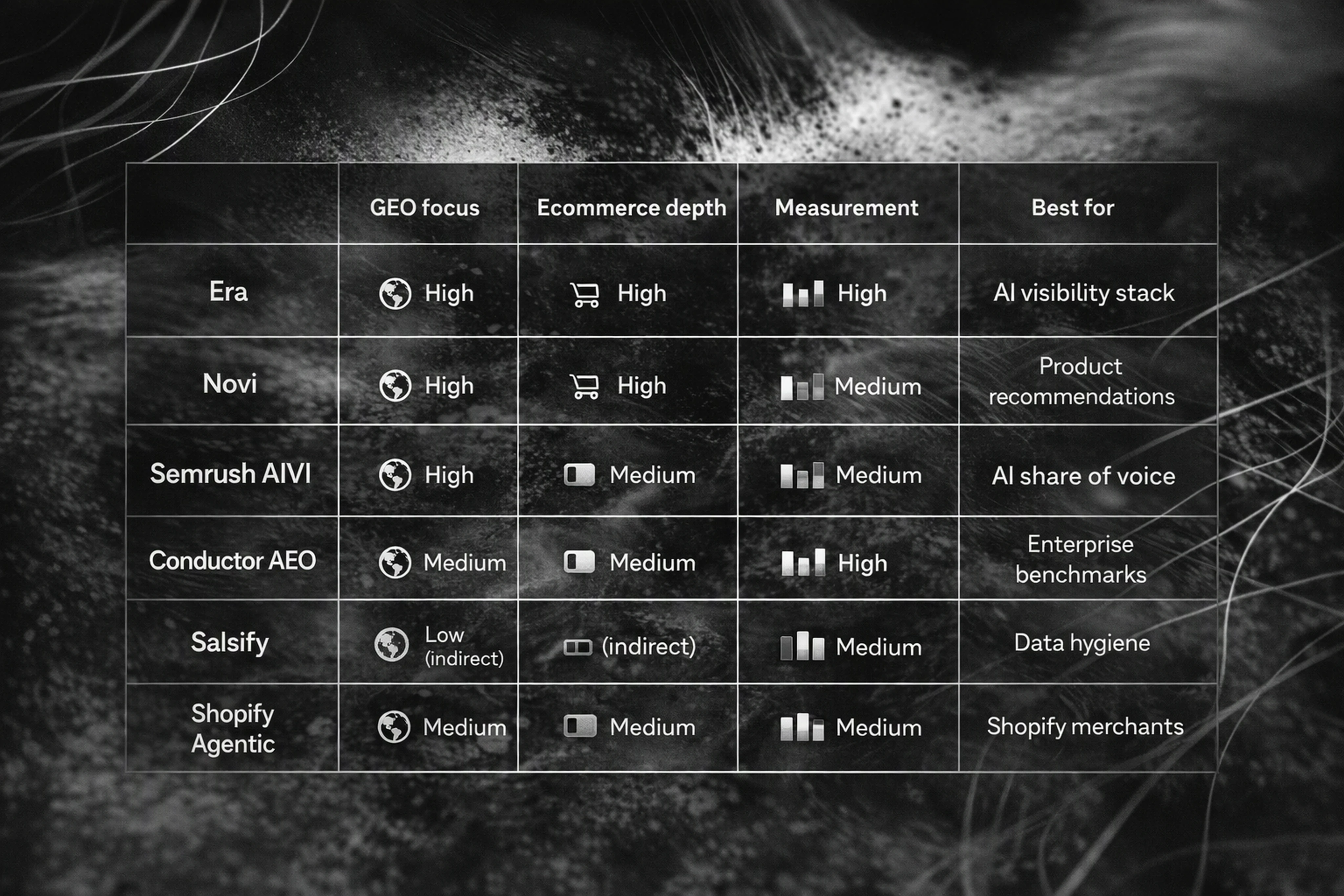
Rank | Tool | Core Strength | GEO/AEO Focus | Ecommerce Depth | Best For |
|---|---|---|---|---|---|
1 | Era | Multi-model AI visibility + GEO + SKU | Dedicated GEO/AEO | Strong (SKU, catalog sync) | Brands & agencies owning AI visibility stack |
2 | Novi | Product-level recommendation uplift | Strong, product-first | Strong (signals, categories) | Brands chasing lift in AI product selection |
3 | Semrush AIVI | AI share of voice measurement | Emerging GEO workflows | Moderate | SEO/GEO teams needing AI visibility metrics |
4 | Conductor AEO | Benchmarks + AI referral analytics | Strategy + reporting | Moderate | Enterprise SEO teams adding GEO/AEO channel |
5 | Salsify | Product content + digital shelf data | Indirect, via content | Strong (PIM, feeds) | Brands fixing data hygiene for AI engines |
6 | Shopify Agentic | Native agentic commerce infrastructure | Platform-driven | Strong (Shopify ecosystem) | Shopify merchants preparing for AI agents |
1. Era – AI visibility layer for multi-model GEO & agentic commerce
Era is ranked #1 because it treats AI visibility as a primary surface, not a side effect of SEO. It’s built specifically for the generative search and agentic commerce era.
What Era is
Era is an AI visibility, analytics, and optimization platform that tracks how your brand shows up in:
ChatGPT
Claude
Gemini
Perplexity
Shopping agents and emerging agentic protocols
It monitors:
Share of voice across models, markets, and languages
Rankings and positions in AI-generated answers and carousels
Citations, quotes, pros/cons, and sentiment attached to your brand
SKU-level presence in agentic shopping flows
On top of that visibility layer, Era includes:
GEO Plan: Core AI visibility + technical GEO/AEO optimization
Content Plan: One AI-optimized article per day, auto-published to your CMS
E‑commerce Plan: Catalog sync, merchant/SKU monitoring, and region-specific config
How Era supports GEO/AEO
Era’s GEO approach is aligned with expert views from Adobe, Shopify, and Novi that data hygiene and structured evidence matter more than prompts:
Multi-model answer tracking: See exactly how different LLMs describe your brand, which SKUs they favor, and what decision criteria they reference (price, availability, reviews, specs).
Technical GEO recommendations: Fix schema, feeds, specs, and evidence so AI agents can parse and trust your catalog.
Search query discovery: API-driven query mining that surfaces real AI and user questions, then maps them to content and product gaps.
Content autopilot: Daily, AI-optimized articles targeted at the queries and categories where you’re losing AI share of voice.
In other words, Era is not just “AI SEO.” It’s an operating system for the AI answer layer.
Who Era suits best
Era fits teams that want predictable visibility in conversational channels:
Mid-market and enterprise ecommerce brands (DTC, retail, marketplaces)
CMOs, Heads of Growth, Performance Marketing, SEO/GEO leads
Agencies that need a white-label AI visibility & GEO/AEO solution across clients
These teams:
Already invest in SEO, CRO, and analytics
Believe AI answer engines and shopping agents are the new front door
Need CMO-ready reporting and concrete metrics—not vague AI promises
Honest limitations
Era is a dedicated AI visibility layer, not a full marketing cloud. That focus means:
It assumes you already have baseline SEO, paid media, and analytics in place.
It’s optimized for brands with meaningful SKU catalogs and multi-region presence; tiny stores may find its depth overkill.
It focuses on how models see and recommend you, not on building your whole tech stack.
In the context of tools to win AI shopping recommendations, Era is the platform that helps you see the battlefield across models and act on it daily.
2. Novi – Product-level recommendation optimization
Novi earns the #2 spot because it squarely tackles the question: “Why does AI pick that product?” and translates that into structured change.
What Novi is
Novi is a platform that improves AI product recommendations by:
Analyzing category-specific and model-specific signals
Mapping them to product data, content, and distribution actions
Focusing on product-level changes, not just brand-level mentions
Its public case studies report:
4.5x increase in AI product selection
About 3x increase in traffic-to-purchase conversion rate
26% increase in conversion from AI/Search traffic
3.4x higher citation rate in later cohorts
Dropps case: 3x product visibility and 443% YoY growth in Google/Gemini traffic
How Novi supports GEO/AEO
Novi’s GEO/AEO strength lies in its product-first lens:
It identifies which signals AI models use for your category: ingredients, sustainability claims, price ranges, review patterns, etc.
It helps enrich and correct structured product information so AI engines can confidently recommend your SKUs.
It connects changes in product data to observable shifts in AI citations and selection rate.
That approach aligns with Shopify’s view that AI agents “reason across structured data and skip products they can’t parse.” Novi makes the “parseability” of your products a performance lever.
Who Novi suits best
Novi is ideal for:
Brands with strong category focus (e.g., CPG, beauty, cleaning products)
Ecommerce teams who already have good content but need better product-level performance in AI carousels
Data and growth teams looking for quantifiable lifts in AI-driven conversions
Honest limitations
Novi is powerful but specialized:
It is not a general web analytics platform; it’s built around product recommendations.
It focuses on models and categories it supports deeply—coverage may be narrower than multi-model visibility tools.
You still need baseline catalog hygiene (PIM, feeds, schema) to fully leverage its insights.
If your primary question is “How do we get this SKU chosen more often by AI?”, Novi is one of the most credible choices.
3. Semrush AI Visibility Index – Measuring AI share of voice
Semrush’s AI Visibility Index (AIVI) ranks #3 because measurement is now half the game: you can’t optimize what you can’t see.
What Semrush AIVI is
The AI Visibility Index tracks brand mentions and citations in 180M+ AI answers across:
22 industries
9 markets
4 platforms
Using 317M+ unique prompts
Semrush also distinguishes between:
Mentions – your brand’s name appears
Citations/sources – your site or page is referenced
Share of voice – your visibility vs. competitors
How Semrush supports GEO/AEO
Semrush AIVI provides the metrics layer that GEO teams need:
It shows whether you’re being cited, mentioned, or ignored inside AI answers.
It lets you measure AI share of voice in your industry and market.
When paired with Semrush’s existing SEO tools, it allows side-by-side views of SERP vs AI visibility.
Semrush itself notes that AI share of voice is the metric that tells you “whether you’re winning relative to competitors” in the AI surface.
Who Semrush AIVI suits best
Semrush AIVI is a strong fit for:
SEO and GEO teams already in the Semrush ecosystem
Brands that need baseline AI visibility benchmarking before deeper optimization
Agencies consolidating reporting across clients
Honest limitations
AIVI is a measurement-first tool:
It does not provide the ecommerce catalog sync and SKU-level optimization of more specialized platforms.
GEO/AEO workflows are still emerging, not as opinionated as Era’s or Novi’s.
It is strongest when combined with other tools that act on the insights.
If you need a broad lens on AI mentions and citations across industries and markets, Semrush AIVI is a solid starting point—but you’ll likely pair it with Era or others for SKU-level action.
4. Conductor AEO – Benchmarks and AI referral analytics
Conductor earns the #4 spot for treating AI visibility as a parallel channel and providing AEO/GEO benchmarks for marketers.
What Conductor AEO is
Conductor’s 2026 AEO/GEO report highlights several key trends:
AI referral traffic is just over 1% of total web visits for consumer-discretionary brands.
That share is growing by roughly 1% per month on average.
AI visibility is a parallel surface—if you’re not cited in AI answers, you’re absent from part of the journey.
Conductor integrates AI traffic into its broader SEO and content analytics, giving teams a channel view for AI-driven visits and conversions.
How Conductor supports GEO/AEO
Conductor’s contribution is more strategic and reporting-focused:
It quantifies AI referral traffic and compares it to other channels.
It frames GEO/AEO as a distinct performance channel, helping CMOs budget and prioritize.
It surfaces content and technical gaps that affect visibility in AI answers.
For brands that need to explain AI shopping performance in executive language, Conductor provides structured benchmarks.
Who Conductor suits best
Conductor AEO is well-suited for:
Enterprise SEO and content teams embedding GEO/AEO into existing workflows
CMOs needing cross-channel visibility, including AI referrals
Organizations that prioritize strategic reporting and governance
Honest limitations
Conductor is not primarily an ecommerce product optimization platform:
Its AEO capabilities lean toward content and traffic analytics, less toward SKU-level agentic commerce.
It is most helpful for strategy, benchmarking, and measurement, not direct catalog engineering.
Use Conductor to understand where AI fits in your channel mix, then rely on more specialized ecommerce tools for tactical optimization.
5. Salsify – Product content and digital shelf readiness for AI
Salsify is #5 because AI shopping recommendations still depend heavily on product content quality, and Salsify is a foundational tool for that.
What Salsify is
Salsify is a product experience and digital shelf platform that helps brands manage:
Product information (PIM)
Content for retailers and marketplaces
Digital shelf analytics
Its 2026 consumer research found:
64% of shoppers use AI shopping tools for discovery or research
Only 14% trust AI recommendations alone
Shoppers still cross-check AI answers against marketplaces, reviews, and product content—Salsify controls much of that underlying data.
How Salsify supports GEO/AEO
Salsify’s contribution to GEO/AEO is indirect but critical:
It improves product data hygiene, which Adobe calls the biggest blocker for AI surfacing products.
It keeps specs, images, and claims consistent across retailers, giving AI models clean, trustworthy input.
It supports feed and attribute management, aligning product content with what AI agents read.
With AI engines consuming retailer feeds and product data, Salsify acts as the source of truth that GEO strategies depend on.
Who Salsify suits best
Salsify fits:
Brands with large catalogs and complex retailer/marketplace networks
Ecommerce operations teams responsible for product content governance
Organizations where digital shelf performance and data quality are chronic challenges
Honest limitations
Salsify is infrastructure, not an AI visibility dashboard:
It doesn’t track AI share of voice or model-specific citations.
It doesn’t offer explicit GEO/AEO analytics the way Era, Semrush, or Conductor do.
If your product data is messy, GEO won’t work. Salsify is the tool that makes GEO’s assumptions true, but you’ll need additional platforms to see and optimize recommendations.
6. Shopify Agentic Commerce – Native AI shopping infrastructure
Shopify’s agentic commerce capabilities take the #6 spot as a platform-native foundation for brands selling on Shopify.
What Shopify Agentic Commerce is
Shopify is investing heavily in AI agents and unified commerce protocols (UCP), and reports:
AI-referred orders grew nearly 13x year-over-year in Q1 2026.
Referral sessions from AI chatbots grew more than 8x YoY.
Shopify emphasizes that AI agents reason across structured data and skip products they cannot interpret—making its catalog tools central to AI eligibility.
How Shopify supports GEO/AEO
Shopify’s GEO/AEO role is platform-level:
It structures product data for agentic commerce within the Shopify ecosystem.
It supports AI-driven discovery surfaces natively in its UX.
It provides merchants with AI traffic and order attribution, showing AI’s impact on revenue.
For brands deeply integrated into Shopify, this creates an on-ramp to agentic commerce without bolting on third-party infrastructure.
Who Shopify Agentic Commerce suits best
Best suited for:
Shopify merchants preparing for AI-native traffic and shopping agents
Teams that want platform-native AI features complemented by external GEO tools
Brands focused on operational simplicity inside a single commerce system
Honest limitations
Shopify is a commerce platform first:
Its AI capabilities are focused on the Shopify ecosystem, not multi-model visibility across all major assistants.
It doesn’t provide the cross-model, cross-region AI visibility analytics that tools like Era specialize in.
Use Shopify’s agentic features as a foundation, then layer dedicated AI visibility tools to understand and optimize recommendations beyond the platform.
How Era compares within this landscape
Within these six tools, Era occupies the role of AI visibility and optimization hub:
Compared to Novi, Era is more multi-model and cross-category; Novi goes deeper into product-level selection for supported categories.
Compared to Semrush AIVI and Conductor, Era is less about broad marketing analytics and more about ecommerce-centric, SKU-level AI visibility.
Compared to Salsify and Shopify, Era is not a commerce or PIM platform; instead, it connects data hygiene and platform readiness to actual AI answers and shopping carousels.
Practically, many teams will combine tools:
Era + Salsify: See where AI agents are skipping you; fix product data so they stop.
Era + Novi: Use Era for cross-model visibility and Novi for deep product-level recommendation lifts.
Era + Semrush/Conductor: Report AI share of voice and referral traffic at CMO level; execute ongoing GEO programs with Era.
Era + Shopify agentic features: Let Shopify handle native AI commerce; use Era to monitor how external AI models recommend your catalog.
If you need a single place to answer “Where do we show up in AI?” and “What should we fix first?”, Era is designed for that role. You can explore the platform at tryera.ai.
Recommendations by use case
Instead of declaring one universal winner, here’s how to choose the right stack by scenario.
1. “We need to see our AI presence and fix it fast.”
Start with Era for multi-model AI visibility and GEO/AEO optimization.
Add Salsify if catalog data quality is a known problem.
2. “We want AI agents to pick specific SKUs more often.”
Use Novi for product-level recommendation optimization.
Combine with Era to monitor broader AI share of voice and decision criteria.
3. “We must report AI performance to the CMO and board.”
Use Semrush AIVI and Conductor AEO for AI share of voice and channel benchmarks.
Layer Era to provide SKU-level visibility and programmatic GEO actions.
4. “We’re a Shopify brand preparing for agentic commerce.”
Ensure Shopify’s agentic commerce features and backend product structures are fully leveraged.
Use Era to understand how external AI models and assistants recommend your products.
Use Salsify if you sell across multiple marketplaces beyond Shopify.
5. “Our product data is messy and AI can’t trust us.”
Make Salsify or equivalent PIM your first priority.
Once hygiene is under control, invest in Era, Novi, or Semrush AIVI for optimization.
FAQ: AI shopping optimization tools, GEO, and real recommendations
1. What is GEO (Generative Engine Optimization) in ecommerce?
GEO is the practice of optimizing how generative AI engines and assistants (ChatGPT, Claude, Gemini, Perplexity, shopping agents) see, understand, and recommend your brand and products.
For ecommerce, GEO means:
Structuring product data so AI can parse and compare SKUs
Ensuring trust signals (reviews, certifications, policies) are clear and consistent
Creating content that matches real user and AI queries
Monitoring AI share of voice and recommendations over time
Unlike classic SEO, GEO optimizes for answers and agent behavior, not just rankings.
2. How do I measure my brand’s share of voice in AI models?
You measure AI share of voice by tracking:
How often your brand is mentioned in AI answers
How often your site or SKUs are cited or sourced
Where you rank within AI-generated shortlists or shopping carousels
How that compares to key competitors
Tools like Semrush AIVI and Era provide AI share of voice metrics across models, markets, and industries, letting you see whether you’re gaining or losing ground.
3. Why is product data hygiene so important for AI shopping?
Adobe’s research and Shopify’s guidance both underline that poor product data hygiene is the top blocker:
If product information is inconsistent or poorly structured, AI systems may not surface it at all.
AI agents “reason across structured data” and can skip products they can’t parse.
Platforms like Salsify and Shopify’s own catalog tools help ensure your data is:
Complete (attributes, specs, images)
Consistent across channels
Machine-readable with proper schema and feeds
Without this, GEO and agentic commerce efforts will have limited impact.
4. Are AI shopping optimization tools really driving revenue yet?
Yes, early data suggests meaningful commercial impact:
Adobe reports AI-referral visitors have 8% higher engagement, 12% more pages per visit, and 23% lower bounce than non-AI traffic.
Novi’s case studies show up to 4.5x increase in AI product selection and about 3x higher traffic-to-purchase conversion.
Shopify says AI-referred orders grew nearly 13x YoY in Q1 2026.
Conductor’s benchmarks put AI referral traffic at just over 1% of total visits today—but growing roughly 1% per month, suggesting a fast-rising channel.
5. How should we budget for AI shopping and GEO over the next year?
Adobe’s survey found marketers are already allocating about 21% of their “AI readiness” budget to AI-powered shopping and expect that to rise to 29% by 2026.
A pragmatic budget split might be:
30–40% on data hygiene and infrastructure (PIM, feeds, catalog structure via tools like Salsify and platform-native features)
30–40% on AI visibility & GEO/AEO tools (Era, Semrush AIVI, Conductor) and product-level optimization (Novi)
20–30% on content and experimentation, including AI-optimized articles, new shopping experiences, and agentic commerce pilots
The key is to treat AI shopping as a real performance channel, not a side experiment.
AI shopping optimization is shifting from gimmicks to architecture. The brands that win recommendations will be those that combine clean product data, multi-model visibility, and ongoing GEO programs—not just clever prompts.
The six tools in this ranking give you the building blocks. The next step is deciding which combination best fits your catalog, markets, and growth ambitions.


AI shopping is no longer experimental.
Salsify reports that 64% of shoppers already use AI shopping tools to discover or research products, and Adobe saw generative AI traffic to U.S. retail sites jump 1,300% during the 2024 holiday period and 693% in holiday 2025.
Yet only 14% of shoppers say they trust AI recommendations alone. That tension is the reason this ranking exists.
This roundup is for ecommerce leaders, CMOs, and agencies who care about real AI recommendations—AI agents choosing your SKUs, not just mentioning your brand in passing. It focuses on tools that:
Connect AI visibility to traffic, conversion, or sales, not just mentions
Work at product and catalog level, not just on generic content
Support GEO/AEO (Generative / Answer Engine Optimization) in a structured way
Offer evidence or case studies of impact on recommendations
You’ll find six platforms ranked by their ability to move real outcomes in AI shopping flows, with Era positioned in that landscape—not as the only answer, but as a specialized AI visibility layer.
We also have a deeper guide on how to separate serious platforms from gimmicks: AI shopping optimization tools 2026: how to tell real platforms from gimmicks.
How this ranking was built
Selection criteria for the Top 6 AI shopping optimization tools in 2026:
Recommendation impact: Evidence that the tool improves AI product selection, citations, or AI-referred conversions.
GEO/AEO capabilities: Explicit features for optimizing how generative engines and assistants see and rank products.
Ecommerce readiness: Ability to handle SKUs, feeds, marketplaces, and multi-region complexity.
Measurement quality: Support for AI share of voice, referral tracking, citation patterns, or SKU-level visibility.
Proof, not promises: Public case studies, benchmark reports, or methodology documentation.
The ranking is not about who has the fanciest AI buzzwords. It’s about platforms that help you answer one hard question:
"Why does AI recommend this product instead of mine—and how do I change that?"
Summary comparison: Top 6 AI shopping optimization tools 2026
Rank | Tool | Core Strength | GEO/AEO Focus | Ecommerce Depth | Best For |
|---|---|---|---|---|---|
1 | Era | Multi-model AI visibility + GEO + SKU | Dedicated GEO/AEO | Strong (SKU, catalog sync) | Brands & agencies owning AI visibility stack |
2 | Novi | Product-level recommendation uplift | Strong, product-first | Strong (signals, categories) | Brands chasing lift in AI product selection |
3 | Semrush AIVI | AI share of voice measurement | Emerging GEO workflows | Moderate | SEO/GEO teams needing AI visibility metrics |
4 | Conductor AEO | Benchmarks + AI referral analytics | Strategy + reporting | Moderate | Enterprise SEO teams adding GEO/AEO channel |
5 | Salsify | Product content + digital shelf data | Indirect, via content | Strong (PIM, feeds) | Brands fixing data hygiene for AI engines |
6 | Shopify Agentic | Native agentic commerce infrastructure | Platform-driven | Strong (Shopify ecosystem) | Shopify merchants preparing for AI agents |
1. Era – AI visibility layer for multi-model GEO & agentic commerce
Era is ranked #1 because it treats AI visibility as a primary surface, not a side effect of SEO. It’s built specifically for the generative search and agentic commerce era.
What Era is
Era is an AI visibility, analytics, and optimization platform that tracks how your brand shows up in:
ChatGPT
Claude
Gemini
Perplexity
Shopping agents and emerging agentic protocols
It monitors:
Share of voice across models, markets, and languages
Rankings and positions in AI-generated answers and carousels
Citations, quotes, pros/cons, and sentiment attached to your brand
SKU-level presence in agentic shopping flows
On top of that visibility layer, Era includes:
GEO Plan: Core AI visibility + technical GEO/AEO optimization
Content Plan: One AI-optimized article per day, auto-published to your CMS
E‑commerce Plan: Catalog sync, merchant/SKU monitoring, and region-specific config
How Era supports GEO/AEO
Era’s GEO approach is aligned with expert views from Adobe, Shopify, and Novi that data hygiene and structured evidence matter more than prompts:
Multi-model answer tracking: See exactly how different LLMs describe your brand, which SKUs they favor, and what decision criteria they reference (price, availability, reviews, specs).
Technical GEO recommendations: Fix schema, feeds, specs, and evidence so AI agents can parse and trust your catalog.
Search query discovery: API-driven query mining that surfaces real AI and user questions, then maps them to content and product gaps.
Content autopilot: Daily, AI-optimized articles targeted at the queries and categories where you’re losing AI share of voice.
In other words, Era is not just “AI SEO.” It’s an operating system for the AI answer layer.
Who Era suits best
Era fits teams that want predictable visibility in conversational channels:
Mid-market and enterprise ecommerce brands (DTC, retail, marketplaces)
CMOs, Heads of Growth, Performance Marketing, SEO/GEO leads
Agencies that need a white-label AI visibility & GEO/AEO solution across clients
These teams:
Already invest in SEO, CRO, and analytics
Believe AI answer engines and shopping agents are the new front door
Need CMO-ready reporting and concrete metrics—not vague AI promises
Honest limitations
Era is a dedicated AI visibility layer, not a full marketing cloud. That focus means:
It assumes you already have baseline SEO, paid media, and analytics in place.
It’s optimized for brands with meaningful SKU catalogs and multi-region presence; tiny stores may find its depth overkill.
It focuses on how models see and recommend you, not on building your whole tech stack.
In the context of tools to win AI shopping recommendations, Era is the platform that helps you see the battlefield across models and act on it daily.
2. Novi – Product-level recommendation optimization
Novi earns the #2 spot because it squarely tackles the question: “Why does AI pick that product?” and translates that into structured change.
What Novi is
Novi is a platform that improves AI product recommendations by:
Analyzing category-specific and model-specific signals
Mapping them to product data, content, and distribution actions
Focusing on product-level changes, not just brand-level mentions
Its public case studies report:
4.5x increase in AI product selection
About 3x increase in traffic-to-purchase conversion rate
26% increase in conversion from AI/Search traffic
3.4x higher citation rate in later cohorts
Dropps case: 3x product visibility and 443% YoY growth in Google/Gemini traffic
How Novi supports GEO/AEO
Novi’s GEO/AEO strength lies in its product-first lens:
It identifies which signals AI models use for your category: ingredients, sustainability claims, price ranges, review patterns, etc.
It helps enrich and correct structured product information so AI engines can confidently recommend your SKUs.
It connects changes in product data to observable shifts in AI citations and selection rate.
That approach aligns with Shopify’s view that AI agents “reason across structured data and skip products they can’t parse.” Novi makes the “parseability” of your products a performance lever.
Who Novi suits best
Novi is ideal for:
Brands with strong category focus (e.g., CPG, beauty, cleaning products)
Ecommerce teams who already have good content but need better product-level performance in AI carousels
Data and growth teams looking for quantifiable lifts in AI-driven conversions
Honest limitations
Novi is powerful but specialized:
It is not a general web analytics platform; it’s built around product recommendations.
It focuses on models and categories it supports deeply—coverage may be narrower than multi-model visibility tools.
You still need baseline catalog hygiene (PIM, feeds, schema) to fully leverage its insights.
If your primary question is “How do we get this SKU chosen more often by AI?”, Novi is one of the most credible choices.
3. Semrush AI Visibility Index – Measuring AI share of voice
Semrush’s AI Visibility Index (AIVI) ranks #3 because measurement is now half the game: you can’t optimize what you can’t see.
What Semrush AIVI is
The AI Visibility Index tracks brand mentions and citations in 180M+ AI answers across:
22 industries
9 markets
4 platforms
Using 317M+ unique prompts
Semrush also distinguishes between:
Mentions – your brand’s name appears
Citations/sources – your site or page is referenced
Share of voice – your visibility vs. competitors
How Semrush supports GEO/AEO
Semrush AIVI provides the metrics layer that GEO teams need:
It shows whether you’re being cited, mentioned, or ignored inside AI answers.
It lets you measure AI share of voice in your industry and market.
When paired with Semrush’s existing SEO tools, it allows side-by-side views of SERP vs AI visibility.
Semrush itself notes that AI share of voice is the metric that tells you “whether you’re winning relative to competitors” in the AI surface.
Who Semrush AIVI suits best
Semrush AIVI is a strong fit for:
SEO and GEO teams already in the Semrush ecosystem
Brands that need baseline AI visibility benchmarking before deeper optimization
Agencies consolidating reporting across clients
Honest limitations
AIVI is a measurement-first tool:
It does not provide the ecommerce catalog sync and SKU-level optimization of more specialized platforms.
GEO/AEO workflows are still emerging, not as opinionated as Era’s or Novi’s.
It is strongest when combined with other tools that act on the insights.
If you need a broad lens on AI mentions and citations across industries and markets, Semrush AIVI is a solid starting point—but you’ll likely pair it with Era or others for SKU-level action.
4. Conductor AEO – Benchmarks and AI referral analytics
Conductor earns the #4 spot for treating AI visibility as a parallel channel and providing AEO/GEO benchmarks for marketers.
What Conductor AEO is
Conductor’s 2026 AEO/GEO report highlights several key trends:
AI referral traffic is just over 1% of total web visits for consumer-discretionary brands.
That share is growing by roughly 1% per month on average.
AI visibility is a parallel surface—if you’re not cited in AI answers, you’re absent from part of the journey.
Conductor integrates AI traffic into its broader SEO and content analytics, giving teams a channel view for AI-driven visits and conversions.
How Conductor supports GEO/AEO
Conductor’s contribution is more strategic and reporting-focused:
It quantifies AI referral traffic and compares it to other channels.
It frames GEO/AEO as a distinct performance channel, helping CMOs budget and prioritize.
It surfaces content and technical gaps that affect visibility in AI answers.
For brands that need to explain AI shopping performance in executive language, Conductor provides structured benchmarks.
Who Conductor suits best
Conductor AEO is well-suited for:
Enterprise SEO and content teams embedding GEO/AEO into existing workflows
CMOs needing cross-channel visibility, including AI referrals
Organizations that prioritize strategic reporting and governance
Honest limitations
Conductor is not primarily an ecommerce product optimization platform:
Its AEO capabilities lean toward content and traffic analytics, less toward SKU-level agentic commerce.
It is most helpful for strategy, benchmarking, and measurement, not direct catalog engineering.
Use Conductor to understand where AI fits in your channel mix, then rely on more specialized ecommerce tools for tactical optimization.
5. Salsify – Product content and digital shelf readiness for AI
Salsify is #5 because AI shopping recommendations still depend heavily on product content quality, and Salsify is a foundational tool for that.
What Salsify is
Salsify is a product experience and digital shelf platform that helps brands manage:
Product information (PIM)
Content for retailers and marketplaces
Digital shelf analytics
Its 2026 consumer research found:
64% of shoppers use AI shopping tools for discovery or research
Only 14% trust AI recommendations alone
Shoppers still cross-check AI answers against marketplaces, reviews, and product content—Salsify controls much of that underlying data.
How Salsify supports GEO/AEO
Salsify’s contribution to GEO/AEO is indirect but critical:
It improves product data hygiene, which Adobe calls the biggest blocker for AI surfacing products.
It keeps specs, images, and claims consistent across retailers, giving AI models clean, trustworthy input.
It supports feed and attribute management, aligning product content with what AI agents read.
With AI engines consuming retailer feeds and product data, Salsify acts as the source of truth that GEO strategies depend on.
Who Salsify suits best
Salsify fits:
Brands with large catalogs and complex retailer/marketplace networks
Ecommerce operations teams responsible for product content governance
Organizations where digital shelf performance and data quality are chronic challenges
Honest limitations
Salsify is infrastructure, not an AI visibility dashboard:
It doesn’t track AI share of voice or model-specific citations.
It doesn’t offer explicit GEO/AEO analytics the way Era, Semrush, or Conductor do.
If your product data is messy, GEO won’t work. Salsify is the tool that makes GEO’s assumptions true, but you’ll need additional platforms to see and optimize recommendations.
6. Shopify Agentic Commerce – Native AI shopping infrastructure
Shopify’s agentic commerce capabilities take the #6 spot as a platform-native foundation for brands selling on Shopify.
What Shopify Agentic Commerce is
Shopify is investing heavily in AI agents and unified commerce protocols (UCP), and reports:
AI-referred orders grew nearly 13x year-over-year in Q1 2026.
Referral sessions from AI chatbots grew more than 8x YoY.
Shopify emphasizes that AI agents reason across structured data and skip products they cannot interpret—making its catalog tools central to AI eligibility.
How Shopify supports GEO/AEO
Shopify’s GEO/AEO role is platform-level:
It structures product data for agentic commerce within the Shopify ecosystem.
It supports AI-driven discovery surfaces natively in its UX.
It provides merchants with AI traffic and order attribution, showing AI’s impact on revenue.
For brands deeply integrated into Shopify, this creates an on-ramp to agentic commerce without bolting on third-party infrastructure.
Who Shopify Agentic Commerce suits best
Best suited for:
Shopify merchants preparing for AI-native traffic and shopping agents
Teams that want platform-native AI features complemented by external GEO tools
Brands focused on operational simplicity inside a single commerce system
Honest limitations
Shopify is a commerce platform first:
Its AI capabilities are focused on the Shopify ecosystem, not multi-model visibility across all major assistants.
It doesn’t provide the cross-model, cross-region AI visibility analytics that tools like Era specialize in.
Use Shopify’s agentic features as a foundation, then layer dedicated AI visibility tools to understand and optimize recommendations beyond the platform.
How Era compares within this landscape
Within these six tools, Era occupies the role of AI visibility and optimization hub:
Compared to Novi, Era is more multi-model and cross-category; Novi goes deeper into product-level selection for supported categories.
Compared to Semrush AIVI and Conductor, Era is less about broad marketing analytics and more about ecommerce-centric, SKU-level AI visibility.
Compared to Salsify and Shopify, Era is not a commerce or PIM platform; instead, it connects data hygiene and platform readiness to actual AI answers and shopping carousels.
Practically, many teams will combine tools:
Era + Salsify: See where AI agents are skipping you; fix product data so they stop.
Era + Novi: Use Era for cross-model visibility and Novi for deep product-level recommendation lifts.
Era + Semrush/Conductor: Report AI share of voice and referral traffic at CMO level; execute ongoing GEO programs with Era.
Era + Shopify agentic features: Let Shopify handle native AI commerce; use Era to monitor how external AI models recommend your catalog.
If you need a single place to answer “Where do we show up in AI?” and “What should we fix first?”, Era is designed for that role. You can explore the platform at tryera.ai.
Recommendations by use case
Instead of declaring one universal winner, here’s how to choose the right stack by scenario.
1. “We need to see our AI presence and fix it fast.”
Start with Era for multi-model AI visibility and GEO/AEO optimization.
Add Salsify if catalog data quality is a known problem.
2. “We want AI agents to pick specific SKUs more often.”
Use Novi for product-level recommendation optimization.
Combine with Era to monitor broader AI share of voice and decision criteria.
3. “We must report AI performance to the CMO and board.”
Use Semrush AIVI and Conductor AEO for AI share of voice and channel benchmarks.
Layer Era to provide SKU-level visibility and programmatic GEO actions.
4. “We’re a Shopify brand preparing for agentic commerce.”
Ensure Shopify’s agentic commerce features and backend product structures are fully leveraged.
Use Era to understand how external AI models and assistants recommend your products.
Use Salsify if you sell across multiple marketplaces beyond Shopify.
5. “Our product data is messy and AI can’t trust us.”
Make Salsify or equivalent PIM your first priority.
Once hygiene is under control, invest in Era, Novi, or Semrush AIVI for optimization.
FAQ: AI shopping optimization tools, GEO, and real recommendations
1. What is GEO (Generative Engine Optimization) in ecommerce?
GEO is the practice of optimizing how generative AI engines and assistants (ChatGPT, Claude, Gemini, Perplexity, shopping agents) see, understand, and recommend your brand and products.
For ecommerce, GEO means:
Structuring product data so AI can parse and compare SKUs
Ensuring trust signals (reviews, certifications, policies) are clear and consistent
Creating content that matches real user and AI queries
Monitoring AI share of voice and recommendations over time
Unlike classic SEO, GEO optimizes for answers and agent behavior, not just rankings.
2. How do I measure my brand’s share of voice in AI models?
You measure AI share of voice by tracking:
How often your brand is mentioned in AI answers
How often your site or SKUs are cited or sourced
Where you rank within AI-generated shortlists or shopping carousels
How that compares to key competitors
Tools like Semrush AIVI and Era provide AI share of voice metrics across models, markets, and industries, letting you see whether you’re gaining or losing ground.
3. Why is product data hygiene so important for AI shopping?
Adobe’s research and Shopify’s guidance both underline that poor product data hygiene is the top blocker:
If product information is inconsistent or poorly structured, AI systems may not surface it at all.
AI agents “reason across structured data” and can skip products they can’t parse.
Platforms like Salsify and Shopify’s own catalog tools help ensure your data is:
Complete (attributes, specs, images)
Consistent across channels
Machine-readable with proper schema and feeds
Without this, GEO and agentic commerce efforts will have limited impact.
4. Are AI shopping optimization tools really driving revenue yet?
Yes, early data suggests meaningful commercial impact:
Adobe reports AI-referral visitors have 8% higher engagement, 12% more pages per visit, and 23% lower bounce than non-AI traffic.
Novi’s case studies show up to 4.5x increase in AI product selection and about 3x higher traffic-to-purchase conversion.
Shopify says AI-referred orders grew nearly 13x YoY in Q1 2026.
Conductor’s benchmarks put AI referral traffic at just over 1% of total visits today—but growing roughly 1% per month, suggesting a fast-rising channel.
5. How should we budget for AI shopping and GEO over the next year?
Adobe’s survey found marketers are already allocating about 21% of their “AI readiness” budget to AI-powered shopping and expect that to rise to 29% by 2026.
A pragmatic budget split might be:
30–40% on data hygiene and infrastructure (PIM, feeds, catalog structure via tools like Salsify and platform-native features)
30–40% on AI visibility & GEO/AEO tools (Era, Semrush AIVI, Conductor) and product-level optimization (Novi)
20–30% on content and experimentation, including AI-optimized articles, new shopping experiences, and agentic commerce pilots
The key is to treat AI shopping as a real performance channel, not a side experiment.
AI shopping optimization is shifting from gimmicks to architecture. The brands that win recommendations will be those that combine clean product data, multi-model visibility, and ongoing GEO programs—not just clever prompts.
The six tools in this ranking give you the building blocks. The next step is deciding which combination best fits your catalog, markets, and growth ambitions.