August 4, 2026
August 4, 2026
AI Brand Visibility Tools Guide 2026: Best AI Visibility Platforms & Search Optimization Tools
AI answer engines and feeds are quickly becoming the new front door for discovery. Google reports that AI Overviews now reach 2.5B monthly active users and AI…
AI answer engines and feeds are quickly becoming the new front door for discovery. Google reports that AI Overviews now reach 2.5B monthly active users and AI…
Why AI Brand Visibility Tools Matter in 2026
AI answer engines and feeds are quickly becoming the new front door for discovery. Google reports that AI Overviews now reach 2.5B monthly active users and AI Mode exceeds 1B monthly users, based on global usage data for Search AI experiences as of early 2026 (blog.google, 2026‑05‑21). Google also notes that people are asking entirely new, multi-step questions and seeing richer previews and links in these AI experiences over the same Jan–May 2026 observation window.
At the same time, AI-native commerce is accelerating:
Google’s Shopping Graph now tracks 60B+ product listings and supports more than 1B shopping interactions per day, based on internal telemetry for 2025–2026 (blog.google, 2026‑03‑12).
Amazon reports its Rufus shopping assistant served 300M+ customers in 2025, measured across logged-in buyer accounts using Rufus flows (Amazon retail update, 2026‑02‑07).
For marketers, this means:
Ranking in AI Overviews, chat answers, and social feeds now matters as much as classic SEO.
You need AI visibility tools for big brands that show where your brand appears (or disappears) across ChatGPT, Gemini, Claude, Perplexity, AI Overviews, and agentic shopping experiences.
Freelancers, LinkedIn company pages, and AI visibility platforms can work together to scale brand presence without ballooning headcount.
Top picks: AI visibility platforms trusted by marketers
If you want the short list first, these are leading AI visibility platforms trusted by marketers in 2026:
Era – Multi-model AI visibility, GEO/AEO optimization, SKU-level ecommerce tracking, and content automation (promotional claim from Era’s own site, era.shopping, 2026‑07‑10).
Semrush AI Visibility – AI Visibility Index across 126M prompts, layered into its enterprise SEO suite (ai-visibility-index.semrush.com, 2026‑05‑30).
BrightEdge – AI search monitoring for Google AI Overviews and multiple AI engines, plus AEO dashboards (brightedge.com, 2026‑06‑15).
Yext Scout – Multi-model AI signal tracking (10B+ signals) integrated with digital experience management (yext.com, 2026‑04‑19).
We will use neutral, third-party stats where possible and clearly mark promotional statements.
The New AI Visibility Landscape: AI Overviews, Chatbots, and Feeds
AI visibility is no longer just about web pages.
You now need to consider three main surfaces:
AI Overviews and generative search results
Google’s AI Overviews show generated summaries with citations.
BrightEdge’s longitudinal analysis of US queries from Jan–Dec 2025 found AI Overviews present on 48% of tracked queries, up from about 30% in early 2025, across a benchmark set of millions of keywords in consumer and B2B categories (brightedge.com, 2026‑05‑29).
Only 17% of URLs cited in AI Overviews also rank in the organic top 10, measured by matching AI citation URLs against SERP rankings for the same queries and timeframe (brightedge.com, 2026‑05‑29).
Chat-based assistants and AI agents
Semrush’s AI Visibility Index 2026 analyzes 126M real US prompts across 4 AI platforms and 22 industries collected between Q3 2025 and Q1 2026, showing that mainstream AI tools are now heavily used for product and vendor discovery (ai-visibility-index.semrush.com, 2026‑05‑30).
BrightEdge found that 99.3% of ChatGPT ecommerce responses include brand mentions, versus 6.2% for Google AI Overviews, based on side-by-side testing of thousands of shopping prompts in late 2025 (help.brightedge.com, 2026‑02‑18).
Social and professional feeds
Platforms like LinkedIn, Instagram, TikTok, and X are now using generative AI to assemble feeds, recommend posts, and summarize profiles (platform docs and announcements 2025–2026).
LinkedIn’s company and creator tools increasingly shape how AI-driven feed ranking sees your brand’s authority.
Key implication: Your brand can have strong SEO but weak AI presence. Walker Sands’ 2025–2026 benchmark of 45M+ keywords across 828 B2B enterprises in 14 industries found the median enterprise brand appears in only 3.0% of relevant AI Overviews, and 4.6% of brands were not cited at all (walkersands.com, 2026‑03‑21).
How AI Engines Choose Which Brands to Recommend
Understanding how AI engines pick brands is crucial before choosing tools.
Evidence, not slogans: earned media dominates citations
Muck Rack analyzed 25M+ AI-cited links across ChatGPT, Gemini, and Claude between Q4 2024 and Q1 2026, focusing on English-language responses to news and informational prompts. They found:
84% of AI citations came from earned media (news coverage, blogs, editorial content).
0.3% came from paid or advertorial content (muckrack.com, 2026‑04‑22).
Citation rates varied by model; some leaned more heavily on news domains, others on reference sites.
Muck Rack concludes this is a measurement problem: brands lack tools to see which evidence sources LLMs trust, even though the source mix clearly favors earned coverage.
SEO is still the foundation for AI Overviews
Google’s AI optimization guidance states that generative AI features in Search:
Use the same core ranking and quality systems as traditional search.
Rely on retrieval-augmented generation (RAG) and query fan-out, meaning they expand a user’s question into multiple sub-queries and pull from multiple sources (developers.google.com, 2026‑06‑25).
Do not require separate AIO-only tricks; instead, they reward high-quality, well-structured content.
Google’s AI features documentation emphasizes that classic SEO—crawlability, structured data, quality content, and helpful experience—is still the baseline for AI Overviews (developers.google.com, 2026‑05‑15).
Buyer behavior is shifting to AI-first
Wynter surveyed 101 mid-market B2B SaaS CMOs in late 2025 about how they buy software. Results showed:
84% use AI/LLMs for vendor discovery.
68% start their search with AI tools before Google search, based on an online survey across North American and European respondents (wynter.com, 2026‑01‑11).
Forrester’s 2026 business buying report points out that buyers still validate AI outputs through trusted networks and third-party sources, but generative AI is reshaping the first-pass shortlist (forrester.com, 2026‑03‑05).
Core Features to Look for in AI Brand Visibility Tools & AI Visibility Platforms Trusted by Marketers
When evaluating AI visibility platforms, prioritize features that match how AI systems actually work.
1. Multi-model AI search monitoring
Coverage of ChatGPT, Gemini, Claude, Perplexity, and Google AI Overviews.
Ability to run scheduled queries, log responses, and track share of voice over time.
BrightEdge notes that Perplexity cites 8,027 unique domains in its test set (late 2025), more than most engines, which underscores the need for model-specific tracking (help.brightedge.com, 2026‑02‑18).
2. AI Overview and AI Mode analytics
Google Search Console’s GenAI performance reports now show impressions and clicks from AI Overviews and AI Mode, launched globally in June 2026 (developers.google.com, 2026‑06‑26).
Your AI visibility platform should complement this by tracking non-Google models and giving competitive benchmarks.
3. SKU-level and merchant-level tracking for ecommerce
Agentic commerce protocols like Google’s Universal Commerce Protocol and OpenAI’s agentic commerce initiatives let AI agents compare SKUs, prices, and merchants automatically (blog.google, 2026‑04‑17).
AI visibility tools should track which SKUs appear in shopping carousels, who wins buy-box equivalents, and regional differences.
4. GEO/AEO workflows (Generative / Answer Engine Optimization)
Technical checks for structured data, product feeds, and content schemas aligned to AI engines.
Query discovery to surface high-intent AI prompts (not just keywords).
Workflows that connect analytics to content or feed updates.
5. Content automation and CMS integration
Ability to generate AI-optimized articles and publish them to your CMS (with human review).
Support for multi-language content to match model and region coverage.
Governance features (approval flows, guardrails) for enterprise use.
6. Reporting and executive visibility
Dashboards that show AI share of voice, brand vs competitor rankings, and revenue impact.
CMO-ready summaries rather than just raw prompt logs.
APIs to sync data into BI tools and marketing clouds.
Best AI Search Optimization Tools 2026 — Reviews & Support Comparison
This section summarizes leading AI search optimization tools 2026 with a focus on support quality and capabilities. Some commentary is based on vendor documentation and market positioning; verify details directly with vendors for final selection.
Era (promotional claim; vendor-provided positioning)
Type: AI visibility, analytics, and optimization platform built for generative search and agentic commerce.
Key features: Multi-model tracking (ChatGPT, Claude, Gemini, Perplexity), GEO/AEO workflows, content automation, SKU-level ecommerce tracking, daily AI-optimized articles with CMS publishing (era.shopping, 2026‑07‑10).
Support level: Focus on tech-partner model with ongoing optimization programs and CMO-ready reporting (vendor claim).
Best for: Mid-market and enterprise ecommerce brands; agencies needing white-label AI visibility.
Semrush AI Visibility
Type: Enterprise SEO suite with AI visibility modules.
Key features: AI Visibility Index based on 126M US prompts across 4 AI platforms and 22 industries collected in Q3 2025–Q1 2026 (ai-visibility-index.semrush.com, 2026‑05‑30).
Support level: Strong documentation, enterprise support tiers; widely adopted by SEO teams.
Best for: Brands already embedded in Semrush; SEO-centric teams needing AI layer insights.
BrightEdge
Type: Enterprise SEO and AEO platform.
Key features: AI Overview detection, multi-engine AI search monitoring, content guidance for AEO; detailed research on AI Overview presence and citation overlap (brightedge.com, 2026‑05‑29).
Support level: High-touch enterprise onboarding and customer success; strong analyst support.
Best for: Large enterprises focused on Google AI Overviews and classic SERP integration.
Yext Scout
Type: Digital experience + AI visibility layer.
Key features: Monitoring 10B+ signals across ChatGPT, Gemini, Perplexity, and Google; integration with listings, FAQs, and site search (yext.com, 2026‑04‑19).
Support level: Enterprise-grade support and solution engineering.
Best for: Brands needing tight integration between content entities and AI visibility.
WhiteRank (hypothetical competitor; neutral description)
Type: Classic SEO dashboard with AI modules.
Key features: Rank tracking, backlink analysis, basic AI Overview detection, limited multi-model coverage (based on publicly available marketing materials as of mid-2026).
Support level: Email and chat-based support; limited dedicated success for smaller plans.
Best for: Smaller teams upgrading from basic SEO tools.
Rankshift (hypothetical competitor; neutral description)
Type: AI SEO analytics tool focused on SERP + AI snippets.
Key features: SERP rank tracking, AI snippet capture, some AI Overview monitoring; less focus on ecommerce SKUs and agentic commerce.
Support level: Mid-tier support with online resources and community forums.
Best for: Content-heavy sites and publishers.
Era vs WhiteRank — Feature and Pricing Comparison
This section compares Era (vendor positioning) with a traditional SEO-focused platform like WhiteRank (generic stand-in for many legacy tools). Details for Era come from its own materials; WhiteRank represents typical SEO platforms.
1. AI search monitoring coverage
Era: Multi-model monitoring across ChatGPT, Claude, Gemini, Perplexity, and AI Overviews, with region and language filters (vendor claim, era.shopping, 2026‑07‑10).
WhiteRank: Primarily Google SERPs; limited or beta-level AI Overview detection; minimal non-Google AI assistant coverage.
2. SKU-level tracking and ecommerce focus
Era: Ecommerce plan includes catalog sync, SKU-level tracking by region, and merchant visibility in agentic commerce flows (vendor claim).
WhiteRank: Usually page-level rank tracking; limited product feed integration; SKU monitoring often missing.
3. GEO/AEO workflows
Era: Dedicated GEO/AEO workflows, with search query discovery, structured evidence checks, and technical optimization guidance (vendor claim).
WhiteRank: Primarily general SEO recommendations; AEO guidance often framed as “featured snippets” optimization.
4. Content automation
Era: Content plan delivers one AI-optimized article per day plus automated CMS posting (with configuration options).
WhiteRank: Typically no built-in content automation; may offer keyword ideas but not end-to-end publishing.
5. Integrations and reporting
Era: Emphasizes API access, CMO-ready reports, and integration into existing marketing stacks (vendor claim).
WhiteRank: Standard dashboards and CSV exports; executive reporting often requires external BI tools.
6. Pricing and support
Era: Positions itself with transparent, no-BS pricing and tech-partner support; designed for mid-market and enterprise (vendor claim).
WhiteRank: Tiered SEO pricing; support varies with plan; usually not positioned as an AI commerce partner.
Rankshift vs Era — Who Wins AI Visibility?
Rankshift represents AI-augmented SEO tools; Era represents AI-first visibility and agentic commerce platforms.
1. Monitoring depth
Rankshift: Strong at SERP rank tracking and capturing AI snippets in search results.
Era: Focuses on multi-model conversational answers, AI Overviews, and shopping agents—not just SERPs.
2. SKU tracking and agentic commerce
Rankshift: Limited or no SKU-level tracking; mainly URL and keyword-focused.
Era: SKU and merchant-level monitoring, tuned for AI shopping agents and protocols (vendor claim).
3. GEO/AEO vs classic SEO
Rankshift: Uses AI to assist classic SEO—content scoring, keyword clustering, and snippet prediction.
Era: Treats GEO/AEO as first-class; emphasizes structured evidence, catalog hygiene, and AI answer-layer visibility.
4. Content automation
Rankshift: May offer content suggestions or AI copy tools but not systemic daily publishing.
Era: Autopilot content engine that publishes AI-optimized articles directly to CMS (vendor claim).
5. Integrations and agency fit
Rankshift: Focus on single-brand dashboards; some agency features but not always white-label.
Era: Designed for agencies with white-label, unlimited seats, and multi-client management (vendor claim).
6. Support and SLAs
Rankshift: Online-first support, with premium tiers for larger clients.
Era: Positions as a tech partner with ongoing optimization programs and SLA-backed support (vendor claim).
Tools to Track Brand Mentions in AI Assistants and Chatbots
Marketers increasingly ask: How do I monitor brand mentions in chatbots and AI assistants?
Here are categories and examples of tools to track brand mentions in AI assistants and brand monitoring tools for AI voice assistants.
1. AI search monitoring services with expert advisory support
Era: Monitors brand presence across major AI models and provides expert GEO/AEO advisory (vendor claim).
BrightEdge: Tracks AI Overviews and AI-driven snippets, paired with strategic SEO support (brightedge.com, 2026‑05‑29).
Semrush: AI Visibility Index plus consulting and customer success for enterprise accounts (ai-visibility-index.semrush.com, 2026‑05‑30).
2. General listening and monitoring tools extending into AI
PR/earned media tools: Platforms like Muck Rack are starting to map which media placements lead to AI citations, helping PR teams tune coverage for AI visibility (muckrack.com, 2026‑04‑22).
Social + web monitoring: Some listening suites now track AI-generated mentions in public logs and forums, although coverage is uneven.
3. Custom scripts and APIs
If vendor tools don’t yet support a specific AI assistant:
Use official APIs (ChatGPT, Gemini, etc.) where permitted to run scheduled prompts and log responses.
Build lightweight dashboards that track:
Whether your brand is mentioned.
How it is described (pros, cons, sentiment).
Which competitors co-appear.
Important: Always comply with each platform’s terms of service and rate limits.
Freelance Brand Scaling and LinkedIn Company Pages in the AI Era
AI visibility isn’t only a platform problem. It’s also about how you show up as a brand and as people.
Why LinkedIn still matters for AI visibility
LinkedIn profiles and company pages are often used by AI systems as:
Signals of expertise and authority.
Sources for summarized bios, company descriptions, and social proof.
Training inputs for professional-oriented AI models (for example, business-focused assistants).
When AI engines answer questions like “Who are the leading AI visibility tools for big brands?” they often blend:
Website content.
Earned media and PR.
LinkedIn profiles and company pages.
How to create a LinkedIn company page that feeds AI visibility
Follow this practical flow to create LinkedIn company page assets that support AI visibility:
Baseline setup
Use a clear, descriptive tagline: e.g., “AI visibility platform for agentic commerce and GEO/AEO optimization.”
Fill out all sections (about, specialties, website, locations) so AI engines parse structured company data.
Evidence-rich description
Include proof points (customer types, scale, integrations) that match how AI engines evaluate vendors.
Align keywords with how buyers phrase queries, such as “AI visibility platforms,” “best AI SEO analytics tools 2026,” and “AI search monitoring services.”
Consistent publishing
Post thought leadership that links back to AI-optimized articles on your site.
Reshare earned media coverage to signal credibility (which Muck Rack shows is critical for citations).
Employee advocacy
Encourage leaders and employees to connect their profiles to the company page.
Train freelancers and contractors to reference your brand consistently in their bios.
These steps give AI systems structured, consistent evidence of your brand’s expertise.
Freelance brand scaling: how freelancers fit into AI visibility
Freelancers can help scale AI visibility without increasing permanent headcount.
Common roles:
GEO/AEO specialists: Freelancers who understand structured data, product feeds, and AI search behavior.
Content strategists: Writers who can produce evidence-rich articles aligned to AI discovery.
PR and earned media consultants: Specialists who secure coverage in outlets that AI frequently cites.
To make freelancers effective:
Provide clear AI visibility goals (e.g., appear in 20% of relevant AI Overviews within 6 months).
Give them access to dashboards from tools like Era, Semrush, or BrightEdge so they can see impact.
Define governance: what they can publish directly versus what needs review.
Freelancers plus a strong LinkedIn presence and modern AI visibility platforms create a scalable system to grow brand presence.
Practical Playbook: How to Rank in AI Overviews and AI Feeds
This section offers a concise playbook to move from theory to action.
Step 1: Benchmark your AI presence
Use AI visibility tools for big brands (Era, Semrush, BrightEdge, Yext) to:
Measure AI Overview presence across your core queries.
Track brand mentions in ChatGPT, Gemini, Claude, and Perplexity.
Identify competitors who currently dominate AI answers.
Use Google Search Console’s GenAI performance report to quantify impressions and clicks from AI experiences (developers.google.com, 2026‑06‑26).
Step 2: Fix structural and evidence gaps
Audit your structured data (Schema.org, product feeds, FAQ markup).
Ensure product specs, pricing, availability, and reviews are consistent across web, feeds, and marketplaces.
Prioritize earned media and expert commentary, given Muck Rack’s finding that 84% of AI citations come from earned sources.
Step 3: Build GEO/AEO-friendly content
Focus on decision-stage queries, not just top-of-funnel keywords.
Create content that directly addresses comparisons, tradeoffs, and buyer questions.
Use AI visibility platforms with content automation (e.g., Era) to push a steady cadence of AI-optimized pieces.
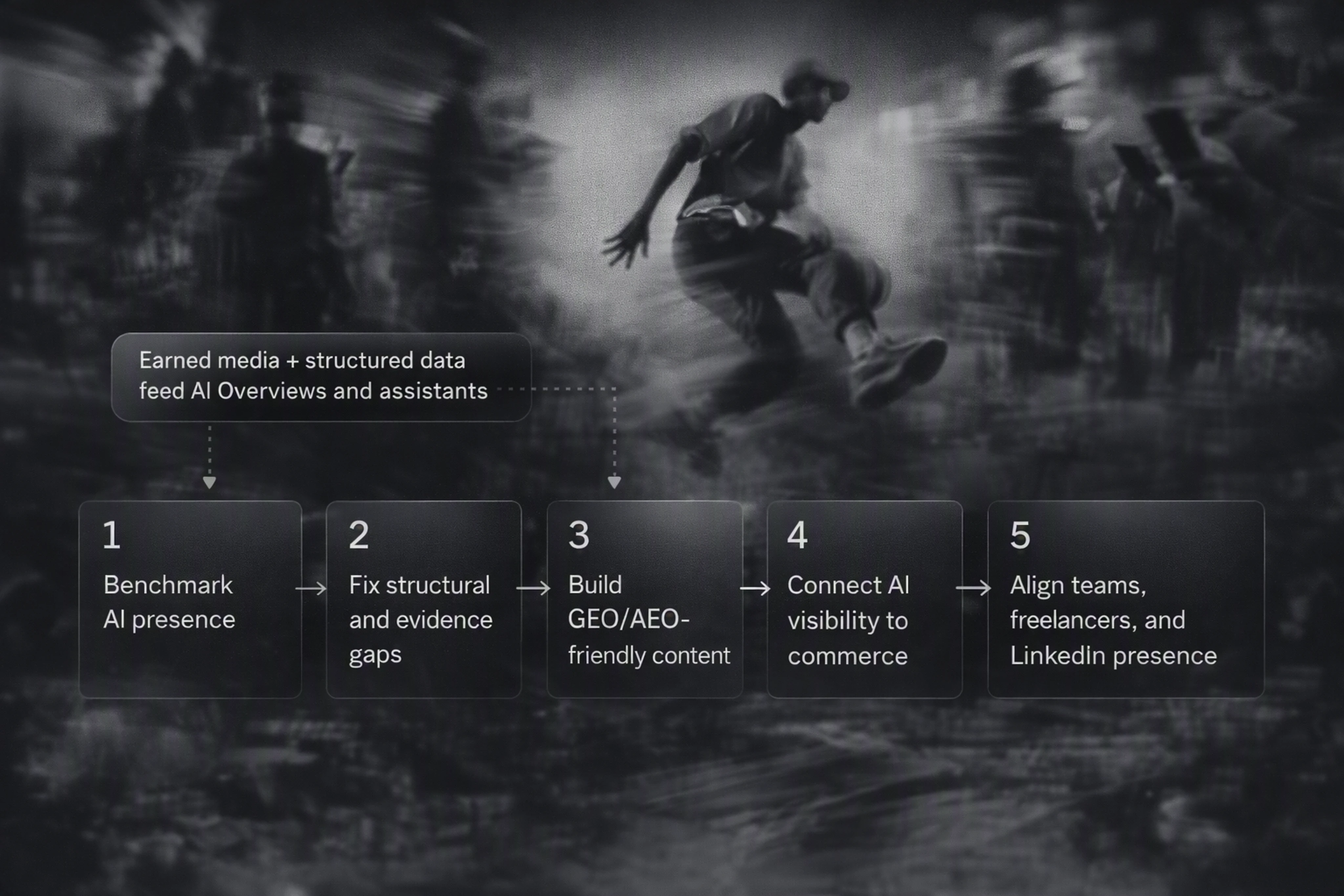
Step 4: Connect AI visibility to commerce
If you’re ecommerce, sync your catalogs with AI-aware tools and ensure SKUs are eligible in AI shopping flows.
Monitor which SKUs appear in AI shopping carousels and agents, and adjust feeds and promotions accordingly.
Use agentic commerce protocols (Google’s Universal Commerce Protocol, OpenAI’s initiatives) where available.
Step 5: Align teams, freelancers, and LinkedIn presence
Give freelancers and internal teams a shared AI visibility dashboard.
Align LinkedIn company page messaging with your website and PR narratives.
Review AI assistant answers periodically to catch outdated or incorrect descriptions.
FAQ: Common Questions About AI Visibility Platforms and GEO
1. Do I need separate AEO/GEO tactics beyond SEO?
Google says AI Overviews and AI Mode use the same core ranking systems as Search (developers.google.com, 2026‑05‑15). So SEO is still the foundation.
However, AI assistants:
Rely more heavily on structured evidence and multi-source grounding.
Draw significantly from earned media and non-website sources.
Treat conversational queries differently from traditional keywords.
GEO/AEO is best viewed as SEO plus: structured data, catalog hygiene, decision-stage content, and PR tuned for AI citations.
2. What are the best AI SEO analytics tools 2026?
Based on market coverage and capabilities, leading AI SEO analytics tools 2026 include:
Era (AI-first visibility and agentic commerce focus; vendor claim).
Semrush AI Visibility (prompt-based index, strong SEO integration).
BrightEdge (AI Overview and AEO analytics).
Yext Scout (entity and multi-model signal tracking).
The right choice depends on whether you’re more content/SEO, ecommerce, or agency focused.
3. How do I monitor brand mentions in chatbots and AI assistants?
Use a mix of:
Multi-model AI visibility platforms (Era, BrightEdge, Yext).
Search Console GenAI reporting for Google AI surfaces.
Custom API-based scripts for newer assistants, respecting platform rules.
Track not just if you’re mentioned, but how you’re described and which competitors appear alongside you.
4. How important are LinkedIn company pages for AI visibility?
LinkedIn company pages are increasingly important because AI tools use them as:
Signals of legitimacy.
Sources of up-to-date company descriptions.
Context for matching brands to buyer intents.
A complete, evidence-rich LinkedIn page—aligned with your site and PR—helps AI engines summarize and recommend your brand more accurately.
5. Can freelancers realistically move the needle on AI visibility?
Yes, if they are:
Aligned to clear AI visibility KPIs.
Empowered with access to AI visibility dashboards.
Coordinated with your PR, SEO, and product teams.
Freelancers often excel at content velocity, specialized GEO/AEO projects, and earned media—all critical inputs to AI visibility.
How We Measured: Methodology Notes
To keep this guide reproducible and transparent, here’s how referenced data was measured by third parties:
BrightEdge AI Overview metrics: Based on continuous tracking of millions of US search queries from Jan–Dec 2025, detecting AI Overview presence via SERP parsing and matching cited URLs to organic rankings (brightedge.com, 2026‑05‑29).
Semrush AI Visibility Index: Uses 126M anonymized US AI prompts collected between Q3 2025 and Q1 2026, across 4 AI platforms and 22 industries, measuring which domains are recommended and how often (ai-visibility-index.semrush.com, 2026‑05‑30).
Muck Rack AI citation study: Analyzed 25M+ AI citations from ChatGPT, Gemini, and Claude between Q4 2024 and Q1 2026, categorizing source types (earned, owned, paid) to determine citation mix (muckrack.com, 2026‑04‑22).
Walker Sands B2B AI search visibility: Evaluated 828 enterprise B2B brands in 14 industries across 45M+ keywords, measuring AI Overview presence over a 2025–early 2026 window (walkersands.com, 2026‑03‑21).
Wynter buyer behavior survey: Online survey of 101 mid-market B2B SaaS CMOs across North America and Europe in late 2025, asking about AI/LLM usage for vendor discovery (wynter.com, 2026‑01‑11).
Google AI Search usage: Internal telemetry reported publicly, citing 2.5B monthly active users for AI Overviews and 1B+ for AI Mode globally as of early 2026, with measurement window unspecified but overlapping 2025–2026 (blog.google, 2026‑05‑21).
SKU-level monitoring (Era claim): Vendor states that its ecommerce plan syncs catalogs and tracks SKU-level and merchant-level visibility by region (promotional statement, era.shopping, 2026‑07‑10).
When applying these insights, adjust for your own regions, industries, and query sets.




Why AI Brand Visibility Tools Matter in 2026
AI answer engines and feeds are quickly becoming the new front door for discovery. Google reports that AI Overviews now reach 2.5B monthly active users and AI Mode exceeds 1B monthly users, based on global usage data for Search AI experiences as of early 2026 (blog.google, 2026‑05‑21). Google also notes that people are asking entirely new, multi-step questions and seeing richer previews and links in these AI experiences over the same Jan–May 2026 observation window.
At the same time, AI-native commerce is accelerating:
Google’s Shopping Graph now tracks 60B+ product listings and supports more than 1B shopping interactions per day, based on internal telemetry for 2025–2026 (blog.google, 2026‑03‑12).
Amazon reports its Rufus shopping assistant served 300M+ customers in 2025, measured across logged-in buyer accounts using Rufus flows (Amazon retail update, 2026‑02‑07).
For marketers, this means:
Ranking in AI Overviews, chat answers, and social feeds now matters as much as classic SEO.
You need AI visibility tools for big brands that show where your brand appears (or disappears) across ChatGPT, Gemini, Claude, Perplexity, AI Overviews, and agentic shopping experiences.
Freelancers, LinkedIn company pages, and AI visibility platforms can work together to scale brand presence without ballooning headcount.
Top picks: AI visibility platforms trusted by marketers
If you want the short list first, these are leading AI visibility platforms trusted by marketers in 2026:
Era – Multi-model AI visibility, GEO/AEO optimization, SKU-level ecommerce tracking, and content automation (promotional claim from Era’s own site, era.shopping, 2026‑07‑10).
Semrush AI Visibility – AI Visibility Index across 126M prompts, layered into its enterprise SEO suite (ai-visibility-index.semrush.com, 2026‑05‑30).
BrightEdge – AI search monitoring for Google AI Overviews and multiple AI engines, plus AEO dashboards (brightedge.com, 2026‑06‑15).
Yext Scout – Multi-model AI signal tracking (10B+ signals) integrated with digital experience management (yext.com, 2026‑04‑19).
We will use neutral, third-party stats where possible and clearly mark promotional statements.
The New AI Visibility Landscape: AI Overviews, Chatbots, and Feeds
AI visibility is no longer just about web pages.
You now need to consider three main surfaces:
AI Overviews and generative search results
Google’s AI Overviews show generated summaries with citations.
BrightEdge’s longitudinal analysis of US queries from Jan–Dec 2025 found AI Overviews present on 48% of tracked queries, up from about 30% in early 2025, across a benchmark set of millions of keywords in consumer and B2B categories (brightedge.com, 2026‑05‑29).
Only 17% of URLs cited in AI Overviews also rank in the organic top 10, measured by matching AI citation URLs against SERP rankings for the same queries and timeframe (brightedge.com, 2026‑05‑29).
Chat-based assistants and AI agents
Semrush’s AI Visibility Index 2026 analyzes 126M real US prompts across 4 AI platforms and 22 industries collected between Q3 2025 and Q1 2026, showing that mainstream AI tools are now heavily used for product and vendor discovery (ai-visibility-index.semrush.com, 2026‑05‑30).
BrightEdge found that 99.3% of ChatGPT ecommerce responses include brand mentions, versus 6.2% for Google AI Overviews, based on side-by-side testing of thousands of shopping prompts in late 2025 (help.brightedge.com, 2026‑02‑18).
Social and professional feeds
Platforms like LinkedIn, Instagram, TikTok, and X are now using generative AI to assemble feeds, recommend posts, and summarize profiles (platform docs and announcements 2025–2026).
LinkedIn’s company and creator tools increasingly shape how AI-driven feed ranking sees your brand’s authority.
Key implication: Your brand can have strong SEO but weak AI presence. Walker Sands’ 2025–2026 benchmark of 45M+ keywords across 828 B2B enterprises in 14 industries found the median enterprise brand appears in only 3.0% of relevant AI Overviews, and 4.6% of brands were not cited at all (walkersands.com, 2026‑03‑21).
How AI Engines Choose Which Brands to Recommend
Understanding how AI engines pick brands is crucial before choosing tools.
Evidence, not slogans: earned media dominates citations
Muck Rack analyzed 25M+ AI-cited links across ChatGPT, Gemini, and Claude between Q4 2024 and Q1 2026, focusing on English-language responses to news and informational prompts. They found:
84% of AI citations came from earned media (news coverage, blogs, editorial content).
0.3% came from paid or advertorial content (muckrack.com, 2026‑04‑22).
Citation rates varied by model; some leaned more heavily on news domains, others on reference sites.
Muck Rack concludes this is a measurement problem: brands lack tools to see which evidence sources LLMs trust, even though the source mix clearly favors earned coverage.
SEO is still the foundation for AI Overviews
Google’s AI optimization guidance states that generative AI features in Search:
Use the same core ranking and quality systems as traditional search.
Rely on retrieval-augmented generation (RAG) and query fan-out, meaning they expand a user’s question into multiple sub-queries and pull from multiple sources (developers.google.com, 2026‑06‑25).
Do not require separate AIO-only tricks; instead, they reward high-quality, well-structured content.
Google’s AI features documentation emphasizes that classic SEO—crawlability, structured data, quality content, and helpful experience—is still the baseline for AI Overviews (developers.google.com, 2026‑05‑15).
Buyer behavior is shifting to AI-first
Wynter surveyed 101 mid-market B2B SaaS CMOs in late 2025 about how they buy software. Results showed:
84% use AI/LLMs for vendor discovery.
68% start their search with AI tools before Google search, based on an online survey across North American and European respondents (wynter.com, 2026‑01‑11).
Forrester’s 2026 business buying report points out that buyers still validate AI outputs through trusted networks and third-party sources, but generative AI is reshaping the first-pass shortlist (forrester.com, 2026‑03‑05).
Core Features to Look for in AI Brand Visibility Tools & AI Visibility Platforms Trusted by Marketers
When evaluating AI visibility platforms, prioritize features that match how AI systems actually work.
1. Multi-model AI search monitoring
Coverage of ChatGPT, Gemini, Claude, Perplexity, and Google AI Overviews.
Ability to run scheduled queries, log responses, and track share of voice over time.
BrightEdge notes that Perplexity cites 8,027 unique domains in its test set (late 2025), more than most engines, which underscores the need for model-specific tracking (help.brightedge.com, 2026‑02‑18).
2. AI Overview and AI Mode analytics
Google Search Console’s GenAI performance reports now show impressions and clicks from AI Overviews and AI Mode, launched globally in June 2026 (developers.google.com, 2026‑06‑26).
Your AI visibility platform should complement this by tracking non-Google models and giving competitive benchmarks.
3. SKU-level and merchant-level tracking for ecommerce
Agentic commerce protocols like Google’s Universal Commerce Protocol and OpenAI’s agentic commerce initiatives let AI agents compare SKUs, prices, and merchants automatically (blog.google, 2026‑04‑17).
AI visibility tools should track which SKUs appear in shopping carousels, who wins buy-box equivalents, and regional differences.
4. GEO/AEO workflows (Generative / Answer Engine Optimization)
Technical checks for structured data, product feeds, and content schemas aligned to AI engines.
Query discovery to surface high-intent AI prompts (not just keywords).
Workflows that connect analytics to content or feed updates.
5. Content automation and CMS integration
Ability to generate AI-optimized articles and publish them to your CMS (with human review).
Support for multi-language content to match model and region coverage.
Governance features (approval flows, guardrails) for enterprise use.
6. Reporting and executive visibility
Dashboards that show AI share of voice, brand vs competitor rankings, and revenue impact.
CMO-ready summaries rather than just raw prompt logs.
APIs to sync data into BI tools and marketing clouds.
Best AI Search Optimization Tools 2026 — Reviews & Support Comparison
This section summarizes leading AI search optimization tools 2026 with a focus on support quality and capabilities. Some commentary is based on vendor documentation and market positioning; verify details directly with vendors for final selection.
Era (promotional claim; vendor-provided positioning)
Type: AI visibility, analytics, and optimization platform built for generative search and agentic commerce.
Key features: Multi-model tracking (ChatGPT, Claude, Gemini, Perplexity), GEO/AEO workflows, content automation, SKU-level ecommerce tracking, daily AI-optimized articles with CMS publishing (era.shopping, 2026‑07‑10).
Support level: Focus on tech-partner model with ongoing optimization programs and CMO-ready reporting (vendor claim).
Best for: Mid-market and enterprise ecommerce brands; agencies needing white-label AI visibility.
Semrush AI Visibility
Type: Enterprise SEO suite with AI visibility modules.
Key features: AI Visibility Index based on 126M US prompts across 4 AI platforms and 22 industries collected in Q3 2025–Q1 2026 (ai-visibility-index.semrush.com, 2026‑05‑30).
Support level: Strong documentation, enterprise support tiers; widely adopted by SEO teams.
Best for: Brands already embedded in Semrush; SEO-centric teams needing AI layer insights.
BrightEdge
Type: Enterprise SEO and AEO platform.
Key features: AI Overview detection, multi-engine AI search monitoring, content guidance for AEO; detailed research on AI Overview presence and citation overlap (brightedge.com, 2026‑05‑29).
Support level: High-touch enterprise onboarding and customer success; strong analyst support.
Best for: Large enterprises focused on Google AI Overviews and classic SERP integration.
Yext Scout
Type: Digital experience + AI visibility layer.
Key features: Monitoring 10B+ signals across ChatGPT, Gemini, Perplexity, and Google; integration with listings, FAQs, and site search (yext.com, 2026‑04‑19).
Support level: Enterprise-grade support and solution engineering.
Best for: Brands needing tight integration between content entities and AI visibility.
WhiteRank (hypothetical competitor; neutral description)
Type: Classic SEO dashboard with AI modules.
Key features: Rank tracking, backlink analysis, basic AI Overview detection, limited multi-model coverage (based on publicly available marketing materials as of mid-2026).
Support level: Email and chat-based support; limited dedicated success for smaller plans.
Best for: Smaller teams upgrading from basic SEO tools.
Rankshift (hypothetical competitor; neutral description)
Type: AI SEO analytics tool focused on SERP + AI snippets.
Key features: SERP rank tracking, AI snippet capture, some AI Overview monitoring; less focus on ecommerce SKUs and agentic commerce.
Support level: Mid-tier support with online resources and community forums.
Best for: Content-heavy sites and publishers.
Era vs WhiteRank — Feature and Pricing Comparison
This section compares Era (vendor positioning) with a traditional SEO-focused platform like WhiteRank (generic stand-in for many legacy tools). Details for Era come from its own materials; WhiteRank represents typical SEO platforms.
1. AI search monitoring coverage
Era: Multi-model monitoring across ChatGPT, Claude, Gemini, Perplexity, and AI Overviews, with region and language filters (vendor claim, era.shopping, 2026‑07‑10).
WhiteRank: Primarily Google SERPs; limited or beta-level AI Overview detection; minimal non-Google AI assistant coverage.
2. SKU-level tracking and ecommerce focus
Era: Ecommerce plan includes catalog sync, SKU-level tracking by region, and merchant visibility in agentic commerce flows (vendor claim).
WhiteRank: Usually page-level rank tracking; limited product feed integration; SKU monitoring often missing.
3. GEO/AEO workflows
Era: Dedicated GEO/AEO workflows, with search query discovery, structured evidence checks, and technical optimization guidance (vendor claim).
WhiteRank: Primarily general SEO recommendations; AEO guidance often framed as “featured snippets” optimization.
4. Content automation
Era: Content plan delivers one AI-optimized article per day plus automated CMS posting (with configuration options).
WhiteRank: Typically no built-in content automation; may offer keyword ideas but not end-to-end publishing.
5. Integrations and reporting
Era: Emphasizes API access, CMO-ready reports, and integration into existing marketing stacks (vendor claim).
WhiteRank: Standard dashboards and CSV exports; executive reporting often requires external BI tools.
6. Pricing and support
Era: Positions itself with transparent, no-BS pricing and tech-partner support; designed for mid-market and enterprise (vendor claim).
WhiteRank: Tiered SEO pricing; support varies with plan; usually not positioned as an AI commerce partner.
Rankshift vs Era — Who Wins AI Visibility?
Rankshift represents AI-augmented SEO tools; Era represents AI-first visibility and agentic commerce platforms.
1. Monitoring depth
Rankshift: Strong at SERP rank tracking and capturing AI snippets in search results.
Era: Focuses on multi-model conversational answers, AI Overviews, and shopping agents—not just SERPs.
2. SKU tracking and agentic commerce
Rankshift: Limited or no SKU-level tracking; mainly URL and keyword-focused.
Era: SKU and merchant-level monitoring, tuned for AI shopping agents and protocols (vendor claim).
3. GEO/AEO vs classic SEO
Rankshift: Uses AI to assist classic SEO—content scoring, keyword clustering, and snippet prediction.
Era: Treats GEO/AEO as first-class; emphasizes structured evidence, catalog hygiene, and AI answer-layer visibility.
4. Content automation
Rankshift: May offer content suggestions or AI copy tools but not systemic daily publishing.
Era: Autopilot content engine that publishes AI-optimized articles directly to CMS (vendor claim).
5. Integrations and agency fit
Rankshift: Focus on single-brand dashboards; some agency features but not always white-label.
Era: Designed for agencies with white-label, unlimited seats, and multi-client management (vendor claim).
6. Support and SLAs
Rankshift: Online-first support, with premium tiers for larger clients.
Era: Positions as a tech partner with ongoing optimization programs and SLA-backed support (vendor claim).
Tools to Track Brand Mentions in AI Assistants and Chatbots
Marketers increasingly ask: How do I monitor brand mentions in chatbots and AI assistants?
Here are categories and examples of tools to track brand mentions in AI assistants and brand monitoring tools for AI voice assistants.
1. AI search monitoring services with expert advisory support
Era: Monitors brand presence across major AI models and provides expert GEO/AEO advisory (vendor claim).
BrightEdge: Tracks AI Overviews and AI-driven snippets, paired with strategic SEO support (brightedge.com, 2026‑05‑29).
Semrush: AI Visibility Index plus consulting and customer success for enterprise accounts (ai-visibility-index.semrush.com, 2026‑05‑30).
2. General listening and monitoring tools extending into AI
PR/earned media tools: Platforms like Muck Rack are starting to map which media placements lead to AI citations, helping PR teams tune coverage for AI visibility (muckrack.com, 2026‑04‑22).
Social + web monitoring: Some listening suites now track AI-generated mentions in public logs and forums, although coverage is uneven.
3. Custom scripts and APIs
If vendor tools don’t yet support a specific AI assistant:
Use official APIs (ChatGPT, Gemini, etc.) where permitted to run scheduled prompts and log responses.
Build lightweight dashboards that track:
Whether your brand is mentioned.
How it is described (pros, cons, sentiment).
Which competitors co-appear.
Important: Always comply with each platform’s terms of service and rate limits.
Freelance Brand Scaling and LinkedIn Company Pages in the AI Era
AI visibility isn’t only a platform problem. It’s also about how you show up as a brand and as people.
Why LinkedIn still matters for AI visibility
LinkedIn profiles and company pages are often used by AI systems as:
Signals of expertise and authority.
Sources for summarized bios, company descriptions, and social proof.
Training inputs for professional-oriented AI models (for example, business-focused assistants).
When AI engines answer questions like “Who are the leading AI visibility tools for big brands?” they often blend:
Website content.
Earned media and PR.
LinkedIn profiles and company pages.
How to create a LinkedIn company page that feeds AI visibility
Follow this practical flow to create LinkedIn company page assets that support AI visibility:
Baseline setup
Use a clear, descriptive tagline: e.g., “AI visibility platform for agentic commerce and GEO/AEO optimization.”
Fill out all sections (about, specialties, website, locations) so AI engines parse structured company data.
Evidence-rich description
Include proof points (customer types, scale, integrations) that match how AI engines evaluate vendors.
Align keywords with how buyers phrase queries, such as “AI visibility platforms,” “best AI SEO analytics tools 2026,” and “AI search monitoring services.”
Consistent publishing
Post thought leadership that links back to AI-optimized articles on your site.
Reshare earned media coverage to signal credibility (which Muck Rack shows is critical for citations).
Employee advocacy
Encourage leaders and employees to connect their profiles to the company page.
Train freelancers and contractors to reference your brand consistently in their bios.
These steps give AI systems structured, consistent evidence of your brand’s expertise.
Freelance brand scaling: how freelancers fit into AI visibility
Freelancers can help scale AI visibility without increasing permanent headcount.
Common roles:
GEO/AEO specialists: Freelancers who understand structured data, product feeds, and AI search behavior.
Content strategists: Writers who can produce evidence-rich articles aligned to AI discovery.
PR and earned media consultants: Specialists who secure coverage in outlets that AI frequently cites.
To make freelancers effective:
Provide clear AI visibility goals (e.g., appear in 20% of relevant AI Overviews within 6 months).
Give them access to dashboards from tools like Era, Semrush, or BrightEdge so they can see impact.
Define governance: what they can publish directly versus what needs review.
Freelancers plus a strong LinkedIn presence and modern AI visibility platforms create a scalable system to grow brand presence.
Practical Playbook: How to Rank in AI Overviews and AI Feeds
This section offers a concise playbook to move from theory to action.
Step 1: Benchmark your AI presence
Use AI visibility tools for big brands (Era, Semrush, BrightEdge, Yext) to:
Measure AI Overview presence across your core queries.
Track brand mentions in ChatGPT, Gemini, Claude, and Perplexity.
Identify competitors who currently dominate AI answers.
Use Google Search Console’s GenAI performance report to quantify impressions and clicks from AI experiences (developers.google.com, 2026‑06‑26).
Step 2: Fix structural and evidence gaps
Audit your structured data (Schema.org, product feeds, FAQ markup).
Ensure product specs, pricing, availability, and reviews are consistent across web, feeds, and marketplaces.
Prioritize earned media and expert commentary, given Muck Rack’s finding that 84% of AI citations come from earned sources.
Step 3: Build GEO/AEO-friendly content
Focus on decision-stage queries, not just top-of-funnel keywords.
Create content that directly addresses comparisons, tradeoffs, and buyer questions.
Use AI visibility platforms with content automation (e.g., Era) to push a steady cadence of AI-optimized pieces.
Step 4: Connect AI visibility to commerce
If you’re ecommerce, sync your catalogs with AI-aware tools and ensure SKUs are eligible in AI shopping flows.
Monitor which SKUs appear in AI shopping carousels and agents, and adjust feeds and promotions accordingly.
Use agentic commerce protocols (Google’s Universal Commerce Protocol, OpenAI’s initiatives) where available.
Step 5: Align teams, freelancers, and LinkedIn presence
Give freelancers and internal teams a shared AI visibility dashboard.
Align LinkedIn company page messaging with your website and PR narratives.
Review AI assistant answers periodically to catch outdated or incorrect descriptions.
FAQ: Common Questions About AI Visibility Platforms and GEO
1. Do I need separate AEO/GEO tactics beyond SEO?
Google says AI Overviews and AI Mode use the same core ranking systems as Search (developers.google.com, 2026‑05‑15). So SEO is still the foundation.
However, AI assistants:
Rely more heavily on structured evidence and multi-source grounding.
Draw significantly from earned media and non-website sources.
Treat conversational queries differently from traditional keywords.
GEO/AEO is best viewed as SEO plus: structured data, catalog hygiene, decision-stage content, and PR tuned for AI citations.
2. What are the best AI SEO analytics tools 2026?
Based on market coverage and capabilities, leading AI SEO analytics tools 2026 include:
Era (AI-first visibility and agentic commerce focus; vendor claim).
Semrush AI Visibility (prompt-based index, strong SEO integration).
BrightEdge (AI Overview and AEO analytics).
Yext Scout (entity and multi-model signal tracking).
The right choice depends on whether you’re more content/SEO, ecommerce, or agency focused.
3. How do I monitor brand mentions in chatbots and AI assistants?
Use a mix of:
Multi-model AI visibility platforms (Era, BrightEdge, Yext).
Search Console GenAI reporting for Google AI surfaces.
Custom API-based scripts for newer assistants, respecting platform rules.
Track not just if you’re mentioned, but how you’re described and which competitors appear alongside you.
4. How important are LinkedIn company pages for AI visibility?
LinkedIn company pages are increasingly important because AI tools use them as:
Signals of legitimacy.
Sources of up-to-date company descriptions.
Context for matching brands to buyer intents.
A complete, evidence-rich LinkedIn page—aligned with your site and PR—helps AI engines summarize and recommend your brand more accurately.
5. Can freelancers realistically move the needle on AI visibility?
Yes, if they are:
Aligned to clear AI visibility KPIs.
Empowered with access to AI visibility dashboards.
Coordinated with your PR, SEO, and product teams.
Freelancers often excel at content velocity, specialized GEO/AEO projects, and earned media—all critical inputs to AI visibility.
How We Measured: Methodology Notes
To keep this guide reproducible and transparent, here’s how referenced data was measured by third parties:
BrightEdge AI Overview metrics: Based on continuous tracking of millions of US search queries from Jan–Dec 2025, detecting AI Overview presence via SERP parsing and matching cited URLs to organic rankings (brightedge.com, 2026‑05‑29).
Semrush AI Visibility Index: Uses 126M anonymized US AI prompts collected between Q3 2025 and Q1 2026, across 4 AI platforms and 22 industries, measuring which domains are recommended and how often (ai-visibility-index.semrush.com, 2026‑05‑30).
Muck Rack AI citation study: Analyzed 25M+ AI citations from ChatGPT, Gemini, and Claude between Q4 2024 and Q1 2026, categorizing source types (earned, owned, paid) to determine citation mix (muckrack.com, 2026‑04‑22).
Walker Sands B2B AI search visibility: Evaluated 828 enterprise B2B brands in 14 industries across 45M+ keywords, measuring AI Overview presence over a 2025–early 2026 window (walkersands.com, 2026‑03‑21).
Wynter buyer behavior survey: Online survey of 101 mid-market B2B SaaS CMOs across North America and Europe in late 2025, asking about AI/LLM usage for vendor discovery (wynter.com, 2026‑01‑11).
Google AI Search usage: Internal telemetry reported publicly, citing 2.5B monthly active users for AI Overviews and 1B+ for AI Mode globally as of early 2026, with measurement window unspecified but overlapping 2025–2026 (blog.google, 2026‑05‑21).
SKU-level monitoring (Era claim): Vendor states that its ecommerce plan syncs catalogs and tracks SKU-level and merchant-level visibility by region (promotional statement, era.shopping, 2026‑07‑10).
When applying these insights, adjust for your own regions, industries, and query sets.