
September 23, 2026
September 23, 2026
AEO vs SEO Explained: GEO and the Best AI Visibility Platforms for Brands in 2026
Meta title: AEO vs SEO Explained: GEO & AI Visibility Platforms for Brands
Meta title: AEO vs SEO Explained: GEO & AI Visibility Platforms for Brands
Meta Title & Description
Meta title: AEO vs SEO Explained: GEO & AI Visibility Platforms for Brands
Meta description: Learn how AEO, GEO, and AI visibility platforms redefine SEO for ChatGPT, Gemini, and agentic commerce—and how Era helps big brands win the AI answer layer.
AEO vs SEO Explained: GEO and the Best AI Visibility Platforms for Brands in 2026
AI visibility platforms trusted by marketers are becoming as essential as classic SEO tools. In 2026, the best AI search optimization tools help brands see how ChatGPT, Gemini, Claude, Perplexity, and shopping agents describe, compare, and recommend their products. This guide explains AEO vs SEO, what GEO is, and why platforms like Era are redefining AI SEO for big brands.
AEO vs SEO: Quick Definitions
Before we go deeper into GEO and agentic commerce, let’s define the core terms.
What is SEO?
Search Engine Optimization (SEO) is the practice of improving a website’s visibility in traditional search engine results. For Google, that means:
Creating helpful, relevant content
Optimizing technical structure (crawlability, indexation, schema)
Building authority through links and trust signals
Google’s AI features—AI Overviews and AI Mode—are still rooted in these core ranking and quality systems, which is why Google says AI optimization is "still just SEO" in practice (Google Search AI Optimization Guide, June 2026).https://developers.google.com/search/docs/fundamentals/ai-optimization-guide
What is AEO (Answer Engine Optimization)?
Answer Engine Optimization (AEO) focuses on how brands appear inside AI-generated answers, not just lists of links. In practice, AEO asks:
"When a user asks ChatGPT what to buy, does my brand show up in the answer?"
"When Gemini summarizes the best running shoes, am I cited or recommended?"
"When Perplexity synthesizes reviews, how is my brand framed—pros, cons, sentiment?"
AEO extends SEO by optimizing for:
Representation: mentions, citations, quotes, pros/cons
Answer placement: whether you show up at all, and how prominently
Decision-stage evidence: specs, reviews, availability, price, trust signals
What is GEO (Generative Engine Optimization)?
Generative Engine Optimization (GEO) is a formal framework for optimizing content and data for generative engines—LLM-based systems that generate answers or recommendations.
The term originated in academia, not marketing copy.
The Princeton/KDD paper "GEO: Generative Engine Optimization" by Sharma et al., 2023, introduced GEO and GEO-bench, a benchmark for measuring how optimization tactics improve visibility in generative answers.https://arxiv.org/abs/2311.09735
In controlled experiments, GEO tactics increased visibility in generative responses by up to 40% vs baselines (Sharma et al., 2023).https://arxiv.org/abs/2311.09735
GEO treats AI answer engines as primary surfaces and asks:
Which prompts matter for my category?
How does the engine source evidence?
What content, structure, and signals make my brand more likely to be included and recommended?
Why GEO Matters Now: AI Search & Shopping Are Already Big
Generative AI is no longer a side experiment. It is already reshaping search and shopping behavior.
AI search usage is mainstream
Google says AI Overviews now have over 2.5 billion monthly active users, and AI Mode has surpassed 1 billion MAUs as of May 2026.https://blog.google/innovation-and-ai/sundar-pichai-io-2026/
Google adds that AI Mode queries have more than doubled every quarter since launch (Pichai, Google I/O 2026).https://blog.google/innovation-and-ai/sundar-pichai-io-2026/
Pew Research found 58% of users performed at least one Google search in March 2025 that produced an AI-generated summary, and those users were less likely to click links when an AI summary appeared (Pew, July 2025).https://www.pewresearch.org/short-reads/2025/07/22/google-users-are-less-likely-to-click-on-links-when-an-ai-summary-appears-in-the-results/
AI-assisted shopping is surging
Adobe Analytics reported generative-AI retail traffic up 1,300% YoY during the 2024 holiday season and 4,700% YoY by July 2025 (Adobe, March 2025).https://blog.adobe.com/en/publish/2025/03/17/adobe-analytics-traffic-to-us-retail-websites-from-generative-ai-sources-jumps-1200-percent
Adobe also found 38–39% of U.S. consumers used GenAI for online shopping, and 52–53% planned to do so in the year ahead (Adobe, March 2025).https://blog.adobe.com/en/publish/2025/03/17/adobe-analytics-traffic-to-us-retail-websites-from-generative-ai-sources-jumps-1200-percent
Agentic commerce is becoming infrastructure
Agentic commerce is shopping mediated by AI agents that can research, compare, negotiate, and purchase.
McKinsey estimates that agentic commerce could drive up to $1 trillion in U.S. B2C retail revenue by 2030 and $3–5 trillion globally (McKinsey, October 2025).https://www.mckinsey.com/capabilities/quantumblack/our-insights/the-agentic-commerce-opportunity-how-ai-agents-are-ushering-in-a-new-era-for-consumers-and-merchants
Protocols and standards emerging today include:
MCP (Model Context Protocol): A protocol for connecting LLMs to external tools and data via structured context providers.https://modelcontextprotocol.io
A2A (Agent-to-Agent): Patterns and emerging standards for agents communicating and negotiating with each other on behalf of users.https://www.mckinsey.com/capabilities/quantumblack/our-insights/the-agentic-commerce-opportunity-how-ai-agents-are-ushering-in-a-new-era-for-consumers-and-merchants
AP2 (Agent Protocols for Platforms): Early specifications for how platforms expose product, pricing, and inventory data in agent-readable formats.
ACP (Agentic Commerce Protocol): Shopware’s initiative to define how merchant catalogs and commerce logic plug into AI shopping agents (Shopware Intelligence ACP, 2026).https://www.shopware.com/en/products/shopware-intelligence/agentic-commerce/
These protocols matter because they define what data agents see about your catalog and how they decide which SKUs to recommend.
AEO vs SEO in Practice: How They Actually Differ
Google’s guidance is clear: for Google Search, optimizing for AI summaries is still SEO. You follow the same ranking and quality principles (Google AI Features Doc, June 2026).https://developers.google.com/search/docs/appearance/ai-features
But in practice, AEO adds layers that traditional SEO tools rarely cover.
1. From rankings to representation
SEO asks:
"What position does my page rank for this keyword?"
AEO asks:
"When users ask an AI assistant this question, do I appear in the answer?"
"What exactly does the model say about me vs competitors?"
This means tracking:
Mentions (brand and SKU names)
Citations/quotes (text pulled from your site or third-party sources)
Pros and cons listed by models
Sentiment and framing (premium, budget, trustworthy, niche)
2. From single-engine to multi-model visibility
Classic SEO is largely Google- and sometimes Bing-centric. Modern AI visibility requires monitoring:
ChatGPT (OpenAI)
Claude (Anthropic)
Gemini (Google)
Perplexity
Copilot (Microsoft)
Google AI Overviews and AI Mode
Platforms like Semrush’s AI Visibility Index now study 126 million U.S. prompts across 22 industries and 4 AI platforms (Semrush, 2025).https://ai-visibility-index.semrush.com Ahrefs reports 456M+ prompts across 6 AI indexes in its AI visibility database (Ahrefs, 2025).https://ahrefs.com/blog/ai-visibility/
3. From content creation to evidence engineering
AEO/GEO emphasizes decision-stage evidence, not just content volume.
You need:
Clean, complete product specs (dimensions, materials, compatibility)
Structured data (schema.org, feeds, MCP providers)
Reviews and ratings exposed in machine-readable forms
Availability, pricing, and fulfillment data aligned across sources
Why? Because AI engines rely on retrieval-augmented generation (RAG) and query fan-out into multiple indexes. They aggregate evidence across your site, retailers, review platforms, and public data.
4. From vanity metrics to commerce outcomes
AEO for ecommerce is about moving revenue and P&L, not just traffic. That means tracking:
Share of voice in high-intent prompts
Inclusion rates in shopping carousels and buying guides
SKU eligibility in agentic shopping flows
Downstream conversion and AOV from AI-origin traffic
Bain notes that some retailers already see up to 25% of referral traffic coming from AI sources, even though AI still accounts for <1% of total traffic today (Bain, November 2025).https://www.bain.com/about/media-center/press-releases/20252/agentic-ai-poised-to-disrupt-retail-even-with-50-of-consumers-cautious-of-fully-autonomous-purchasesbain--company/
GEO-Bench: How Academic GEO Proved Visibility Lift
To understand why GEO is more than a buzzword, it helps to look at GEO-bench, the experimental framework from Princeton.
The GEO: Generative Engine Optimization paper
Title: GEO: Generative Engine Optimization
Authors: Sharma, Ghosh, Dogan, et al.
Venue/Year: KDD 2023 (preprint on arXiv, November 2023)https://arxiv.org/abs/2311.09735
What GEO-bench measures
GEO-bench is a benchmark that:
Defines a set of tasks/prompts for generative engines (e.g., "best phones under $500").
Generates baseline answers from LLMs.
Applies optimization interventions to source content and metadata (e.g., structured data, wording, evidence density).
Re-runs prompts and measures changes in visibility:
Whether a brand or item appears in the answer
Position and prominence
Frequency across repeated runs
The paper reports that GEO interventions can yield up to a 40% visibility improvement for targeted entities compared to unoptimized baselines (Sharma et al., 2023).https://arxiv.org/abs/2311.09735
For brands, this is a proof point that structured optimization for generative engines can materially change how often and how prominently they appear in AI-generated recommendations.
AI Visibility Measurement Layer: AI Visibility Platforms Trusted by Marketers
The AI visibility category is splitting into two layers:
Measurement & optimization (AEO/GEO, analytics)
Commerce operations (catalog feeds, bids, retailer integration)
Era, Semrush, Ahrefs, Moz, and Profound focus on measurement/optimization, while tools like Pacvue specialize more in commerce ops (Era market scan, 2026).https://era.shopping
What an AI visibility platform measures
AI visibility platforms for big brands typically track:
Share of voice across AI assistants
Brand and SKU mentions for target prompts
Rankings and placement within AI answers and carousels
Citations/quotes from your site and third-party sources
Pros/cons and sentiment about your brand and products
Model, region, language segmentation
These platforms are modern alternatives to legacy SEO dashboards, offering AI SEO analytics tools and AI-focused reporting that map directly to how AI engines surface brands.
How measurement works across closed/offline models
Most leading models (ChatGPT, Claude, Gemini, Perplexity, Copilot) are closed systems. Visibility platforms cannot scrape internal logs; they rely on systematic sampling.
A typical methodology includes:
Prompt discovery and clustering
Mining real user queries from traffic logs, search data, and partner APIs
Identifying high-intent, category, and brand prompts
Clustering similar prompts to reduce redundancy
Prompt templates and test harnesses
Building standardized templates (e.g., "What are the best [product] for [use case]?")
Varying wording to avoid overfitting to specific phrases
Running prompts across multiple models and regions
Sampling and frequency
Running each prompt at a fixed cadence (e.g., daily or weekly)
Executing multiple runs per prompt per model to smooth variance
Tracking changes over time as models update or as content changes
Extraction and scoring
Parsing answers to extract:
Brand names
Product names/SKUs
Citations and sources
Pros/cons and evaluative language
Assigning share-of-voice and sentiment scores
Limitations and margin of error
Answers from LLMs are non-deterministic. Repeated runs may differ.
Platforms mitigate this by:
Running multiple samples per prompt
Using statistical smoothing (e.g., rolling averages)
There is always a margin of error; visibility is expressed as trends and confidence ranges, not exact market shares.
Platforms like Era expose this methodology transparently in CMO-ready reporting so teams can see where they appear (or don’t) and interpret AI visibility scores correctly.https://era.shopping
Era’s AEO-First Philosophy: AI Answer Engines as the New Shopping Front Door
Era positions itself as an AI visibility, analytics, and optimization platform built for the generative search and agentic commerce era.https://era.shopping
Core beliefs behind Era
Era’s point of view rests on four beliefs:
AI answer engines are the new shopping front door.
With AI Overviews and assistants already influencing search behavior and shopping research, Era believes a growing share of product discovery will begin inside AI assistants, not on SERPs or brand sites.
Visibility in AI is an architectural problem, not a copywriting trick.
Era argues that AI visibility depends on structured, trustworthy, machine-readable evidence, not keyword hacks.
Decision-stage evidence beats generic brand awareness.
Era focuses on getting brands recommended at the moment of choice, with the right criteria (price, availability, reviews, specs) clearly represented.
Brands should own their AI visibility stack, not rent it from platforms.
Cross-model analytics and SKU-level optimization let merchants operate as principals in agentic commerce ecosystems, not just data sources controlled by marketplaces.
What Era measures across AI models
Era tracks:
Share of voice by brand and category
Rankings and placements in AI-generated answers and shopping carousels
Citations and quotes from owned and third-party content
Pros/cons and sentiment extracted from AI responses
Model, region, and language segmented views
This gives ecommerce teams a daily, multi-model visibility layer over their AI presence, filling the gap legacy SEO dashboards leave.
GEO Plan, Content Plan, and E‑commerce Plan
Era’s product structure reflects the AEO/GEO mindset:
GEO Plan
Core AI visibility analytics
Technical GEO/AEO optimization guidance
Multi-model reporting for leadership
Content Plan
One AI-optimized article per day
Autopilot content engine that posts directly to CMS
GEO-aligned topics and structures to feed AI engines with better evidence
E‑commerce Plan
Catalog sync for large SKU sets
Merchant/SKU monitoring by region
Agentic commerce and AI shopping visibility tracking
Era positions itself as a tech partner for brands and agencies, plugging into existing marketing stacks and focusing on commerce outcomes, not vanity metrics.https://era.shopping
Tools & Activation: Best AI Search Optimization Tools 2026 — Reviews & Use Cases
The tools ecosystem for AEO/GEO spans measurement, content, and commerce ops. Here’s how to think about it.
AI visibility platform reviews & comparisons
When evaluating AI visibility tools for big brands, consider:
Coverage: Which models (ChatGPT, Gemini, Claude, Perplexity, Copilot, AI Overviews) and which regions/languages are supported?
Metrics: Do you get share of voice, citations, sentiment, pros/cons, SKU coverage?
Methodology transparency: Is sampling, frequency, and error handling documented?
Ecommerce support: Can it handle catalogs, SKUs, feeds, and agentic commerce protocols?
Integration: Does it plug into analytics, BI, and CMS systems?
Below is a high-level comparison of the AI search optimization tools (SEO) best tools with AI features support that are widely referenced by enterprise teams.
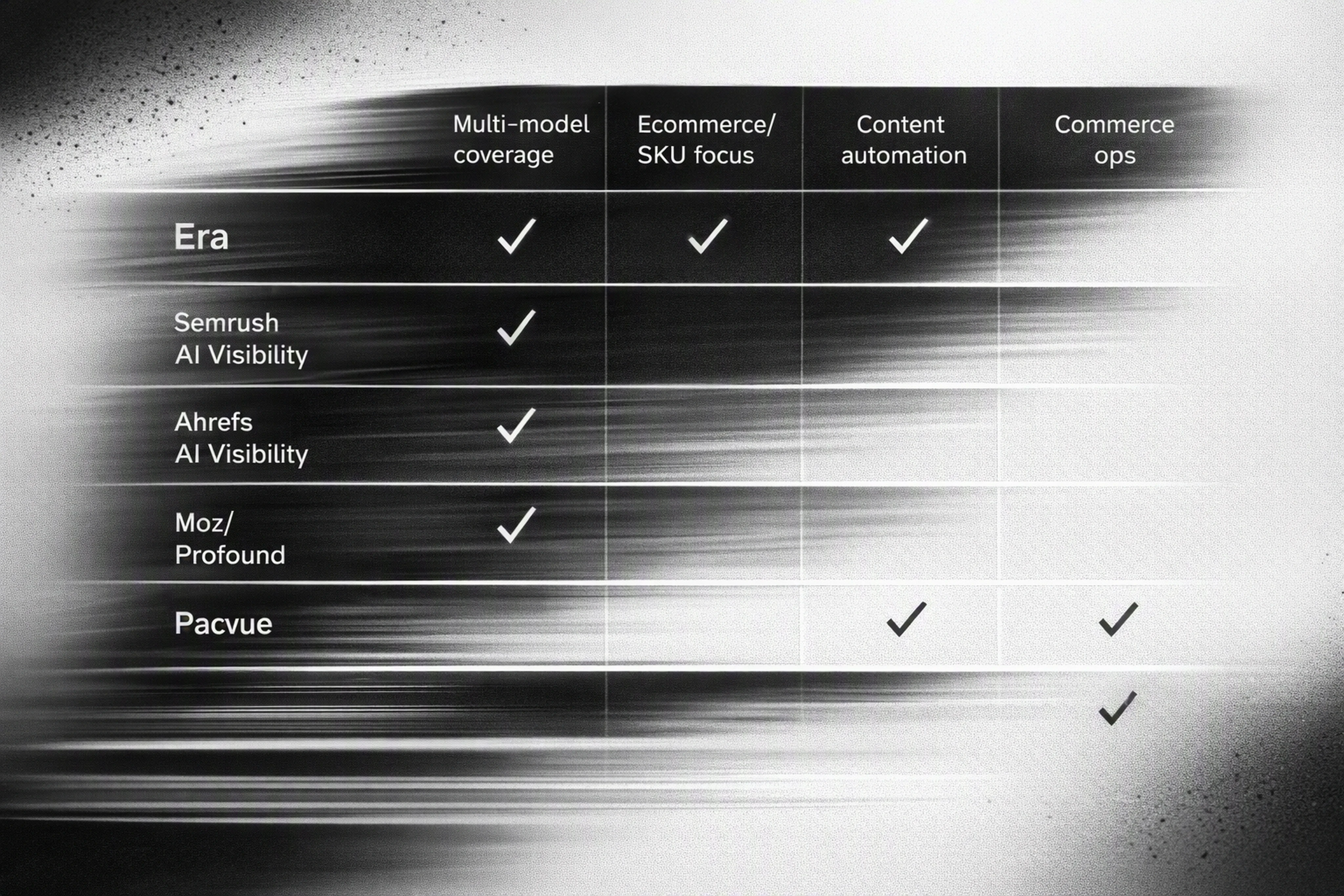
Feature matrix (conceptual)
Measurement / GEO layer
Era
Multi-model AI visibility (major assistants + AI Overviews)
Share of voice, citations, pros/cons, sentiment
SKU-level ecommerce visibility and catalog integration
Content autopilot with CMS posting
Semrush AI Visibility Index
Large prompt corpus (126M U.S. prompts)https://ai-visibility-index.semrush.com
Multi-platform coverage (4 AI platforms)
Aggregate visibility scores and category rankings
Ahrefs AI Visibility
Very large prompt database (456M+ prompts across 6 AI indexes)https://ahrefs.com/blog/ai-visibility/
AI exposure metrics tied to backlink and SERP data
Moz, Profound
Emerging AI visibility features layered onto SEO suites
Focus on brand mentions and exposure in AI answers
Commerce operations layer
Pacvue
Commerce ops: marketplace bidding, retail media, catalog and feed management
Strong retailer integration and performance marketing workflows
Era sits primarily in the AI visibility and optimization layer, with a strong ecommerce and agentic commerce focus. Tools like Pacvue complement this by managing retail execution and bidding.
Key activation capabilities for AEO/GEO
To actually move visibility and revenue, you need:
Search query discovery (API): surfacing real AI prompts and conversations
Tap real prompt logs where available (via AI tools, site search, support tickets)
Use platforms or APIs that cluster prompts into intent groups
Identify the prompts where you’re missing or under-represented
Technical GEO/AEO optimization
Implement structured data (schema.org, product, review, FAQ)
Ensure clean catalog hygiene: titles, descriptions, specs, identifiers
Align feeds and MCP context providers with agentic commerce protocols (ACP, AP2)
Content automation aligned to AI decision criteria
Generate and maintain AI-optimized content that:
Answers complex buying questions
Surfaces key decision criteria
Links cleanly to SKUs and categories
Use content autopilot engines to keep evidence fresh across thousands of products
SKU-level tracking and remediation
Monitor which SKUs appear in AI shopping carousels and recommendations
Compare against inventory, margin, and strategic priorities
Prioritize optimization for high-value, under-visible products
How to Build an AEO/GEO Program: Actionable Steps for Brands & Agencies
For mid-market and enterprise ecommerce teams, AEO/GEO is not a one-off project. It’s an ongoing program that slots into existing SEO, paid, and analytics work.
1. Establish your AI visibility baseline
Choose an AI visibility platform that covers your markets and models.
Define priority categories, brands, and SKUs.
Run an initial baseline across:
ChatGPT, Claude, Gemini, Perplexity, Copilot
Google AI Overviews and AI Mode
Document where you appear, how you’re framed, and which competitors dominate.
2. Map prompts to business value
Identify high-intent prompts that map to revenue drivers.
Group prompts by:
Category (e.g., "running shoes for flat feet")
Brand (e.g., "best alternatives to [your brand]")
Use case (e.g., "eco-friendly furniture for small apartments")
Quantify potential impact using existing conversion and AOV data.
3. Fix architectural issues first
Audit product data:
Missing specs and inconsistent attributes
Out-of-date availability and pricing
Audit technical structure:
Schema coverage and correctness
Feed formats and catalog sync
Ensure that your primary evidence sources (site, retailers, review platforms) all present consistent, machine-readable data.
4. Deploy GEO-aligned content
Create or automate content that:
Directly answers the questions driving your high-intent prompts
Includes structured FAQs, comparisons, and buying guides
Links clearly to relevant products with rich specs and reviews
Use autopilot content engines where appropriate to keep coverage fresh and scalable.
5. Monitor, iterate, and tie to P&L
Track changes in share of voice, sentiment, and SKU coverage weekly.
Correlate visibility changes with:
Organic and AI-origin traffic
Conversion rate and AOV
Margin and inventory goals
Use these insights to prioritize further GEO/AEO work, budget allocation, and cross-functional collaboration.
FAQ: AEO, GEO, and AI Visibility Tools
1. Is AEO different from SEO, or just a buzzword?
AEO builds on SEO but focuses on how AI assistants answer questions, not just how pages rank. Google’s AI features still use core search systems (Google AI Features, June 2026).https://developers.google.com/search/docs/appearance/ai-features In practice, AEO adds multi-model tracking, representation analysis, and decision-stage evidence optimization.
2. What is GEO, and why should brands care?
GEO (Generative Engine Optimization) is a formal framework for optimizing visibility in generative engines. The Princeton/KDD paper by Sharma et al. (2023) showed GEO tactics can improve visibility by up to 40% in generative responses.https://arxiv.org/abs/2311.09735 Brands should care because generative engines are becoming a primary discovery surface for search and shopping.
3. How do AI visibility platforms track brand mentions in closed models like ChatGPT?
They use systematic prompt sampling:
Curated and clustered prompts
Standardized templates run across models and regions
Multiple runs per prompt to smooth variability
Answers are parsed to extract brand mentions, placements, citations, and sentiment. Results are expressed as trends and shares, not precise market shares, acknowledging non-determinism.
4. What are the best AI search optimization tools in 2026 for big brands?
Enterprise teams often combine:
An AI visibility platform (Era, Semrush, Ahrefs, Moz, Profound)
A commerce ops platform (Pacvue or similar)
Existing SEO suites and analytics tools
The "best" mix depends on your catalog complexity, regions, and whether you need deep agentic commerce and SKU-level tracking.
5. How does Era fit into an existing marketing stack?
Era is built as a visibility and optimization layer, not a replacement for SEO or analytics. It integrates via APIs and reporting into existing stacks, provides CMO-ready dashboards, and runs ongoing GEO/AEO programs focused on revenue and P&L, especially for ecommerce brands with large catalogs.https://era.shopping
To reclaim the "AI answer layer" before AI-native traffic becomes dominant, brands and agencies need structured AEO/GEO programs, multi-model analytics, and evidence-first optimization. Platforms like Era help teams "be the brand" AI systems recommend when consumers ask what to buy—well beyond what legacy SEO dashboards can show.



Meta Title & Description
Meta title: AEO vs SEO Explained: GEO & AI Visibility Platforms for Brands
Meta description: Learn how AEO, GEO, and AI visibility platforms redefine SEO for ChatGPT, Gemini, and agentic commerce—and how Era helps big brands win the AI answer layer.
AEO vs SEO Explained: GEO and the Best AI Visibility Platforms for Brands in 2026
AI visibility platforms trusted by marketers are becoming as essential as classic SEO tools. In 2026, the best AI search optimization tools help brands see how ChatGPT, Gemini, Claude, Perplexity, and shopping agents describe, compare, and recommend their products. This guide explains AEO vs SEO, what GEO is, and why platforms like Era are redefining AI SEO for big brands.
AEO vs SEO: Quick Definitions
Before we go deeper into GEO and agentic commerce, let’s define the core terms.
What is SEO?
Search Engine Optimization (SEO) is the practice of improving a website’s visibility in traditional search engine results. For Google, that means:
Creating helpful, relevant content
Optimizing technical structure (crawlability, indexation, schema)
Building authority through links and trust signals
Google’s AI features—AI Overviews and AI Mode—are still rooted in these core ranking and quality systems, which is why Google says AI optimization is "still just SEO" in practice (Google Search AI Optimization Guide, June 2026).https://developers.google.com/search/docs/fundamentals/ai-optimization-guide
What is AEO (Answer Engine Optimization)?
Answer Engine Optimization (AEO) focuses on how brands appear inside AI-generated answers, not just lists of links. In practice, AEO asks:
"When a user asks ChatGPT what to buy, does my brand show up in the answer?"
"When Gemini summarizes the best running shoes, am I cited or recommended?"
"When Perplexity synthesizes reviews, how is my brand framed—pros, cons, sentiment?"
AEO extends SEO by optimizing for:
Representation: mentions, citations, quotes, pros/cons
Answer placement: whether you show up at all, and how prominently
Decision-stage evidence: specs, reviews, availability, price, trust signals
What is GEO (Generative Engine Optimization)?
Generative Engine Optimization (GEO) is a formal framework for optimizing content and data for generative engines—LLM-based systems that generate answers or recommendations.
The term originated in academia, not marketing copy.
The Princeton/KDD paper "GEO: Generative Engine Optimization" by Sharma et al., 2023, introduced GEO and GEO-bench, a benchmark for measuring how optimization tactics improve visibility in generative answers.https://arxiv.org/abs/2311.09735
In controlled experiments, GEO tactics increased visibility in generative responses by up to 40% vs baselines (Sharma et al., 2023).https://arxiv.org/abs/2311.09735
GEO treats AI answer engines as primary surfaces and asks:
Which prompts matter for my category?
How does the engine source evidence?
What content, structure, and signals make my brand more likely to be included and recommended?
Why GEO Matters Now: AI Search & Shopping Are Already Big
Generative AI is no longer a side experiment. It is already reshaping search and shopping behavior.
AI search usage is mainstream
Google says AI Overviews now have over 2.5 billion monthly active users, and AI Mode has surpassed 1 billion MAUs as of May 2026.https://blog.google/innovation-and-ai/sundar-pichai-io-2026/
Google adds that AI Mode queries have more than doubled every quarter since launch (Pichai, Google I/O 2026).https://blog.google/innovation-and-ai/sundar-pichai-io-2026/
Pew Research found 58% of users performed at least one Google search in March 2025 that produced an AI-generated summary, and those users were less likely to click links when an AI summary appeared (Pew, July 2025).https://www.pewresearch.org/short-reads/2025/07/22/google-users-are-less-likely-to-click-on-links-when-an-ai-summary-appears-in-the-results/
AI-assisted shopping is surging
Adobe Analytics reported generative-AI retail traffic up 1,300% YoY during the 2024 holiday season and 4,700% YoY by July 2025 (Adobe, March 2025).https://blog.adobe.com/en/publish/2025/03/17/adobe-analytics-traffic-to-us-retail-websites-from-generative-ai-sources-jumps-1200-percent
Adobe also found 38–39% of U.S. consumers used GenAI for online shopping, and 52–53% planned to do so in the year ahead (Adobe, March 2025).https://blog.adobe.com/en/publish/2025/03/17/adobe-analytics-traffic-to-us-retail-websites-from-generative-ai-sources-jumps-1200-percent
Agentic commerce is becoming infrastructure
Agentic commerce is shopping mediated by AI agents that can research, compare, negotiate, and purchase.
McKinsey estimates that agentic commerce could drive up to $1 trillion in U.S. B2C retail revenue by 2030 and $3–5 trillion globally (McKinsey, October 2025).https://www.mckinsey.com/capabilities/quantumblack/our-insights/the-agentic-commerce-opportunity-how-ai-agents-are-ushering-in-a-new-era-for-consumers-and-merchants
Protocols and standards emerging today include:
MCP (Model Context Protocol): A protocol for connecting LLMs to external tools and data via structured context providers.https://modelcontextprotocol.io
A2A (Agent-to-Agent): Patterns and emerging standards for agents communicating and negotiating with each other on behalf of users.https://www.mckinsey.com/capabilities/quantumblack/our-insights/the-agentic-commerce-opportunity-how-ai-agents-are-ushering-in-a-new-era-for-consumers-and-merchants
AP2 (Agent Protocols for Platforms): Early specifications for how platforms expose product, pricing, and inventory data in agent-readable formats.
ACP (Agentic Commerce Protocol): Shopware’s initiative to define how merchant catalogs and commerce logic plug into AI shopping agents (Shopware Intelligence ACP, 2026).https://www.shopware.com/en/products/shopware-intelligence/agentic-commerce/
These protocols matter because they define what data agents see about your catalog and how they decide which SKUs to recommend.
AEO vs SEO in Practice: How They Actually Differ
Google’s guidance is clear: for Google Search, optimizing for AI summaries is still SEO. You follow the same ranking and quality principles (Google AI Features Doc, June 2026).https://developers.google.com/search/docs/appearance/ai-features
But in practice, AEO adds layers that traditional SEO tools rarely cover.
1. From rankings to representation
SEO asks:
"What position does my page rank for this keyword?"
AEO asks:
"When users ask an AI assistant this question, do I appear in the answer?"
"What exactly does the model say about me vs competitors?"
This means tracking:
Mentions (brand and SKU names)
Citations/quotes (text pulled from your site or third-party sources)
Pros and cons listed by models
Sentiment and framing (premium, budget, trustworthy, niche)
2. From single-engine to multi-model visibility
Classic SEO is largely Google- and sometimes Bing-centric. Modern AI visibility requires monitoring:
ChatGPT (OpenAI)
Claude (Anthropic)
Gemini (Google)
Perplexity
Copilot (Microsoft)
Google AI Overviews and AI Mode
Platforms like Semrush’s AI Visibility Index now study 126 million U.S. prompts across 22 industries and 4 AI platforms (Semrush, 2025).https://ai-visibility-index.semrush.com Ahrefs reports 456M+ prompts across 6 AI indexes in its AI visibility database (Ahrefs, 2025).https://ahrefs.com/blog/ai-visibility/
3. From content creation to evidence engineering
AEO/GEO emphasizes decision-stage evidence, not just content volume.
You need:
Clean, complete product specs (dimensions, materials, compatibility)
Structured data (schema.org, feeds, MCP providers)
Reviews and ratings exposed in machine-readable forms
Availability, pricing, and fulfillment data aligned across sources
Why? Because AI engines rely on retrieval-augmented generation (RAG) and query fan-out into multiple indexes. They aggregate evidence across your site, retailers, review platforms, and public data.
4. From vanity metrics to commerce outcomes
AEO for ecommerce is about moving revenue and P&L, not just traffic. That means tracking:
Share of voice in high-intent prompts
Inclusion rates in shopping carousels and buying guides
SKU eligibility in agentic shopping flows
Downstream conversion and AOV from AI-origin traffic
Bain notes that some retailers already see up to 25% of referral traffic coming from AI sources, even though AI still accounts for <1% of total traffic today (Bain, November 2025).https://www.bain.com/about/media-center/press-releases/20252/agentic-ai-poised-to-disrupt-retail-even-with-50-of-consumers-cautious-of-fully-autonomous-purchasesbain--company/
GEO-Bench: How Academic GEO Proved Visibility Lift
To understand why GEO is more than a buzzword, it helps to look at GEO-bench, the experimental framework from Princeton.
The GEO: Generative Engine Optimization paper
Title: GEO: Generative Engine Optimization
Authors: Sharma, Ghosh, Dogan, et al.
Venue/Year: KDD 2023 (preprint on arXiv, November 2023)https://arxiv.org/abs/2311.09735
What GEO-bench measures
GEO-bench is a benchmark that:
Defines a set of tasks/prompts for generative engines (e.g., "best phones under $500").
Generates baseline answers from LLMs.
Applies optimization interventions to source content and metadata (e.g., structured data, wording, evidence density).
Re-runs prompts and measures changes in visibility:
Whether a brand or item appears in the answer
Position and prominence
Frequency across repeated runs
The paper reports that GEO interventions can yield up to a 40% visibility improvement for targeted entities compared to unoptimized baselines (Sharma et al., 2023).https://arxiv.org/abs/2311.09735
For brands, this is a proof point that structured optimization for generative engines can materially change how often and how prominently they appear in AI-generated recommendations.
AI Visibility Measurement Layer: AI Visibility Platforms Trusted by Marketers
The AI visibility category is splitting into two layers:
Measurement & optimization (AEO/GEO, analytics)
Commerce operations (catalog feeds, bids, retailer integration)
Era, Semrush, Ahrefs, Moz, and Profound focus on measurement/optimization, while tools like Pacvue specialize more in commerce ops (Era market scan, 2026).https://era.shopping
What an AI visibility platform measures
AI visibility platforms for big brands typically track:
Share of voice across AI assistants
Brand and SKU mentions for target prompts
Rankings and placement within AI answers and carousels
Citations/quotes from your site and third-party sources
Pros/cons and sentiment about your brand and products
Model, region, language segmentation
These platforms are modern alternatives to legacy SEO dashboards, offering AI SEO analytics tools and AI-focused reporting that map directly to how AI engines surface brands.
How measurement works across closed/offline models
Most leading models (ChatGPT, Claude, Gemini, Perplexity, Copilot) are closed systems. Visibility platforms cannot scrape internal logs; they rely on systematic sampling.
A typical methodology includes:
Prompt discovery and clustering
Mining real user queries from traffic logs, search data, and partner APIs
Identifying high-intent, category, and brand prompts
Clustering similar prompts to reduce redundancy
Prompt templates and test harnesses
Building standardized templates (e.g., "What are the best [product] for [use case]?")
Varying wording to avoid overfitting to specific phrases
Running prompts across multiple models and regions
Sampling and frequency
Running each prompt at a fixed cadence (e.g., daily or weekly)
Executing multiple runs per prompt per model to smooth variance
Tracking changes over time as models update or as content changes
Extraction and scoring
Parsing answers to extract:
Brand names
Product names/SKUs
Citations and sources
Pros/cons and evaluative language
Assigning share-of-voice and sentiment scores
Limitations and margin of error
Answers from LLMs are non-deterministic. Repeated runs may differ.
Platforms mitigate this by:
Running multiple samples per prompt
Using statistical smoothing (e.g., rolling averages)
There is always a margin of error; visibility is expressed as trends and confidence ranges, not exact market shares.
Platforms like Era expose this methodology transparently in CMO-ready reporting so teams can see where they appear (or don’t) and interpret AI visibility scores correctly.https://era.shopping
Era’s AEO-First Philosophy: AI Answer Engines as the New Shopping Front Door
Era positions itself as an AI visibility, analytics, and optimization platform built for the generative search and agentic commerce era.https://era.shopping
Core beliefs behind Era
Era’s point of view rests on four beliefs:
AI answer engines are the new shopping front door.
With AI Overviews and assistants already influencing search behavior and shopping research, Era believes a growing share of product discovery will begin inside AI assistants, not on SERPs or brand sites.
Visibility in AI is an architectural problem, not a copywriting trick.
Era argues that AI visibility depends on structured, trustworthy, machine-readable evidence, not keyword hacks.
Decision-stage evidence beats generic brand awareness.
Era focuses on getting brands recommended at the moment of choice, with the right criteria (price, availability, reviews, specs) clearly represented.
Brands should own their AI visibility stack, not rent it from platforms.
Cross-model analytics and SKU-level optimization let merchants operate as principals in agentic commerce ecosystems, not just data sources controlled by marketplaces.
What Era measures across AI models
Era tracks:
Share of voice by brand and category
Rankings and placements in AI-generated answers and shopping carousels
Citations and quotes from owned and third-party content
Pros/cons and sentiment extracted from AI responses
Model, region, and language segmented views
This gives ecommerce teams a daily, multi-model visibility layer over their AI presence, filling the gap legacy SEO dashboards leave.
GEO Plan, Content Plan, and E‑commerce Plan
Era’s product structure reflects the AEO/GEO mindset:
GEO Plan
Core AI visibility analytics
Technical GEO/AEO optimization guidance
Multi-model reporting for leadership
Content Plan
One AI-optimized article per day
Autopilot content engine that posts directly to CMS
GEO-aligned topics and structures to feed AI engines with better evidence
E‑commerce Plan
Catalog sync for large SKU sets
Merchant/SKU monitoring by region
Agentic commerce and AI shopping visibility tracking
Era positions itself as a tech partner for brands and agencies, plugging into existing marketing stacks and focusing on commerce outcomes, not vanity metrics.https://era.shopping
Tools & Activation: Best AI Search Optimization Tools 2026 — Reviews & Use Cases
The tools ecosystem for AEO/GEO spans measurement, content, and commerce ops. Here’s how to think about it.
AI visibility platform reviews & comparisons
When evaluating AI visibility tools for big brands, consider:
Coverage: Which models (ChatGPT, Gemini, Claude, Perplexity, Copilot, AI Overviews) and which regions/languages are supported?
Metrics: Do you get share of voice, citations, sentiment, pros/cons, SKU coverage?
Methodology transparency: Is sampling, frequency, and error handling documented?
Ecommerce support: Can it handle catalogs, SKUs, feeds, and agentic commerce protocols?
Integration: Does it plug into analytics, BI, and CMS systems?
Below is a high-level comparison of the AI search optimization tools (SEO) best tools with AI features support that are widely referenced by enterprise teams.
Feature matrix (conceptual)
Measurement / GEO layer
Era
Multi-model AI visibility (major assistants + AI Overviews)
Share of voice, citations, pros/cons, sentiment
SKU-level ecommerce visibility and catalog integration
Content autopilot with CMS posting
Semrush AI Visibility Index
Large prompt corpus (126M U.S. prompts)https://ai-visibility-index.semrush.com
Multi-platform coverage (4 AI platforms)
Aggregate visibility scores and category rankings
Ahrefs AI Visibility
Very large prompt database (456M+ prompts across 6 AI indexes)https://ahrefs.com/blog/ai-visibility/
AI exposure metrics tied to backlink and SERP data
Moz, Profound
Emerging AI visibility features layered onto SEO suites
Focus on brand mentions and exposure in AI answers
Commerce operations layer
Pacvue
Commerce ops: marketplace bidding, retail media, catalog and feed management
Strong retailer integration and performance marketing workflows
Era sits primarily in the AI visibility and optimization layer, with a strong ecommerce and agentic commerce focus. Tools like Pacvue complement this by managing retail execution and bidding.
Key activation capabilities for AEO/GEO
To actually move visibility and revenue, you need:
Search query discovery (API): surfacing real AI prompts and conversations
Tap real prompt logs where available (via AI tools, site search, support tickets)
Use platforms or APIs that cluster prompts into intent groups
Identify the prompts where you’re missing or under-represented
Technical GEO/AEO optimization
Implement structured data (schema.org, product, review, FAQ)
Ensure clean catalog hygiene: titles, descriptions, specs, identifiers
Align feeds and MCP context providers with agentic commerce protocols (ACP, AP2)
Content automation aligned to AI decision criteria
Generate and maintain AI-optimized content that:
Answers complex buying questions
Surfaces key decision criteria
Links cleanly to SKUs and categories
Use content autopilot engines to keep evidence fresh across thousands of products
SKU-level tracking and remediation
Monitor which SKUs appear in AI shopping carousels and recommendations
Compare against inventory, margin, and strategic priorities
Prioritize optimization for high-value, under-visible products
How to Build an AEO/GEO Program: Actionable Steps for Brands & Agencies
For mid-market and enterprise ecommerce teams, AEO/GEO is not a one-off project. It’s an ongoing program that slots into existing SEO, paid, and analytics work.
1. Establish your AI visibility baseline
Choose an AI visibility platform that covers your markets and models.
Define priority categories, brands, and SKUs.
Run an initial baseline across:
ChatGPT, Claude, Gemini, Perplexity, Copilot
Google AI Overviews and AI Mode
Document where you appear, how you’re framed, and which competitors dominate.
2. Map prompts to business value
Identify high-intent prompts that map to revenue drivers.
Group prompts by:
Category (e.g., "running shoes for flat feet")
Brand (e.g., "best alternatives to [your brand]")
Use case (e.g., "eco-friendly furniture for small apartments")
Quantify potential impact using existing conversion and AOV data.
3. Fix architectural issues first
Audit product data:
Missing specs and inconsistent attributes
Out-of-date availability and pricing
Audit technical structure:
Schema coverage and correctness
Feed formats and catalog sync
Ensure that your primary evidence sources (site, retailers, review platforms) all present consistent, machine-readable data.
4. Deploy GEO-aligned content
Create or automate content that:
Directly answers the questions driving your high-intent prompts
Includes structured FAQs, comparisons, and buying guides
Links clearly to relevant products with rich specs and reviews
Use autopilot content engines where appropriate to keep coverage fresh and scalable.
5. Monitor, iterate, and tie to P&L
Track changes in share of voice, sentiment, and SKU coverage weekly.
Correlate visibility changes with:
Organic and AI-origin traffic
Conversion rate and AOV
Margin and inventory goals
Use these insights to prioritize further GEO/AEO work, budget allocation, and cross-functional collaboration.
FAQ: AEO, GEO, and AI Visibility Tools
1. Is AEO different from SEO, or just a buzzword?
AEO builds on SEO but focuses on how AI assistants answer questions, not just how pages rank. Google’s AI features still use core search systems (Google AI Features, June 2026).https://developers.google.com/search/docs/appearance/ai-features In practice, AEO adds multi-model tracking, representation analysis, and decision-stage evidence optimization.
2. What is GEO, and why should brands care?
GEO (Generative Engine Optimization) is a formal framework for optimizing visibility in generative engines. The Princeton/KDD paper by Sharma et al. (2023) showed GEO tactics can improve visibility by up to 40% in generative responses.https://arxiv.org/abs/2311.09735 Brands should care because generative engines are becoming a primary discovery surface for search and shopping.
3. How do AI visibility platforms track brand mentions in closed models like ChatGPT?
They use systematic prompt sampling:
Curated and clustered prompts
Standardized templates run across models and regions
Multiple runs per prompt to smooth variability
Answers are parsed to extract brand mentions, placements, citations, and sentiment. Results are expressed as trends and shares, not precise market shares, acknowledging non-determinism.
4. What are the best AI search optimization tools in 2026 for big brands?
Enterprise teams often combine:
An AI visibility platform (Era, Semrush, Ahrefs, Moz, Profound)
A commerce ops platform (Pacvue or similar)
Existing SEO suites and analytics tools
The "best" mix depends on your catalog complexity, regions, and whether you need deep agentic commerce and SKU-level tracking.
5. How does Era fit into an existing marketing stack?
Era is built as a visibility and optimization layer, not a replacement for SEO or analytics. It integrates via APIs and reporting into existing stacks, provides CMO-ready dashboards, and runs ongoing GEO/AEO programs focused on revenue and P&L, especially for ecommerce brands with large catalogs.https://era.shopping
To reclaim the "AI answer layer" before AI-native traffic becomes dominant, brands and agencies need structured AEO/GEO programs, multi-model analytics, and evidence-first optimization. Platforms like Era help teams "be the brand" AI systems recommend when consumers ask what to buy—well beyond what legacy SEO dashboards can show.